
Captain Billy's Whiz Bang, December 1921 · page 58 of 68
Captain Billy's Whiz Bang #28 — page 58: what you’re looking at
What you’re looking at
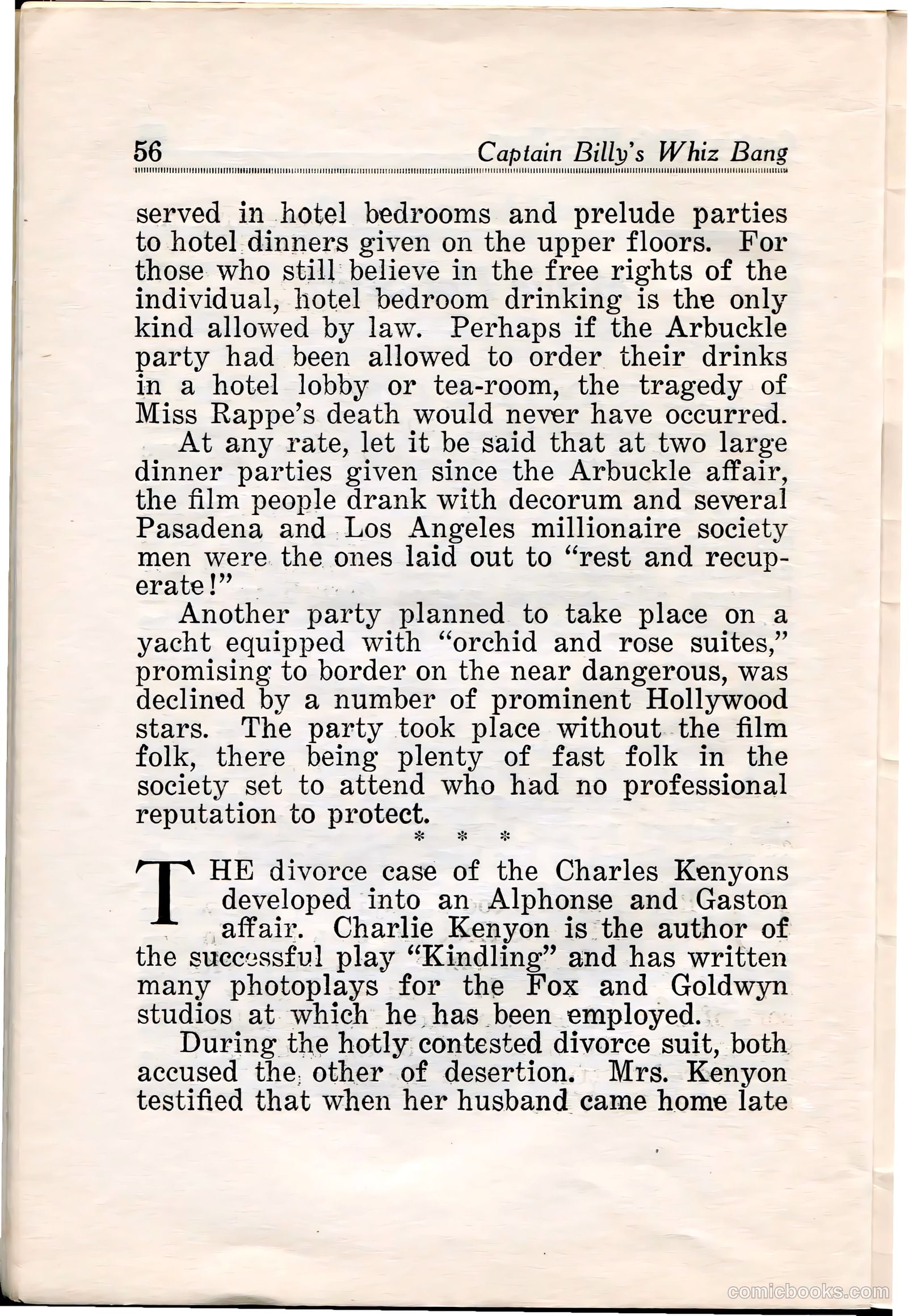
This page from **Captain Billy's Whiz Bang** satirizes 1920s Hollywood excess and hypocrisy. The text references the **Arbuckle scandal** (involving silent film star Roscoe "Fatty" Arbuckle and actress Virginia Rappe's death), criticizing Prohibition-era drinking laws that forced alcohol into private hotel rooms rather than public spaces. The satire mocks Hollywood's moral pretense: after the Arbuckle tragedy, film industry figures attended dinner parties where they drank "with decorum," while wealthy non-celebrities got drunk without professional reputations to lose. A planned yacht party with "orchid and rose suites" was rejected by prominent stars but proceeded with "fast folk" from society. The piece also covers the **Kenyon divorce case**—a playwright's dissolution devolving into mutual desertion accusations. The "Alphonse and Gaston" reference (a comic strip about overly polite Frenchmen) suggests absurd courtroom politeness masking real marital conflict. The overall tone critiques Hollywood's selective morality and celebrity scandal culture.
📄 Transcribed text from this page (OCR, searchable)
Machine-transcribed from the original scan — historical spelling and the odd misread are preserved.
56 Captain Billy's Whiz Bang served in hotel bedrooms and prelude parties to hotel dinners given on the upper floors. For those who still believe in the free rights of the individual, hotel bedroom drinking is the only kind allowed by law. Perhaps if the Arbuckle party had been allowed to order their drinks in a hotel lobby or tea-room, the tragedy of Miss Rappe's death would never have occurred. At any rate, let it be said that at two large dinner parties given since the Arbuckle affair, the film people drank with decorum and several Pasadena and Los Angeles millionaire society men were the ones laid out to "rest and recup- erate!" Another party planned to take place on a yacht equipped with "orchid and rose suites," promising to border on the near dangerous, was declined by a number of prominent Hollywood stars. The party took place without the film folk, there being plenty of fast folk in the society set to attend who had no professional reputation to protect. * * * THE divorce case of the Charles Kenyons developed into an Alphonse and Gaston affair. Charlie Kenyon is the author of the successful play "Kindling" and has written many photoplays for the Fox and Goldwyn studios at which he has been employed. During the hotly contested divorce suit, both accused the other of desertion. Mrs. Kenyon testified that when her husband came home late