
Captain Billy's Whiz Bang, December 1921 · page 57 of 68
Captain Billy's Whiz Bang #28 — page 57: what you’re looking at
What you’re looking at
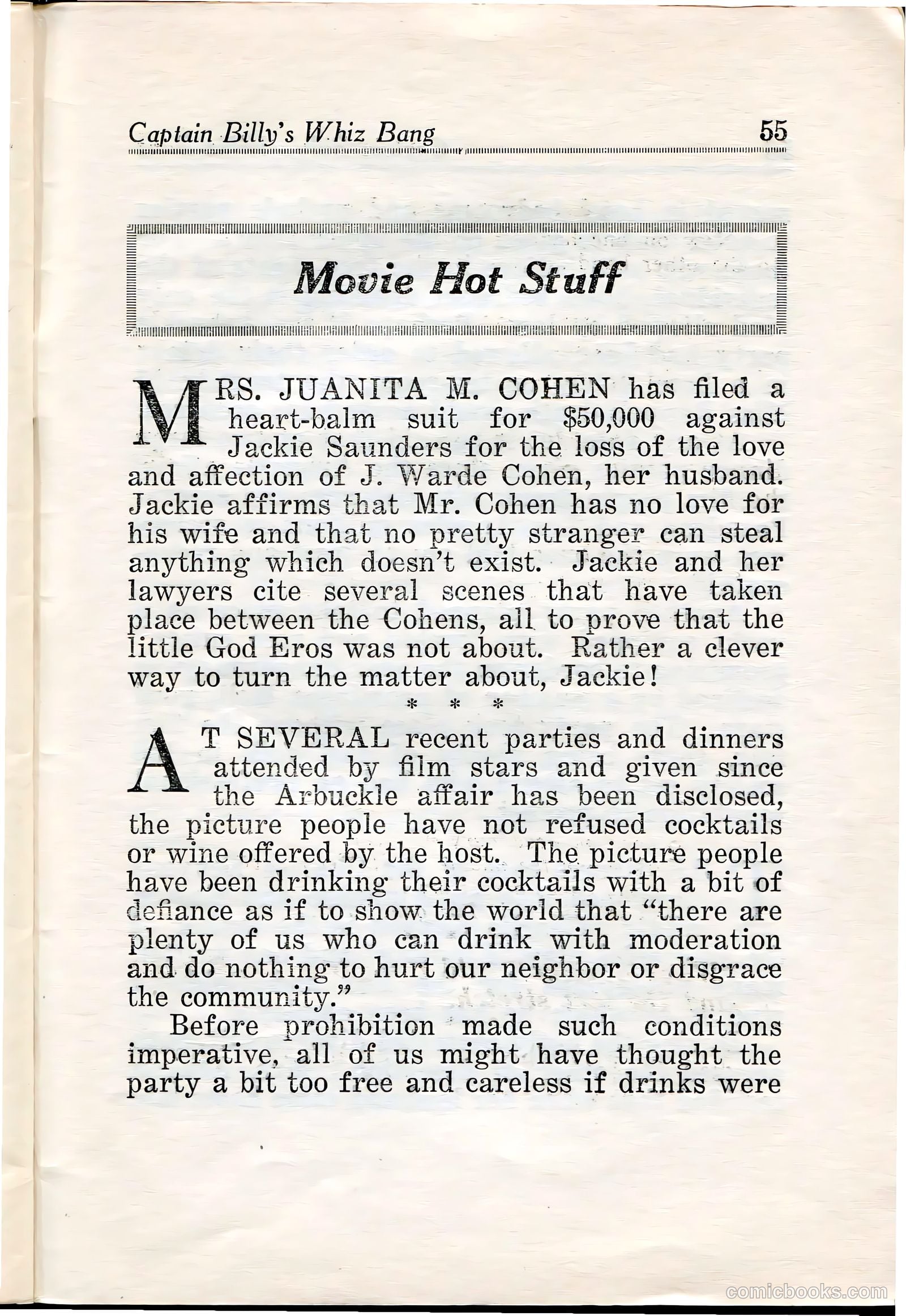
This page from the satirical magazine contains two gossip items about Hollywood scandals, likely from the early 1920s. The first item mocks a "heart-balm" lawsuit where Mrs. Juanita Cohen sued actress Jackie Saunders for $50,000, claiming Saunders stole her husband's affection. The satire lies in Jackie's clever legal defense: she argued Mr. Cohen had no love for his wife to steal in the first place—therefore nothing was taken. The writer applauds this rhetorical dodge. The second item references "the Arbuckle affair" (likely Roscoe "Fatty" Arbuckle's 1921 rape scandal), noting that Hollywood stars now pointedly drink alcohol at parties "with defiance" to prove they're responsible drinkers, not like Arbuckle. The satire suggests Prohibition has made this performative moderation necessary—before the law, such careful drinking would've seemed overly cautious. The implication is that Hollywood excess contributed to Prohibition's passage.
📄 Transcribed text from this page (OCR, searchable)
Machine-transcribed from the original scan — historical spelling and the odd misread are preserved.
Captain Billy's Whiz Bang 55 Movie Hot Stuff MRS. JUANITA M. COHEN has filed a heart-balm suit for $50,000 against Jackie Saunders for the loss of the love and affection of J. Warde Cohen, her husband. Jackie affirms that Mr. Cohen has no love for his wife and that no pretty stranger can steal anything which doesn't exist. Jackie and her lawyers cite several scenes that have taken place between the Cohens, all to prove that the little God Eros was not about. Rather a clever way to turn the matter about, Jackie! * * * AT SEVERAL recent parties and dinners attended by film stars and given since the Arbuckle affair has been disclosed, the picture people have not refused cocktails or wine offered by the host. The picture people have been drinking their cocktails with a bit of defiance as if to show the world that “there are plenty of us who can drink with moderation and do nothing to hurt our neighbor or disgrace the community.” Before prohibition made such conditions imperative, all of us might have thought the party a bit too free and careless if drinks were