
A complete issue · 68 pages · 1921
Captain Billy's Whiz Bang #25
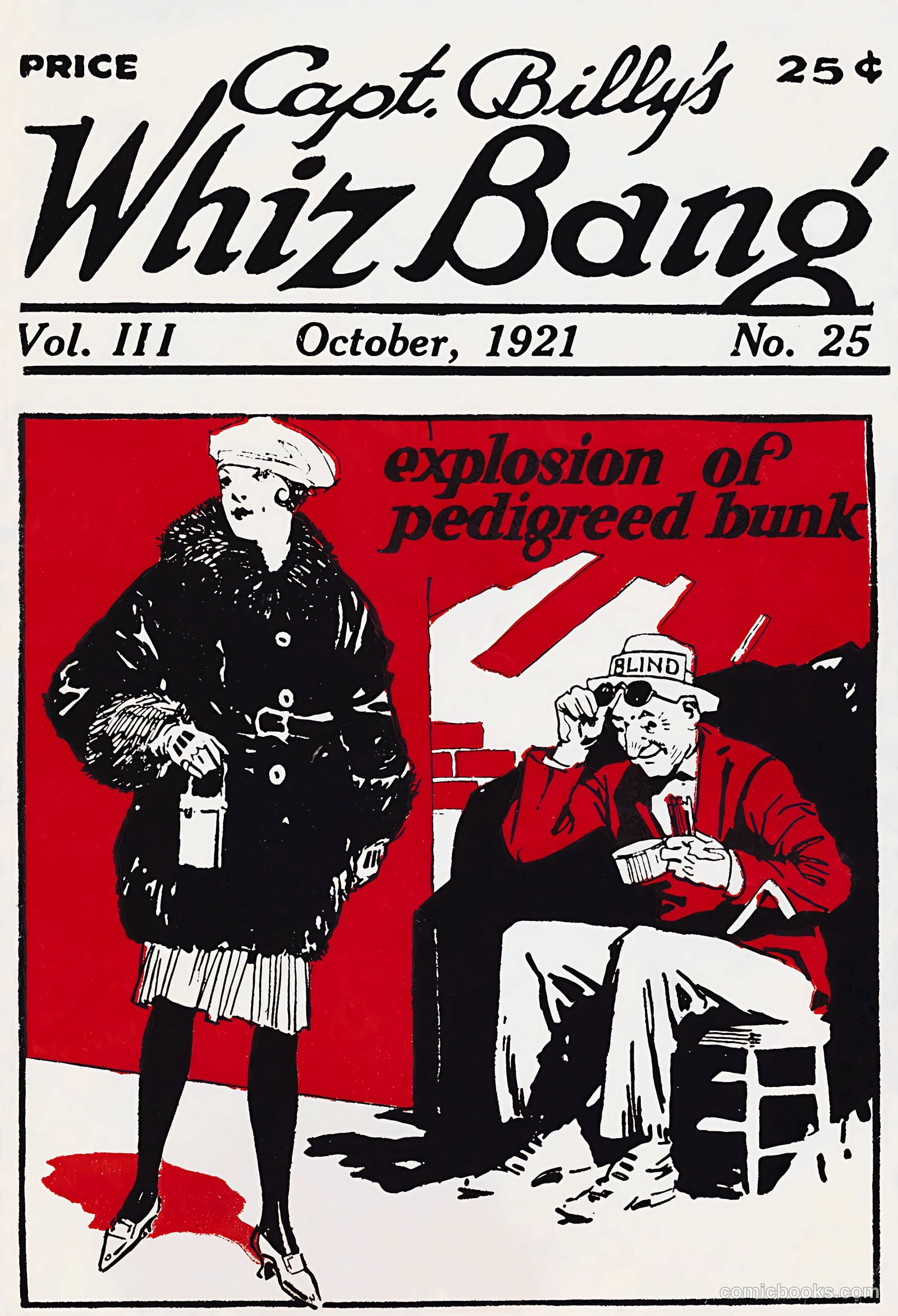
This satirical cartoon depicts two figures amid destruction from an explosion. On the left stands a well-dressed woman in fashionable attire; on the right sits a blind man labeled "BLIND," apparently injured or dazed from the blast. The satire targets pretentious deception—"pedigreed bunk" refers to lies dressed up as legitimate or high-class. The blind man's label suggests he couldn't see through the fraud anyway. The cartoon likely mocks post-WWI American society's gullibility toward false claims or scams being marketed as respectable. *Whiz Bang* was known for irreverent humor about current events and social hypocrisy. Without additional context, the specific target remains unclear, though it probably references a contemporary scandal or widespread con of 1921.
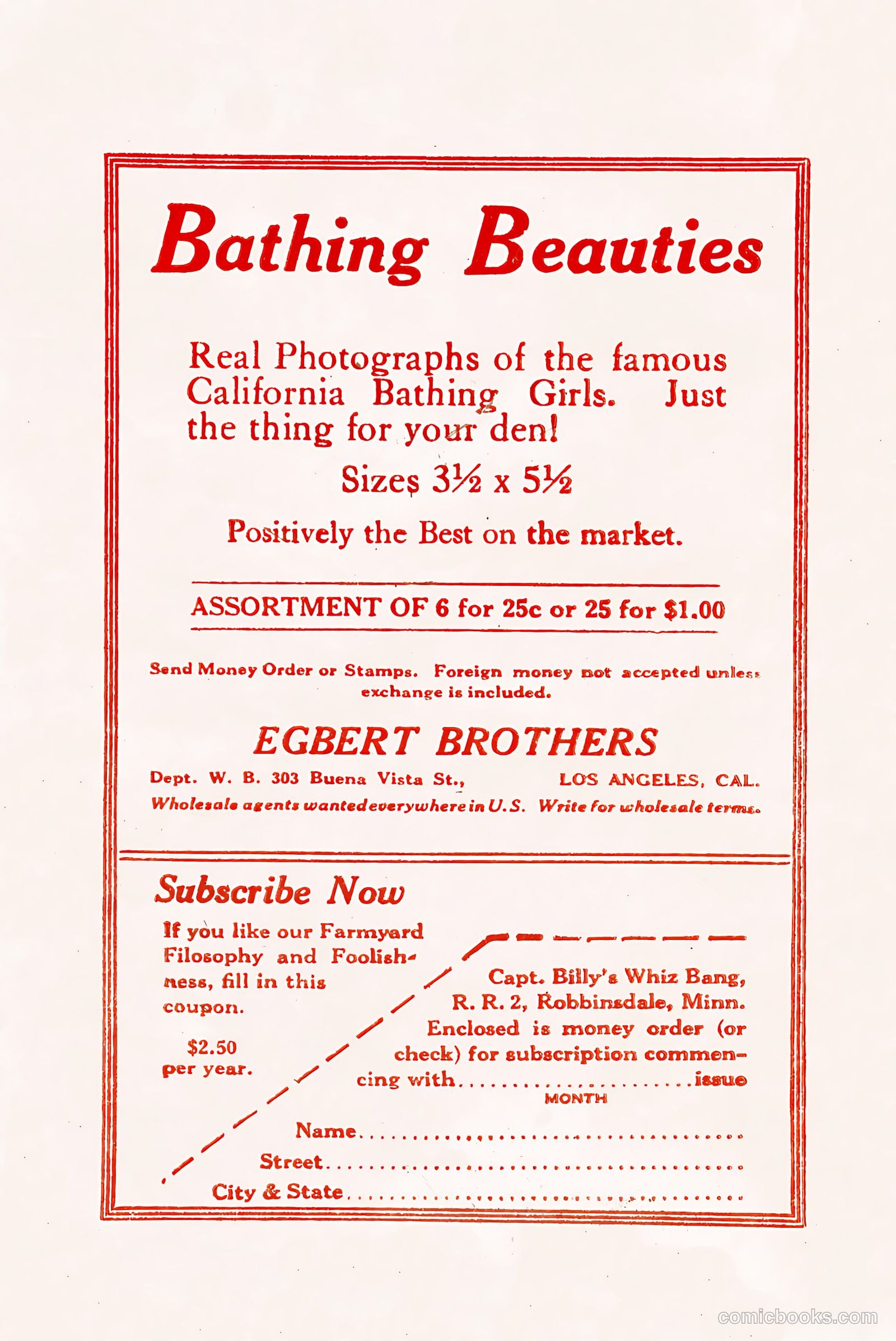
This page contains **advertisements, not satire or cartoons**. It's primarily a mail-order ad for "Bathing Beauties" photographs sold by Egbert Brothers in Los Angeles—photographs of women in swimwear marketed as decorative items for men's dens. The second ad promotes a subscription to "Capt. Billy's Whiz Bang" itself ($2.50/year), a farmyard-themed humor magazine. This self-promotional section includes a coupon for subscribing. The content reflects early 20th-century attitudes: cheesecake photography was a common commercial product, and the framing as "the thing for your den" assumes a male audience purchasing decorative pin-up style images. There's no political commentary visible—just period advertising practices that would seem dated and problematic to modern sensibilities.
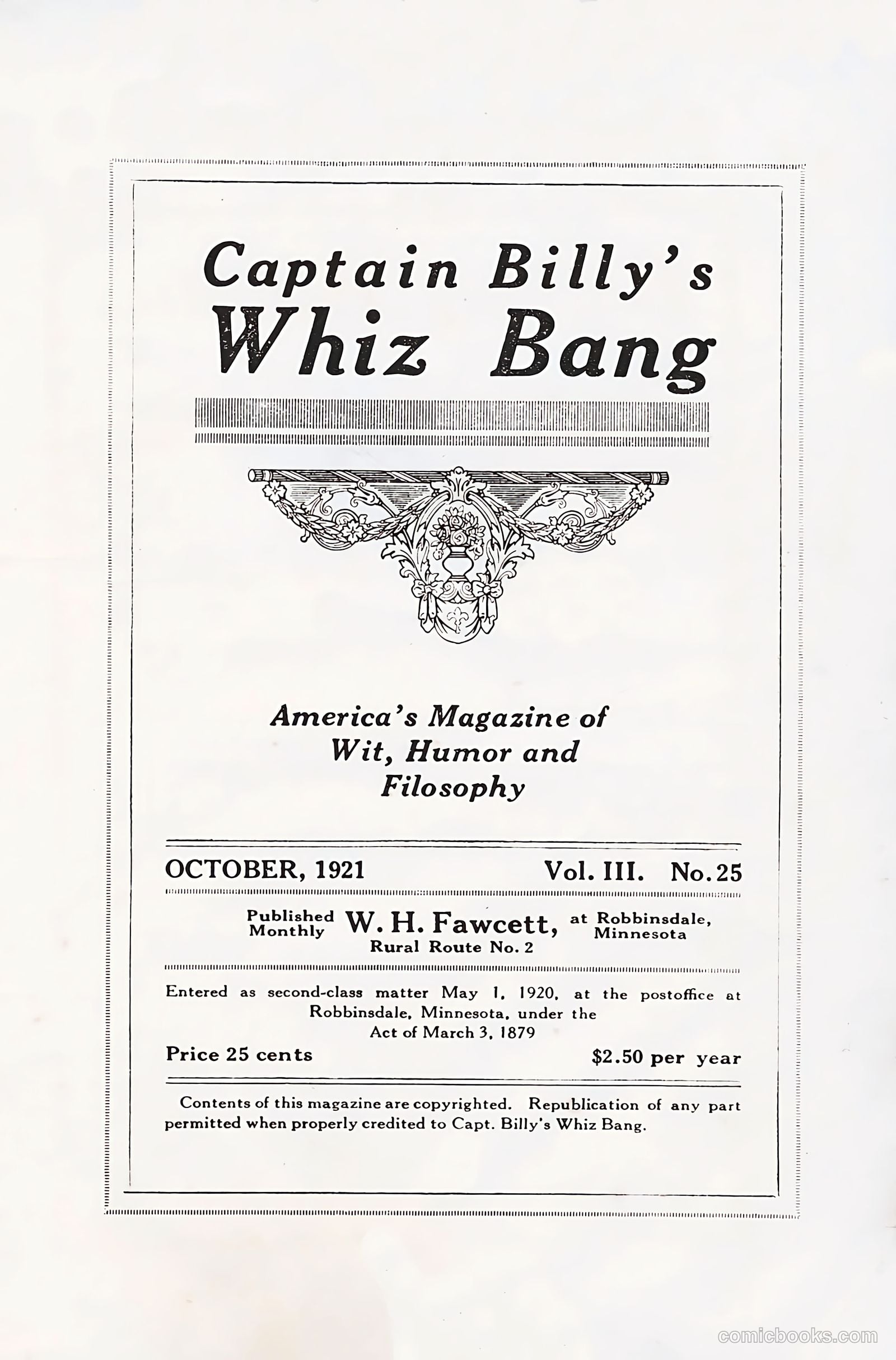
This is a **title/masthead page**, not a cartoon. It identifies *Captain Billy's Whiz Bang* as "America's Magazine of Wit, Humor and Philosophy," published monthly by W.H. Fawcett in Robbinsdale, Minnesota. The ornamental design features a decorative Art Deco-style bracket or architectural element—typical cover ornamentation for the era, not satirical content. Key details: Volume III, No. 25 (October 1921); 25 cents per issue or $2.50 yearly; entered as second-class mail in 1920. The copyright notice reserves rights to "Capt. Billy's Whiz Bang." This was a legitimate, commercially published humor magazine of the 1920s, not underground satire. Without viewing interior pages, the specific political or social commentary remains unclear.
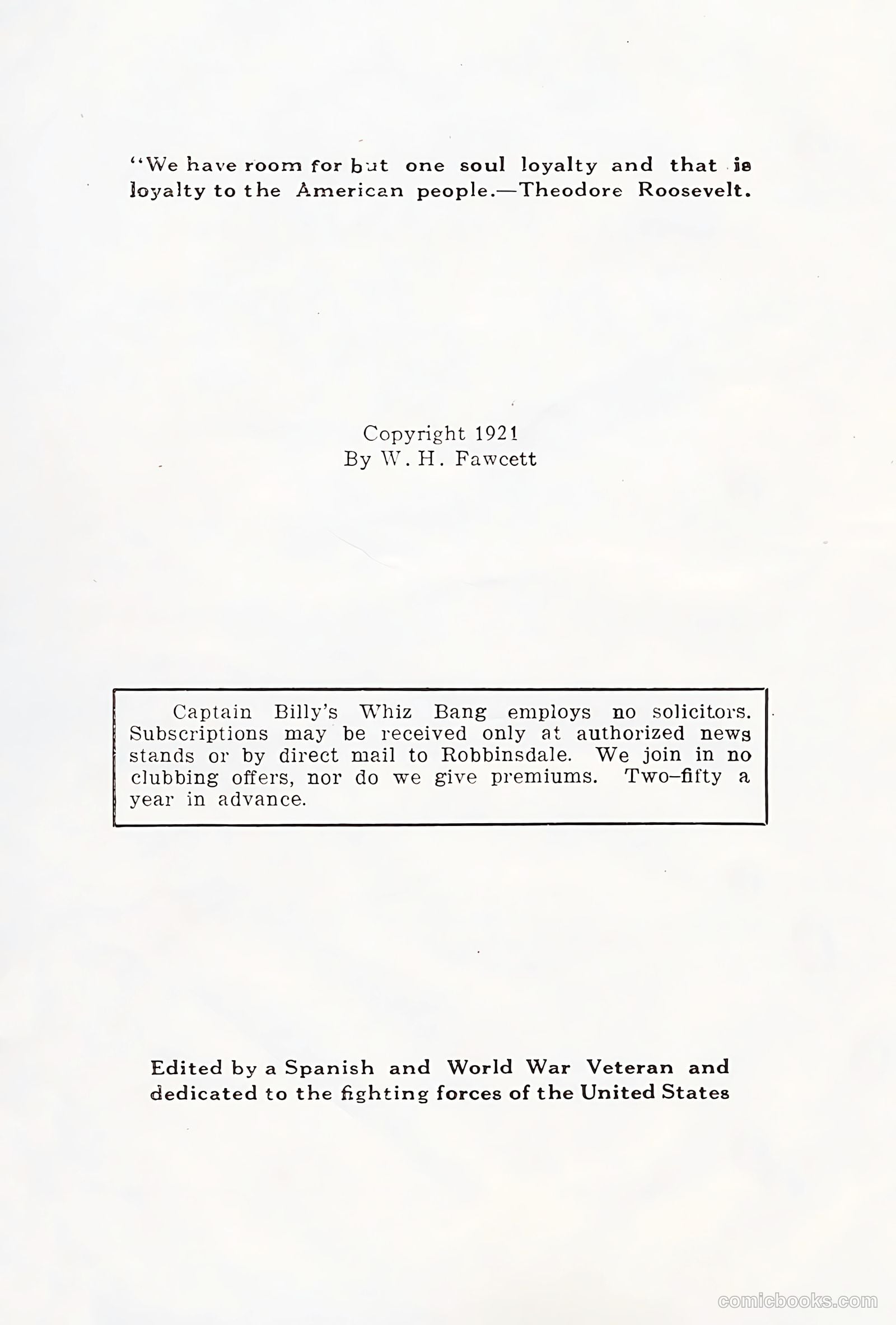
This is primarily a **title/front matter page**, not a cartoon page. It contains: 1. **A Theodore Roosevelt quote** emphasizing single loyalty to America—likely referencing debates about immigrant loyalty during/after WWI (1917-1918). 2. **Copyright information** (1921) by W.H. Fawcett 3. **Subscription information** for "Captain Billy's Whiz Bang," a humor magazine that sold only through authorized newsstands and direct mail at 50¢/year 4. **Editorial note** stating the publication was edited by a Spanish-American War and World War I veteran, dedicated to U.S. fighting forces The page establishes the magazine's patriotic credentials and distribution model rather than presenting satirical content. The Roosevelt epigraph sets a nationalist tone fitting the post-WWI era.
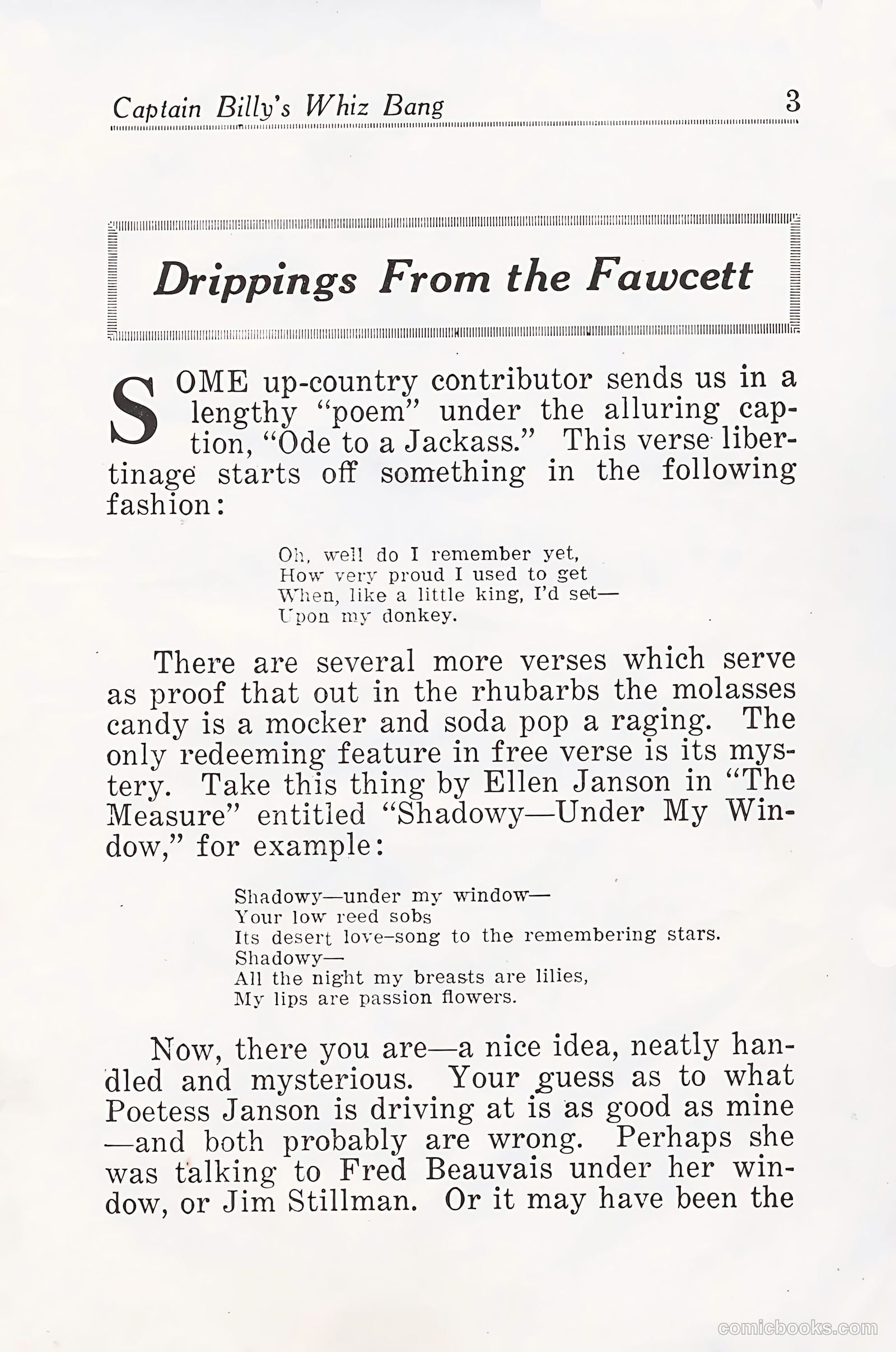
This column mocks the free-verse poetry movement gaining popularity in the 1920s. The editor ridicules an amateur "Ode to a Jackass" for its clumsy, pointless verses, then contrasts it with Ellen Janson's published work in *The Measure* (a real modernist journal). The satire works through ironic praise: Janson's deliberately obscure poem about "Shadowy" and sensual imagery ("breasts are lilies") is presented as "mysterious" and "neatly handled," but the author admits nobody—including himself—understands what she actually means. He sardonically suggests she might simply be flirting with some fellow (Fred Beauvais or Jim Stillman) out her window. The joke targets modernist poetry's pretension and opacity: even published, respected free verse is portrayed as incomprehensible nonsense masquerading as art. It reflects widespread 1920s cultural anxiety about avant-garde movements replacing traditional literary standards.
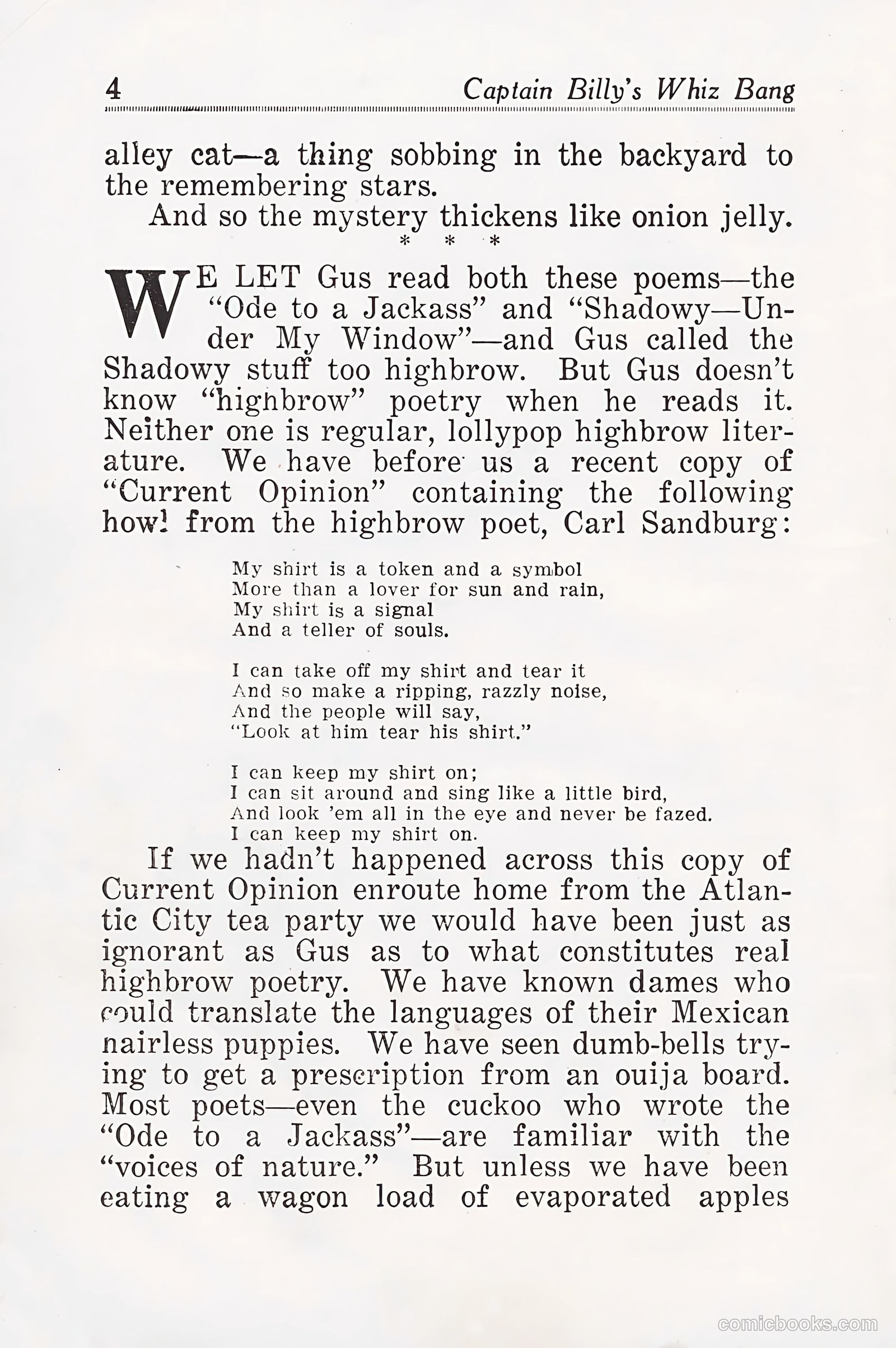
This page mocks the pretentiousness of modernist poetry, specifically targeting Carl Sandburg's abstract work. The magazine's character "Gus" dismisses a poem called "Shadowy—Under My Window" as incomprehensibly highbrow, but the editors reveal that *neither* poem is actually sophisticated literature—one is literally titled "Ode to a Jackass." The satire centers on Sandburg's published poem about a shirt as a "token," "symbol," and "signal" of the soul. The editors ridicule this as meaningless pseudo-intellectual drivel, comparing it unfavorably to actually understanding nature. They mock readers who pretend to comprehend such work, while they themselves claim bewilderment at what constitutes "real highbrow poetry." The joke: modernist poetry's obscurity and self-importance deserve mockery. The editors present themselves as regular people baffled by elitist literary pretense, appealing to working-class readers skeptical of highbrow culture.
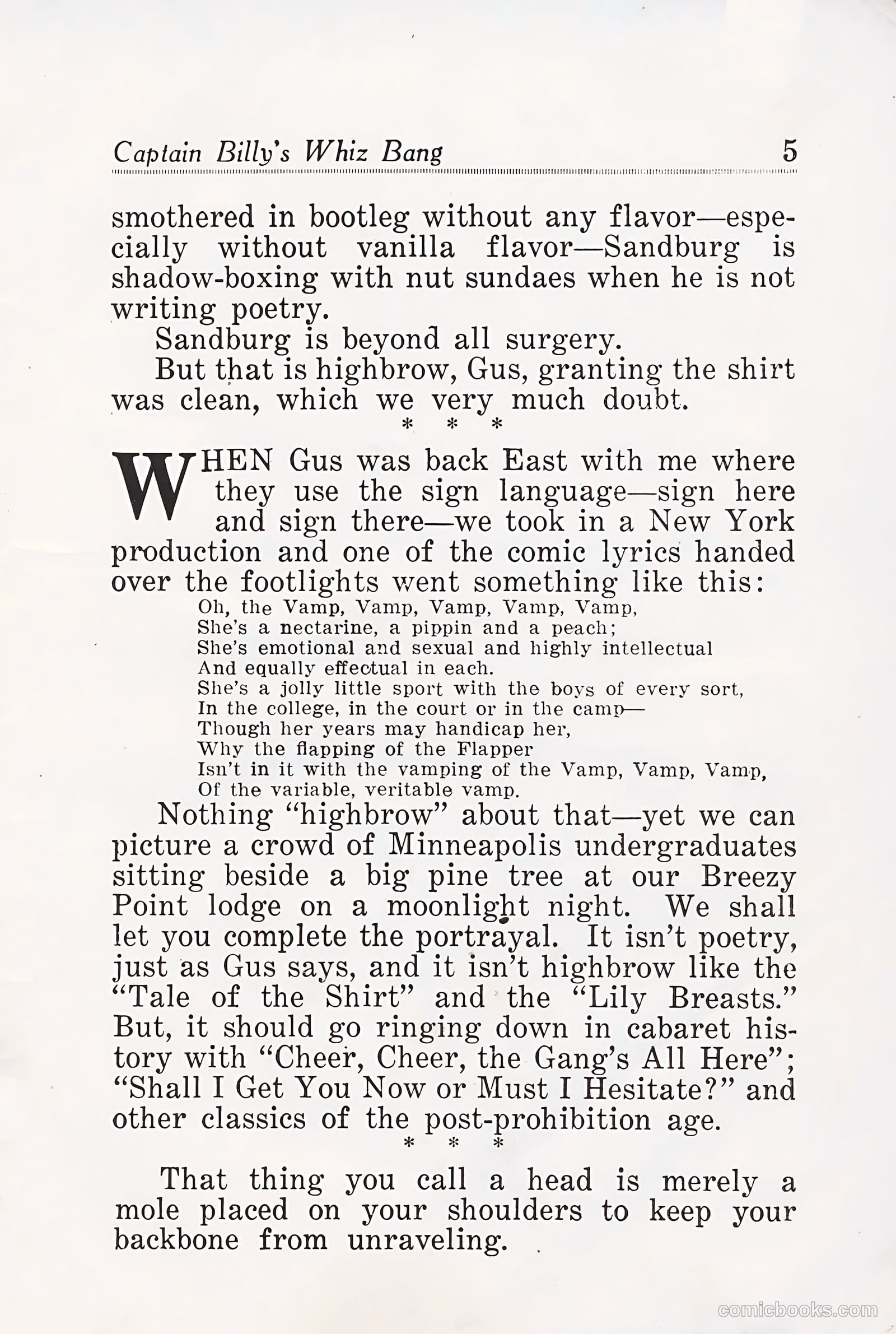
This page is primarily **text-based commentary** rather than a cartoon. The author discusses Carl Sandburg (the famous American poet), characterizing him as intellectually impressive but beyond practical understanding—"shadow-boxing with nut sundaes" when not writing poetry. The bulk discusses a New York theatrical production's comedic lyrics about a woman character ("the Vamp"), which the author argues is accessible popular entertainment—not "highbrow" like Sandburg's work. The satire targets the perceived pretentiousness of highbrow literature by contrasting it with cabaret-style popular songs from the post-Prohibition era. The final cynical observation about heads merely preventing backbone unraveling is general philosophizing, not political commentary.
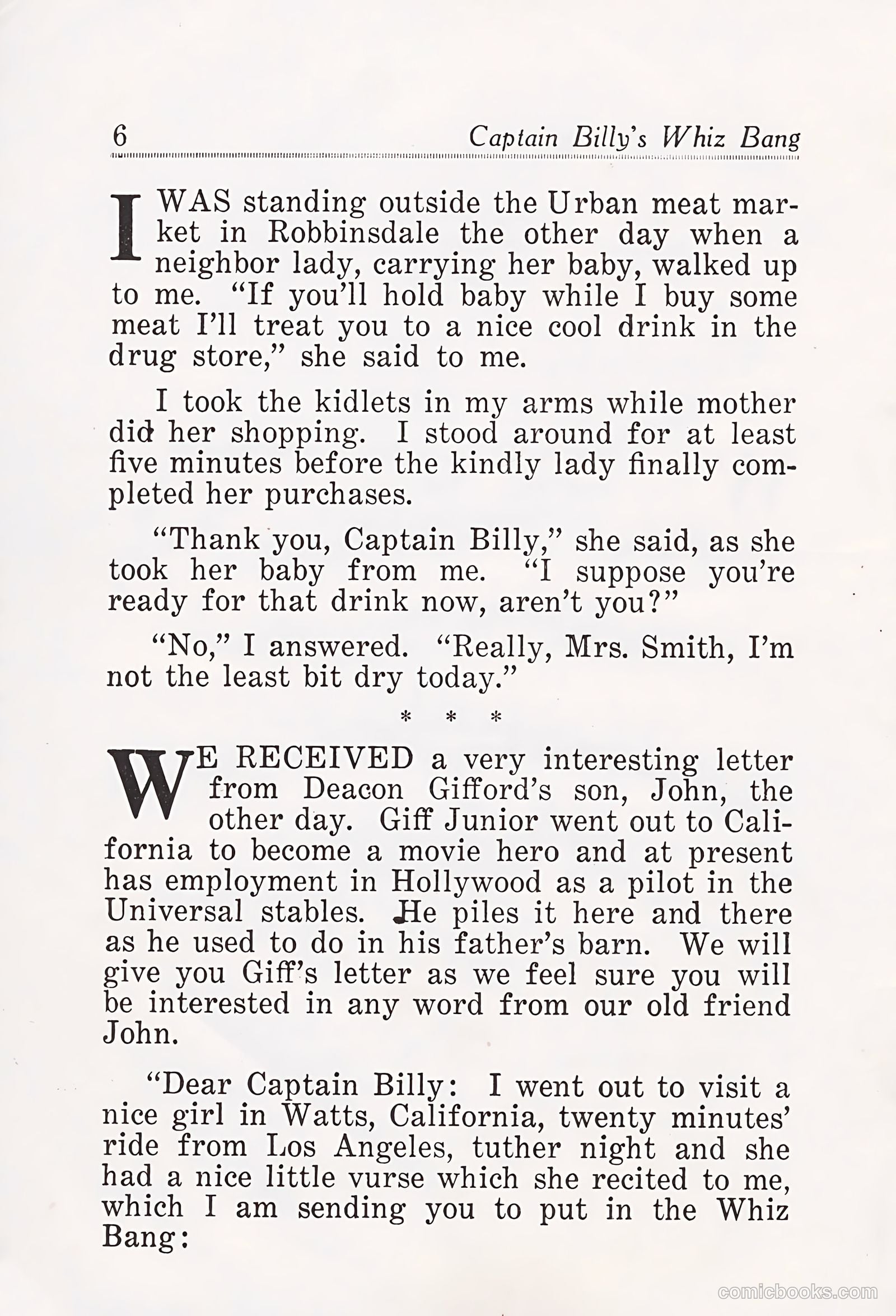
This page contains two anecdotal pieces from "Captain Billy's Whiz Bang," a humor magazine. The first story describes the narrator (called "Captain Billy") holding a neighbor's baby while the mother shops, with the neighbor promising him a cold drink at a drugstore afterward. When he declines the drink, saying he's "not the least bit dry," it's likely a humorous reference to Prohibition-era attitudes—the joke may involve drugstore drinks as coded references to alcohol, or simply mock his unexpected sobriety. The second section relays a letter from John Gifford Jr., son of "Deacon Gifford," describing his work as a pilot in Hollywood's film industry. The piece positions this as amusing content worth sharing with readers. Without seeing any actual illustrations, the exact satirical intent remains unclear, though the tone suggests light, anecdotal humor typical of the magazine's style.
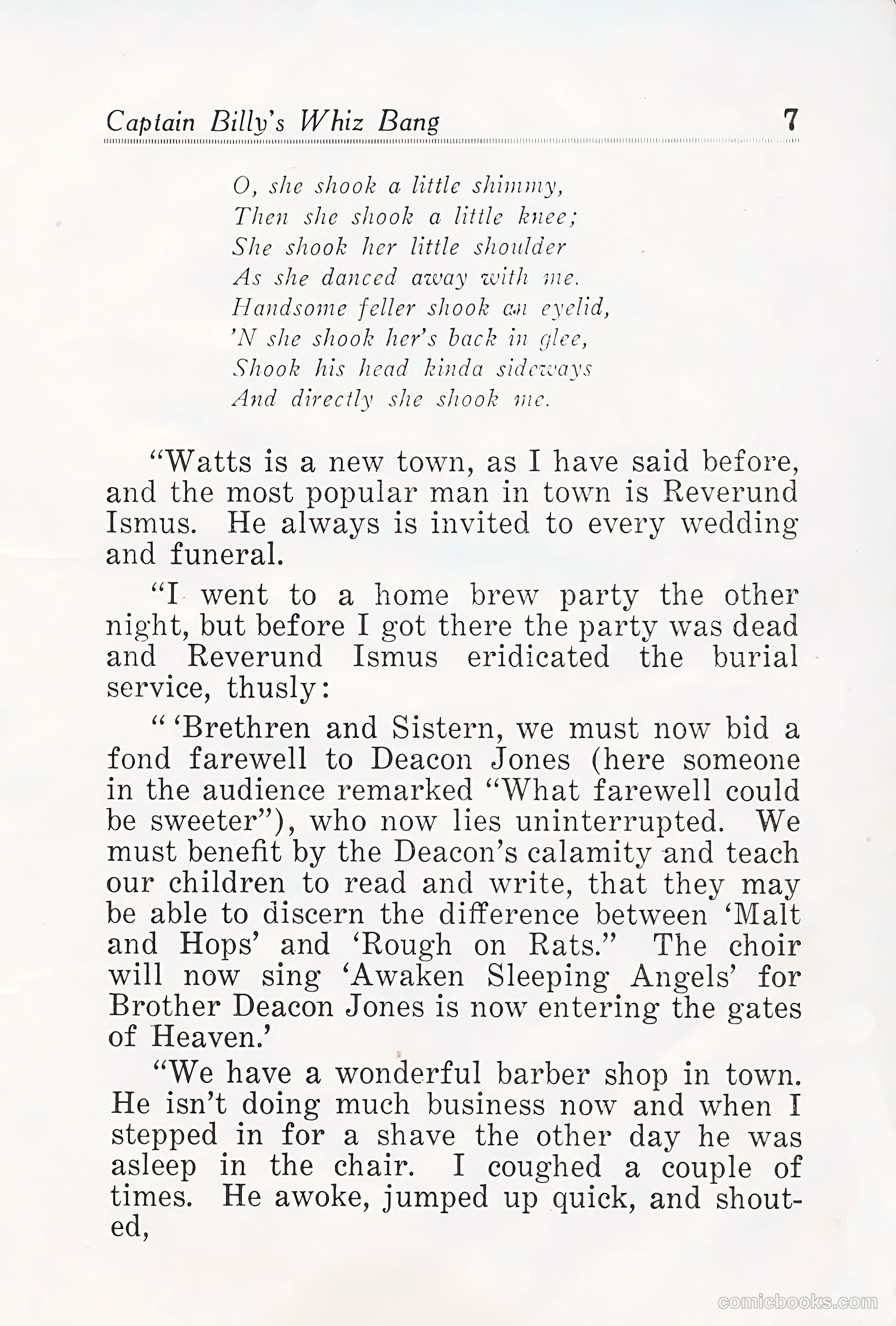
This page contains humorous anecdotes and a poem rather than political cartoons. The poem "O, she shook a little shimmy" celebrates Jazz Age dance moves, particularly the shimmy—a popular 1920s dance involving shoulder and body shaking that scandalized conservative audiences. The prose sections mock small-town American life: a reverend who monopolizes social events, an inappropriately irreverent funeral sermon for "Deacon Jones," and a barber asleep on the job. The funeral joke satirizes the gap between solemn occasions and actual behavior, while the barber anecdote gently ridicules rural business lethargy. The overall tone is lighthearted Americana satire targeting provincial attitudes and social pretense rather than serious political critique.
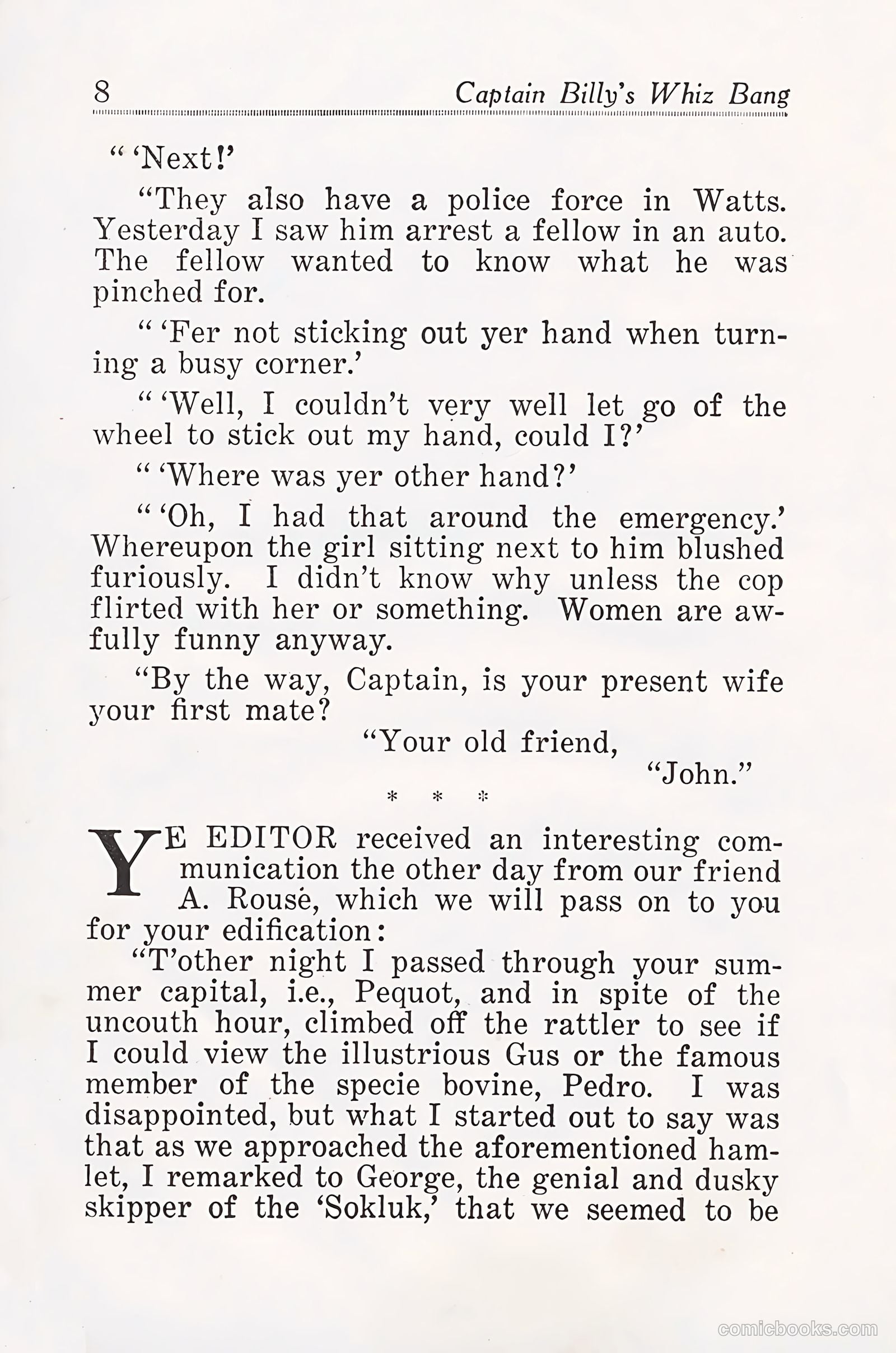
This page contains three humorous anecdotes rather than cartoons. The first two are brief jokes about traffic violations and awkward situations. The third piece, attributed to "A. Rousé," describes a visit to Pequot (appears to be a summer resort or vacation destination) where the writer sought to view "the illustrious Gus or the famous member of the specie bovine, Pedro"—apparently a locally-known cattle animal or attraction. The humor lies in the anticlimax: the writer was disappointed in what they found, though the text cuts off before revealing the punchline. The reference to "George, the genial and dusky skipper of the 'Sokluk'" suggests these are inside jokes about local personalities familiar to the magazine's readers.
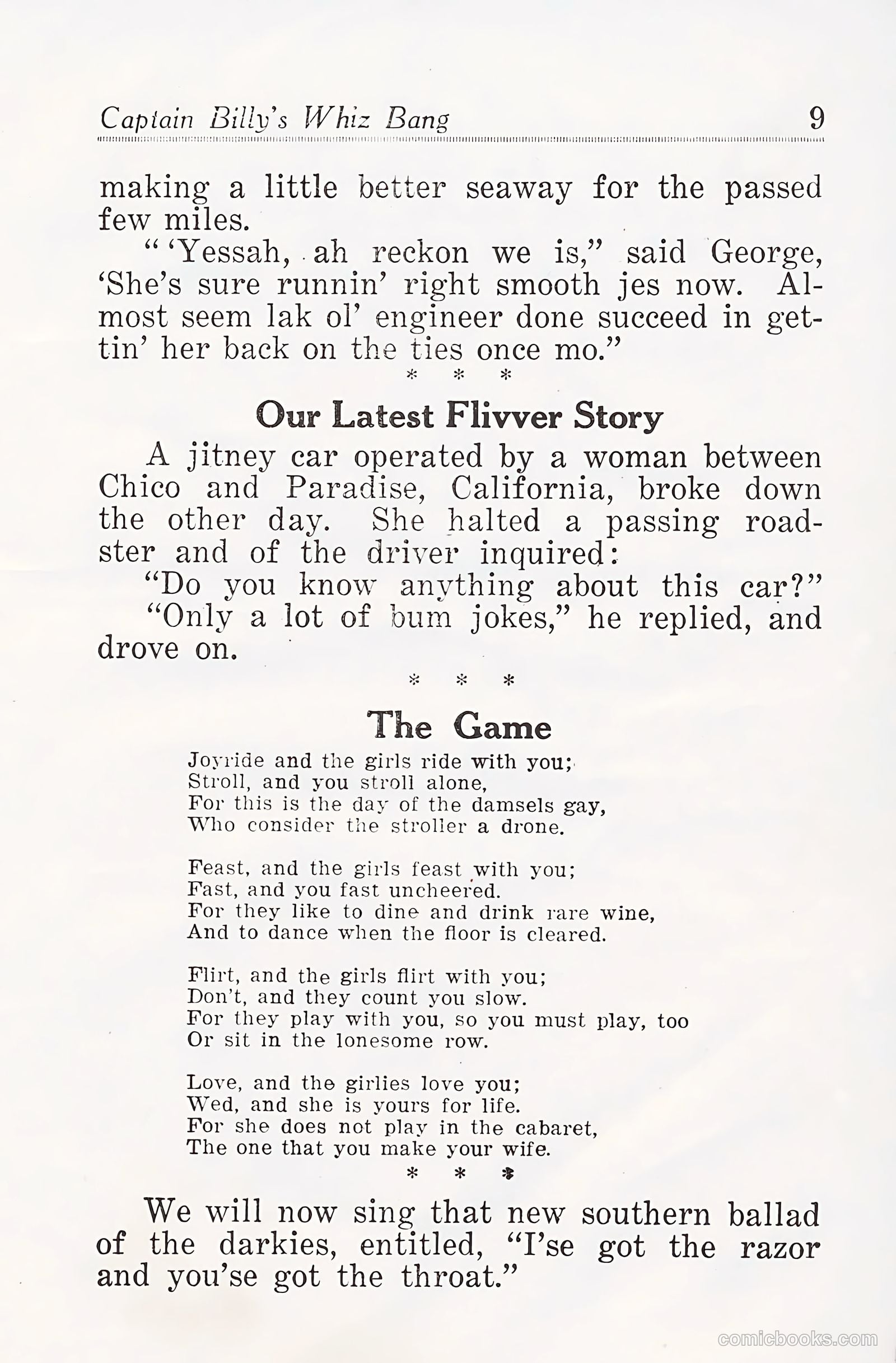
This page from *Whiz Bang* contains three humorous anecdotes rather than traditional cartoons. The first continues a story about "Captain Billy's Whiz Bang," apparently involving a boat or ship repair. The second is a brief joke about a woman's broken-down "jitney car" (a small bus or shared-ride vehicle) between California towns—the humor lies in the roadster's dismissive response that the car is only known for "bum jokes." The third section, "The Game," is a satirical poem about courtship rituals, suggesting different behaviors toward casual dates ("joyride," "stroll," "flirt," "feast") versus a wife one actually marries. The final line alludes to a "southern ballad" about razors and throats, likely referencing period violence stereotypes.
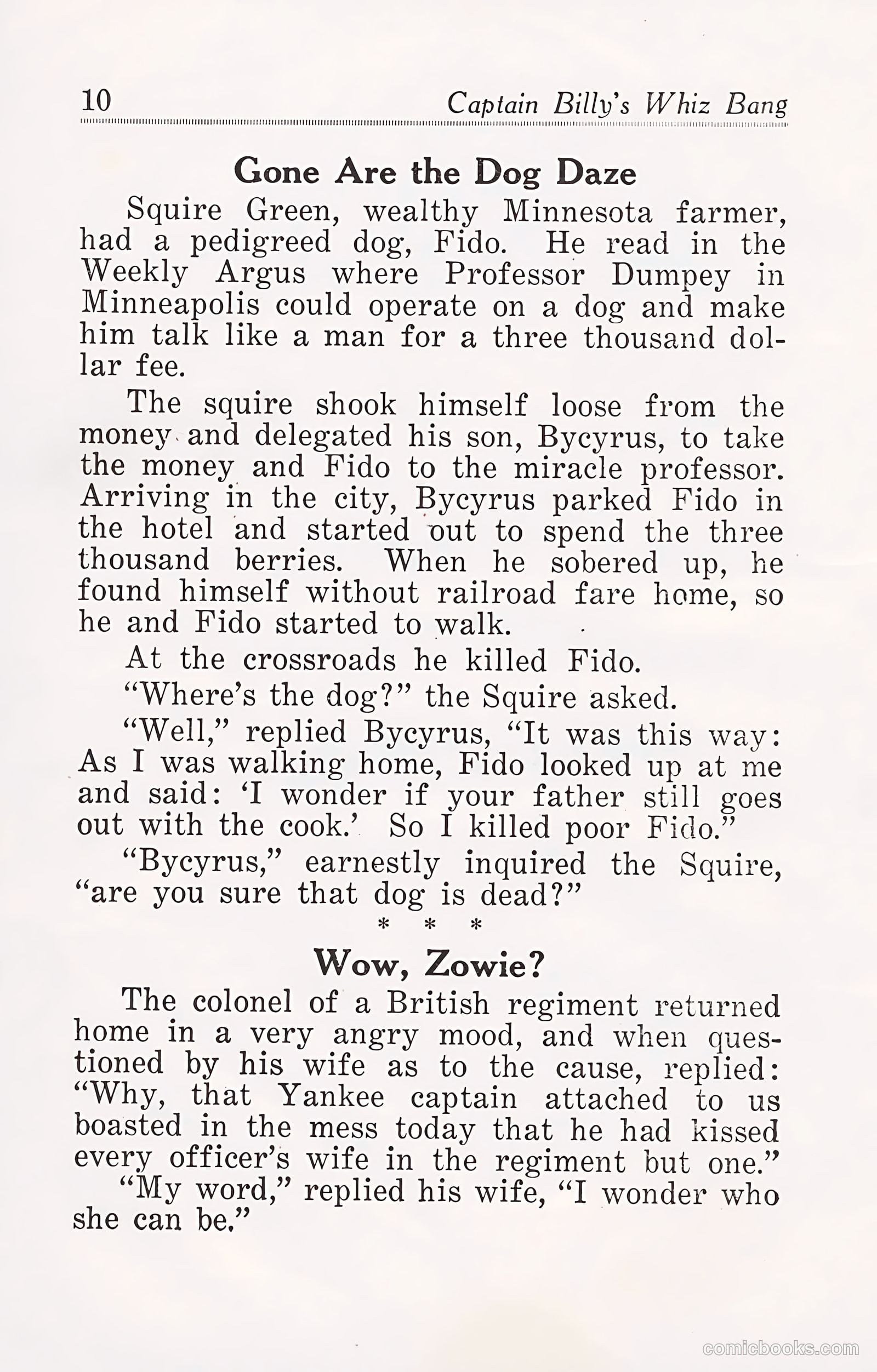
This page contains two humor pieces typical of 1920s satirical magazines: **"Gone Are the Dog Daze"** mocks a wealthy farmer's gullibility. The joke: Squire Green pays a supposed Minneapolis professor $3,000 to make his dog talk. His son Bycyrus, sent with the dog and money, gets drunk, kills the dog, then absurdly claims the dog insulted their father—justifying the murder. The satire targets both rural naïveté about "miracle" urban experts and the son's transparent lie. **"Wow, Zowie?"** uses a British colonel's domestic tension for humor. A Yankee captain allegedly kissed every officer's wife except one—the colonel's. The wife's witty response ("I wonder who she can be") suggests the colonel himself is the unfaithful party, reversing the embarrassment onto him. Both deploy period-typical crude humor and social stereotypes (rural farmers, "Yankees," class dynamics).
This column mocks a real Hollywood religious movement, likely referencing Madam Edith Maida Lessing's actual "Temple" community in the 1920s that promoted free love and rejected conventional institutions. The satire ridicules the movement's radical teachings: rejecting civil marriage, property ownership, and organized religion in favor of "divine marriage" (commitment before God alone, dissolvable at will). The author uses period slang ("the berries," "biscuits," "hot dog") and absurdist imagery—scantily-clad elves, spirit dances, red flags of love—to mock the movement as frivolous and dangerous nonsense. The piece suggests that this philosophy so seduced Hollywood women ("bungalow sweeties") that respectable families feared losing their daughters to the cult. The humor targets both the movement's idealism and Hollywood's susceptibility to fashionable fads, portraying the entire episode as ridiculous theatrical performance rather than genuine spirituality.
This page from the satirical magazine contains a prose narrative about a woman whose loud protests are heard in Los Angeles, prompting police intervention. The text describes confusion over her plans for establishing a religious community—a temple of Helois featuring facilities for disabled veterans, childcare, goat farming, and fishing operations. The narrative concludes with the woman arrested and taken to a county hotel, where she "broke forth in a fit of poetry." The poem "Red Is the Color of Love" follows, using red as metaphor for love, sacrifice, and revolutionary fervor—appearing to reference radical or activist sentiment. The satire seems to mock both the woman's grandiose community schemes and her passionate idealism, though specific historical figures or events remain unclear without additional context.
This is a mock film review satirizing contemporary movies and Hollywood excess. The piece parodies "The Four Horsemen of the Apocalypse," a famous 1921 film, by reimagining it as a low-budget Western melodrama set in Reno (famous for quick divorces). The satire targets several things: the absurdity of amateur filmmaking (directed by "formerly a bartender"), overwrought morality tales about gambling and romantic ruin, and B-movie clichés (the virtuous girl, the dissolute gambler, death by suicide). The reference to "Mack Sennet" earlier suggests mockery of slapstick comedians getting away with questionable content. The reviewer's breathless, contradictory praise ("greatest non-star picture ever produced" while highlighting its ridiculous plot) is the joke—*Whiz Bang* is ridiculing both the film industry's pretensions and audiences' gullibility. The absurd ending (death from taking a writing tablet) amplifies the parody.
This is a humorous review of a silent film called "Deception" depicting Henry VIII's reign. The satire works on multiple levels: **Historical satire:** The text mockingly calls Henry VIII "Henry the Flivver" (referencing Ford automobiles), joking that he was a good king because he found a Ford that runs efficiently—anachronistic absurdity mixed with 1920s consumer culture. **Film critique:** The reviewer complains that subtitles prevented viewers from seeing truly "wicked" content, suggesting the silent film's morality restrictions were disappointing. **Period humor:** References to Henry playing "crap" (dice games) and reading "sixteenth century funny papers" featuring "Omar, the tentmaker" treat historical figures as contemporary vaudeville characters. **Final joke:** The closing quip about a girl calling someone "Charles" when his name is "George" appears to reference either casting confusion or a broader marital/romantic mix-up joke typical of 1920s comedy. The piece exemplifies *Whiz Bang*'s irreverent, anachronistic humor mocking both historical film adaptations and contemporary entertainment.
This satirical poem attacks moral censors—"ministerial prolocutors"—who condemn the "toddle," a popular 1920s dance involving close physical contact between partners (cheeks pressed together, synchronized movements to jazz). The author defends the dance as inspiring and beautiful, sarcastically mocking the censors' label of it as "vicious." The satire suggests authorities are overly puritanical in condemning youthful romantic expression and modern dance culture. Two brief anecdotes follow: one mocking a woman named Funk who bought a skunk thinking it was a cat, and another about dishonesty not paying off—the "corkscrew out of a job" reference is unclear but appears cautionary. The piece exemplifies 1920s cultural friction between traditionalist morality and modern youth culture.
This page contains four humorous poems/verses rather than cartoons. The content consists of: 1. **"Here's to the Woman"** — a complimentary toast celebrating women's emotional resilience 2. **"Sermonette"** — a quip suggesting dancing for romantic purposes is morally questionable 3. **"Memories of the Past"** — a nostalgic drinking song referencing Dublin and cheap meals at "Hink's," with an anecdote about "Mary" wearing silk stockings despite having had chickenpox 4. **"Of Course Not"** — satirizing women's beauty routines, specifically mocking the vanity of rouging knees and powdering to conceal physical imperfections The humor relies on period-typical observations about women's appearance, behavior, and social pretenses. No specific political figures or events are referenced; instead, the satire targets general social conventions and gender dynamics of the 1920s era.
This page contains two humorous anecdotes typical of early-20th-century American comic magazines. **"Where Silence Was Golden"** mocks social awkwardness. A man with a severe stutter asks for the time; when another passenger doesn't respond, the stutterer assumes he's addressed a foreigner and leaves. The third man criticizes the silent passenger for being "uncivil," but the punchline reveals the passenger *also* stutters—he stayed quiet to avoid getting his "head knocked off," implying stutterers were often mocked or bullied. **"Does It Pay to Forget?"** plays on ethnic stereotypes common to the era. An Irishman ("Pat") and German ("Heinie"/"Fritzie") fight, agreeing to say "Sufficient" when beaten. After an exhausting match, the German surrenders—but Pat admits he'd forgotten the word during the fight, suggesting Irish characters as dim-witted or forgetful. Both jokes rely on period prejudices: against disabled speech and against Irish and German immigrants, reflecting contemporary social attitudes.
This is a satirical essay (not a cartoon) by Rev. "Golightly" Morrill attacking Palm Beach, Florida as a den of moral corruption and wasteful excess. Writing from a conservative Protestant perspective, Morrill uses military metaphors to mock the resort's dining culture and hyperbolic language to condemn beachgoers' scanty clothing ("low necks, high skirts, bare legs") and flirtation ("wicked winks," "conquests"). The piece ridicules both the commercialism (money extracted immediately upon arrival) and the social hierarchy of the wealthy resort, where outsiders face "cold shoulders" while "regulars" enjoy status. The comparison of dinner to a battlefield and guests to soldiers humorously exaggerates the competitive, materialistic atmosphere Morrill finds morally objectionable. The satire targets Jazz Age leisure culture and changing sexual mores—particularly the abandonment of Victorian propriety—as symptoms of spiritual emptiness.
This is a satirical editorial essay criticizing wealthy American society's materialism and moral emptiness. The author describes an elderly woman at what appears to be a high-society gathering, desperate for attention despite her age. She's laden with jewelry and finery—pearls, diamonds, gold chains, bracelets—yet her physical decay ("wrinkled," "snaky neck," "withered arms") contrasts starkly with her desperate display. The satire's point: external wealth merely exposes inner spiritual poverty. The author finds it obscene that an elderly woman should spend her final years pursuing fashion and social validation rather than spiritual preparation ("Bible on her knees"). The piece then transitions to describing the "Beach Club," presented as America's equivalent to Monte Carlo gambling resort, suggesting wealthy leisure culture promotes vice. The reference to "Cerberus at the door" (the mythological guard dog) implies exclusionary gatekeeping. The text breaks off mid-sentence, suggesting continued criticism of this exclusive institution.
This is satirical social commentary, not a cartoon. The author describes visiting an exclusive Palm Beach, Florida gambling club called the "Beach" Club (sarcastically nicknamed the "White House"). The satire targets wealthy elite hypocrisy: the club strictly enforces dress codes (rejecting him for lacking evening wear) yet openly violates state gambling laws. The author witnesses "old satyrs" and morally compromised women being admitted despite breaking rules, while he—dressed improperly—is rejected. He mocks the idle, frivolous daily routines of Palm Beach's wealthy residents (sun-tanning, shopping, cocktails, flirting) while questioning why law enforcement ignores the club's blatant lawbreaking. The core complaint: the wealthy operate above the law while ordinary people face prosecution. The piece exemplifies *Whiz Bang*'s working-class, anti-establishment perspective from the 1920s.
This page contains two distinct pieces from *Captain Billy's Whiz Bang*, a satirical magazine known for irreverent humor. The first section is a lengthy editorial rant attacking Palm Beach, Florida as a shallow, artificial resort town for the wealthy. The author (identified as a minister's son) criticizes the ostentatious displays of wealth—fancy pets, manicured nature, cigar smoke—and calls Palm Beach a "painted, pampered prostitute of Florida" with a "do as you damn please" ethos. He leaves by midnight train to escape moral corruption. Below that is a brief joke titled "Froth Pulls This One," playing on the name "Buoy" (homophone of "boy"). Belle questions why respectable Clarice associates with a common grocery delivery boy. Buoy's punchline—"unless it's because he delivers the goods"—is a double entendre suggesting sexual favors, mocking both the grocery boy and Clarice's virtue. It reflects period-typical class snobbery and crude sexual humor typical of 1920s men's magazines.
This is a gossip column mocking French tennis champion Suzanne Lenglen. The satire attacks her for allegedly faking illness during matches—specifically, developing a convenient "cough" only when losing points, which mysteriously disappears when she gains ground. The author sarcastically calls this a new "medical malady." The deeper joke: Lenglen's real problem isn't physical illness but an inflated ego from excessive publicity and celebrity status. The anecdote about her arriving at an Antwerp stadium without a ticket and imperiously announcing "I am the great Lenglen" to the gatekeeper illustrates her arrogance. The column frames this as nationalist ribbing—a French player coming to America to dominate American female tennis players while behaving badly. The tone is mock-serious ("I don't want to bring on another European war") but fundamentally dismissive of her pretensions.
This is a satirical sports article mocking French tennis champion **Suzanne Lenglen**, who apparently gave arrogant interviews dismissing American players upon arriving in the U.S. The piece celebrates her comeuppance when she faced **Molla Bjurstedt Mallory**, a Norwegian-American player, at Forest Hills. The satire ridicules Lenglen's snobbishness: she claimed easy victory over Mallory, but when they actually played, Lenglen was soundly defeated and quit mid-match with a convenient "cough." The article applauds Mallory's dignified sportsmanship and notes Lenglen made herself thoroughly unpopular during her brief stay. The final paragraph predicts similar poor reception for French boxer **Carpentier**, suggesting French athletes' arrogance would not charm American audiences. The humor targets French superiority and celebrates American grit triumphing over Continental pretension—typical 1920s American magazine populism.
This is satirical commentary on 1920s film censorship and the "Streisand Effect." The piece mocks New York picture censors who recently banned images of women in bathing suits, specifically: 1. **Dallas beauty pageant winners** in one-piece bathing suits 2. **Hope Hampton's seal-skin bathing suit** (a luxury item that cost $1,000 but was necessarily minimal due to seal skin's expense) The censors justified banning Hampton's suit by claiming it violated Atlantic City ordinances—an absurd technicality since it was taken in New Jersey. **The satire's point**: By attempting to suppress these images, the censors actually achieved the opposite effect. New York newspapers printed the "forbidden pictures" anyway, giving them far more publicity than they'd have received as regular film content. The text also references boxer **Jack Dempsey** and fighters **Tom Gibbons** and **Georges** (likely Georges Carpentier), suggesting this piece dates to the early 1920s when boxing was major entertainment. The overall message criticizes censorship as counterproductive and hypocritical.
This page contains **gossip and satirical commentary about 1920s Hollywood figures**, not a cartoon. The content targets: **Hope Hampton**: A silent film actress criticized for demanding formal address ("Miss Hampton") from studio workers—satirizing emerging star ego and celebrity entitlement during early Hollywood's rapid growth. **Governor Miller reference**: Appears to mock newspaper editors' defiance of censorship attempts, suggesting they challenge authority figures to censor them too. **Theda Bara**: The famous "vamp" actress whose screen persona (seductress) contrasted sharply with her intelligent, charming real personality—the satire notes she "wrote like a fool and talked like an angel" (inverting the Goldsmith quip), highlighting the gap between Hollywood image and reality. The piece satirizes **celebrity pretension, early film industry power dynamics, and the constructed nature of movie star personas** during Hollywood's silent era. The tone is gossipy but relatively affectionate toward Bara while mocking Hampton's newfound dignity.
This page satirizes **Theda Bara**, the famous silent film actress (born Theodosia Goodman), mocking both her professional mediocrity and her recent marriage to director Charles Braban. The main joke concerns a courtroom scene where a skeptical lawyer demands Bara's "real name," implying her stage name is fake. She responds with dignity that courts have legally recognized "Theda Bara" as her actual name—only to immediately undercut herself by exclaiming she's now "Mrs. Charles Braban," suggesting her identity shifts with marital status. The piece criticizes her films as worse than her photographs, yet acknowledges her acting ability if she'd choose better material. It also pivots to commentary on American musical culture, lamenting that American-born singers must adopt foreign names and credentials to succeed in classical music circles—referencing the recent death of tenor Enrico Caruso. The satire attacks cultural snobbery that privileges European authenticity over American talent.
This page from *Captain Billy's Whiz Bang* is a humorous article celebrating Mario Chamley, a young American opera tenor at the Metropolitan Opera. The satire works on several levels: **The Setup:** The text first critiques American opera culture's excessive deference to European authority—how American singers (especially women) must seek approval from German and Italian impresarios to work in their own country, often facing hardship abroad. **The Joke:** Chamley represents a refreshing alternative: a regular American guy ("talks baseball," "goes to all the fights") who's risen rapidly at the Met *without* European pretension. He treats opera as just a job. **The Humor:** The climactic anecdote—his pants splitting during his Metropolitan debut and the impresario trying to force him onstage for applause while Chamley can't communicate the problem in Italian—mocks both operatic grandiosity and the language barrier that plagues American singers dependent on European managers. The satire celebrates American straightforwardness over European pretension in opera.
This page contains several brief humor pieces typical of 1920s American satirical magazines: **Metropolitan Opera anecdote**: References a shy singer at the Met who had to be coaxed onto stage—a brief joke about performance anxiety. **Ziegfeld Follies jab**: Mocks the famous chorus girls' defensive "club" denying wild behavior, using heavy sarcasm. The author claims to believe they spent time on wholesome domestic activities like reading dictionaries and doing needlework—clearly false and satirical commentary on the girls' actual reputation for partying. **"A Gimme For Fair"**: A short verse about a woman being romantically ghosted ("given the air") after providing kisses, hugs, and a lock of hair—playing on 1920s slang where "gimme" meant a con artist or someone taking without reciprocating. **"Getting the Sheckels"**: Brief wisdom about seizing money ("sheckels") while young. **Prunell/Raisenell**: A weak pun about Italian and American liqueurs, likely referencing Prohibition-era drinking.
This page from the satirical magazine contains several brief humorous items: **The Drug Store Joke**: A stranger winking while asking for a "good drug store" suggests he's seeking illegal alcohol during Prohibition. The villager's reply—"You're talking to one right now"—implies pharmacies were fronts for bootleg liquor sales, a common satirical target of the era. **The Two Tommies**: Likely British soldiers ("Tommy" being slang for British infantrymen), this dialogue jokes about facial hair and self-image through mirrors—mild humor about vanity. **Bobbie's Logic**: A child refuses to kiss a lady, fearing she'll slap him "like she did Papa," implying marital discord or the woman's volatile temperament. The humor relies on childish innocence revealing adult domestic friction. **That's Righto!**: The final piece contrasts material wealth with family devotion, suggesting a working man's love from his family and children rivals a millionaire's status. References to "Babe Ruth" (baseball celebrity) and "High-Gate Pete" (unclear figure) emphasize this sentimental value system.
This page contains several short satirical pieces from this 1920s humor magazine: **"The Modern Way"** mocks post-WWI domesticity by listing modest Depression-era pleasures (buttermilk, near-beer, jazz records, a chicken) as preferable to President Harding's job—satirizing both economic hardship and political dissatisfaction. **The golf joke** relies on ethnic stereotyping, depicting a Jewish character ("old Hebrew," "Ikey") who mishears "Fore!" (the golf warning) as "Four" (dollars), playing on antisemitic caricatures of Jewish bargaining and litigiousness common in 1920s American humor. **"Good Night, Shirt"** presents domestic banter between Jack and his wife about her nightwear, playing on the double meaning of "frock" (dress vs. slang term) for mild marital humor. The opening passage about romantic devotion uses flowery, sentimental language ironically—typical of the magazine's irreverent tone toward conventional romance.
This page contains a satirical poem and editorial essay from *Captain Billy's Whiz Bang*, a popular American humor magazine of the 1920s-30s. The poem humorously reinterprets the Adam and Eve story, arguing that the devil is actually female, not male. It claims Eve's cunning—using clothing and feminine charm to manipulate Adam—proves woman is the true "devil." The piece presents this as a tongue-in-cheek gender argument: women are more devious than men because they use intellect and appearance strategically. The follow-up prose passage (beginning "Hush, my dear...") appears to shift tone, invoking sentimental maternal imagery of a mother lullabying her baby—possibly setting up a contrasting view or ironic punchline on the following page. The satire reflects 1920s-era attitudes about gender relations: anxieties about female independence and sexuality, presented as ribald humor for a male readership. The magazine's subtitle, "The Bull is Mightier Than the Bullet," suggests irreverent, plainspoken commentary.
This page contains no cartoon or satire—it's sentimental prose about childhood memories. The text is a nostalgic essay celebrating motherhood, describing an old family cradle as a refuge from life's hardships. The author recalls how the cradle served multiple children over years, with mother rocking babies while knitting and praying. The piece emphasizes maternal devotion and sacrifice—the mother's "tired foot" on the rocker, her singing "as only the mother can, whose child is born of pain." The cradle becomes metaphorical: a "Noah's Ark" protecting children through "storms of early years." *Whiz Bang* was primarily a humor magazine, but this appears to be a sincere, sentimental contribution—the type of earnest nostalgia pieces magazines occasionally published alongside satirical content. No political or social satire is evident on this page.
This page contains sentimental prose about childhood cradles and motherhood, followed by political commentary. The main text is a nostalgic reflection on a child's death (Gordon) and mother's passing, emphasizing how adults long for maternal comfort. The final section satirizes pacifists and moral reformers who condemned the 1921 Dempsey-Carpentier boxing match as uncivilized. The author mocks these "sanctimonious" critics as hypocrites—the same people who advocated disarmament and reducing military strength to minimal levels. The phrase "boy scouts with Easter lilies" derisively portrays pacifism as weak and feminine. The satire reflects post-WWI American debates between isolationists/pacifists and those favoring military strength, with the magazine's editors clearly on the militarist side, dismissing peace advocates as naïve and contradictory moralists.
This is an opinion piece defending prize fighting (boxing) against moral critics. The author argues that boxing isn't inherently more brutal than other socially accepted uses of force—like law enforcement or property protection—which also rely on physical threat. The satire targets moral hypocrisy: society condemns boxing as "mercenary" and "sordid," yet accepts profit-driven commerce and mortgages without complaint. The author suggests that critics are motivated by snobbish class prejudice rather than genuine ethical concerns. The piece also contains a cryptic cultural reference: opposing prize fighting somehow threatens to make America "a nation of male toe dancers"—likely mocking what the author sees as emasculating cultural trends or foreign influences the "organized minority" (unclear which group) supposedly promotes. The final line, "My hip is often my castle," appears unrelated, possibly a separate joke or personal motto from Captain Billy himself.
This page contains three separate jokes typical of 1920s American humor magazines: **"Ikey's New Bank"**: A joke playing on Jewish stereotypes (the character name "Ikey" and "Levy"). The humor relies on a father's supposed frugality—he gives his son quarters but tells him the gas meter is a "bank," so the boy thinks he's saving money when actually feeding coins into the utility meter. **"Report From London"**: A Scottish dialect joke about an inquest. A Scottish juror argues for "accidental death" rather than suicide because the drowned man had a nearly-full whisky bottle on him—implying a Scot wouldn't waste whisky by dying, so it must be accidental. The satire mocks Scottish drinking stereotypes. **Final Joke**: A brief anecdote where a hired man awkwardly dodges answering about the foreman's fever by revealing he died—dark humor based on misunderstanding the neighbor's question. All three rely on ethnic/regional stereotypes and dialect humor common to that era's popular comedy.
This page from *Captain Billy's Whiz Bang* (a humor magazine) announces upcoming poetry features rather than presenting cartoons. The content centers on sentimental and prison-themed verse. The page promotes two poems: a Civil War classic about a Confederate officer's lost love, and "The Prisoner's Prayer," written by Arthur Winter on a McNeil Island prison wall in 1909. Winter's poem expresses prisoner resentment—suggesting divine injustice through imagery of lingering anger and punishment. The magazine frames these as noteworthy contributions to its "Smokehouse Poetry" column, appealing to readers' nostalgia (the Civil War poem) and interest in authentic prisoner testimony. The tone suggests *Whiz Bang* positioned itself as a platform for unconventional voices, including incarcerated writers. The plea to "send your dollar" indicates this was a subscription incentive for the upcoming Winter Annual.
This page contains two distinct works. The first is a dark, protest poem describing prisoners in devastating conditions—starving, diseased, dying. The speaker addresses God directly, demanding divine intervention against this "damn den of despair" or asking God to destroy creation itself, since "man's" cruelty exceeds even divine wrath. The second piece, "The Sunflower Kid" by Koffdrop DeHaven, begins a boxing narrative. The narrator recalls his youth when he weighed 110 pounds and trained intensely at a gym while working in a boiler shop. He was matched to fight "The Sunflower Kid," identified as "the colored bantam champ." The racial descriptor appears casual by the story's framing, typical of 1920s-era sports writing, though such terminology reflects period attitudes. The story promises to explain why the narrator, despite dedication, "never was a top notch" in boxing—continuing on a following page.
This page contains two pieces of satirical verse from an early 20th-century American humor magazine. **"Captain Billy's Whiz Bang"** (main text): A first-person boxing narrative where the narrator describes training rigorously, fighting a rival nicknamed "The Kid" (whom he knew from school), and accidentally killing him with a knockout punch in the eighth round. The narrator is imprisoned for ten years as a result. The satire likely mocks exaggerated sporting tales and the brutal consequences of prize-fighting culture. **"Not Me"** (poem): A brief, ironic piece about masculine hypocrisy. It contrasts how men ogle attractive women in public ("pretty Fairy") versus how they pretend to be virtuous "model men" when accompanying a serious girlfriend. The repeated refrain "Even as you and I" implies the reader recognizes this two-faced behavior. Both pieces reflect *Whiz Bang*'s characteristic blend of crude humor, working-class perspectives, and social commentary on American masculinity and behavior.
This poem by Neil McConlogue uses dice as a metaphor for African American evolution and experience. It traces humanity's biological evolution (from prehistoric creatures) through human civilization, culminating in commentary on gambling and race relations. The satire centers on dice games—initially called "Crap," later renamed "African Golf"—as stand-ins for Black Americans. The poem suggests these games/people were manipulated, controlled, and constrained by white society ("the hand that held us fast, / Was sure to hold us a bit too long"). References to "darkies" and "Come little Joe" evoke minstrelsy and racist stereotypes. The final lines suggest progressive change ("improvement the white man made"), though the irony cuts multiple ways—whether celebrating liberation or critiquing incomplete progress remains ambiguous. The poem appears to satirize both racial dynamics and gambling culture in early 20th-century America.
This page presents satirical poetry mocking gambling, particularly dice games. The main piece traces dice from ancient times through modern "Gambledom," where they're renamed "Bounding Domino" and used in high-stakes gambling near the Pamlico racetrack. The satire targets gamblers' behavior—their fights over money, foul language, and desperation when "hard-luck" strikes. The dice themselves "speak," boasting that even though cities have risen where wars occurred, gambling persists, with suckers perpetually losing their money. The "Moral" section provides absurdist logic: just because someone studies lunar systems doesn't make them insane; just because someone gambles doesn't define them—except the final punchline undermines this by recommending poker instead of dice. The romantic poem below appears unrelated, possibly filler content typical of 1920s humor magazines. Overall, this criticizes compulsive gambling culture while maintaining the satirical, somewhat cynical tone characteristic of *Whiz Bang*.
This page from *Captain Billy's Whiz Bang* (a 1920s humor magazine) contains three separate pieces: **"Oh! You City Slickers"**: A poem mocking rural vs. urban class differences. A working-class waiter from Pennsylvania's Lehigh Valley loses his beloved to a slick city man and vows revenge. The satire targets "city slickers"—sophisticated urbanites seen as seducers and threats to rural virtue. **"Our Paris Letter"**: A dark WWI joke set in trench warfare. Two Irish soldiers (Pat and Mike) experience the absurdity of combat: Pat claims he's shot in the foot, but actually has his head blown off. The humor derives from the grotesque gap between what soldiers say and the horrific reality—a gallows humor response to wartime casualties. **"Oh, Pickle My Bones"**: A short joke about medical fraud. A doctor demands advance payment from a patient with memory loss, exploiting the patient's condition for profit. These reflect post-WWI American humor: rural-urban tensions, the trauma of recent war, and skepticism toward professionals.
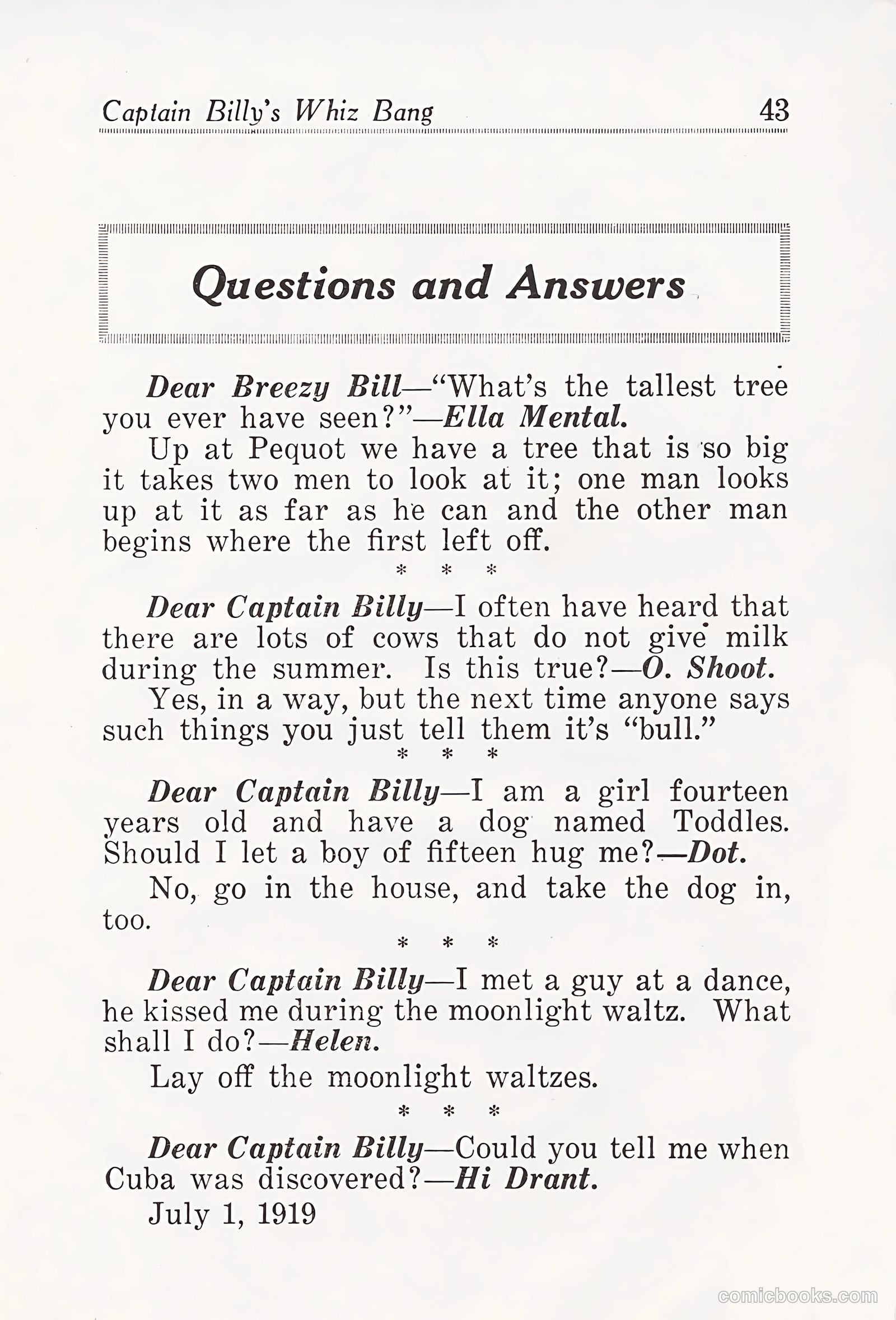
This page from *Captain Billy's Whiz Bang*, a humor magazine, presents a "Dear Captain Billy" advice column featuring absurdist jokes targeting early 1920s readers. The humor relies on punning and deliberate misinterpretation: - **The giant tree joke** uses physical impossibility for laughs—two men can't literally "divide" looking at a tree. - **The cow/milk answer** pivots on calling false claims "bull"—crude wordplay typical of the era. - **Dating advice** mocks young people's romantic anxieties with dismissive, comedic responses (take the dog inside; avoid moonlight dances). - **Cuba's discovery date** satirizes absurdity by claiming Cuba was discovered in 1919—obviously false, likely mocking current events or readers' gullibility. The column targets a working-class audience with lowbrow humor. "Whiz Bang" was known for bawdy, irreverent content. The pseudonymous questioners and responses create a folksy, populist tone while poking fun at conventional wisdom and romantic propriety.
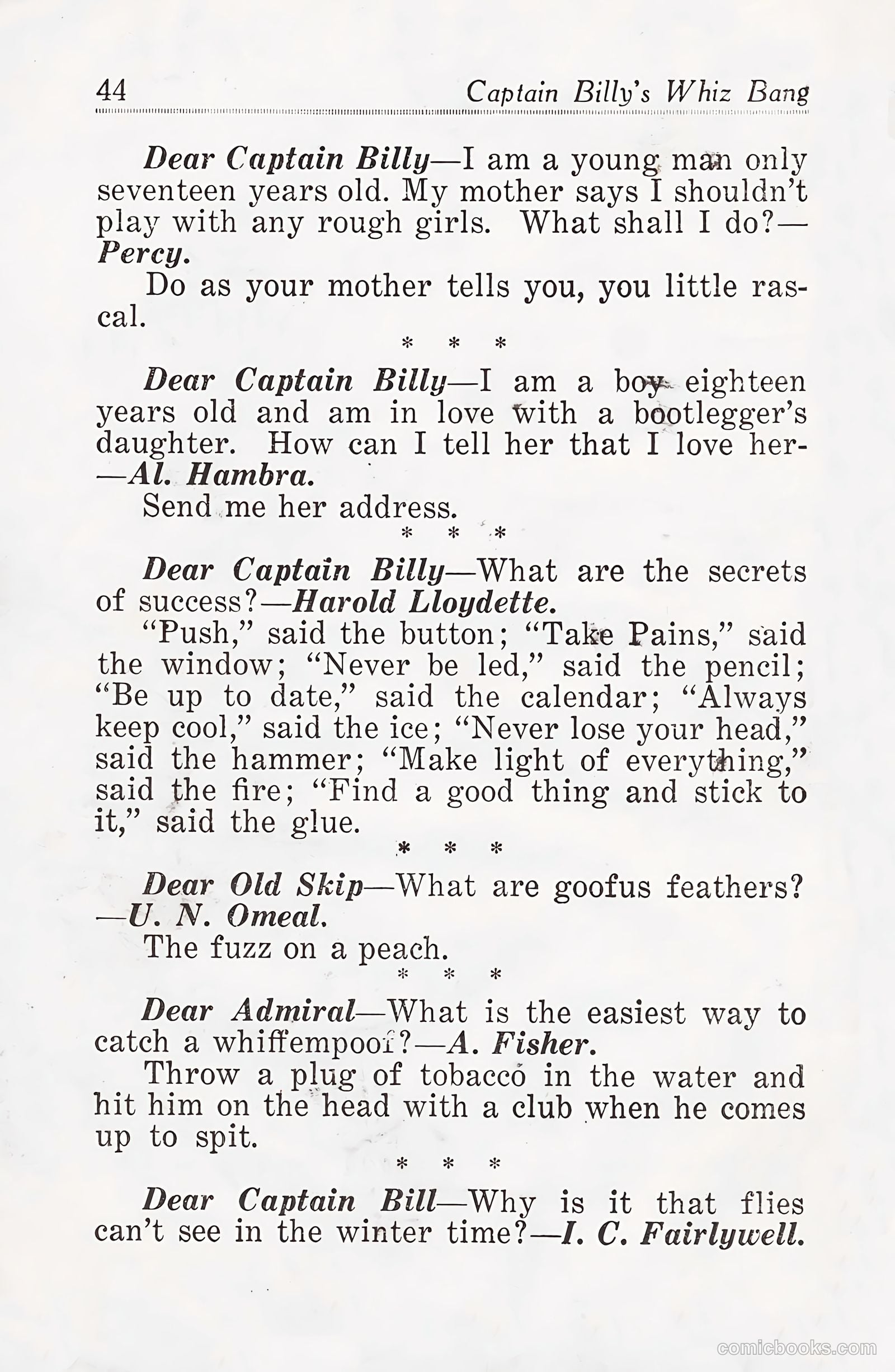
This is a humorous advice column from *Whiz Bang*, a satirical magazine known for ribald humor and clever wordplay. The page contains no visible cartoon illustrations—just text-based jokes disguised as reader letters. The humor relies on: 1. **Prohibition-era references**: A joke about a "bootlegger's daughter" reflects 1920s illegal alcohol culture. 2. **Punny pseudonyms**: Reader names like "U.N. Omeal" (You an Omial/unusual), "I.C. Fairlywell," and "A. Fisher" are jokes themselves. 3. **Absurdist answers**: Responses use pun-based logic (goofus feathers = peach fuzz; catching whiffempoofs involves tobacco and clubbing). 4. **The success advice**: Uses anthropomorphized objects offering motivational platitudes—likely mocking self-help culture popular in the 1920s. 5. **Mild sexual innuendo**: The bootlegger's daughter joke and "rough girls" reference hint at sexual behavior without explicit language. The column's appeal was clever wordplay and irreverent humor aimed at young adult readers.
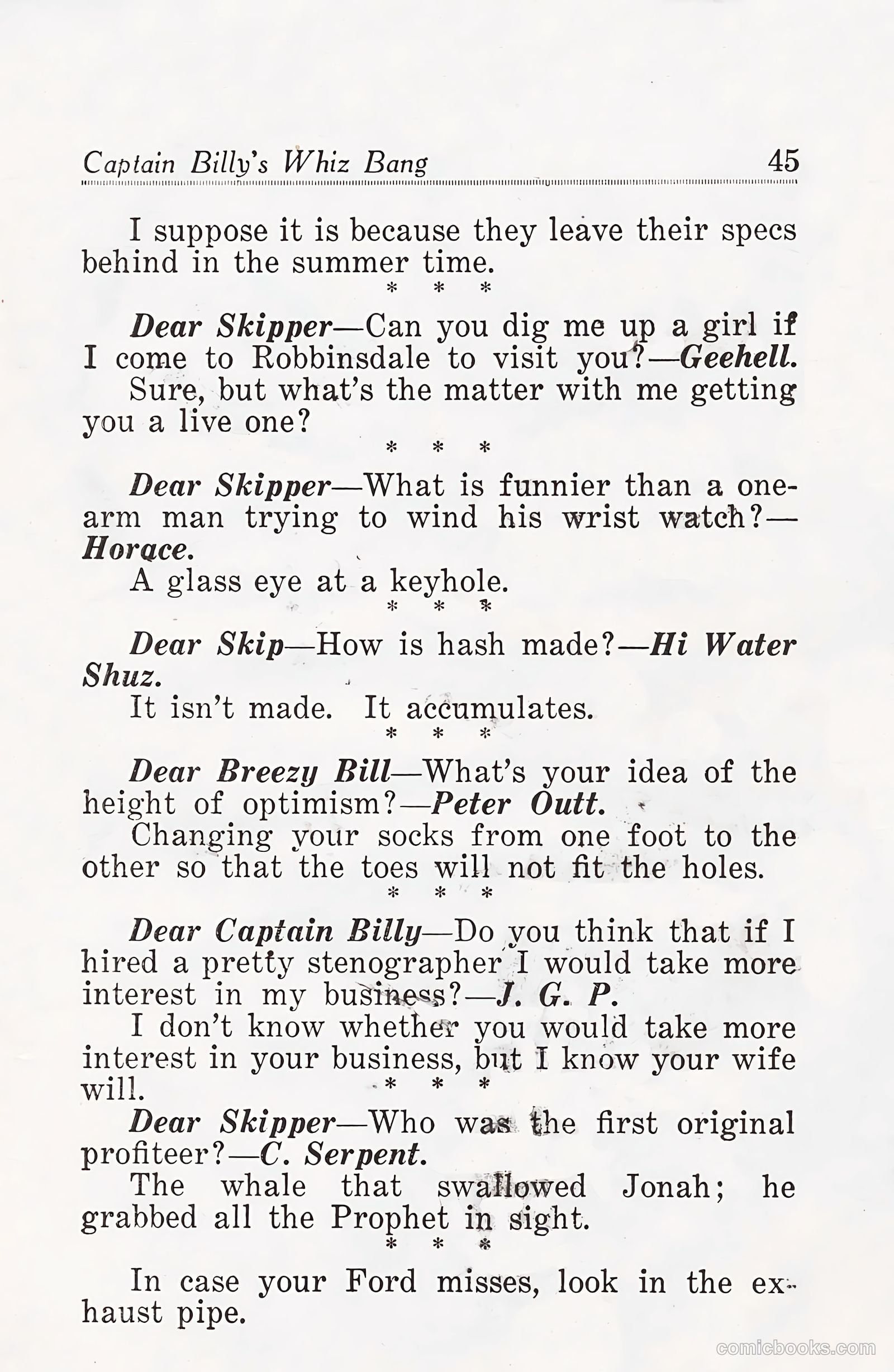
This is a humor advice column from *Captain Billy's Whiz Bang*, an early 20th-century satirical magazine featuring ribald jokes and witty one-liners. The page contains reader questions and humorous responses: **Key jokes:** - One-armed man winding a watch vs. glass eye at keyhole (disability humor common to the era) - Hash "accumulates" rather than being made (commentary on restaurant quality) - Optimistic sock-switching to avoid holes (absurdist poverty humor) - Hiring a pretty stenographer will interest the boss's wife, not him (workplace/marriage humor) - The whale that swallowed Jonah as first "profiteer"—a biblical pun (Prophet/profit) - Ford car humor about exhaust pipes (Model T was notoriously unreliable) The humor reflects 1920s sensibilities: disability jokes, marriage anxiety, class commentary, and automobile culture. "Robbinsdale" appears to be the magazine's location. This format—brief, punchy jokes addressing social situations—was popular in American humor magazines of this period.
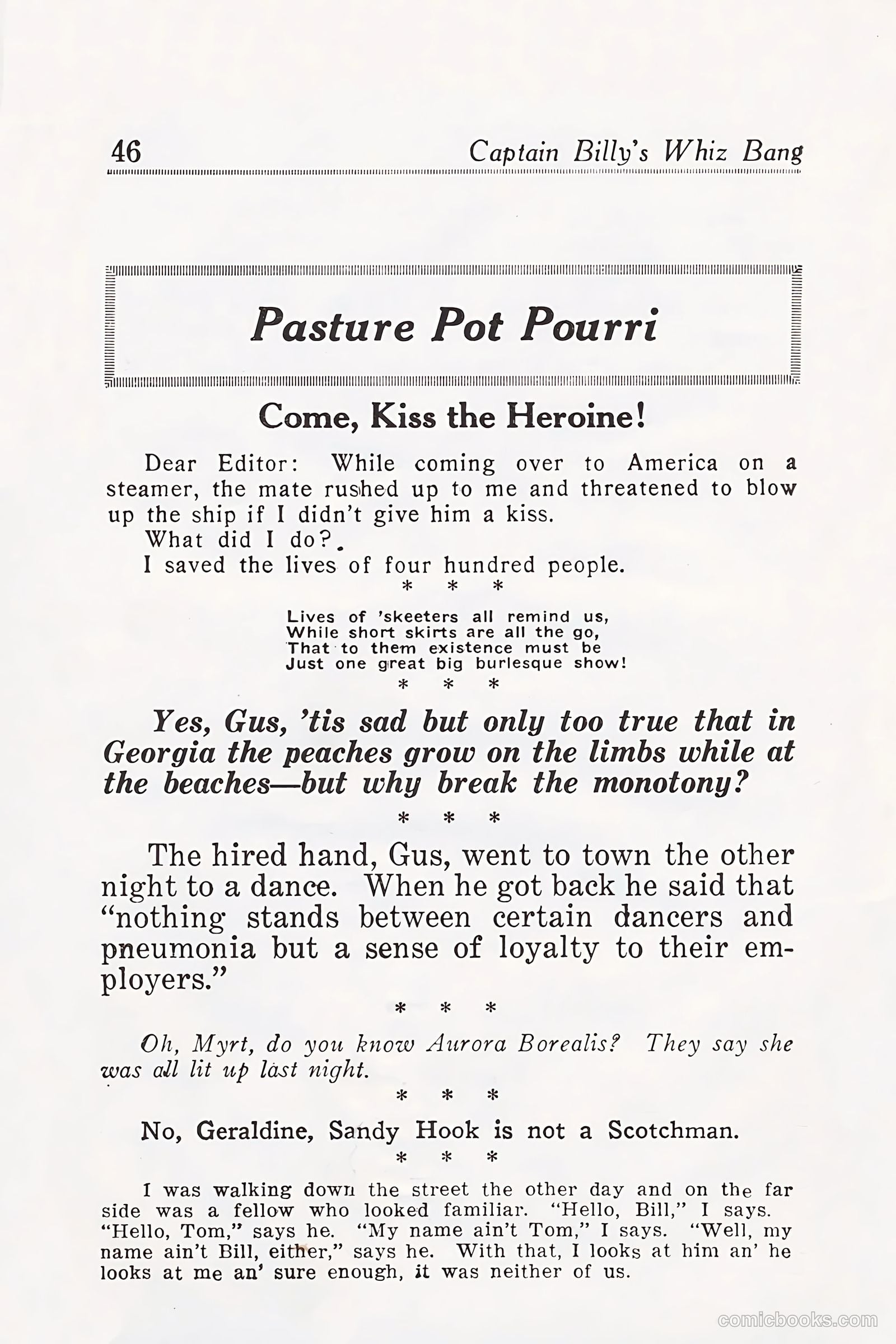
This is a humor column from *Captain Billy's Whiz Bang*, a popular American satirical magazine known for bawdy jokes and social commentary. The page contains brief, disconnected gags rather than formal cartoons. The humor targets several 1920s concerns: women's changing social roles (short skirts, independent behavior at dances), modern dating conventions (the ship mate's kiss demand), and linguistic/logical absurdities (the confused stranger exchange). The references to "skeeters" (mosquitoes), pneumonia from dancing, and the Aurora Borealis pun reflect contemporary anxieties about new freedoms and their perceived health consequences. The column's title suggests miscellaneous commentary—a "pot pourri" of rural ("pasture") observations. The tone is lighthearted small-town gossip mixed with double-entendre, typical of the magazine's irreverent approach to post-WWI American social change.
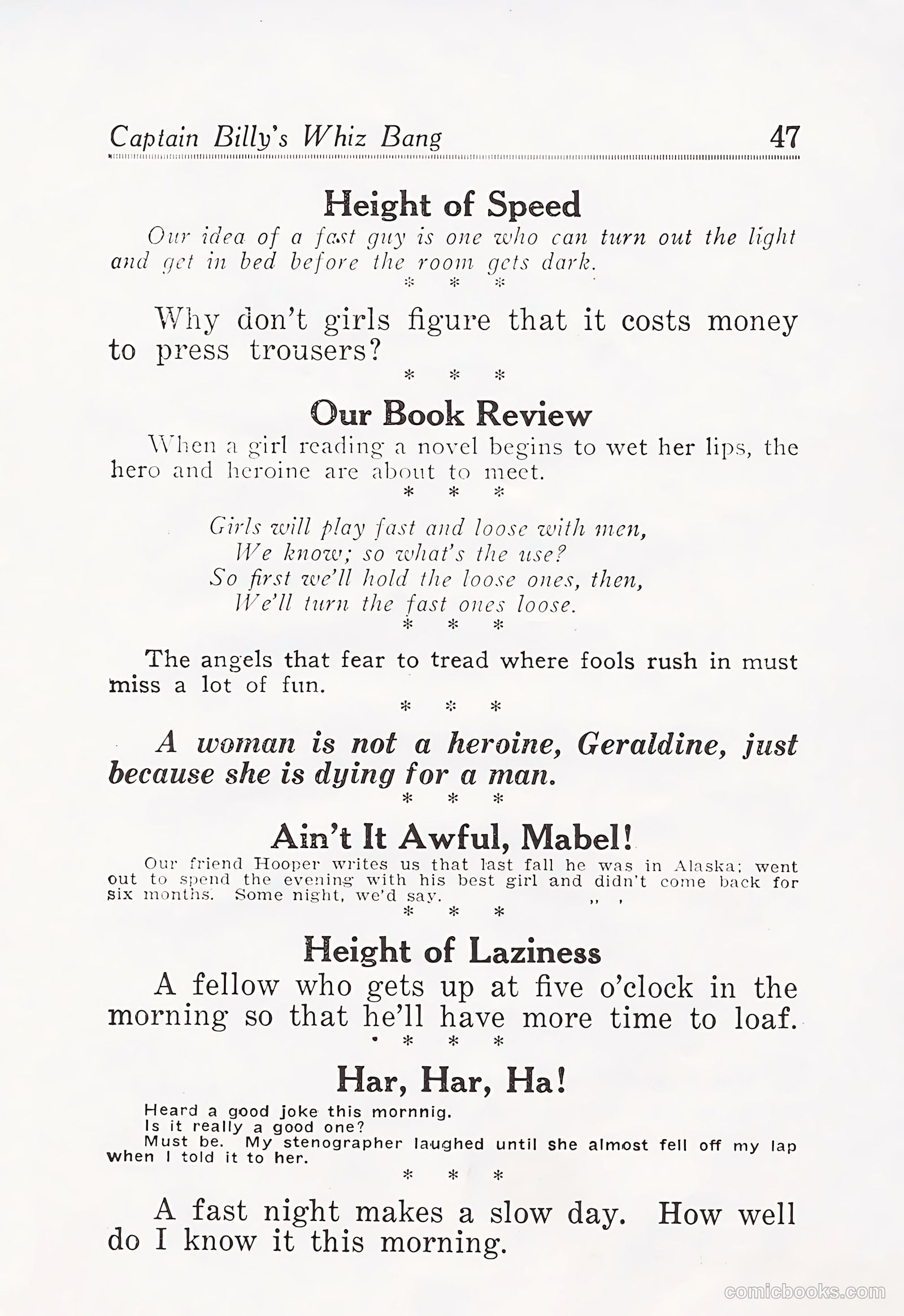
This page contains brief, disconnected jokes and witticisms typical of 1920s satirical magazines. The humor targets: **Sexual/Gender Relations**: Multiple jokes mock courtship and gender dynamics—girls spending money on men's clothing, women becoming emotionally invested in romance novels, and the double standard of "fast" (sexually loose) versus "loose" (available) women. **Workplace Behavior**: A joke about a boss's stenographer laughing at his joke "until she almost fell off my lap" suggests inappropriate workplace intimacy, treated as humorous rather than problematic. **Laziness and Contradiction**: Absurdist humor about someone waking early specifically to have more time lounging around. The overall tone is cheeky and irreverent, poking fun at modern courtship, workplace relations, and human contradictions. Nothing suggests these are political cartoons—this is purely lighthearted social satire aimed at adult readers.
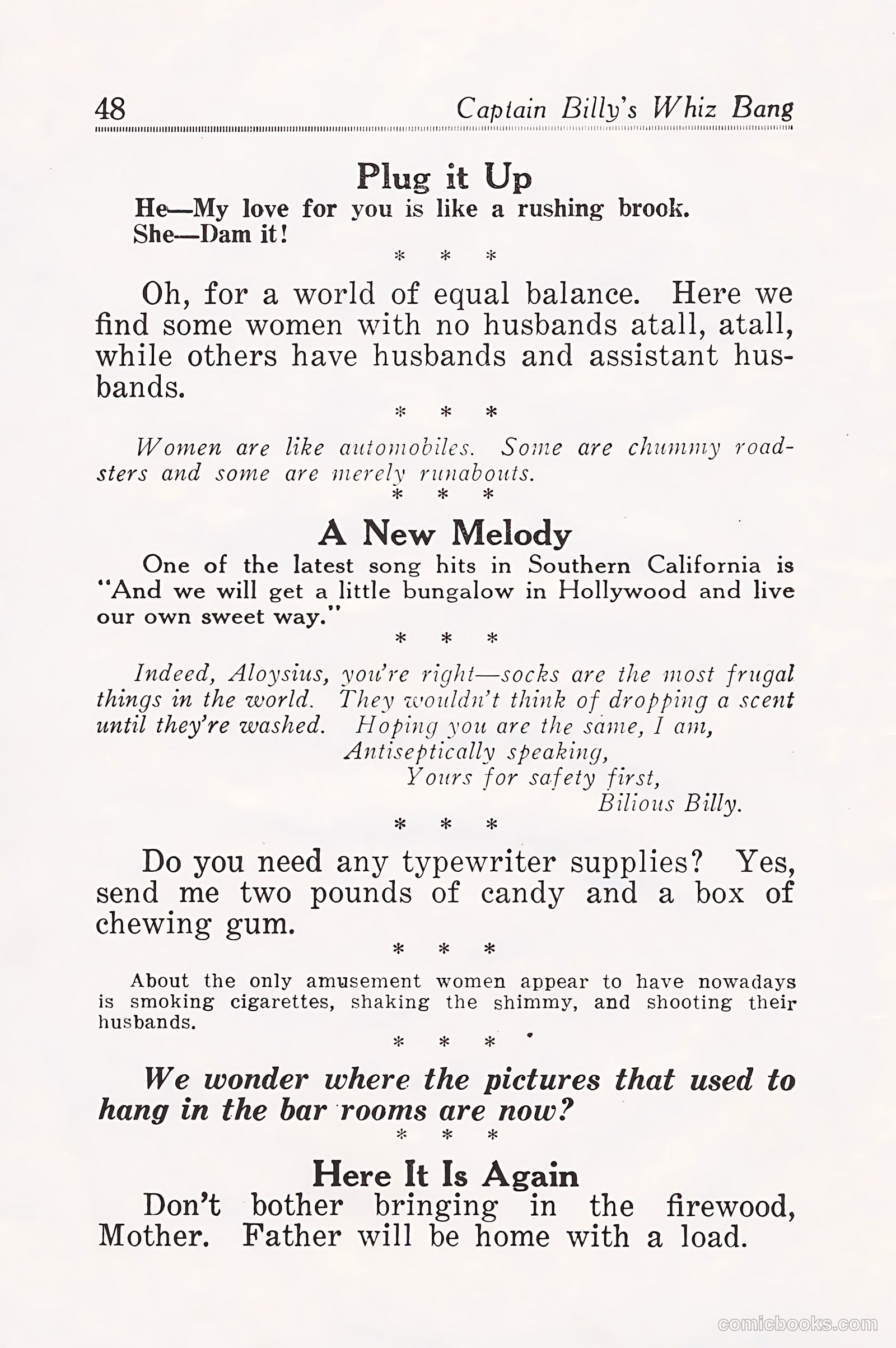
This page contains satirical one-liners and jokes typical of 1920s humor magazines. The jokes target: **Gender relations and marriage**: Jokes mock both romantic idealization ("love like a rushing brook") and women's infidelity ("assistant husbands"), reflecting post-WWI anxieties about changing gender roles. **Modern women**: References to women smoking, dancing the "shimmy" (a scandalous dance), and the dark joke about "shooting their husbands" reflect concern over women's newfound freedoms during the Jazz Age. **Prohibition era**: The final joke about "Father will be home with a load" alludes to illegal alcohol smuggling during Prohibition—a common practice husbands undertook. **Hollywood culture**: A song lyric about bungalows in Hollywood reflects the era's fascination with California's emerging film industry. The humor is crude and misogynistic by modern standards, but represents period anxieties about women's liberation, changing social mores, and Prohibition's impact on American life.
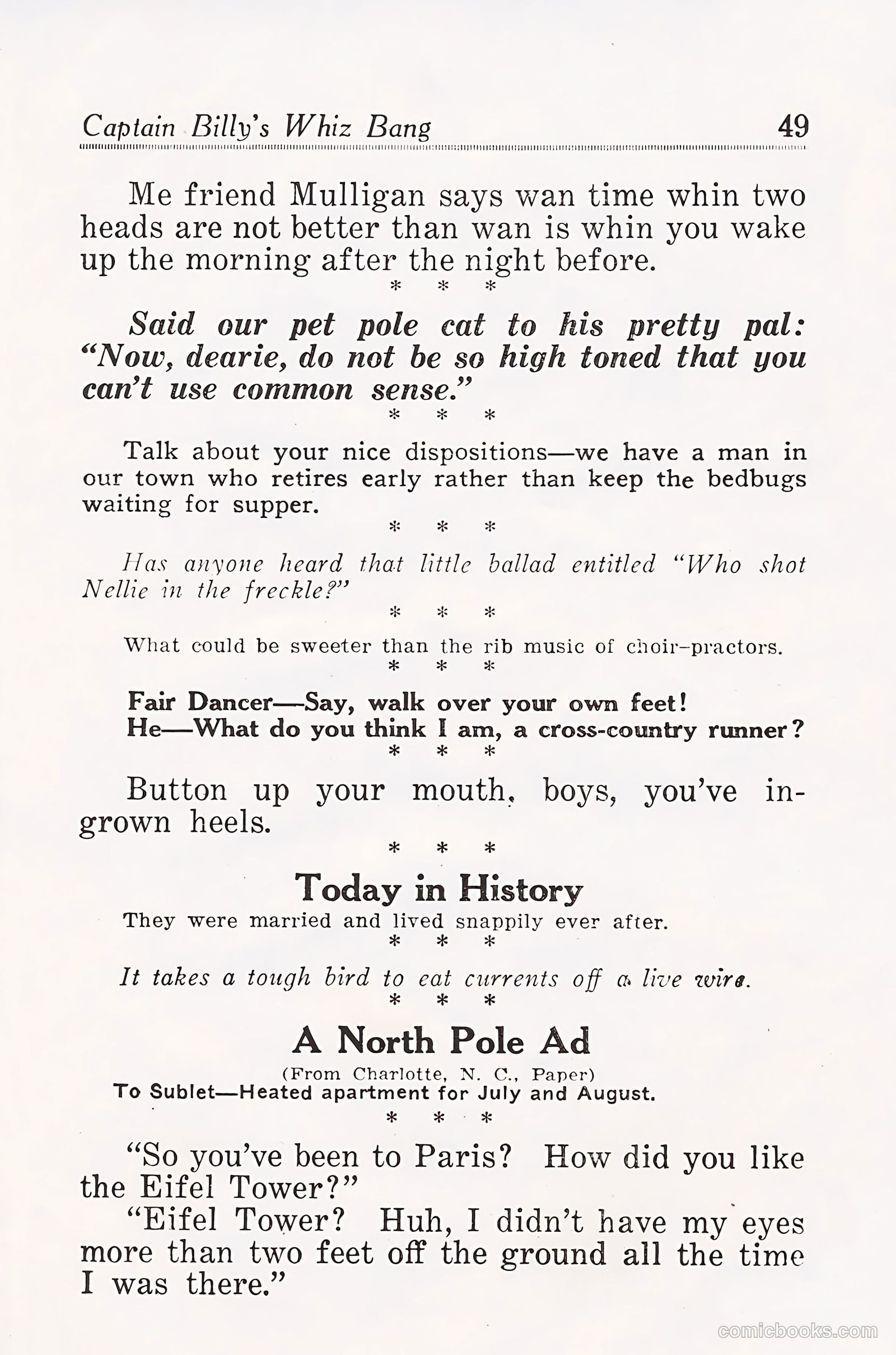
This page from *Captain Billy's Whiz Bang*, a popular early-20th-century humor magazine, contains brief satirical jokes and quips with no accompanying cartoons. The humor targets everyday social situations: a Mulligan quote about hangovers; a polecat dispensing practical advice to his mate; a man so considerate of bedbugs he retires early; crude puns ("Who shot Nellie in the freckle"); and physical comedy (dancers stumbling, ingrown heels). The "Today in History" section mocks marriage and danger with absurdist observations. The "North Pole Ad" joke plays on climate—advertising a heated apartment for summer months in an arctic location is deliberately illogical. The final Paris anecdote suggests a woman so distracted by romantic or social concerns while touring Paris that she never looked up to see the Eiffel Tower—a common satirical theme mocking women's priorities and inattentiveness. Overall, the page reflects working-class, somewhat crude humor typical of 1920s American popular magazines.
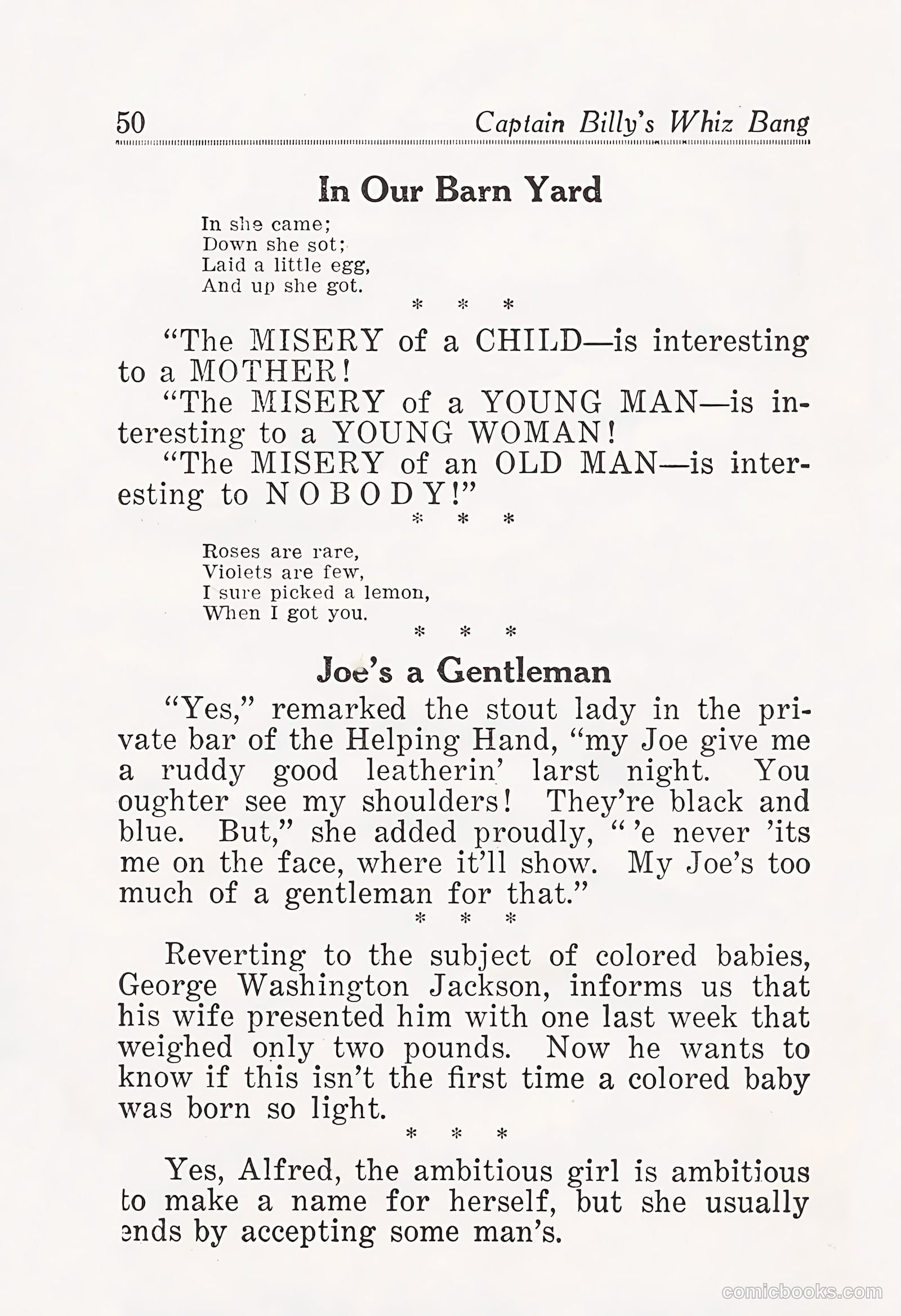
This page from the satirical magazine contains several crude jokes typical of early 20th-century American humor: **"In Our Barn Yard"** is a simple pun about a hen laying an egg. **The "Misery" verses** mock life stages—suggesting an old man's suffering matters to no one, a cynical comment on aging and social indifference. **"Roses are rare"** is a standard breakup insult poem. **"Joe's a Gentleman"** presents dark satire: a woman brags that her abusive husband beats her but avoids her face—framing domestic violence as a mark of his "gentlemanly" consideration. This reflects disturbing period attitudes normalizing spousal abuse. **The "colored babies" section** contains racist "humor" based on skin tone, using a stereotyped name (George Washington Jackson) to mock Black families. **The final quip** is a sexist jab at women's ambitions, suggesting career aspirations inevitably yield to marriage. The page reflects the casual racism, sexism, and acceptance of domestic violence embedded in early 20th-century popular humor.
This page contains short satirical jokes from *Captain Billy's Whiz Bang*, a 1920s American humor magazine. Key themes: **WWI References**: The first joke mocks pacifists by having a British soldier ("Tommy") outwit an anti-war speaker in Hyde Park—suggesting pacifists lack practical wisdom. **Prohibition Era**: Multiple jokes reference Prohibition (1920-1933). One sarcastically notes that umbrellas with curved handles hang over bars—implying bars still operated illegally. Another jokes that eating corn and drinking water in "Robbinsdale" recreates 'good old days' before alcohol was banned. **Social Commentary**: Other jokes target gender dynamics (men carrying women to avoid wet feet; women's emotional recklessness) and orphans, using cynical humor typical of the era. The magazine's tone is irreverent and cynical, mocking contemporary figures, institutions, and social conventions through short quips rather than illustrated cartoons on this page.
This page from *Captain Billy's Whiz Bang* (a 1920s-era men's humor magazine) contains a collection of short jokes and satirical observations rather than a single cartoon. The humor targets women and relationships through crude sexual innuendo and domestic stereotypes typical of the era. The "Naughty Nellie" song parody mocks sentimental romance while joking about violence toward women ("I'll blacken 'em for you"). The editor then sarcastically critiques another verse for anatomical absurdity ("what part of a woman's anatomy are the stairs"), while making light of domestic violence by referencing a woman shot "in the boiler room." The final joke plays on newlywed coldness—the bachelor assumes "cold feet" means hesitation, but the newlywed implies his wife is literally refusing physical intimacy. Throughout, the tone reflects period attitudes normalizing domestic discord and treating women as objects of conquest or complaint. The scattered jokes about being "half shot" anchor this in drinking-culture humor common to the magazine's demographic.
This is a humorous personal essay rather than a political cartoon. The author describes encountering a beautiful young woman on the New York subway at Columbus Circle, becoming so entranced he misses his stop. The punchline reveals she was lame (disabled), undermining his romantic fantasy. The piece then shifts to mockery of a door-to-door salesman pitching silk stockings, with a innuendo-laden reply about being "careful"—likely referencing concerns about sexually transmitted infections, a social anxiety of the 1920s era. The humor relies on deflating romantic idealization and poking fun at overeager salesmen. The tone is lighthearted satire of urban dating anxieties and commercial intrusion into professional life. No specific political figures are referenced.
This page from *Captain Billy's Whiz Bang* (a 1920s satirical magazine) contains three separate humorous anecdotes: 1. **The Subway Incident**: A story about a girl named Rosie on the subway whose mother warns her to keep her leg down because the wind is lifting her dress. The girl replies she's "not deformed," implying she has nothing to be ashamed of. The humor targets prudish attitudes about women's bodies. 2. **All Was Not Well**: A brief joke about a preacher catching his congregation gambling (shooting craps). A parishioner admits he's "paying for his sins"—a dark joke suggesting he's losing money at craps as divine punishment. 3. **A Tiresome Job**: A classified ad from the *Minneapolis Journal* where someone wants to sell their "shoe hospital" (a shoe repair business) because they're tired of sitting all day—mild workplace humor. The overall tone is lighthearted, working-class satire typical of 1920s humor magazines.
This page from a satirical magazine contains several brief humor pieces typical of early-20th-century American comedy publications. The opening joke mocks stinginess: a wife's exaggerated claim that her miserly husband wouldn't even share water with a clam demonstrates extreme cheapness. "Old Time Facts" presents absurdist humor—tautological statements (McGirth "was born on the day of his birth") and an Irish character's deadpan cemetery joke about honesty. The "Photographer's Sign" uses ambiguous wording for humor: "enlarge your babies" could suggest physical growth rather than photo enlargement. The cow anecdote plays on a double meaning: "pinched her calf" (stole the young cow) rather than the literal action. The "Lost or Stolen" notice satirizes overly detailed horse descriptions while the closing mother-son dialogue jokes about relative discipline standards between families. Overall, these represent the gentle, pun-heavy humor typical of 1920s-era American comic magazines.
This is a page of **joke and humor content** from an early 20th-century American satirical magazine. There are no political cartoons here—just printed gags and one-liners typical of the era. The jokes target **women and marriage** with period-typical sexism: a woman is like an umbrella because she's "used to reign" (a pun on "rain"); marriage is defined as a monologue (implying wives dominate conversation); and the letter "E" is tied to women's names while representing poverty and hardship. One joke mocks **modern fatigue**—"somewhere it is always time to get up in the morning"—reflecting industrial-era anxieties about relentless routine. A romantic poem about a woman's "fast" past life suggests **judgment of female morality**, common in the period. The wordplay and puns are intentionally groan-worthy, the magazine's trademark style. This represents **casual, everyday misogyny** normalized in American popular humor of the era.
This is a humorous anecdote from a post-WWI satirical magazine. An Irish soldier named Paddy O'Loughlin recounts visiting Paris after the armistice and encounters what he describes as dangerous "enemy attacks"—actually aggressive flirtations from Parisian women. The joke relies on comparing romantic advances to military combat. Women with makeup ("lips like strawberries," heavily made-up eyes) are portrayed as seductively predatory, "swooping down" and trying to "carry him off" like soldiers capturing prisoners. The irony is that Paddy survived actual German machine gun fire but feels genuinely threatened by French women's romantic pursuit. The satire plays on 1920s attitudes about both war and gender: soldiers as objects of female desire, cosmetics as "camouflage," and women's sexuality as something dangerously aggressive. It reflects post-war American popular culture's simultaneous celebration of soldiers' return and anxiety about changing gender dynamics.
This page from *Captain Billy's Whiz Bang* contains two pieces of content: **First anecdote**: A WWI soldier's account of combat on "the Boulevard" (likely referring to a specific battle location). He describes artillery fire using military terminology—"one pounders" and "seventy-fives" are artillery pieces. References to "German mass formation," "No Man's Land," and barbed wire establish the Western Front context. "Kamerad" is a German surrender call. The joke's punchline relies on suggesting "Paddy" (an Irish soldier) experienced something embarrassing afterward that he won't detail—likely implying cowardice or bodily functions under fire. **Main content**: "The Horse That Wins the Race" is a lengthy poem about success. It uses horse racing as a metaphor for life achievement, arguing that results matter more than effort or merit. The satirical point: society judges only winners, not noble attempts; success is measured by financial gain and visible victory, not inherent worth. This reflects post-WWI cynicism about meritocracy.
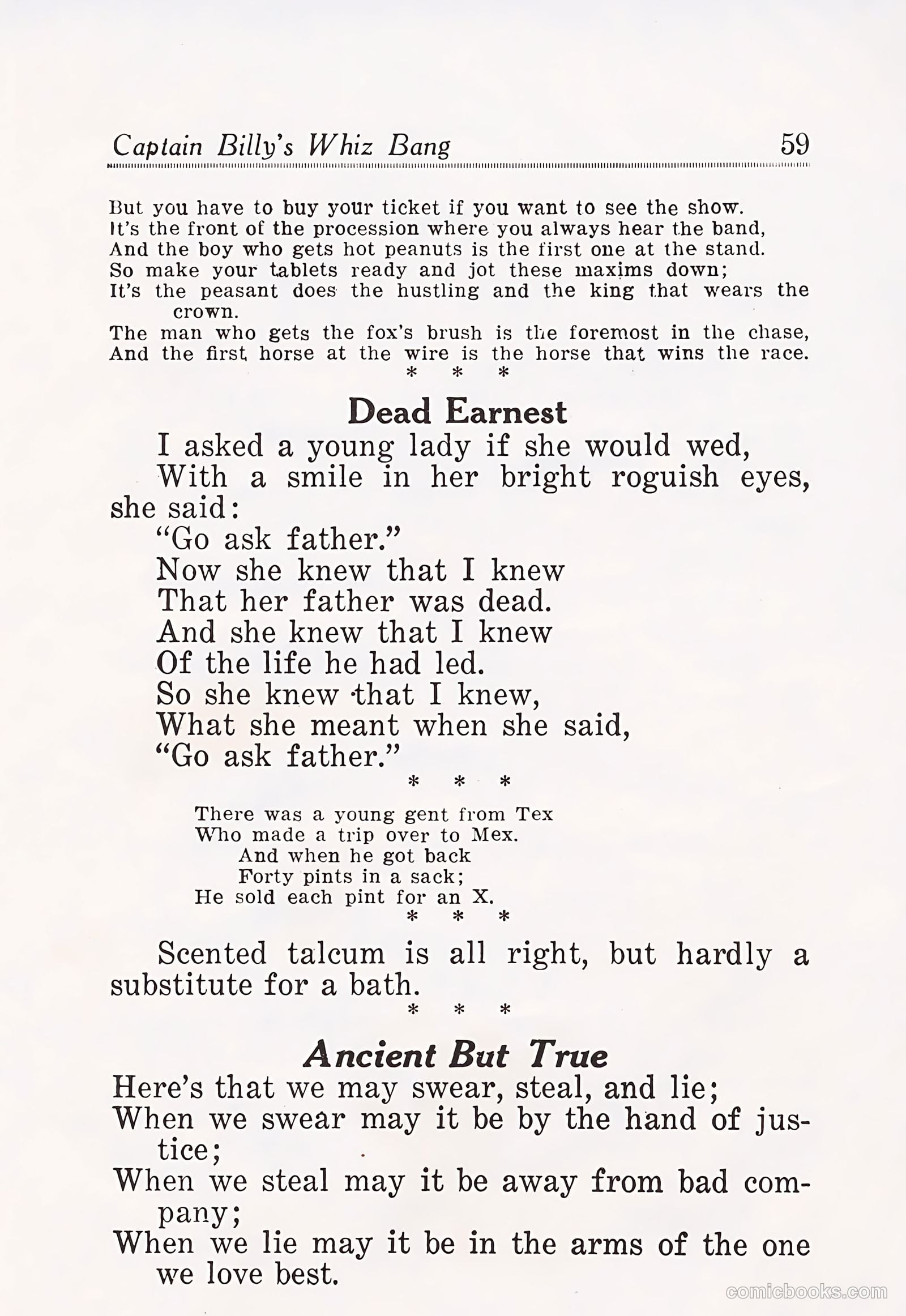
This page contains **poetry and humorous verses** rather than cartoons. The content includes: 1. **"Captain Billy's Whiz Bang"** — concluding lines about buying tickets to a show and observing social hierarchy (peasants hustling, kings wearing crowns, fox hunts) 2. **"Dead Earnest"** — a poem about a young woman who, when proposed to, deflects by saying "Go ask father," knowing the speaker understands her father is dead—a darkly humorous rejection 3. **Brief jokes** about a Texan selling "pints" (unclear if literal or coded reference) and talcum powder as bath substitute 4. **"Ancient But True"** — a moral verse about the ethical circumstances under which one might swear, steal, or lie The page represents typical *Whiz Bang* content: bawdy, cynical humor mixed with folk wisdom, targeting post-WWI American audiences.
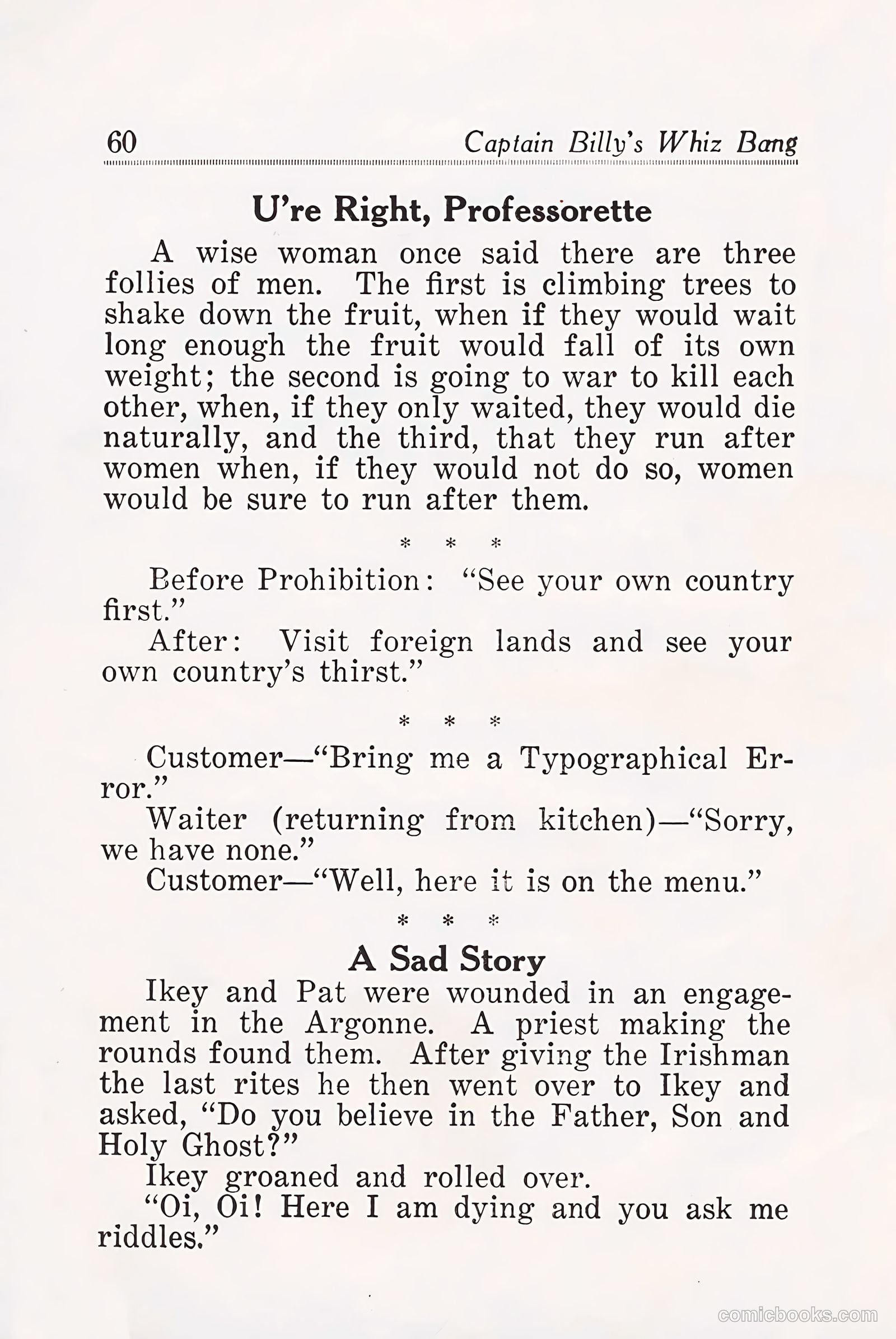
This page contains four brief satirical pieces typical of 1920s humor magazine content: **"U're Right, Professorette"** mocks male behavior through a misogynistic "wise woman's" observations—men are foolish in pursuit, war, and romance. The satire targets conventional masculine behavior. **Prohibition joke** contrasts pre-Prohibition tourism slogans with post-1920 reality: Americans now travel abroad to drink alcohol illegally, while domestic "thirst" (caused by Prohibition) drives the country's desperation. This satirizes Prohibition's failure and hypocrisy. **Restaurant joke** plays on typographical errors as menu items—a simple pun about restaurant mistakes. **"A Sad Story"** uses ethnic caricature (Ikey = Jewish, Pat = Irish stereotypes) for dark wartime humor. A priest offers last rites to both; when he asks the Jewish soldier theological questions, the dying man groans that he's being asked "riddles" at death. The humor derives from perceived Jewish-Christian cultural difference and the absurdity of religious conversion attempts during combat. The content reflects 1920s attitudes: Prohibition satire, casual ethnic stereotyping, and irreverent wartime humor.
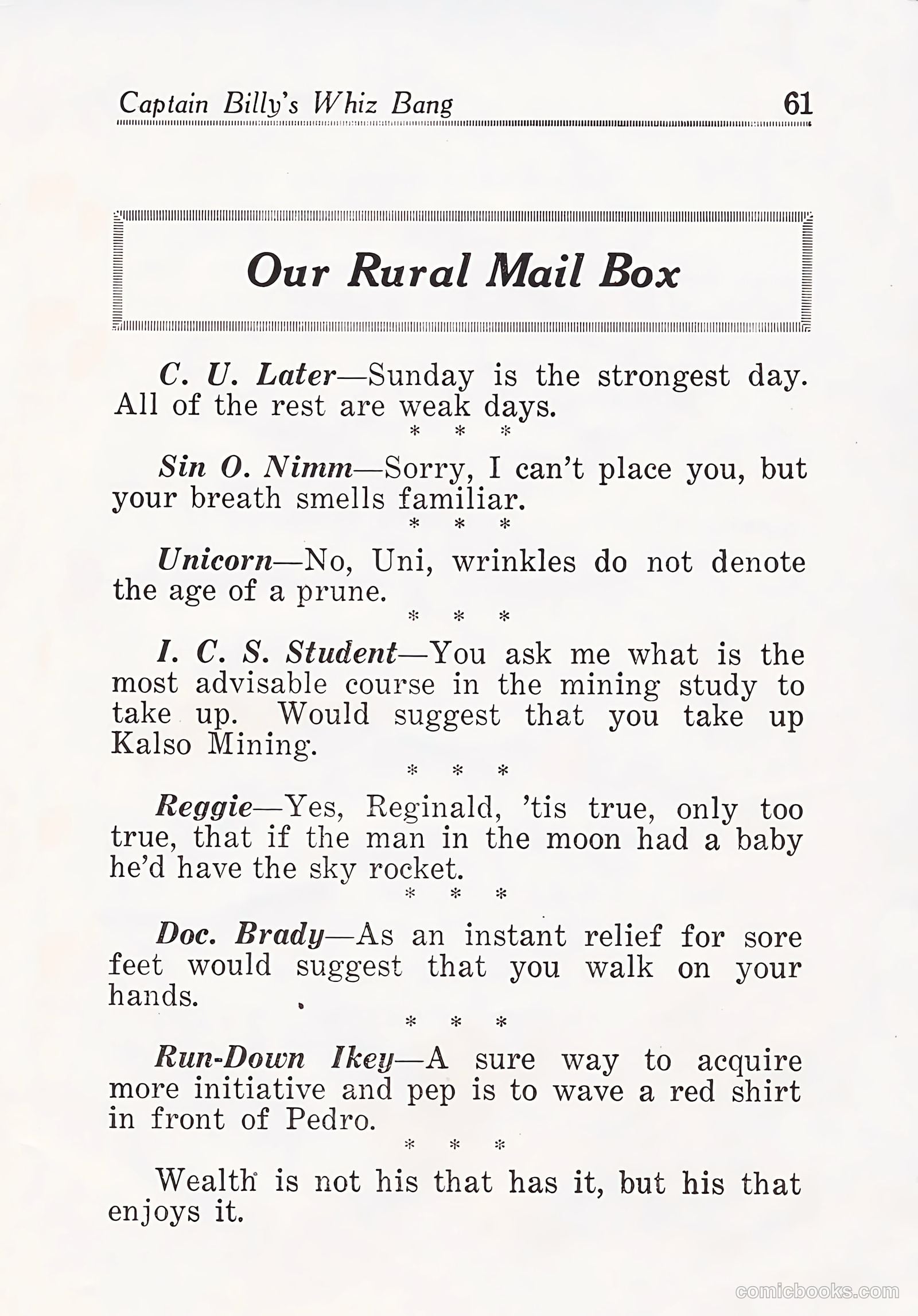
This is a humor column featuring short jokes and puns submitted by readers with playful pseudonyms. The jokes rely on wordplay and absurdist logic typical of 1920s American comic magazines. Notable examples include: - **"Kalso Mining"** — a pun on "callus" (foot condition), mocking correspondence school students - **"Sky rocket"** — crude sexual innuendo about the man in the moon having a baby - **"Walk on your hands"** — absurdist advice for sore feet - **"Red shirt in front of Pedro"** — likely references bullfighting, suggesting waving something provocative creates energy The final aphorism about wealth emphasizes enjoyment over possession—common Depression-era or post-WWI sentiment about materialism. The column's format mimics actual rural mailbags where readers submitted jokes—a popular magazine feature of the era. The humor is crude, pun-heavy, and occasionally crude or stereotypical by modern standards.
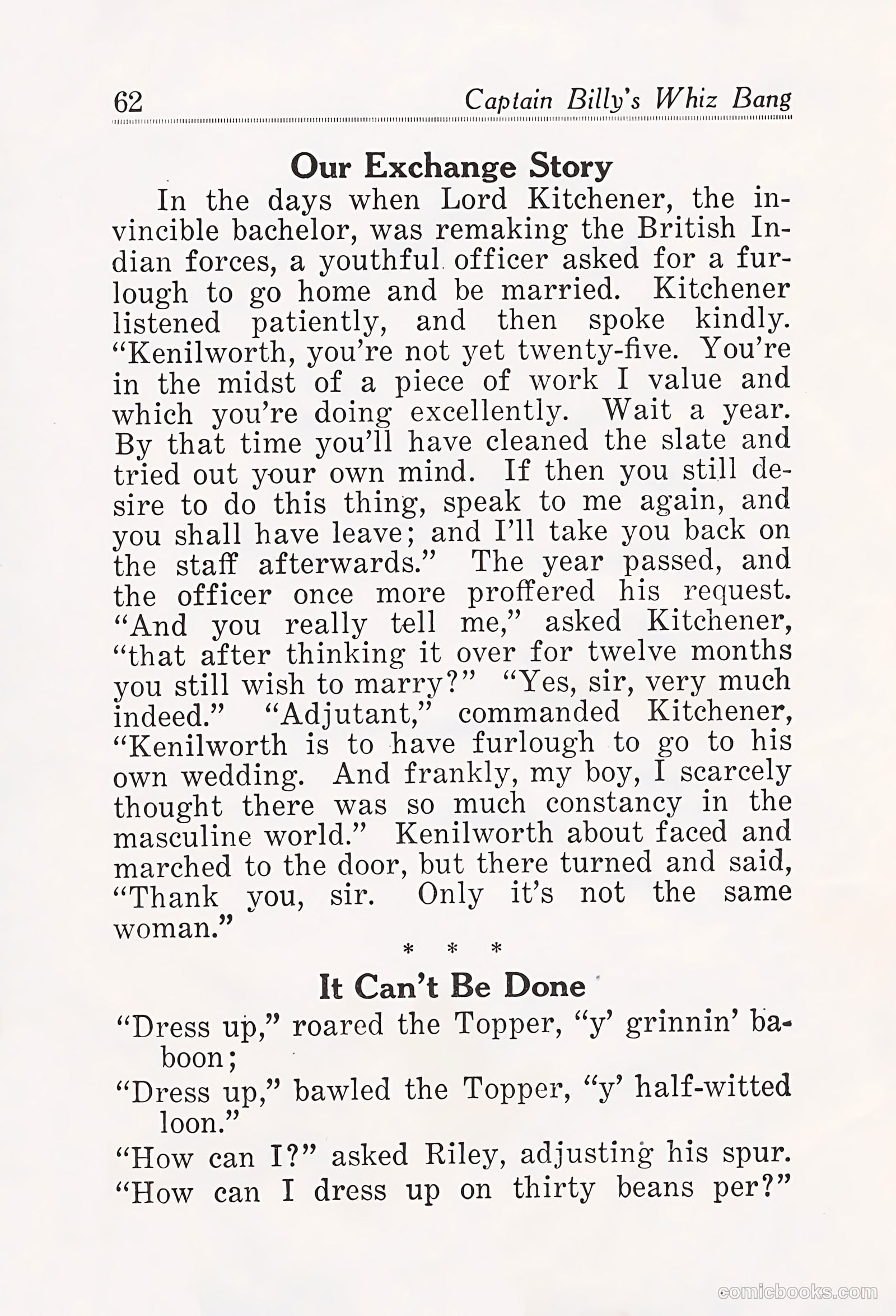
This page contains two humorous stories from *Captain Billy's Whiz Bang*, an early 20th-century satirical magazine. **"Our Exchange Story"** recounts an anecdote about Lord Kitchener (the actual British military leader who reorganized Indian forces) and an officer named Kenilworth. The joke's punchline hinges on constancy in love: Kitchener is impressed that Kenilworth remained committed to marriage after a year's reflection, but the final twist reveals the officer's commitment was to *marriage itself*, not to the same woman—implying he'd fallen in love with someone else during his furlough, undercutting Kitchener's sentimental praise. **"It Can't Be Done"** is a brief comedic dialogue where a superior officer ("the Topper") orders Riley to dress up formally, but Riley protests he cannot afford proper dress on his meager pay of thirty cents ("beans"). The humor derives from the impossible class gap between military rank and soldier's wages. Both stories mock military hierarchy and expose financial hardship among enlisted men.
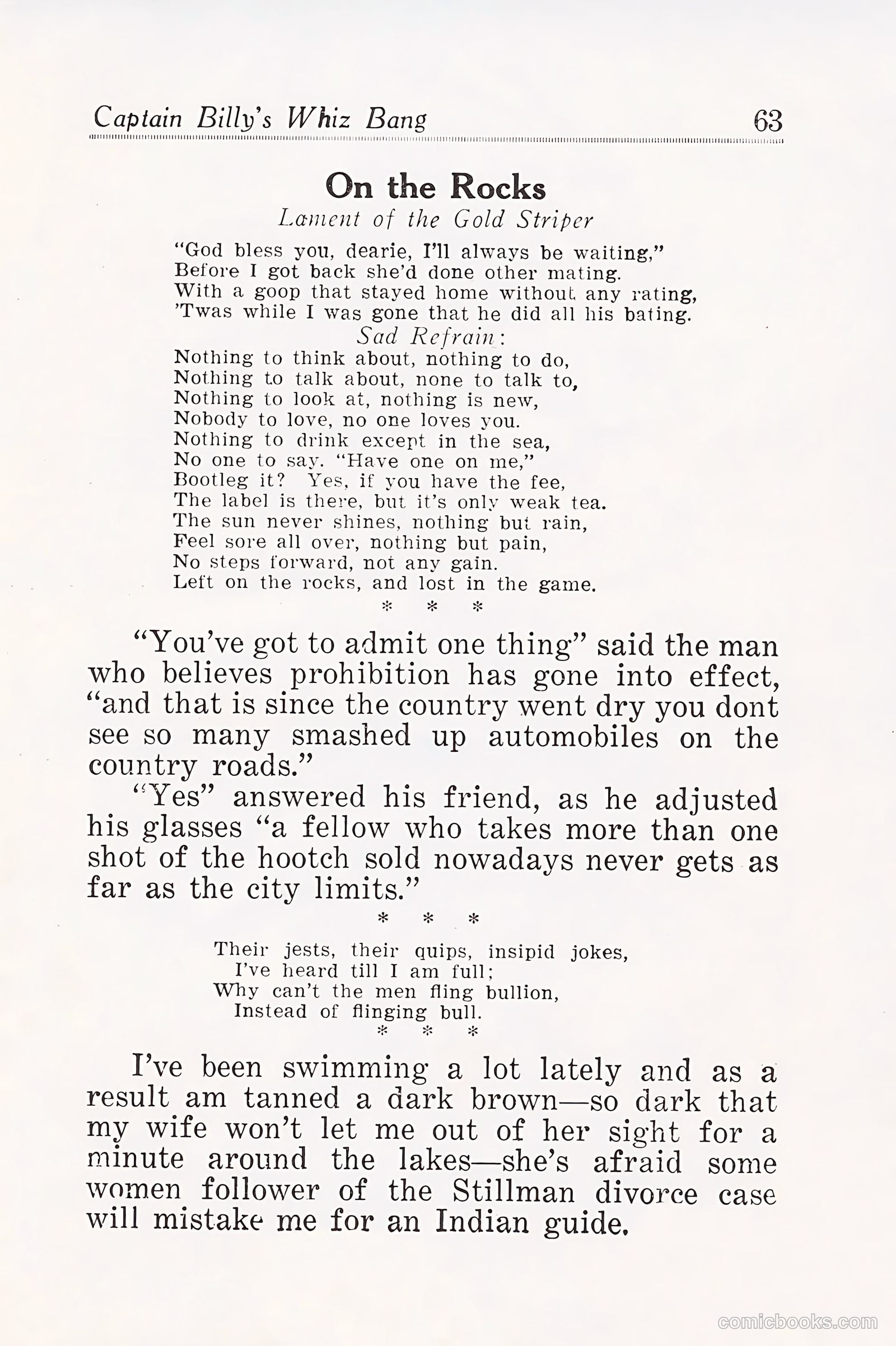
This page satirizes 1920s American social anxieties, primarily Prohibition's effects. The opening poem mocks a cuckolded soldier ("Gold Striper"—likely a WWI veteran) whose wife infidelity occurred during his absence, now leaving him emotionally destitute ("on the rocks"). The dialogue between two men debates Prohibition's success: one claims fewer car accidents since the country "went dry," but his friend counters that bootleg alcohol is so weak that drinkers never make it far enough to crash. The satire suggests Prohibition failed—illegal liquor remains available but inferior. The final joke references the "Stillman divorce case," a scandalous 1921 society divorce involving infidelity. The author jests that his deep tan from swimming makes him resemble "an Indian guide," so his jealous wife fears other women (obsessed with the famous affair) will mistake him for one. This mocks both the scandal's pervasiveness and period-era casual racism. The page combines romantic betrayal with Prohibition critique and social gossip humor.
This is primarily an **advertisement/promotional page**, not a cartoon. It announces the release of *Whiz Bang*'s 1921-22 Winter Annual—a 256-page humor collection featuring jokes, stories, and poetry. **Key points for modern readers:** - *Whiz Bang* was a satirical magazine published by "Captain Billy" (likely referring to the editor) - The ad uses aggressive sales tactics common to 1920s marketing: artificial scarcity ("sold out on the Pacific Coast within three or four days"), first-come-first-served urgency, and the unusual payment method of **pinning a dollar bill to a coupon** - The book cost $1—substantial for 1921 - "Smokehouse poetry" suggests ribald/adult humor typical of the magazine's tone - The final note ("Don't write for early back copies") reinforces manufactured scarcity to drive immediate orders This reflects both 1920s entrepreneurial sales psychology and the genuine printing/distribution constraints of the era.
This is an **advertisement/order form**, not a cartoon page. It announces *Captain Billy's Whiz Bang*'s first Winter Annual for 1921-22, priced at one dollar. *Whiz Bang* was a popular American humor magazine known for jokes, light verse, and satirical stories. The ad lists upcoming content including pieces titled "Johnnie and Frankie," "The Shooting of Dan McGrew," and parodies like "Stunning Percy LaDue" and a Kipling takeoff—typical early-20th-century vaudeville-style humor. The publication was based in Robbinsdale, Minnesota, and solicited advance orders via mail with payment options (check, money order, or stamps). The tone is lighthearted and commercial rather than politically satirical. This represents mass-market American humor entertainment circa 1921-22.
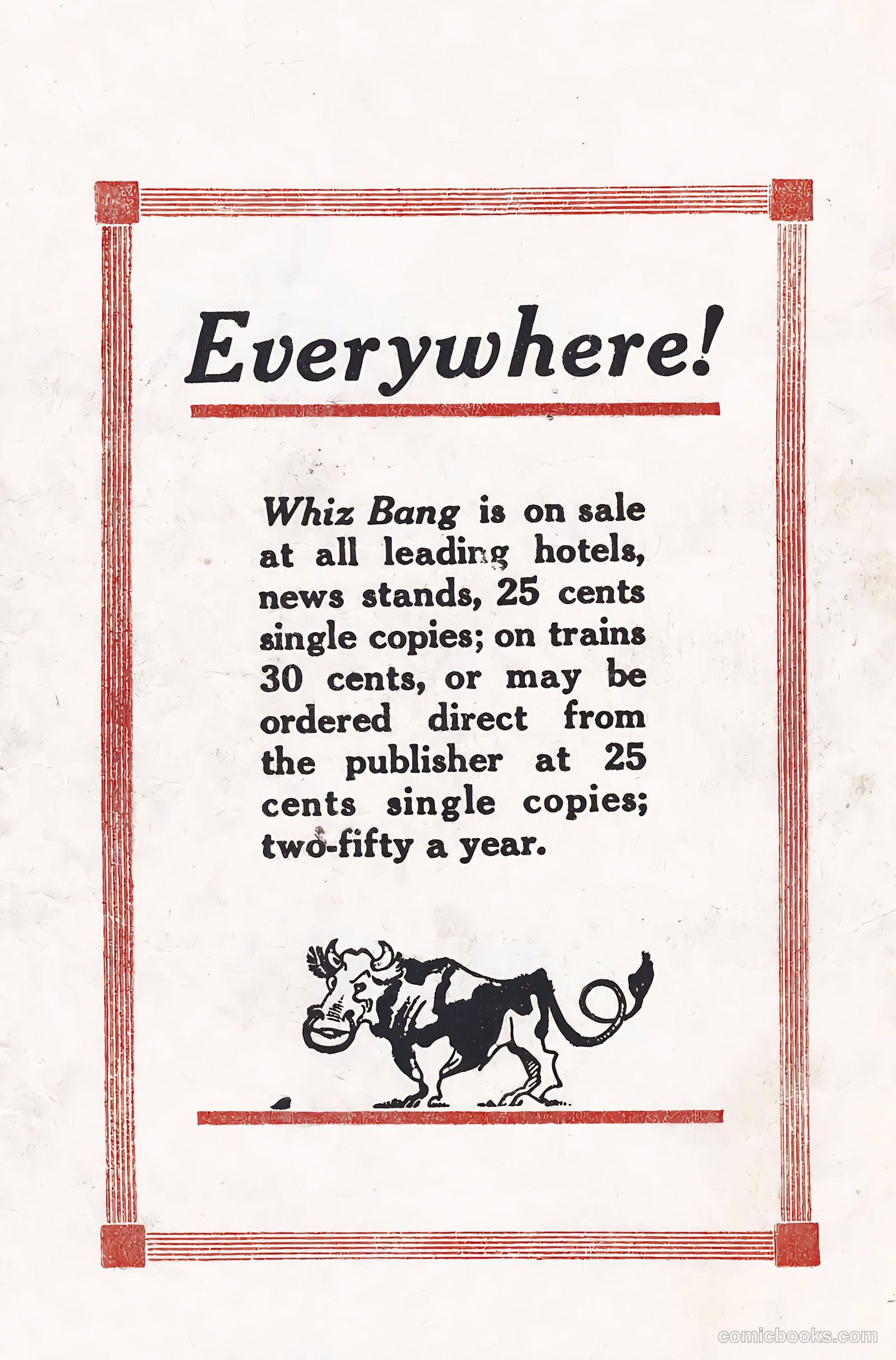
This is a **title/advertisement page** for *Whiz Bang*, an American satirical magazine. The page promotes the publication's availability and subscription options to readers. The only illustration is a **cartoon cow** with horns and an exaggerated expression, serving as a mascot or visual brand identifier for the magazine. The text announces distribution channels (hotels, newsstands, trains) and pricing: 25 cents for single copies at stands, 30 cents on trains, or $2.50 yearly by direct subscription. This reflects early 20th-century publishing economics. The page functions purely as promotional material rather than containing political or social satire. It's designed to maximize visibility of the magazine's availability to potential customers.