
Captain Billy's Whiz Bang, October 1921 · page 25 of 68
Captain Billy's Whiz Bang #25 — page 25: what you’re looking at
What you’re looking at
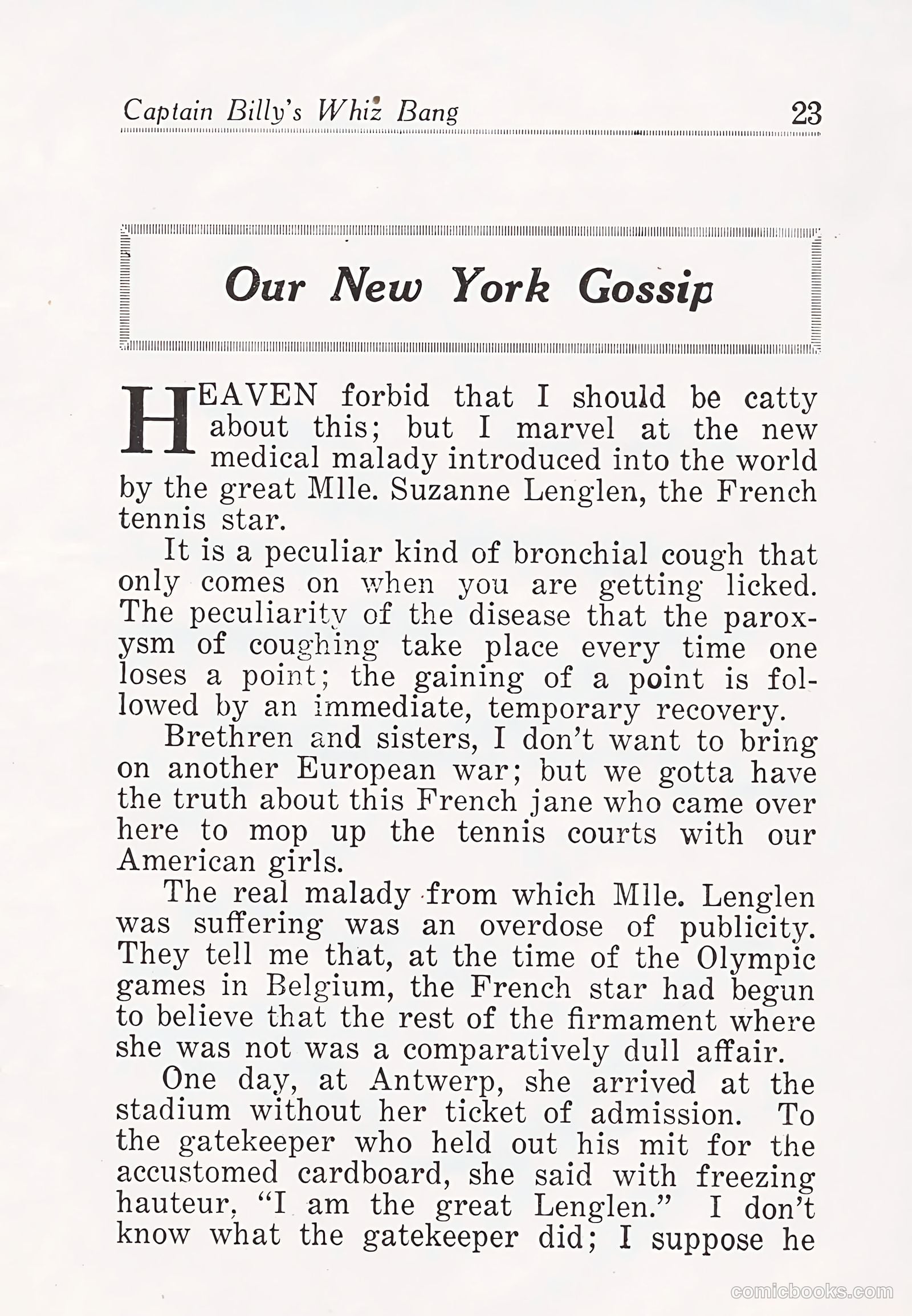
This is a gossip column mocking French tennis champion Suzanne Lenglen. The satire attacks her for allegedly faking illness during matches—specifically, developing a convenient "cough" only when losing points, which mysteriously disappears when she gains ground. The author sarcastically calls this a new "medical malady." The deeper joke: Lenglen's real problem isn't physical illness but an inflated ego from excessive publicity and celebrity status. The anecdote about her arriving at an Antwerp stadium without a ticket and imperiously announcing "I am the great Lenglen" to the gatekeeper illustrates her arrogance. The column frames this as nationalist ribbing—a French player coming to America to dominate American female tennis players while behaving badly. The tone is mock-serious ("I don't want to bring on another European war") but fundamentally dismissive of her pretensions.
📄 Transcribed text from this page (OCR, searchable)
Machine-transcribed from the original scan — historical spelling and the odd misread are preserved.
Captain Billy’s Whiz Bang 23 Our New York Gossip HEAVEN forbid that I should be catty about this; but I marvel at the new medical malady introduced into the world by the great Mlle. Suzanne Lenglen, the French tennis star. It is a peculiar kind of bronchial cough that only comes on when you are getting licked. The peculiarity of the disease that the paroxysm of coughing take place every time one loses a point; the gaining of a point is followed by an immediate, temporary recovery. Brethren and sisters, I don’t want to bring on another European war; but we gotta have the truth about this French jane who came over here to mop up the tennis courts with our American girls. The real malady from which Mlle. Lenglen was suffering was an overdose of publicity. They tell me that, at the time of the Olympic games in Belgium, the French star had begun to believe that the rest of the firmament where she was not was a comparatively dull affair. One day, at Antwerp, she arrived at the stadium without her ticket of admission. To the gatekeeper who held out his mit for the accustomed cardboard, she said with freezing hauteur, “I am the great Lenglen.” I don’t know what the gatekeeper did; I suppose he