
Captain Billy's Whiz Bang, October 1921 · page 35 of 68
Captain Billy's Whiz Bang #25 — page 35: what you’re looking at
What you’re looking at
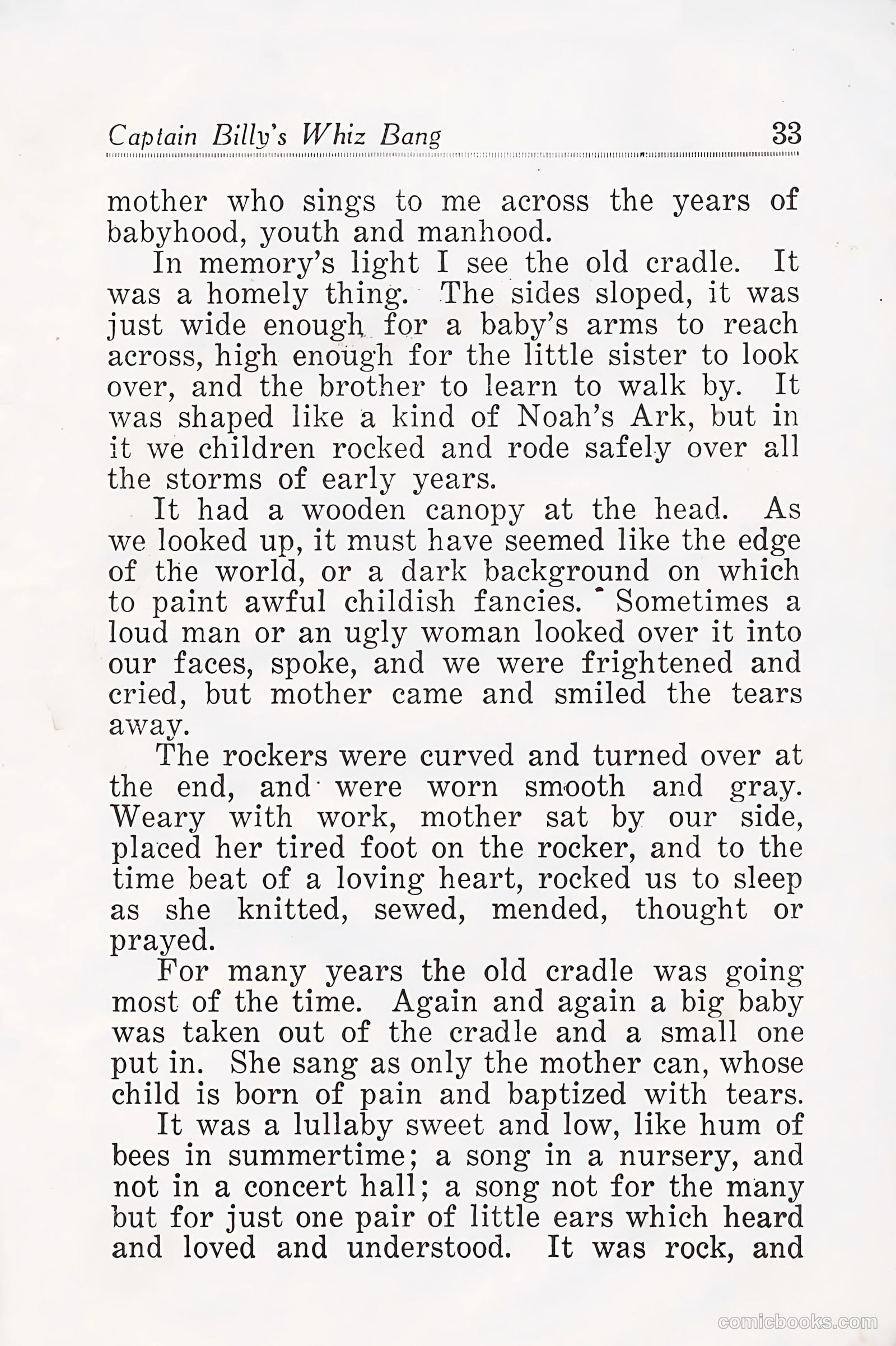
This page contains no cartoon or satire—it's sentimental prose about childhood memories. The text is a nostalgic essay celebrating motherhood, describing an old family cradle as a refuge from life's hardships. The author recalls how the cradle served multiple children over years, with mother rocking babies while knitting and praying. The piece emphasizes maternal devotion and sacrifice—the mother's "tired foot" on the rocker, her singing "as only the mother can, whose child is born of pain." The cradle becomes metaphorical: a "Noah's Ark" protecting children through "storms of early years." *Whiz Bang* was primarily a humor magazine, but this appears to be a sincere, sentimental contribution—the type of earnest nostalgia pieces magazines occasionally published alongside satirical content. No political or social satire is evident on this page.
📄 Transcribed text from this page (OCR, searchable)
Machine-transcribed from the original scan — historical spelling and the odd misread are preserved.
Captain Billy's Whiz Bang 33 mother who sings to me across the years of babyhood, youth and manhood. In memory's light I see the old cradle. It was a homely thing. The sides sloped, it was just wide enough for a baby's arms to reach across, high enough for the little sister to look over, and the brother to learn to walk by. It was shaped like a kind of Noah's Ark, but in it we children rocked and rode safely over all the storms of early years. It had a wooden canopy at the head. As we looked up, it must have seemed like the edge of the world, or a dark background on which to paint awful childish fancies. Sometimes a loud man or an ugly woman looked over it into our faces, spoke, and we were frightened and cried, but mother came and smiled the tears away. The rockers were curved and turned over at the end, and were worn smooth and gray. Weary with work, mother sat by our side, placed her tired foot on the rocker, and to the time beat of a loving heart, rocked us to sleep as she knitted, sewed, mended, thought or prayed. For many years the old cradle was going most of the time. Again and again a big baby was taken out of the cradle and a small one put in. She sang as only the mother can, whose child is born of pain and baptized with tears. It was a lullaby sweet and low, like hum of bees in summertime; a song in a nursery, and not in a concert hall; a song not for the many but for just one pair of little ears which heard and loved and understood. It was rock, and