
Captain Billy's Whiz Bang, October 1921 · page 59 of 68
Captain Billy's Whiz Bang #25 — page 59: what you’re looking at
What you’re looking at
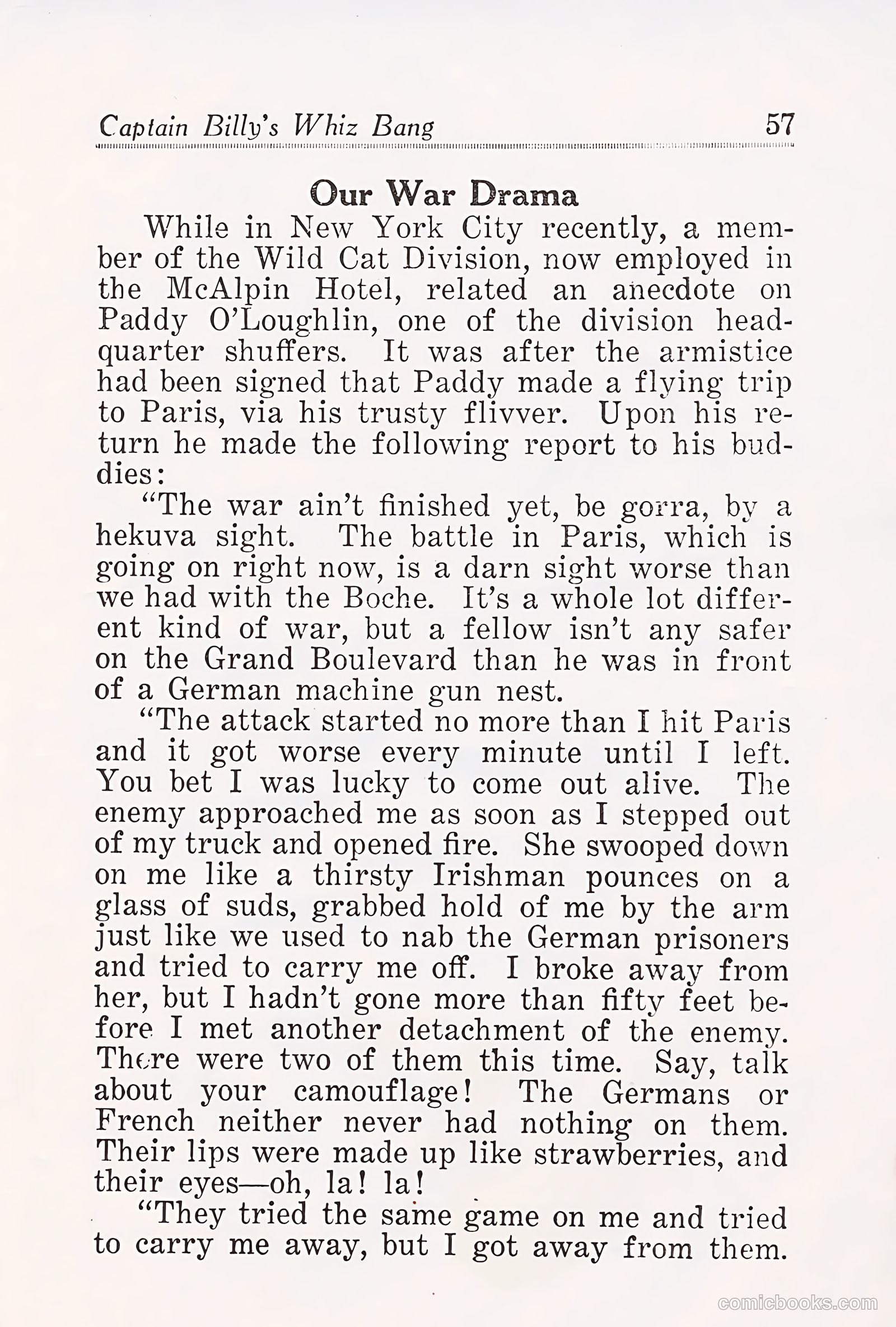
This is a humorous anecdote from a post-WWI satirical magazine. An Irish soldier named Paddy O'Loughlin recounts visiting Paris after the armistice and encounters what he describes as dangerous "enemy attacks"—actually aggressive flirtations from Parisian women. The joke relies on comparing romantic advances to military combat. Women with makeup ("lips like strawberries," heavily made-up eyes) are portrayed as seductively predatory, "swooping down" and trying to "carry him off" like soldiers capturing prisoners. The irony is that Paddy survived actual German machine gun fire but feels genuinely threatened by French women's romantic pursuit. The satire plays on 1920s attitudes about both war and gender: soldiers as objects of female desire, cosmetics as "camouflage," and women's sexuality as something dangerously aggressive. It reflects post-war American popular culture's simultaneous celebration of soldiers' return and anxiety about changing gender dynamics.
📄 Transcribed text from this page (OCR, searchable)
Machine-transcribed from the original scan — historical spelling and the odd misread are preserved.
Captain Billy's Whiz Bang 57 Our War Drama While in New York City recently, a mem- ber of the Wild Cat Division, now employed in the McAlpin Hotel, related an anecdote on Paddy O'Loughlin, one of the division head- quarter shuffers. It was after the armistice had been signed that Paddy made a flying trip to Paris, via his trusty flivver. Upon his re- turn he made the following report to his bud- dies: “The war ain't finished yet, be gorra, by a hekuva sight. The battle in Paris, which is going on right now, is a darn sight worse than we had with the Boche. It's a whole lot differ- ent kind of war, but a fellow isn't any safer on the Grand Boulevard than he was in front of a German machine gun nest. “The attack started no more than I hit Paris and it got worse every minute until I left. You bet I was lucky to come out alive. The enemy approached me as soon as I stepped out of my truck and opened fire. She swooped down on me like a thirsty Irishman pounces on a glass of suds, grabbed hold of me by the arm just like we used to nab the German prisoners and tried to carry me off. I broke away from her, but I hadn't gone more than fifty feet be- fore I met another detachment of the enemy. There were two of them this time. Say, talk about your camouflage! The Germans or French neither never had nothing on them. Their lips were made up like strawberries, and their eyes—oh, la! la! “They tried the same game on me and tried to carry me away, but I got away from them.