
Captain Billy's Whiz Bang, October 1921 · page 60 of 68
Captain Billy's Whiz Bang #25 — page 60: what you’re looking at
What you’re looking at
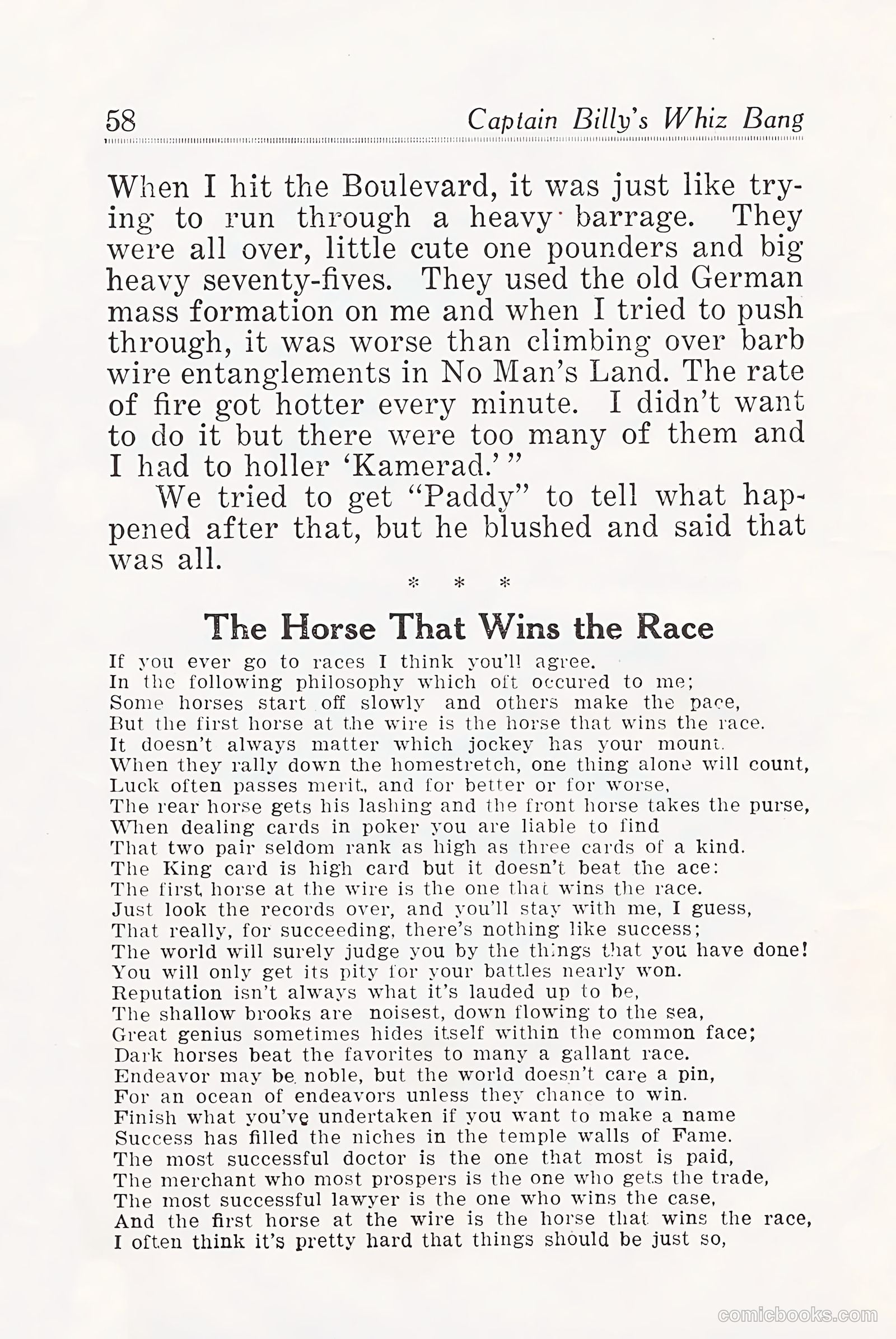
This page from *Captain Billy's Whiz Bang* contains two pieces of content: **First anecdote**: A WWI soldier's account of combat on "the Boulevard" (likely referring to a specific battle location). He describes artillery fire using military terminology—"one pounders" and "seventy-fives" are artillery pieces. References to "German mass formation," "No Man's Land," and barbed wire establish the Western Front context. "Kamerad" is a German surrender call. The joke's punchline relies on suggesting "Paddy" (an Irish soldier) experienced something embarrassing afterward that he won't detail—likely implying cowardice or bodily functions under fire. **Main content**: "The Horse That Wins the Race" is a lengthy poem about success. It uses horse racing as a metaphor for life achievement, arguing that results matter more than effort or merit. The satirical point: society judges only winners, not noble attempts; success is measured by financial gain and visible victory, not inherent worth. This reflects post-WWI cynicism about meritocracy.
📄 Transcribed text from this page (OCR, searchable)
Machine-transcribed from the original scan — historical spelling and the odd misread are preserved.
58 Captain Billy's Whiz Bang When I hit the Boulevard, it was just like try- ing to run through a heavy barrage. They were all over, little cute one pounders and big heavy seventy-fives. They used the old German mass formation on me and when I tried to push through, it was worse than climbing over barb wire entanglements in No Man's Land. The rate of fire got hotter every minute. I didn't want to do it but there were too many of them and I had to holler ‘Kamerad.' ” We tried to get “Paddy” to tell what hap- pened after that, but he blushed and said that was all. * * * The Horse That Wins the Race If you ever go to races I think you'll agree. In the following philosophy which oft occured to me; Some horses start off slowly and others make the pace, But the first horse at the wire is the horse that wins the race. It doesn't always matter which jockey has your mount. When they rally down the homestretch, one thing alone will count, Luck often passes merit, and for better or for worse, The rear horse gets his lashing and the front horse takes the purse, When dealing cards in poker you are liable to find That two pair seldom rank as high as three cards of a kind. The King card is high card but it doesn't beat the ace: The first horse at the wire is the one that wins the race. Just look the records over, and you'll stay with me, I guess, That really, for succeeding, there's nothing like success; The world will surely judge you by the things that you have done! You will only get its pity for your battles nearly won. Reputation isn't always what it's lauded up to be, The shallow brooks are noisest, down flowing to the sea, Great genius sometimes hides itself within the common face; Dark horses beat the favorites to many a gallant race. Endeavor may be noble, but the world doesn't care a pin, For an ocean of endeavors unless they chance to win. Finish what you've undertaken if you want to make a name Success has filled the niches in the temple walls of Fame. The most successful doctor is the one that most is paid, The merchant who most prospers is the one who gets the trade, The most successful lawyer is the one who wins the case, And the first horse at the wire is the horse that wins the race, I often think it's pretty hard that