
A complete issue · 68 pages · 1921
Captain Billy's Whiz Bang #23
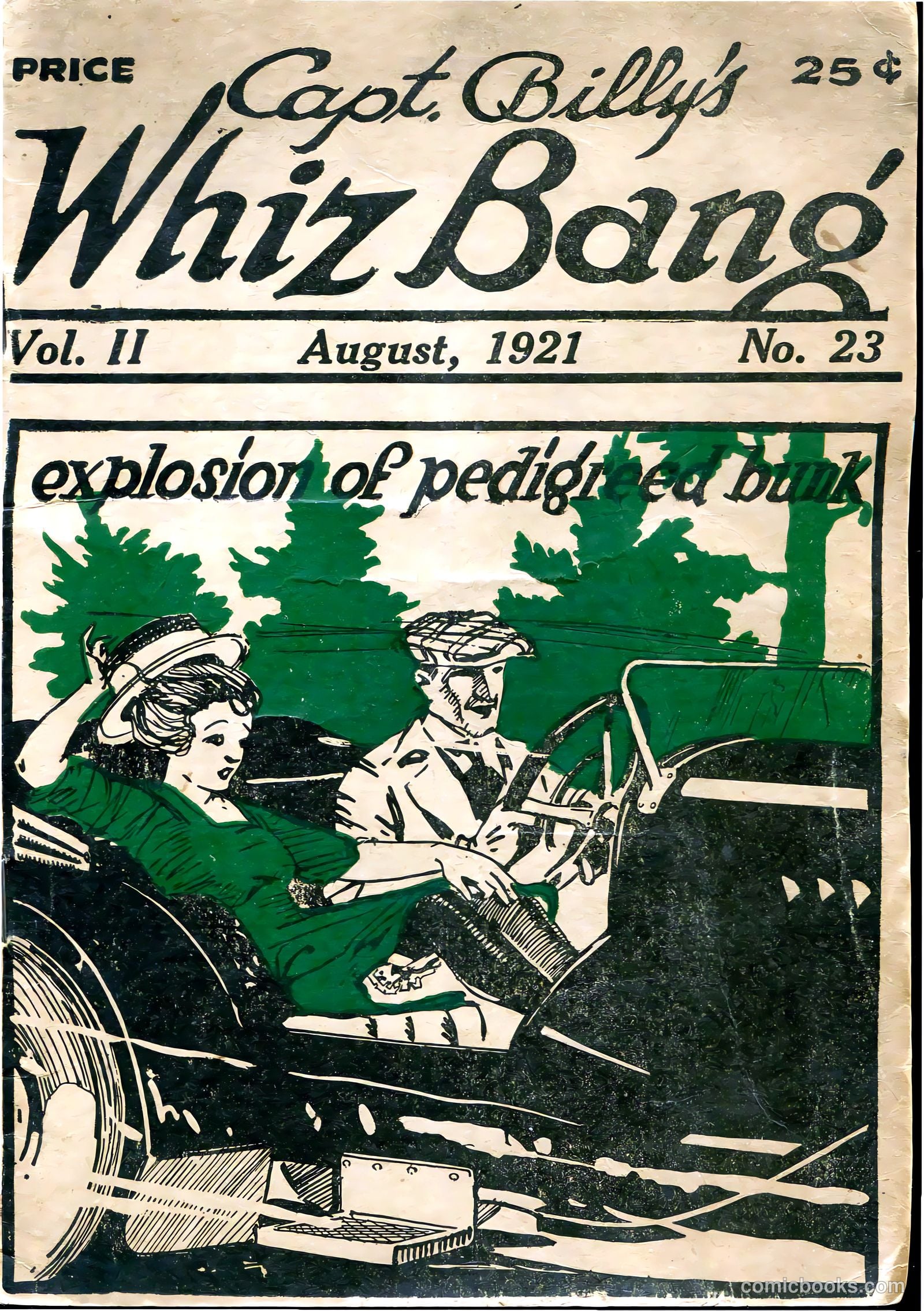
This August 1921 cover of *Capt. Billy's Whiz Bang* depicts a comedic automobile accident. The illustration shows a well-dressed couple in a car that appears to have crashed or encountered trouble, with trees visible in the background. The headline "explosion of pedigreed bunk" suggests the cartoon satirizes pretentious or false claims—likely about the automobile, the couple's social status, or their driving abilities. "Pedigreed bunk" was 1920s slang for nonsense dressed up as respectable or upper-class. The image may mock either wealthy people's incompetence or exaggerated advertising claims about automobiles during the early automotive era. *Whiz Bang* was known for irreverent humor and satire targeting contemporary figures and follies.
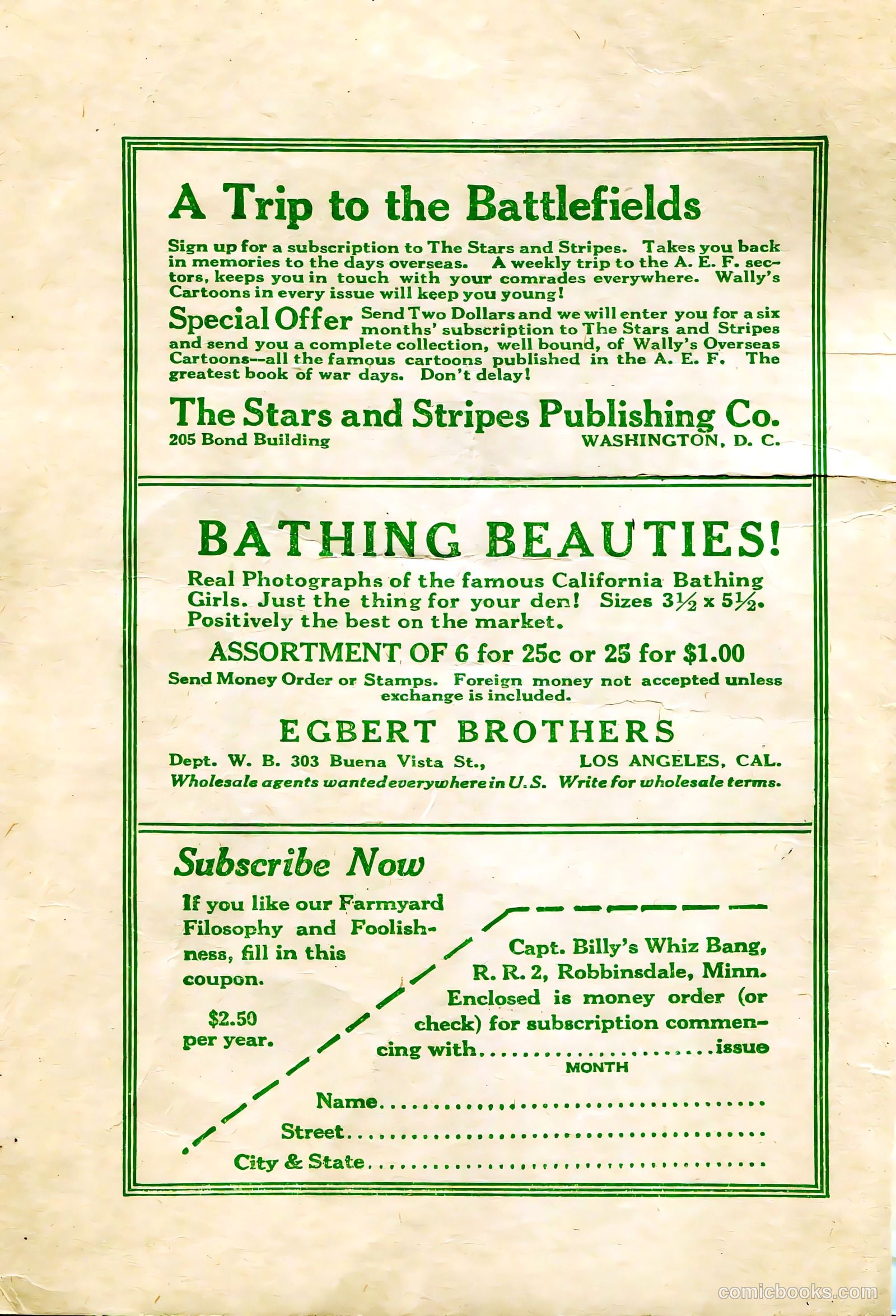
This page is **entirely advertising**, not satirical content. It contains four separate ads targeting post-WWI American readers: 1. **The Stars and Stripes Publishing Co.** — advertising subscriptions to a military publication, appealing to nostalgia among veterans ("takes you back in memories to the days overseas") 2. **Egbert Brothers** — selling photographs of "California Bathing Girls," marketed as den decoration 3. **"Subscribe Now"** — promoting a farmyard-themed publication at $2.50/year, with a subscription coupon The ads reflect early 1920s consumer culture aimed at returning soldiers. The "Bathing Beauties" ad is notable for its casual objectification standard to that era. There is no visible cartoon or satirical commentary on this page—it's purely commercial content.
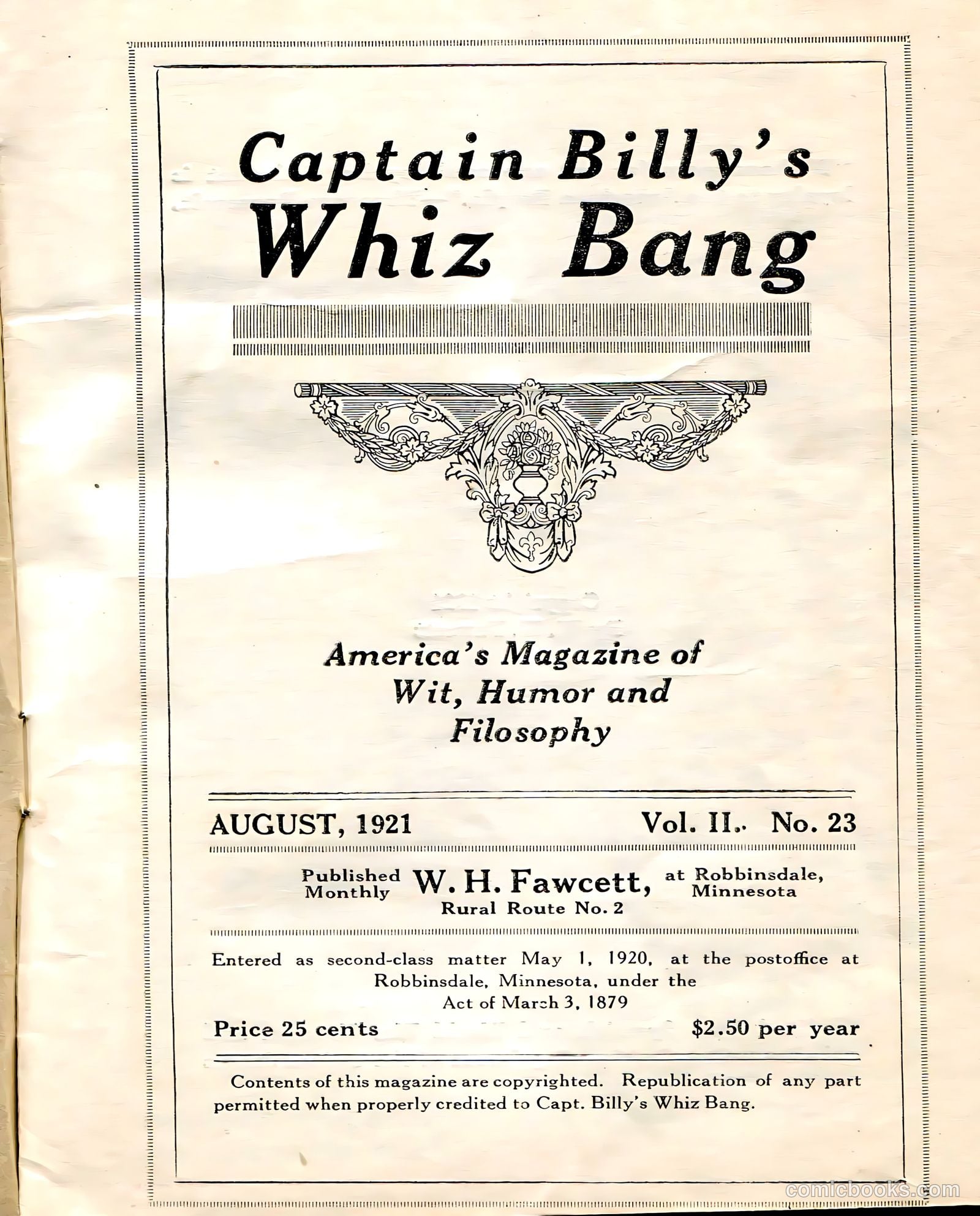
This is a **title page**, not a cartoon or satirical content page. It identifies the publication: "Captain Billy's Whiz Bang," described as "America's Magazine of Wit, Humor and Philosophy," published monthly by W.H. Fawcett in Robbinsdale, Minnesota. The ornate decorative header suggests a respectable publication, though the irreverent title suggests humor content. The August 1921 issue (Vol. II, No. 23) cost 25 cents or $2.50 yearly. The page provides publishing details, copyright notice, and postal information. To understand the actual satirical content or jokes, we would need to see the interior pages. The decorative flourish is typical of 1920s magazine design.
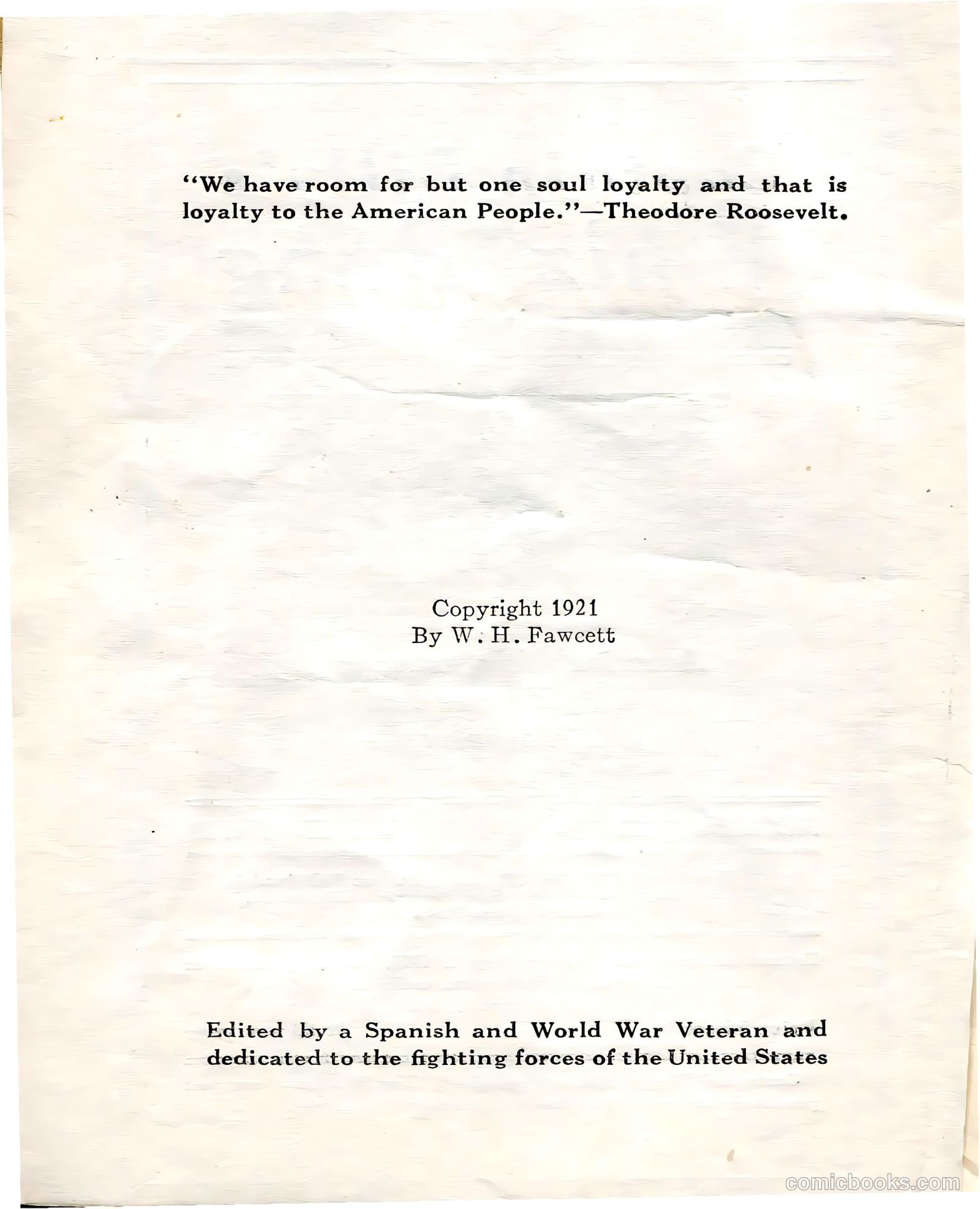
This is a title/dedication page from *Whiz-Bang* magazine (1921), not a cartoon page. It features a Theodore Roosevelt quote emphasizing singular American patriotism—likely responding to post-WWI anxieties about hyphenated identities and divided loyalties among immigrants and ethnic communities. The quote reflects Roosevelt's well-known nativist stance on assimilation. The page notes the editor is a Spanish-American War and World War I veteran, positioning the magazine as patriotic. This framing suggests *Whiz-Bang* positioned itself as advocating for undivided American loyalty during a period of significant immigration restriction debates and Red Scare concerns about foreign influences in America.
This is a humorous personal essay rather than a cartoon. The author recounts a cautionary tale about alcohol temptation during Prohibition era (references to "the wagon" suggest abstinence efforts). The narrative describes receiving a suspicious bottle of bourbon—likely bootleg liquor, given the "peculiar shade" of the bonded stamp, a detail suggesting counterfeit authenticity markers. The author jokes that the whiskey tasted poor ("reverse action to an old maid's age") and suspects it was adulterated with harsh additives: cayenne pepper, ether, and tobacco sauce. The piece satirizes both the poor quality of illegal alcohol during Prohibition and the narrator's own weakness in breaking sobriety. The self-deprecating tone ("the devil got the upper hand") and the previous anecdote about a friend's drunken behavior with cotton illustrate the social consequences of drinking.
This is a humorous narrative piece (not a political cartoon) from *Captain Billy's Whiz Bang*, a 1920s satirical magazine. The unnamed narrator describes a drunken aviation adventure with his friend "Gus" and pilot Homer Cole, a WWI veteran. The satire targets post-war excess and frivolous spending: the narrator, already intoxicated ("bender"), impulsively spends his last $50 on a plane ride, then—while continuing to drink—convinces the pilot to make additional flights and eventually buy a plane on installment. The humor lies in the absurdity: two drunk men deciding they need an airship for commuting between their Minnesota cabin and farm, leading to an impulsive purchase they can barely afford. The piece mocks 1920s consumerism, the novelty of aviation, and bohemian excess among the rural wealthy—typical *Whiz Bang* fare targeting contemporary American behavior.
This is a narrative piece from *Captain Billy's Whiz Bang*, a humor magazine. The text describes the editor's trip to New York City, bringing along Gus, a farm worker from the magazine's rural operations. The satire centers on **Prohibition-era America** (the 1920s): the mention of "gin mills" (illegal bars), "motley moonshine," and being told "we could get no liquor in New York" reflects the absurdity of Prohibition enforcement. The humor lies in Gus's culture clash—a rural farmhand refusing to change from overalls and red necktie in a fancy Manhattan hotel, contrasting rural simplicity with urban sophistication. The Schlitz Hotel reference appears nostalgic for pre-Prohibition beer culture. This is comedic Americana about modernization's discomfort and Prohibition's hypocrisy.
This appears to be a humorous narrative (not a cartoon) from an early 20th-century satirical magazine. The story follows a narrator and his hired farmhand "Gus" from Minnesota on a trip to Atlantic City. The humor relies on Gus's rural naïveté contrasted with urban sophistication. Key jokes include: Gus ignoring a "Gentlemen" restroom sign and entering anyway; his dismissive response to a telegram warning about hotel availability ("If the Schlitz Hotel is full it has nothing on me"—a crude pun about his digestive system); and his reluctance to bathe, claiming "it wasn't the right time of the month." The satire targets unsophisticated rural Americans encountering modern city life, playing on period stereotypes of farmers as crude, hygiene-averse, and socially oblivious. The final warning about pickpockets suggests Gus remains a target for exploitation.
This page is a humorous narrative story rather than a political cartoon. It's a comedic anecdote about a character named Gus who gets pickpocketed ("touched") at what appears to be a convention, losing money he'd hidden in his sock. The joke is his relief upon later discovering the money still there—he'd simply forgotten where he stashed it. The story escalates when Gus receives a telegram about "Pedro," apparently a prized bull at a packing plant who's fallen ill from homesickness. The satire targets sentimental attachment to livestock and the absurdity of a bull's emotional state being taken seriously by agricultural specialists. The repeated telegrams suggest escalating complications, typical of early-20th-century humor relying on miscommunication and dramatic reversals. Without seeing the second telegram's content, the full joke remains incomplete, but the tone is lighthearted, working-class comedy common to *Whiz Bang*, a post-WWI magazine known for irreverent, bawdy humor.
This page from *Captain Billy's Whiz Bang* (a 1920s humor magazine) contains two humorous anecdotes with no visible cartoons. The first story humorously describes a trip's misfortunes: a man named Pedro dies, yet simultaneously a Hereford cow births a calf, which the narrator facetiously names "Pedro Junior" to continue the "Pedro Bullage" (a pun on "bulldog" or cattle lineage). The narrator then cheers up his depressed friend Gus by buying him a ring-tailed monkey at a Chicago pet store—presented as a consolation prize that apparently becomes Gus's obsession. The second item mocks Deacon Miller's son Pete, who purchased a "golden trombone" from a mail-order catalog and now entertains neighborhood children nightly. The closing line—about Pete's ability to "slide that golden trombone in and out to beat the band"—appears to be a crude sexual innuendo typical of the magazine's lowbrow humor style. Both pieces exemplify the magazine's folksy, rural-Minnesota-focused comedy and double-entendre humor.
This page contains two humorous anecdotes rather than cartoons. The first is a mock-serious "In Memoriam" obituary for Pedro, a pedigreed bull who died of homesickness while his owner Gus visited Broadway. The joke plays on treating a farm animal's death with exaggerated solemnity, typical of *Whiz Bang's* irreverent humor. The second joke is a wry commentary on hypocrisy. After a minister preaches about Lot's wife looking back and turning to salt, the narrator's hired man Gus observes the minister himself sneaking away with Deacon Smith's wife—implying the minister is engaging in improper behavior. The punchline suggests both "turned into a dark side street" (hid themselves), inverting the biblical lesson about the consequences of looking back. Both pieces mock rural/small-town America's pretensions and moral contradictions through deadpan wit.
This page from the satirical magazine contains three unrelated humor pieces typical of the publication's style: 1. **The Gus/Ole story**: A running gag about the magazine's fictional hired man, Gus, whose Swedish brother Ole visits. The humor relies on ethnic stereotypes—Ole is portrayed as unsophisticated ("not any too dainty," has "weak pedals") and overwhelmed by small-town life, finding even Robbinsdale "too fast." The joke plays on immigrant culture and rural/urban culture clash. 2. **The Whiffenpoof correction**: A reader correction about a fictional creature. The original false definition (fish swimming backward) is replaced with an equally absurd one (a dog with mismatched leg lengths for hillside walking). The humor is pure nonsense wordplay. 3. **"A Succulent Table d'Hote"**: A brief poetic joke using French terminology ("table d'hôte"—fixed menu meal) to describe a cow nursing its calf, creating an ironic juxtaposition of refined dining language with pastoral animal imagery. These pieces exemplify Whiz Bang's irreverent, pun-heavy humor style.
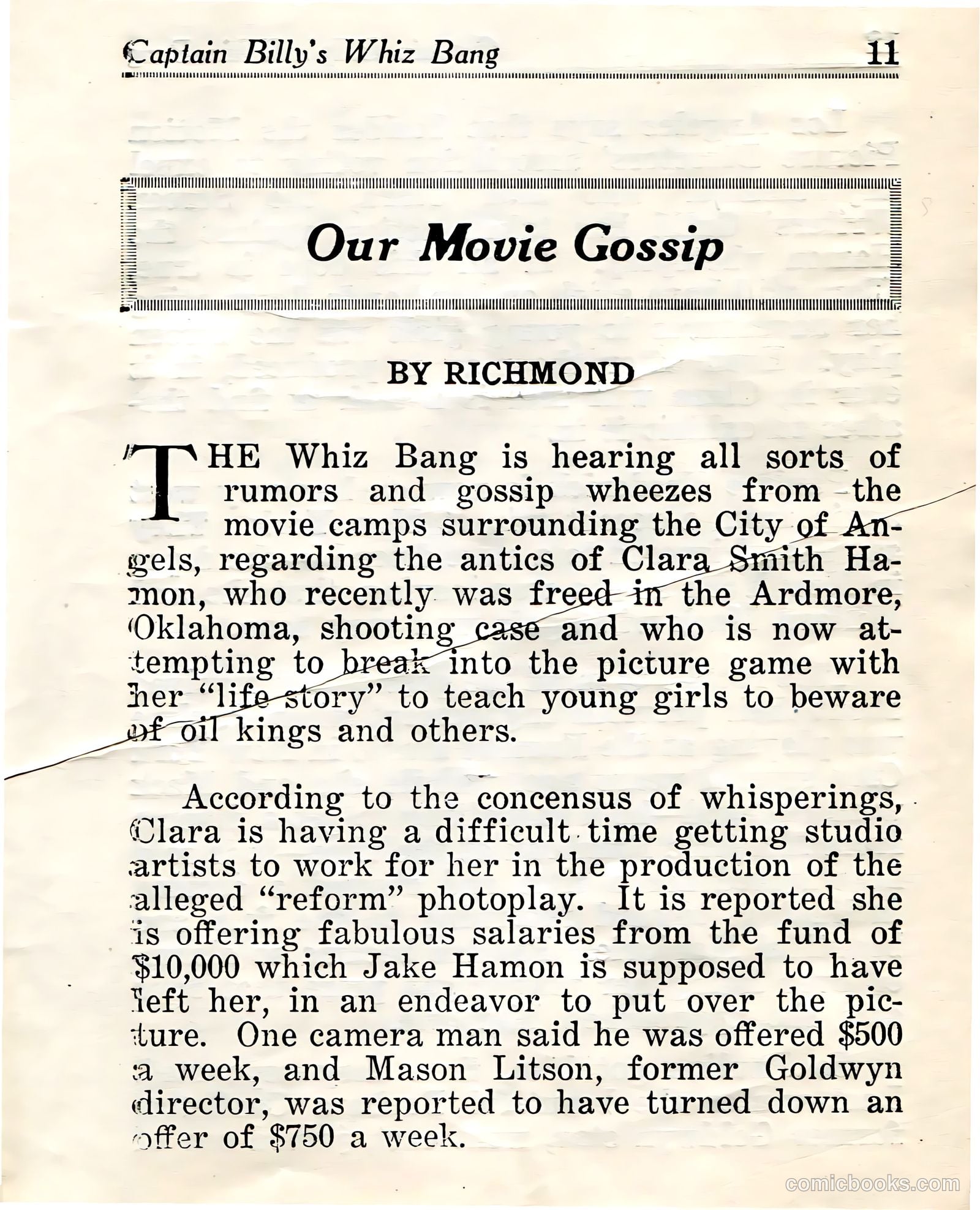
This is a gossip column satirizing Clara Smith Hamon's attempt to enter Hollywood filmmaking. Hamon was a real figure involved in a 1920s Oklahoma oil scandal—she was acquitted in a shooting case in Ardmore, Oklahoma. The column mocks her efforts to produce a "reform" photoplay (silent film) based on her life story, ostensibly to warn young women about wealthy oil magnates. The satire targets her difficulty recruiting talent despite offering high salaries ($500-$750 weekly) allegedly funded by $10,000 left by Jake Hamon (an oil tycoon she was connected to). The mockery lies in the irony: her morality-tale project struggles to find collaborators, and the publication presents this as amusing Hollywood gossip. The piece reflects contemporary skepticism about both Hamon's credibility and her filmmaking ambitions.
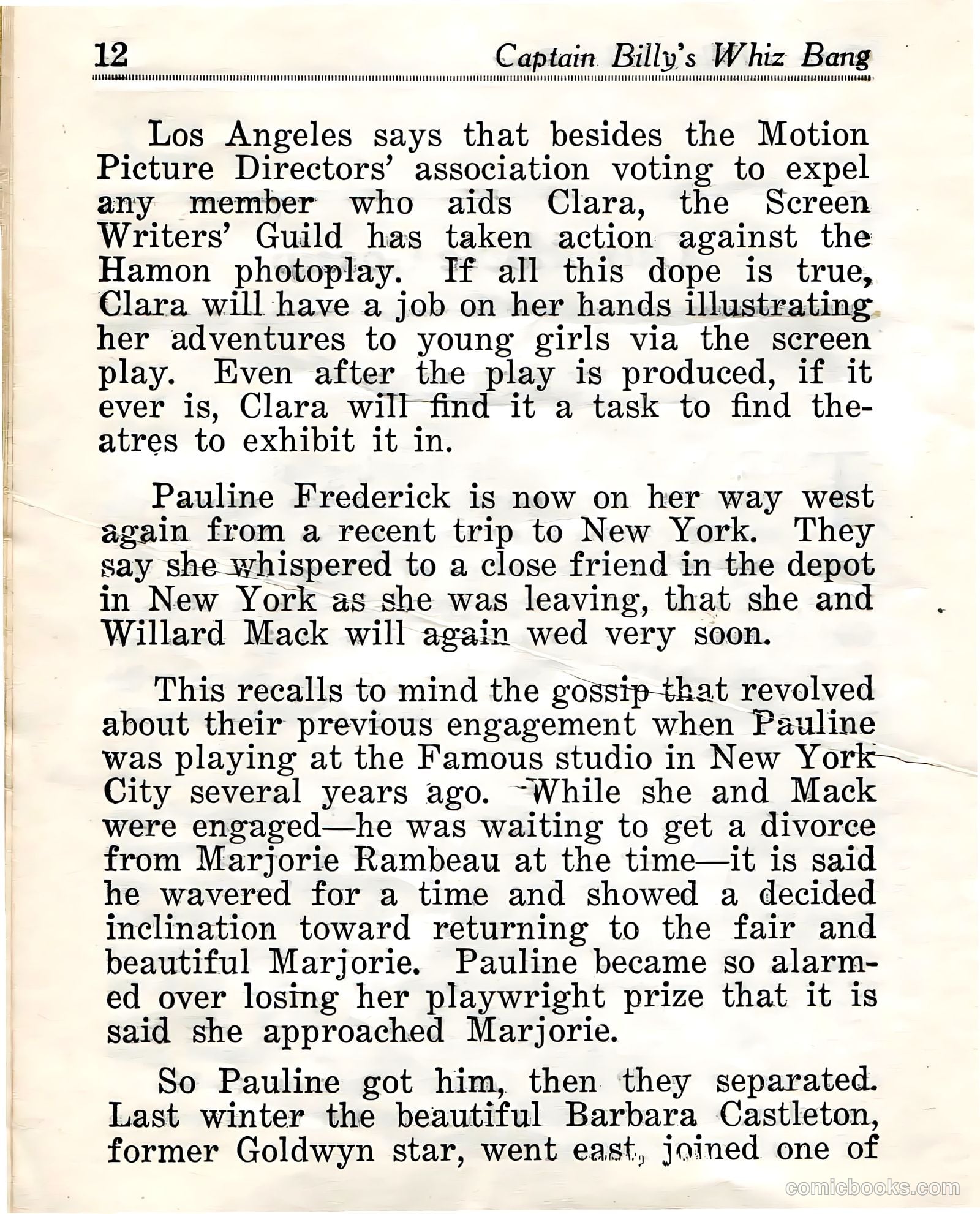
This page contains Hollywood gossip columns, a staple of 1920s entertainment journalism. The text discusses: 1. **Clara** (last name unclear from text) facing industry blacklisting—the Motion Picture Directors' association and Screen Writers' Guild allegedly opposing her photoplay project, making it nearly impossible to produce or exhibit. 2. **Pauline Frederick** (silent film actress) reportedly planning to remarry **Willard Mack** after a recent New York visit. The column revives old scandal: during their previous engagement, Mack wavered toward returning to his then-wife **Marjorie Rambeau**. Frederick allegedly confronted Rambeau, ultimately "winning" Mack before they separated. The satire mocks Hollywood's romantic melodrama and industry politics—treating actors' personal lives and professional feuds as entertainment. The tone is gossipy and moralistic, reflecting 1920s attitudes about women competing for men and the film industry's power to punish controversial figures.
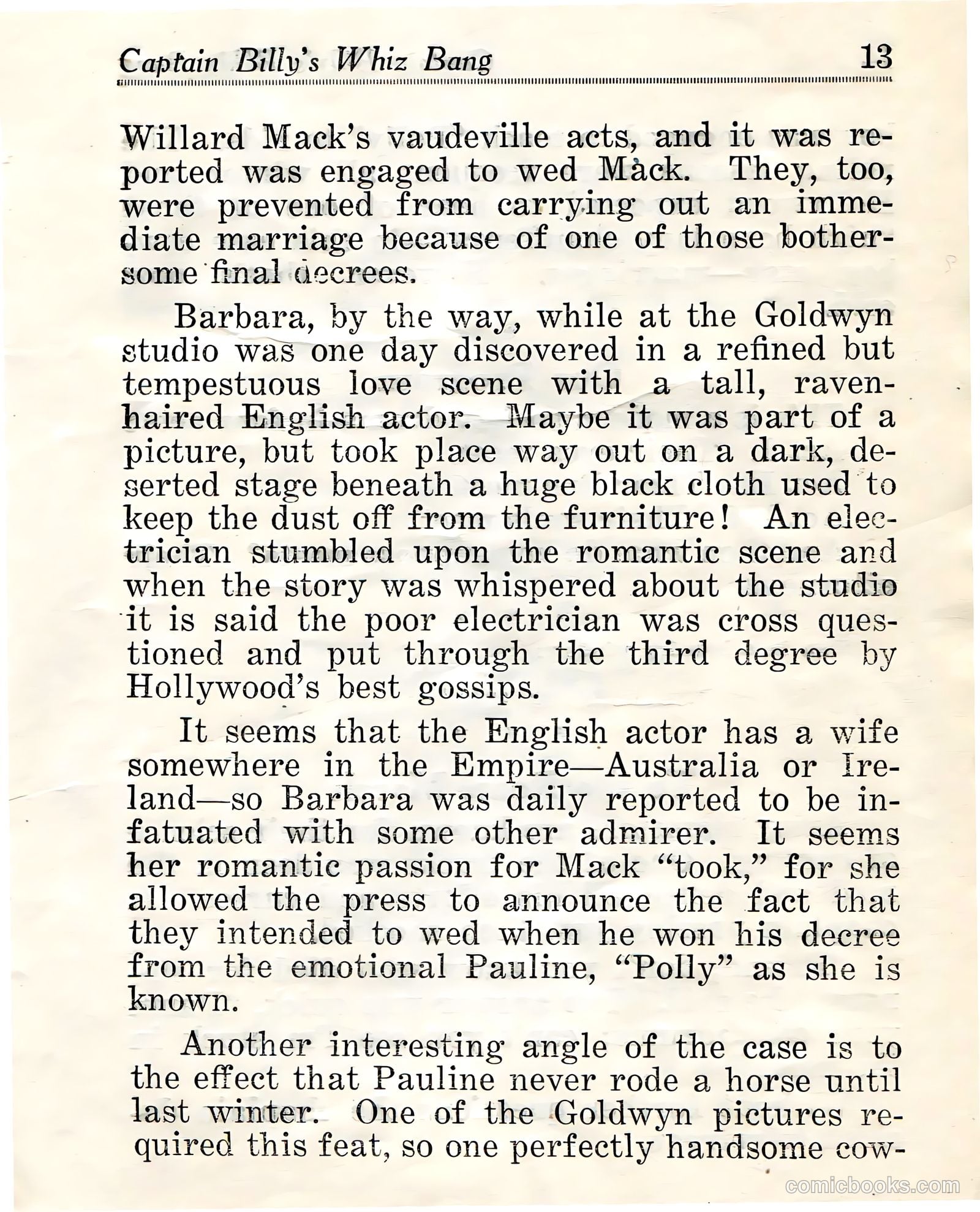
This page from *Captain Billy's Whiz Bang* is Hollywood gossip-column satire targeting entertainment industry scandals of the 1920s. The text discusses: **Main figures**: Willard Mack (vaudeville performer), Barbara (actress at Goldwyn studio), an unnamed English actor, and Pauline/"Polly" (Mack's wife seeking divorce). **The satire**: The piece mocks the melodramatic entanglements of silent-film era celebrities—multiple engagements blocked by divorce decrees, affairs discovered on studio sets, and studio gossip machinery. An electrician's discovery of Barbara and the English actor in a "tempestuous love scene" becomes fodder for relentless interrogation by "Hollywood's best gossips." **The joke**: The breathless, scandal-hungry tone lampooning how trivial incidents (like learning to ride horses for a film) and romantic entanglements dominate entertainment reporting. The implication that Barbara's engagement to Mack persists despite his existing marriage to Polly highlights period divorce law complications and casual infidelity. No visible cartoon accompanies this text—it appears to be purely satirical prose.
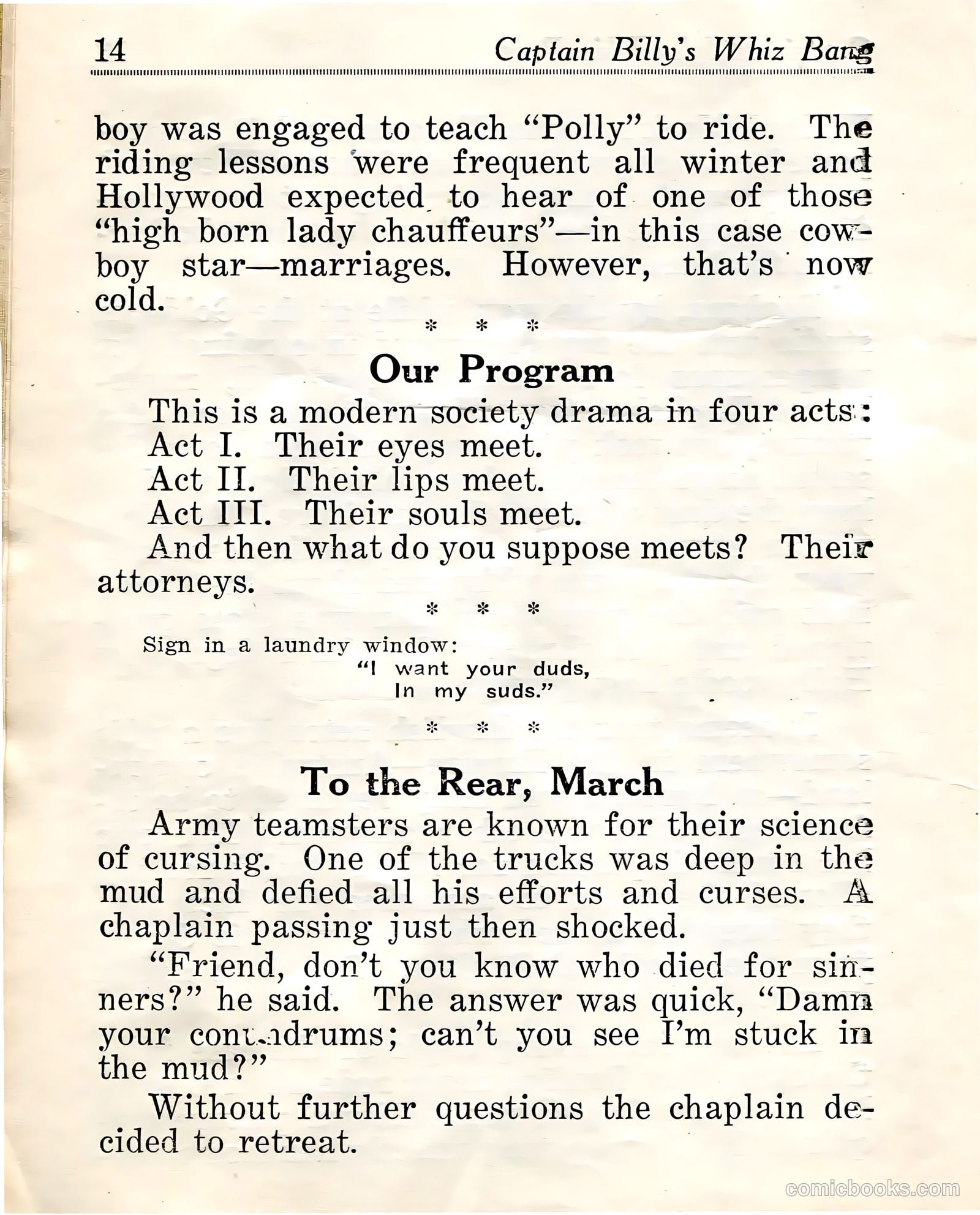
This page from the satirical magazine contains three unrelated jokes typical of 1920s humor: 1. **Hollywood gossip**: References a cowboy film star and an unnamed woman ("Polly") taking riding lessons, with speculation about a romance or marriage. The joke is that such pairings were expected Hollywood scandals—but nothing came of it. 2. **Modern romance satire**: A four-act play synopsis mocking contemporary courtship, where the punchline is that after romantic progression (eyes, lips, souls meeting), the inevitable conclusion is litigation—satirizing the era's rising divorce rates and legal complications. 3. **Army chaplain anecdote**: A crude joke about a truck stuck in mud. When a chaplain invokes Christ's sacrifice to shame a soldier out of cursing, the soldier responds that religious exhortation won't help practical problems—he needs help with "contraceptives" (implied censoring of a stronger word), not spiritual guidance. The overall tone is cynical about romance, marriage, and religion—typical of post-WWI American satirical magazines.
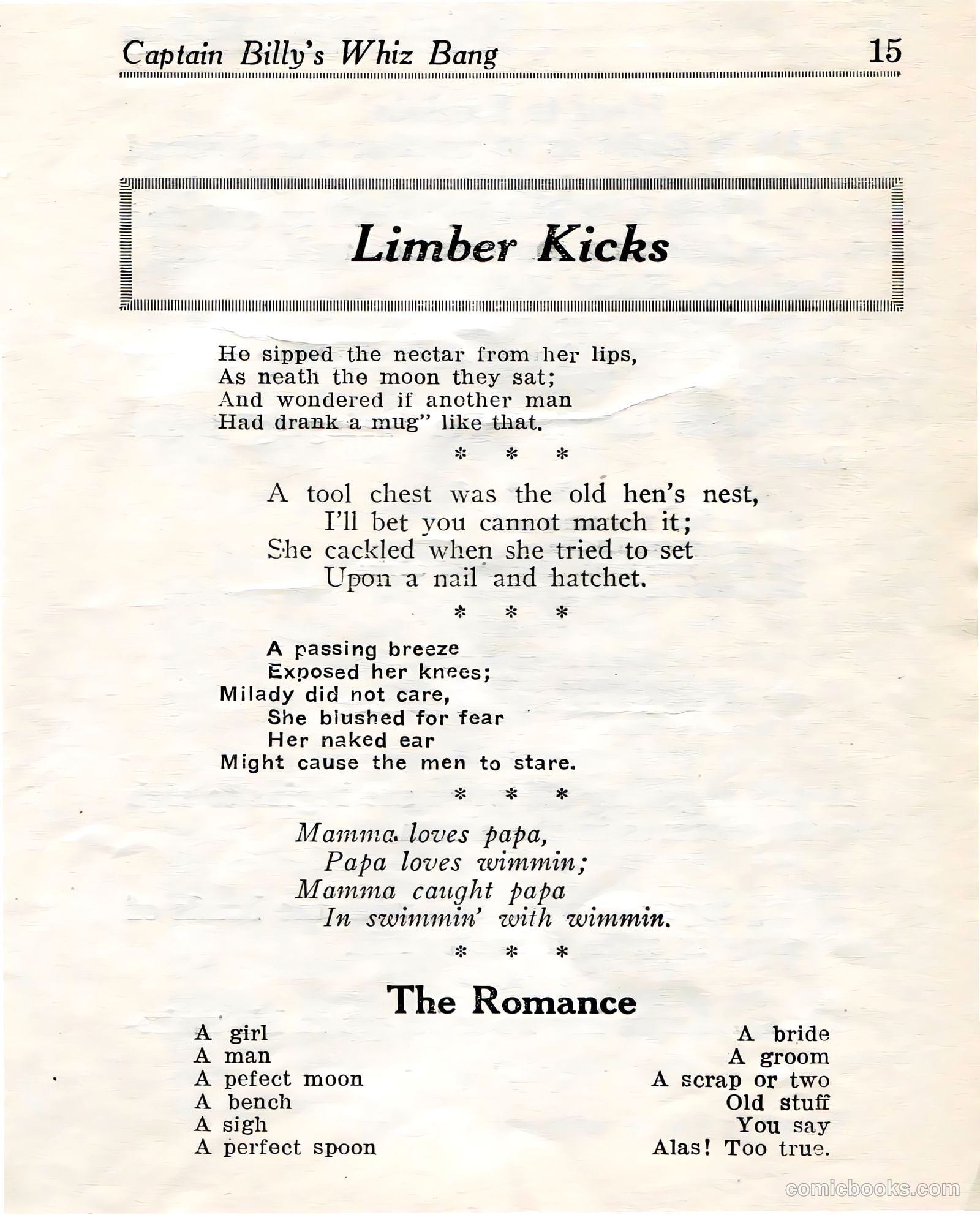
This page from *Captain Billy's Whiz Bang* contains humorous verse poking fun at romantic and domestic life. "Limber Kicks" offers ribald jokes: a man drinking from a woman's lips; a hen nesting in a toolbox; and a woman concerned her exposed ear (rather than knee) might scandalize men—satirizing Victorian prudishness. The final verse jokes about infidelity: Papa's caught swimming with another woman. "The Romance" is a cynical take on courtship, listing its stereotypical elements (moonlight, bench, sighs, spoon) before reducing marriage to "a scrap or two / Old stuff," with the punchline "Alas! Too true." The satire targets sentimental romance narratives and marital disillusionment, reflecting post-WWI irreverence toward 19th-century romantic conventions that *Whiz Bang* was known for.
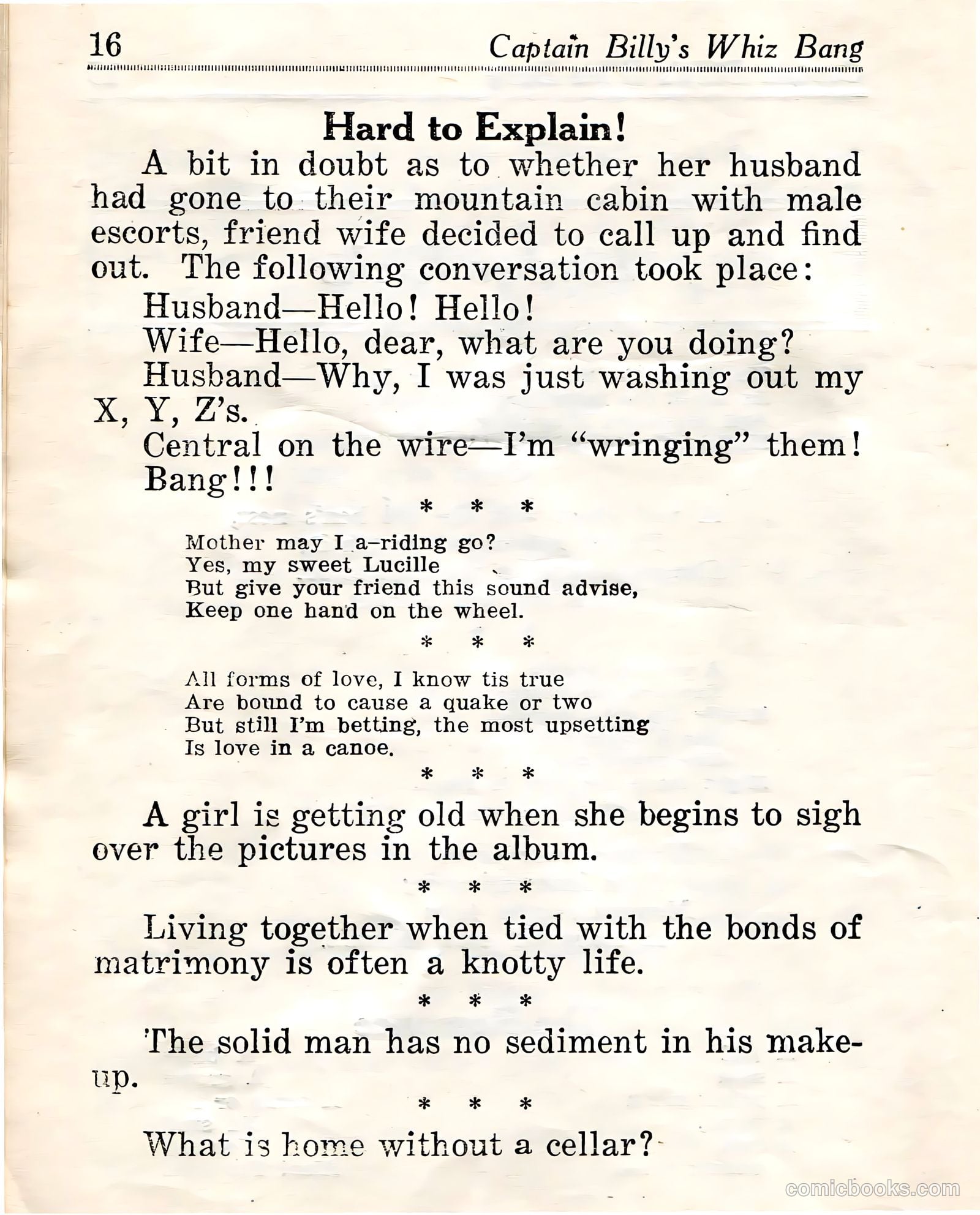
This page from the satirical magazine contains multiple short jokes and quips typical of 1920s humor. The main piece, "Hard to Explain!," plays on marital suspicion and double entendre. When a wife calls her husband at a mountain cabin to check on him, he claims to be "washing out my X, Y, Z's." The telephone operator interrupts, saying she's "wringing" them—a pun suggesting suggestive activity rather than laundry work, implying infidelity. The remaining items are brief gags about relationships: warnings about distracted driving while courting, the instability of love in canoes, aging women becoming nostalgic, marriage as complicated ("knotty"), and character observations. The humor relies on wordplay, innuendo, and domestic situations—standard fare for this era's populist comedy magazines aimed at working-class readers seeking irreverent, risqué entertainment.
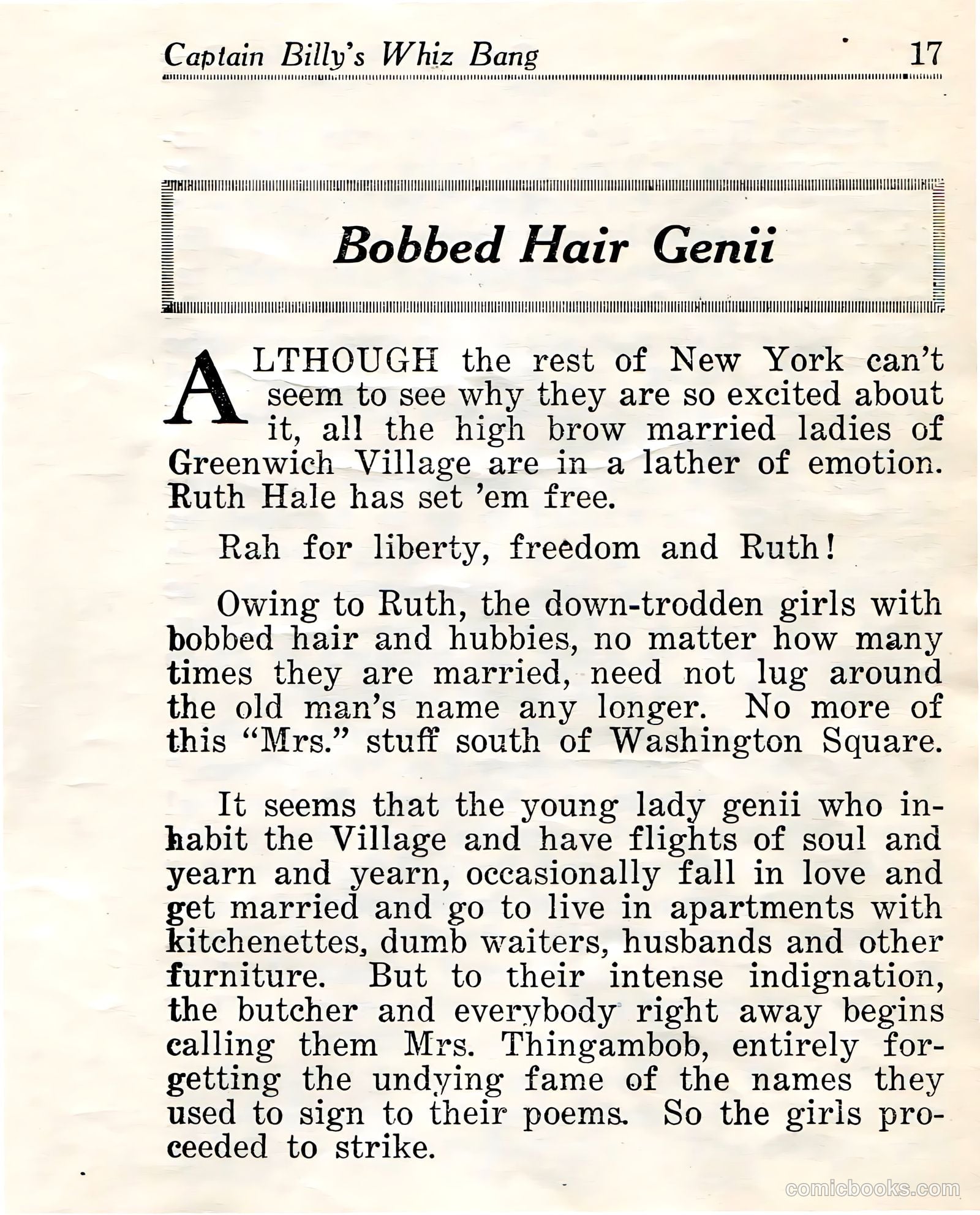
This satirical piece mocks the feminist activism of Ruth Hale, a real journalist and women's rights advocate who campaigned against married women being legally required to adopt their husbands' surnames. The satire targets Greenwich Village bohemians—young, artistic women with bobbed hair (a symbol of modern, rebellious femininity) who resent losing their maiden names and personal identities upon marriage. The piece ridicules them as self-absorbed "genii" obsessed with poetic fame, suggesting their protest is pretentious and absurd rather than principled. The joke: these aspiring poets care less about legal rights than about their vanity—they want recognition under their "undying" names rather than being addressed as "Mrs. Thingambob." The magazine dismisses their grievance as the petty concern of silly bohemians rather than recognizing it as legitimate advocacy for women's legal autonomy.
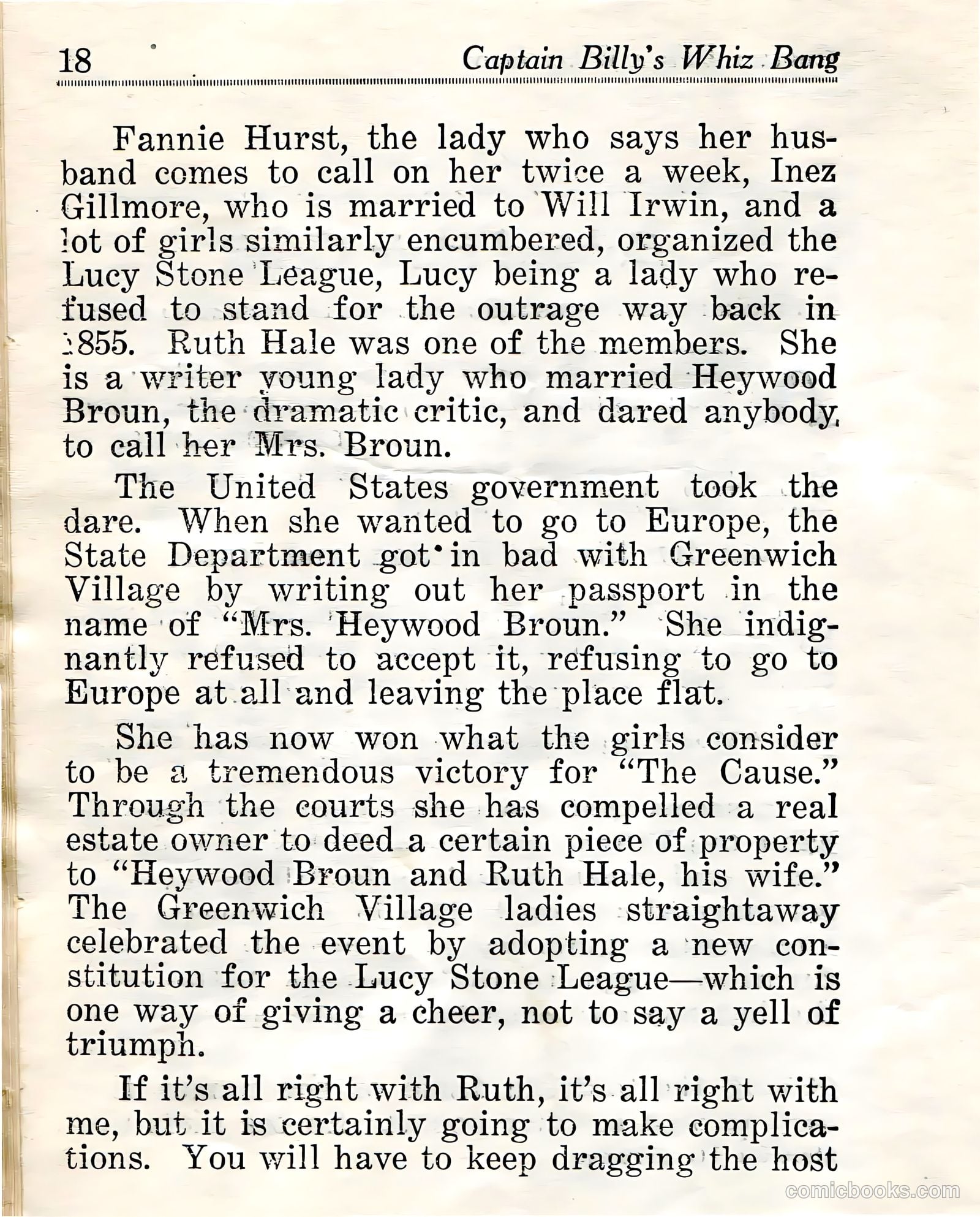
This text satirizes 1920s women's rights activism, specifically the Lucy Stone League—a real organization advocating for women's right to retain their maiden names after marriage. **Key figures:** Ruth Hale (writer, wife of drama critic Heywood Broun) refused to accept a passport issued under her married name, escalating her refusal into a legal battle. The League, founded by writers like Fannie Hurst and Inez Gillmore, celebrated her court victory forcing a property deed to read "Heywood Broun and Ruth Hale, his wife"—preserving her name equality. **The satire's point:** *Captain Billy's Whiz Bang* mocks these Greenwich Village feminists as self-righteous troublemakers. The closing line—"you will have to keep dragging the host"—suggests their activism creates social awkwardness and complications, positioning women's equality claims as annoying rather than legitimate. The magazine ridicules feminist principles while naming real activists, reflecting mainstream 1920s resistance to women's independence movements.
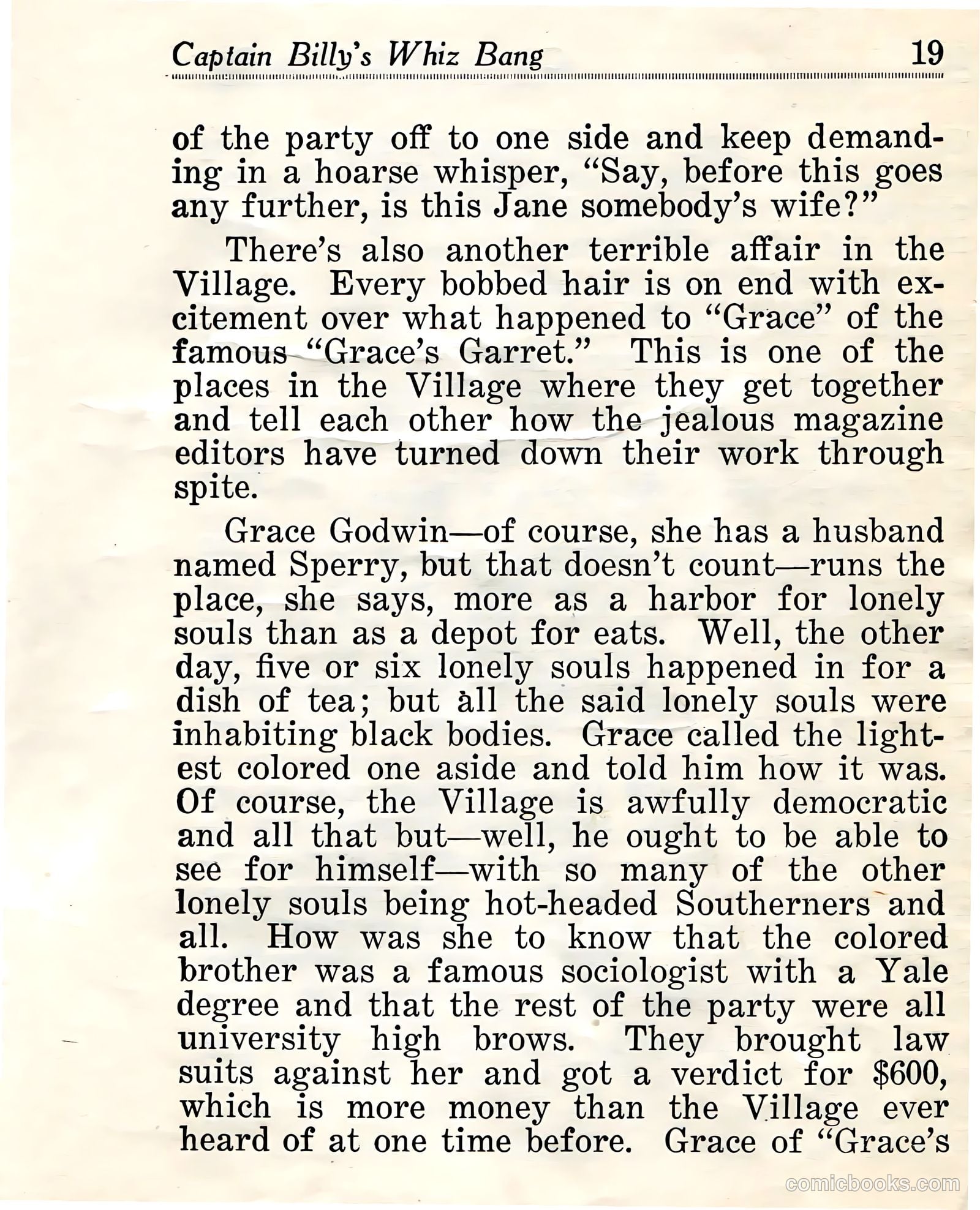
This text satirizes Greenwich Village bohemian culture and exposes racial prejudice among self-styled progressives. The passage describes Grace Godwin, who runs "Grace's Garret"—a Village gathering place where aspiring writers complain about magazine rejections. When Black visitors (described as "lonely souls inhabiting black bodies") arrive for tea, Grace privately warns the lightest-skinned man that Southern patrons might object. She didn't realize he was a prominent Yale-educated sociologist; the group sued and won $600—described as shocking wealth to the Village. The satire targets Village hypocrisy: self-proclaimed democrats and artistic rebels who embrace progressive ideals but practice racial discrimination. The joke exposes how quickly bohemian "democracy" crumbles when confronted with actual integration, and mocks Grace's assumption that education and credentials wouldn't matter—only skin color. The lawsuit represents accountability for discriminatory behavior disguised as polite concern.
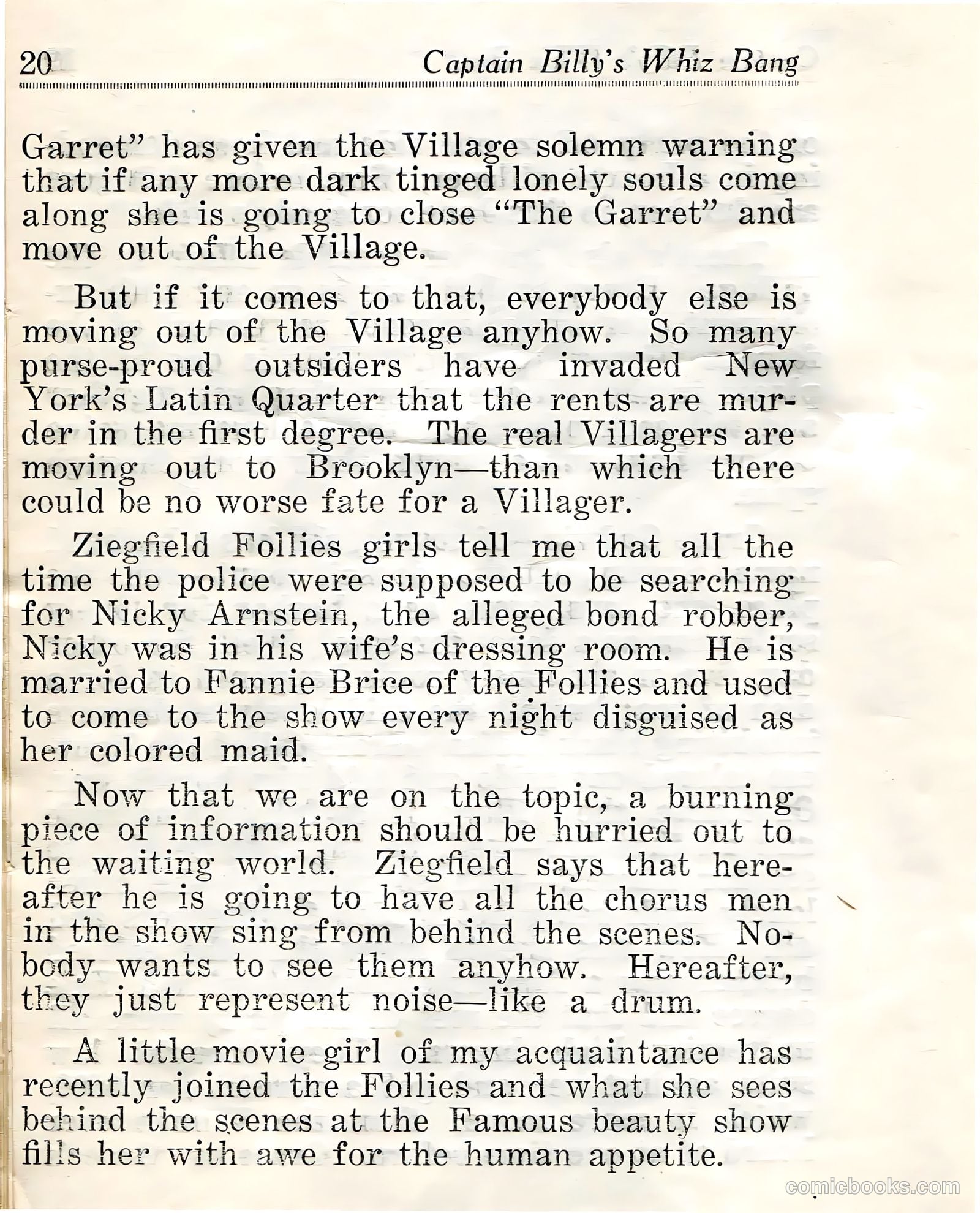
This page is gossip-column satire about 1920s New York theater and bohemia. The main targets are: **Greenwich Village gentrification**: Wealthy outsiders ("purse-proud") have invaded the artistic "Latin Quarter," driving up rents so badly that actual Villagers flee to Brooklyn—presented as social death for bohemians. **Nicky Arnstein scandal**: A real fugitive bond robber married to Ziegfeld Follies star Fannie Brice allegedly hid in her dressing room while police searched, disguised as her maid. This mocks both the criminal and the audacity of the deception. **Ziegfeld's chorus changes**: The impresario plans to hide male chorus members offstage because audiences don't want to see them—reducing them to mere "noise like a drum." This satirizes theatrical vanity and the objectification of performers. The final anecdote about a "movie girl" joining the Follies and being shocked by backstage behavior suggests moral corruption or hedonism behind glamorous appearances.
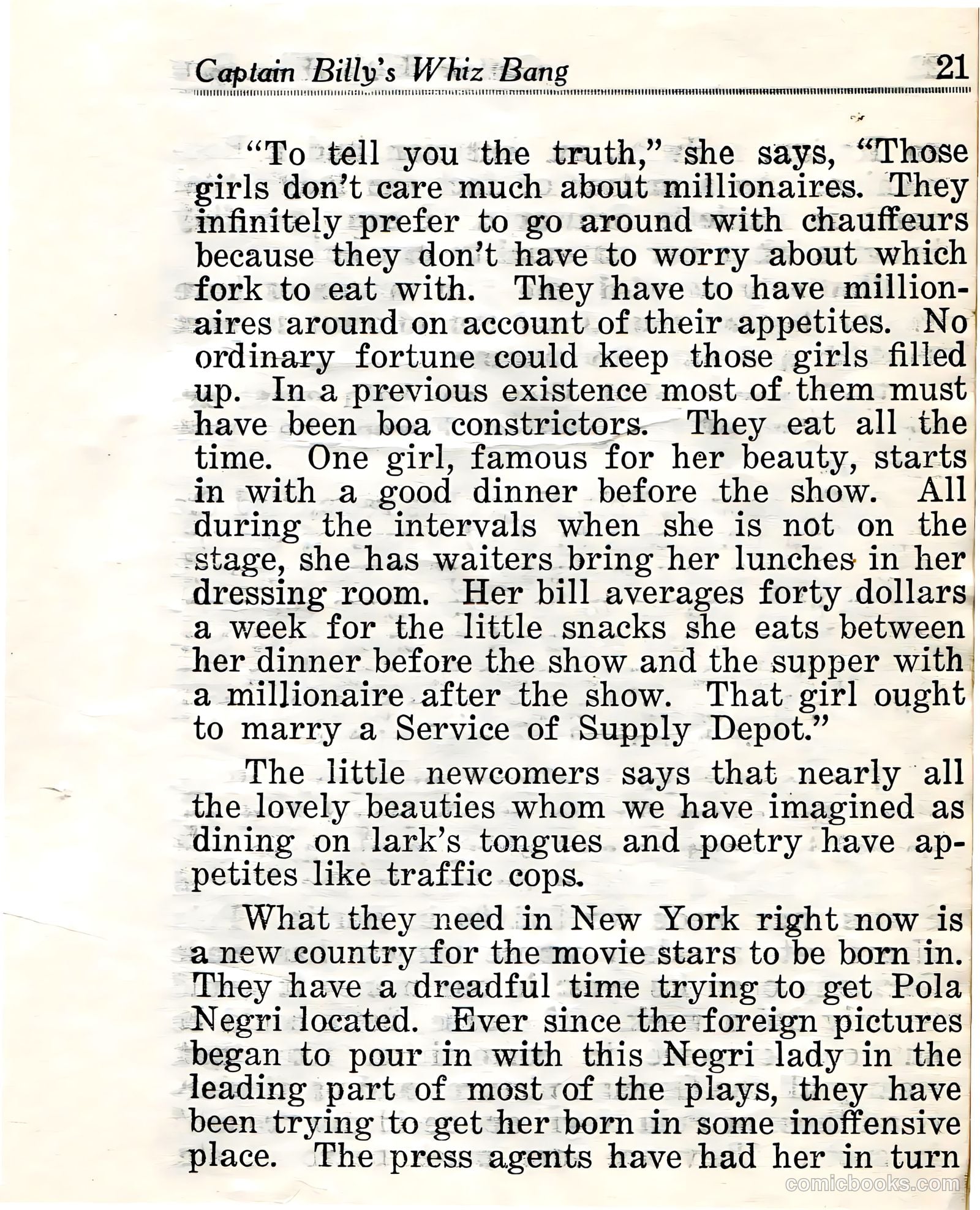
This page satirizes 1920s Hollywood mythology. A speaker mocks the romanticized image of beautiful actresses, claiming they're actually voracious eaters who prefer chauffeurs (working-class drivers) to millionaires because dating rich men requires "knowing which fork to eat with"—mocking upper-class etiquette. The text ridicules one unnamed "beauty" whose weekly food bills average $40 (substantial then), eating continuously between stage performances. The satire culminates in commentary about **Pola Negri**, a famous Polish-born silent film star. Hollywood publicity agents allegedly struggled to find an acceptably "inoffensive" birthplace for her, fabricating her origins repeatedly. The joke targets both actresses' actual appetites and Hollywood's manufactured glamour—the gap between carefully constructed public images and mundane reality.
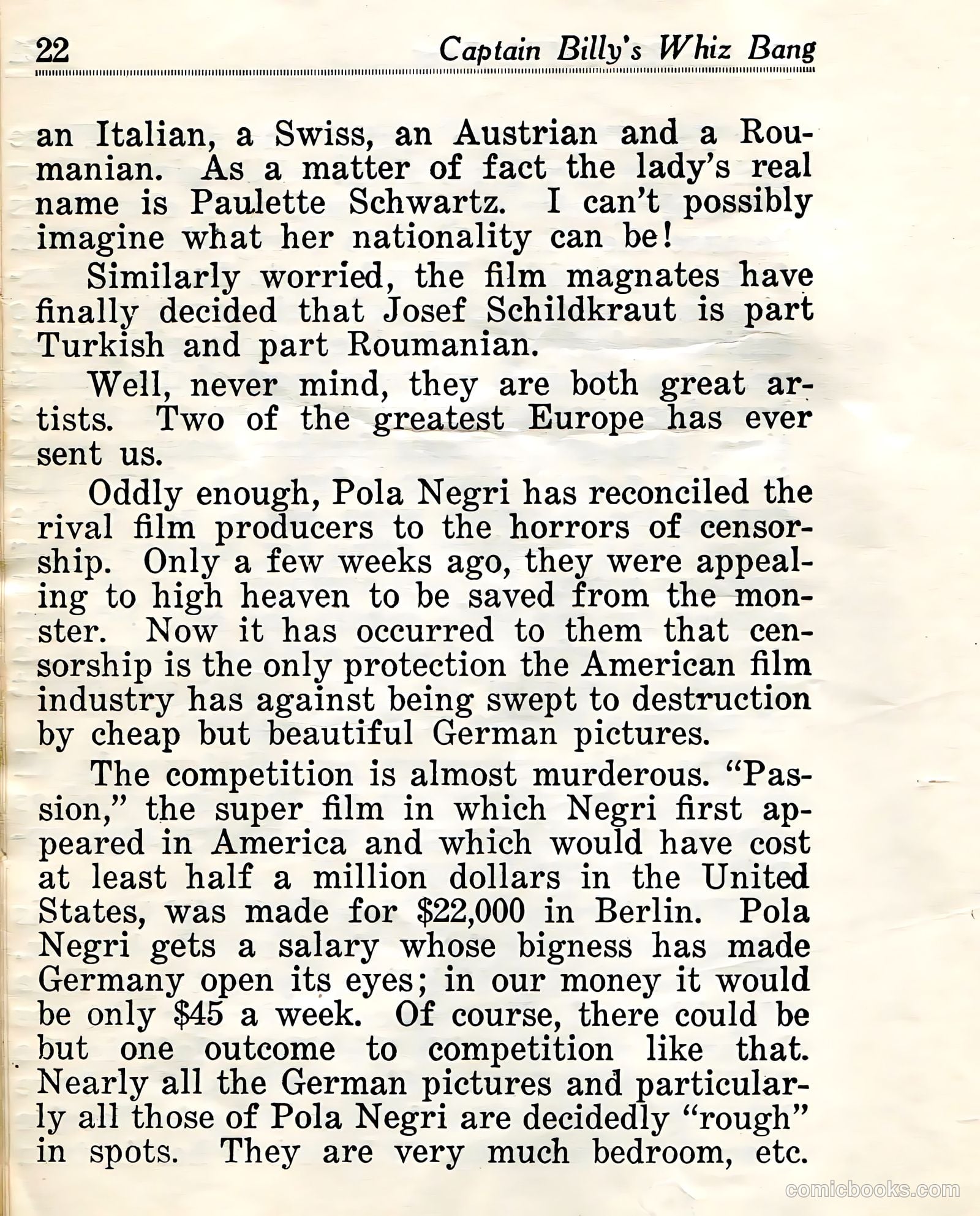
This satirical column mocks early 1920s Hollywood's anxieties about foreign competition and censorship. The piece ridicules film producers' confusion over European actors' nationalities—citing Paulette Schwartz and Josef Schildkraut as examples of stars with mixed ethnic backgrounds that studios struggle to market. The main target is the film industry's sudden embrace of censorship. Producers previously opposed it fiercely, but now recognize it as protection against cheaper, more risqué German films flooding the American market. The Polish actress Pola Negri exemplifies this threat: her film "Passion" cost only $22,000 in Berlin (versus half a million dollars for American equivalents), and her salary—$45/week in American currency—reveals the economic disparity. The satire suggests producers cynically support censorship not for morality but competitive advantage, while German films' "bedroom" content makes them commercially dangerous to American studios.
This page from *Captain Billy's Whiz Bang* (a 1920s satirical magazine) contains three separate items mocking contemporary culture: 1. **Italian film censorship**: The piece sarcastically suggests American censors "cut the gizzards out" of imported Italian films—likely referring to sexual or violent content deemed immoral. It notes a recent Italian production paid extras only four cents daily, criticizing both exploitative labor and the need for censorship to make such films acceptable. 2. **Evelyn Nesbit's retirement**: The actress/dancer, famous for scandal and her "message to young girls" (likely about morality or sexual propriety), has opened a novelty shop in Manhattan's theater district. The satire mocks her failed attempt at moral influence. 3. **"Sweet Essence of Prune Juice"**: This excerpt from a novel titled "Rainbow" is florid, sexually suggestive prose about kissing and physical union. The title suggests the passage is overwrought, pretentious purple prose—likely mocking contemporary "serious" literature for its overwrought sexuality masquerading as art.
This page contains three separate jokes typical of 1920s men's humor magazines: 1. **"Drummers, Front and Center"**: A joke about "traveling men" (sales representatives who visited towns regularly). The punchline is that "bad girls" go to the depot to meet these men—implying loose morality and flirtation. 2. **"Justification"**: A Marlowe quote arguing that things should be "used" and "exercised"—a thin pretext for suggesting women should be sexually active rather than remain chaste. 3. **"Starting the Day Right"**: A stenographer newly transferred jokes that she needs the boss to kiss her "to start working"—likely a double entendre suggesting sexual favors were routine office practice. All three jokes normalize sexual harassment and presumed female promiscuity as entertainment for male readers. They reflect workplace power dynamics and gender attitudes of the era that would be immediately recognized as offensive today.
This page features a "Dear Captain" advice column with humorous, insulting responses—typical of *Whiz Bang*, a bawdy 1920s humor magazine. Each joke relies on wordplay or insult humor: **T. Bone's river question** gets a cheap personal attack about his large mouth. **Bob O. Link** asks about "triumvirate" (three rulers), and the joke answers with three women's names—implying women are what a man needs. **Al Fresco** gets roasted with a birthplace insult. **Jean Ology** receives impractical advice (stove polish on shoes will damage them). **Art I. Choke** gets a pun on his name. The humor is crude and relies on name-puns, insults, and double meanings—no political content here, just typical 1920s satirical magazine filler meant to provoke laughs through irreverence and rudeness.
This page from *Captain Billy's Whiz Bang* (a humor magazine popular in the early 20th century) consists of a "Dear Captain" advice column featuring comedic Q&A exchanges. The humor relies on wordplay and absurdist logic rather than political satire. The jokes include: a fountain pen that only leaks when it contains ink (logical absurdity); the definition of curiosity as testing soup's density with a finger (physical comedy); patriotic preference for America over Paris (mild nationalist humor); puns about a musician having "drums in his ears" (playing on "drums" as both musical instruments and ear anatomy); and exaggerated movie-influenced romantic advice about chest-heaving. One correspondent signs as "Jim Crowe"—likely just a common name at the time, not necessarily the later segregation laws reference. The satire targets everyday social pretension, romantic advice, and common sense failures rather than specific political events or figures.
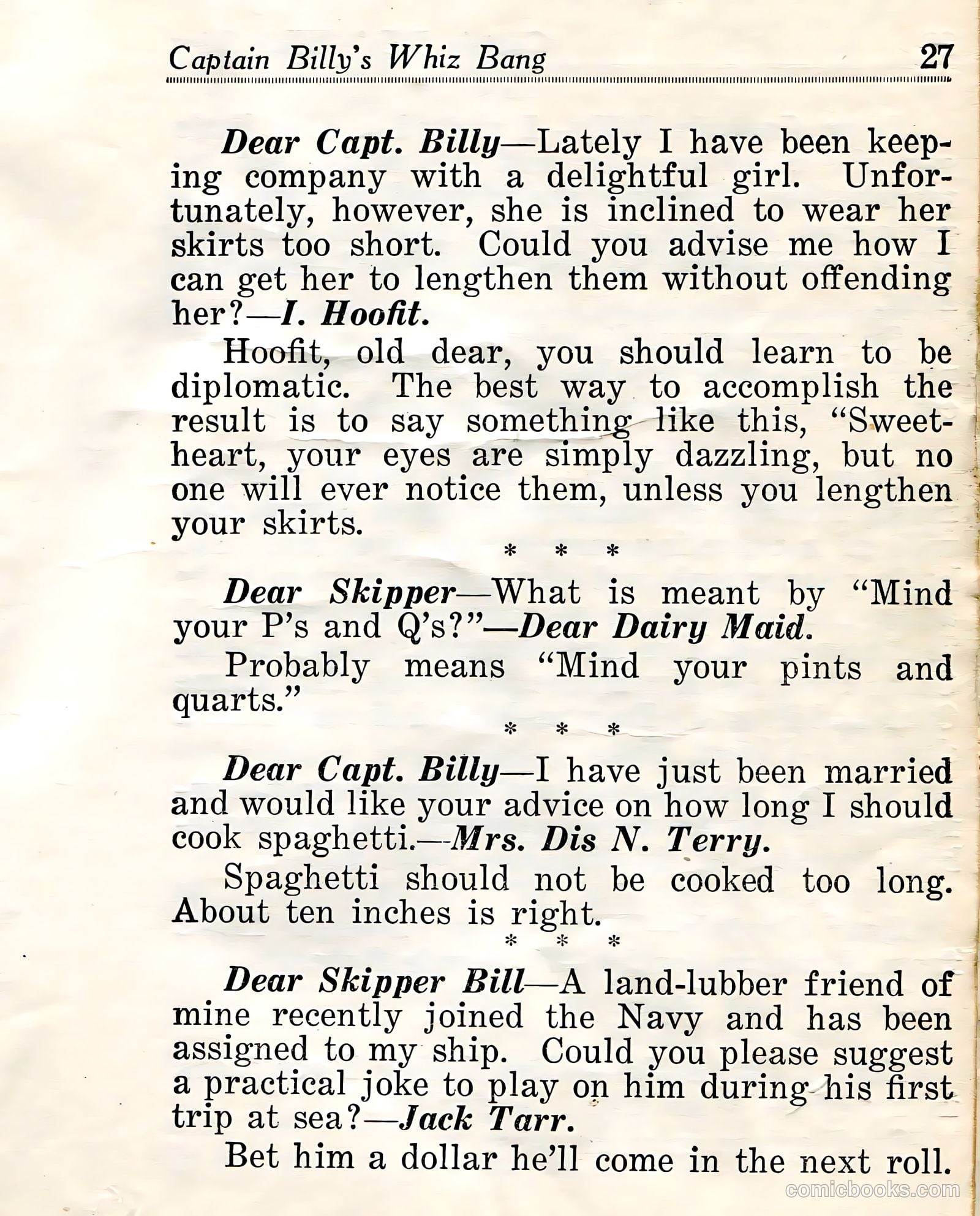
This is an advice column featuring Captain Billy dispensing humorous responses to readers' letters. The humor relies on deliberate misinterpretation and double meanings: **Letter 1** addresses the 1920s concern about women wearing shorter skirts—a genuine social controversy. Captain Billy's "diplomatic" advice sarcastically flatters the woman while subtly criticizing her hemline. **Letter 2** plays on the idiom "mind your P's and Q's" (mind your manners), interpreting it literally as pints and quarts—suggesting dairy-related measurements. **Letter 3** makes an intentional pun: advice about cooking spaghetti length becomes advice about the pasta's actual length (ten inches). **Letter 4** describes a classic naval prank: convincing a newcomer he'll "come in the next roll"—likely referring to seasickness, where victims would be prone during rough waves. This targets nautical inexperience. The entire page exemplifies *Whiz Bang's* style of gentle, pun-based satire aimed at everyday situations.
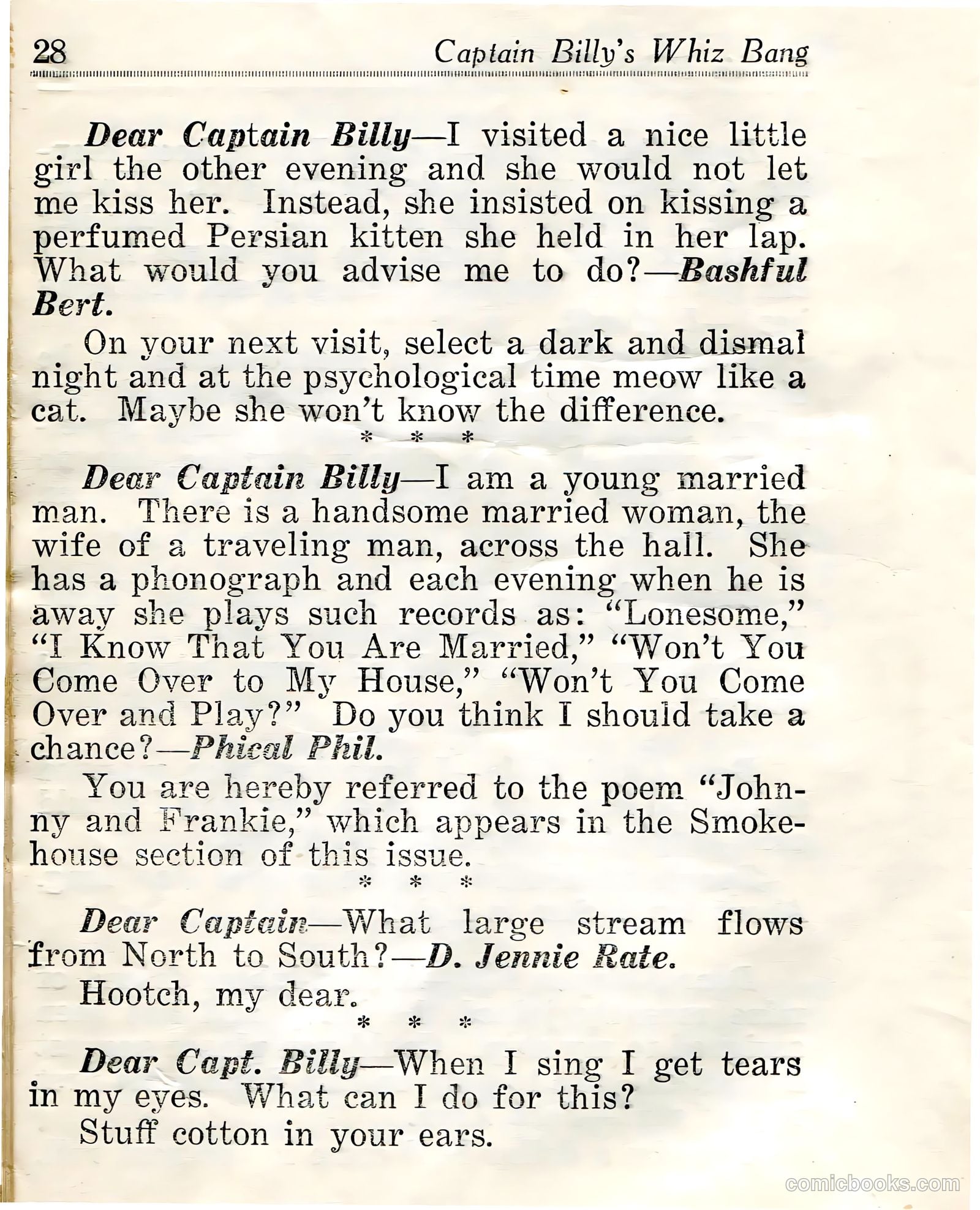
This is a humor advice column from *Captain Billy's Whiz Bang*, a satirical magazine known for crude, ribald jokes. The page contains four Q&A exchanges that mock readers through deliberately absurd or insulting responses. **The jokes rely on:** - Sexual innuendo (the "traveling man" letter hints at infidelity; the suggestion to "meow" plays on animal sounds as seduction) - Wordplay ("What large stream flows North to South?" answered with "Hootch"—slang for bootleg alcohol during Prohibition) - Insult humor (suggesting someone's singing is so bad they should block their own ears) The column's appeal lay in its irreverent tone and double meanings aimed at adult readers. The "Phical Phil" response references a poem presumably containing a cautionary tale about infidelity, likely related to the famous ballad "Frankie and Johnny" (variations exist). This represents early 20th-century American male-oriented humor—bawdy, dismissive of social conventions, and reliant on readers' familiarity with period slang and cultural references.
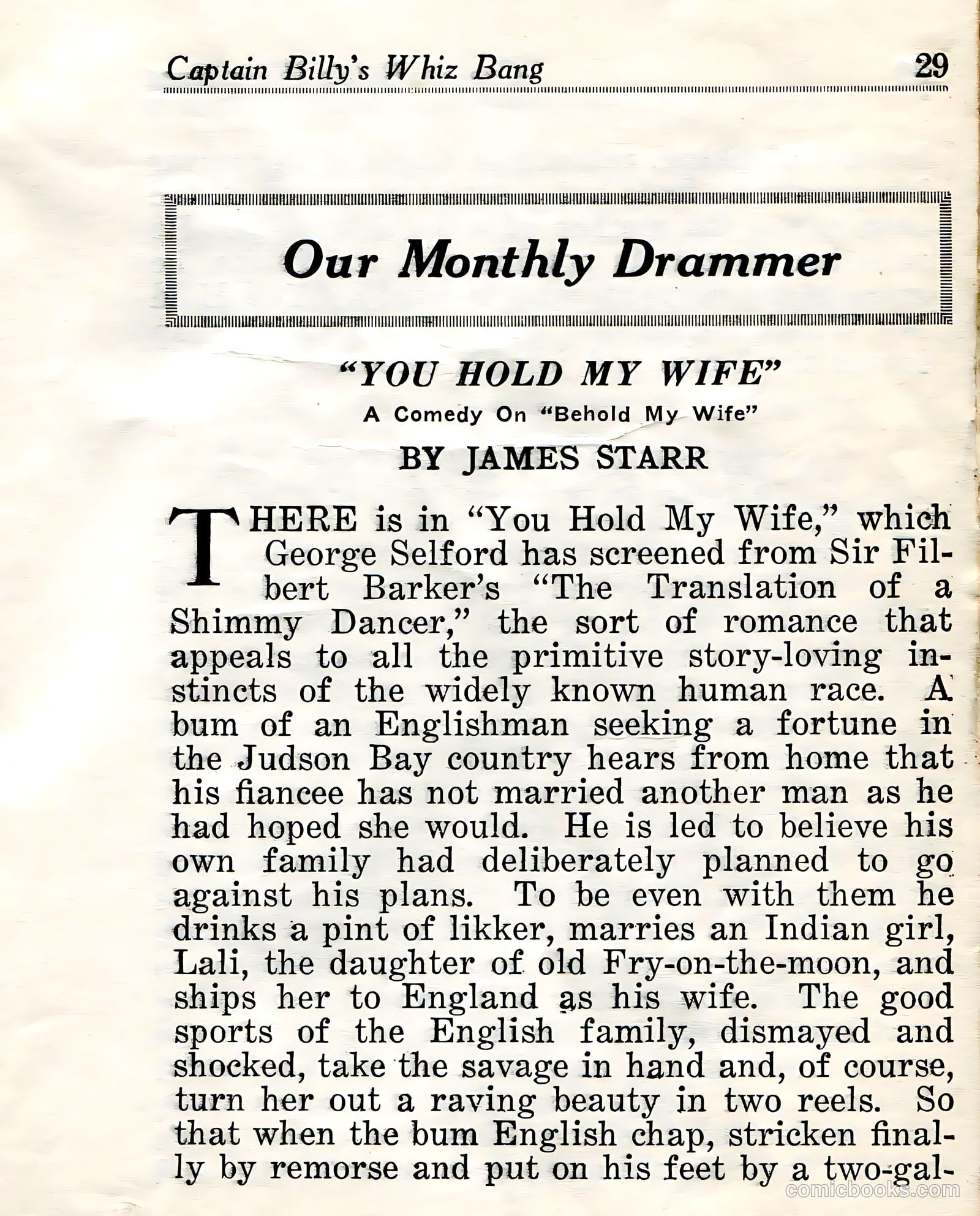
This page reviews a 1920s silent film adaptation of "The Translation of a Shimmy Dancer." The plot centers on an English fortune-seeker in Hudson Bay who, learning his fiancée didn't marry as he'd hoped, spitefully marries an Indigenous woman named Lali (daughter of "Fry-on-the-moon") and ships her to England to shock his family. The satire targets class pretensions: the "good sports" of the English family transform the "savage" into a "raving beauty in two reels"—mocking both the family's snobbery and cinema's miraculous transformations. The protagonist's drunken revenge marriage and subsequent remorse suggest commentary on colonial attitudes and casual cruelty. The review's tone is gleefully irreverent about the melodrama, typical of *Whiz Bang*'s satirical approach to popular entertainment and social hypocrisy.
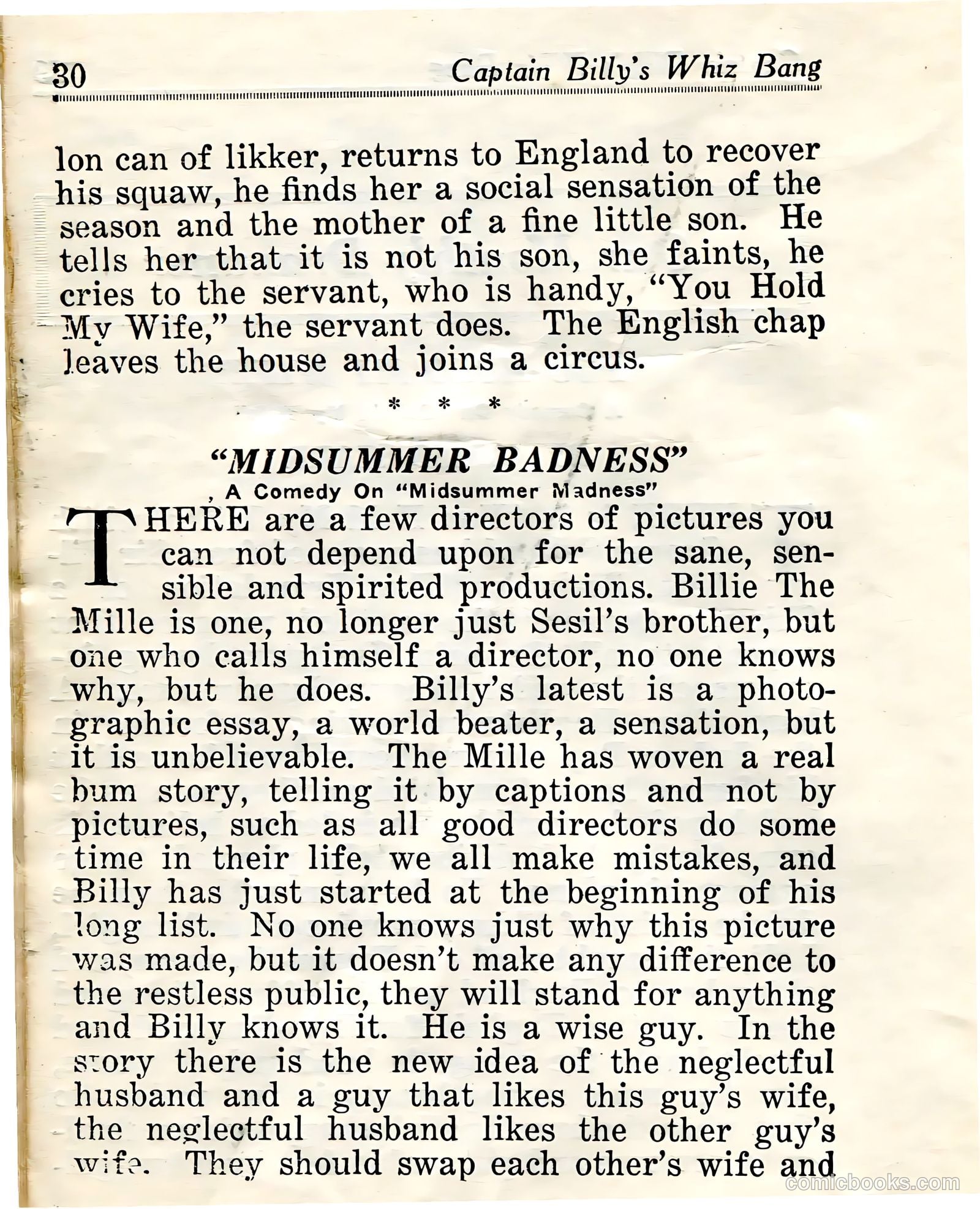
This page contains two satirical film reviews targeting early 1920s cinema. The first brief item mocks a melodramatic plot involving infidelity and colonial settings—an English soldier returns from abroad to find his wife (referred to dismissively as his "squaw") has become a society figure and borne a child. The absurd resolution has him joining a circus. The longer review savagely critiques director **Billie (Billy) The Mille** (likely Cecil B. DeMille), dismissing his latest film as a pretentious "photographic essay" that tells its story through captions rather than images—a fundamental directorial failure. The review mocks the film's plot concept of wife-swapping as unoriginal and cynically suggests audiences will accept anything from Mille because he understands their gullibility. The tone is contemptuous, treating the acclaimed director as an incompetent taking advantage of the public's appetite for sensational content.
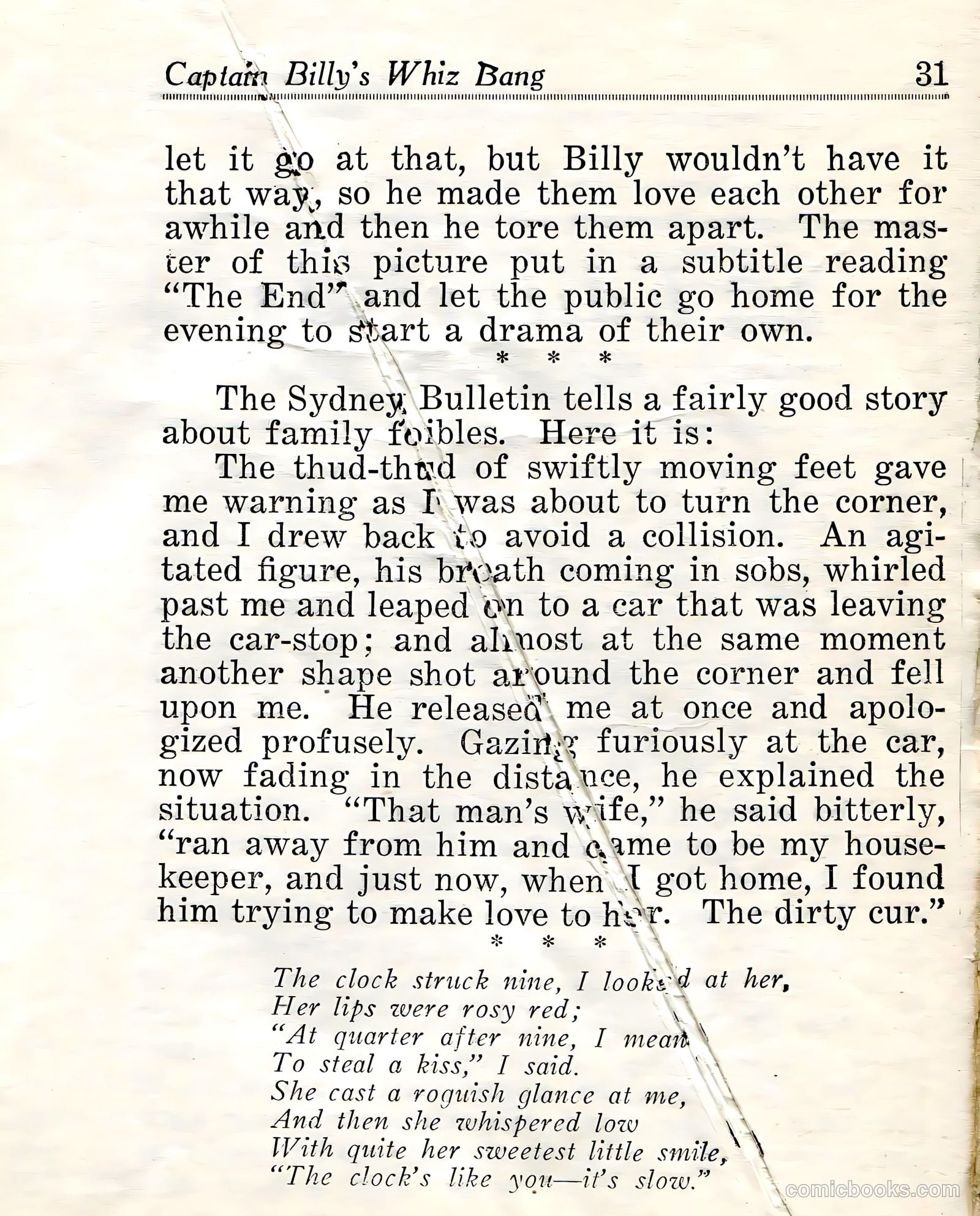
This page from the satirical magazine *Captain Billy's Whiz Bang* contains three separate humorous pieces about romance and infidelity. The first section critiques a film ("The End") that manipulates audiences emotionally, making them invested in a couple's relationship before separating them—leaving viewers to imagine their own dramatic conclusions. The second piece, reprinted from the *Sydney Bulletin*, is a comedic anecdote about domestic chaos: a man discovers his housekeeper (who left her husband) being seduced by that same husband. The humor derives from the tangled romantic/social situation and the aggrieved man's bitter reaction. The final item is a flirtatious poem about attempted seduction. A man declares his intention to "steal a kiss" at 9:15, but the woman deflects with a witty retort comparing his slowness to a slow clock—a cheeky rejection disguised as a compliment. Overall, the page emphasizes romantic entanglement and sexual tension as sources of comedy.
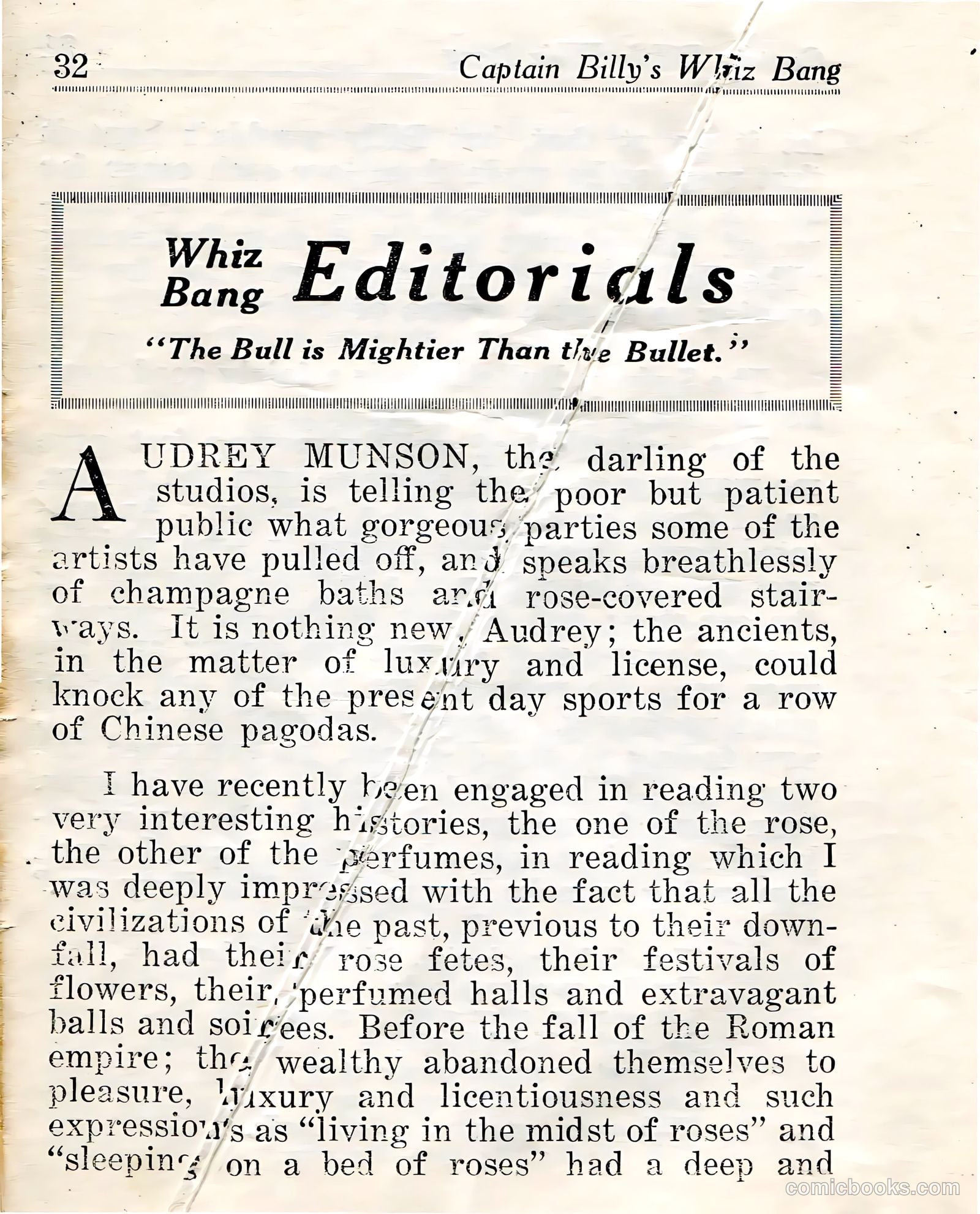
This editorial satirizes actress **Audrey Munson**, who was famous in the 1910s-20s as a sculptor's model and silent film actress. The piece mocks her for breathlessly describing lavish artist parties featuring champagne baths and rose-decorated staircases to the public. The satire's point: such excess isn't novel—ancient civilizations indulged similarly before collapsing. The editorial draws a moralistic parallel, suggesting that Rome's wealthy abandoned themselves to pleasure, luxury, and "licentiousness" before the empire's fall. By referencing roses, perfumes, and extravagant balls in past civilizations, the writer implies that modern American excess signals potential societal decline. The headline—"The Bull is Mightier Than the Bullet"—appears unrelated to this text section, possibly referencing another article. The overall tone reflects early 20th-century anxieties about wealth, morality, and civilization's fragility.
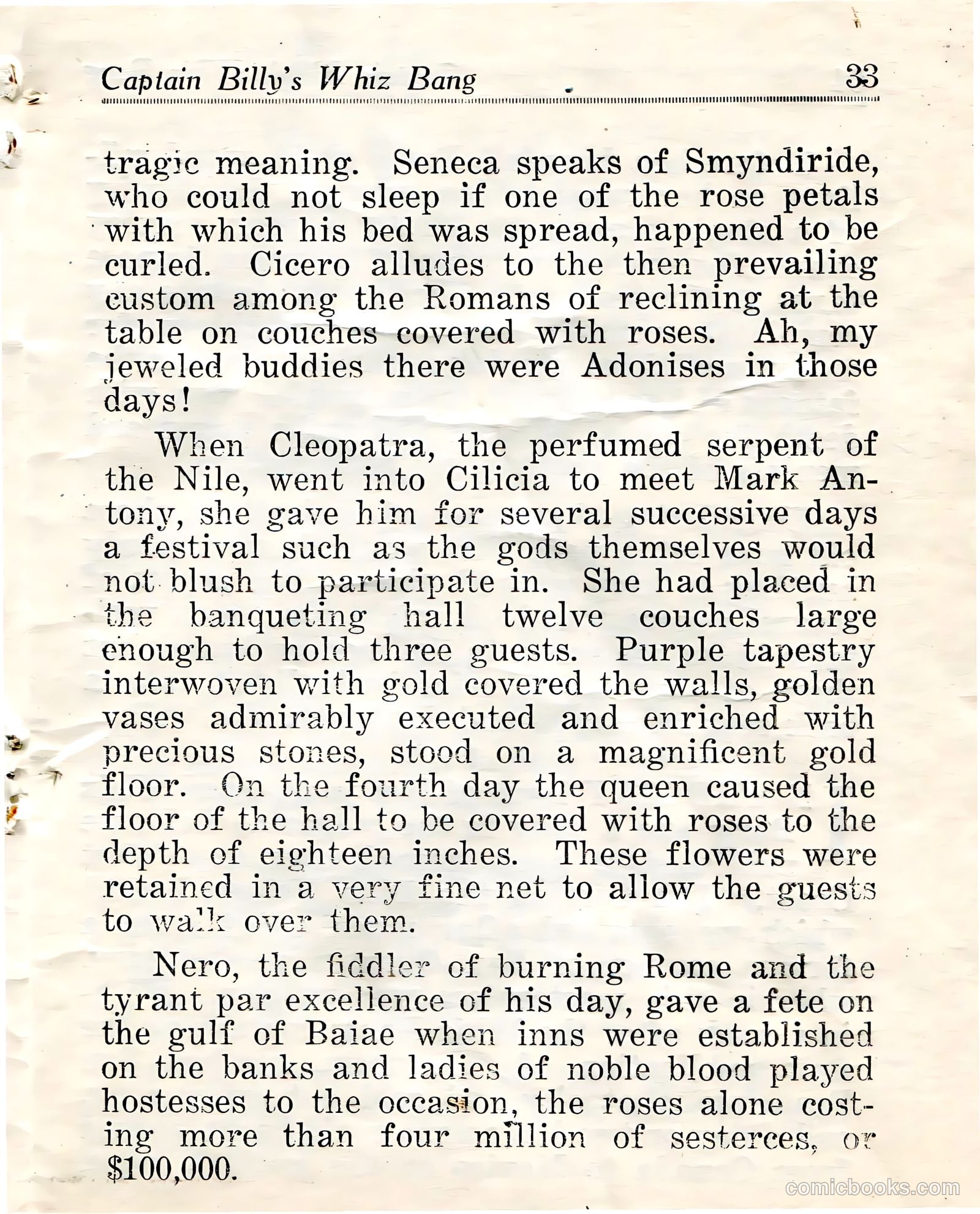
This page from the satirical magazine presents a humorous essay on historical extravagance, specifically ancient Rome's obsession with roses at luxurious banquets. The author catalogs increasingly outrageous examples: Seneca's account of an insomniac so delicate a curled rose petal disturbed him; Romans reclining on rose-covered couches; Cleopatra's legendary banquet for Mark Antony featuring eighteen inches of roses retained by netting on the floor; and Nero's party where roses alone cost $100,000. The satire targets wealthy excess and decadence, implicitly comparing ancient Roman indulgence to contemporary (1920s) American wealth and frivolity. By presenting these historical examples with mock admiration ("Ah, my jeweled buddies"), the author ridicules both ancient and modern pretension—suggesting little has changed in humanity's wasteful pursuit of luxury.
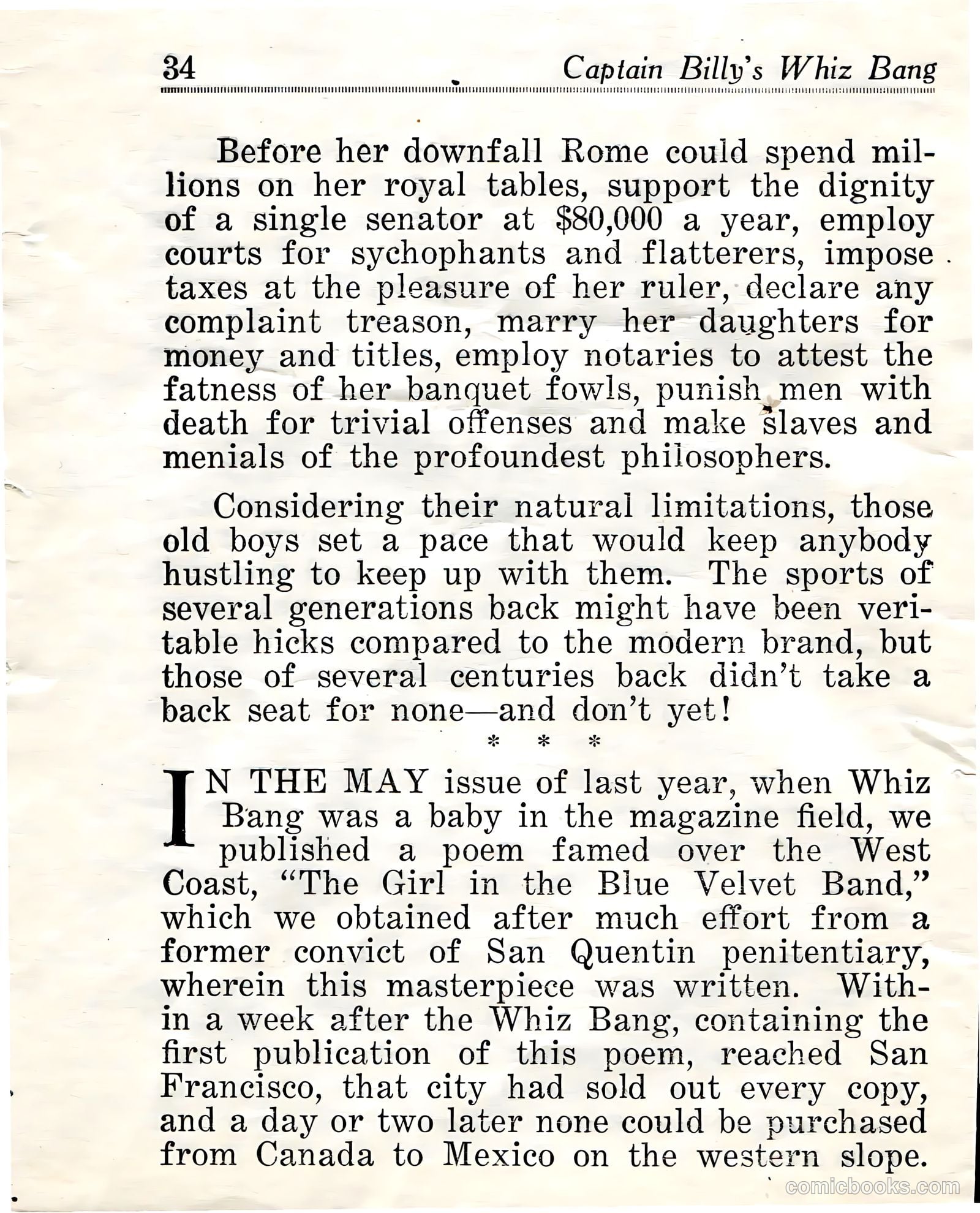
This page contains two distinct pieces of satirical content: **First section**: A critique of Roman imperial excess and decadence, drawing parallels to contemporary concerns about wealth inequality and authoritarian power. The passage lists Roman abuses—extravagant spending, arbitrary taxation, suppression of dissent, corruption of justice—as historical cautionary tales. The satire implies modern readers should recognize similar dangers in their own society. **Second section**: Self-promotion for *Whiz Bang* magazine itself. The editors boast that their May issue featuring a poem called "The Girl in the Blue Velvet Band" (sourced from a San Quentin convict) became so wildly popular that copies sold out across the entire West Coast within days. This appears tongue-in-cheek exaggeration designed to establish the magazine's cultural relevance and appeal among readers seeking edgy, unconventional content. No specific political figures or events are named or caricatured on this page.
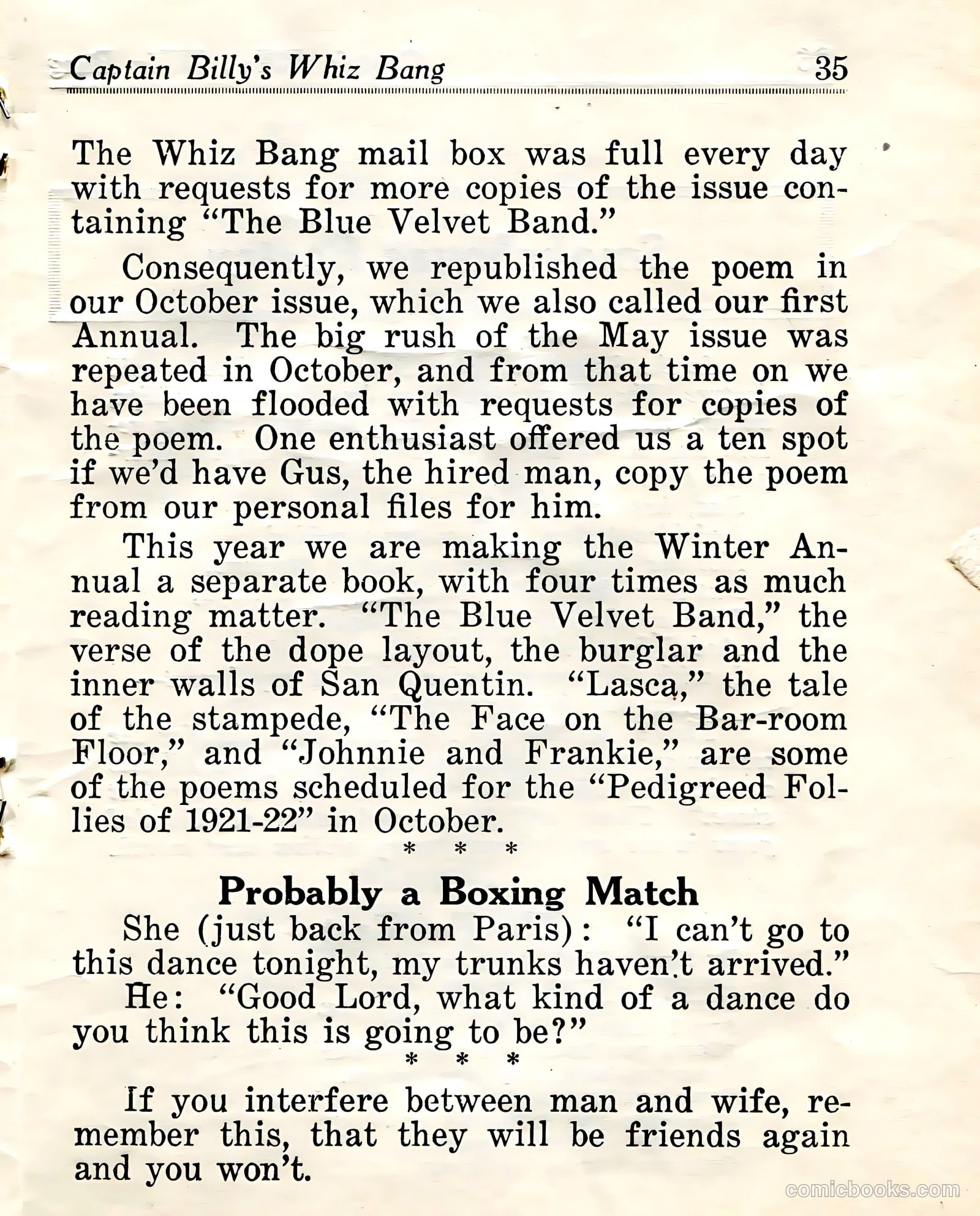
This page from the satirical magazine contains editorial notes and two brief jokes. The editorial describes the overwhelming popularity of "The Blue Velvet Band" poem, which generated so many reader requests that the magazine republished it and saw similar demand spikes. The text indicates this became their most popular content. The "Probably a Boxing Match" section presents a domestic humor joke playing on a misunderstanding. A woman recently returned from Paris tells her husband she can't attend a dance because her trunks (luggage) haven't arrived. He responds with mock alarm, implying she means her swimsuit/bathing trunks—suggesting he's sarcastically questioning what sort of "dance" she thinks they're attending. The humor derives from the wife's innocent reference to luggage being deliberately misinterpreted as swimwear. The final aphorism offers cynical relationship advice: don't meddle in marital disputes, as the couple will reconcile while you'll lose both as friends—a common theme in period satire about domestic life.
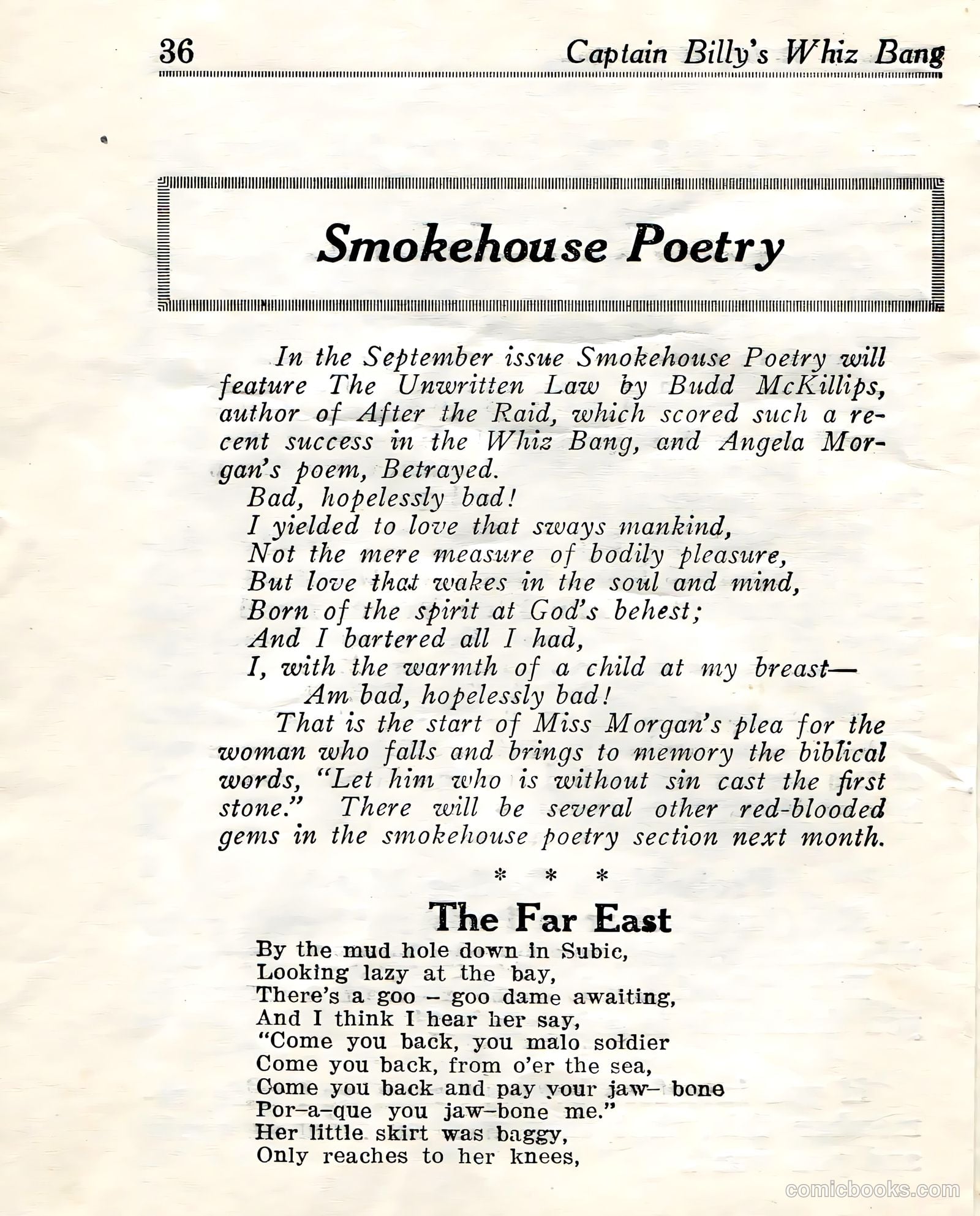
This page announces upcoming poetry submissions to *Whiz Bang*'s "Smokehouse Poetry" section—apparently their venue for edgy, morally provocative verse. **"Betrayed"** by Angela Morgan addresses female sexual transgression sympathetically, arguing against judgment of "fallen women" by invoking Christ's defense of the adulteress ("Let him without sin cast the first stone"). The poem emphasizes spiritual love over bodily pleasure, framing the woman's "fall" as yielding to profound emotional connection rather than mere lust. **"The Far East"** appears to be a soldier's poem set in the Philippines (Subic Bay is a real location). It depicts a Filipino woman in stereotypical terms ("goo-goo dame," pidgin English dialogue), presenting her as sexually available and waiting for a departing American soldier. The poem romanticizes this transactional relationship in casual, comedic verse. Together, these pieces reveal *Whiz Bang*'s editorial interests: defending moral complexity regarding women's sexuality while simultaneously trafficking in crude racial/ethnic stereotypes about non-Western women. The juxtaposition reflects period attitudes toward respectability and "otherness."
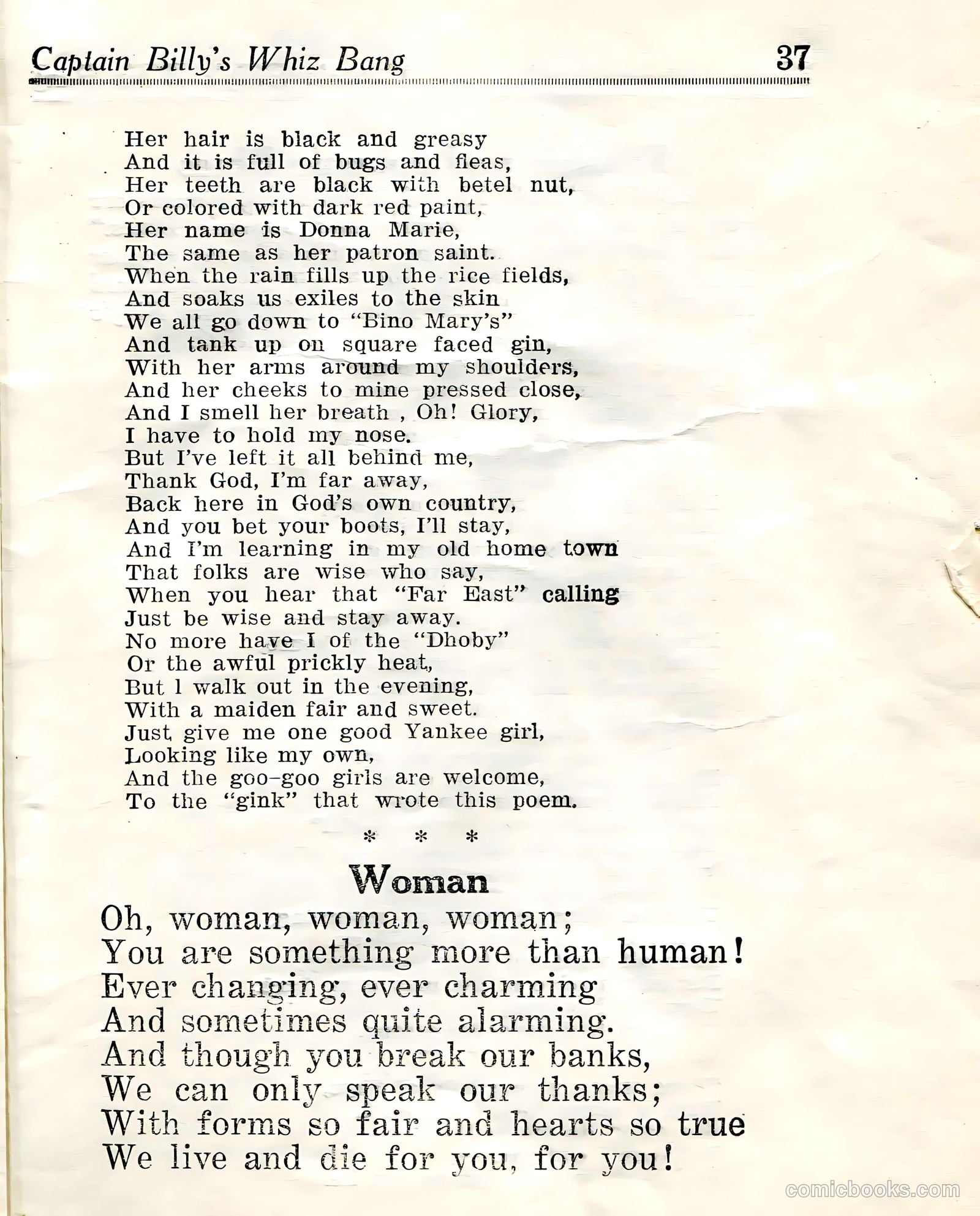
This page from *Captain Billy's Whiz Bang* (a 1920s-era humor magazine) contains two poems expressing post-WWI soldier nostalgia and attitudes. The first poem describes a serviceman's encounter with "Donna Marie," a Southeast Asian woman (likely Filipino or similar), using crude stereotypes: poor hygiene, betel-nut-stained teeth, and alcoholism at a bar. The speaker initially found her appealing but now claims relief to be back in America, warning others away from "Far East calling"—likely referencing the allure of colonial Asia and sex work associated with military postings. The second, untitled poem ("Woman") is a florid compliment to femininity itself, celebrating women's beauty and charm while claiming men willingly sacrifice for them. Together, these poems reflect post-WWI American soldier attitudes: exoticized contempt for Asian women contrasted with idealized reverence for American women. The satire likely mocks both the soldiers' contradictory attitudes and contemporary gender anxieties.
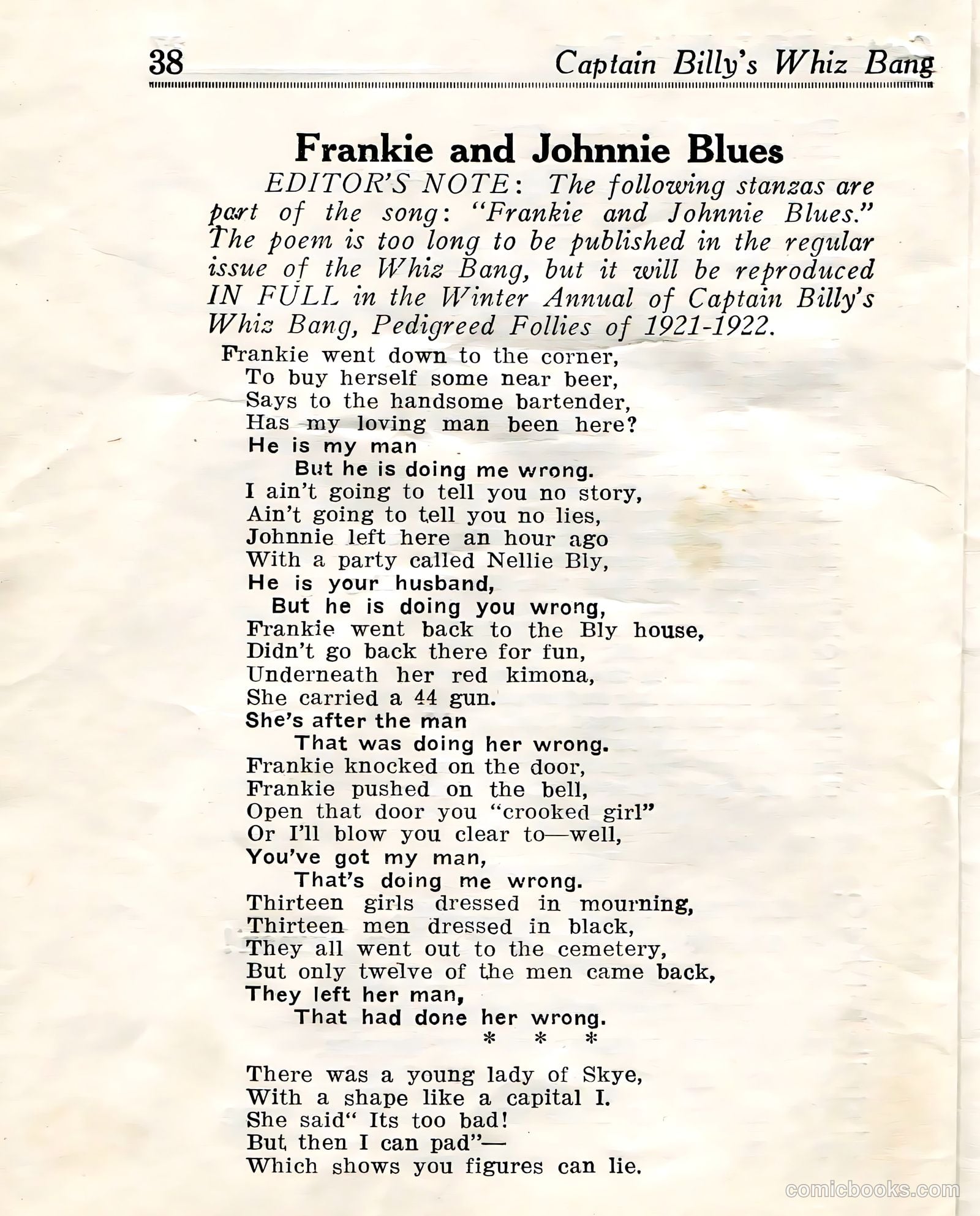
This page reproduces stanzas from a folk ballad about infidelity and violent retribution. The song tells of Frankie discovering her husband Johnnie has left with another woman (Nellie Bly). Frankie retrieves a .44 gun hidden in her kimona and confronts them at the Bly house, resulting in a shooting death. The ballad concludes with a funeral: thirteen mourners depart, but only twelve men return—implying Frankie killed Johnnie. The "Frankie and Johnnie" ballad was an actual American folk song popular in the early 1900s, based on a real 1899 crime in St. Louis. Whiz Bang presents it as entertainment for a 1921-22 audience familiar with this notorious story. The brief joke appended about a woman's figure serves as filler comedy.
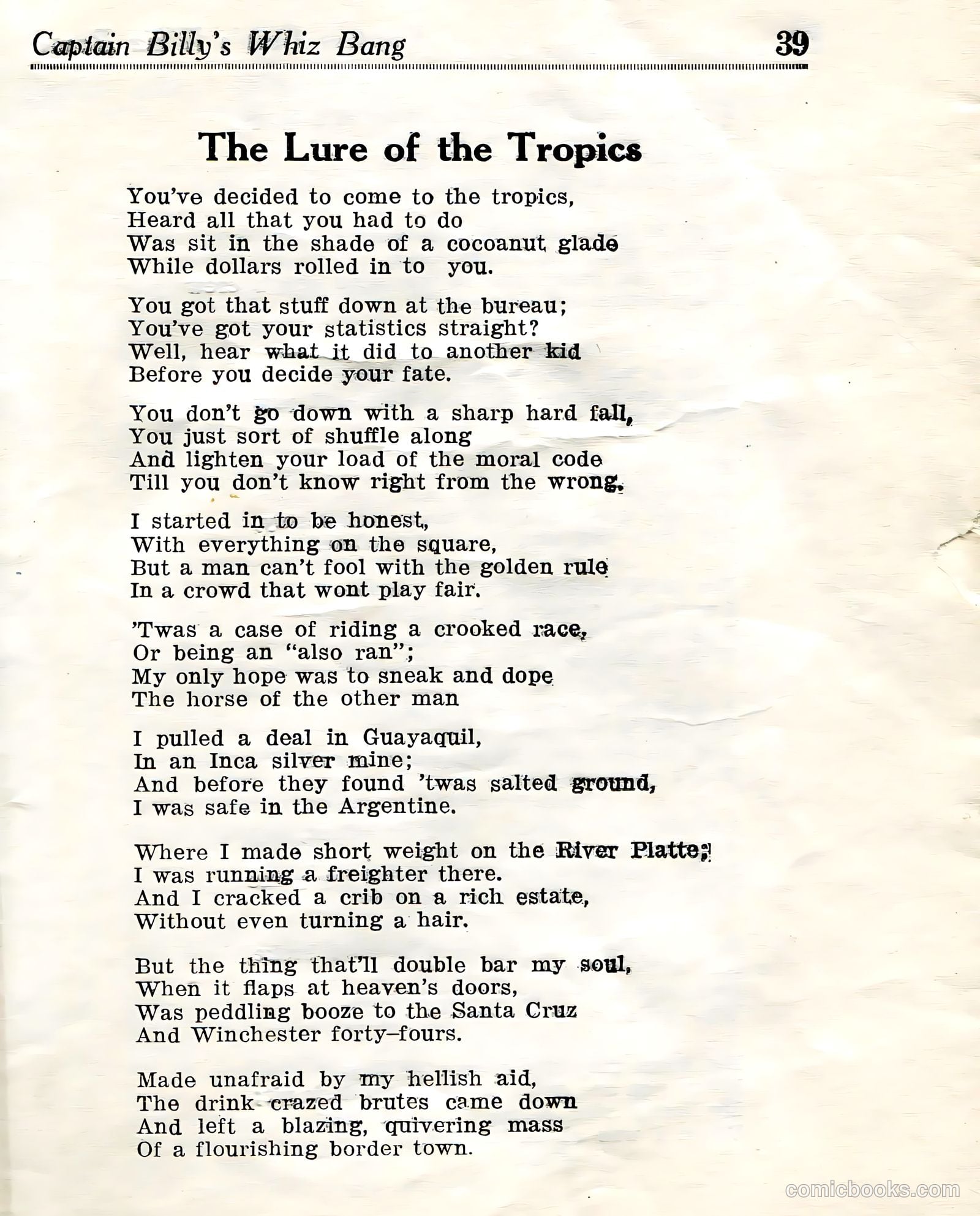
This is a cautionary poem, not a cartoon, appearing in *Captain Billy's Whiz Bang*, a satirical American magazine popular in the 1920s-30s. The narrator warns against the romanticized fantasy of tropical wealth: arrive in the tropics, relax, and profit effortlessly. Instead, he confesses a progressive moral collapse. Beginning honest, he's corrupted by dishonest competitors, committing increasingly serious crimes across Latin America—mining fraud in Guayaquil, theft in Argentina, and finally selling alcohol and weapons to indigenous peoples ("Santa Cruz"), causing a massacre. The satire targets two audiences: those seduced by "get-rich-quick" tropical schemes, and the exploitative colonial/imperial attitudes toward Latin America and indigenous peoples. The narrator's final remorse—that weapons-dealing will "double bar my soul"—suggests the poem indicts not just personal corruption but the systematic violence embedded in colonial trade.
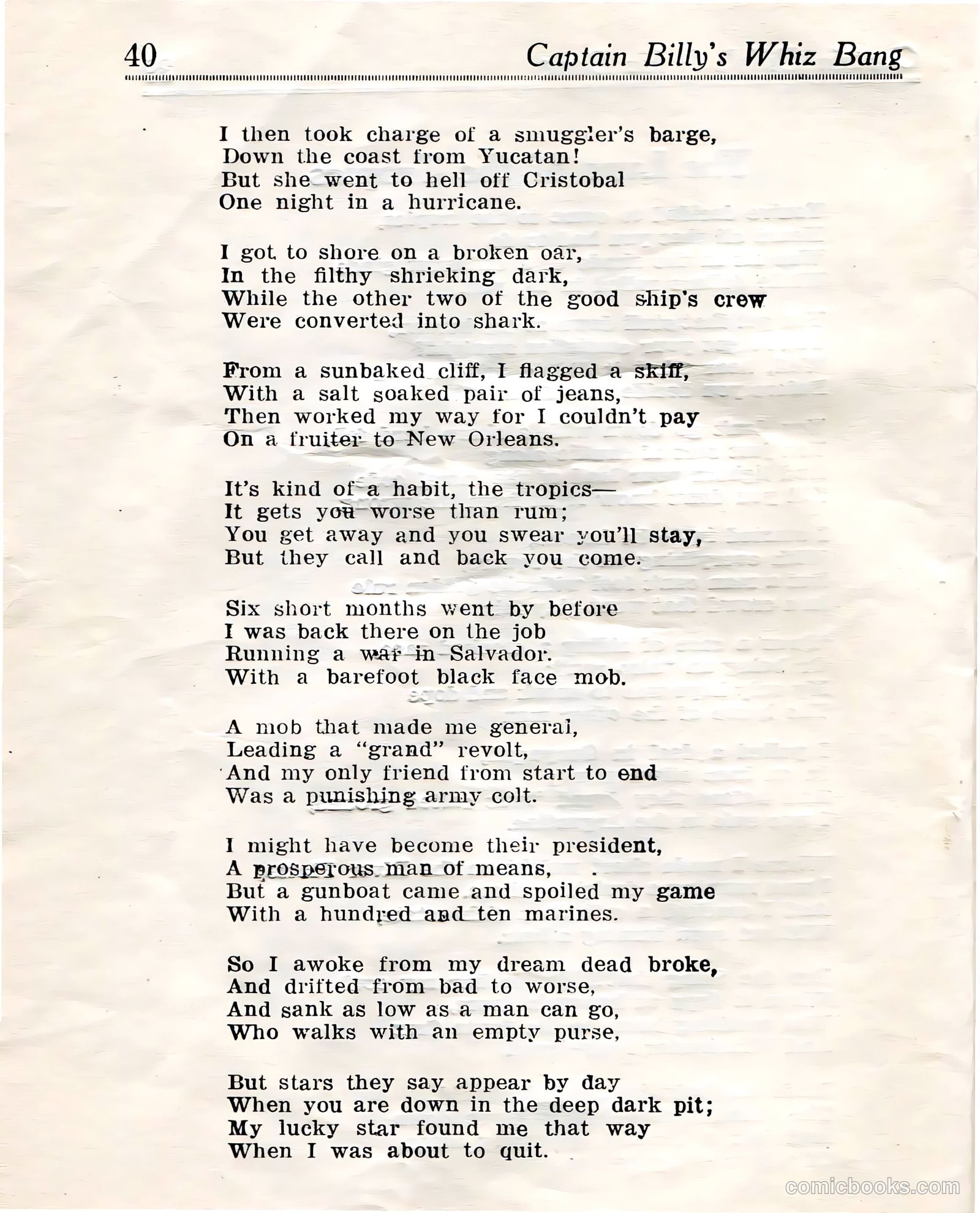
This page presents a first-person narrative poem satirizing American interventionism in Central America and the Caribbean during the early 20th century. The narrator recounts a life of tropical adventure—smuggling, shipwrecks, and military involvement—before ending broke and desperate. The satire targets U.S. military adventurism, particularly in Salvador (El Salvador) and the Canal Zone (Cristobal reference). The poem mocks both the romanticism of tropical escapades and the ham-handed U.S. military interventions that installed American-backed leaders. The "gunboat came and spoiled my game / With a hundred and ten marines" directly references actual U.S. Marine deployments to overthrow or prop up regimes. The tone oscillates between self-mockery and cynicism about how tropical environments seduce men into repeated failed ventures. The ending offers redemption through luck rather than judgment—a sardonic conclusion fitting Whiz Bang's irreverent satirical style aimed at post-WWI American readers skeptical of foreign military adventures.
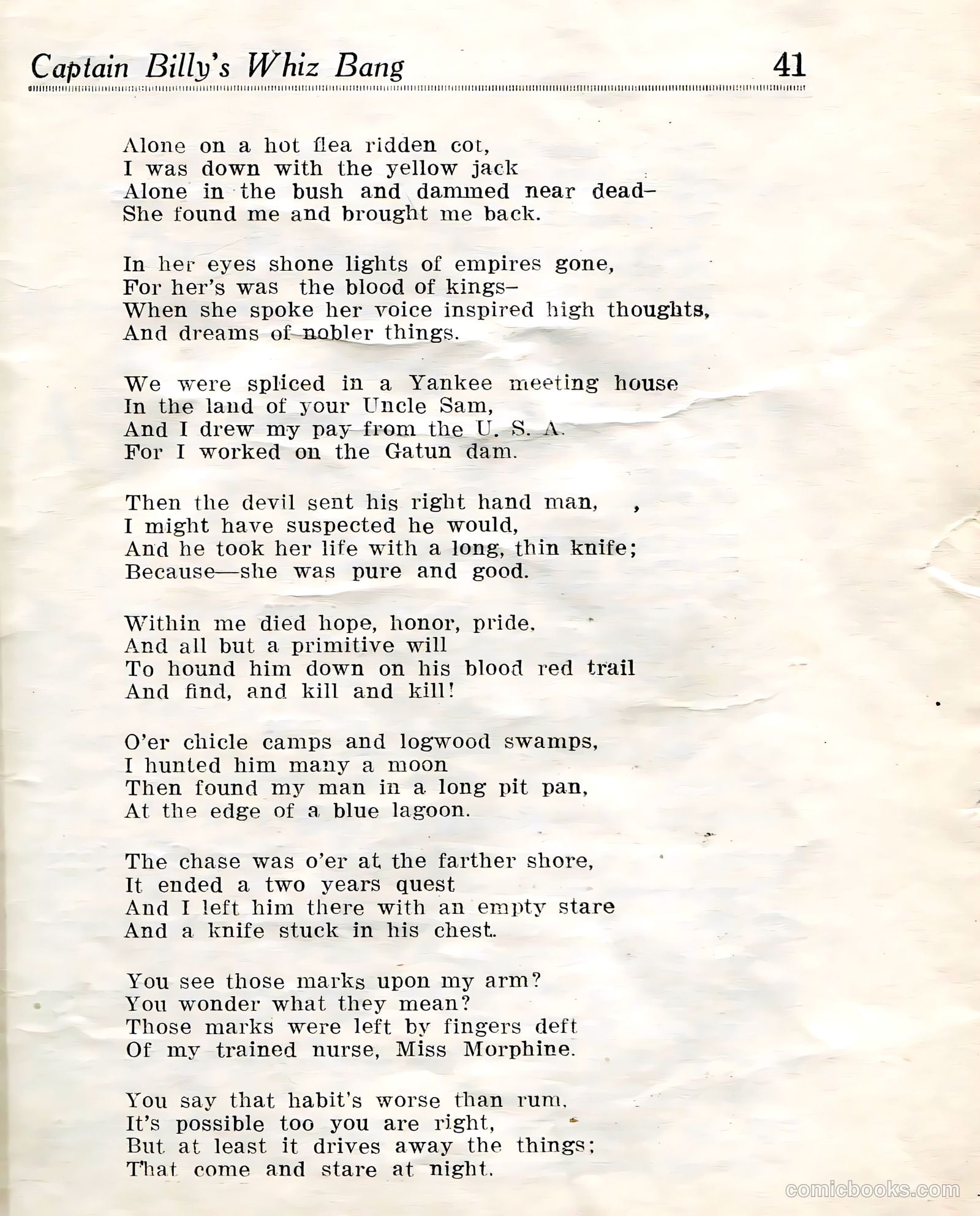
This page contains a narrative poem—not a cartoon—depicting a revenge tragedy with drug addiction themes. The unnamed narrator recounts marrying a noble woman at the Panama Canal (Gatun dam), whose murder by an unnamed villain drives him to a two-year manhunt across Central American terrain. He achieves vengeance but is left psychologically destroyed. The final stanza reveals the poem's darker point: the narrator has become addicted to morphine ("Miss Morphine"), using it to suppress traumatic memories and hallucinations ("things that come and stare at night"). The bitter conclusion suggests drug addiction, while worse than alcohol, at least provides escape from psychological torment. This reflects post-WWI anxieties about veteran trauma, morphine addiction, and moral corruption—common satirical subjects in 1920s American humor magazines. The tone is melodramatic rather than comedic.
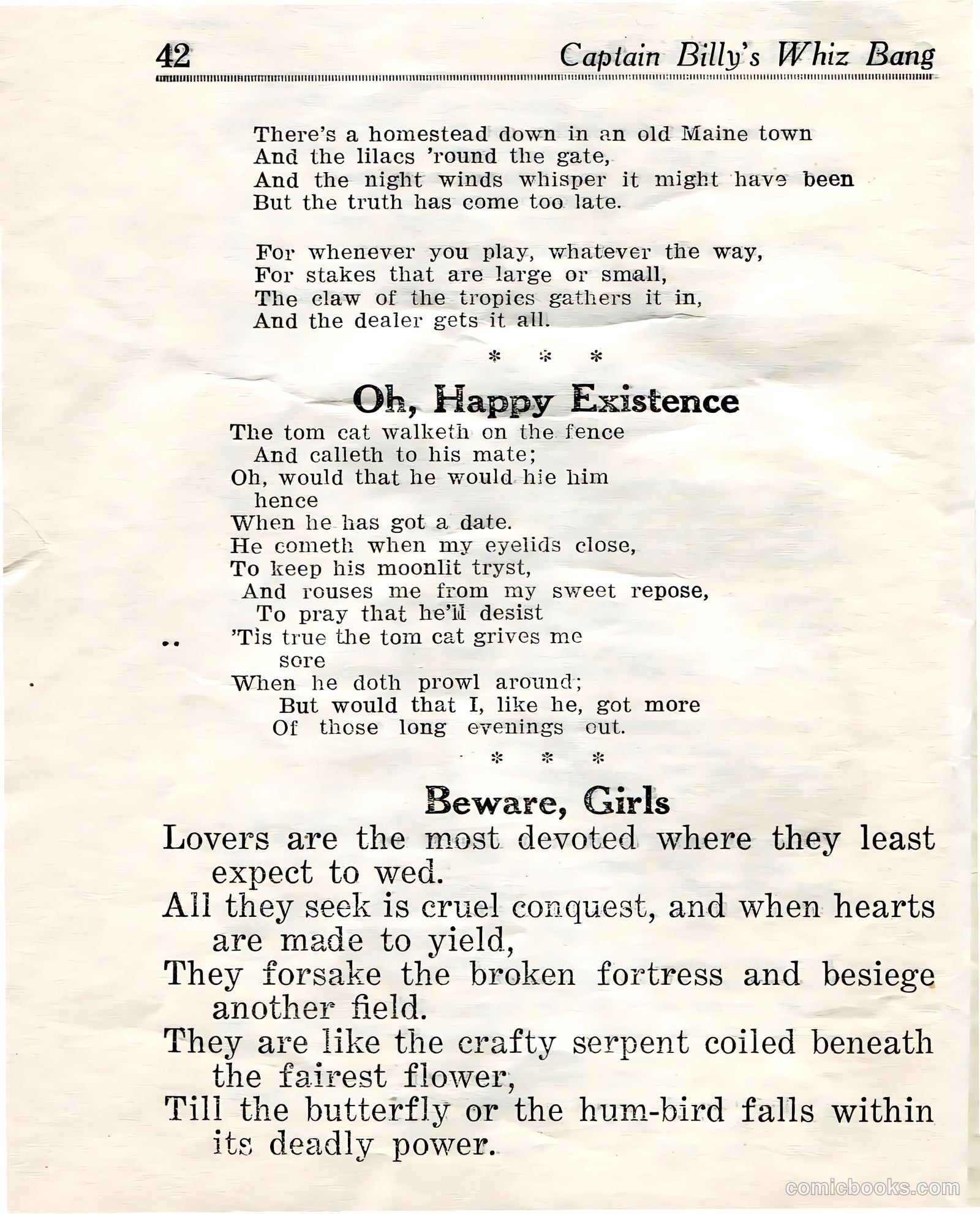
This page contains three humorous poems with no visible cartoons or illustrations. The content reflects early 20th-century satirical themes: **"There's a homestead..."** warns against gambling ("the dealer gets it all"), using a Maine setting with tropical imagery suggesting casinos or vice operations drawing money away. **"Oh, Happy Existence"** presents a domestic complaint: a tom cat's nighttime courtship antics disturb the narrator's sleep. The humor lies in the speaker's envy of the cat's freedom to enjoy "long evenings out"—a subtle commentary on marital constraints and gender roles, where the speaker wishes for the cat's bachelor liberty. **"Beware, Girls"** is a cautionary poem warning women about deceitful lovers who pursue conquest but abandon partners once they've achieved intimacy, comparing men to hidden serpents. This reflects period anxieties about seduction and female vulnerability. Overall, the page combines cynical humor about gambling, domestic life, and romantic relationships—typical subjects for *Whiz Bang*, a magazine known for ribald, satirical content aimed at post-WWI male readers.
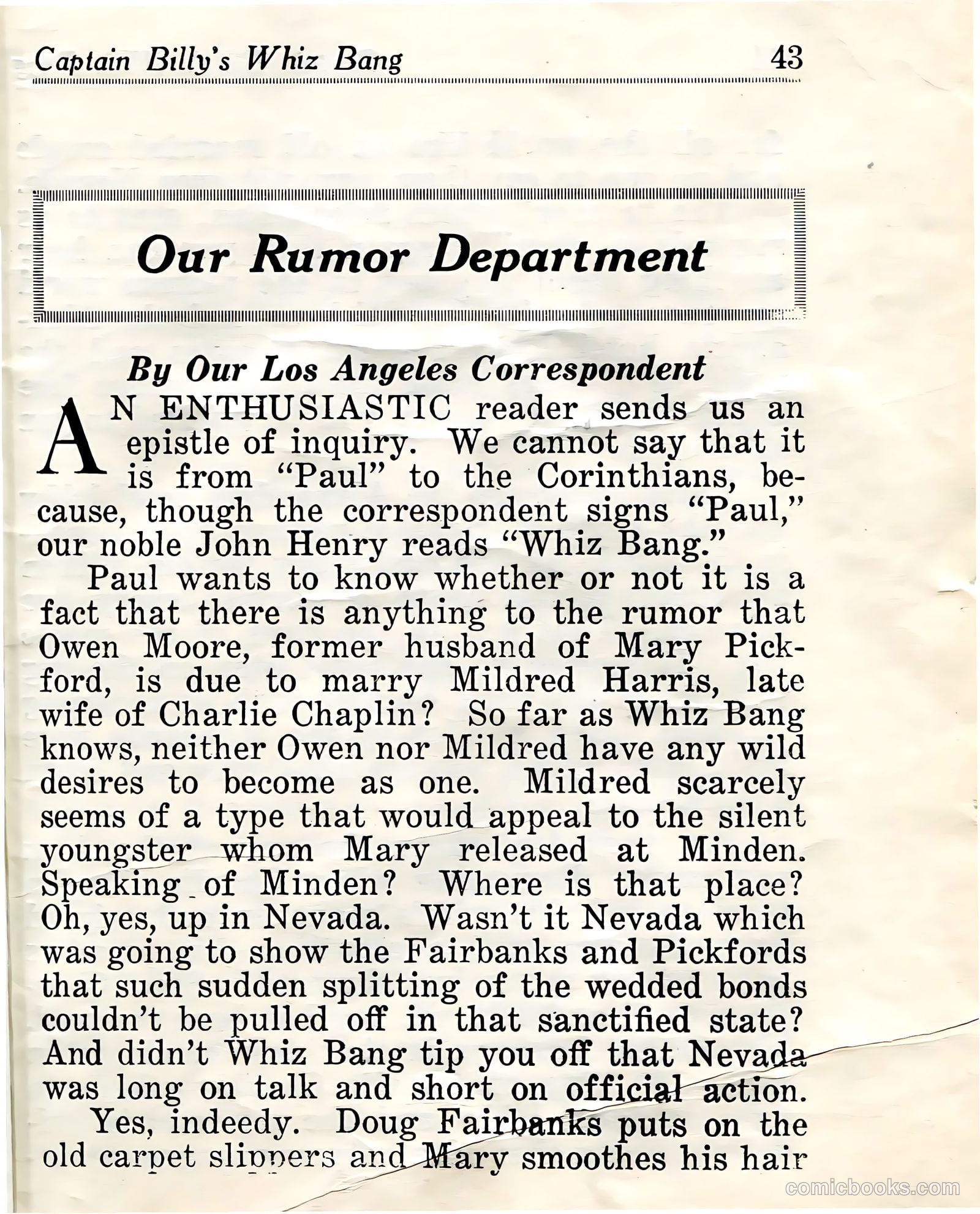
This gossip column addresses Hollywood scandal involving silent-film stars. The piece denies a rumor that actor Owen Moore (ex-husband of Mary Pickford) plans to marry Mildred Harris (ex-wife of Charlie Chaplin). The satire mocks Nevada's inability to enforce divorce laws despite its reputation for easy splits. The column sarcastically notes Nevada was expected to demonstrate that even famous couples couldn't dissolve marriages there, yet proved "long on talk and short on official action." The final lines mock Douglas Fairbanks and Mary Pickford's reconciliation with domestic imagery (carpet slippers, hair-smoothing), suggesting their marital drama was theater. The piece satirizes both celebrity gossip culture and Nevada's contradictory legal reputation regarding divorce during an era when marriage dissolution was controversial and legally complex.
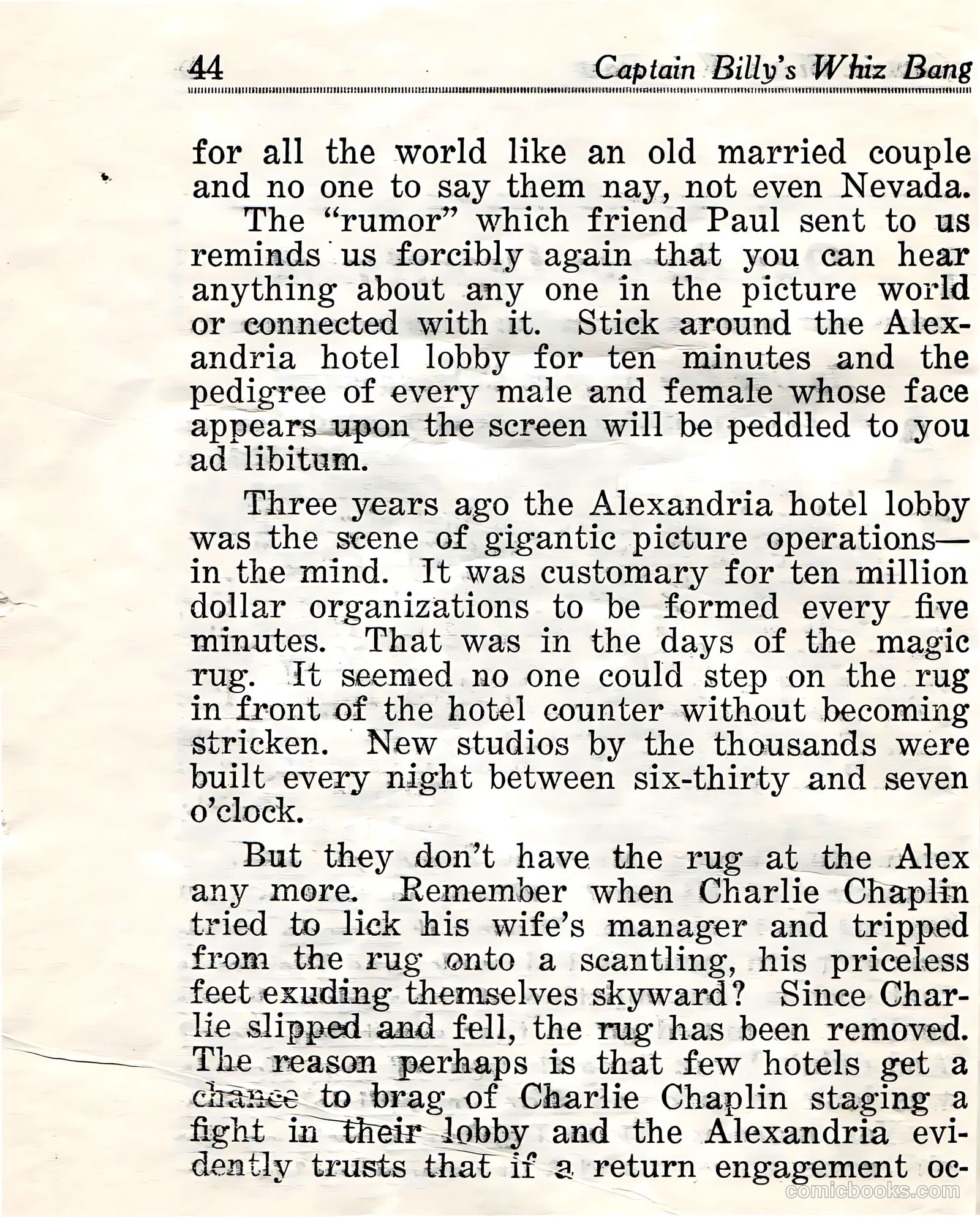
This satirical column mocks Hollywood gossip culture and the film industry's boom-and-bust cycles around 1920. The piece criticizes how rumors spread unchecked in entertainment circles, particularly in the Alexandria Hotel lobby—apparently a hub for film industry dealings. The text references a famous incident where Charlie Chaplin allegedly tripped over a "magic rug" while fighting his wife's manager, injuring himself. The hotel subsequently removed the rug, apparently hoping to avoid publicity from future celebrity incidents. The broader satire targets the feverish speculation and exaggeration of the early cinema era: ten-million-dollar companies supposedly forming every five minutes, studios being "built" overnight. The column suggests the industry's golden age (the "days of the magic rug") has passed, replaced by ordinary hotel operations and less glamorous activity. The "rumor" and gossip about unnamed figures reflects how unverifiable stories dominated entertainment discourse.
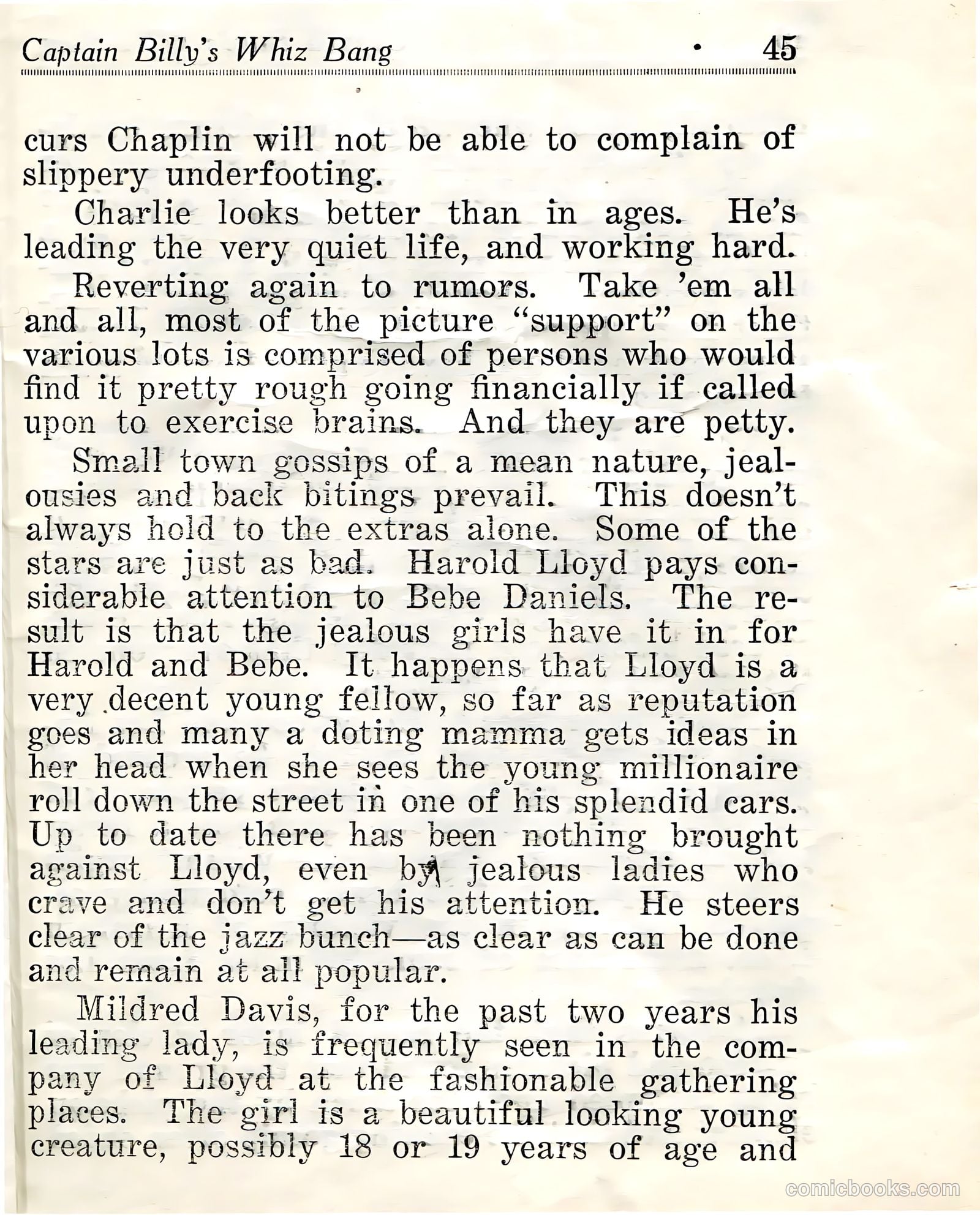
This gossip column discusses Hollywood celebrities and film industry rumors circa the 1920s. Key figures mentioned: **Charlie Chaplin** — referenced as living quietly and working hard, with a joke about his famous "slippery" physical comedy. **Harold Lloyd** — a major silent-film star portrayed positively as financially successful, decent-mannered, and notably *avoiding* the "jazz bunch" (associated with wild, immoral behavior). The column defends him against jealous gossip. **Bebe Daniels** — Lloyd's frequent companion, which reportedly sparked jealousy among other women. **Mildred Davis** — Lloyd's leading lady for two years, noted as beautiful and young (18-19). The satire targets Hollywood's petty gossip culture, small-minded extras, and the jealous rumors circulating about stars' personal lives. It contrasts Lloyd's respectable reputation against the morally suspect "jazz crowd," reflecting 1920s anxieties about Hollywood's decadence while praising those who maintained propriety.
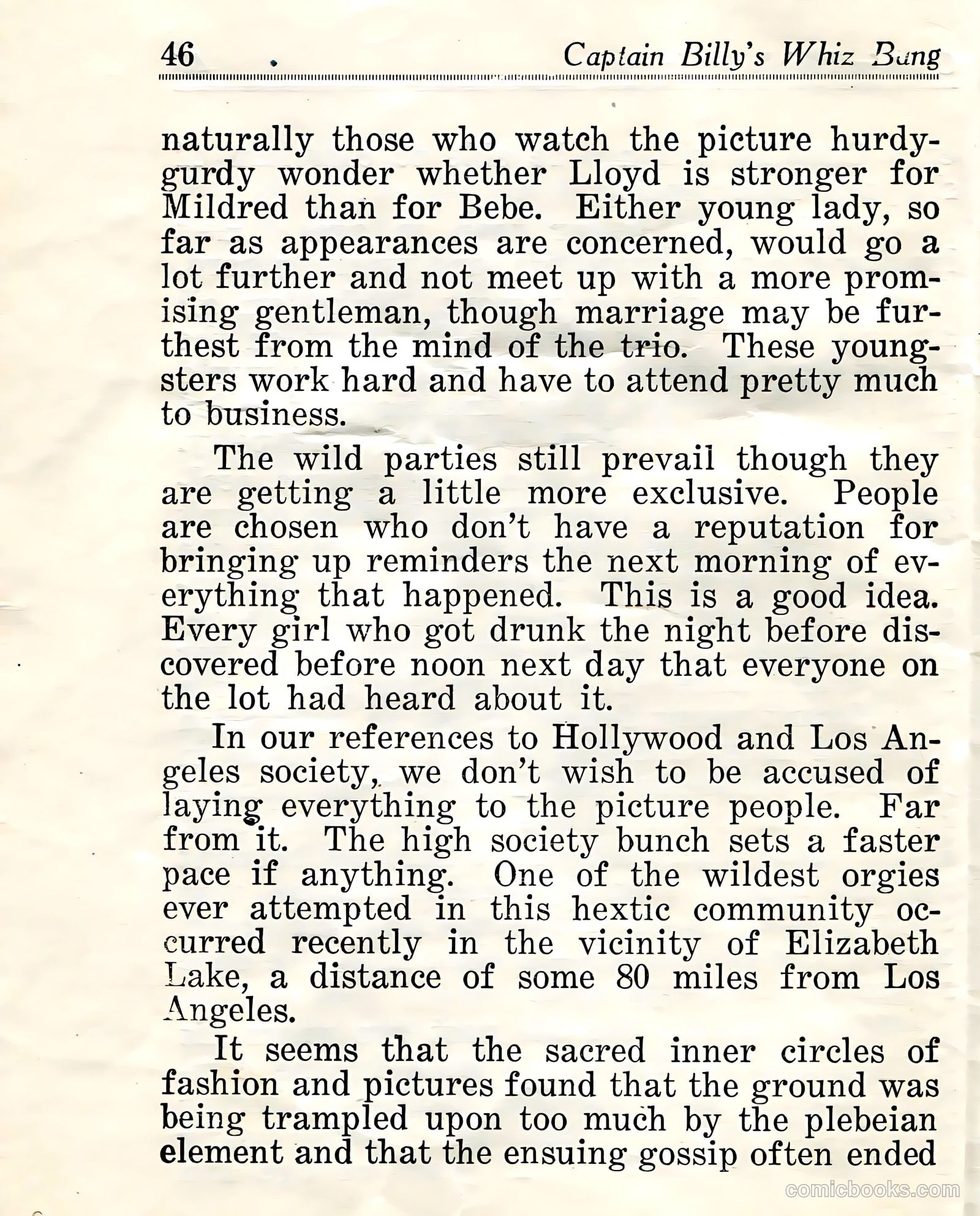
This page from *Captain Billy's Whiz Bang* (a 1920s satirical magazine) discusses Hollywood social scandals, specifically gossiping about an actor named Lloyd and two women—Mildred and Bebe (likely referring to silent film stars, though specific identities aren't confirmed here). The satire mocks: 1. **Hollywood excess**: Wild parties among film industry figures, though the writer notes high society participates equally 2. **Social hypocrisy**: "Fashion and pictures" circles attempting to exclude "plebeian element" (working-class people) from their parties to contain gossip 3. **Loose morality**: References to drunkenness and scandalous behavior among young actresses and socialites 4. **Gossip culture**: The inevitability that indiscretions become public knowledge on "the lot" (film studio grounds) The piece satirizes both Hollywood's reputation for permissiveness and the pretensions of its elite circles trying to maintain exclusivity while engaging in the same wild behavior they fear being gossiped about.
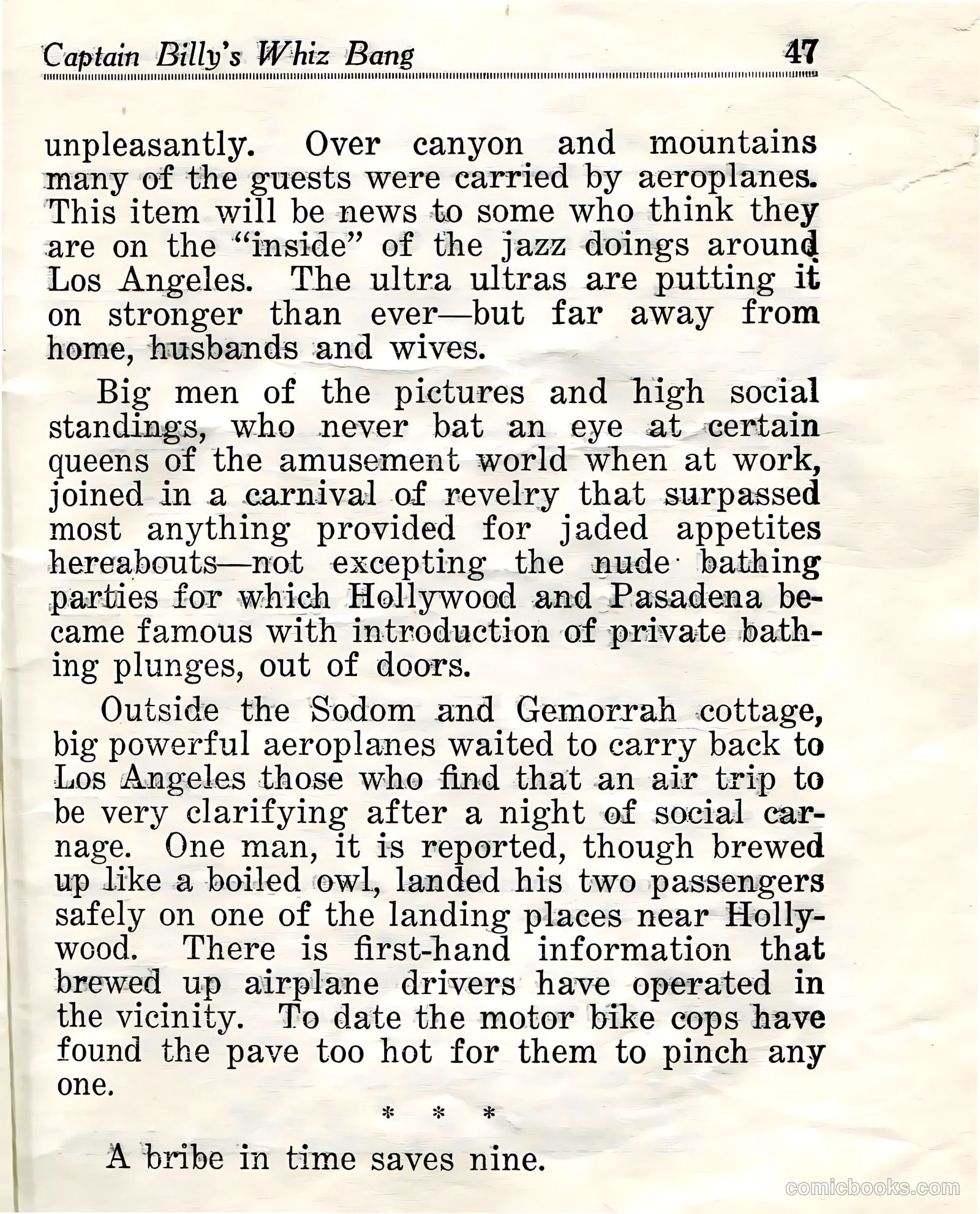
This is a satirical piece mocking Hollywood excess and moral hypocrisy in the 1920s. The text describes a secret party ("Sodom and Gemorrah cottage") where prominent film industry figures and high-society men engaged in wild revelry—including nude bathing—away from their wives and families, using private aeroplanes for transportation and quick escapes. The satire targets the double standard: these "big men of the pictures" publicly maintain respectability while privately indulging in scandalous behavior. References to "jaded appetites" and nude bathing parties allude to Hollywood's then-notorious reputation for moral laxity. The closing anecdote about a drunk pilot landing safely, plus the cryptic final line ("A bribe in time saves nine"), suggests law enforcement corruption—that even reckless or illegal behavior goes unpunished if properly paid off. The piece exposes the gap between Hollywood's public image and private conduct during the Jazz Age.
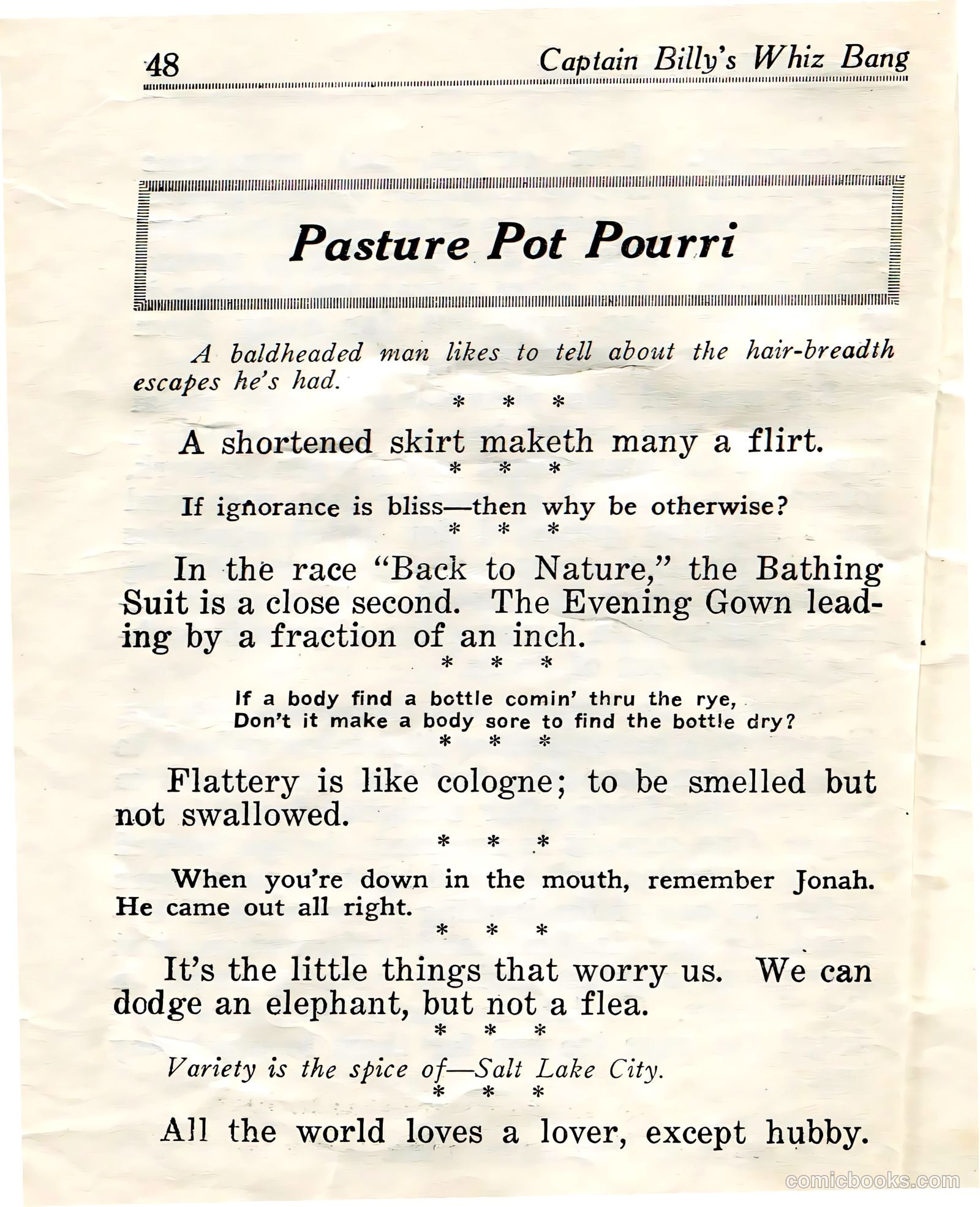
This page contains no illustrations—it's a collection of brief satirical quips and observations typical of 1920s humor magazines. The jokes mock contemporary social trends and gender relations: **Social commentary includes:** - Women's fashion changes (shortened skirts, bathing suits as "back to nature") - Marital discord ("All the world loves a lover, except hubby") - Prohibition-era drinking ("bottle comin' thru the rye") - Male vanity (baldheaded men's excuses) **The humor style** relies on wordplay, proverbs, and cynical observations about human nature—flattery compared to cologne, worry about trivial matters. References like "Salt Lake City" (known for polygamy) make oblique social jabs. This represents *Captain Billy's Whiz Bang*'s characteristic format: rapid-fire, irreverent one-liners aimed at urban, adult readers. No specific political figures or events are targeted—instead, the satire targets universal human behavior and 1920s social anxieties.
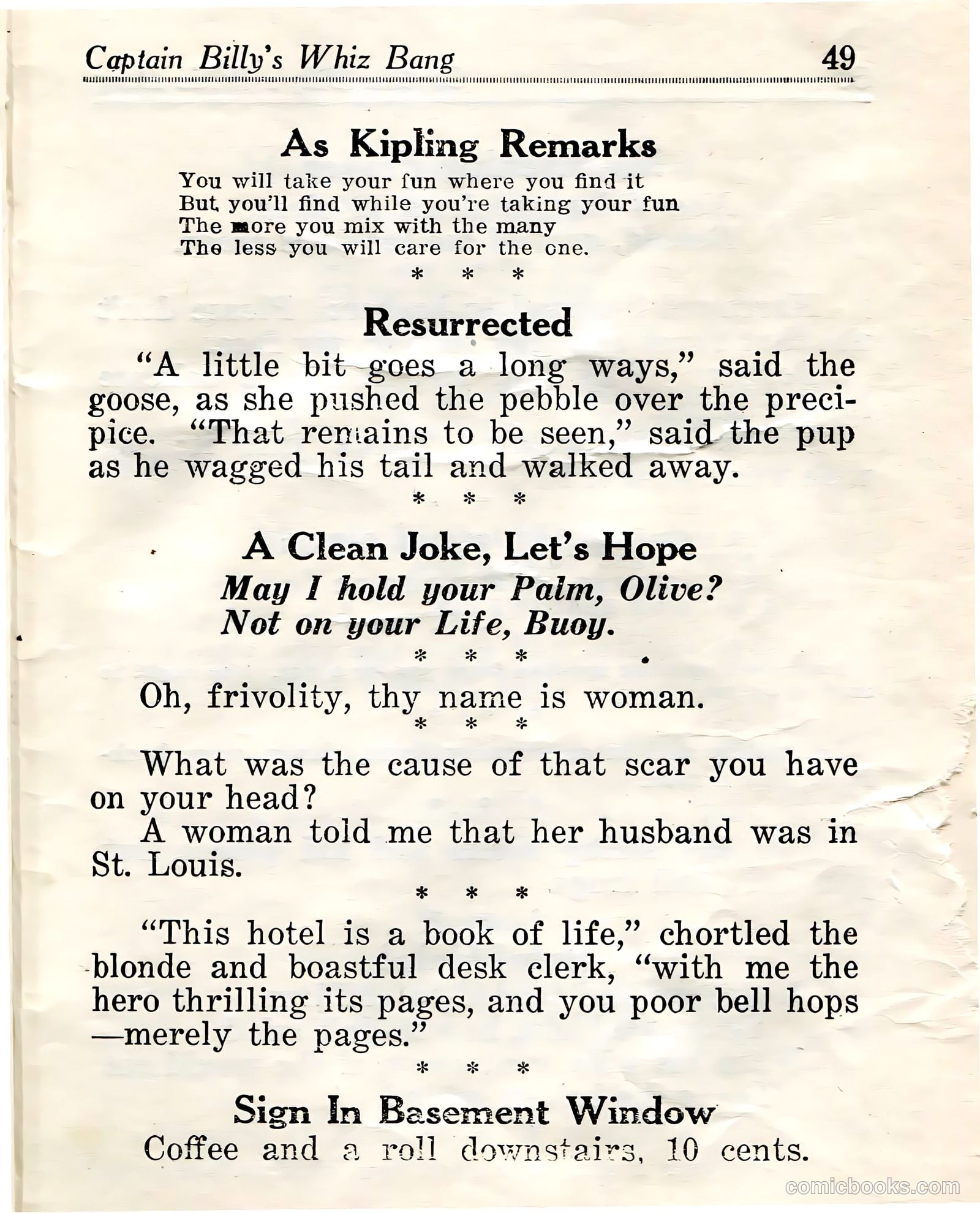
This page from a 1920s satirical magazine contains a collection of brief jokes and witticisms rather than political cartoons. The humor relies on wordplay and gender stereotypes typical of the era: **Content includes:** A Kipling quotation about socializing; animal fables; puns ("May I hold your Palm, Olive?"—plays on the names Olive and Buoy); and gendered jokes stereotyping women as frivolous and dangerous (a woman's gossip causes injury; women are blamed for marital discord in St. Louis). **The desk clerk joke** satirizes class pretension—a low-ranking hotel employee inflates his self-importance while denigrating bell hops as minor figures. **The basement window sign** advertises cheap food (10 cents), suggesting the magazine's working-class readership. Overall, this reflects Whiz Bang's accessible, irreverent humor aimed at ordinary Americans, mixing mild social observation with conventional period prejudices.
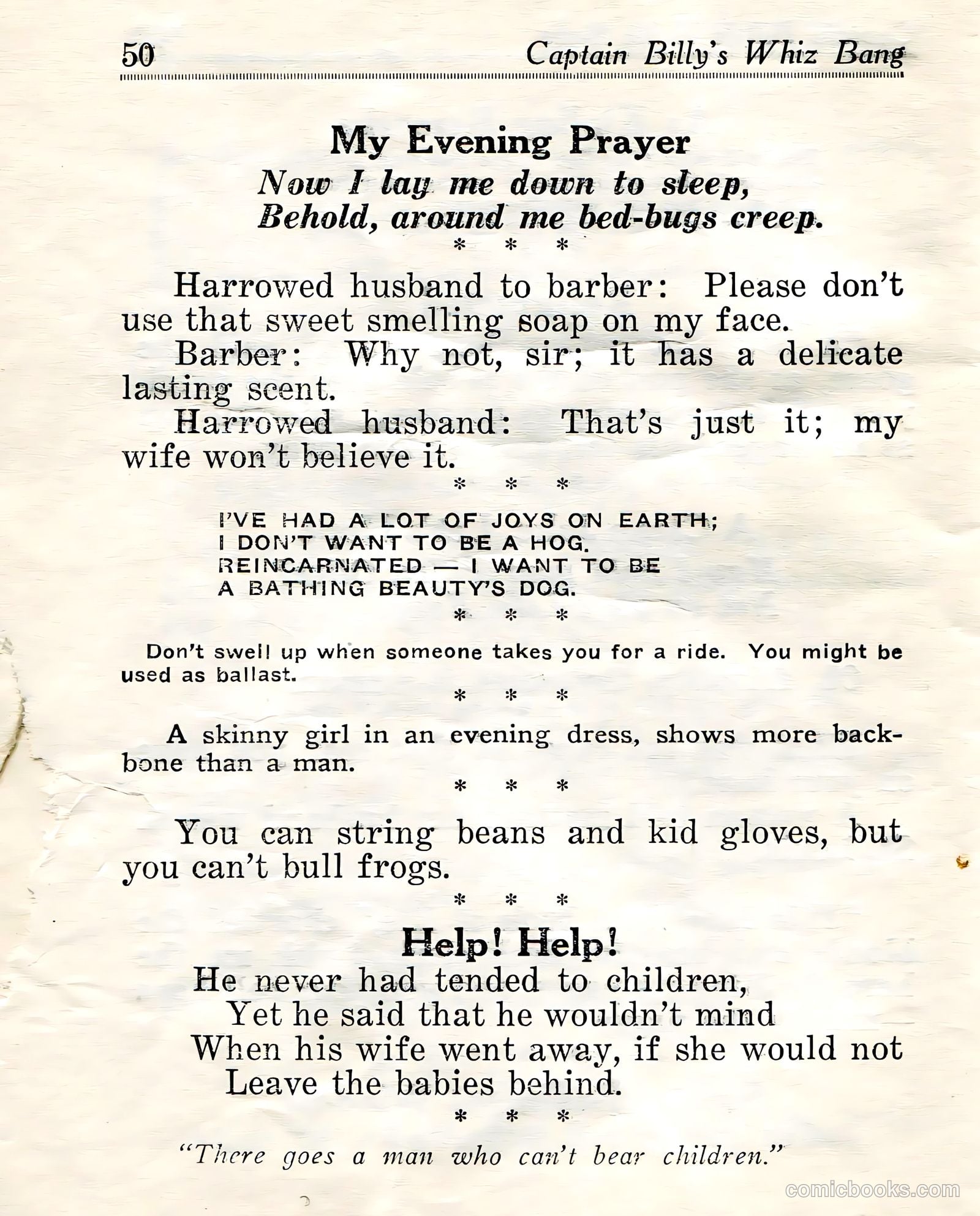
This page from *Captain Billy's Whiz Bang* (a 1920s-30s American humor magazine) collects brief jokes and satirical observations targeting social conventions of the era. **Key jokes:** - The barber anecdote mocks marital distrust—the husband fears his wife won't believe an innocent explanation for smelling of perfume - The reincarnation quip plays on materialism and objectification of "bathing beauties" (popular pin-up culture) - "Help! Help!" satirizes male incompetence with childcare—a man claims he'd accept his wife leaving if she takes the children, revealing his inability (or unwillingness) to parent - The closing joke's irony: only a man can "bear children" (metaphorically endure them), implying men avoid parental responsibility **Overall tone:** These are workplace/relationship humor targeting gender stereotypes, marital skepticism, and domestic incompetence—typical of the magazine's target male audience. The satire relies on readers recognizing exaggerated masculine failings as relatable comic types.
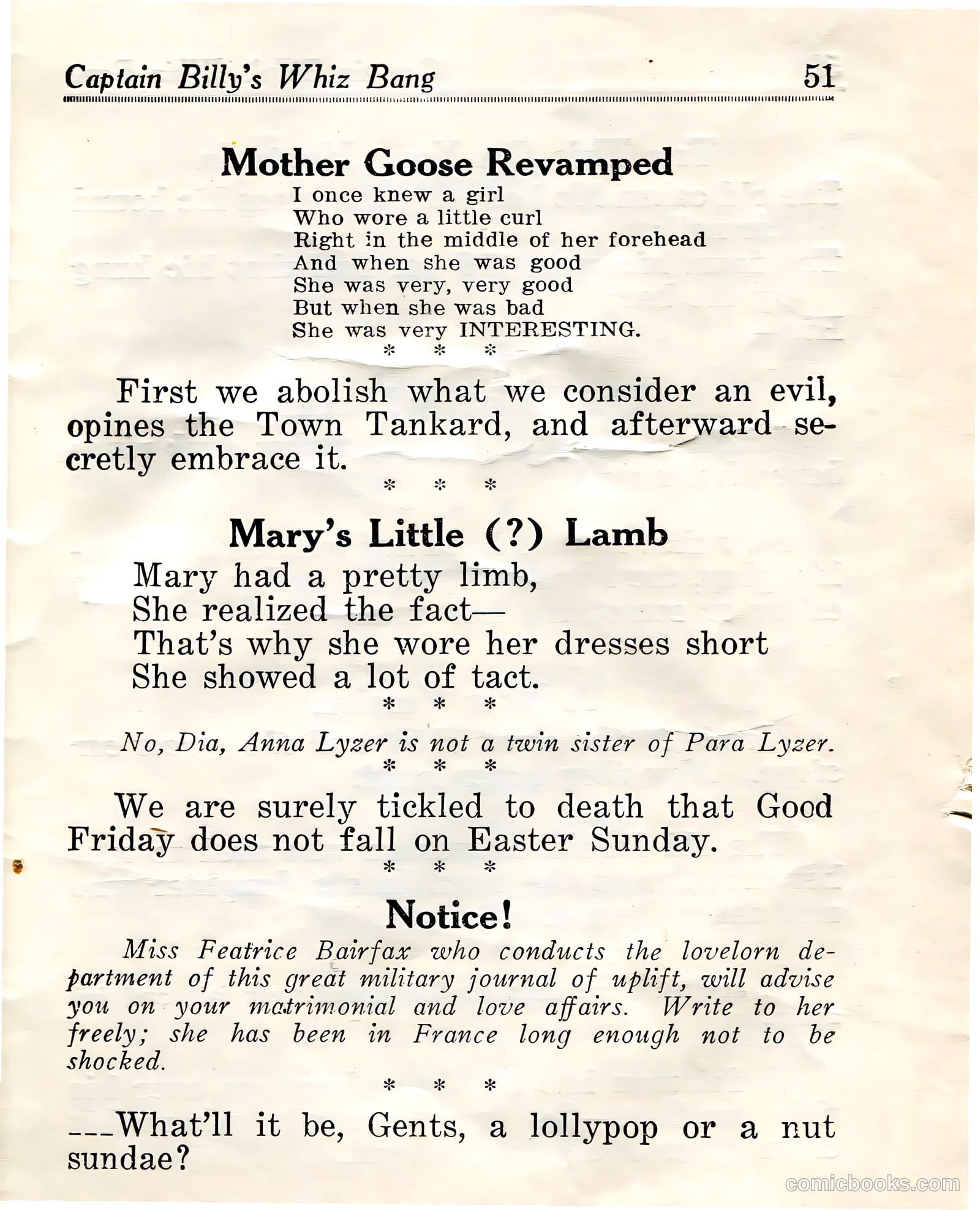
This page contains satirical humor typical of 1920s American magazines, mixing nursery rhyme parodies with social commentary: **"Mother Goose Revamped"** modernizes the classic rhyme about the girl with a curl, replacing innocent morality with innuendo—when she's "bad," she becomes "very INTERESTING," suggesting scandalous behavior. **"Mary's Little Lamb"** similarly subverts the original, replacing the lamb with a "pretty limb" (leg). The joke concerns post-WWI fashion: women wearing shorter dresses to display legs, framed as "tact" rather than impropriety. **The Town Tankard quote** satirizes hypocrisy: condemning vices publicly while privately indulging them. **The "Anna Lyzer/Para Lyzer" line** appears to be wordplay—possibly "analyzer/paralyzer"—though its specific reference is unclear. **The Miss Featrice Bairfax notice** parodies advice columnists while joking that wartime France has made her unshockable regarding romantic scandals. Overall, the page reflects post-WWI social anxieties about changing morality and women's behavior.
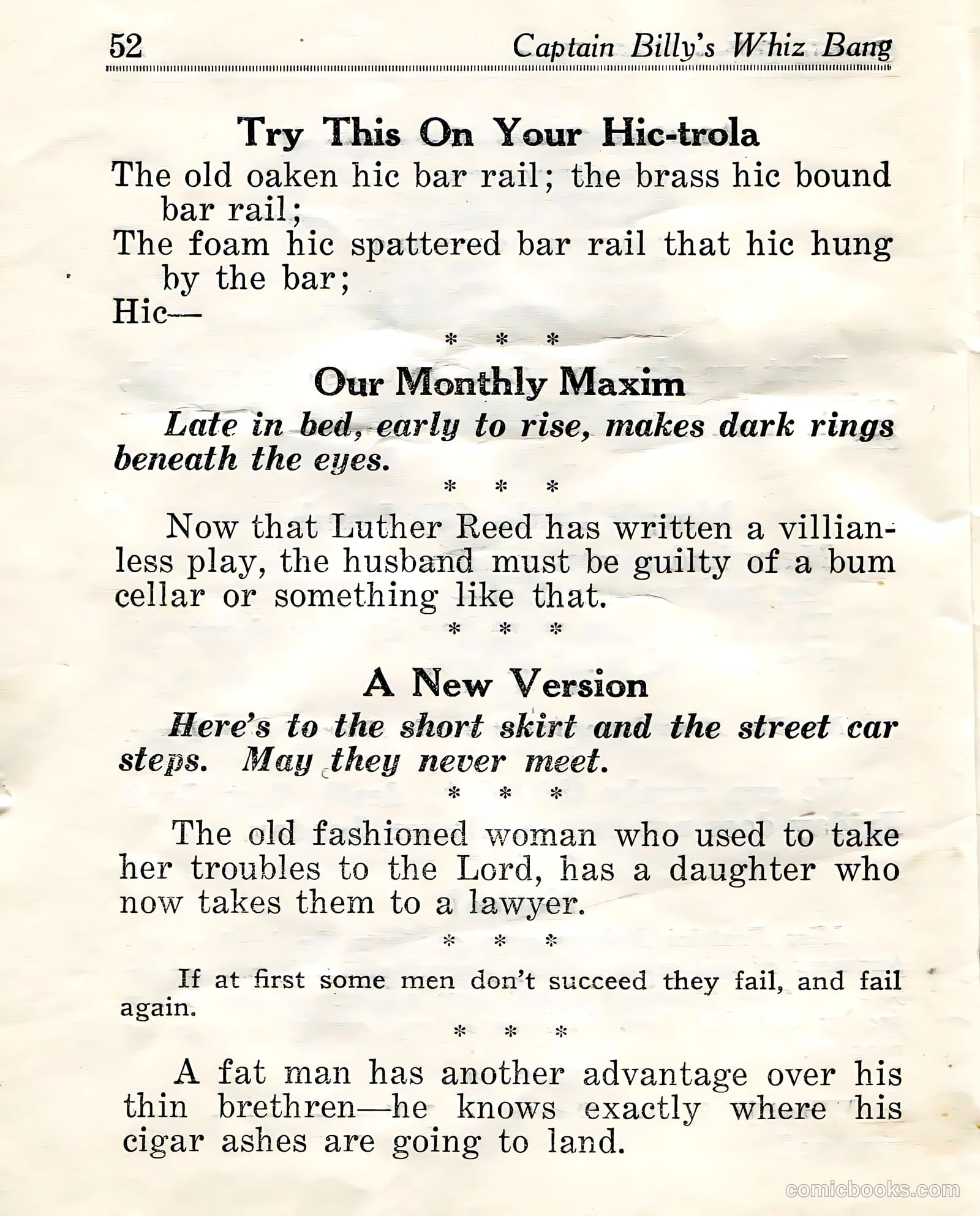
This page from the satirical magazine collects brief humorous observations and wordplay typical of 1920s American humor. The "Hic-trola" section mocks hiccupping—a drunk person trying to recite a poem phonetically, with "hic" (the sound of a hiccup) interrupting every line. It's a drinking joke. Other items satirize contemporary social changes: women's fashion (short skirts creating awkward situations on streetcars), the decline of religious faith (daughters consulting lawyers instead of praying), and generational shifts (modern women litigating rather than accepting hardship). "Luther Reed" reference likely alludes to a contemporary playwright, though specifics are unclear from the image alone. The humor relies on observational jokes about male vanity, corpulence, and life's minor frustrations—typical of this era's magazine humor, which favored wordplay and social commentary over elaborate narrative.
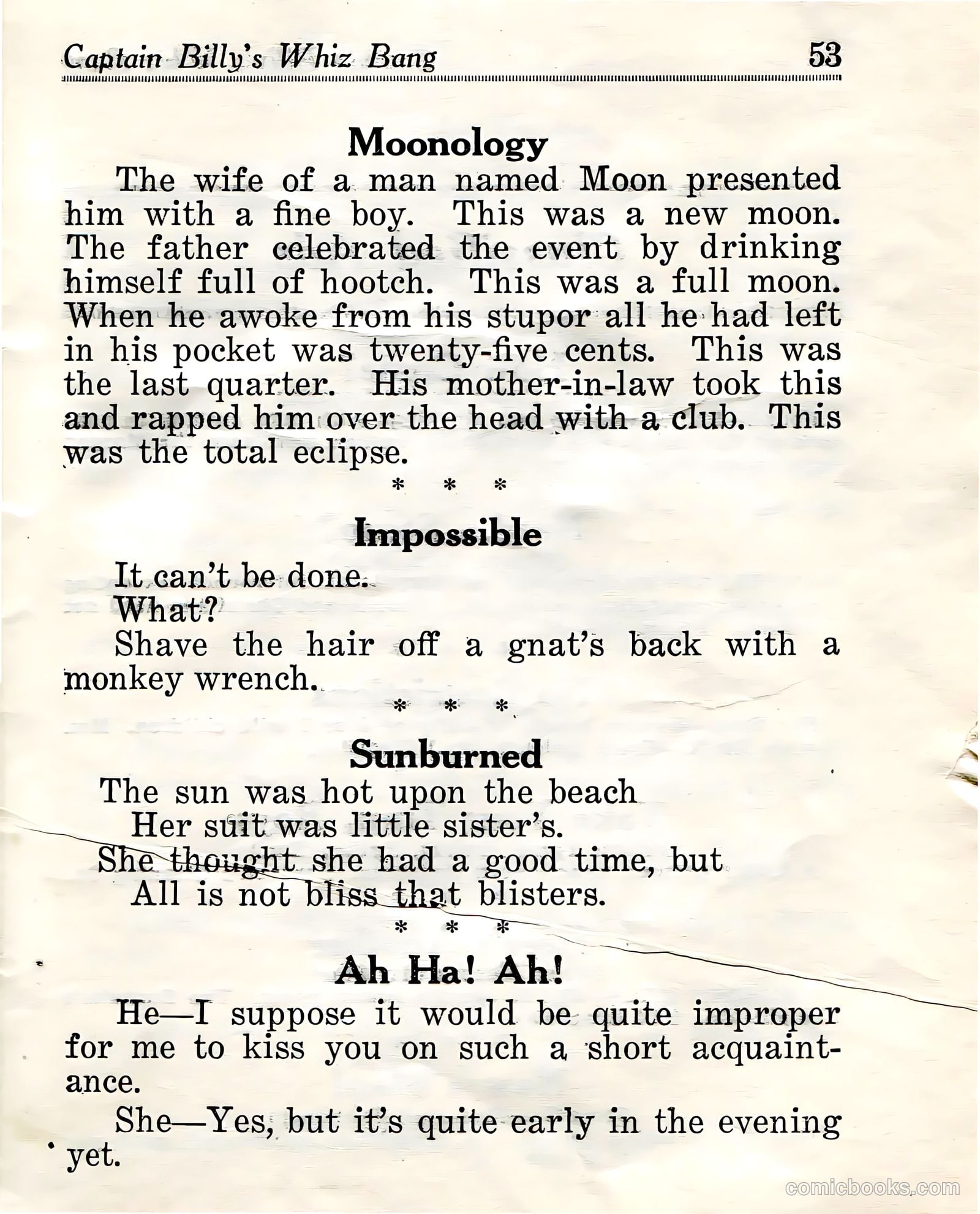
This page contains four brief jokes typical of 1920s humor magazines: **"Moonology"** is a pun-heavy joke using lunar phases to describe a man's misfortune: a newborn ("new moon"), drunken celebration ("full moon"), poverty ("last quarter"), and a beating from his mother-in-law ("total eclipse"). **"Impossible"** presents an absurdist challenge: shaving a gnat's back with a monkey wrench—deliberately nonsensical humor. **"Sunburned"** is a cautionary rhyme about a young woman wearing her sister's skimpy swimsuit at the beach, getting sunburned, with a pun on "bliss/blisters." **"Ah Ha! Ah!"** is flirtatious banter where a man hesitates to kiss a woman due to brevity of acquaintance, and she coyly suggests his reluctance is merely timing—implying she's open to it later in the evening. The humor relies on wordplay, puns, and mild risqué innuendo typical of pre-Depression American popular comedy magazines.
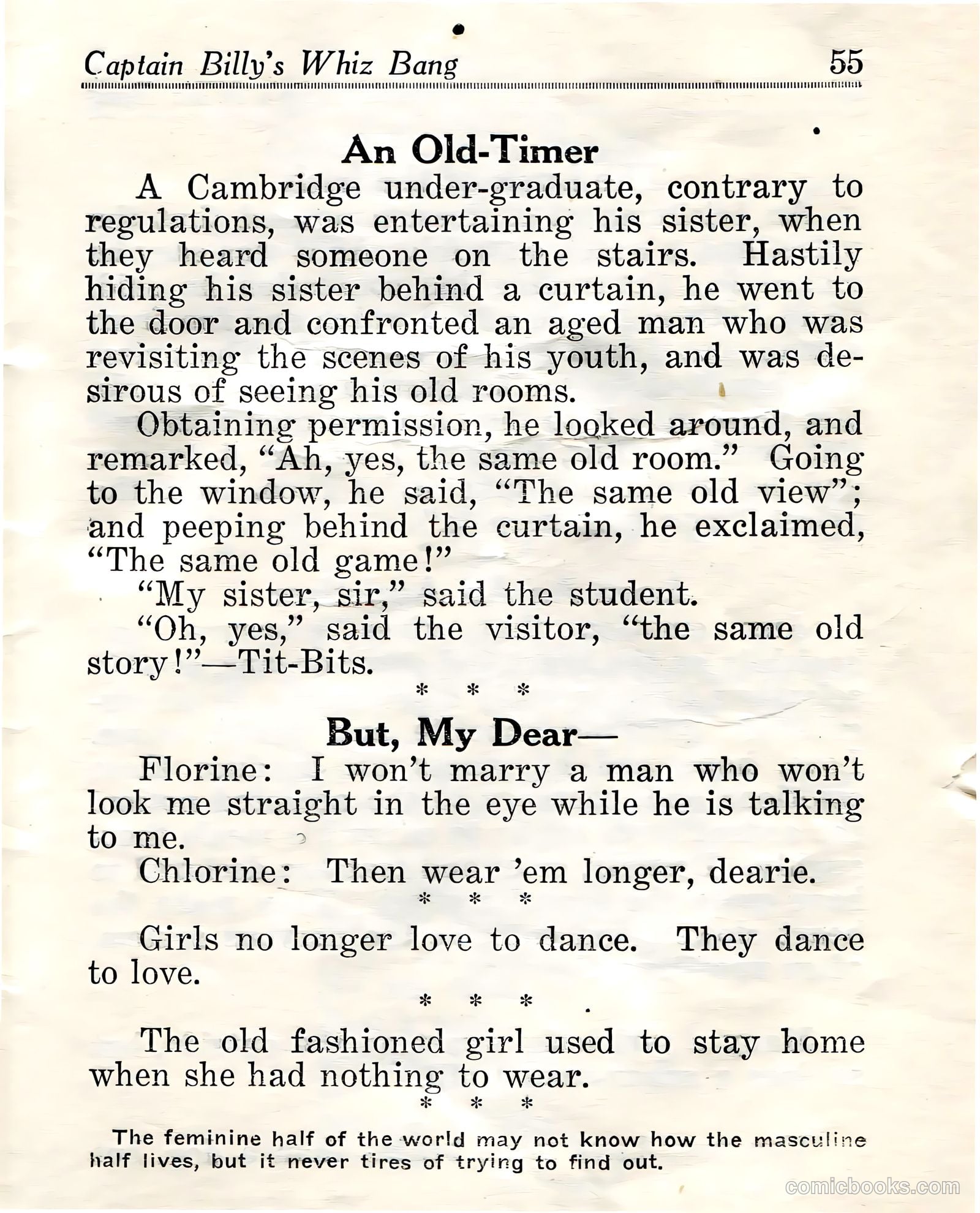
This page contains three separate humor pieces satirizing social changes, particularly around courtship and gender roles. **"An Old-Timer"** jokes about generational consistency in rule-breaking. A Cambridge student hides his sister (violating dorm regulations) when an elderly alumnus visits. The visitor sees behind the curtain but treats it as unremarkable—"the same old game"—suggesting that students have always secretly entertained female visitors, making the rule violation timeless rather than scandalous. **"But, My Dear"** satirizes women's fashion and dating standards. Florine demands eye contact from suitors; Chlorine's reply suggests wearing longer eyelashes so Florine can't maintain eye contact, mocking both women's vanity and unrealistic expectations. The remaining aphorisms mock modern girls' behavior: they pursue romance through dancing rather than for dancing's sake; unlike "old-fashioned girls," they'll go out regardless of wardrobe; women are endlessly curious about men's private lives. The overall theme: modern youth, especially women, are abandoning traditional propriety and propriety-based constraints.
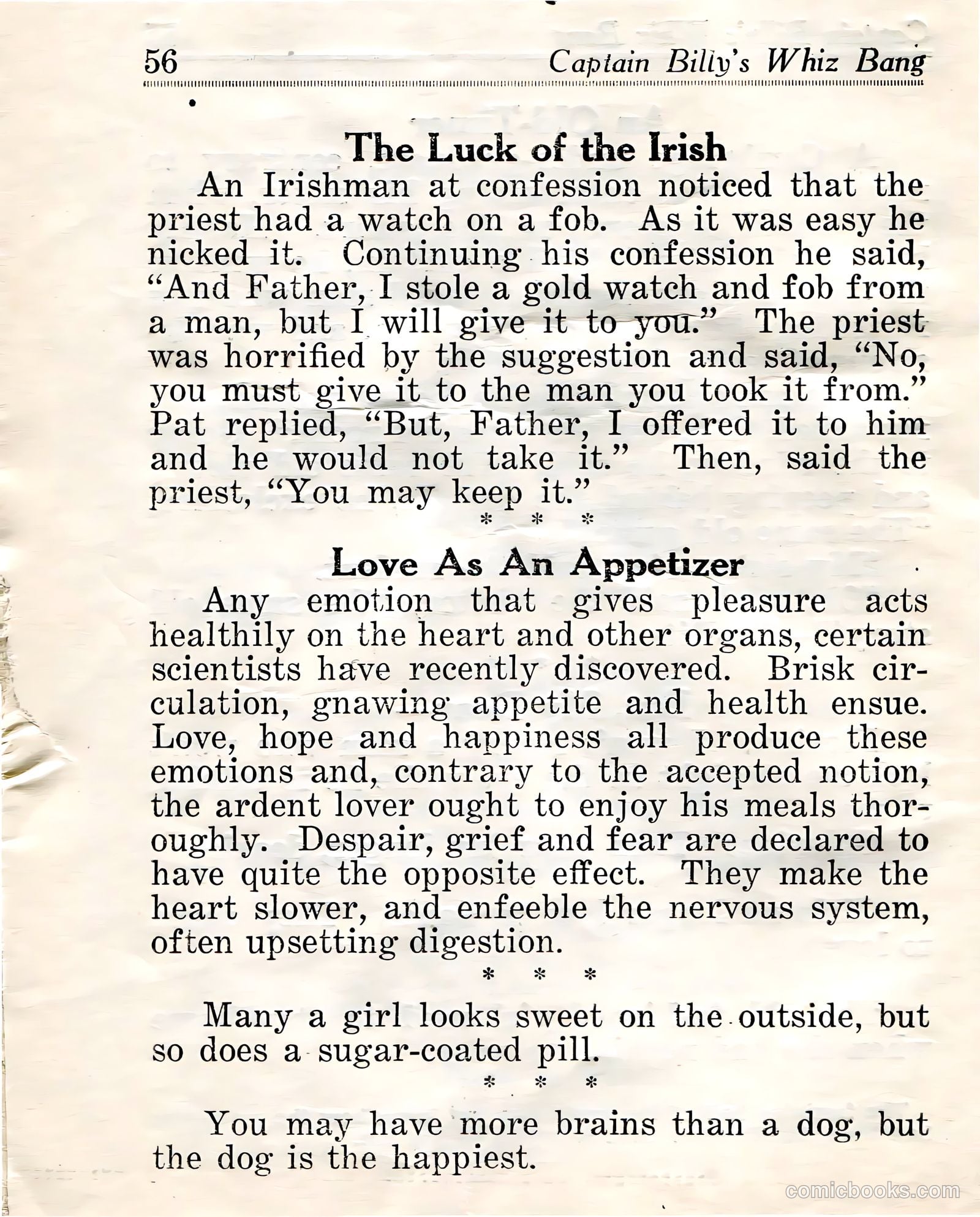
This page from *Captain Billy's Whiz Bang* contains three distinct humor pieces with no visible cartoons or caricatures: **"The Luck of the Irish"** is an ethnic joke playing on Irish stereotypes—specifically depicting an Irishman ("Pat") as a thief who confesses to stealing a priest's watch, then offers it back to the original owner. The humor relies on the absurd logic: when the victim refuses it, the priest allows him to keep it. The "luck" suggests Irish cunning or moral flexibility. **"Love As An Appetizer"** presents pseudo-scientific health advice (likely satirizing contemporary wellness trends) claiming love, hope, and happiness aid digestion and circulation, while despair harms health. The remaining short quips are cynical observations: comparing a sweet-looking girl to a sugar-coated pill (attractive exterior hiding unpleasantness) and contrasting human intelligence with dog contentment. The page represents *Whiz Bang's* typical mix of ethnic humor, satirical health commentary, and sardonic aphorisms—early 20th-century pulp magazine fare targeting working-class readers.
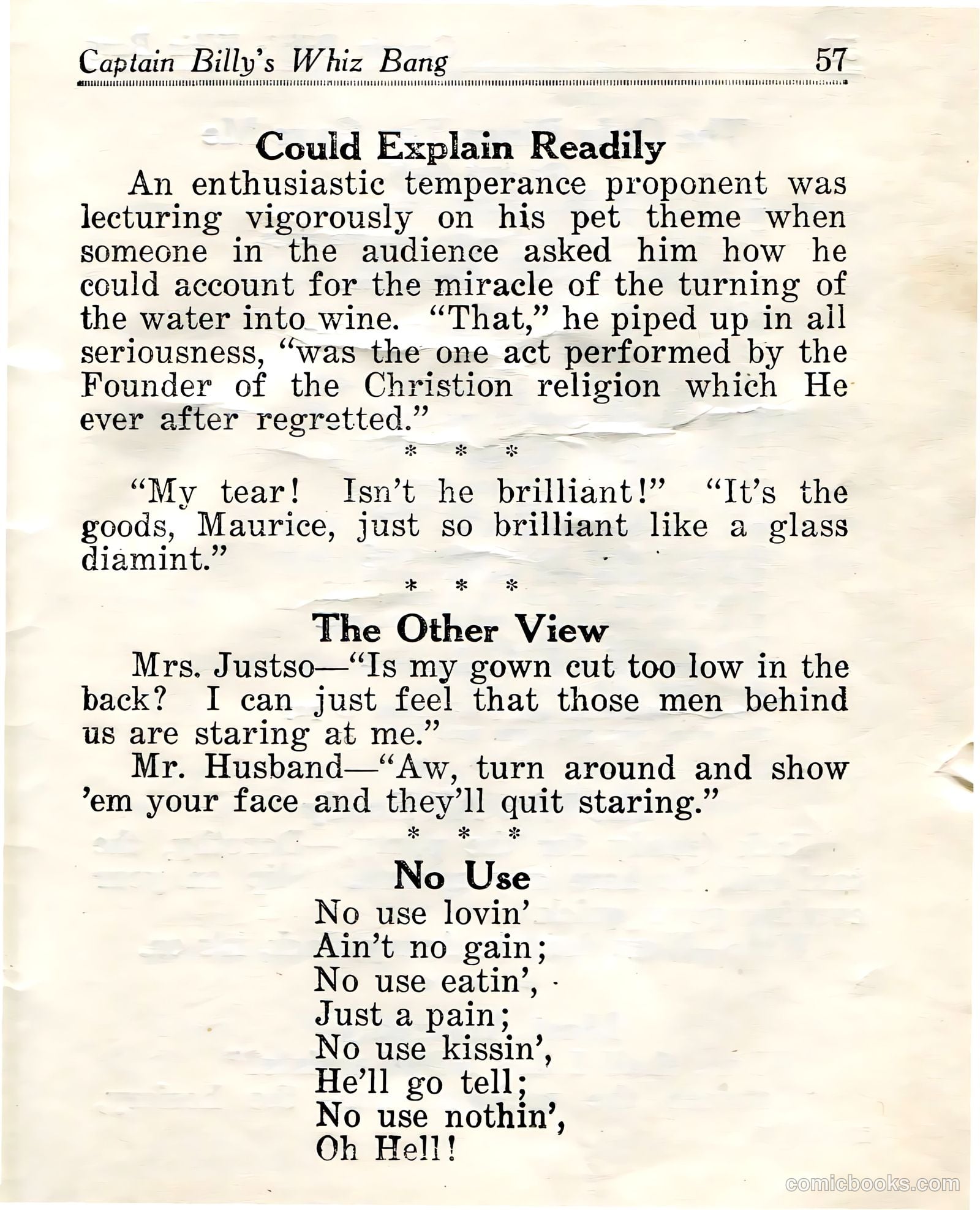
This page from the satirical magazine contains four brief humor pieces typical of early 20th-century American comedy: 1. **"Could Explain Readily"**: Mocks a temperance lecturer by having him claim Jesus regretted turning water into wine—absurd logic that undercuts the prohibition movement's moral authority. 2. **"My tear!"**: Appears to satirize affected speech or snobbery, with characters using exaggerated diction ("diamint" for "diamond"). 3. **"The Other View"**: A domestic joke where a wife worries her low-cut dress attracts stares; her husband's brutal comeback suggests her face is so unattractive it will repel attention instead. 4. **"No Use"**: A cynical poem about romantic disappointment—love gains nothing, eating causes pain, kissing leads to gossip. Expresses romantic disillusionment in humorous verse. The humor relies on period attitudes: anti-temperance sentiment, class mockery, marital ridicule, and romantic pessimism. These short jokes were standard filler content in early 1900s comic magazines.
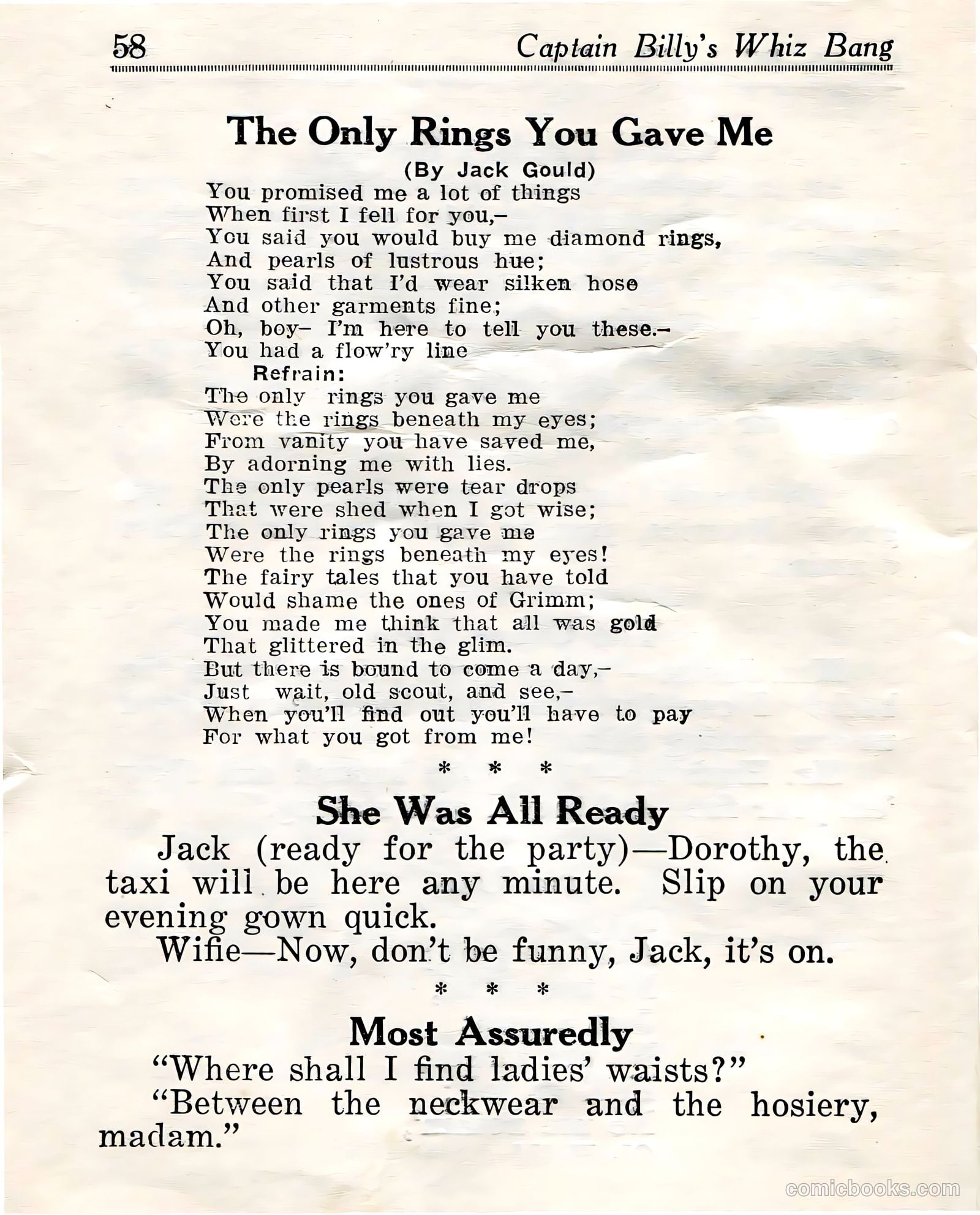
This page contains three satirical pieces from *Captain Billy's Whiz Bang*, a 1920s-era humor magazine. **"The Only Rings You Gave Me"** is a song-poem about romantic deception. A woman accuses her suitor of making extravagant promises (diamond rings, pearls, fine clothes) that he never delivered. Instead, the "rings" she received were dark circles under her eyes from crying when she realized his lies. The satire targets men who use flattery and false promises to manipulate women romantically. **"She Was All Ready"** is a brief marital joke playing on women's fashion of the era—likely referring to women's restrictive corsetry or the difficulty of dressing quickly. The humor relies on the wife's deadpan response suggesting she's already wearing her evening gown (implying she's gained weight or the garment is permanently affixed). **"Most Assuredly"** is a joke about department store layout, punning on "waists" (garments) versus women's bodies, implying ladies' figures fall between neckwear and hosiery measurements. All three pieces reflect post-WWI attitudes toward gender, courtship, and consumer culture.
This is a "Rural Mail Box" advice column—a popular feature in early 20th-century magazines where readers submitted questions under pseudonyms and editors replied with witty, often risqué answers. The humor relies on double meanings and innuendo. "Rev. Golightly Morrill" likely references clergy hypocrisy; "Rev. Numm's" recipe question (don't forget raisins) appears to reference homemade alcohol during Prohibition; Lew Dikrus's comment about Gus shaving his head and burning clothes suggests drastic reaction to illness or madness; Cora Gate's advice to "slap his face" responds to unspecified male misbehavior; Iva Byte's cynical "all men are like that" is sardonic commentary on male behavior. The final joke—that the stork rivals the eagle as America's national bird—is a fertility/birth reference, playing on the stork mythology used to explain where babies come from. The feature trades in gentle, coded sexual humor and domestic complaint typical of 1920s-era men's magazines.
This page contains three humorous pieces typical of 1920s satirical magazines: **"Essence of Joy, By Gum"** is a comedic poem about a young woman who agrees to kiss a youth only if he buys her chewing gum. The joke plays on her obsessive gum-chewing—as the moment approaches, she chews faster and faster, eventually swallowing her gum mid-kiss and lamenting the loss of the gum more than enjoying the romantic moment. The satire targets consumerism and the triviality of modern romance. **"His First Offense"** presents a brief ethnic comedy (likely featuring Yiddish-inflected speech from a character named "Abe," suggesting Jewish immigrant humor). The joke: when a jail bath attendant asks if the prisoner ever bathed before, he replies he's never been arrested before—implying poor hygiene correlates with criminal activity. **The final couplet** is conventional romantic verse with no apparent satirical content. These pieces reflect Whiz Bang's focus on risqué humor, consumer culture mockery, and ethnic stereotypes typical of American humor magazines of that era.
This is a humor page from *Captain Billy's Whiz Bang*, a satirical magazine popular in the 1920s-30s. The content consists of three unrelated jokes: 1. **The opening poem** is a deliberately incomplete sea shanty about a sailor on a ship bound for Sydney. The narrator tells the mate to "go away"—likely a euphemistic or suggestive punchline that trails off. 2. **The editorial note** acknowledges the poem is amateurish ("we grew tired and finished it up"), self-deprecatingly admitting the writers couldn't sustain the verse. 3. **The "Gus" anecdote** is a romantic/flirtation joke: a man meets a girl at a movie; she has her arm around him, but afterward he discovers her arm was also in his pocket—suggesting either theft or intimate contact he didn't fully notice. 4. **The closing quip** sardonically suggests romantic loss is preferable to hearing divorce court testimony. The humor is mild, bawdy-adjacent, and relies on innuendo rather than explicit content—typical of the era's popular humor magazines.
This is a comedic dialogue between a father interrogating his son about college behavior. The satire works through the son's responses: he claims to have avoided vices while actually confessing to worse ones. The humor relies on **evasive wordplay and technical honesty**. When the father asks about cards, the son says he "only played dice"—technically not cards, but still gambling. Asked about cigarettes, he smokes cigars and a pipe instead. Denied sneaking drinks, he made alcohol himself. He didn't go to midnight revues—he "went with the chorus when they were through" (implying inappropriate encounters). The escalation culminates in casual admissions of carrying a gun, making homemade liquor, and "dancing without any light" (sexual activity). **Context**: This reflects 1920s concerns about youth morality during Prohibition. The satire mocks both the father's naive questioning and the son's brazen deflections—suggesting young men were openly flouting social expectations while technically answering their elders truthfully. The joke is that the son is far *worse* than feared, not better.
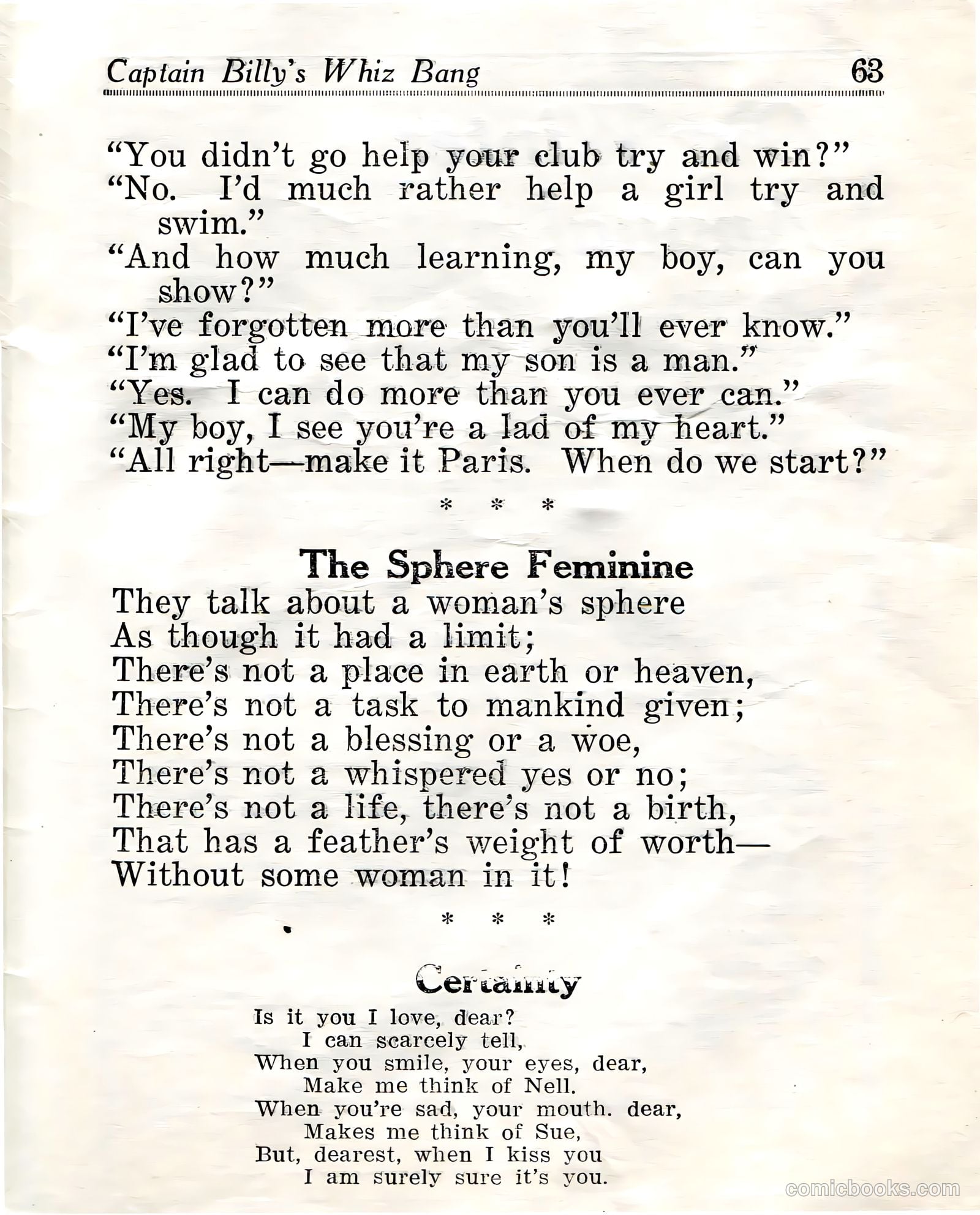
This page from the satirical magazine contains three humorous pieces about gender and courtship. The opening dialogue satirizes youthful male priorities and cockiness. A young man chooses helping a girl swim over club competition, then boasts of superior knowledge while seducing his father into funding a Paris trip—a common trope for young men seeking adventure (and moral freedom) abroad. The joke mocks both adolescent swagger and paternal indulgence. "The Sphere Feminine" is a pro-women's rights poem asserting that women's influence permeates all human activity, countering the Victorian notion of separate "spheres" limiting women to domestic life. It advocates for female significance across all endeavors. "Certainty" is a lighthearted romantic poem where a man admits his lover reminds him of other women until—in a playful twist—he's confident kissing proves it's actually *her*. It gently mocks the superficiality of romantic attraction while celebrating physical intimacy as proof of authentic connection. Together, these pieces blend satirical social commentary with era-typical romance humor.
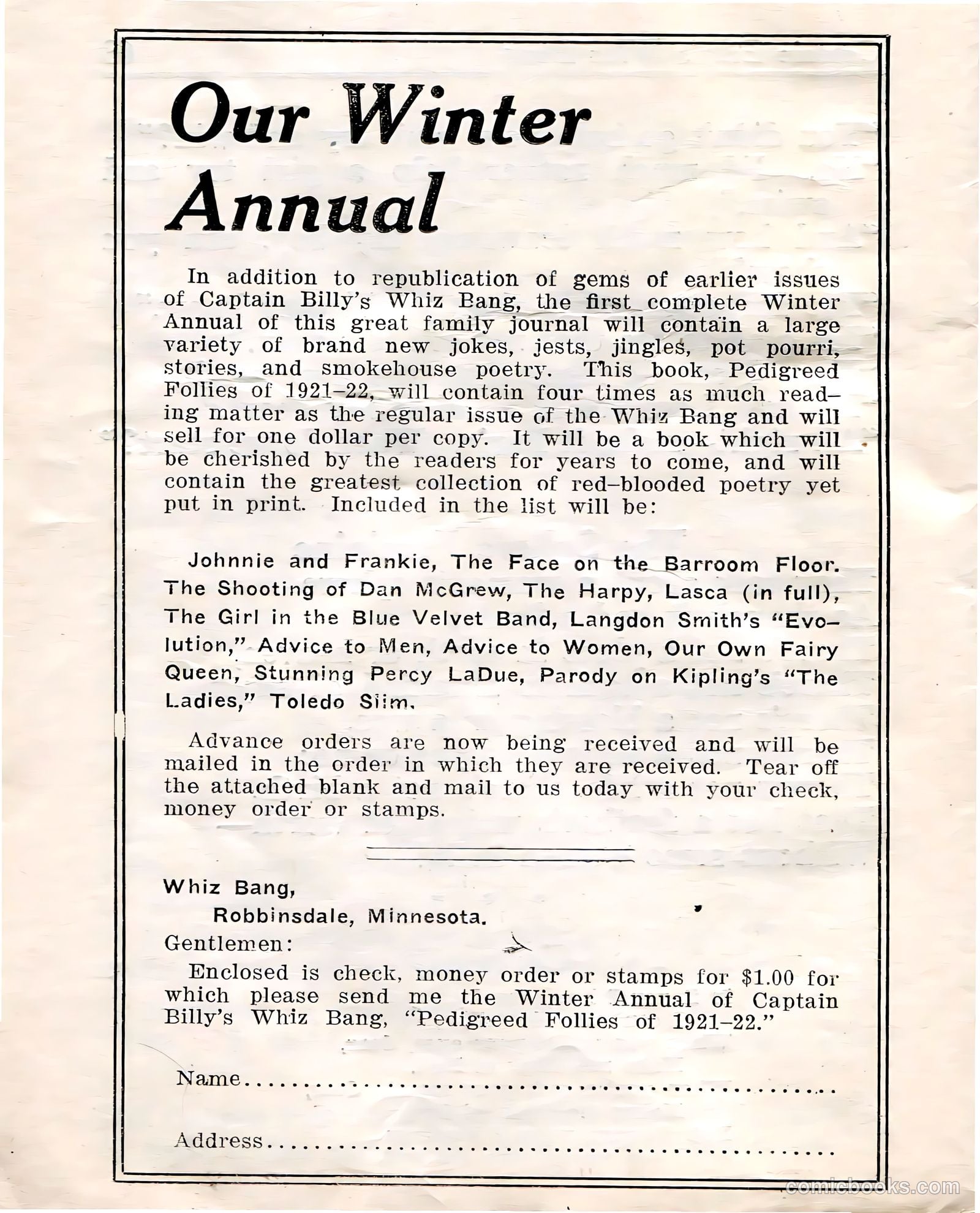
This is primarily an **advertisement page**, not a cartoon. It promotes Captain Billy's *Whiz Bang* magazine's upcoming "Winter Annual" for 1921-22. The page announces a special $1 publication containing four times the regular content—jokes, poetry, stories, and what they call "red-blooded poetry." It lists upcoming pieces including titles like "Johnnie and Frankie," "The Face on the Barroom Floor," and "The Shooting of Dan McGrew," suggesting content mixing humor, melodrama, and popular verse. The order form at bottom allows readers to purchase by check, money order, or stamps from Robbinsdale, Minnesota. This reflects typical 1920s mail-order publishing practices. The magazine targeted male readers with working-class humor and sentimental storytelling.
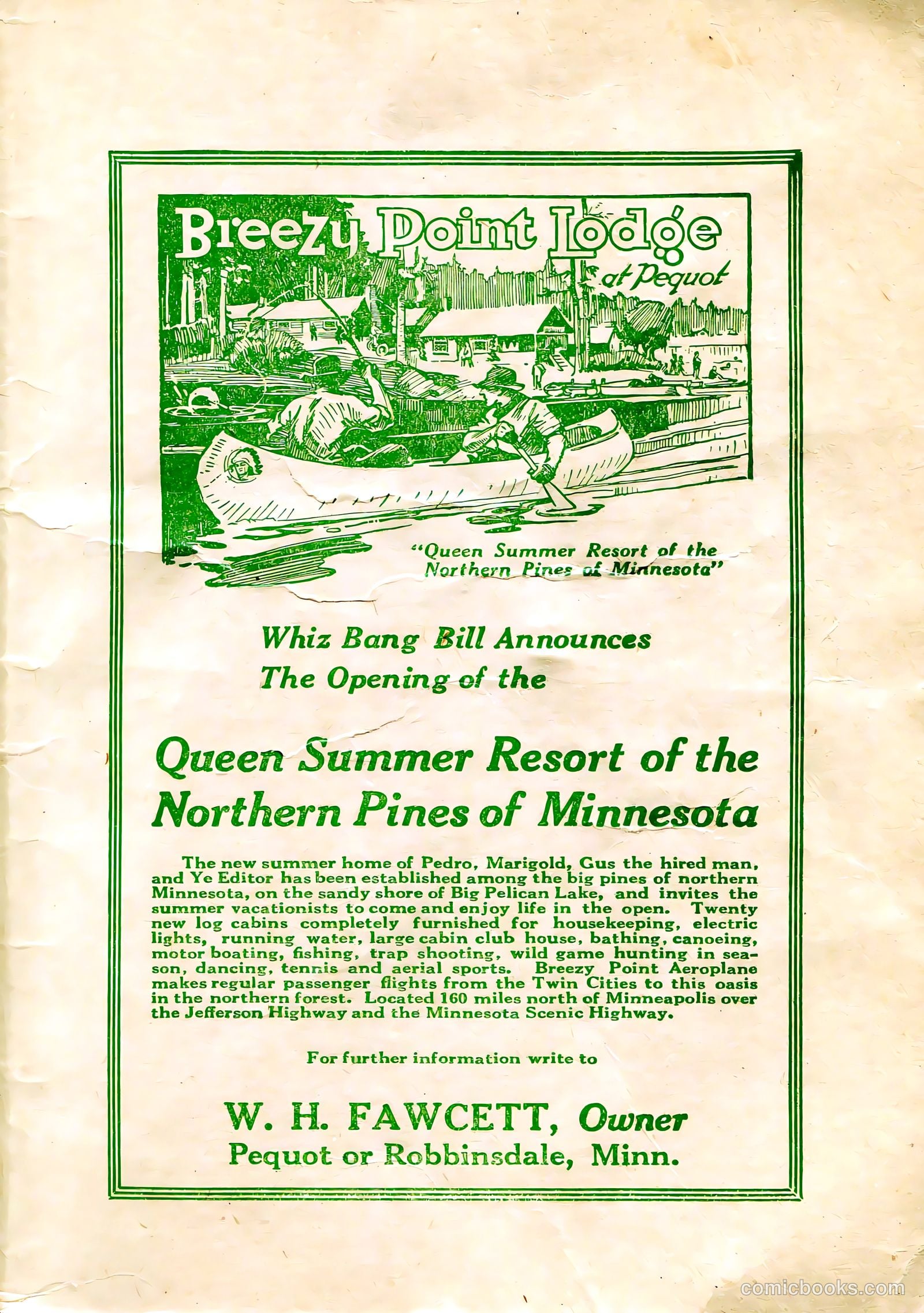
This is primarily **a resort advertisement**, not political satire. It announces the opening of Breezy Point Lodge on Big Pelican Lake in northern Minnesota, owned by W.H. Fawcett. The page references "Whiz Bang Bill" and mentions "Pedro, Marigold, Gus the hired man, and Ye Editor" as the resort's new summer home. These appear to be recurring characters from *Whiz Bang* magazine itself—the publication's own mascots or editorial personas claiming to endorse this vacation destination. The illustration shows period-appropriate leisure activities: canoeing, log cabins, and tourists. This reflects 1920s American tourism marketing, emphasizing wilderness escape, modern amenities (electric lights), and novel attractions like "aerial sports" and aeroplane service from Minneapolis. **No political commentary is evident.** This is straightforward early-20th-century advertorial content, using the magazine's brand recognition to promote a real business venture 160 miles north of Minneapolis.
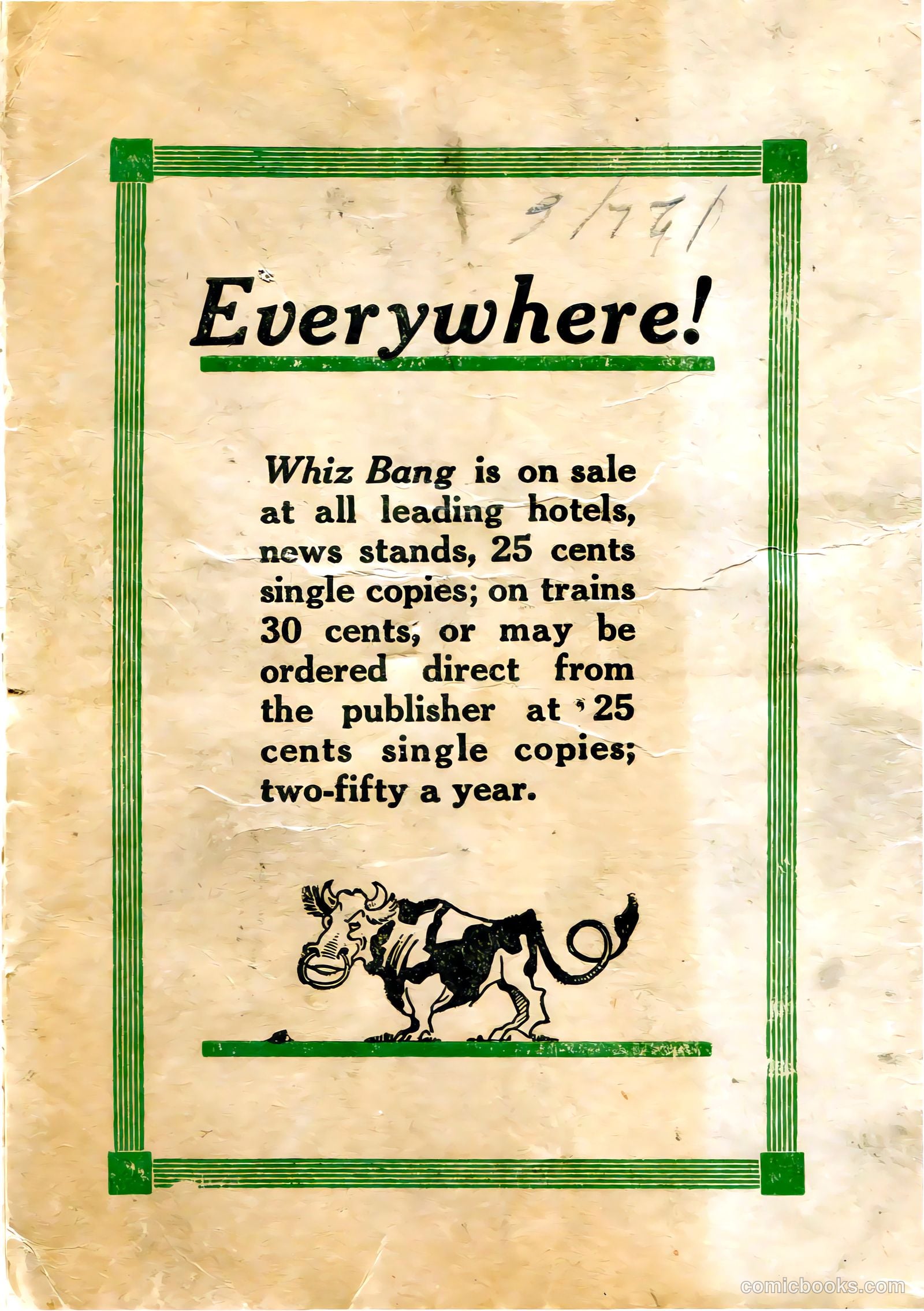
This is primarily a **title/advertisement page** for *Whiz Bang*, an American satirical magazine. The page announces the publication's availability and pricing across various retail channels—hotels, newsstands (25 cents), trains (30 cents), and direct subscription ($2.50 annually). The cartoon element is minimal: a playful **cow mascot** with horns and a mischievous expression serves as the magazine's logo or brand identifier. The cow appears designed to convey humor and irreverence, fitting for a satirical publication. The decorative green art deco border frames the content in the style typical of 1920s-era printing. The overall design emphasizes the magazine's widespread distribution and accessibility to the general public during this period.