
Captain Billy's Whiz Bang, August 1921 · page 24 of 68
Captain Billy's Whiz Bang #23 — page 24: what you’re looking at
What you’re looking at
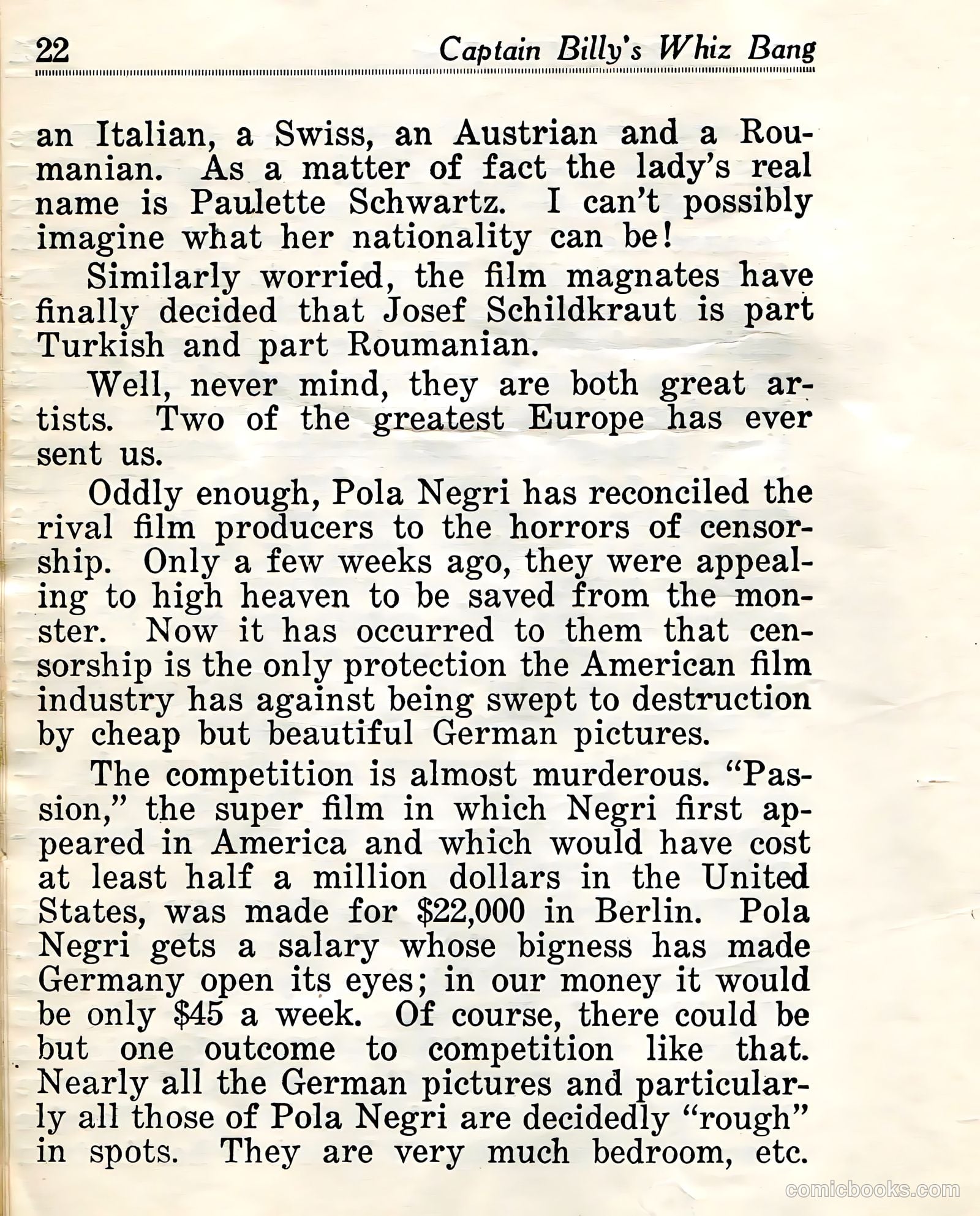
This satirical column mocks early 1920s Hollywood's anxieties about foreign competition and censorship. The piece ridicules film producers' confusion over European actors' nationalities—citing Paulette Schwartz and Josef Schildkraut as examples of stars with mixed ethnic backgrounds that studios struggle to market. The main target is the film industry's sudden embrace of censorship. Producers previously opposed it fiercely, but now recognize it as protection against cheaper, more risqué German films flooding the American market. The Polish actress Pola Negri exemplifies this threat: her film "Passion" cost only $22,000 in Berlin (versus half a million dollars for American equivalents), and her salary—$45/week in American currency—reveals the economic disparity. The satire suggests producers cynically support censorship not for morality but competitive advantage, while German films' "bedroom" content makes them commercially dangerous to American studios.
📄 Transcribed text from this page (OCR, searchable)
Machine-transcribed from the original scan — historical spelling and the odd misread are preserved.
22 Captain Billy's Whiz Bang an Italian, a Swiss, an Austrian and a Rou- manian. As a matter of fact the lady's real name is Paulette Schwartz. I can't possibly imagine what her nationality can be! Similarly worried, the film magnates have finally decided that Josef Schildkraut is part Turkish and part Roumanian. Well, never mind, they are both great ar- tists. Two of the greatest Europe has ever sent us. Oddly enough, Pola Negri has reconciled the rival film producers to the horrors of censor- ship. Only a few weeks ago, they were appeal- ing to high heaven to be saved from the mon- ster. Now it has occurred to them that cen- sorship is the only protection the American film industry has against being swept to destruction by cheap but beautiful German pictures. The competition is almost murderous. “Pas- sion,” the super film in which Negri first ap- peared in America and which would have cost at least half a million dollars in the United States, was made for $22,000 in Berlin. Pola Negri gets a salary whose bigness has made Germany open its eyes; in our money it would be only $45 a week. Of course, there could be but one outcome to competition like that. Nearly all the German pictures and particular- ly all those of Pola Negri are decidedly “rough” in spots. They are very much bedroom, etc.