
Captain Billy's Whiz Bang, August 1921 · page 61 of 68
Captain Billy's Whiz Bang #23 — page 61: what you’re looking at
What you’re looking at
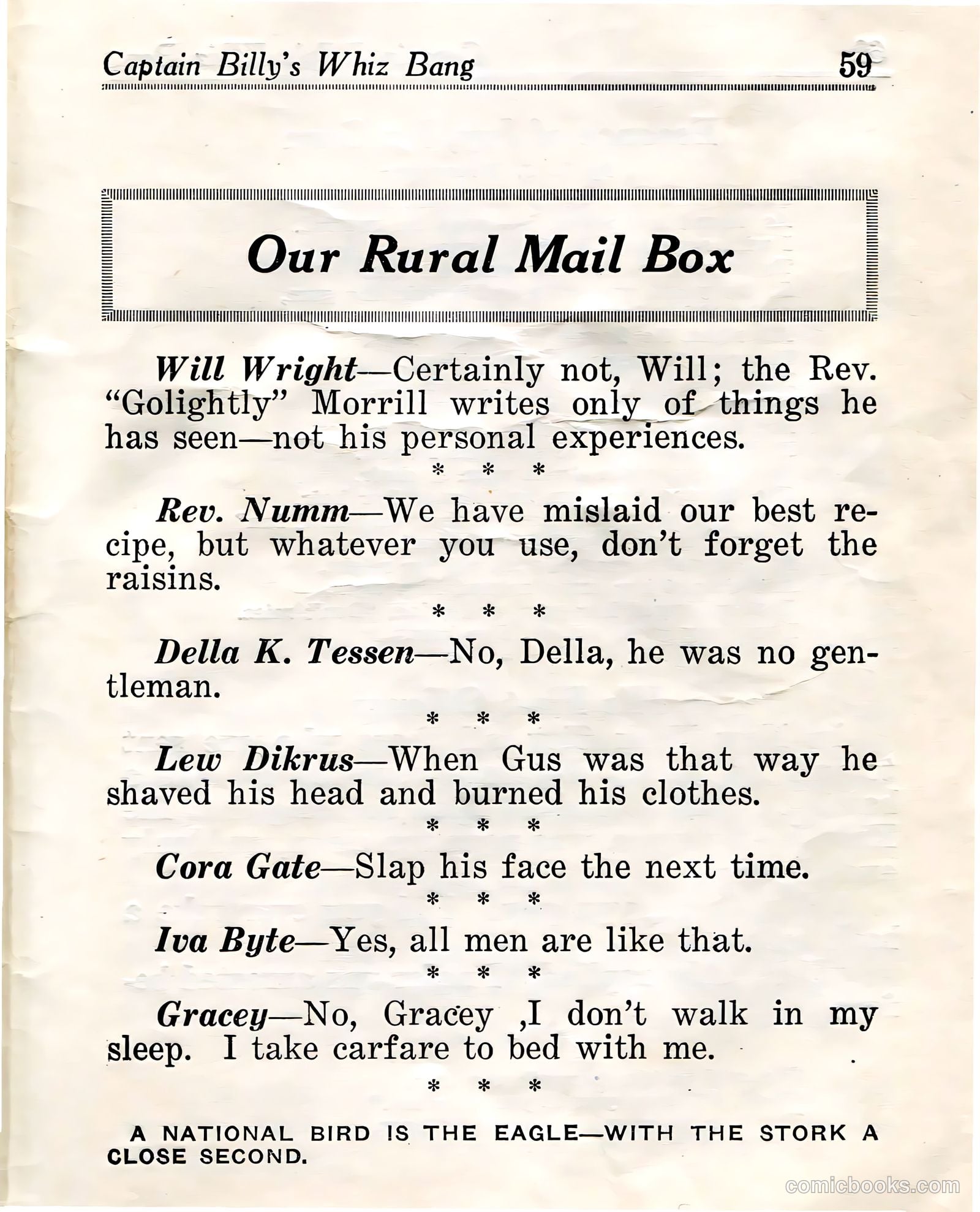
This is a "Rural Mail Box" advice column—a popular feature in early 20th-century magazines where readers submitted questions under pseudonyms and editors replied with witty, often risqué answers. The humor relies on double meanings and innuendo. "Rev. Golightly Morrill" likely references clergy hypocrisy; "Rev. Numm's" recipe question (don't forget raisins) appears to reference homemade alcohol during Prohibition; Lew Dikrus's comment about Gus shaving his head and burning clothes suggests drastic reaction to illness or madness; Cora Gate's advice to "slap his face" responds to unspecified male misbehavior; Iva Byte's cynical "all men are like that" is sardonic commentary on male behavior. The final joke—that the stork rivals the eagle as America's national bird—is a fertility/birth reference, playing on the stork mythology used to explain where babies come from. The feature trades in gentle, coded sexual humor and domestic complaint typical of 1920s-era men's magazines.
📄 Transcribed text from this page (OCR, searchable)
Machine-transcribed from the original scan — historical spelling and the odd misread are preserved.
Captain Billy’s Whiz Bang 59 Our Rural Mail Box Will Wright—Certainly not, Will; the Rev. “Golightly” Morrill writes only of things he has seen—not his personal experiences. * * * Rev. Numm—We have mislaid our best re- cipe, but whatever you use, don’t forget the raisins. * * * Della K. Tessen—No, Della, he was no gen- tleman. * * * Lew Dikrus—When Gus was that way he shaved his head and burned his clothes. * * * Cora Gate—Slap his face the next time. * * * Iva Byte—Yes, all men are like that. * * * Gracey—No, Gracey ,I don’t walk in my sleep. I take carfare to bed with me. * * * A NATIONAL BIRD IS THE EAGLE—WITH THE STORK A CLOSE SECOND.