
Captain Billy's Whiz Bang, August 1921 · page 21 of 68
Captain Billy's Whiz Bang #23 — page 21: what you’re looking at
What you’re looking at
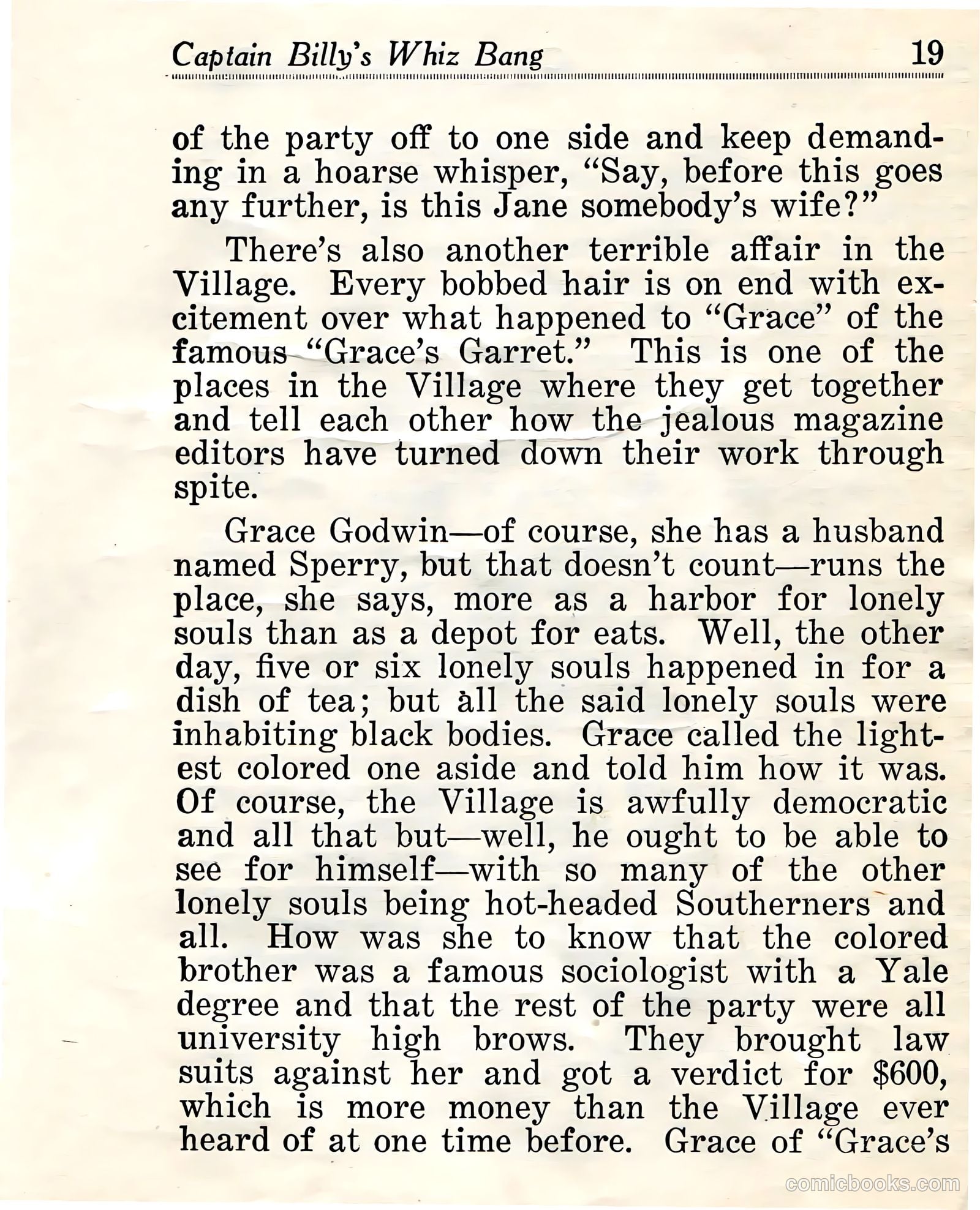
This text satirizes Greenwich Village bohemian culture and exposes racial prejudice among self-styled progressives. The passage describes Grace Godwin, who runs "Grace's Garret"—a Village gathering place where aspiring writers complain about magazine rejections. When Black visitors (described as "lonely souls inhabiting black bodies") arrive for tea, Grace privately warns the lightest-skinned man that Southern patrons might object. She didn't realize he was a prominent Yale-educated sociologist; the group sued and won $600—described as shocking wealth to the Village. The satire targets Village hypocrisy: self-proclaimed democrats and artistic rebels who embrace progressive ideals but practice racial discrimination. The joke exposes how quickly bohemian "democracy" crumbles when confronted with actual integration, and mocks Grace's assumption that education and credentials wouldn't matter—only skin color. The lawsuit represents accountability for discriminatory behavior disguised as polite concern.
📄 Transcribed text from this page (OCR, searchable)
Machine-transcribed from the original scan — historical spelling and the odd misread are preserved.
Captain Billy's Whiz Bang 19 of the party off to one side and keep demand- ing in a hoarse whisper, “Say, before this goes any further, is this Jane somebody’s wife?” There’s also another terrible affair in the Village. Every bobbed hair is on end with ex- citement over what happened to “Grace” of the famous “Grace’s Garret.” This is one of the places in the Village where they get together and tell each other how the jealous magazine editors have turned down their work through spite. Grace Godwin—of course, she has a husband named Sperry, but that doesn’t count—runs the place, she says, more as a harbor for lonely souls than as a depot for eats. Well, the other day, five or six lonely souls happened in for a dish of tea; but all the said lonely souls were inhabiting black bodies. Grace called the light- est colored one aside and told him how it was. Of course, the Village is awfully democratic and all that but—well, he ought to be able to see for himself—with so many of the other lonely souls being hot-headed Southerners and all. How was she to know that the colored brother was a famous sociologist with a Yale degree and that the rest of the party were all university high brows. They brought law suits against her and got a verdict for $600, which is more money than the Village ever heard of at one time before. Grace of “Grace’s