A complete issue · 116 pages · 1941
10-Story Detective, March 1941
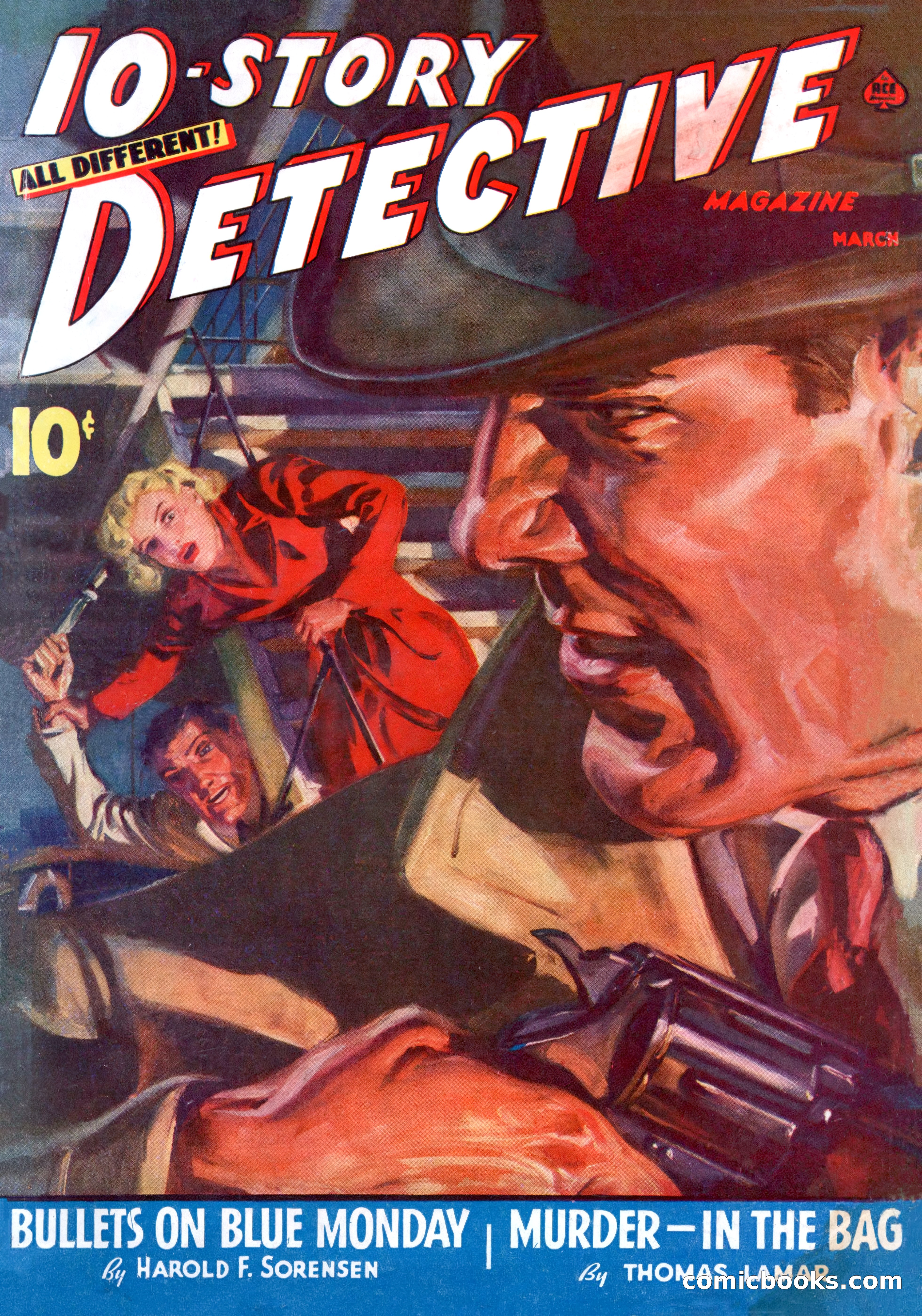
# 10-Story Detective Magazine Cover This is the cover of a pulp detective magazine from March, priced at 10 cents. The cover features dramatic artwork depicting what appears to be a violent confrontation: a woman in a red coat appears alarmed or endangered, while a large man's face dominates the right side of the composition, his expression angry or menacing. A revolver is visible in the lower portion of the image. The visible story titles advertised are "Bullets on Blue Monday" by Harold F. Sorensen and "Murder—in the Bag" by Thomas (last name unclear in OCR). The tagline "All Different!" appears prominently near the top of the cover.
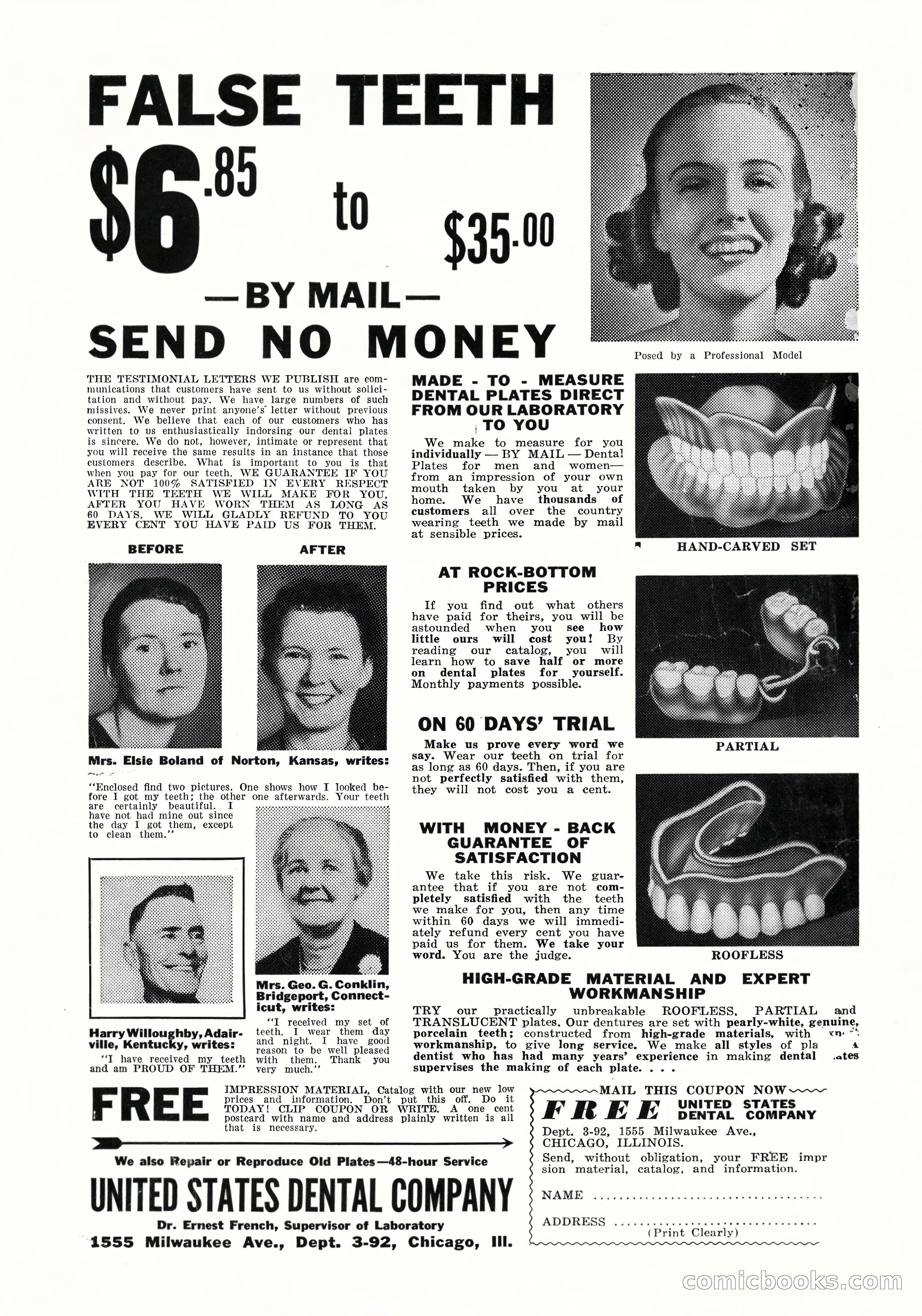
# Advertisement for Mail-Order Dentures This page is primarily a commercial advertisement for the United States Dental Company, promoting made-to-measure false teeth by mail at prices ranging from $6.85 to $35.00. The ad features before-and-after photographs of satisfied customers, testimonial letters praising the dentures, images of different denture styles (hand-carved, partial, and roofless varieties), and emphasizes a 60-day trial period with a money-back guarantee. The company guarantees customer satisfaction and offers to repair or replace old dentures.
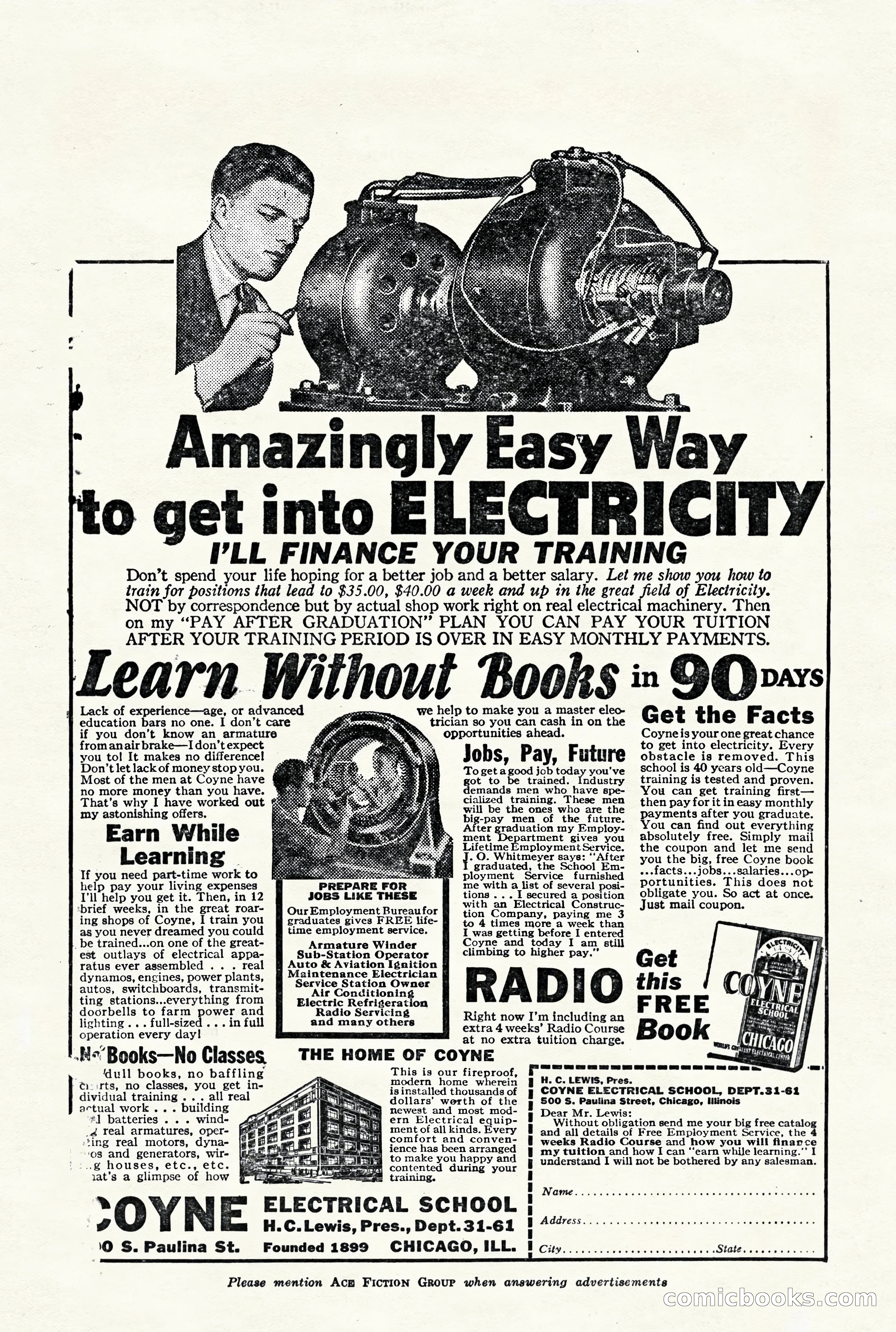
This page is an advertisement for Coyne Electrical School in Chicago, offering vocational training in electricity. The ad emphasizes learning practical skills without books in just 90 days, earning money while training, and paying tuition after graduation through installment plans. It promises job placement assistance, competitive salaries of $35-40+ per week, and includes a free radio course. A mail-in coupon requests reader contact information, and the school offers a free informational booklet about jobs and salaries in electrical fields.
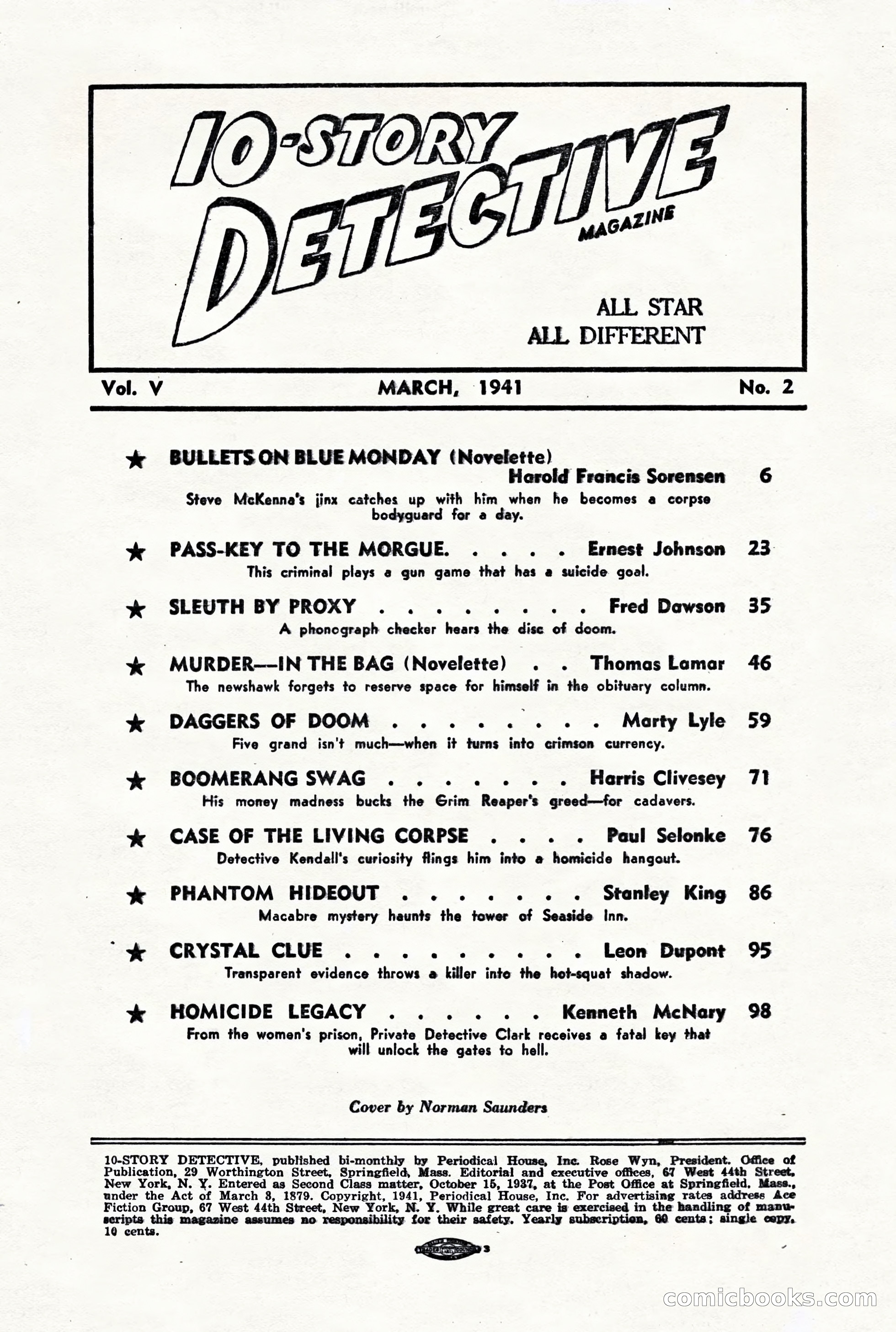
This is a table of contents page from the March 1941 issue of *10-Story Detective*, a bi-monthly pulp crime magazine. The page lists eleven detective and crime stories by various authors, including titles like "Bullets on Blue Monday," "Pass-Key to the Morgue," and "Murder—In the Bag," with page numbers and brief synopses describing plots involving murders, criminals, and detectives. The cover illustration is credited to Norman Saunders. Standard publication information appears at the bottom.
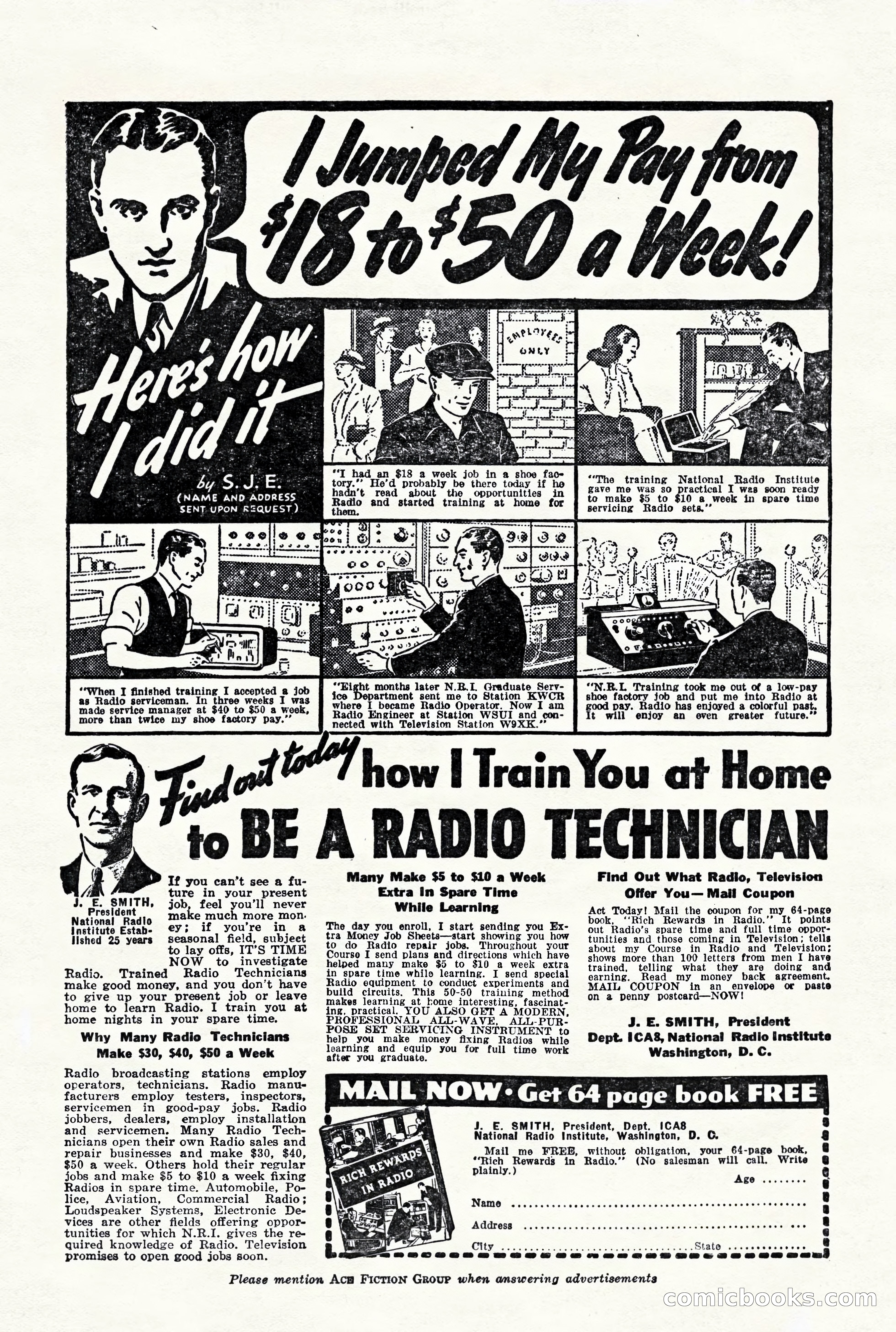
# Page Analysis This is an **advertisement page** from a pulp magazine, not story prose or a cover. The page promotes the National Radio Institute's home-study course for training radio technicians. It features testimonials from graduates who claim to have increased their earnings from $18 weekly to $40-$50 per week through radio training, along with illustrated scenes of radio work and a mail-in coupon offering a free 64-page informational booklet. The advertisement emphasizes both full-time employment opportunities and spare-time income potential in radio repair and broadcasting.
# Analysis of This Pulp Magazine Page This is an **advertising and content page** from a pulp fiction magazine, likely from the 1930s-1940s. The page is dominated by classified advertisements for various products and services—tire sales, medical remedies (Ru-Ex Compound for rheumatic pain), car-cleaning products, patent services, and dental plates. However, the lower portion prominently advertises the **February issue of *Lone Wolf Detective* magazine**, which features five complete novels by authors including W.T. Ballard, H.Q. Masur, Ronald Flagg, Paul Adams, and Grant Mason. The page directs readers that these stories are "now on sale at all newsstands."
# Page Analysis This is an **advertisements and classified listings page** from a pulp-fiction magazine. The page contains numerous small advertisements and recruitment notices rather than editorial content or illustrations. Featured ads include LaSalle Extension University's correspondence courses for career advancement, a religious prayer group, stomach ulcer treatment information, used correspondence courses, asthma remedies, drug sundries sales opportunities, cushioned shoes commissions, music composition services, and U.S. government civil service examination preparation. The page represents typical classified advertising common in early-20th-century American pulp magazines.
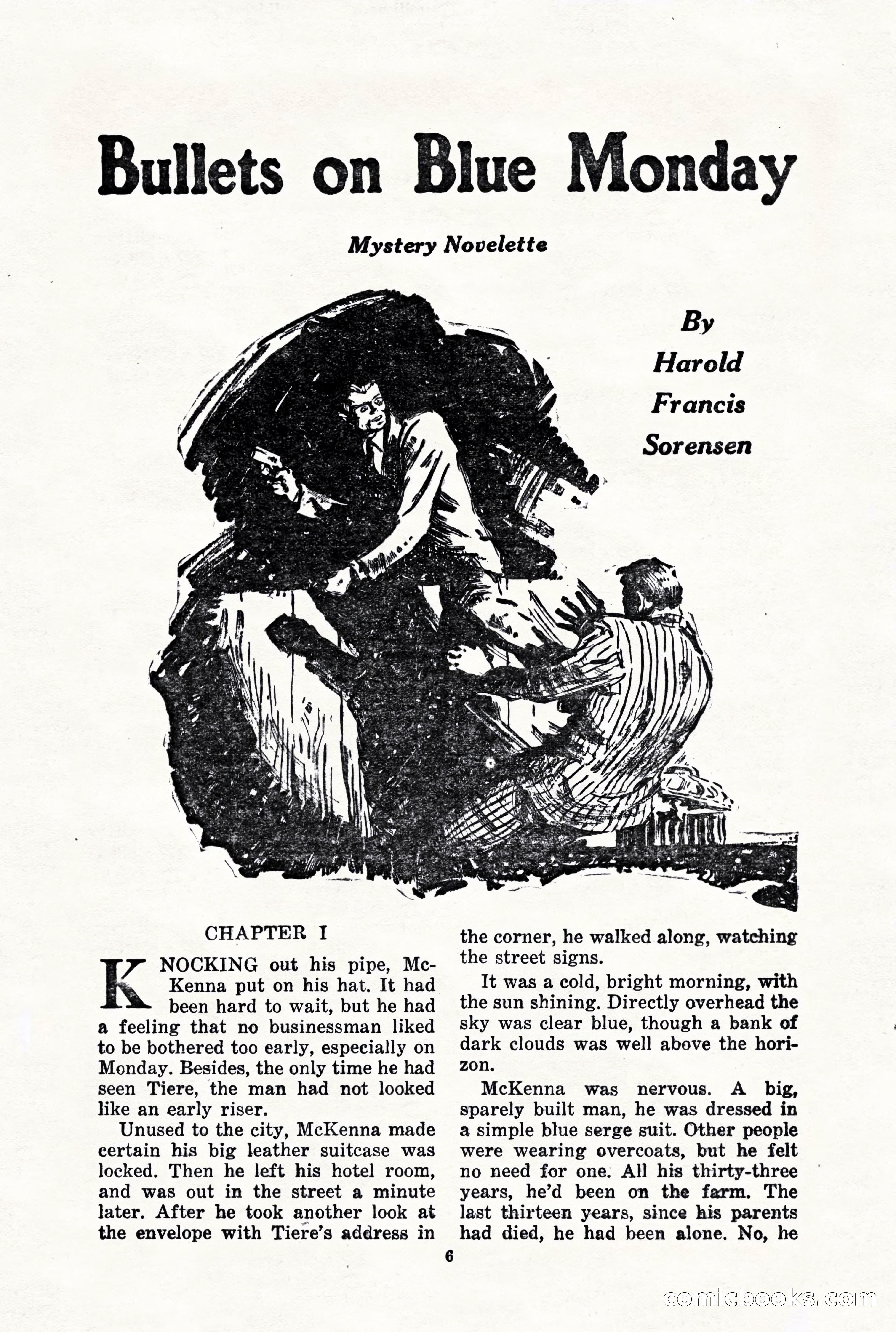
This is the opening page of story prose from a mystery novelette titled "Bullets on Blue Monday" by Harold Francis Sorensen. Chapter I introduces McKenna, a nervous, farm-raised man visiting the city for the first time, who is traveling through cold Monday morning streets to find someone named Tiere. The text establishes McKenna as an outsider in the city, dressed in a simple blue serge suit and carrying a locked leather suitcase.
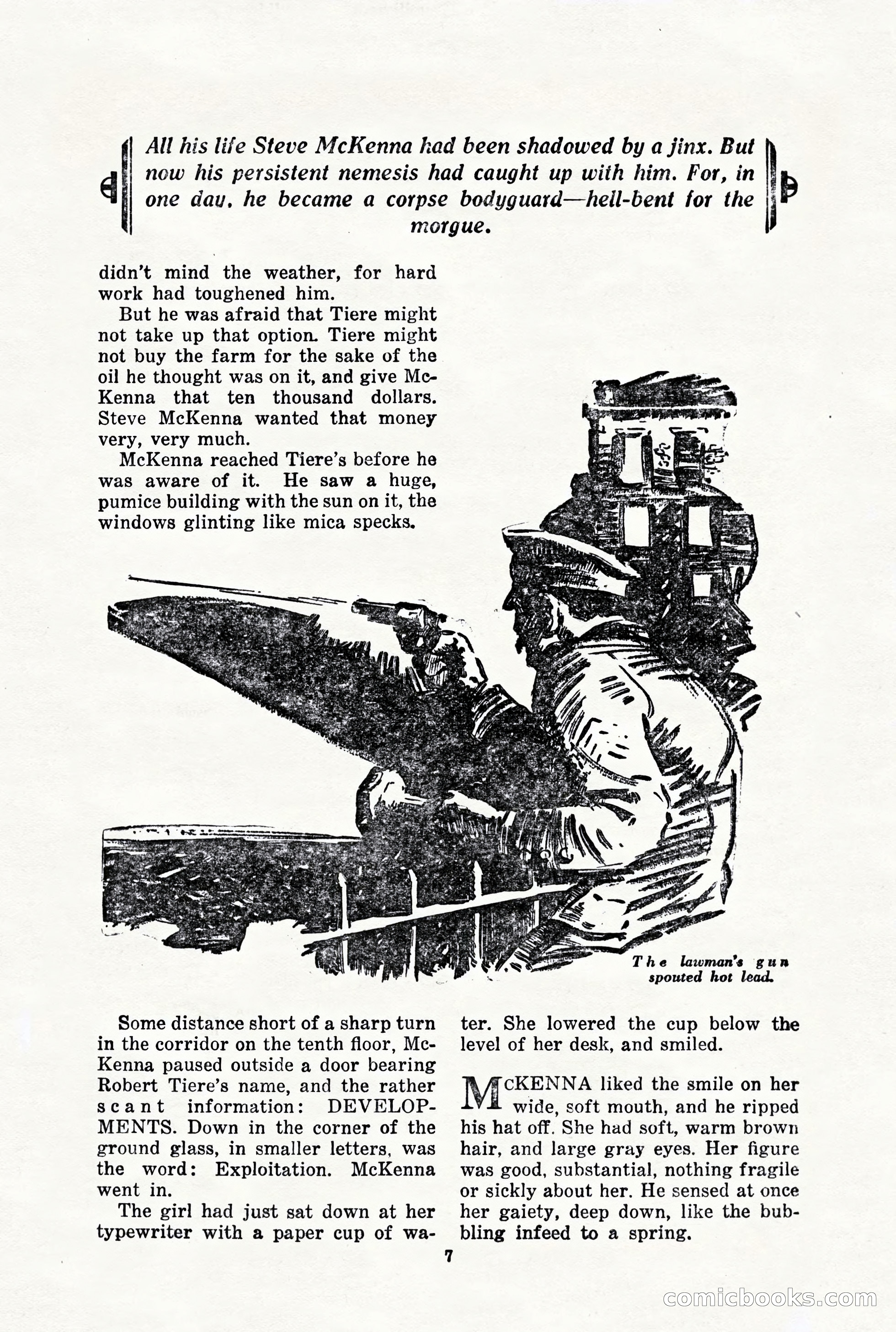
# Page Analysis This is an interior story page from a pulp fiction magazine featuring both prose and illustration. The text depicts protagonist Steve McKenna entering a office building to meet with Robert Tiere regarding a potential farm purchase involving oil rights. McKenna encounters Tiere's receptionist—a woman with brown hair and gray eyes whom he finds attractive. An inset illustration shows a figure firing a gun with caption "The lawman's gun spouted hot lead," suggesting action sequences elsewhere in the story. The narrative appears to be hardboiled crime or adventure fiction, with McKenna motivated by financial desperation.
# Page Analysis: "10-Story Detective" Pulp Fiction This page contains **story prose** from what appears to be a hardboiled crime/detective pulp magazine titled "10-Story Detective." The narrative follows detective Steve McKenna, who arrives for an appointment with a man named Tiere, only to discover Tiere dead at his desk with a knife in his neck. After McKenna alerts the secretary and police arrive, they initially suspect him of the murder. The passage describes the subsequent police investigation and the arrival of various suspects and detectives at the crime scene, including a man named Harvey Logan and a Captain Pearson who begins interrogating those present.
This is a page of story prose from a hardboiled crime pulp magazine. The text depicts a murder investigation led by Captain Pearson, who interrogates several suspects including Steve McKenna regarding a land deal with the deceased Robert Tiere. When McKenna admits Tiere gave him money for a farm option, Pearson becomes suspicious and has him arrested and taken to a police station for processing and questioning. The page transitions between the interrogation scene and the beginning of Chapter II, showing McKenna's arrest and booking procedures.
# Analysis This page contains story prose from a pulp detective magazine titled "10-STORY DETECTIVE" (visible in the header). The text depicts an interrogation scene where a character named McKenna is questioned by Captain Pearson about a murder involving a kitchen knife. Pearson reveals he's checked McKenna's alibi and doesn't believe McKenna committed the crime, but grows suspicious when McKenna demonstrates knowledge of criminal slang like "shill" and "stooge." After McKenna's dismissal, the narrative follows him to his hotel room where he reflects on his lack of connection to farming heritage. The page is entirely text with no illustrations or advertisements visible.
# Page Analysis: Story Prose This page contains story prose from "Bullets on Blue Monday," a pulp crime fiction narrative. The text follows protagonist Steve McKenna as he grapples with suspicion surrounding a murder victim named Tiere, considers visiting a man named Wesley Allen to secure business investment, and then travels to Allen's house during threatening winter weather. The passage explores McKenna's internal conflict about a woman named Betty Dunbar while advancing the plot through his decision to approach potential investors, culminating in his arrival at Allen's cold but welcoming home where Allen—apparently ill with a cold—has prepared a fire and medicinal supplies.
This page contains story prose from a hardboiled crime pulp fiction narrative titled "Bullets on Blue Monday." The text depicts an interrogation scene in which Detective Captain Pearson questions two suspects—Steve McKenna and Harvey Logan—about the murder of Wesley Allen, who was killed with a kitchen knife. Logan reveals an injury and claims he was in a car accident near warehouses around the time of the murder. When McKenna and Logan nearly fight, Pearson ejects Logan and then confronts McKenna about his suspicious behavior during the investigation.
# Page Analysis: 10-Story Detective (Page 14) This page contains **story prose** from what appears to be a hardboiled detective or crime fiction story. The narrative follows a character named Steve McKenna, who is involved in some kind of murder investigation. After being warned by Captain Pearson to leave the city, McKenna instead visits a hotel, eats dinner, and—driven by romantic feelings for Betty Dunbar—impulsively travels to her apartment building. The page ends with McKenna visiting Betty at her home, where he struggles to discuss either the murders or his business dealings, instead talking about his unhappy life on a farm.
# Page from "Bullets on Blue Monday" — Story Prose This page contains story prose from a hardboiled crime pulp fiction narrative. The text depicts a dramatic scene in which protagonist McKenna, suspected of murder by Captain Pearson, is with a woman named Betty Dunbar when the apartment lights suddenly go out. Betty screams and is cut on the shoulder; police burst in with weapons drawn. When lights are restored, authorities discover a bloody kitchen knife on the floor, and McKenna is arrested and manacled despite Betty's protests of his innocence. The passage emphasizes suspicion, danger, and mystery surrounding the central character.
# Page 16 from "10-Story Detective" This is a page of story prose from what appears to be a hardboiled detective magazine. The narrative follows Captain Pearson and Detective McKenna as they deal with the aftermath of an attack on a woman named Betty. The text describes McKenna's distressed reaction to learning how close Betty came to death, and shows Pearson angrily ejecting McKenna from a hotel room after discovering he'd improperly obtained tweezers (apparently used as a weapon) from the premises. The page ends with Harvey Logan, described as "slight bodied" and "blonde," entering McKenna's locked room at a police station.
# Page Analysis: "Bullets on Blue Monday" This page contains story prose from a hardboiled crime pulp fiction narrative. The text depicts an intense confrontation where McKenna, apparently accused of murder, flees from Logan (who holds a gun) through a hotel's basement passages and cellar. McKenna escapes into the street and rushes to Betty's apartment. The scene ends with McKenna, now alone with Betty in her darkened apartment, drawing a large jackknife—the narrative's final image suggesting imminent danger or dramatic action. The visible text captures the climactic chase and reunion sequences of this crime story.
# 10-Story Detective Magazine Page This page contains story prose from a detective pulp magazine. It shows Chapter V of what appears to be a crime or mystery narrative. The text depicts a character named McKenna installing an ingenious alarm system using wires connected to a doorbell throughout an apartment to alert the occupants if anyone attempts entry through windows or doors. The scene involves McKenna explaining this booby-trap setup to a woman named Betty while they hide in the apartment, apparently evading some threat. The prose is typical hardboiled detective fiction from early pulp era publications.
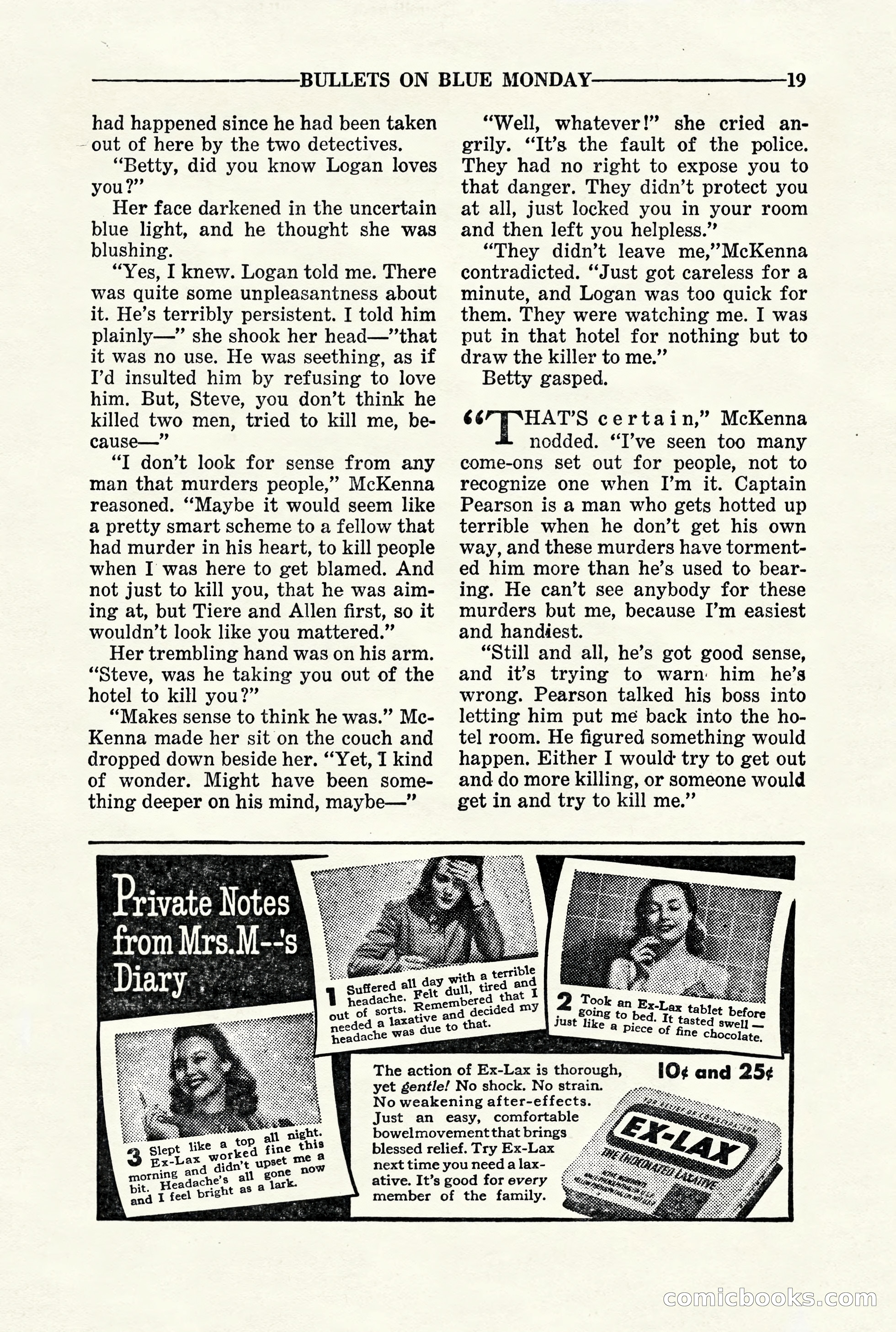
# Page 19 of "Bullets on Blue Monday" This page contains story prose from a hardboiled crime pulp fiction narrative. The text depicts a dialogue between characters McKenna and Betty discussing a murder investigation. McKenna explains that he was deliberately placed in a hotel as bait to catch a killer, and theorizes that Captain Pearson—frustrated by the murders—arranged this dangerous setup. The page concludes with a vintage advertisement for Ex-Lax laxative, featuring testimonial notes from "Mrs. M--'s Diary" with photographs of a woman describing the product's effects.
# Page Analysis: "10-Story Detective" This page contains story prose from a pulp detective/crime fiction magazine. The narrative follows a conversation between characters named McKenna and Betty, where McKenna theorizes about murders involving individuals named Tiere and Allen. McKenna discusses how his land's true value creates a motive for murder, and expresses concern that an unknown killer specifically wants to eliminate Betty because she knows something incriminating. He reveals he has installed an alarm system to protect her. The text appears mid-scene, with dialogue continuing to a cut-off point at the page's bottom.
# Page Analysis: "Bullets on Blue Monday" This is **story prose** from a hardboiled crime pulp magazine. The page depicts a violent climactic confrontation in which McKenna pursues a murderer (revealed to be James Nisbet) through a yard and over a fence. After a gunfight involving characters Pearson and Nisbet, Nisbet is shot and wounded. As he lies dying, he confesses to McKenna and Pearson that he committed murders to steal a million-dollar property from McKenna because he had embezzled client funds and faced financial ruin.
# Page Analysis This page contains the conclusion of a hardboiled crime story, followed by a full-page advertisement. The story prose resolves a murder mystery involving characters named McKenna, Pearson, Nisbet, Logan, and Betty—apparently concluding that Nisbet committed killings motivated by a farm property dispute, while Logan attempted vigilante justice out of jealousy. The narrative ends with McKenna and Betty's romantic moment. Below the story is a vintage advertisement for Thin Gillette razor blades, featuring an illustration of sailboats and promoting the product at "4 for 10" with pricing information visible. The ad emphasizes comfort and economy appeal to male consumers.
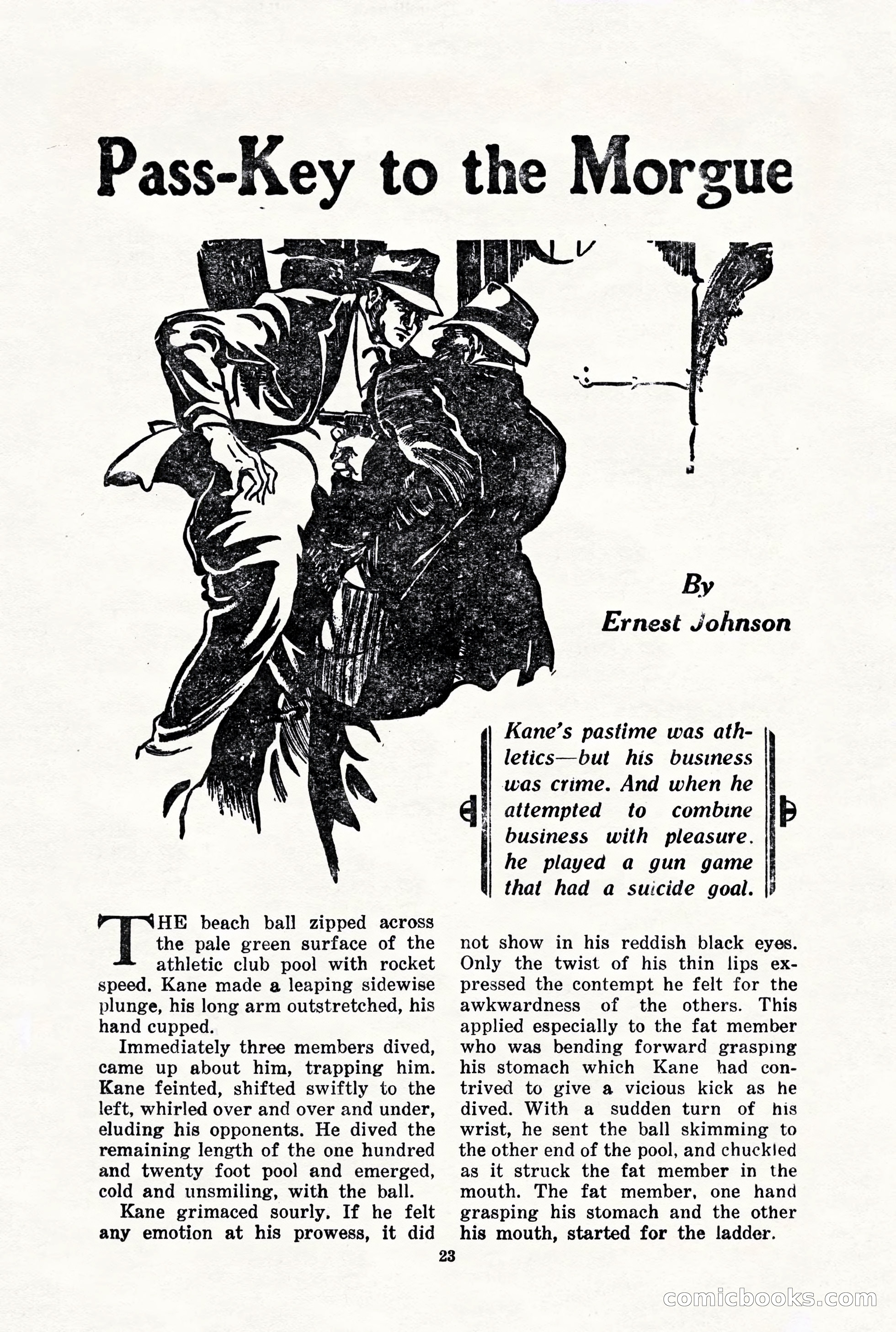
# Page Analysis This is an interior story page from a pulp magazine featuring prose fiction by Ernest Johnson titled "Pass-Key to the Morgue." The page shows the opening of a crime story about a character named Kane, an athletic man whose legitimate pastime is sports but whose actual business is crime. The visible text describes Kane playing a competitive and aggressive beach ball game at an athletic club pool, where he demonstrates both athletic prowess and callous contempt for other swimmers, deliberately kicking one member and striking another with the ball. A sidebar teases that Kane combines athletics with criminal activity through a dangerous "gun game."
# Page 24 of "10-Story Detective" This page contains story prose—specifically the opening scene of a hardboiled detective narrative. Two men, Kane and Lawler, meet at a swimming pool club. Kane is swimming when Lawler arrives with urgent news: Mrs. Sanford, an honorary member and wife of a wealthy banker, has died unexpectedly in Honolulu two days prior, prompting the black mourning drapes visible at the club. Lawler appears agitated about something related to Sanford's death, while Kane remains characteristically cool and dismissive, more interested in billiards than whatever scheme Lawler is hinting at. The passage establishes Kane as a tough, athletic professional and Lawler as a nervous, finicky associate.
# Pulp Fiction Story Page This is a prose story page from a pulp magazine titled "Pass-Key to the Morgue" (page 25). The text depicts two characters, Kane and Lawler, playing billiards while Lawler proposes a theft scheme: breaking into a lakeside house belonging to someone named Sanford to steal valuable jewelry—including a diamond necklace and bracelet worth approximately one hundred thousand dollars—left behind while the owner is away. Lawler explains that only an elderly caretaker named Quinn remains at the property.
This page is story prose from a pulp detective magazine titled "10-Story Detective." The text depicts a crime-planning scene between two characters, Kane and Lawler, who discuss stealing sixty thousand dollars in jewels from a wealthy but scatterbrained woman's summer home. After preparing weapons and supplies in Kane's apartment, they head downstairs to leave. A conflict erupts when Lawler attempts to phone accomplices named Fred and Slats to join them, but Kane angrily forbids it, insisting they work alone. The dialogue reveals Kane's ruthless, violent nature and his authority over the operation.
# Page Content Description This page contains story prose from a hardboiled crime fiction narrative titled "Pass-Key to the Morgue" (page 27). The text depicts two criminals, Kane and Lawler, hiring a reluctant taxi driver named Crawford to take them from a city club northward toward Lake Trantine—a seventy-five to eighty-mile journey. Kane coerces the driver by implying he carries a weapon. During the drive, Lawler reveals they're planning a safe robbery at "Mrs. Sanford's bedroom" on the second floor of a house. The narrative follows their departure through snowy mountain terrain toward Beavers and a lake location, suggesting a crime caper plot.
# Page 28 of "10-Story Detective" This is story prose from a pulp detective magazine. The text follows Kane and Lawler as they arrive at the dark Sanford farmhouse late at night. Upon entering through the back door, Kane slips on something wet and discovers an inert body on the floor. When Lawler finally gets the flashlight working, they confirm it's a man lying prone. Kane strikes Lawler in the darkness, apparently suspecting him, then demands he stay quiet. The passage emphasizes suspense and danger as the characters investigate this mysterious scene.
# Page Analysis This is **story prose** from page 29 of a pulp fiction mystery or crime story titled "Pass-Key to the Morgue." The text depicts detectives Kane and Lawler investigating a murder scene—they discover a dead man (apparently named Quinn) and search the house for a valuable necklace. The passage moves through various rooms including a cellar with a billiard table, where Kane waits while Lawler cracks a safe. The page ends with Lawler returning, pale and excited, holding a glittering necklace while Kane questions what has happened and why the cellar lights suddenly switched on.
# Page Analysis: 10-Story Detective Pulp Fiction This page contains **story prose** from what appears to be a hardboiled crime story titled "10-Story Detective." The text depicts an action sequence in which a character named Kane finds himself in a dangerous confrontation with criminals over a stolen Sanford necklace. After mysteriously losing power, gunfire erupts in darkness. Kane escapes through a doorway, recovers the necklace, and prepares to continue the conflict. The narrative focuses on dialogue, physical action, and Kane's internal thoughts as he navigates the violent encounter.
# Page 31: "Pass-Key to the Morgue" This page contains story prose from what appears to be a hardboiled crime or detective pulp fiction magazine. The text describes a gunfight scene in which the protagonist Kane shoots and kills a man named Fred, then quickly conceals the body when he hears a group of young people arriving at the house for a social gathering. Kane positions himself to face them calmly as they enter, unaware of what has just occurred. The narrative emphasizes Kane's cool composure and quick thinking under pressure.
# Page 32 of "10-Story Detective" Magazine This page contains story prose from a hardboiled detective narrative. Kane, a private detective from Sacramento, has discovered dead bodies in a farmhouse kitchen and must now manage a group of unexpected party guests who have arrived. After serving them spiked cocktails to keep them occupied and prevent them from discovering the bodies, Kane realizes his getaway driver has fled with the car. The passage depicts Kane's tense maneuvering as he tries to contain the situation while a new stranger enters through the front door.
# Page Analysis This is a text-only story page from a pulp crime fiction magazine titled "Pass-Key to the Morgue" (page 33). The narrative depicts a tense scene at what appears to be a house party where a detective confronts a character named Kane after a necklace theft and murder. Kane, who possesses the stolen necklace and appears to be a killer, prepares to shoot the detective. The passage ends mid-sentence with gunshots being fired from Kane's weapon, leaving the outcome unclear.
# Page Analysis This page contains **story prose** from a pulp detective magazine (page 34 of "10-Story Detective"). The text depicts a dramatic escape scene in which a character named Kane steals skis and flees a house under gunfire, then descends a snowy slope toward a frozen lake. He plans to ski across the ice to reach the village of Beavers, carrying a stolen necklace. The passage ends mid-sentence as Kane attempts to avoid some unseen obstacle on the ice. The narrative emphasizes Kane's growing confidence in his skiing ability and his exhilaration at the dangerous sport, building tension toward an apparent collision or accident.
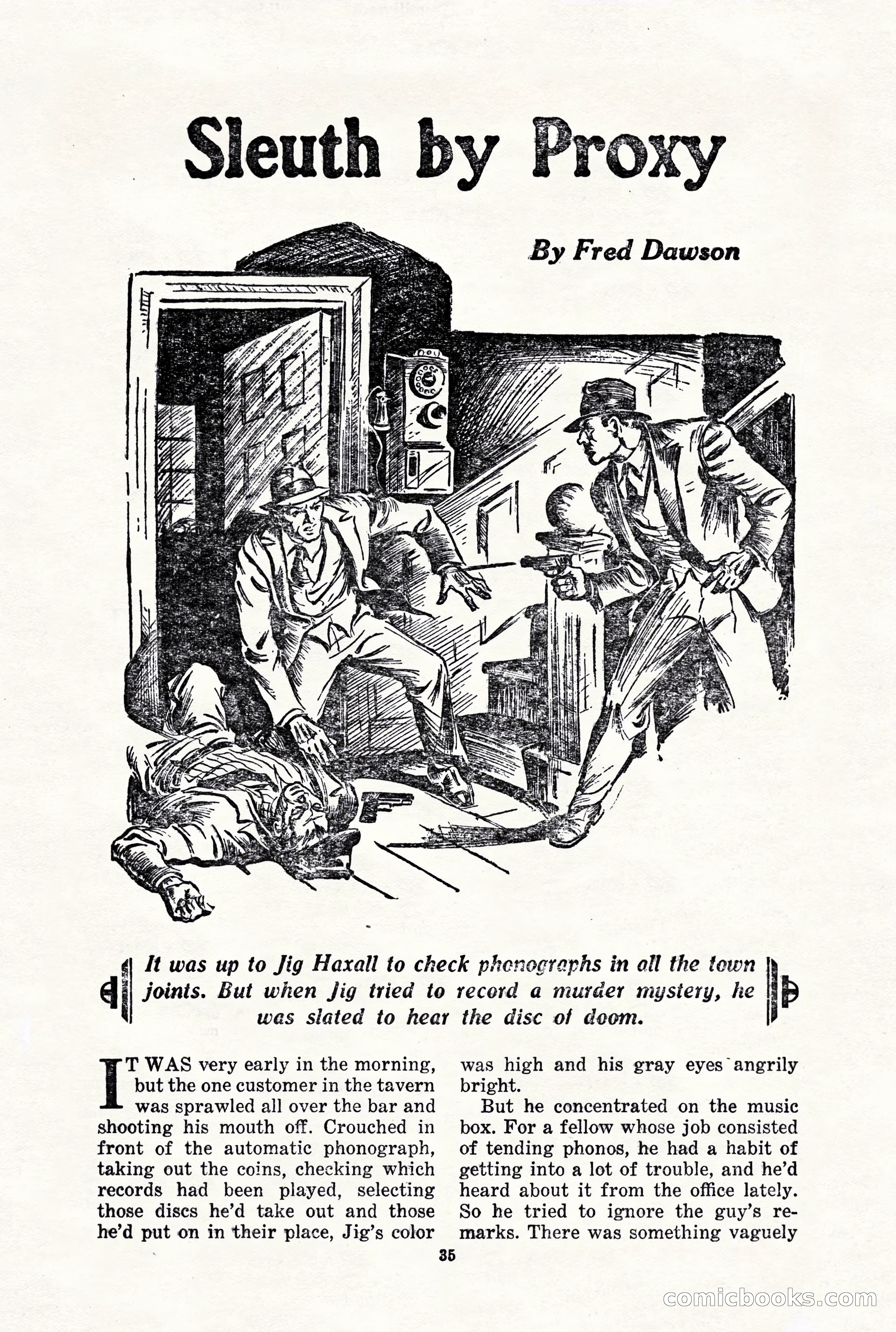
# Page Analysis This page contains story prose from a hardboiled crime fiction narrative titled "10-Story Detective." The text depicts a bar confrontation involving a character named Jig, who defends the reputation of Detective Lieutenant Vinson against a drunk patron's accusations. After the disturbance, Jig encounters the troubled Vinson on the street and they sit in a car where Vinson begins confessing details about an incident—apparently related to someone named Reuwer's death. The narrative explores themes of loyalty between friends and the burden of public suspicion on honest law enforcement.
# Page Analysis This is **story prose** from a pulp crime/detective fiction story titled "Sleuth by Proxy." The narrative follows a suspended police officer named Vinson recounting to someone called Jig how he was framed for a murder—he arrived at a holdup involving Leonard Reuwer, was knocked unconscious, and awoke to find Reuwer dead, shot with Vinson's own revolver. Despite Vinson's innocence, he's been suspended pending charges. The passage concludes with Jig driving to Reuwer's restaurant, where he encounters a man named Carl MacCrowe leaving.
# Page 38: "10-Story Detective" — Story Prose This page contains story prose from what appears to be a hardboiled detective narrative. A detective named Jig investigates who played records on a diner's phonograph machine, having discovered a mysteriously marked nickel. The scene involves questioning Mrs. Reuwer (the diner owner), her cook Paul Adkins (who appears hostile with a bruised face), and introduces Edward Zieman, a dapper waiter. Jig deduces the records were played by Mrs. Reuwer, Adkins, Zieman, and likely a customer named MacCrowe, though the full picture remains unclear.
# Page Analysis This page contains story prose from a hardboiled crime pulp fiction titled "Sleuth by Proxy." The narrative follows a detective character named Jig investigating a case involving a man named MacCrowe. The visible text depicts Jig questioning a restaurant employee named Zieman about MacCrowe's habits, then Jig traveling to MacCrowe's address at Fourteen Astor Street, where he is violently attacked on the staircase by an unknown assailant. A character named Vinson appears at the scene, claiming he was walking by and that the attacker escaped.
This page is story prose from a hardboiled crime pulp magazine titled "10-Story Detective." The visible text shows a confrontation scene in which the character Jig accuses a man named MacCrowe of murdering someone named Reuwer. Jig presents evidence—a cross-marked lucky nickel—that MacCrowe placed in Reuwer's phonograph machine after the murder. Jig further suggests MacCrowe was collecting protection money from Reuwer's restaurant and killed him when he refused to pay or threatened to expose the operation. MacCrowe becomes enraged and orders them to leave.
# Page Analysis: "Sleuth by Proxy" This page contains story prose from a hardboiled crime pulp fiction, specifically page 41 of a story titled "Sleuth by Proxy." The text depicts a tense confrontation between detective Vinson and a man named MacCrowe, whom Vinson suspects of involvement in Reuwer's murder. MacCrowe confesses to framing Reuwer in a blackmail scheme but denies killing him. After Vinson strikes MacCrowe and leaves with his companion Jig, they discuss alternative suspects—including the possibility that Mrs. Reuwer, disguised as a man, committed the crime. The passage emphasizes Vinson's dangerous emotional state and the investigation's narrowing focus.
# Page Analysis: "10-Story Detective" This page contains prose fiction from a hardboiled detective pulp magazine. The narrative follows a detective named Jig investigating a case, with dialogue between Jig and another character named Vinson. The text describes Jig's work placing phonograph records in various establishments and his pursuit of leads in what appears to be a murder investigation. Vinson reports on alibis for suspects including Zieman, Adkins, and MacCrowe, ultimately deciding to focus his investigative efforts on MacCrowe despite uncertainty about the direction of the case. The page is numbered 42 and shows the middle of a serialized story.
# Page Analysis: Story Prose from "Sleuth by Proxy" This page contains prose fiction from a story titled "Sleuth by Proxy" (visible at page header). The narrative follows a character named Jig, who confronts a man named Adkins in Reuwer's restaurant kitchen about a murder investigation involving a marked nickel coin. When Jig questions Adkins about Mrs. Reuwer's whereabouts, Adkins attacks him with a knife and potato masher, then traps him inside a large walk-in refrigerator. The page ends with Jig desperately trying to stay warm and mobile inside the freezing, insulated space while contemplating his grim situation.
This page contains story prose from a hardboiled crime detective magazine titled "10-Story Detective." The text depicts an intense action sequence in which the protagonist Jig, weakened from cold, interrupts a confrontation between Zieman (who has a gun) and Adkins in a kitchen. After a brief struggle, Zieman attempts to flee but is struck down by Adkins with a cleaver. Jig then recovers the gun and confronts both men, revealing accusations about a stolen nickel and murder.
# Page Analysis: "Sleuth by Proxy" This page contains story prose from a hardboiled crime fiction narrative titled "Sleuth by Proxy" (page 45). The text depicts the climactic resolution of a murder case where detective Jig has identified the real killer—a man named Zieman who robbed and killed Reuwer. Through dialogue, Jig explains to Detective Vinson how he deduced Zieman's guilt: Reuwer had reported his gun missing the night before, so when Zieman claimed to have taken it from a cigar counter, Jig knew he was lying. Zieman confesses to the robbery and murder, and Vinson expresses gratitude before Jig deflects the praise, suggesting Vinson receive credit instead.
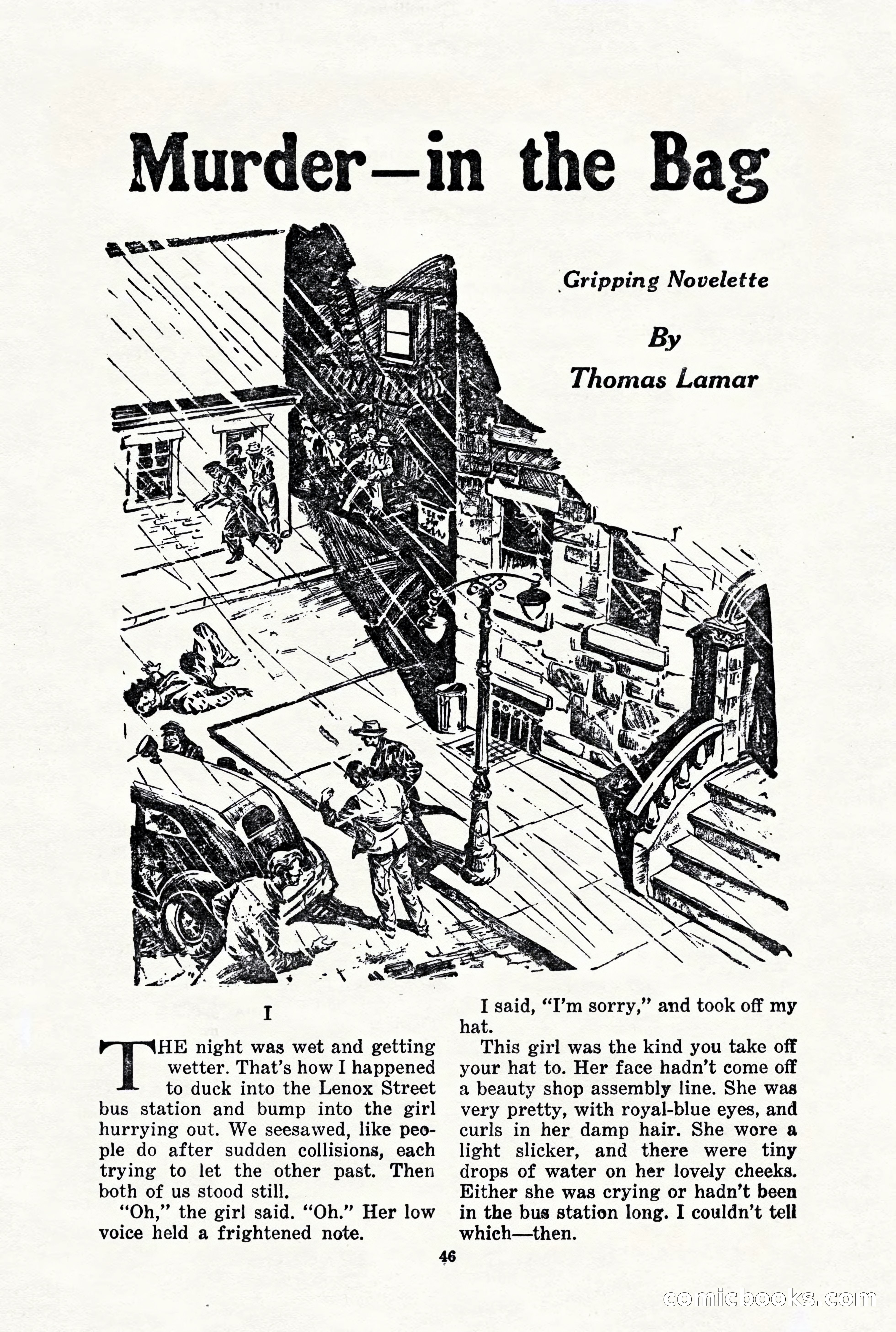
This page contains the opening of a crime fiction story titled "Murder—in the Bag" by Thomas Lamar, labeled as a "Gripping Novelette." The top features an illustration depicting an urban street scene with buildings and figures. The prose below describes a narrator's chance encounter with a frightened young woman in a wet Lenox Street bus station, where they collide and the narrator is immediately struck by her appearance and distressed demeanor, though he cannot yet determine the reason for her apparent distress.
# Page 47: Hardboiled Crime Story Prose This page presents prose fiction from what appears to be a hardboiled detective story. Newshawk Morgan Butler discovers a dead woman in a train station waiting room and becomes a suspect when Detective Lieutenant Munson arrives. The narrative focuses on Butler's earlier encounter with a nervous young woman who left the station just before he found the body, suggesting possible connection between the two events and creating ambiguity about what actually occurred.
# Page 48: Story Prose from "10-Story Detective" This page contains prose fiction from a hardboiled detective pulp magazine. The narrative follows a reporter investigating the death of Myra Withington, a woman found dead at a bus station. A coroner determines she died of natural causes (coronary thrombosis), and the reporter returns to his apartment. He's interrupted by Willie Fargo, a small-time hustler working for someone named Nick Canalli, who arrives at the apartment demanding "them beans"—apparently something the reporter possesses. The story involves police procedures, casual period-era slang, and suggests mysterious criminal interest in an unspecified item.
# Page Analysis This is story prose from a hardboiled crime fiction tale titled "Murder—in the Bag." The page depicts a narrator who receives a visit from an armed man demanding a bag of beans, which the narrator produces. After the visitor leaves, a woman named Audrey McHale calls and then arrives at the narrator's apartment, desperately seeking the same package of beans. The narrator refuses to return them, suspecting they are dangerous, despite McHale's pleas. The mysterious importance of ordinary Lima beans drives the plot forward.
# Page Analysis: "10-Story Detective" Pulp Crime Fiction This page contains **story prose** from a hardboiled detective narrative. The protagonist, a reporter-detective, confronts a desperate woman named Audrey McHale who demands he return her property. When he refuses, she pulls a small automatic pistol on him; he disarms her. Later, walking through an alley to catch a cab, he discovers the body of Willie Fargo—shot through the head with a heavy-caliber bullet. Police arrive and find the girl's gun in his pocket, making him the prime suspect. A detective named Munson arrives at the scene and orders the protagonist arrested, despite his protests.
# Page Analysis This is **story prose** from a hardboiled crime pulp fiction magazine titled "Murder—in the Bag." The page shows the narrator (Butler), a newspaper reporter, being interrogated by Lieutenant Munson at police headquarters regarding his presence at two crime scenes. When the powerful gangster Nick Canalli arrives and vouches for Butler, Munson releases him. Butler leaves the precinct carrying a mysterious bag, planning to lose any police tail by heading to the crowded Market Street area. The text emphasizes noir elements: corrupt police, organized crime figures, and a suspicious death at a bus depot.
This is a page of story prose from a pulp detective magazine. The narrative follows a detective who infiltrates the McHale residence and overhears a telephone conversation between a girl named Audrey and an unknown man with a distinctive voice demanding she obtain mysterious "beans" or her father will be killed. The detective then speaks directly with Audrey, revealing that her father has been kidnapped and the kidnappers are demanding the beans as ransom. The plot involves extortion tied to these valuable beans.
# Page Analysis **Type:** Story prose (page 53 of a hardboiled crime pulp fiction magazine titled "Murder—In the Bag") **Content:** This page continues a kidnapping mystery involving a ransom demand for mysterious "beans." A newspaper reporter interrogates a young woman (Audrey McHale) about how her father was kidnapped and how a woman died during a ransom exchange at a bus station. The reporter deduces that the dead woman was merely a disposable intermediary. The page ends with police detectives arriving, having apparently followed criminals who were trailing the reporter, suggesting the situation is escalating.
This page contains story prose from a hardboiled crime narrative titled "10-Story Detective." The text follows detective Morgan Butler as he intervenes in the kidnapping of Audrey McHale, whose captors seek a mysterious bag of beans. After a gunfight in the street leaves a police detective dead, Butler pursues the kidnappers toward a lake, uses a revolver to wound one and scare off the others, then returns with McHale and the beans to her house. The passage concludes with a phone call from the kidnapper, to whom Butler speaks directly, claiming he recovered the beans and that police involvement was uninvited.
# Page Content Analysis This page contains two distinct sections: **story prose** at the top and **advertising** at the bottom. The upper portion continues a hardboiled crime narrative titled "Murder—in the Bag," depicting a telephone negotiation between the narrator and a criminal kingpin over a kidnapping involving "Lima beans" as apparent ransom. The dialogue reveals a murdered police officer and escalating criminal complications. The lower half is a full-page advertisement for a self-help scheme, where a man named Frank B. Robinson claims that "talking with God" transformed his life from failure to prosperity—he now owns a newspaper, office building, and Cadillac. He invites readers to write for details about this purported God-Power, offering it as a solution to poverty and unhappiness.
# 10-Story Detective Magazine - Page 56 This page contains story prose from a hardboiled crime fiction narrative. The text describes a detective's undercover operation in a run-down real estate development area. The protagonist, disguised in a woman's coat and hat, passes a suspicious package to a thin man at a seedy pool hall, then attempts surveillance. When a mob led by someone named Nick Canalli discovers the ruse, a chaotic chase ensues, with the protagonist fleeing across open fields after fighting off a broad-faced attacker. The narrative emphasizes action, deception, and street-level criminal intrigue typical of early pulp detective fiction.
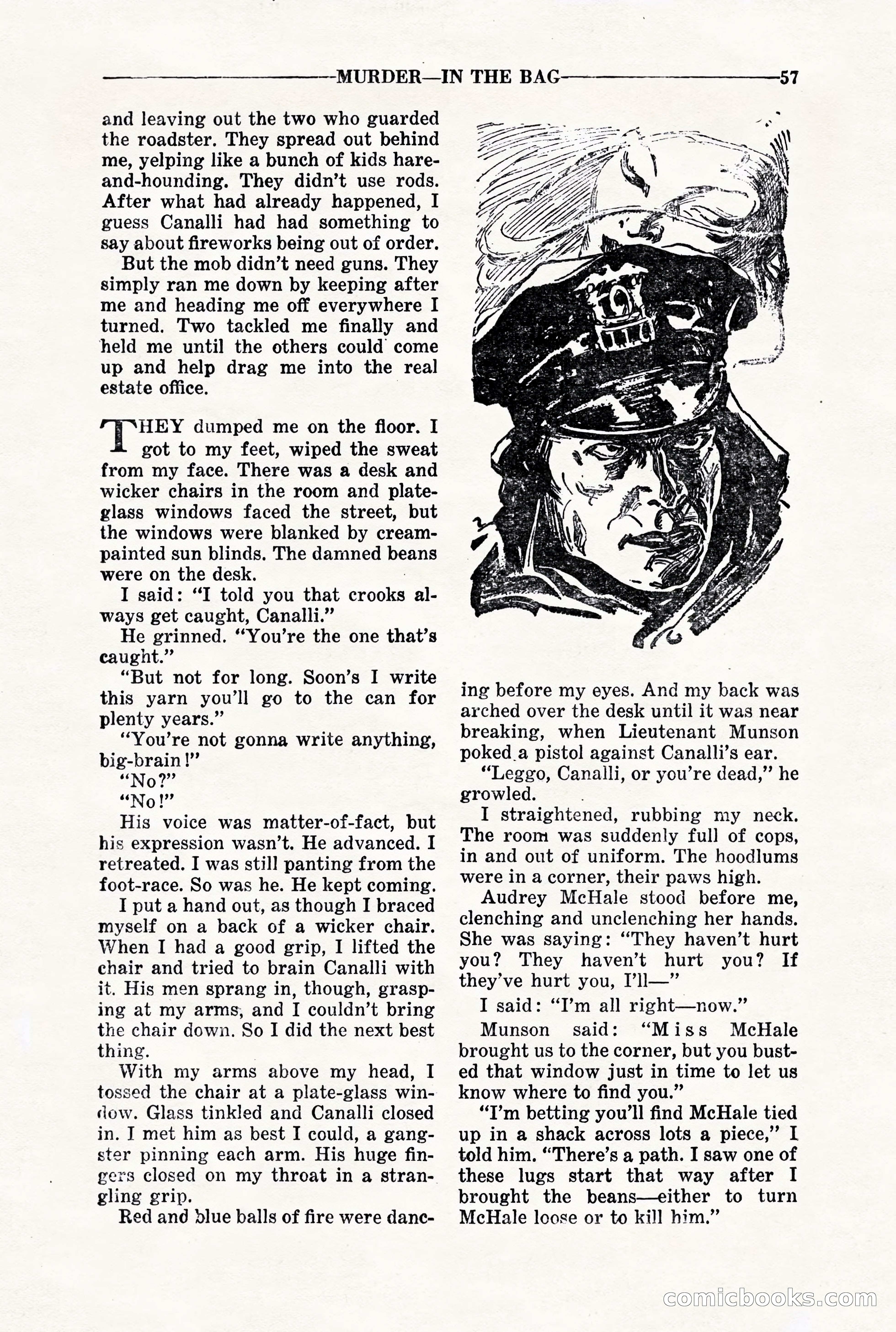
# Page Content Analysis This is a text page from a hardboiled crime pulp story titled "Murder—in the Bag" (page 57). The page contains narrative prose with an inset illustration showing a man's face in profile wearing a cap. The visible text depicts the climax of a confrontation: the narrator, captured by gangster Canalli and his men in a real estate office, fights back by throwing a chair through a window. This alerts Lieutenant Munson and police officers nearby, who arrive in time to stop Canalli from strangling the narrator. The scene concludes with the narrator reporting that another character (McHale) has been taken to a shack and may be in danger.
# Page Analysis: 10-Story Detective This page contains story prose from a hardboiled crime detective narrative. The visible text depicts the aftermath of a police operation where the protagonist (appears to be named Morgan Butler) interrogates Mr. McHale, whose daughter Audrey has just been reunited with him. McHale reveals that Canalli—a crime boss—kidnapped him to obtain rare Lima bean seeds, the only plants of their kind in the world, which would grant monopoly control over bean seed production worth substantial profits. The story concludes with Audrey inviting Morgan for a celebratory drink.
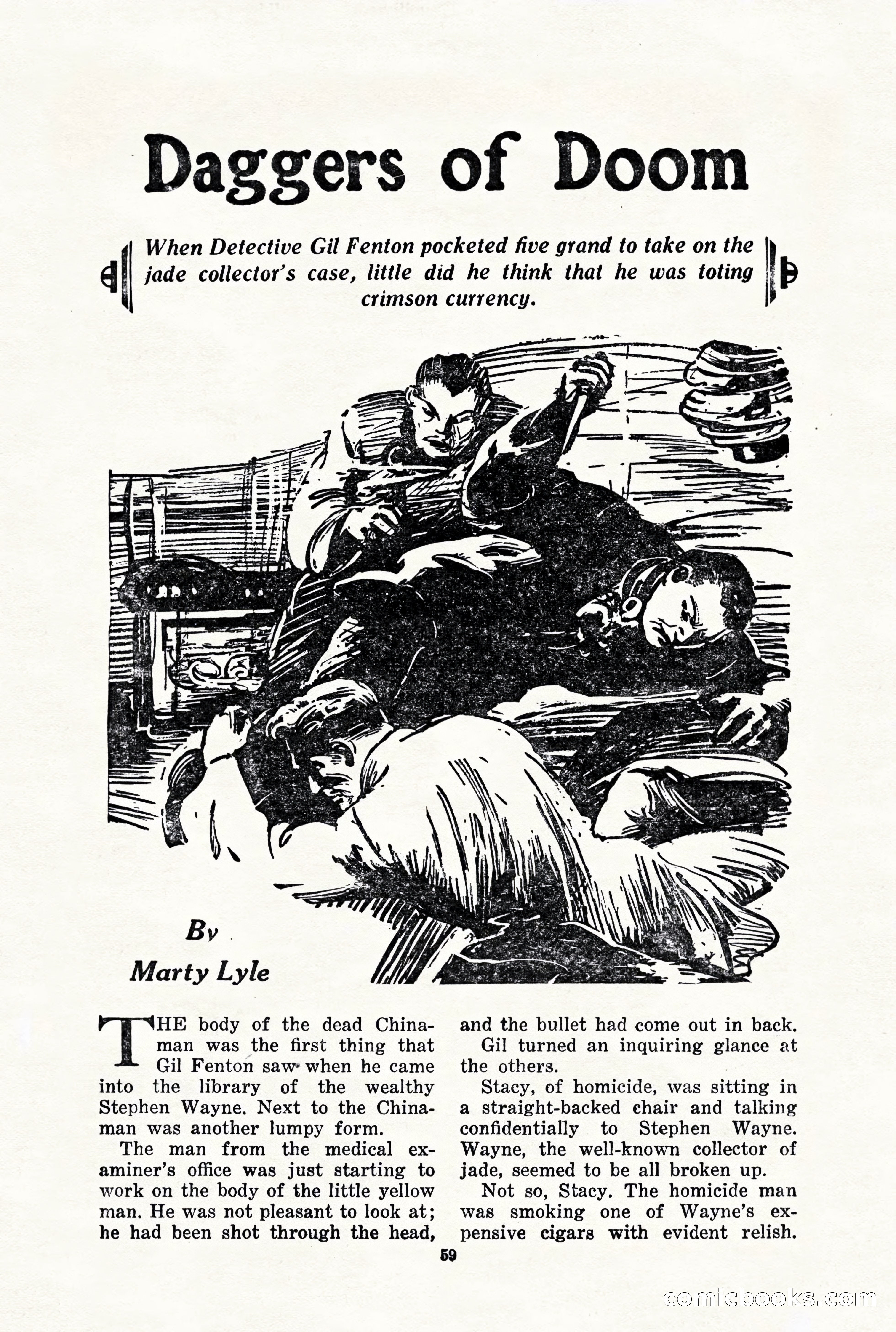
# Page Analysis This is **story prose** from a pulp crime-detective magazine titled "10-Story Detective" (visible at page top). The page depicts a crime scene investigation where private detective Gil Fenton arrives at the home of jade collector Wayne, who has shot a Chinese man caught robbing his safe. Wayne claims the man killed his secretary Krell. Gil examines the body and notices a gold band with Chinese characters on the dead man's finger, then discovers Wayne has two pieces of jade with matching jagged edges—suggesting plot complications beyond the apparent straightforward robbery and murder.
# Page Analysis This page contains story prose from "Daggers of Doom," a hardboiled crime pulp fiction narrative. The text depicts a detective named Gil negotiating with a wealthy man named Wayne over protection from the Kung Tong—a Chinese organized crime group—after a murder involving a stolen jade Confucius figurine. Gil then travels to a house on Marley Street to meet with someone named Charley Mee, where he notices a suspicious gold ring matching one worn by the dead man. The prose emphasizes noir elements: danger, negotiation, and rising tension as Gil enters what appears to be an enemy's lair.
# Page 62: Story Prose from "10-Story Detective" This page contains prose fiction from what appears to be a hardboiled crime or detective pulp magazine. The text depicts a tense meeting between a detective named Gil Fenton and Charlie Mee, the apparent head of the Kung Tong, a Chinese criminal organization. Gil has been hired to protect a jade collector named Stephen Wayne, whose secretary was killed by a tong member whom Wayne shot in self-defense. Gil attempts to negotiate with Charlie Mee, offering monetary compensation to prevent the tong from seeking revenge, while Charlie warns that Wayne is destined to die according tong law. The narrative emphasizes the mysterious, controlled demeanor of the fat Chinese crime boss.
# What This Page Shows This page contains story prose from a pulp-fiction narrative titled "Daggers of Doom" (page 63). The text depicts a tense confrontation between a character named Gil and a fat Chinaman named Charlie Mee, who has invited Gil to his house under false pretenses. Charlie reveals he has set a trap—a gunman hidden behind a wall panel armed with a Browning rapid-firer—and declares war on Gil to prevent him from leaving alive. The scene climaxes with gunfire erupting as Gil attempts to draw his own weapon and escape, while Charlie Mee uses a concealed button to raise a steel barrier for protection.
This page contains story prose from a hardboiled crime/detective narrative titled "10-Story Detective." The text depicts an action sequence in which the protagonist Gil engages in gunfire with a hatchet-man in a sound-proofed metal corridor, kills him, escapes through a locked door into a back yard, and hears a window opening above—suggesting imminent danger. The narrative emphasizes suspense and physical combat as Gil pursues what appears to be a fugitive named Charlie Mee through a concealed passage within a building.
# Page Analysis This is **story prose** from page 65 of a pulp-fiction magazine titled "Daggers of Doom." The text depicts an action sequence in which a character named Gil escapes from pursuers—apparently Chinese gangsters led by someone called Charlie Mee—by vaulting over fences and through yards after a violent confrontation. The scene concludes with Gil fleeing in a taxi, only to arrive at Wayne's house to discover police activity, an ambulance, and a crowd being held back by officers.
# Page Analysis: 10-Story Detective This page contains story prose from a hardboiled detective pulp magazine. The narrative depicts the aftermath of a violent raid on a house. Inspector Glenn brings detective Gil Fenton to a living room that resembles a field hospital, where several of Gil's operatives lie injured from an attack by Chinese assailants wielding a sawed-off shotgun. Through dialogue, Joe Baird explains that the raiders kidnapped a man named Wayne and took him away in a delivery truck marked "Fancy Groceries." Gil discovers that jade figurines—apparently the target of the raid—were never on Wayne's person, having been given to Baird for safekeeping. The page ends with Glenn confronting Gil about his whereabouts during the attack.
# Page Content Analysis This page contains **story prose** from a hardboiled crime pulp fiction titled "Daggers of Doom." The narrative follows a detective named Gil (apparently Fenton) as he retrieves a jade figure as evidence and travels to a hand laundry in Hoboken operated by a man named Sam Mee. The text depicts Gil's confrontation with a colleague Glenn over taking the jade, his cab ride through the Holland Tunnel, and his arrival at the laundry where he speaks Cantonese to the proprietor. The scene suggests Gil possesses knowledge of the Chinese operator and appears to be conducting some form of detective work or investigation. The passage ends with tension as Sam Mee reaches beneath his counter.
# Page Analysis This is story prose from a pulp detective magazine (page 68). The narrative follows a character named Gil who infiltrates a building to rescue a man named Wayne who is being tortured. Gil confronts armed adversaries, disables a guard, and discovers Wayne strapped to a table while three men torture him with a spiked device. The passage depicts classic hardboiled crime fiction action: gunplay, hand-to-hand combat, and a rescue attempt in what appears to be a Chinese criminal organization's hideout.
# Page Analysis This is **story prose** from a pulp fiction magazine, specifically page 69 of what appears to be a hardboiled crime or mystery tale titled "Daggers of Doom." The text depicts a dramatic interrogation scene in which a character named Wayne, apparently tortured and restrained, confesses to killing a Chinaman and someone named Krell to obtain halves of a precious jade statue called the Confucius. Charlie Mee, described as a fat man speaking Cantonese, orchestrates the confession before a character named Gil. The passage involves violence, torture, and apparent involvement with a criminal organization referred to as "the tong," with themes of vengeance and stolen artifacts central to the plot.
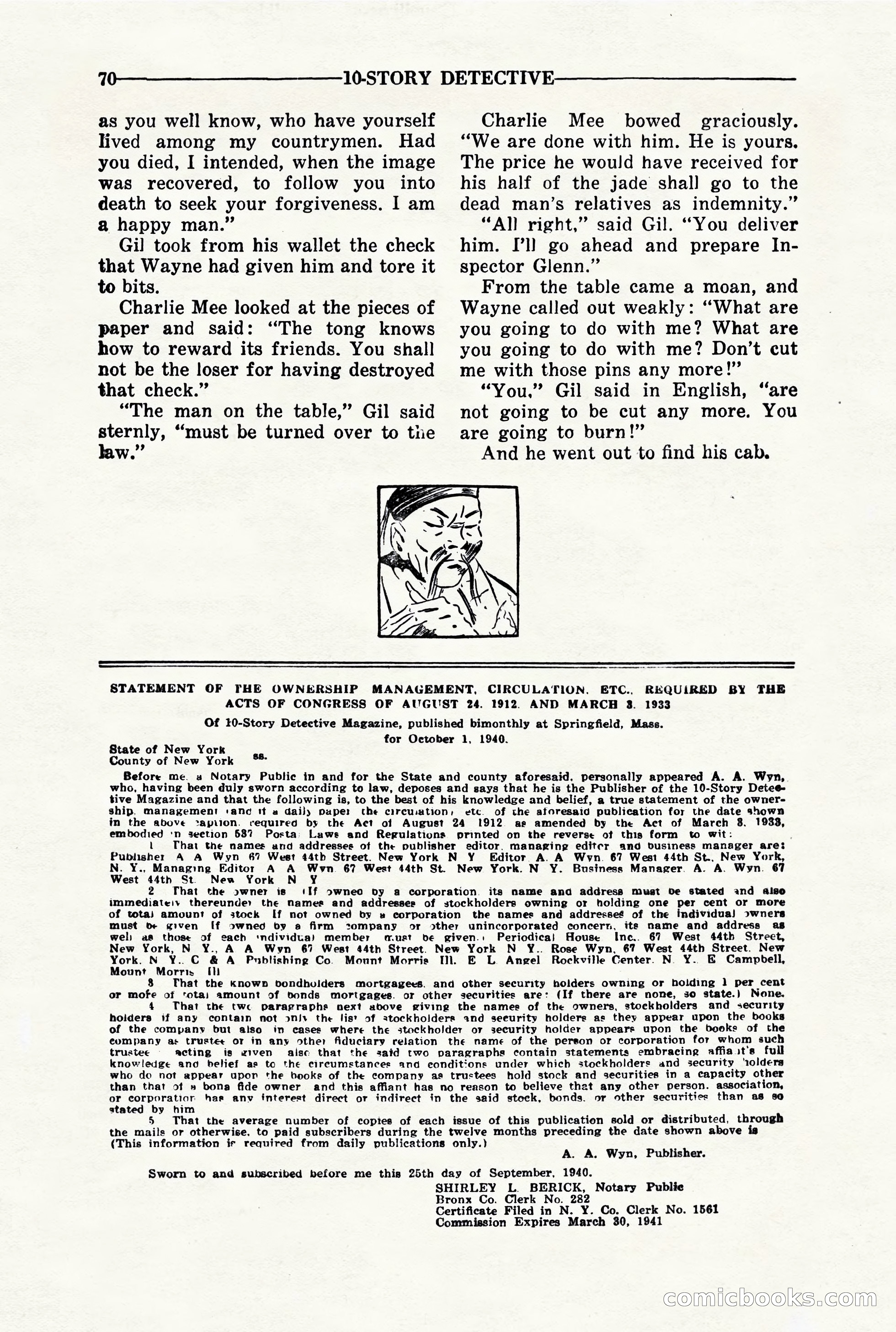
# Page 70: 10-Story Detective Magazine (October 1, 1940) This page contains the conclusion of a crime story followed by a legal ownership statement. The story prose shows a confrontation where Gil, apparently a detective or law enforcement officer, has apprehended a criminal named Wayne and arranges to turn him over to Inspector Glenn. Charlie Mee, likely representing a Chinese tong organization, agrees to surrender Wayne to the law and compensate the dead man's relatives. The bottom two-thirds of the page is occupied by a notarized "Statement of Ownership, Management, Circulation" document required by Congress, listing publisher A. A. Wyn and other business details for the magazine.
# Page 72 of "10-Story Detective" This page contains story prose from a hardboiled crime tale. It depicts Shane, a rough, antagonistic man who has won Pop's annual raffle and receives a case of whisky as the prize. When others congratulate him and Rick Vargo demands a cut, Shane responds with violence, slapping Vargo to the ground and insulting him. Shane then sells the whisky cheap to a pinochle player for pocket cash. The scene ends with Shane eating and observing men gambling at a machine in the back room, suggesting his lucky streak continues.
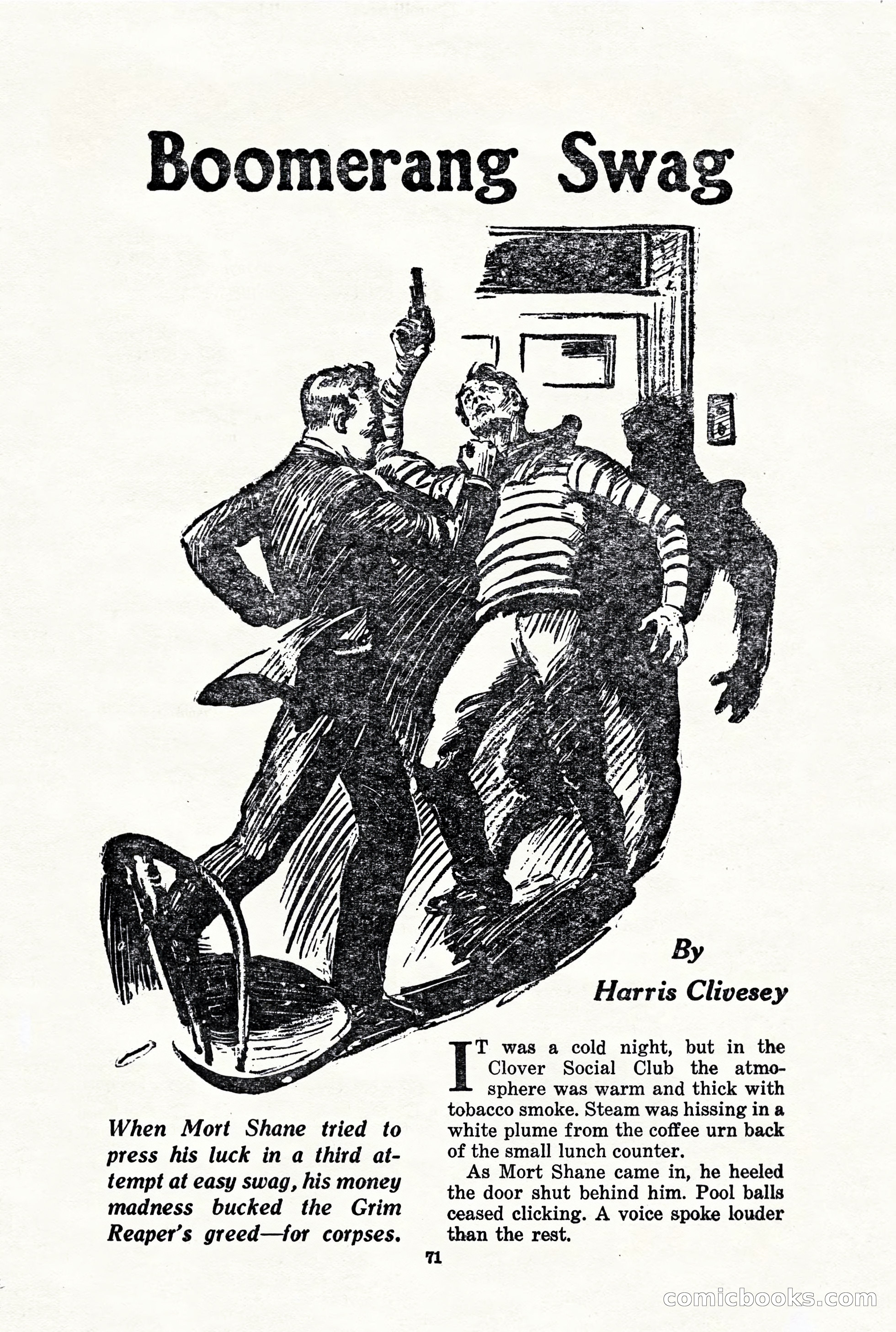
# Page from Pulp Crime Fiction This is story prose from page 73 of a pulp magazine titled "Boomerang Swag." The narrative follows a character named Shane who wins money at a slot machine, then retrieves a hidden revolver from his apartment. He stakes out the Allied Cigar Store, observing that a clerk carries the day's cash receipts to a bank each night via Miller Street. Shane positions himself in a doorway to ambush the clerk, pulling a gun and forcing the man into a nearby alley at gunpoint. The story appears to be a hardboiled crime tale depicting a planned robbery.
# 10-Story Detective (Pulp Crime Magazine) This page contains story prose from a hardboiled crime narrative. The text follows a criminal named Shane who robs a cigar store clerk, shoots him during the robbery, then narrowly avoids being seen by an acquaintance named Rick Vargo. Shane returns to his apartment, hides the stolen money (approximately ninety-one dollars) and his gun under a floorboard, and then overhears men on the street below discussing the murder he just committed. The page is numbered 74 and appears mid-story.
# Page Analysis: "Boomerang Swag" This page contains story prose from a hardboiled crime pulp fiction narrative titled "Boomerang Swag." The text depicts the climactic confrontation between a criminal named Shane and a policeman on a stairwell landing. After learning he's been informed on by an informant named Rick Vargo, Shane attempts to escape but encounters Officer Wilson. A shootout ensues in which Shane is fatally shot. The passage concludes with Wilson discovering evidence linking Shane to an Allied Cigar Store robbery, and another officer arriving to learn that Vargo had squealed on Shane out of personal hatred—specifically over Shane winning and discarding a case of whisky.
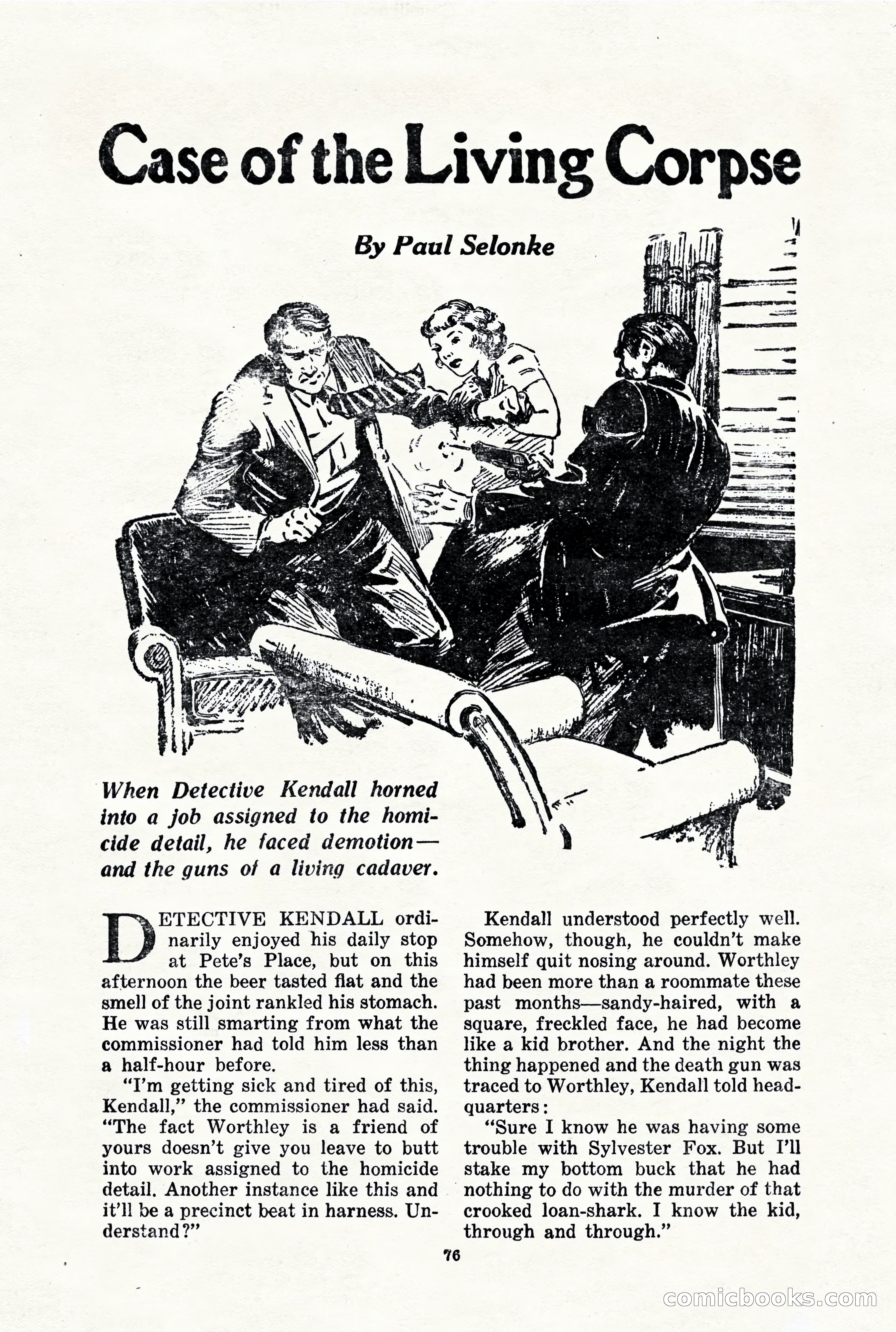
# Page Analysis This is a story page from a pulp-fiction magazine featuring the opening of "Case of the Living Corpse" by Paul Selonke. The page includes a dramatic illustration showing three men in what appears to be an urgent confrontation, along with the story's opening prose. The visible text introduces Detective Kendall, who has been assigned to a homicide case despite his personal connection to a suspect named Worthley; Kendall insists his friend couldn't be responsible for murdering a loan shark, though a "death gun" has been traced to him.
# Page from "Case of the Living Corpse" This is story prose from a hardboiled crime pulp magazine. Detective Kendall investigates the murder of Sylvester Fox and the suspicious disappearance of a suspect named Worthley. While pursuing leads, Kendall is approached by Joe Sweeny, a reformed safecracker from New York, who claims a mysterious muscular man with a half-paralyzed face coerced him into cracking a safe in Hyde Park. Sweeny identifies the man as Ed Garvey—the very person Kendall was investigating, who supposedly died of a heart attack months earlier.
# Page 78: Hardboiled Crime Story Prose This page contains story prose from what appears to be a hardboiled detective narrative titled "10-Story Detective." Detective Kendall convinces ex-convict Sweeny to allow him to impersonate him during a meeting with the dangerous Ed Garvey, who wants Sweeny to steal something from a safe. Kendall believes this setup will help prove that another suspect, Worthley, is innocent of murder. The page depicts Kendall's tense arrival at Sweeny's dilapidated shack on Fourth Street and his instructions to leave the door unlocked, suggesting an ambush or trap is about to unfold.
# Page 79 of "Case of the Living Corpse" This page contains story prose from what appears to be a hardboiled crime or detective pulp fiction tale. The narrative follows Kendall, who orchestrates a staged fight with Sweeny to deceive someone—only to be shocked when Ed Garvey arrives alive, despite Kendall having attended his funeral. Garvey, now armed with a .45 automatic, coerces Kendall into committing a robbery ("blow a crib") in place of the injured Sweeny. The text emphasizes plot twists, violent action, and criminal intrigue typical of pulp crime fiction.
This page contains story prose from a hardboiled crime pulp magazine titled "10-Story Detective." The narrative follows a character named Kendall who is being forced by the criminal Ed Garvey to help break into a house in Hyde Park. Kendall discovers that Sheila Fox, daughter of a murdered loan-shark, is unexpectedly present, and realizes they're targeting the home of a private detective named Carthers who previously disappeared—suggesting a connection between multiple crimes that police had been investigating.
# Page Analysis This page contains story prose from a pulp fiction narrative titled "Case of the Living Corpse." The text depicts a tense safe-cracking scene in which a character named Kendall is being coerced at gunpoint by Ed Garvey to open a wall safe. Garvey cryptically mentions wanting "a dead man's face" from the safe, creating mystery and suspense. The scene unfolds in a dark house with Kendall using drilling tools while Garvey watches suspiciously, suggesting Kendall may be deliberately stalling to avoid completing the theft or creating an opportunity to trap Garvey.
# Page 82 of "10-Story Detective" This page contains prose fiction text from a hardboiled crime story. It depicts a detective named Kendall surviving a gunshot wound (protected by a bulletproof vest) in a library, discovering a photograph revealing that a character named Worthley is actually Carthers' son, and then commandeering a cab to rush to Sweeny's shack to confront the villain Ed Garvey—all while puzzling over the involvement of a woman named Sheila Fox in the murder plot.
# Page Content Analysis This page contains **story prose** from a hardboiled crime pulp fiction narrative titled "Case of the Living Corpse" (page 83). The text depicts an action sequence in which protagonist Kendall, discovering he left his bullet-proof vest behind, sneaks toward a shack where he witnesses criminal Ed Garvey threatening Sheila Fox. When Garvey shoots Sheila, Kendall bursts through the door and engages Garvey in physical combat, ultimately knocking him unconscious and retrieving Garvey's .45 revolver. The passage emphasizes Kendall's sense of justice and his concern for Sheila and a character named Sweeny, who lies wounded on the floor.
# Page Analysis This is story prose from a pulp detective magazine (page 84). The text presents a lengthy dialogue scene in which detective Kendall questions a woman named Sheila Fox about the disappearance and death of her father, Tom Carthers, and a criminal named Garvey. Sheila reveals that Tom Carthers' son (using the alias Worthley) had been living with Kendall, and she explains a complex scheme involving an exhumed body, a wax mask, and attempts to expose Garvey's guilt—though Garvey ultimately killed her father before Tom could enact his revenge.
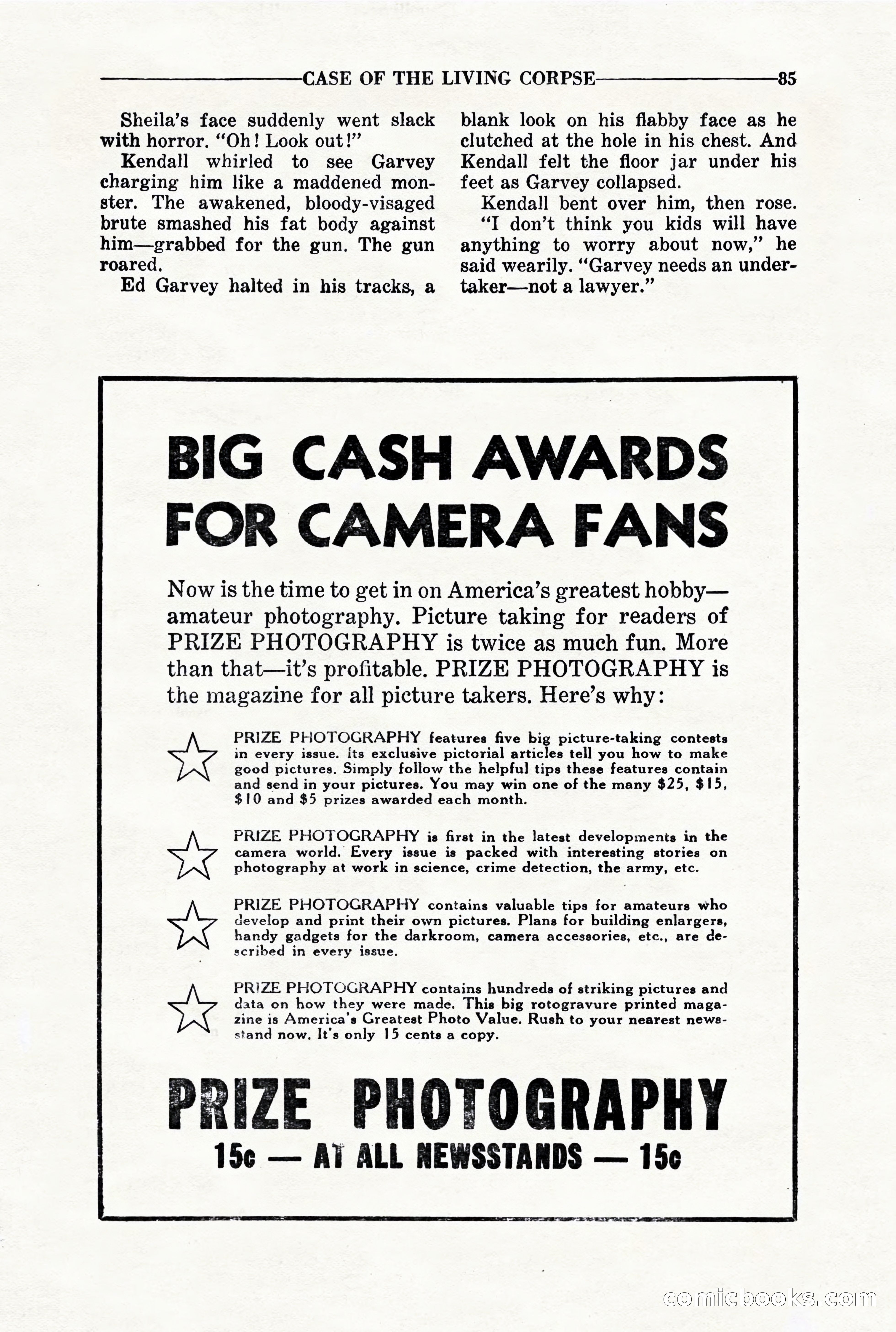
This page contains story prose from "Case of the Living Corpse" (page 85) at the top, depicting a violent climax where a character named Kendall shoots Ed Garvey during a struggle over a gun. Below the story excerpt is a full-page advertisement for *Prize Photography* magazine, promoting it as America's premier amateur photography publication with picture-taking contests offering cash prizes ($25, $15, $10, $5), instructional articles on darkroom techniques and camera equipment, and striking photographs. The magazine costs 15 cents at newsstands.
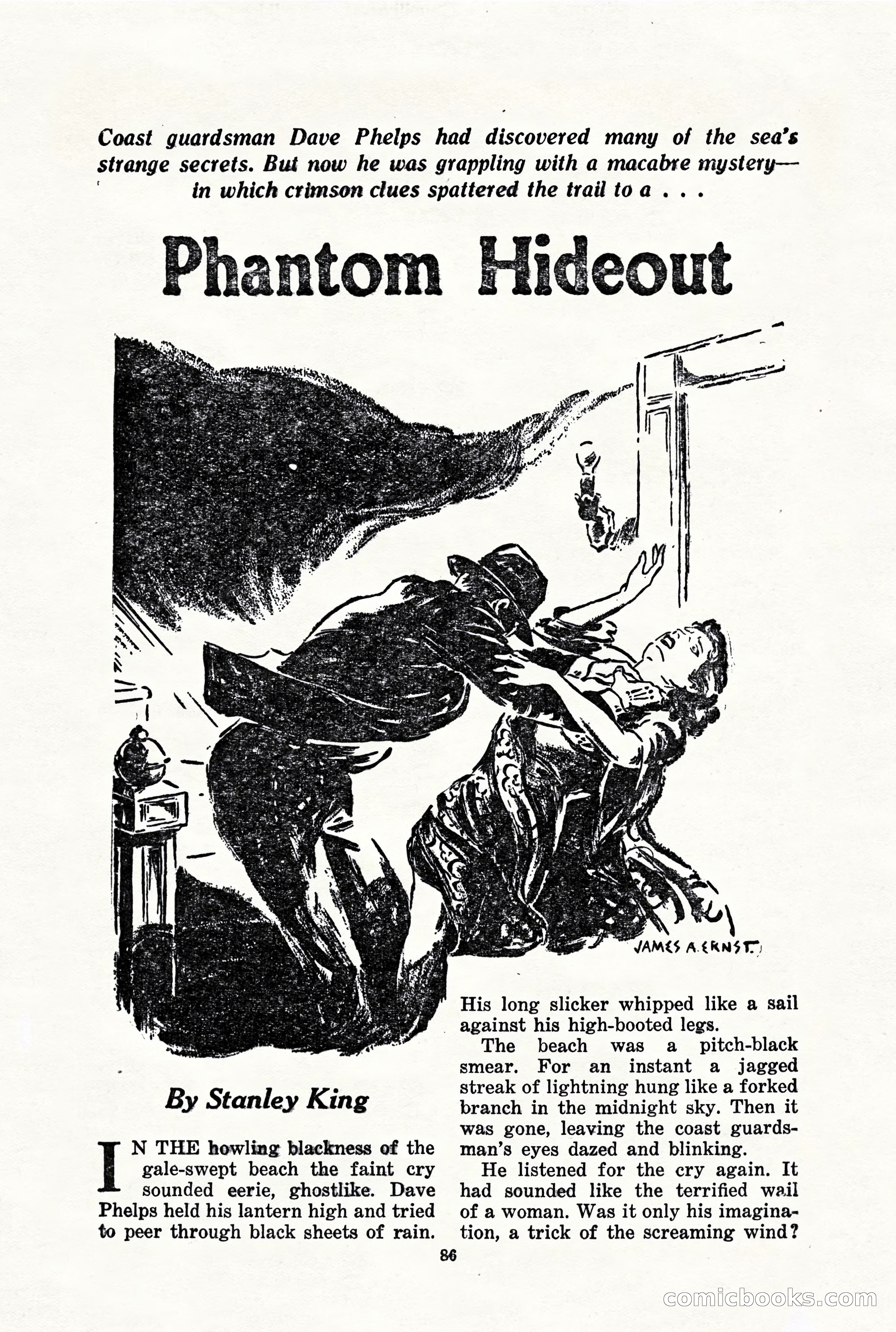
# "Phantom Hideout" by Stanley King This page is an illustrated story opening from a pulp magazine. The dramatic black-and-white illustration (credited to James A. Cernst) depicts a coast guardsman named Dave Phelps during a violent storm, apparently struggling with or pursuing a caped figure on a dark beach. The prose beneath describes Phelps investigating an eerie nighttime cry on a gale-swept beach, uncertain whether he heard a woman's terrified scream or merely the wind. The story promises a "macabre mystery" involving cryptic clues.
This page contains story prose from a pulp fiction narrative (page 87, titled "Phantom Hideout"). The text depicts a coast guard officer named Phelps discovering an unconscious woman named Rita Daly on a storm-swept beach near the closed Seaside Inn. Rita, who smells of liquor despite never drinking, regains consciousness and speaks frantically of seeing her brother Clem's dead, blood-covered face, though she cannot remember how she arrived at the beach. The scene combines mystery and suspense typical of early pulp fiction.
# Page Analysis This is **story prose** from page 88 of a pulp detective magazine titled "10-Story Detective." The visible text depicts a dramatic mystery scene in which a Coast Guard officer named Phelps interrogates a woman named Rita about her brother Clem's apparent murder. Rita, found on a beach with blood on her hands, confesses to a fragmented, drug-induced memory of Clem lying dead with a broken bottle beside him. Phelps carries her to the Seaside Inn to investigate, where he discovers someone hiding inside—apparently Tim, a local carpenter—and draws his gun, unsure of the person's intentions.
# Phantom Hideout — Page 89 This page contains story prose from what appears to be a hardboiled crime or mystery pulp fiction tale. The narrative describes a coast guard detective named Phelps investigating a murder at an abandoned dance hall. A carpenter named Tim reports finding the body of watchman Clem Daly with his head smashed, but when Phelps examines the scene, the corpse has vanished. Phelps discovers blood smears and circular rag marks on the floor, suggesting someone recently attempted to clean up evidence. Rita Daly, apparently the victim's sister, confirms witnessing her brother's body at the stairs, implying the investigation has taken a puzzling turn.
# Page Analysis: 10-Story Detective This page contains **story prose** from what appears to be a detective or mystery pulp story. The narrative follows characters named Phelps (apparently a coast guardsman), Tim (a carpenter), and Sheriff Craig as they investigate a suspicious death in a dance pavilion. The plot centers on a mysterious corpse: bloody footprints lead upstairs but mysteriously end in the hallway's center, with no body found and no descent back down. Phelps suspects a killer is hiding the evidence, possibly in an attic accessible by trapdoor. Sheriff Craig arrives in response to Phelps' call, and the two men prepare to ascend with a ladder to search the attic. The page ends with Phelps leading the way upstairs, suggesting a climactic discovery ahead.
# Page Analysis This is story prose from a pulp detective/mystery magazine. The text, titled "Phantom Hideout" (page 91), depicts a dramatic scene where detective Phelps and Sheriff Craig investigate a murder by ascending through a trapdoor into an attic. They discover blood on the floor, evidence the killer escaped through a tower, and—most crucially—uncover stolen silk bales from the Patterson Raw Silk Corporation hidden in the attic, solving a separate crime of four truck thefts in the county. The passage combines elements of hardboiled crime fiction with mystery-solving investigation.
# Page 92 of 10-Story Detective This page contains story prose from what appears to be a hardboiled crime or detective narrative. The text follows detectives Phelps and Craig as they investigate a murder at a coastal tower during a storm. After hearing a mysterious scream from the tower roof, they rush upstairs and discover the body is missing. Phelps deduces that the murderer escaped using a pulley system attached to the searchlight housing, lowering the corpse to the beach below. The passage emphasizes atmospheric storm effects and the detectives' racing to pursue the suspect.
# "Phantom Hideout" Page 93 This page contains story prose from a pulp crime/mystery fiction narrative. The text depicts an action sequence on a beach during a storm, where protagonist Phelps pursues and fights an unknown killer near the Seaside Inn. Phelps discovers a dead body (Clem Daly), engages in gunfire and hand-to-hand combat with the fleeing murderer in darkness, and ultimately defeats him. The passage concludes with the sheriff arriving and identifying the unconscious killer as Ridley, the inn's owner, who apparently committed murder to prevent blackmail. The dramatic scene emphasizes action, danger, and noir-style detective work typical of early pulp crime fiction.
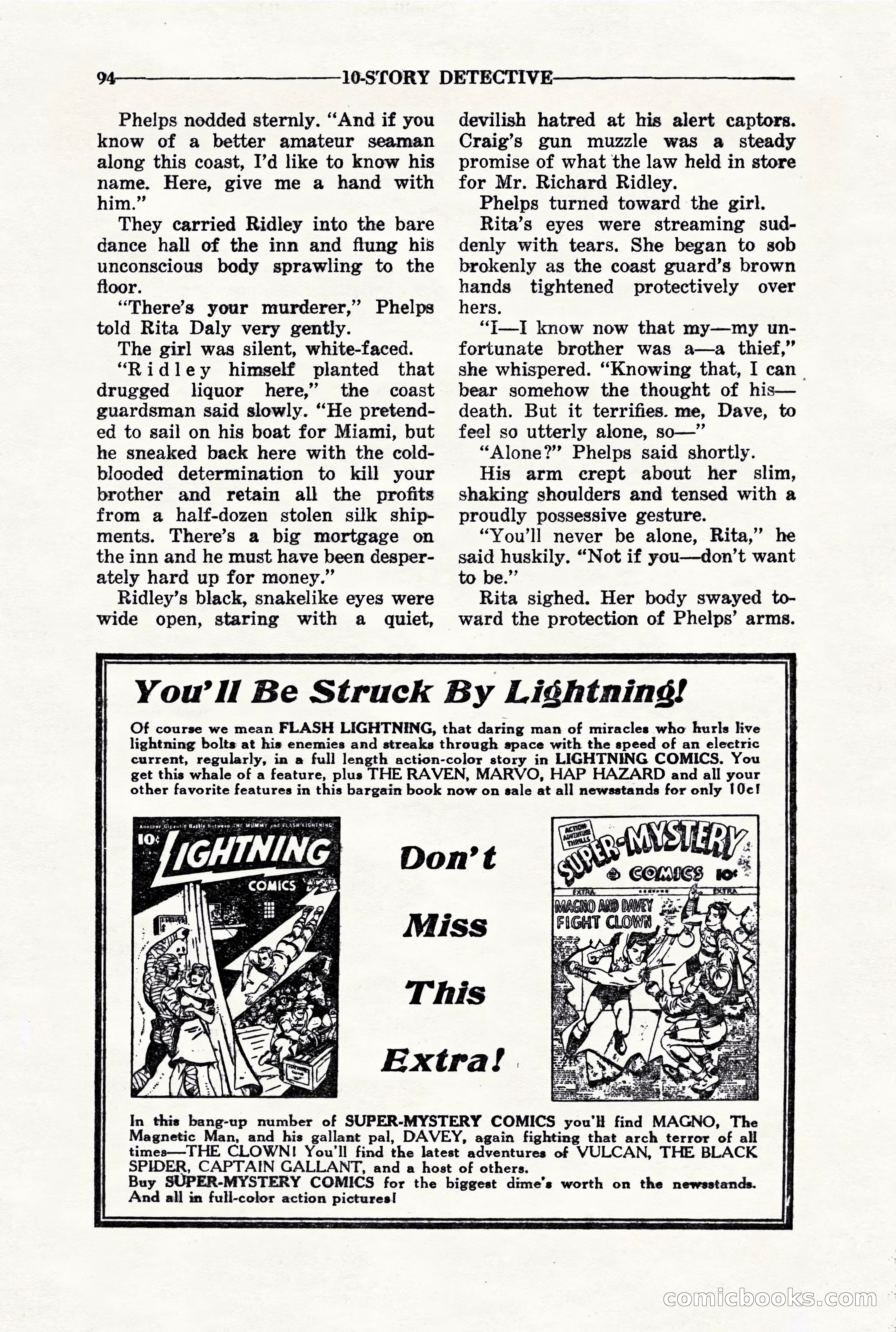
# Page Analysis: 10-Story Detective This page contains story prose from a detective fiction narrative titled "10-Story Detective" (visible at page top). The text describes the climax of a murder case where a coast guard officer named Phelps reveals that a man named Ridley murdered Rita Daly's brother for profits from stolen silk shipments. The scene concludes with an emotional moment between Rita and Phelps. Below the story text is a full-page advertisement promoting two competing comic books—Lightning Comics and Super-Mystery Comics—both priced at ten cents and featuring action heroes and adventure stories.
# Crystal Clue by Leon Dupont This is a story page from a pulp fiction magazine, showing prose narrative text with a small illustration in the upper left corner. The visible text depicts the opening of a crime story in which the protagonist, Henry York, plans to murder his elderly Uncle Walter to inherit his wealth. The page shows York carrying out the murder by suffocating his uncle with a heavy robe, then carefully staging the scene to appear accidental—moving the body to the bathroom and arranging the dead man's clothing to suggest he drowned in the bathtub. The narrative emphasizes York's calculated coldness and confidence in his "perfect crime."
# 10-Story Detective - Story Prose This page contains text-only story prose from a pulp detective magazine. It depicts Henry York murdering his Uncle Walt by drowning him in a bathtub, then carefully staging the scene to appear accidental. The narrative details York's meticulous efforts to remove evidence and establish an alibi by spending the evening with friends. After calling a doctor and police, the death is pronounced strangulation by drowning, and officers arrive to investigate, appearing initially disinterested in the case.
# Page 97 of "Crystal Clue" This page contains prose fiction from what appears to be a hardboiled crime story. Detective Davis interrogates Henry York, who is under arrest for murdering his uncle Walter York. The narrative reveals York's guilty knowledge while he attempts to maintain an alibi. Davis and Dr. Leeds present evidence—including a chlorine disinfectant test on the bathwater and a deliberately stopped watch with reversed positioning—that contradicts York's account and suggests premeditation. The page ends mid-sentence as Davis explains the final piece of incriminating evidence.
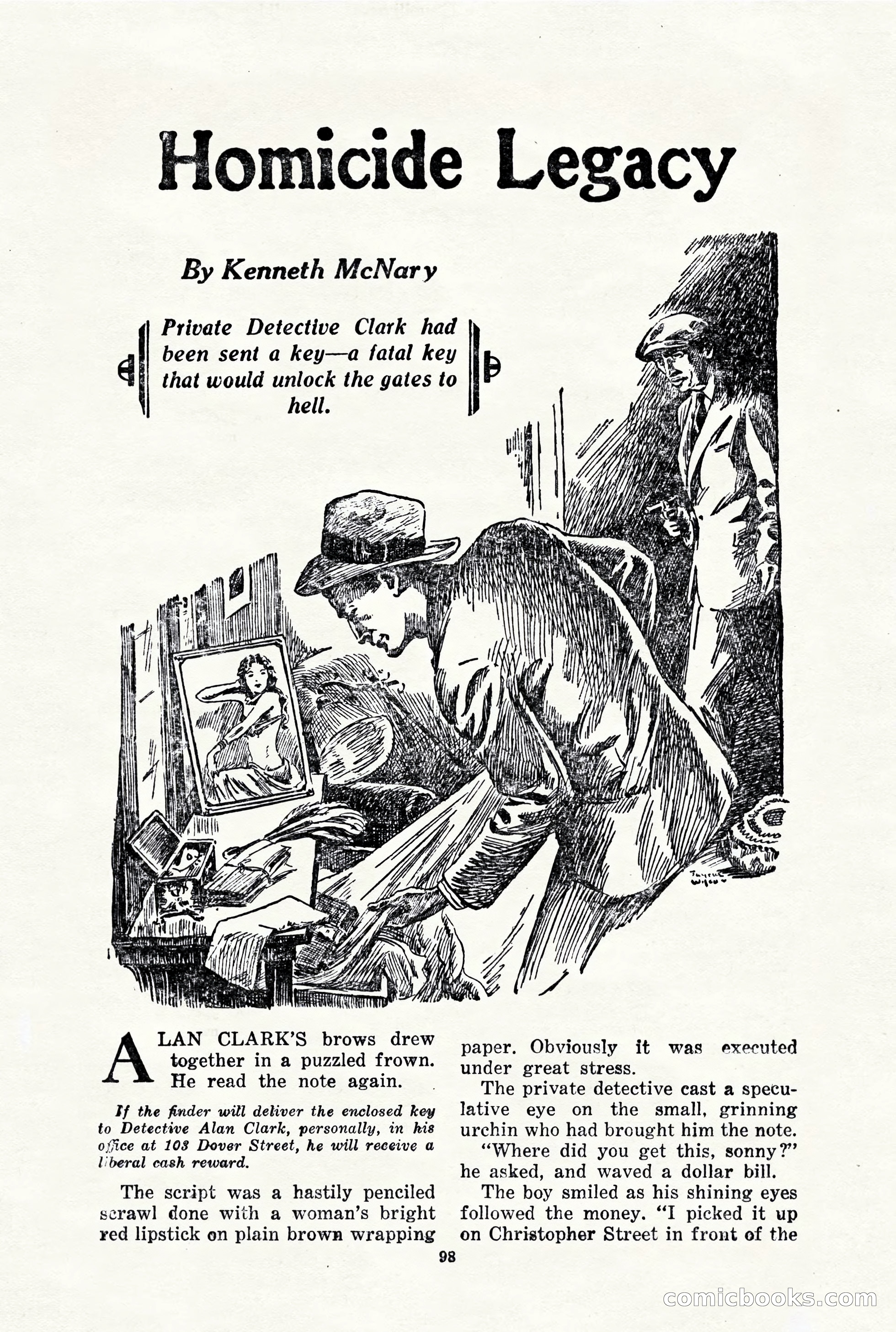
# Page Analysis This is a **story prose page** from a hardboiled crime pulp fiction story titled "Homicide Legacy" by Kenneth McNary. The page opens a narrative about Private Detective Alan Clark, who receives a mysterious note written in red lipstick on brown wrapping paper, delivered by a street urchin. The note contains a key and promises a cash reward if Clark receives it personally at his office on Dover Street. The story's opening establishes an ominous premise: the key will "unlock the gates to hell." An illustration showing Clark examining the note accompanies the text.
# Page Analysis This is **story prose** from page 99 of a hardboiled crime pulp magazine titled "Homicide Legacy." The text depicts a confrontation between detective Clark and Pete Lynch, a criminal gang leader, who interrogates Clark about a mysterious key that a child delivered to him. When Clark refuses to reveal the key's location, Lynch and his associates—"Slug" Nixon and "Butch" Scott—physically assault the detective, demanding information. The scene escalates into violence, with Lynch beating Clark while Slug covers him with a pistol, and ends with Lynch ordering his associates to further disfigure the detective to force a confession.
# Page Analysis This is **story prose** from a hardboiled detective pulp magazine titled "10-Story Detective." The page depicts Private Detective Alan Clark recovering from a brutal beating by criminals searching for a mysterious key hidden in his office. After regaining consciousness and retrieving the key from his inkwell, Clark is visited by Joan Hallet, a recently released prisoner who claims the key is "terribly important." Clark, despite being distracted by her appearance, recognizes the key's value and that multiple criminal parties seek it.
# "Homicide Legacy" - Story Prose Page This is a page of prose fiction from a hardboiled crime story titled "Homicide Legacy." Detective Clark interrogates a mysterious beautiful woman about a key she claims to have hidden and thrown to him via a note. As she recounts details and hands him a thousand dollars as payment, Clark grows suspicious—she remembers every word of the note perfectly but claims it was written in red pencil when he knows it was written in red lipstick. He realizes she's connected to criminals and never actually wrote the note herself, deducing she's in league with the "Lynch toughs." The page concludes as Clark, having verified she doesn't possess the key, returns her money.
This page is **story prose** from a pulp detective magazine titled "10-STORY DETECTIVE" (visible at the top). The text depicts a tense confrontation where Detective Alan Clark refuses to surrender a mysterious key to a veiled woman who attempts to buy it, then threatens him with a pistol. After forcing her from his office, Clark visits a prison matron and learns that the woman—Joan Hallet—was recently an inmate in Cell 6 of Christopher Street prison, providing him a crucial clue to the case. The page contains no illustrations.
# Page Analysis: "Homicide Legacy" This page contains prose fiction text from a hardboiled crime story titled "Homicide Legacy." The narrative follows Detective Clark as he discovers that actress Doris Adair—starring at the Paradise theater—is actually Joan Hallet, the sister of someone he once knew. After attending her performance, Clark returns to his apartment to find it ransacked and a mysterious visitor waiting: Wilson Drake, a powerful political figure, who offers ten thousand dollars for an unspecified "key." Clark refuses the bribe, declaring the key is "not for sale," though Drake's response remains incomplete at the page's end.
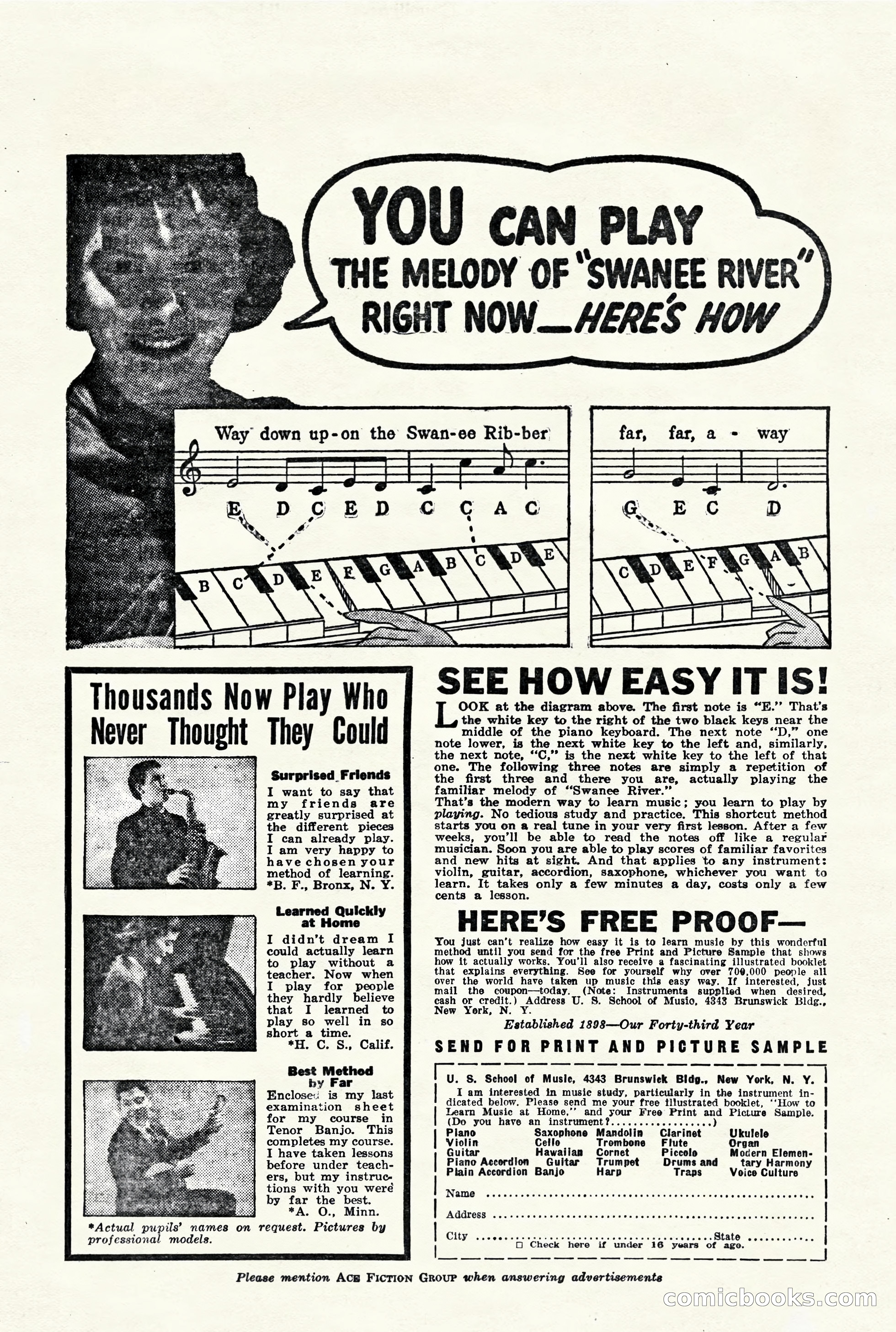
# Page Analysis This is an **advertisement page** from a pulp magazine, likely from the early 20th century (the masthead indicates "Established 1898—Our Forty-third Year," suggesting circa 1941). The page promotes the U.S. School of Music's correspondence course for learning to play instruments "by playing" rather than through traditional study. It features testimonials from satisfied students claiming they learned quickly without teachers, followed by instructions demonstrating how to play "Swanee River" on piano using a simple note-diagram system. The bulk of the page is devoted to a mail-in coupon offering free instructional materials and promising that anyone can learn music in just minutes per day at minimal cost. The advertisement emphasizes that over 700,000 people worldwide have used this method.
# 10-Story Detective (Page 106) This page contains story prose from a hardboiled crime pulp magazine. The narrative follows Detective Clark as he pursues the mystery surrounding actress Doris Adair's disappearance and a coveted key. After learning Adair has vanished from her theater role, Clark is ambushed by Pete Lynch outside the Paradise Theatre, leading to a high-speed cab chase through city streets. The page ends with Clark returning to his apartment at dawn, only to be confronted at gunpoint by Slug Nixon and Jim Hill, continuing the tale's escalating danger and intrigue.
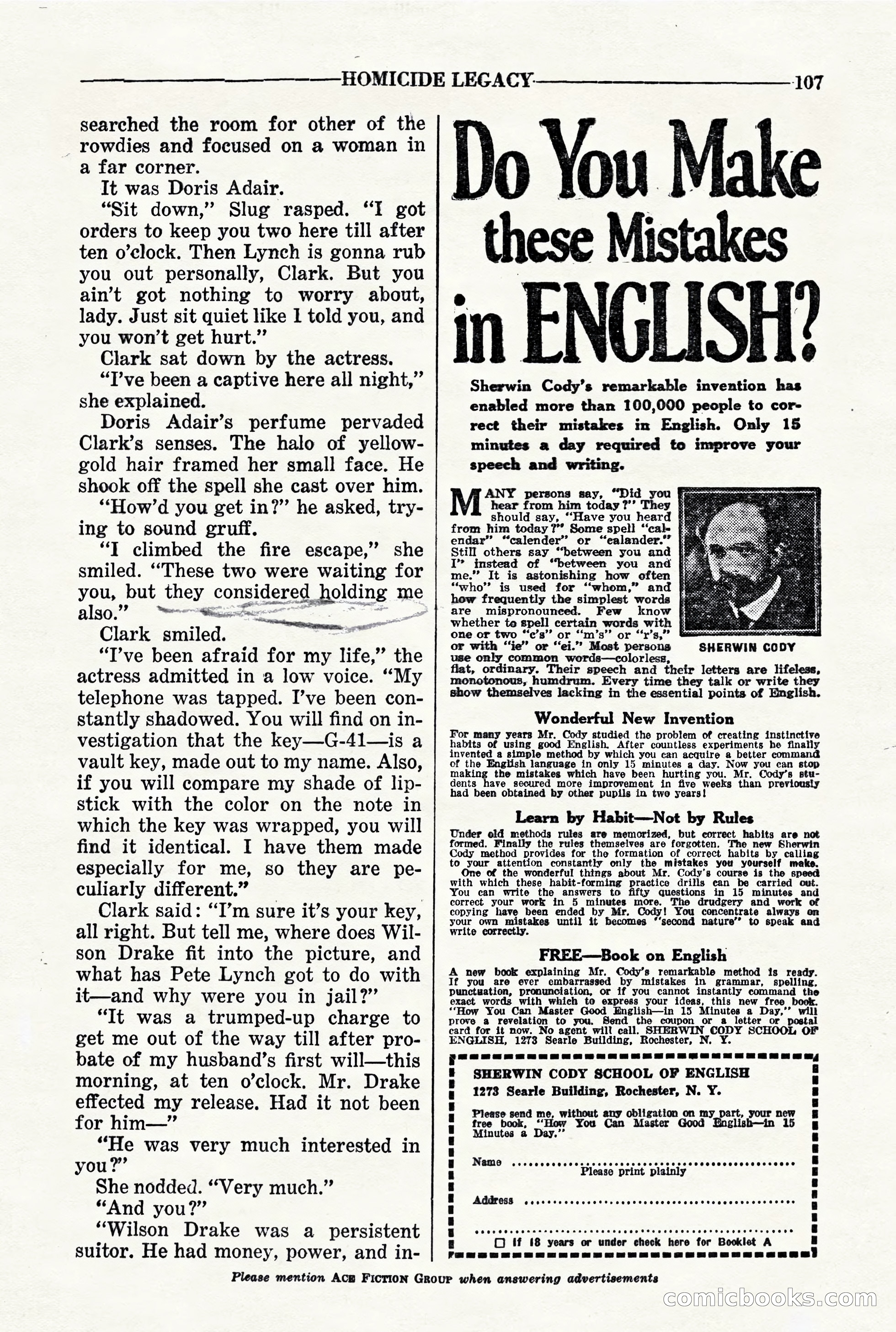
# Page 107: Story Text and Advertisement This page contains the conclusion of a hardboiled crime narrative alongside a substantial advertisement. The fiction section depicts a dialogue between characters named Clark and an actress, Doris Adair, who has infiltrated a criminal operation. Clark questions her about a vault key, her involvement with a man named Wilson Drake, and her recent jailing. The narrative involves kidnapping, murder threats, and criminal intrigue. The right half of the page features a large advertisement for "Sherwin Cody's School of English," promoting a method to correct common English mistakes in fifteen minutes daily. The ad includes a photograph of Sherwin Cody and describes his "remarkable invention" for improving speech and writing through habit-formation rather than memorizing rules.
# Page 108: Story Prose with Advertisements This page contains story prose from a detective fiction narrative alongside vintage advertisements. The visible text shows dialogue from a character named Clark investigating a case involving Doris Adair, who must retrieve her husband's will from a Downtown Bank vault and present it in court by 10 a.m. to prevent his first wife from filing a competing will for probate. The narrative involves a criminal named Pete Lynch and suggests Clark is contemplating a dangerous situation. The left margin contains period advertisements for various products and services (asthma relief, songwriting, food assortments, etc.), typical of pulp magazine layouts.
This page contains story prose from a hardboiled crime or detective pulp magazine. The narrative appears to involve Clark addressing a detective about a key, with references to a husband, captors, and a hoodlum. The text mentions characters named Jim, Slug, Hill, and Nixon in what seems to be a tense scene in a club setting, with someone apparently holding or threatening with a gun. The OCR quality is poor due to page damage and margin cuts, making precise plot details difficult to discern.
# Analysis of Page This is **story prose** from a pulp fiction narrative, likely a hardboiled crime or gangster story. The text depicts an action scene involving a character named Slug Nixon confronting an actress over a script. Slug threatens the actress with a gun ("Drop it—or I !"), but she fights back—she acts frightened to distract him, then struggles and squirms away as Slug loosens his grip. The fragmented OCR text makes the complete plot unclear, but the scene involves coercion, a gun, and physical struggle between the gangster character and a female character over something involving a script or film role.
# Page Content Description This page contains story prose from "Homicide Legacy," a pulp crime fiction narrative. The visible text depicts a dramatic courthouse scene where characters Clark and a girl arrive too late to prevent Lynch and an "adventuress" from completing a transaction involving signed papers. Clark confronts them with accusations about "phony papers," while Lynch appears nervous about drawing court attendants' attention. The page is interrupted by a vintage advertisement for a hair color product offering a free trial bottle, positioned in the upper right. The story text is partially obscured or cut off at the bottom of the page.
# Page Description This is a story page from *10-Story Detective*, a pulp crime magazine. The page contains narrative prose describing a scene where a character (apparently named Clark) has been shot by someone called "Slug Nixon" and is recovering, while an actress named Doris Adair has helped him. The text suggests Clark is emotionally affected by Doris and will be out of work indefinitely, with a mysterious "fateful key" serving a double purpose in the plot. A recruitment advertisement ("WANTED: 2000 MEN & WOMEN PREPARE YOU FOR A JOB") appears in the upper left, typical of pulp magazine advertising.
This appears to be a mostly blank page from a pulp magazine, with minimal visible text. At the top of the page, there is heavily degraded or obscured text in black and yellow/orange coloring that is illegible. At the bottom of the page, there is similarly obscured text, also difficult to read clearly. The OCR text "CO DOO CO" does not provide meaningful information about the page's content. Given the poor image quality and illegible text, it is unclear whether this is a cover, an illustration, story prose, or advertising material. The page's actual subject matter cannot be reliably determined from what is visible.
# Analysis of This Page This is a **missing page** from a pulp magazine. The page displays only placeholder text reading "Missing Page" in red and yellow stylized letters at the top, and "Back cover" in similar styling at the bottom. The rest of the page is blank white space. There is no actual story content, illustration, or advertisement visible—only the notation that this particular page is absent from the magazine. The comicbooks.com watermark appears in the lower right corner, suggesting this is from a digitized collection where this page could not be scanned or was not available.