
Pulp Fiction, 1941 · page 16 of 116
10-Story Detective, March 1941 — page 16: what you’re looking at
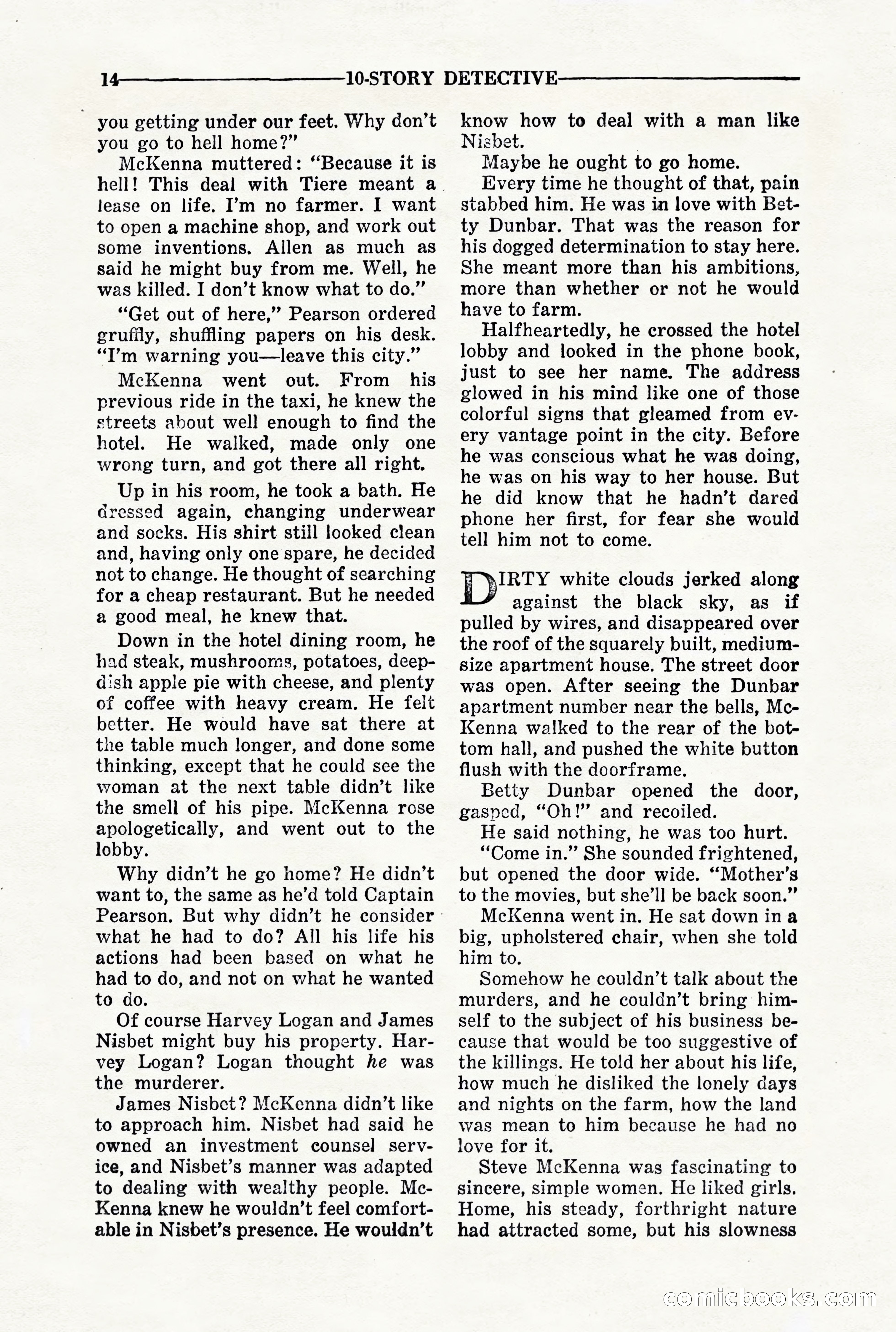
A restored page from Pulp Fiction, 1941. Page through the whole issue in the reader above.
📄 Transcribed text from this page (OCR, searchable)
Machine-transcribed from the original scan — historical spelling and the odd misread are preserved.
14—_—__————_10-STORY DETECTIVE : you getting under our feet. Why don’t you go to hell home?” McKenna muttered: “Because it is hell! This deal with Tiere meant a. lease on life. I’m no farmer. I want to open a machine shop, and work out some inventions. Allen as much as said he might buy from me. Well, he was killed. I don’t know what to do.” “Get out of here,” Pearson ordered gerufily, shuffling papers on his desk. “I’m warning you—leave this city.” McKenna went out. From his previous ride in the taxi, he knew the streets about well enough to find the hotel. He walked, made only one wrong turn, and got there all right. Up in his room, he took a bath. He dressed again, changing underwear and socks. His shirt still looked clean and, having only one spare, he decided not to change. He thought of searching for a cheap restaurant. But he needed a good meal, he knew that. Down in the hotel dining room, he had steak, mushrooms, potatoes, deep- dish apple pie with cheese, and plenty of coffee with heavy cream. He felt better. He would have sat there at the table much longer, and done some thinking, except that he could see the woman at the next table didn’t like the smell of his pipe. McKenna rose apologetically, and went out to the lobby. Why didn’t he go home? He didn’t want to, the same as he’d told Captain Pearson. But why didn’t he consider what he had to do? All his life his actions had been based on what he had to do, and not on what he wanted to do. Of course Harvey Logan and James Nisbet might buy his property. Har- vey Logan? Logan thought he was the murderer. James Nisbet? McKenna didn’t like to approach him. Nisbet had said he owned an investment counsel serv- ice, and Nisbet’s manner was adapted to dealing with wealthy people. Mc- Kenna knew he wouldn’t feel comfort- able in Nisbet’s presence. He wouldn’t know how to deal with a man like Nisbet. Maybe he ought to go home. Every time he thought of that, pain stabbed him. He was in love with Bet- ty Dunbar. That was the reason for his dogged determination to stay here. She meant more than his ambitions, more than whether or not he would have to farm. Halfheartedly, he crossed the hotel lobby and looked in the phone book, just to see her name. The address glowed in his mind like one of those colorful signs that gleamed from eyv- ery vantage point in the city. Before he was conscious what he was doing, he was on his way to her house. But he did know that he hadn’t dared phone her first, for fear she would tell him not to come. IRTY white clouds jerked along against the black sky, as if pulled by wires, and disappeared over the roof of the squarely built, medium- size apartment house. The street door was open. After seeing the Dunbar apartment number near the bells, Mc- Kenna walked to the rear of the bot- tom hall, and pushed the white button flush with the doorframe. Betty Dunbar opened the door, gasped, “Oh!” and recoiled. He said nothing, he was too hurt. “Come in.” She sounded frightened, but opened the door wide. “Mother’s to the movies, but she’ll be back soon.” McKenna went in. He sat down ina big, upholstered chair, when she told him to. Somehow he couldn’t talk about the murders, and he couldn’t bring him- self to the subject of his business be- cause that would be too suggestive of the killings. He told her about his life, how much he disliked the lonely days and nights on the farm, how the land was mean to him because he had no love for it. Steve McKenna was fascinating to sincere, simple women. He liked girls. Home, his steady, forthright nature had attracted some, but his slowness COmiclboo S CO