
Pulp Fiction, 1941 · page 90 of 116
10-Story Detective, March 1941 — page 90: what you’re looking at
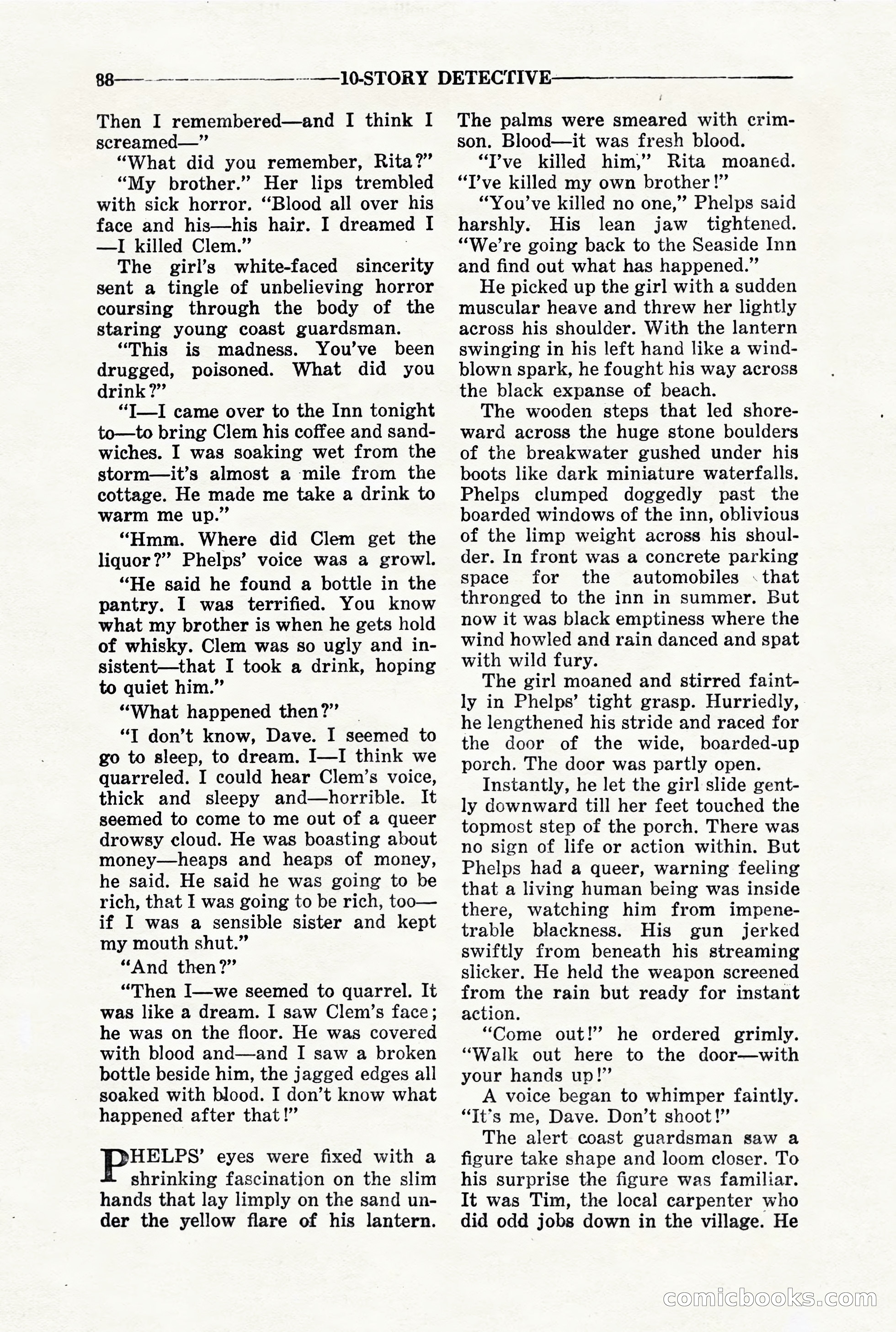
A restored page from Pulp Fiction, 1941. Page through the whole issue in the reader above.
📄 Transcribed text from this page (OCR, searchable)
Machine-transcribed from the original scan — historical spelling and the odd misread are preserved.
88——_- ——-—-—-—_—_---—_10-STORY DETECTIVE- Then I remembered—and I think I screamed—” “What did you remember, Rita?’ “My brother.” Her lips trembled with sick horror. ‘Blood all over his face and his—his hair. I dreamed I —I killed Clem.” 3 The girl’s white-faced sincerity sent a tingle of unbelieving horror coursing through the body of the staring young coast guardsman. “This is madness. You’ve been drugged, poisoned. What did you drink ?” “TI came over to the Inn tonight to—to bring Clem his coffee and sand- wiches. I was soaking wet from the storm—it’s almost a mile from the cottage. He made me take a drink to warm me up.” “Hmm. Where did Clem get the liquor?” Phelps’ voice was a growl. “He said he found a bottle in the pantry. I was terrified. You know what my brother is when he gets hold of whisky. Clem was so ugly and in- sistent—that I took a drink, hoping to quiet him.” “What happened then?” “T don’t know, Dave. I seemed to go to sleep, to dream. I—I think we quarreled. I could hear Clem’s voice, thick and sleepy and—horrible. It seemed to come to me out of a queer drowsy cloud. He was boasting about money—heaps and heaps of money, he said. He said he was going to be rich, that I was going to be rich, too— if I was a sensible sister and kept my mouth shut.” “And then?” “Then I—we seemed to quarrel. It was like a dream. I saw Clem’s face; he was on the floor. He was covered with blood and—and I saw a broken bottle beside him, the jagged edges all soaked with blood. I don’t know what happened after that!’ HELPS’ eyes were fixed with a shrinking fascination on the slim hands that lay limply on the sand un- der the yellow flare of his lantern. The palms were smeared with crim- son. Blood—it was fresh blood. “T’ve killed him,” Rita moaned. “T’ve killed my own brother!’ “You’ve killed no one,” Phelps said harshly. His lean jaw tightened. “We’re going back to the Seaside Inn and find out what has happened.” He picked up the girl with a sudden muscular heave and threw her lightly across his shoulder. With the lantern swinging in his left hand like a wind- blown spark, he fought his way across the black expanse of beach. The wooden steps that led shore- ward across the huge stone boulders of the breakwater gushed under his boots like dark miniature waterfalls. Phelps clumped doggedly past the boarded windows of the inn, oblivious of the limp weight across his shoul- der. In front was a concrete parking space for the automobiles -that thronged to the inn in summer. But now it was black emptiness where the wind howled and rain danced and spat with wild fury. The girl moaned and stirred faint- ly in Phelps’ tight grasp. Hurriedly, he lengthened his stride and raced for the door of the wide, boarded-up porch. The door was partly open. Instantly, he let the girl slide gent- ly downward till her feet touched the topmost step of the porch. There was no sign of life or action within. But Phelps had a queer, warning feeling that a living human being was inside there, watching him from impene- trable blackness. His gun jerked swiftly from beneath his streaming slicker. He held the weapon screened from the rain but ready for instant action. “Come out!” he ordered grimly. “Walk out here to the door—with your hands up!” A voice began to whimper faintly. “It’s me, Dave. Don’t shoot!’ The alert coast guardsman saw a figure take shape and loom closer. To his surprise the figure was familiar. It was Tim, the local carpenter who did odd jobs down in the village. He comicbook CO