
Pulp Fiction, 1941 · page 108 of 116
10-Story Detective, March 1941 — page 108: what you’re looking at
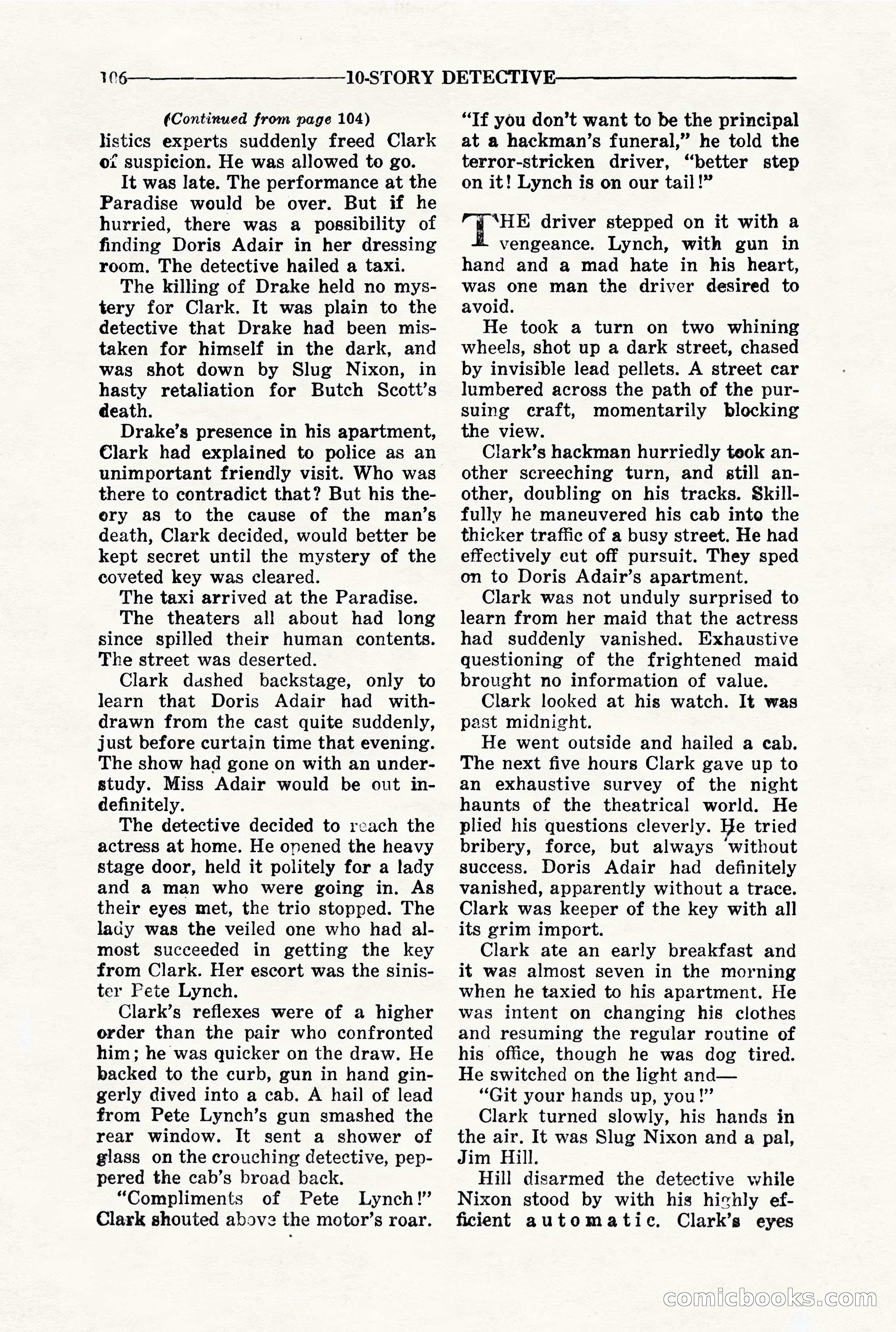
A restored page from Pulp Fiction, 1941. Page through the whole issue in the reader above.
📄 Transcribed text from this page (OCR, searchable)
Machine-transcribed from the original scan — historical spelling and the odd misread are preserved.
C6 (Continued from page 104) listics experts suddenly freed Clark ot suspicion. He was allowed to go. It was late. The performance at the Paradise would be over. But if he hurried, there was a possibility of finding Doris Adair in her dressing room. The detective hailed a taxi. The killing of Drake held no mys- tery for Clark. It was plain to the detective that Drake had been mis- taken for himself in the dark, and was shot down by Slug Nixon, in hasty retaliation for Butch Scott’s death. Drake’s presence in his apartment, Clark had explained to police as an unimportant friendly visit. Who was there to contradict that? But his the- ery as to the cause of the man’s death, Clark decided, would better be kept secret until the mystery of the coveted key was cleared. The taxi arrived at the Paradise. The theaters all about had long since spilled their human contents. The street was deserted. Clark dashed backstage, only to learn that Doris Adair had with- drawn from the cast quite suddenly, just before curtain time that evening. The show had gone on with an under- study. Miss Adair would be out in- definitely. The detective decided to rcach the actress at home. He onened the heavy stage door, held it politely for a lady and a man who were going in. As their eyes met, the trio stopped. The laagy was the veiled one who had al- most succeeded in getting the key from Clark. Her escort was the sinis- ter Pete Lynch. Clark’s reflexes were of a higher order than the pair who confronted him; he was quicker on the draw. He backed to the curb, gun in hand gin- gerly dived into a cab. A hail of lead from Pete Lynch’s gun smashed the rear window. It sent a shower of glass on the crouching detective, pep- pered the cab’s broad back. “Compliments of Pete Lynch!” Clark shouted above the motor’s roar. 10-STORY DETECTIVE “If you don’t want to be the principal at a hackman’s funeral,” he told the terror-stricken driver, “better step on it! Lynch is on our tail!” gi ee driver stepped on it with a vengeance. Lynch, with gun in hand and a mad hate in his heart, was one man the driver desired to avoid. He took a turn on two whining wheels, shot up a dark street, chased by invisible lead pellets. A street car lumbered across the path of the pur- suing craft, momentarily blocking the view. Clark’s hackman hurriedly teok an- other screeching turn, and still an- other, doubling on his tracks. Skill- fully he maneuvered his cab into the thicker traffic of a busy street. He had effectively eut off pursuit. They sped on to Doris Adair’s apartment. Clark was not unduly surprised to learn from her maid that the actress had suddenly vanished. Exhaustive questioning of the frightened maid brought no information of value. Clark looked at his watch. It was past midnight. He went outside and hailed a cab. The next five hours Clark gave up to an exhaustive survey of the night haunts of the theatrical world. He plied his questions cleverly. He tried bribery, force, but always without success. Doris Adair had definitely vanished, apparently without a trace. Clark was keeper of the key with all its grim import. Clark ate an early breakfast and it was almost seven in the morning when he taxied to his apartment. He was intent on changing his clothes and resuming the regular routine of his office, though he was dog tired. He switched on the light and— “Git your hands up, you!” Clark turned slowly, his hands in the air. It was Slug Nixon and a pal, Jim Hill. Hill disarmed the detective while Nixon stood by with his hichly ef- ficient automatic. Clark’s eyes COMICLOO CO