
Pulp Fiction, 1941 · page 12 of 116
10-Story Detective, March 1941 — page 12: what you’re looking at
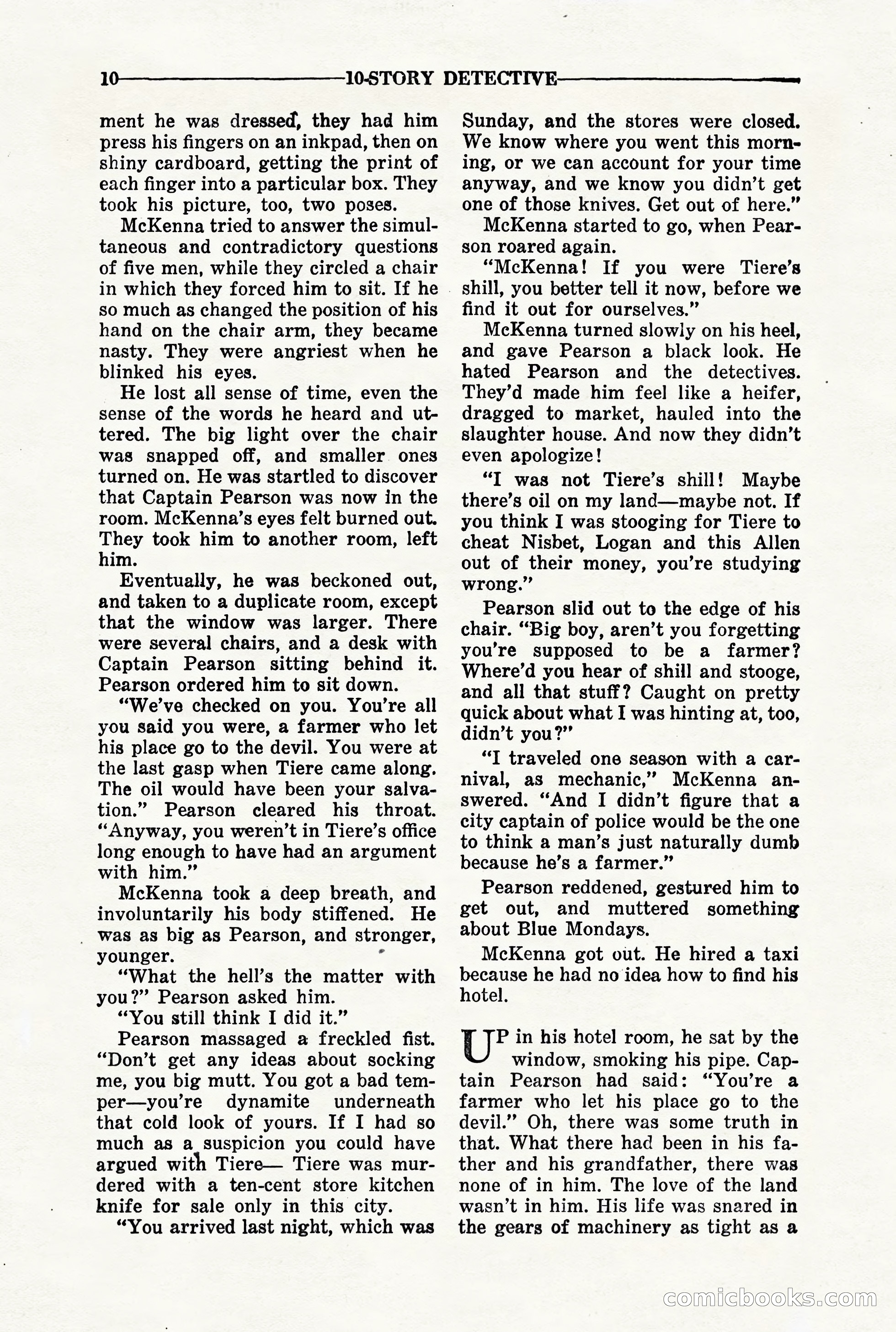
A restored page from Pulp Fiction, 1941. Page through the whole issue in the reader above.
📄 Transcribed text from this page (OCR, searchable)
Machine-transcribed from the original scan — historical spelling and the odd misread are preserved.
10—___—_—_————-10-STORY DETECTIVE ment he was dressed, they had him press his fingers on an inkpad, then on shiny cardboard, getting the print of each finger into a particular box. They took his picture, too, two poses. McKenna tried to answer the simul- taneous and contradictory questions of five men, while they circled a chair in which they forced him to sit. If he . so much as changed the position of his hand on the chair arm, they became nasty. They were angriest when he blinked his eyes. He lost all sense of time, even the sense of the words he heard and ut- tered. The big light over the chair was snapped off, and smaller ones turned on. He was startled to discover that Captain Pearson was now in the room. McKenna’s eyes felt burned out. They took him to another room, left him. Eventually, he was beckoned out, and taken to a duplicate room, except that the window was larger. There were several chairs, and a desk with Captain Pearson sitting behind it. Pearson ordered him to sit down. “We’ve checked on you. You’re all you said you were, a farmer who let his place go to the devil. You were at the last gasp when Tiere came along. The oil would have been your salva- tion.” Pearson cleared his throat. “Anyway, you weren’t in Tiere’s office long enough to have had an argument with him.” McKenna took a deep breath, and involuntarily his body stiffened. He _ was as big as Pearson, and stronger, younger. . “What the hell’s the matter with you?” Pearson asked him. “You still think I did it.” Pearson massaged a freckled fist. “Don’t get any ideas about socking me, you big mutt. You got a bad tem- per—you’re dynamite underneath that cold look of yours. If I had so much as a suspicion you could have argued with Tiere— Tiere was mur- dered with a ten-cent store kitchen knife for sale only in this city. “You arrived last night, which was Sunday, and the stores were closed. We know where you went this morn- ing, or we can account for your time anyway, and we know you didn’t get one of those knives. Get out of here.” McKenna started to go, when Pear- son roared again. “McKenna! If you were Tiere’s shill, you better tell it now, before we find it out for ourselves.” McKenna turned slowly on his heel, and gave Pearson a black look. He hated Pearson and the detectives. They’d made him feel like a heifer, dragged to market, hauled into the slaughter house. And now they didn’t even apologize! “I was not Tiere’s shill! Maybe there’s oil on my land—maybe not. If you think I was stooging for Tiere to cheat Nisbet, Logan and this Allen out of their money, you’re studying wrong.” Pearson slid out to the edge of his chair. “Big boy, aren’t you forgetting you’re supposed to be a farmer? Where'd you hear of shill and stooge, and all that stuff? Caught on pretty quick about what I was hinting at, too, didn’t you?” “I traveled one season with a car- nival, as mechanic,’ McKenna an- swered. “And I didn’t figure that a city captain of police would be the one to think a man’s just naturally dumb because he’s a farmer.” Pearson reddened, gestured him to get out, and muttered something about Blue Mondays. McKenna got out. He hired a taxi because he had no idea how to find his hotel. P in his hotel room, he sat by the window, smoking his pipe. Cap- tain Pearson had said: “‘You’re a farmer who let his place go to the devil.’”’” Oh, there was some truth in that. What there had been in his fa- ther and his grandfather, there was none of in him. The love of the land wasn’t in him. His life was snared in the gears of machinery as tight as a COmiclbooks CO