
Pulp Fiction, 1941 · page 41 of 116
10-Story Detective, March 1941 — page 41: what you’re looking at
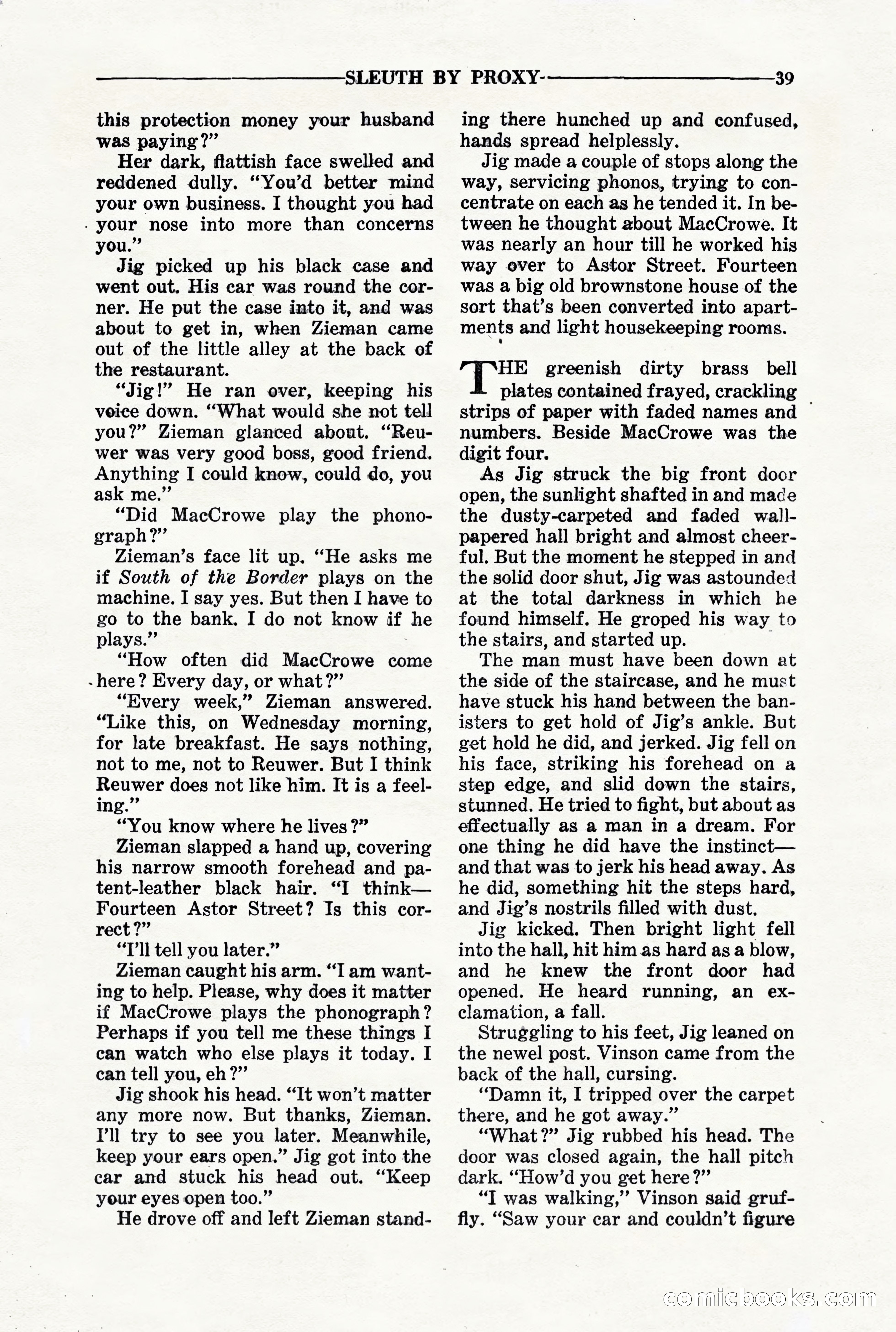
A restored page from Pulp Fiction, 1941. Page through the whole issue in the reader above.
📄 Transcribed text from this page (OCR, searchable)
Machine-transcribed from the original scan — historical spelling and the odd misread are preserved.
SLEUTH BY PROXY- this protection money your husband was paying?” Her dark, flattish face swelled and reddened dully. “You’d better mind your own business. I thought you had - your nose into more than concerns you.” Jig picked up his black case and went out. His car was round the cor- ner. He put the case into it, and was about to get in, when Zieman came out of the little alley at the back of the restaurant. “Jig!” He ran over, keeping his voice down. ‘What would she not tell you?” Zieman glanced about. “Reu- wer was very good boss, good friend. Anything I could know, could do, you ask me.”’ “Did MacCrowe play the phono- graph?” Zieman’s face lit up. ““He asks me if South of the Border plays on the machine. I say yes. But then I have to go to the bank. I do not know if he plays.” “How often did MacCrowe come -here? Every day, or what?” “Every week,” Zieman answered. “Like this, on Wednesday morning, for late breakfast. He says nothing, not to me, not to Reuwer. But I think Reuwer does not like him. It is a feel- ing.” “You know where he lives ?” Zieman slapped a hand up, covering his narrow smooth forehead and pa- tent-leather black hair. “I think— Fourteen Astor Street? Is this cor- rect ?” “T’ll tell you later.” Zieman caught his arm. “I am want- ing to help. Please, why does it matter if MacCrowe plays the phonograph? Perhaps if you tell me these things I can watch who else plays it today. I can tell you, eh ?”’ Jig shook his head. “It won’t matter any more now. But thanks, Zieman. T’ll try to see you later. Meanwhile, keep your ears open.” Jig got into the car and stuck his head out. “Keep your eyes open too.” He drove off and left Zieman stand- 39 ing there hunched up and confused, hands spread helplessly. Jig made a couple of stops along the way, servicing phonos, trying to con- centrate on each as he tended it. In be- tween he thought about MacCrowe. It was nearly an hour till he worked his way over to Astor Street. Fourteen was a big old brownstone house of the sort that’s been converted into apart- ments and light housekeeping rooms. HE greenish dirty brass bell plates contained frayed, crackling _ strips of paper with faded names and numbers. Beside MacCrowe was the digit four. As Jig struck the big front door open, the sunlight shafted in and mace the dusty-carpeted and faded wall- papered hall bright and almost cheer- ful. But the moment he stepped in and the solid door shut, Jig was astounded at the total darkness in which he found himself. He groped his way to the stairs, and started up. The man must have been down at the side of the staircase, and he must have stuck his hand between the ban- isters to get hold of Jig’s ankle. But get hold he did, and jerked. Jig fell on his face, striking his forehead on a step edge, and slid down the stairs, stunned. He tried to fight, but about as effectually as a man in a dream. For one thing he did have the instinct— and that was to jerk his head away. As he did, something hit the steps hard, and Jig’s nostrils filled with dust. Jig kicked. Then bright light fell into the hall, hit him as hard as a blow, and he knew the front door had opened. He heard running, an ex- clamation, a fall. Struggling to his feet, Jig leaned on the newel post. Vinson came from the back of the hall, cursing. “Damn it, I tripped over the carpet there, and he got away.” “What?” Jig rubbed his head. The door was closed again, the hall pitch dark. ““How’d you get here?” “I was walking,”’ Vinson said gruf- fly. “Saw your car and couldn’t figure CO clo@olx CO