
Pulp Fiction, 1941 · page 13 of 116
10-Story Detective, March 1941 — page 13: what you’re looking at
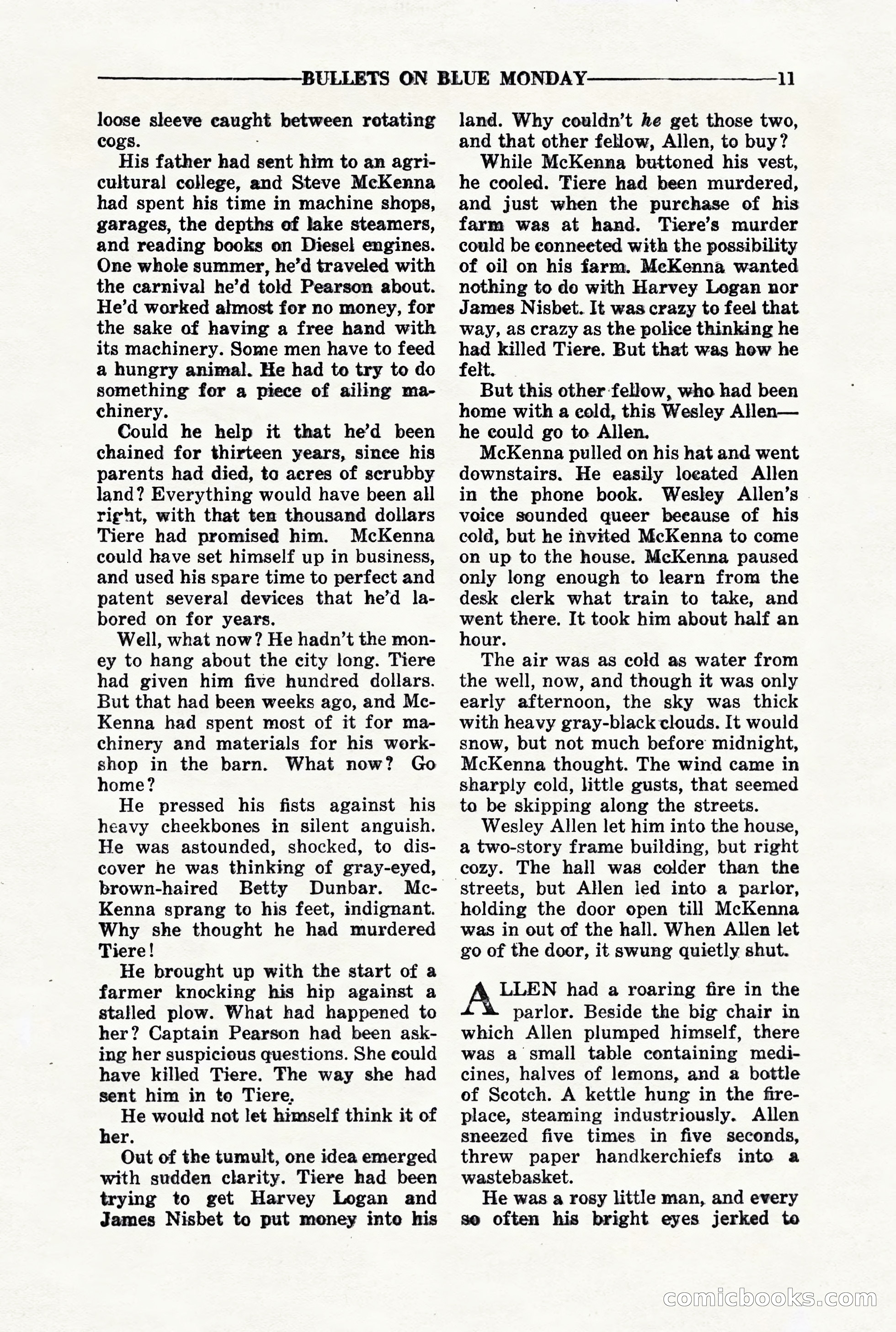
A restored page from Pulp Fiction, 1941. Page through the whole issue in the reader above.
📄 Transcribed text from this page (OCR, searchable)
Machine-transcribed from the original scan — historical spelling and the odd misread are preserved.
BULLETS ON BLUE MONDAY loose sleeve caught between rotating cogs. His father had sent him to an agri- cultural college, and Steve McKenna had spent his time in machine shops, garages, the depths of lake steamers, and reading books on Diesel engines. One whole summer, he’d traveled with the carnival he’d told Pearson about. He’d worked almost for no money, for the sake of having a free hand with its machinery. Some men have to feed a hungry animal. He had to try to do something for a piece of ailing ma- chinery. Could he help it that he’d been chained for thirteen years, since his parents had died, to acres of scrubby land? Everything would have been all right, with that ten thousand dollars Tiere had promised him. McKenna could have set himself up in business, and used his spare time to perfect and patent several devices that he’d la- bored on for years. Well, what now? He hadn’t the mon- ey to hang about the city long. Tiere had given him five hundred dollars. But that had been weeks ago, and Mc- Kenna had spent most of it for ma- chinery and materials for his work- shop in the barn. What now? Go home? He pressed his fists against his heavy cheekbones in silent anguish. He was astounded, shocked, to dis- cover he was thinking of gray-eyed, brown-haired Betty Dunbar. Kenna sprang to his feet, indignant. Why she thought he had murdered Tiere! He brought up with the start of a farmer knocking his hip against a stalled plow. What had happened to her? Captain Pearson had been ask- ing her suspicious questions. She could have killed Tiere. The way she had sent him in to Tiere, He would not let himself think it of her. Out of the tumult, one idea emerged with sudden clarity. Tiere had been trying to get Harvey Logan and James Nisbet to put money into his Mc- 1] land. Why couldn’t he get those two, and that other fellow, Allen, to buy? While McKenna buttoned his vest, he cooled. Tiere had been murdered, and just when the purchase of his farm was at hand. Tiere’s murder could be eonneeted with the possibility of oil on his farm. MeKenna wanted nothing to do with Harvey Logan nor James Nisbet. It was crazy to feel that way, as crazy as the police thinking he had killed Tiere. But that was how he felt. | But this other fellow, who had been home with a cold, this Wesley Allen— he could go to Allen. McKenna pulled on his hat and went downstairs. He easily loeated Allen in the phone book. Wesley Allen’s voice sounded queer beeause of his cold, but he invited McKenna to come on up to the house. McKenna paused only long enough to learn from the desk clerk what train to take, and went there. It took him about half an hour. The air was as cold as water from the well, now, and though it was only early afternoon, the sky was thick with heavy gray-black clouds. It would snow, but not much before midnight, McKenna thought. The wind came in sharply cold, little gusts, that seemed to be skipping along the streets. Wesley Allen let him into the house, a two-story frame building, but right cozy. The hall was colder than the ‘streets, but Allen ied into a parlor, holding the door open till McKenna was in out of the hall. When Allen let go of the door, it swung quietly shut. LLEN had a roaring fire in the parlor. Beside the big chair in which Allen plumped himself, there was a small table containing medi- cines, halves of lemons, and a bottle of Scotch. A kettle hung in the fire- place, steaming industriously. Allen sneezed five times in five seconds, threw paper handkerchiefs into a wastebasket. He was a rosy little man, and every se often his bright eyes jerked to COmiclbook CO