
Pulp Fiction, 1941 · page 59 of 116
10-Story Detective, March 1941 — page 59: what you’re looking at
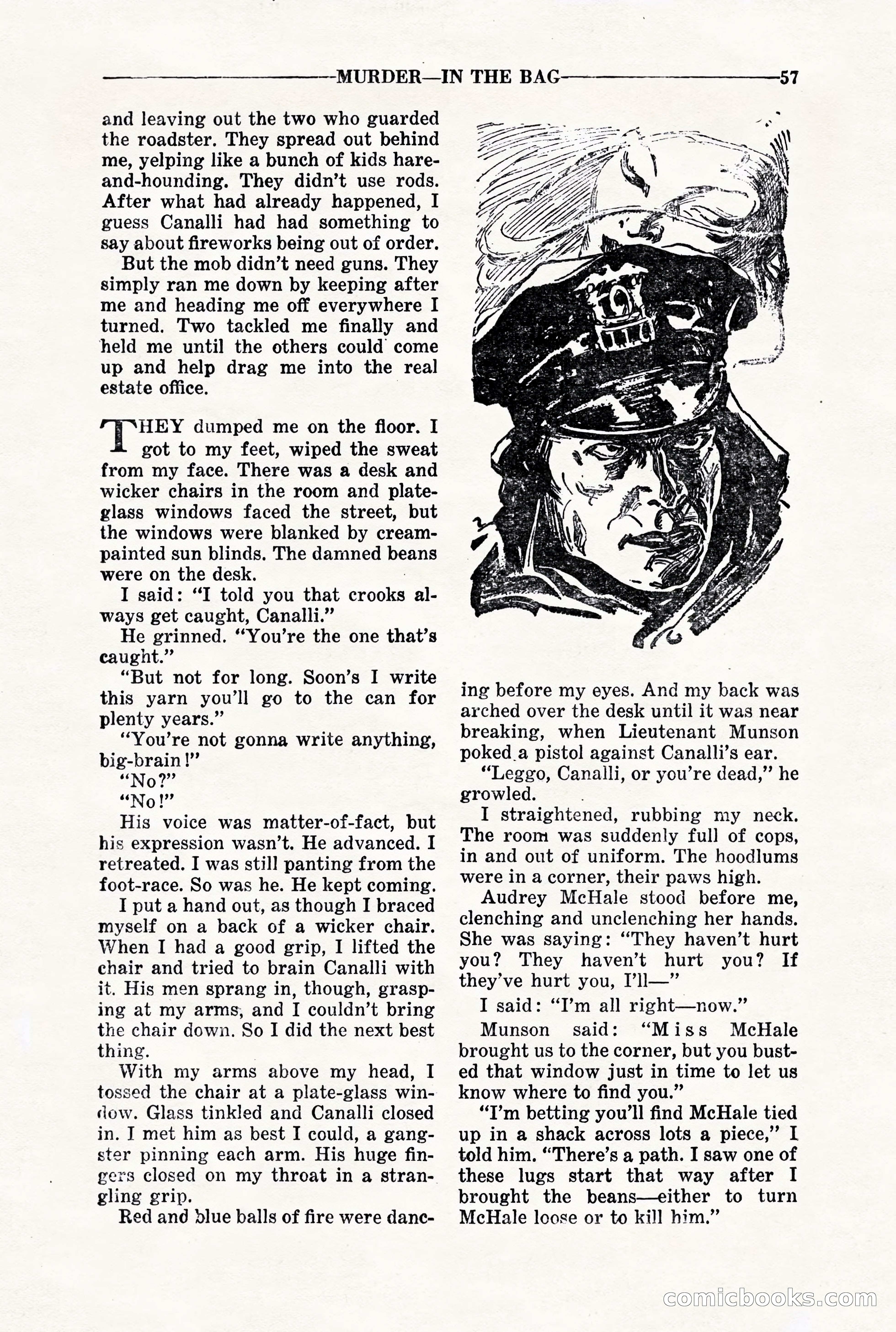
A restored page from Pulp Fiction, 1941. Page through the whole issue in the reader above.
📄 Transcribed text from this page (OCR, searchable)
Machine-transcribed from the original scan — historical spelling and the odd misread are preserved.
———— and leaving out the two who guarded the roadster. They spread out behind me, yelping like a bunch of kids hare- and-hounding. They didn’t use rods. After what had already happened, I guess Canalli had had something to say about fireworks being out of order. But the mob didn’t need guns. They simply ran me down by keeping after me and heading me off everywhere I turned. Two tackled me finally and held me until the others could come up and help drag me into the real estate office. 7 HEY dumped me on the floor. I got to my feet, wiped the sweat from my face. There was a desk and wicker chairs in the room and plate- glass windows faced the street, but the windows were blanked by cream- painted sun blinds. The damned beans were on the desk. 7 I said: “I told you that crooks al- ways get caught, Canalli.” He grinned. ‘*You’re the one that’s caught.” “But not for long. Soon’s I write this yarn you'll go to the can for plenty years.” ‘“You’re not gonna write anything, big-brain !”’ “No?” “No des His voice was matter-of-fact, but his expression wasn’t. He advanced. I retreated. I was still panting from the foot-race. So was he. He kept coming. I put a hand out, as though I braced myself on a back of a wicker chair. When I had a good grip, I lifted the chair and tried to brain Canalli with it. His men sprang in, though, grasp- ing at my arms, and I couldn’t bring the chair down. So I did the next best thing. | With my arms above my head, I tossed the chair at a plate-glass win- dow. Glass tinkled and Canalli closed in. J met him as best I could, a gang- ster pinning each arm. His huge fin- gers closed on my throat in a stran- gling grip. Red and dlue balls of fire were danc- —~-MURDER—IN THE BAG ing before my eyes. And my back was arched over the desk until it was near breaking, when Lieutenant Munson poked _a pistol against Canalli’s ear. “Leggo, Canalli, or you’re dead,” he growled. I straightened, rubbing my neck. The room was suddenly full of cops, in and out of uniform. The hoodlums were in a corner, their paws high. Audrey McHale stood before me, clenching and unclenching her hands. She was saying: “They haven’t hurt you? They haven’t hurt you? If they’ve hurt you, [’ll—” I said: “Um all right—now.”’ Munson said: “Miss McHale brought us to the corner, but you bust- ed that window just in time to let us know where to find you.” “I’m betting you'll find McHale tied up in a shack across lots a piece,” I told him. “There’s a path. I saw one of these lugs start that way after I brought the beans—either to turn McHale loose or to kill him.” COMmicloo CO