
A complete issue · 18 pages · 1879
Puck — October 15, 1879
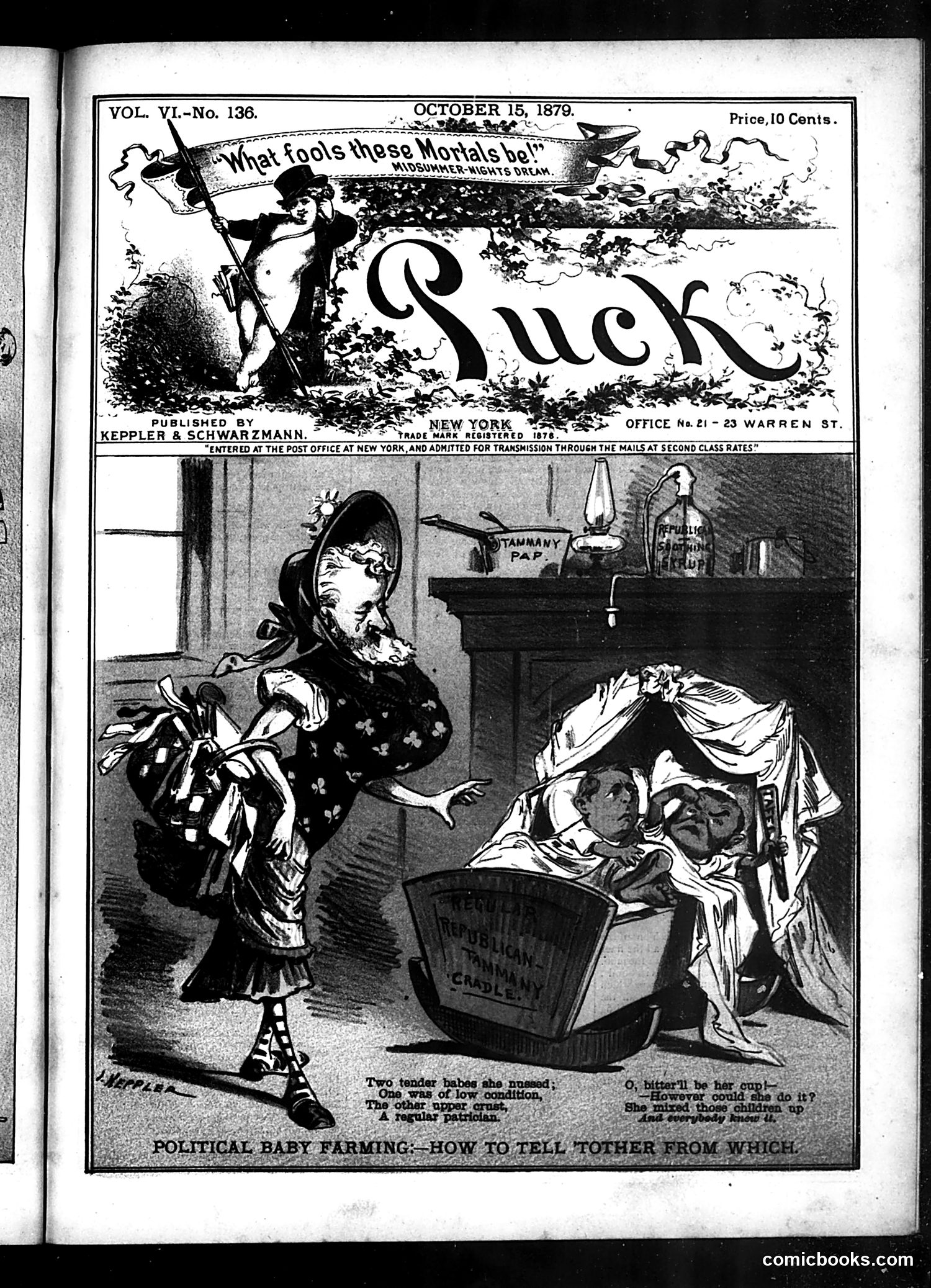
This Puck cartoon from October 15, 1879 satirizes corrupt political practices using a metaphor of baby farming—a contemporary social scandal involving neglectful caretakers of infants. The illustration shows a woman (likely representing a political operative or machine boss) presenting two babies labeled as representing different political conditions: "one was of low condition, The other upper crust" and "a regular politician." The caption "Political Baby Farming: How to Tell Tother from Which" suggests that politicians, regardless of their stated backgrounds or principles, are interchangeable products of the same corrupt system. The satire implies that political machines manufacture and manipulate candidates without regard to genuine differences, treating politics like a neglectful caretaking operation where outcomes are predetermined and indistinguishable.
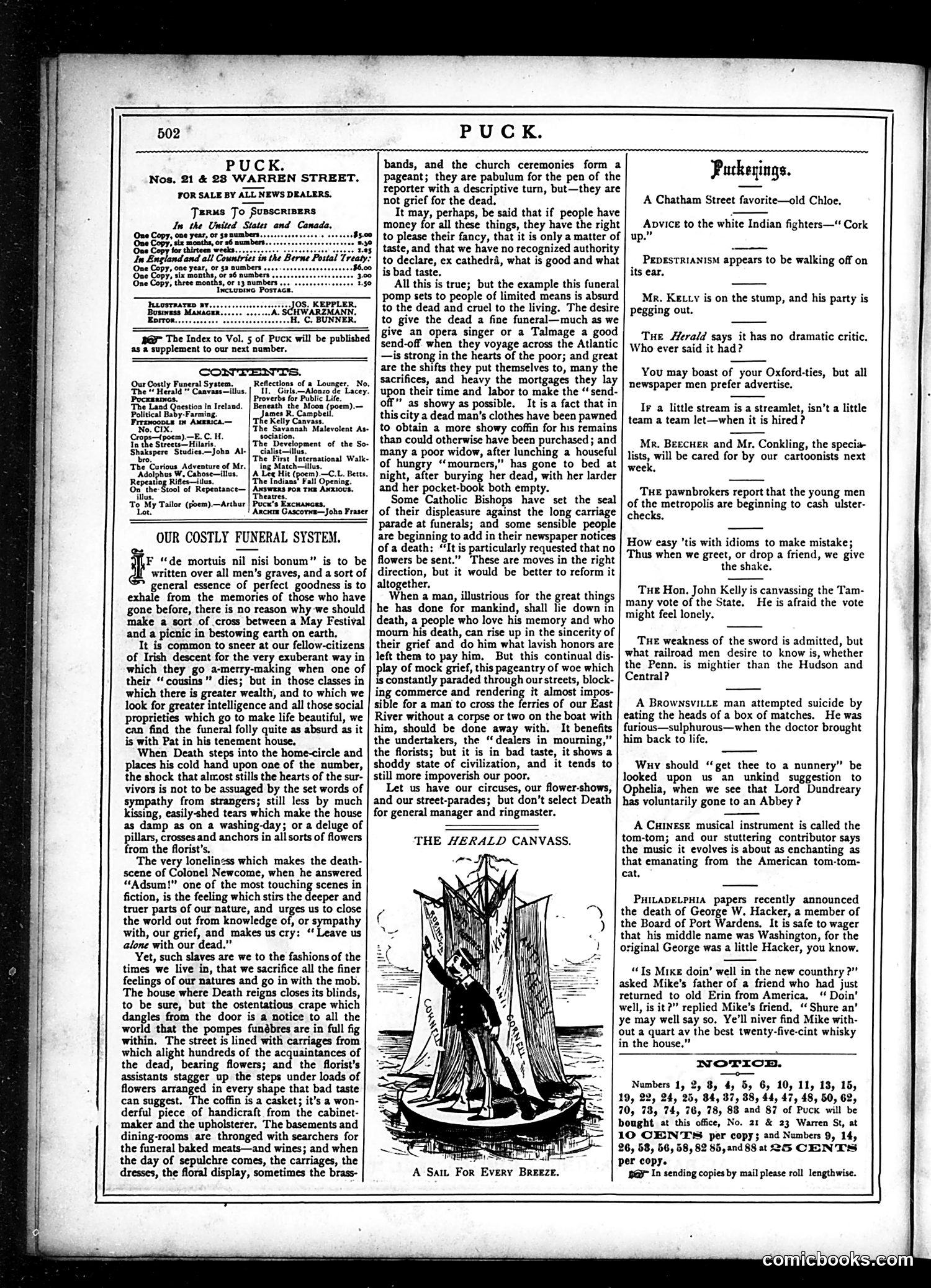
This political cartoon depicts a ship in distress, its sails torn and tattered. The illustration appears to comment on instability or turbulent conditions—likely referencing political or economic upheaval of the era when *Puck* was published. The title "A Sail For Every Breeze" suggests adaptability or opportunism, possibly satirizing politicians or leaders who shift positions depending on circumstances. The damaged vessel could represent the nation, government, or a specific institution struggling under changing conditions. Without additional context identifying the specific historical moment, the exact targets remain unclear, but the maritime metaphor was common in 19th-century American political satire to represent the nation's course through troubled waters.
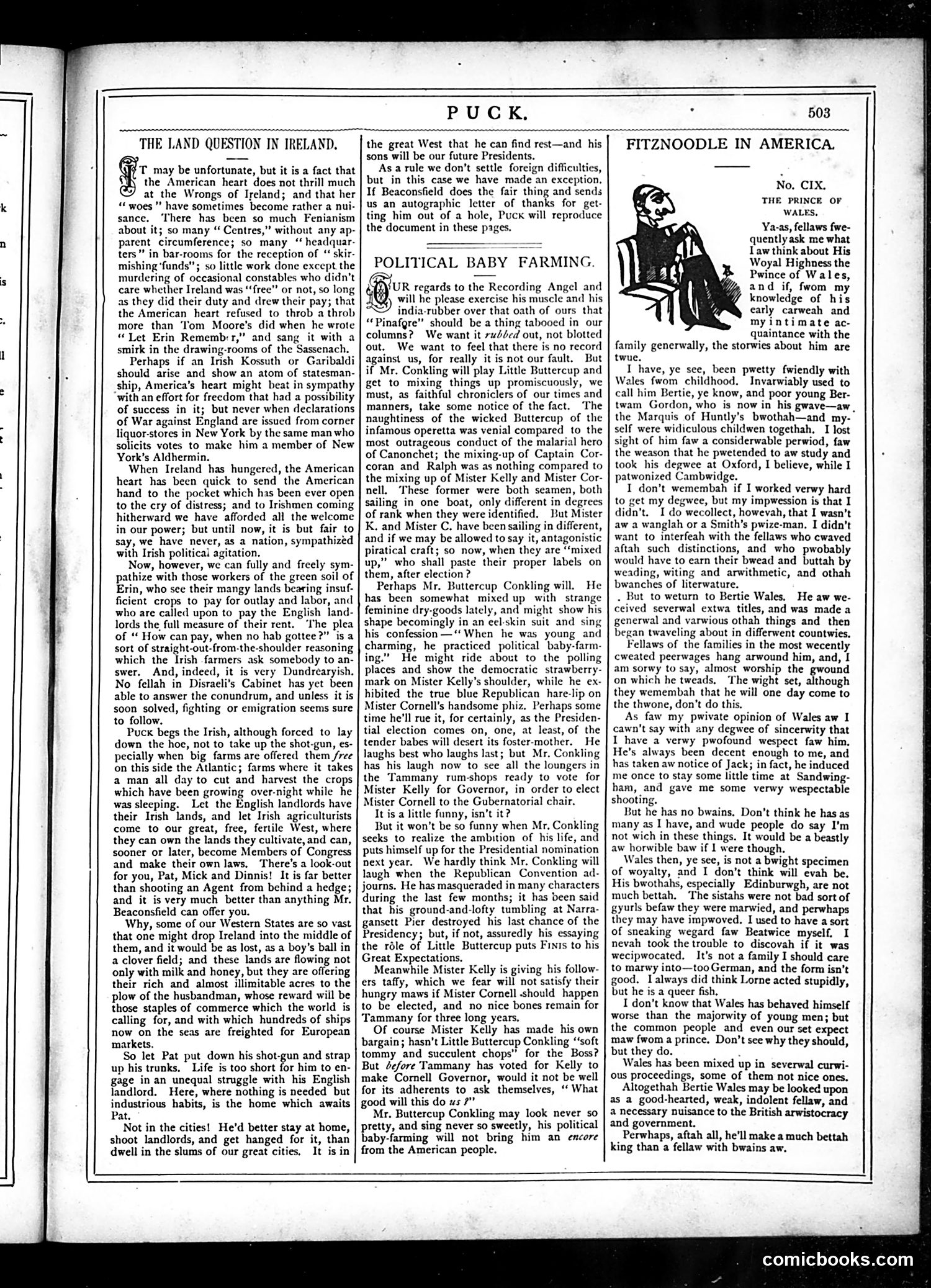
This cartoon appears to be a satirical character sketch titled "The Prince of Wales," depicting an exaggerated Irish or British figure labeled "Fitznoodle." The accompanying text is a lengthy political commentary mocking what appears to be a Irish-American politician or public figure involved in political "baby farming" — a practice of exploiting public offices for patronage and personal gain. The satire criticizes this figure's involvement in American electoral politics, suggesting he manipulates voters and positions for self-interest rather than genuine public service. The text references specific accusations about shirking duties and misusing political influence, particularly regarding Irish immigration and American political conventions. The caricatured facial features and exaggerated style are typical of Puck's approach to political criticism through visual mockery.
This page contains three distinct sections rather than integrated political cartoons: 1. **"Crops"** — A humorous poem listing agricultural products, apparently satirizing agricultural abundance or farming practices. 2. **"In the Streets"** — A satirical article about urban transportation chaos, particularly focusing on streetcars and reckless drivers in what appears to be New York City. It critiques dangerous driving habits, traffic congestion, and the disorder of city life. 3. **"Shakespere Studies"** — Brief notes extracting observations from Macbeth, apparently using Shakespeare to comment on contemporary social behavior (drinking habits, digestion, anarchism, etc.). The page lacks clearly identified political figures or specific historical events. It represents Puck's general satirical approach to everyday urban life and social customs rather than focused political commentary.
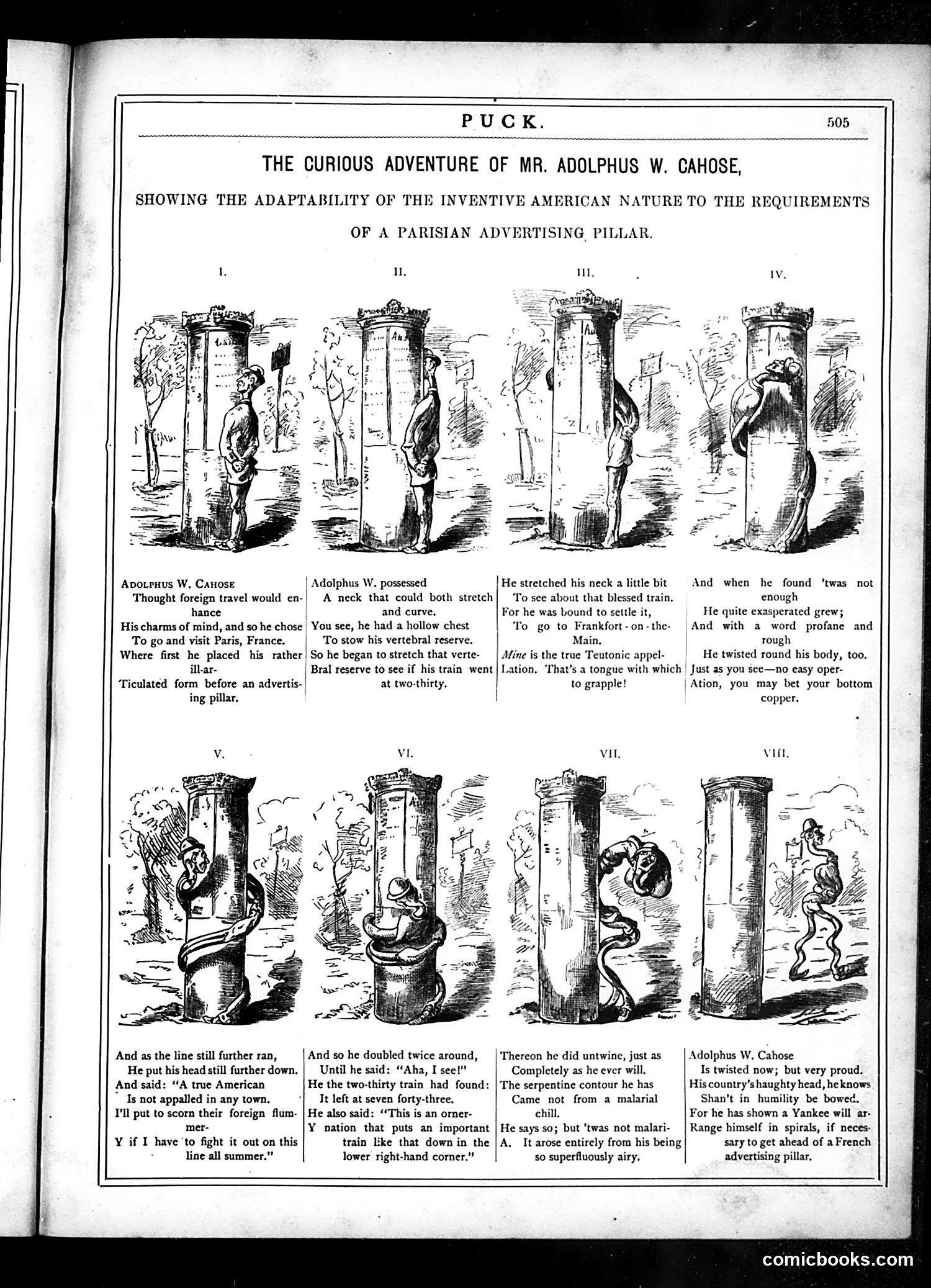
This satirical comic strip mocks an American businessman's attempt to adapt himself to Parisian advertising standards. The eight-panel sequence shows Mr. Cahose progressively contorting and twisting his body around an advertising pillar—stretching his neck, bending his torso, and eventually wrapping himself serpent-like around the structure. The humor targets American commercial ingenuity and adaptability, suggesting that enterprising Americans will literally reshape themselves to meet foreign market demands. The repeated phrase about fighting "foreign humbuggery" satirizes both American business ambition and perhaps anti-European sentiment. The comic suggests the absurd lengths capitalism will push individuals to pursue profit and international commercial success.
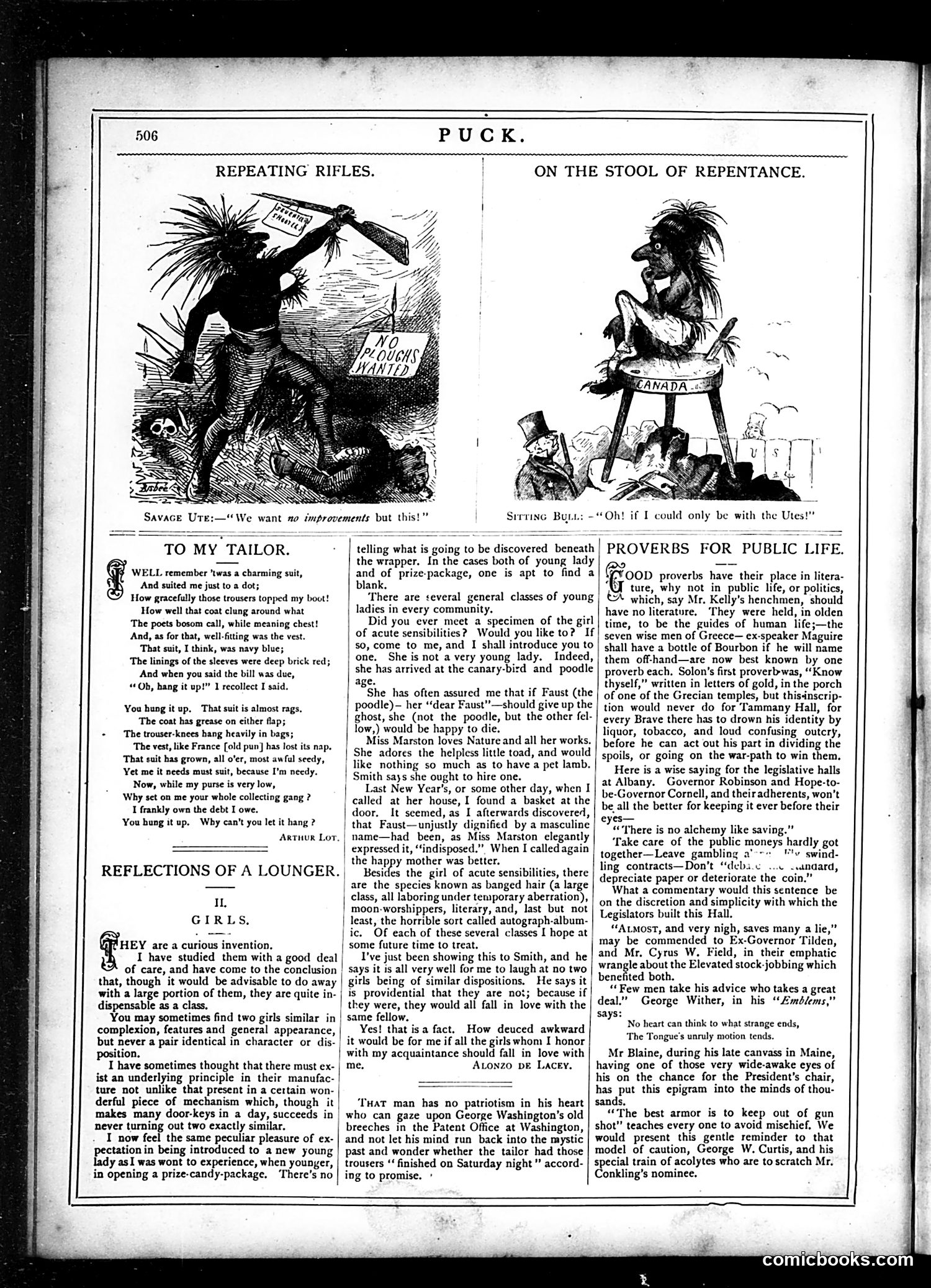
**Top Left Cartoon: "Repeating Rifles"** A caricatured figure labeled "Savage Ute" (depicting a Native American with exaggerated features) says "We want *no* improvement but this!" while holding what appears to be a repeating rifle. This satirizes debates over weapons technology and Indigenous peoples' access to firearms. **Top Right Cartoon: "On the Stool of Repentance"** A figure on a stool labeled "Canada" says "Oh! if I could only be with the Utes!" This appears to reference tensions between Canada and the United States, possibly regarding Native American policy or border relations. The remaining content comprises literary pieces ("To My Tailor," "Reflections of a Lounger," "Proverbs for Public Life"), which are satirical essays rather than visual cartoons.
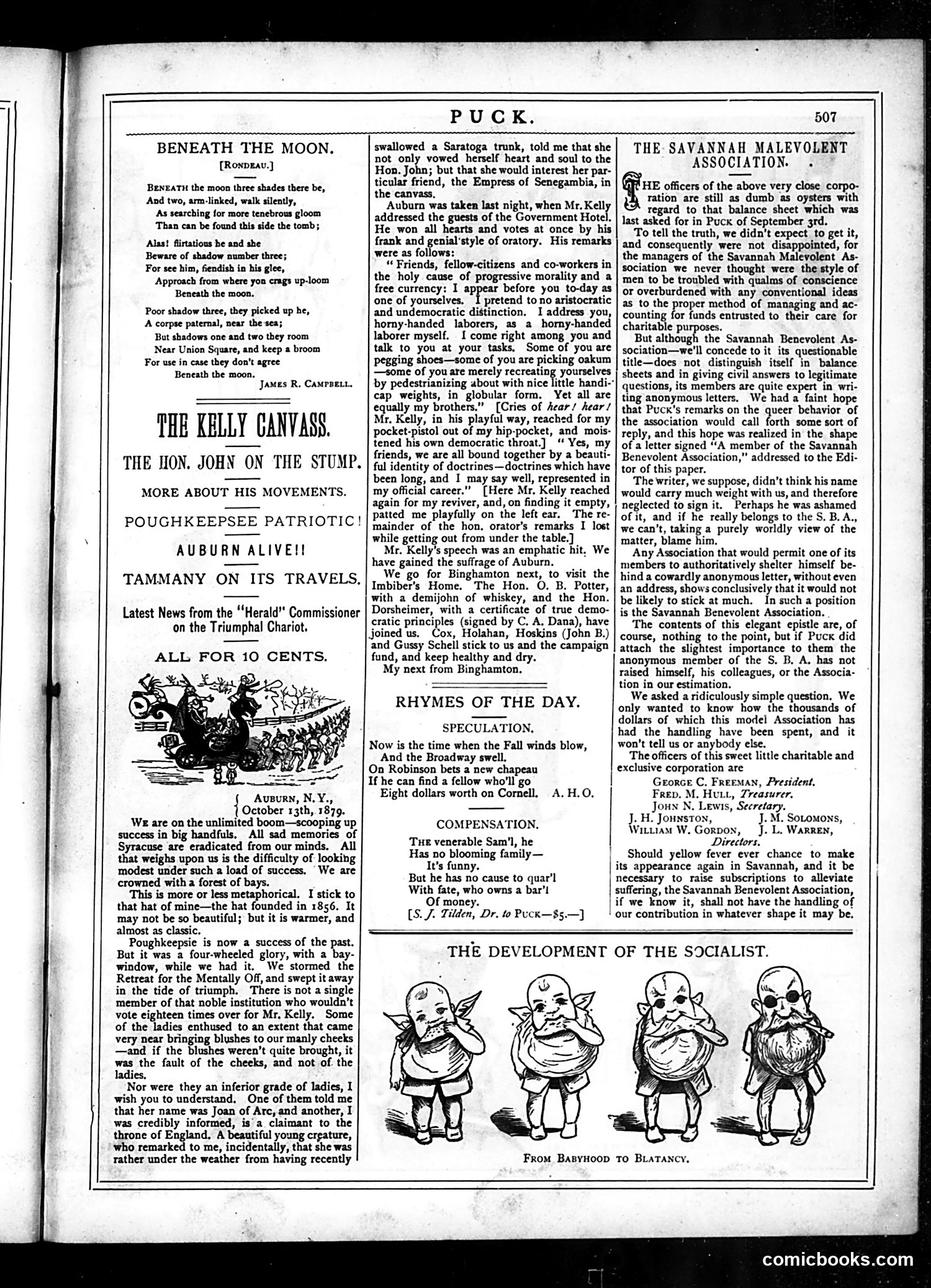
This page contains several political satire sections mocking Auburn (likely a political figure or movement) and John Kelly's campaign activities. "The Kelly Canvass" ridicules Kelly's democratic campaign speeches, portraying him as patronizing workers with empty rhetoric about "horny-handed laborers." The main cartoon, "The Development of the Socialist," shows four progressive stages of a figure becoming increasingly corpulent and satisfied—satirizing how socialists supposedly abandon their radical principles as they gain comfort and status ("From Babyhood to Blatancy"). "The Savannah Benevolent Association" section criticizes the organization for mishandling charity funds and tolerating anonymous letters—attacking their lack of accountability. The overall theme mocks political hypocrisy: candidates making false populist appeals, and reformers compromising their principles.
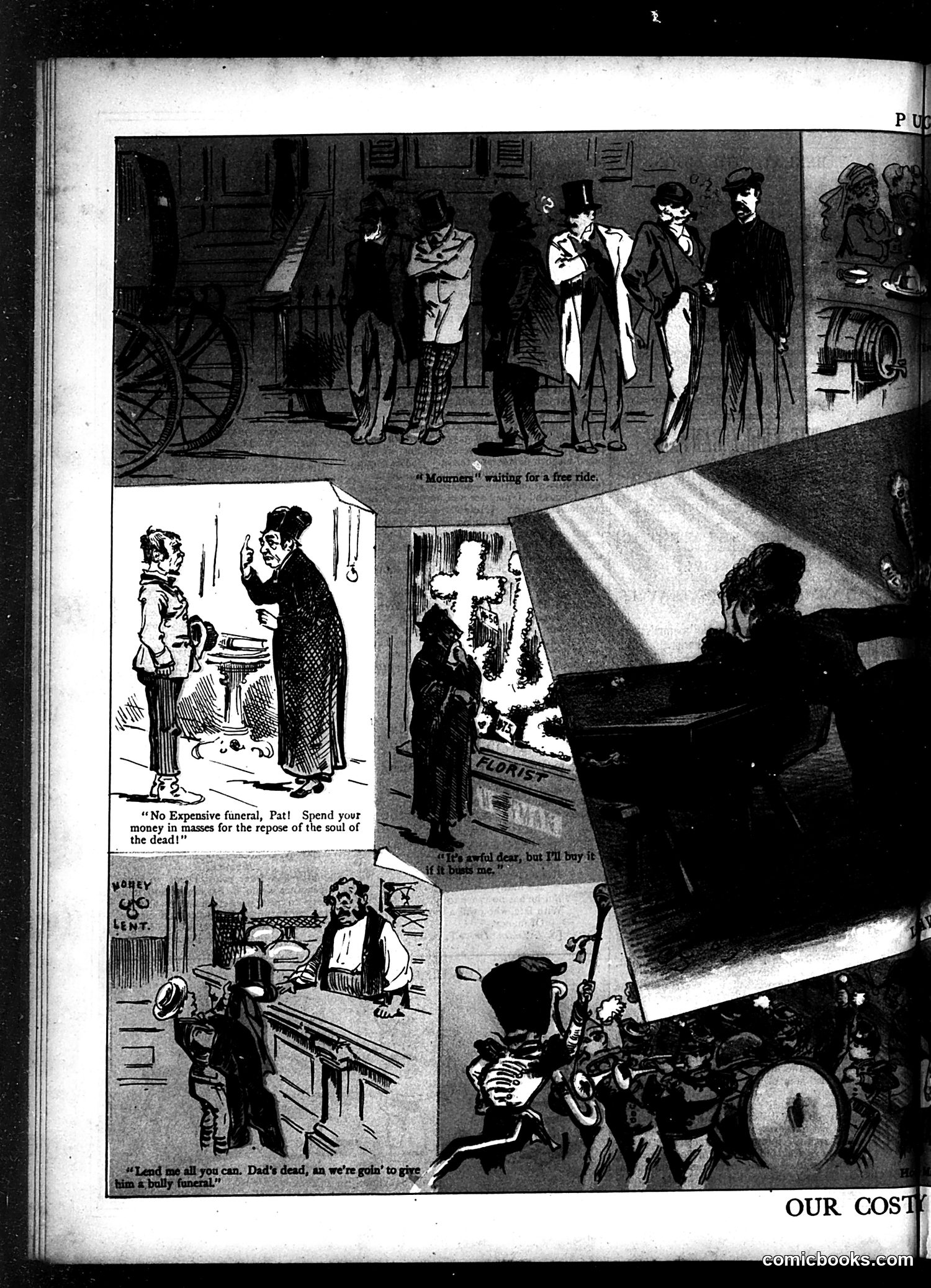
This page contains four separate comic strips satirizing funeral expenses and working-class financial struggles. The narratives follow characters named Pat and others confronting the high costs of funerals—a significant economic burden for poor families. **Key themes:** - A priest advises spending money on masses rather than expensive funerals - A character considers buying an expensive casket despite financial hardship - A father promises his son "a bully funeral" despite lacking funds The satire targets the funeral industry's exploitation of grief and the moral pressure placed on poor families to spend beyond their means for "proper" burials. The comics mock both undertakers' greed and the cultural/religious expectations that trap working people in debt during mourning. The page title "OUR COST" emphasizes economic hardship as the central concern.
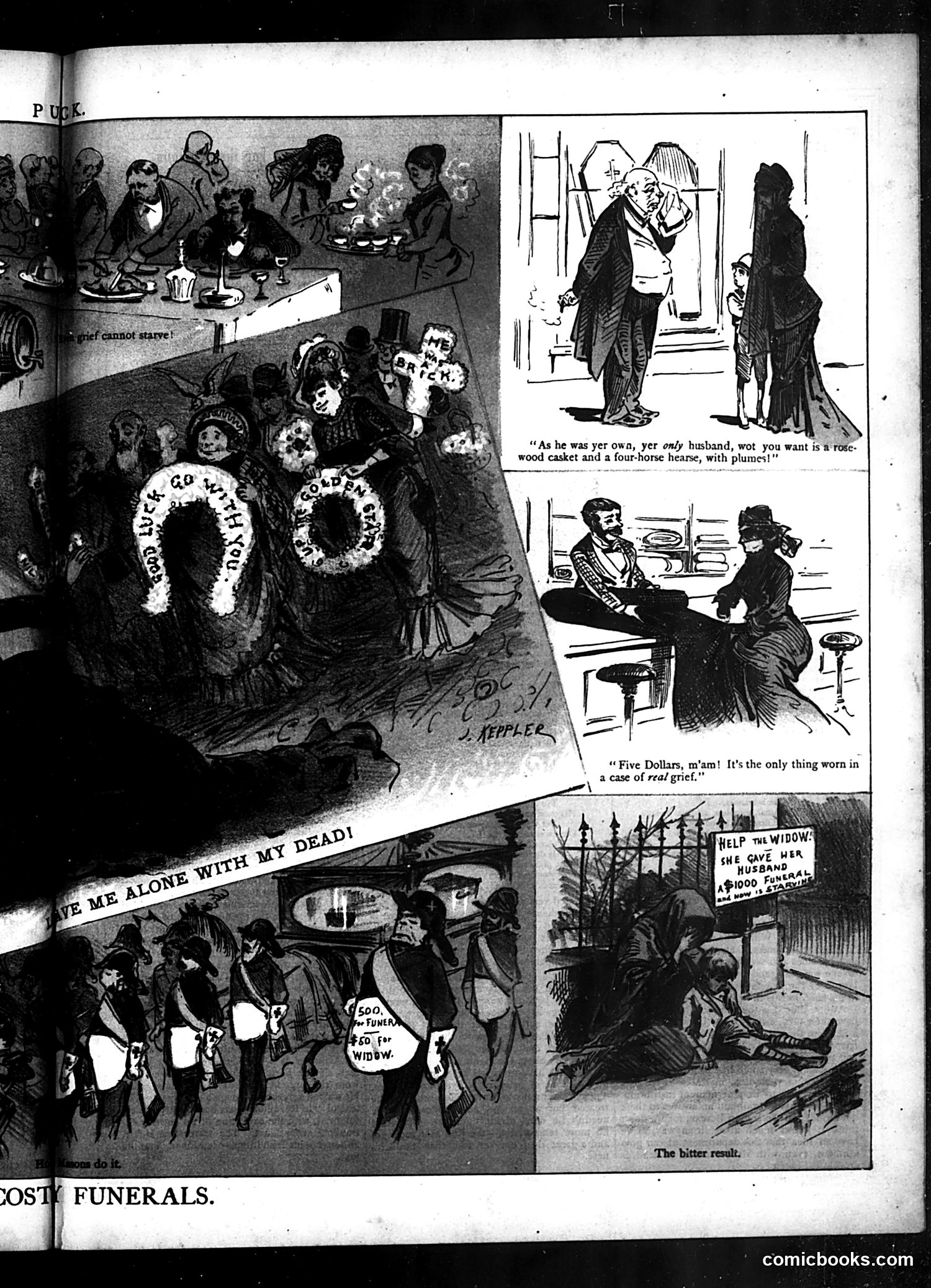
This satirical page critiques excessive funeral expenses, particularly their impact on widows. The top panels show a widow being propositioned by an undertaker offering increasingly expensive casket options ("a rose-wood casket and a four-horse, with plumes!"), while she counters that she needs only five dollars, "the only thing worn in a case of real grief." The lower section, titled "Leave Me Alone With My Dead!," depicts mourners at a funeral arguing over costs while the widow grieves, with dialogue about paying for the widow's support. The final panel shows "the bitter result"—a widow begging in the street. The cartoon satirizes how funeral industry practices exploit grieving families financially, leaving widows impoverished. It advocates for simpler, more affordable funerals.
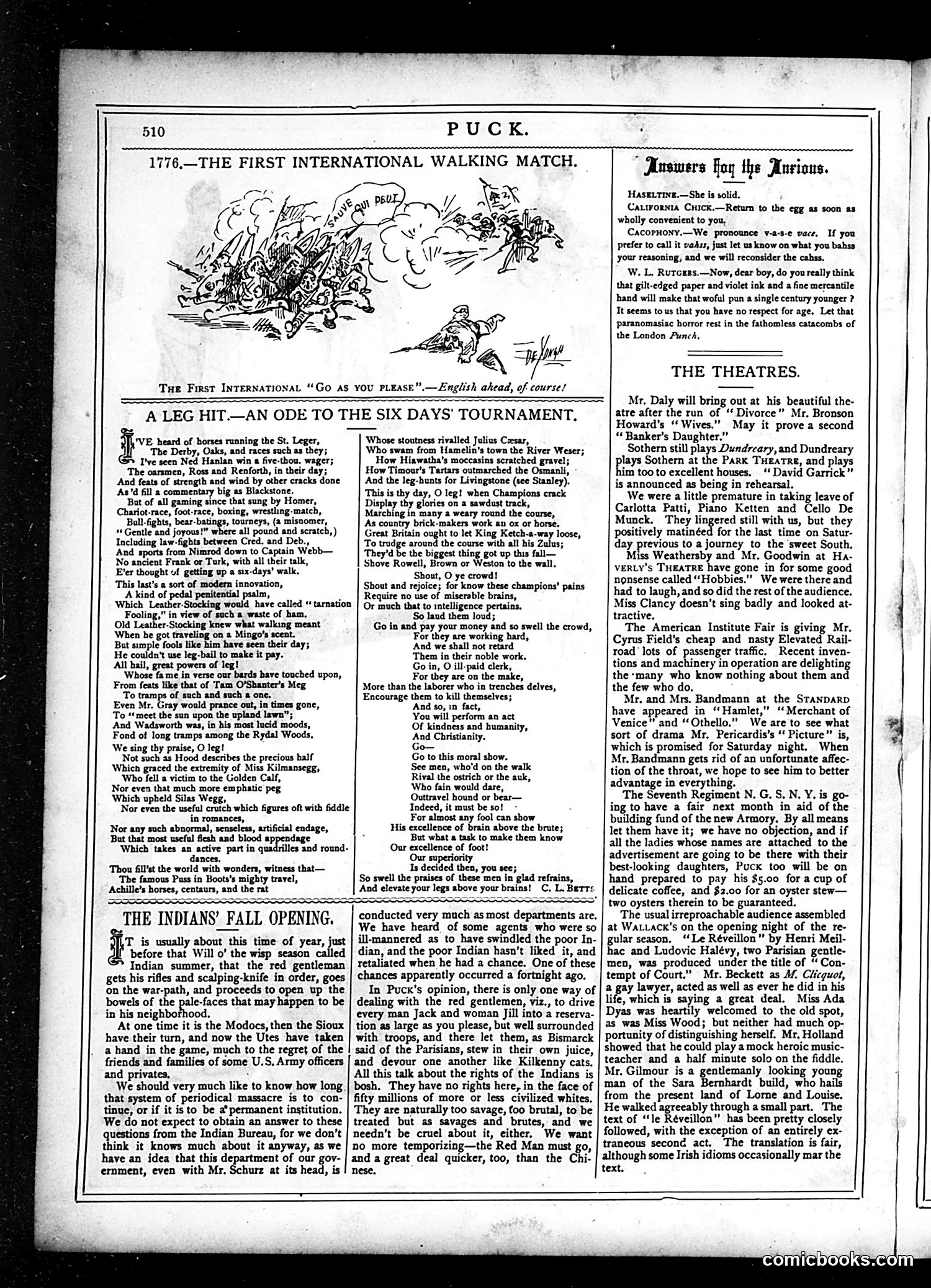
The main cartoon, titled "The First International Walking Match, 1776," satirizes the "Go as You Please" walking race—apparently a new sporting spectacle. The chaotic illustration depicts various figures in absurd walking postures, suggesting the event was ridiculous or undignified. The accompanying poem "A Leg Hit" mocks the Six Days Tournament (a walking competition), listing famous historical figures and racehorses alongside contemporary walkers, implying the sport was mockingly elevated to absurd importance. The satire targets the craze for pedestrian racing competitions that were apparently popular entertainment. By invoking 1776 and treating walkers as heroic figures comparable to historical legends, Puck ridicules what it saw as a trivial, undignified sporting fad gaining excessive public attention and enthusiasm.
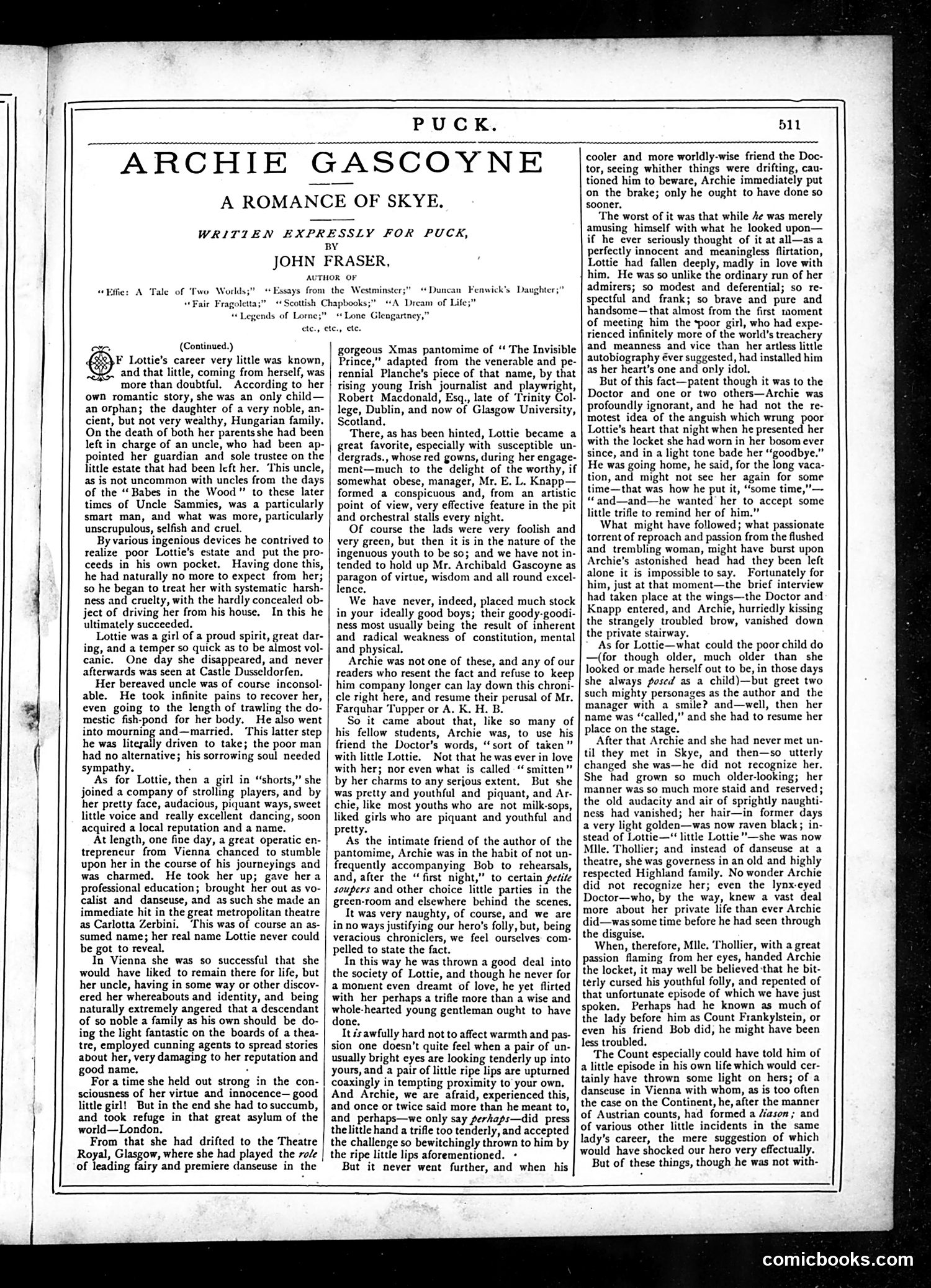
This page is primarily **literary content, not political satire**. It contains "Archie Gascoyne: A Romance of Skye," a serialized story by John Fraser, written expressly for Puck magazine. The text describes a romantic narrative set in Scotland involving characters named Archie, Lottie, and the Doctor. It discusses Archie's relationship with an orphan girl named Lottie and various romantic entanglements—including references to his behavior in Vienna and interactions with theatrical circles. There are **no political cartoons visible** on this page. Instead, this appears to be filler content—serialized fiction that Puck used to supplement its satirical offerings. The page represents the magazine's broader publishing strategy beyond pure political humor.
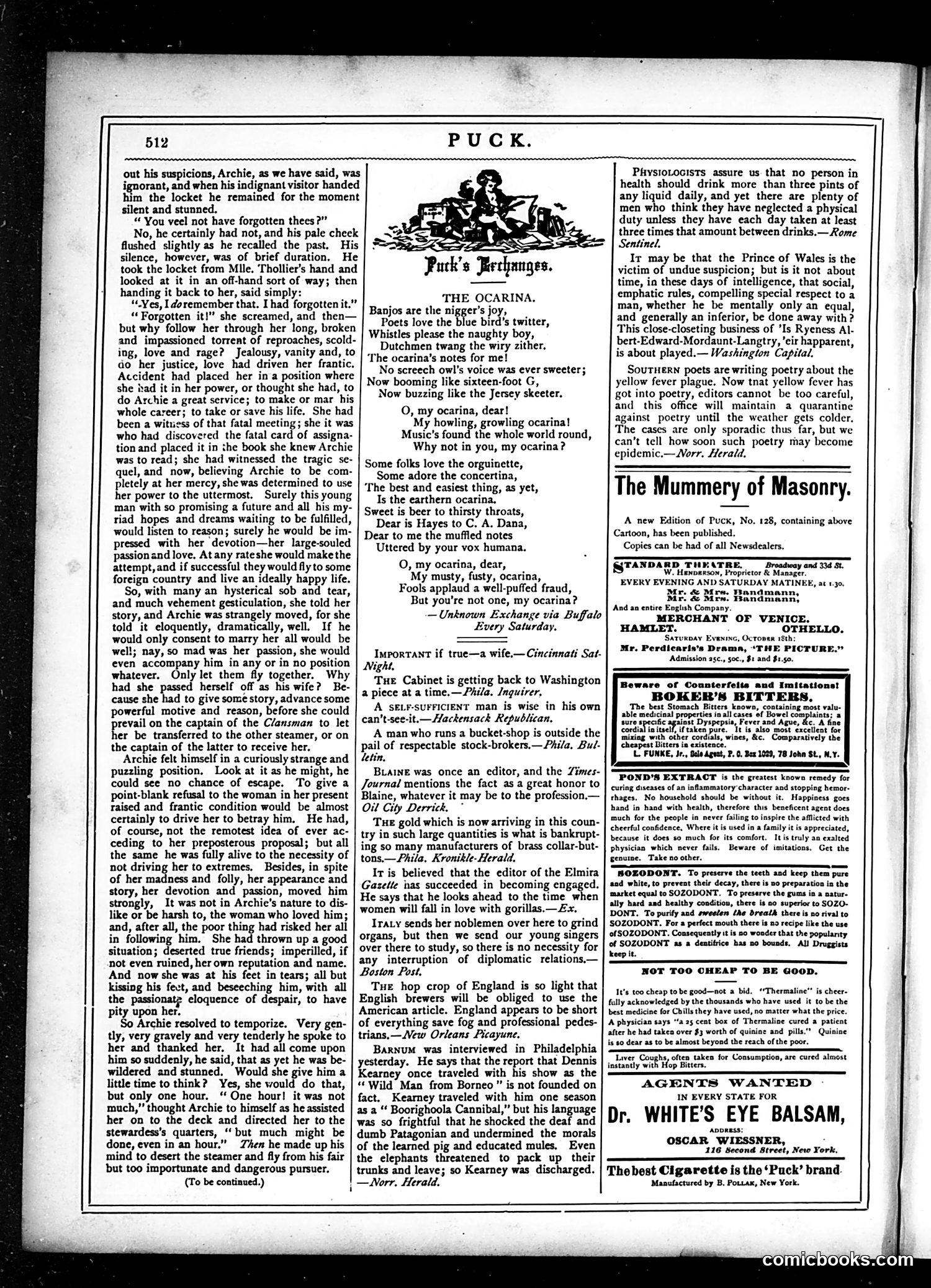
The central cartoon illustrates a satirical piece about the **ocarina** (a wind instrument), featuring what appears to be cherubs or putti playing the instrument amid floral arrangements. The accompanying verse mocks the ocarina's popularity, suggesting it produces unpleasant sounds compared to other instruments. References include jokes about the instrument's quality ("No screech owl's voice was ever sweeter") and its widespread adoption among amateur musicians. The satire targets the Victorian-era fad for ocarinas as mass-market musical instruments—poking fun at untrained players and the instrument's tinny, unpleasant acoustic qualities that nonetheless made it fashionable among the general public.
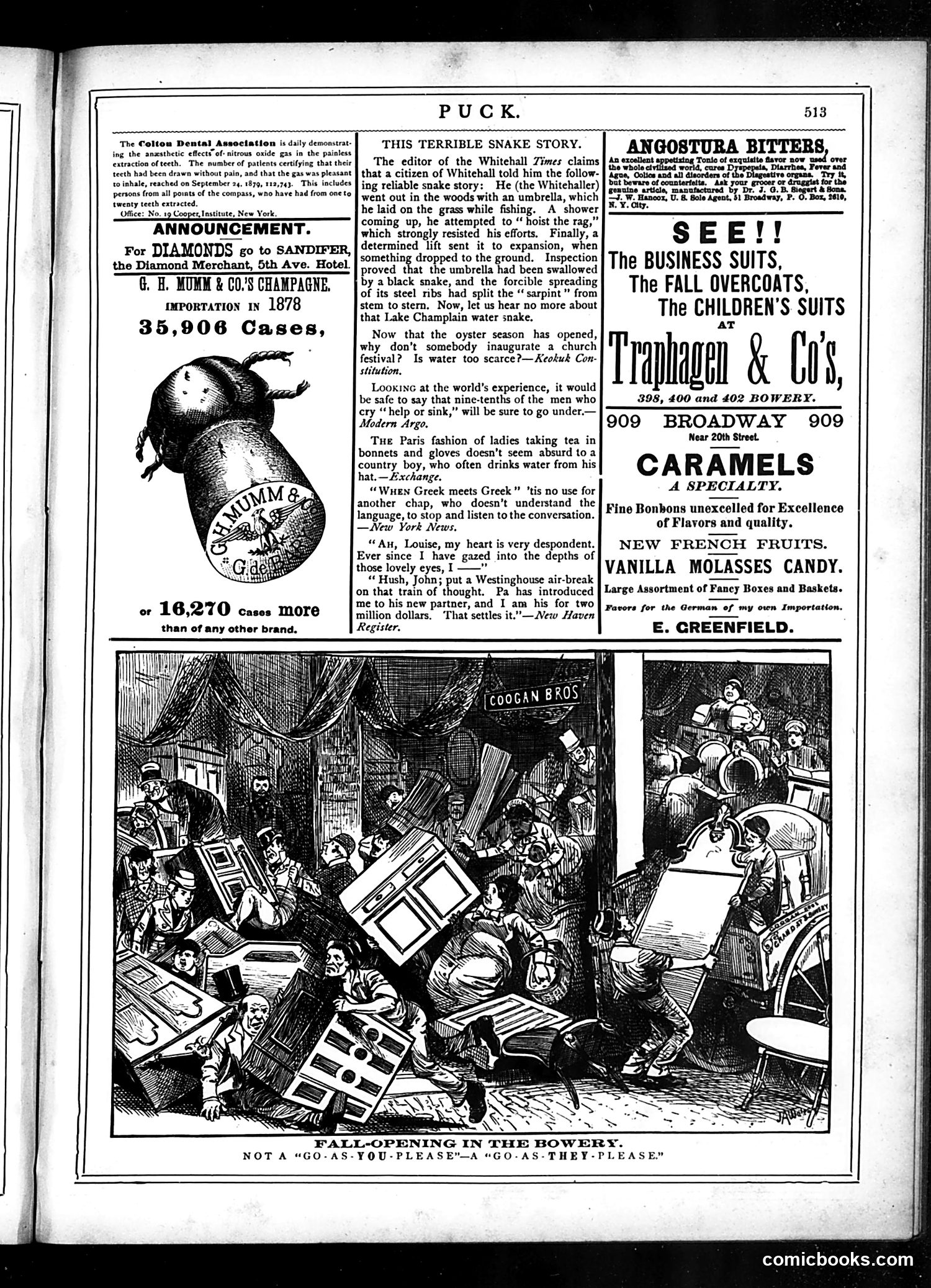
This page is primarily **advertising and announcements** rather than political satire. The main cartoon at bottom ("Fall-Opening in the Bowery") depicts a chaotic street scene labeled "NOT A 'GO-AS-YOU-PLEASE'—A 'GO-AS-THEY-PLEASE'" with numerous figures and falling merchandise, apparently satirizing disorderly commerce or street vending practices in New York's Bowery neighborhood. The upper half contains ads for G. Mumm champagne, Angostura Bitters, Traubagen & Co's clothing, and E. Greenfield's candies. There's also "This Terrible Snake Story"—a humorous anecdote about a Whitehall resident's encounter with a water snake. The page lacks clear political commentary; it's a typical mixed-content issue of the satirical magazine blending commercial advertisements with light humor pieces.
This page is **primarily advertising** with one brief humorous anecdote in the center column titled "A SMART WIFE." The main content is a short joke about a man who exchanges house keys with a neighbor, then repeatedly gets locked out over several days. When his wife finally suggests he simply carry the correct key, he responds it would be "mighty smart" — the humor depending on the man's obliviousness to an obvious solution. The surrounding advertisements promote late-19th-century retail goods: E. Ridley & Sons advertises bonnets, gloves, and dress goods; Weber manufactures pianos; James McCreery offers silk department items; and H. O'Neill & Co. sells various dry goods. This layout is typical of Puck's revenue model, where advertising subsidized satirical content.
This page is primarily **advertising content**, not satirical cartoons. It contains approximately 20 different advertisements for late 19th-century American merchants and manufacturers, arranged in a dense layout typical of Puck magazine's revenue model. The ads feature furniture dealers, importers of spirits, coffee pots, house furnishings, patents, beer brands, billiard equipment, dental services, hats, and roofing supplies. Most list New York City addresses. Notable entries include the Vienna Coffee Pot (with an illustration), Bohemian Bier, and Dunlap & Co.'s Gentlemen's Hats. There's also a small ad claiming to cure tapeworms. The page demonstrates how 19th-century magazines funded themselves through advertising rather than subscriptions alone. There are **no political cartoons or satire visible** on this page.
This page is primarily **advertising**, not editorial content or political satire. It features numerous commercial advertisements from late 19th-century New York businesses, including: - Sohmer pianos and Calenberg & Vaupel pianos - D.A. Mayer Hungarian wines - Pachtmann & Moelich jewelry - Keep's shirts - J.M. Brunswick & Balke Co. billiard tables - Nicoll the tailor - Various champagnes and mineral waters - Photographers and manufacturers The single illustrated element—a classical/mythological engraving in the center—appears decorative rather than satirical. Without identifying political figures or satirical commentary, this represents Puck magazine's revenue model: selling advertising space to wealthy merchants and manufacturers targeting the magazine's affluent readership.
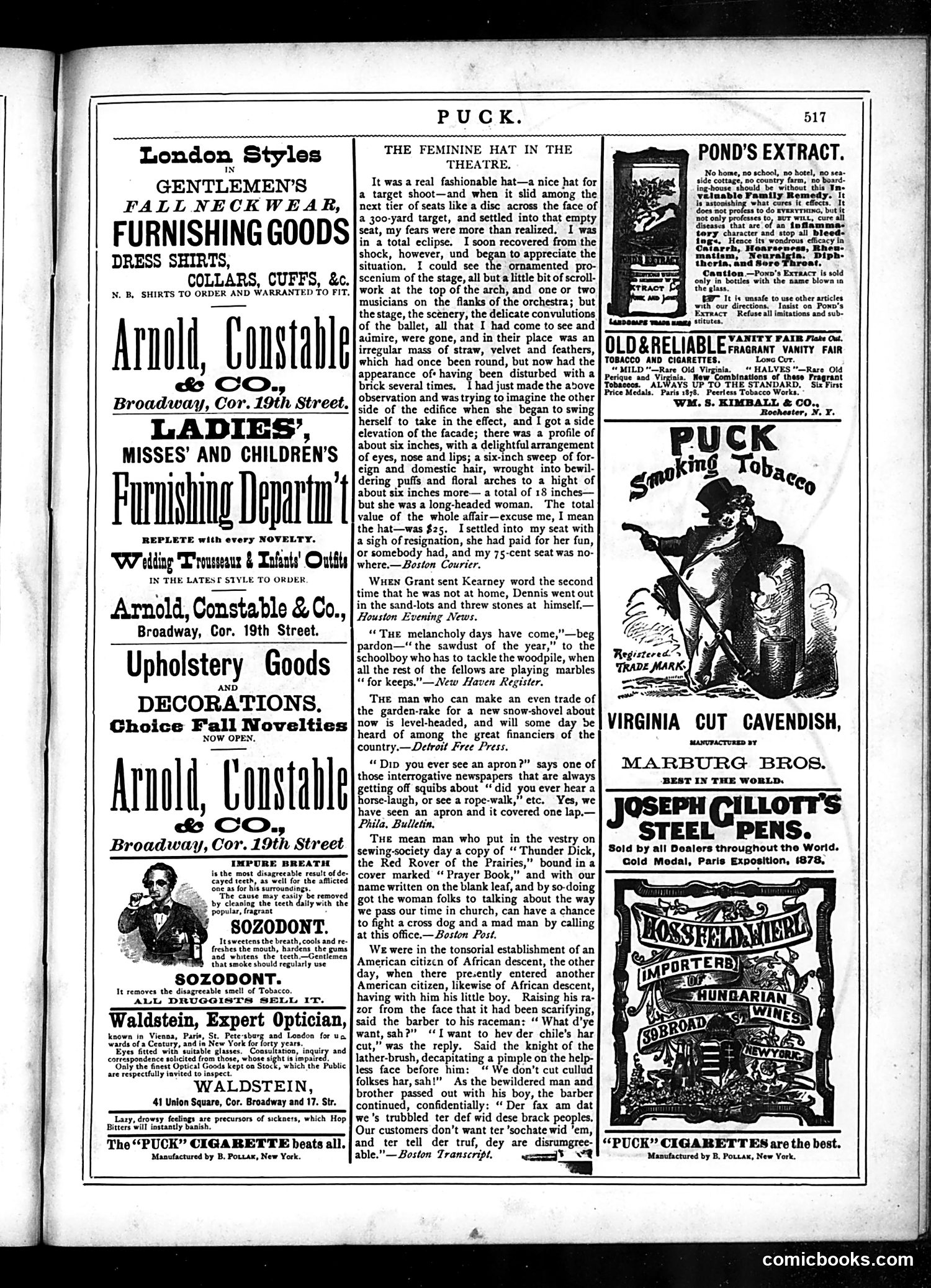
This page is primarily **advertising and commercial content** rather than political satire. It contains multiple ads for gentlemen's furnishings (Arnold, Constable & Co.), ladies' clothing, upholstery goods, tobacco products, steel pens, wine, and dental services. The only cartoon-like illustration appears to be the **Puck Smoking Tobacco mascot** — a jovial figure in period dress — which is a brand mascot rather than political commentary. The page includes some humorous short anecdotes in the text (about theatrical observations, aprons, and barber shops), but these are light social humor rather than satirical commentary on political issues or public figures. This represents a typical revenue page from Puck magazine, where advertising subsidized the publication.
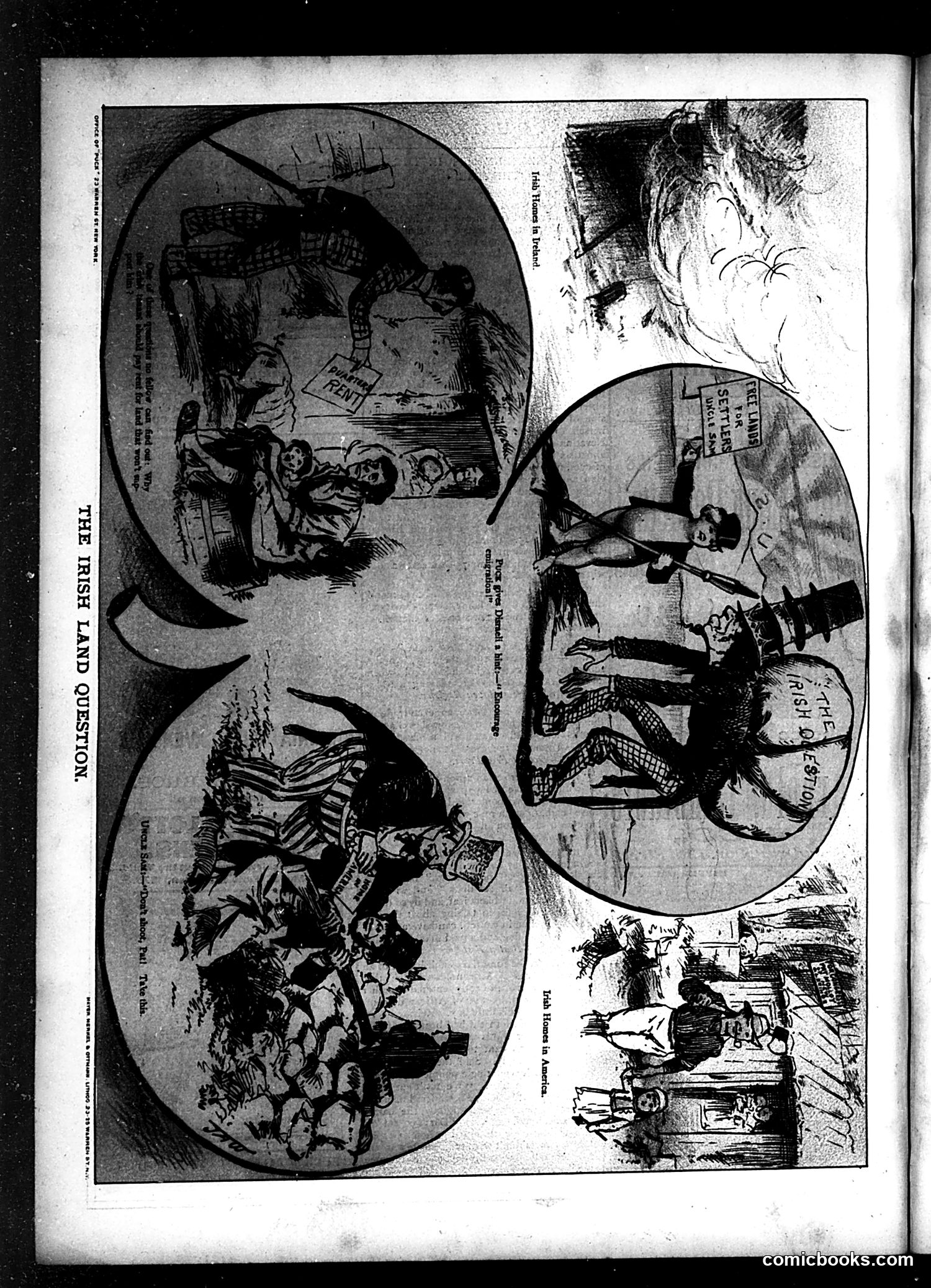
This page from *Puck* is titled "THE IRISH LAND QUESTION" and uses oval-framed satirical illustrations to comment on Irish land reform debates, a major political issue in late 19th-century America and Britain. The cartoons appear to depict Irish figures in stereotypical caricature styles common to the era, showing scenes related to land disputes and tenant-landlord conflicts. The Irish Land Question refers to disputes over land ownership, tenant rights, and agricultural reform in Ireland—issues that generated significant political debate and emigration to America. The satire likely mocks either Irish political demands for land reform or American responses to Irish immigration and political activism. Without clearer caption legibility, specific figures remain unclear, though the imagery suggests commentary on Irish-American political involvement or attitudes toward Irish affairs.