
Puck, 1879-10-15 · page 4 of 18
Puck — October 15, 1879 — page 4: what you’re looking at
What you’re looking at
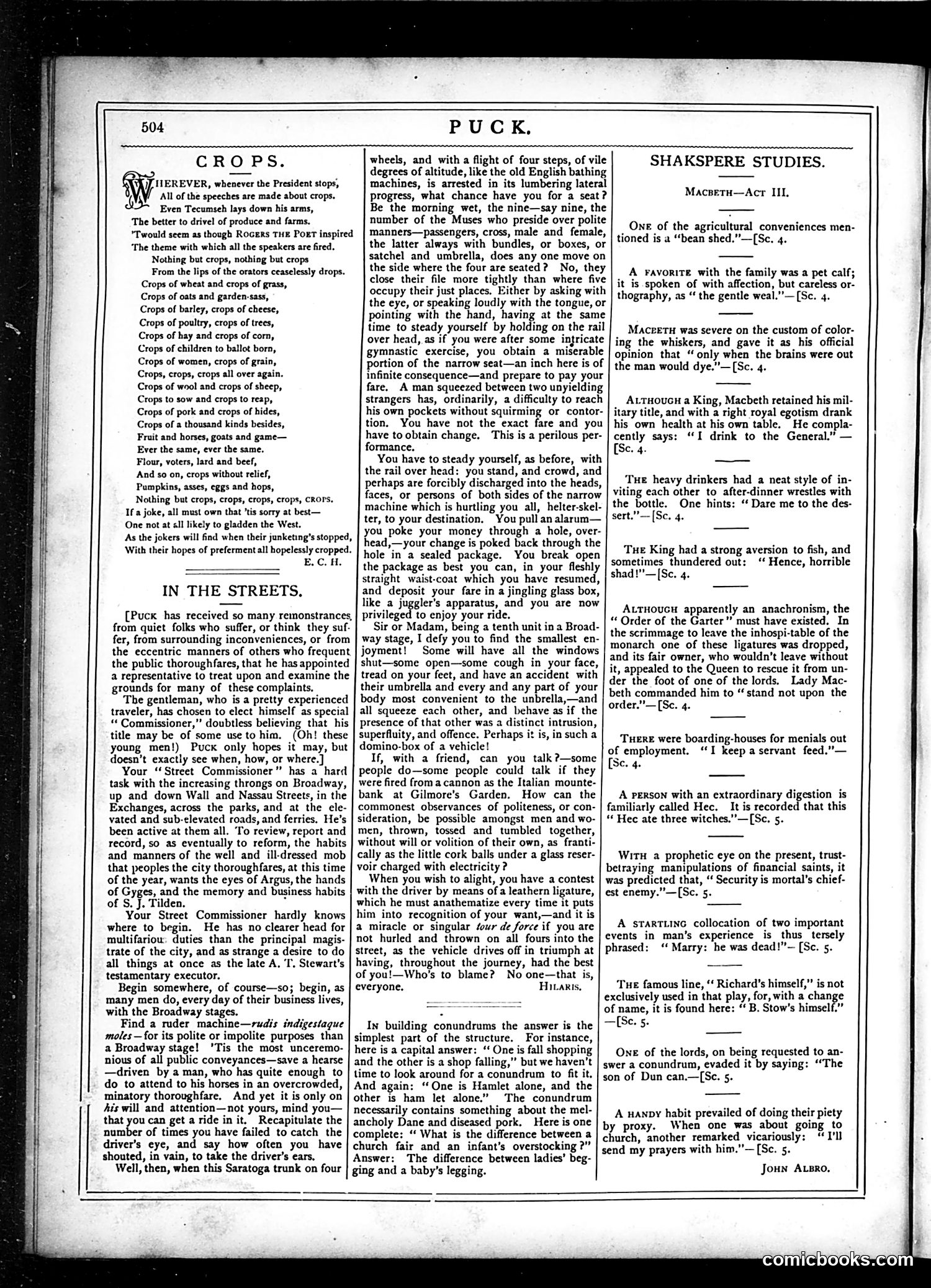
This page contains three distinct sections rather than integrated political cartoons: 1. **"Crops"** — A humorous poem listing agricultural products, apparently satirizing agricultural abundance or farming practices. 2. **"In the Streets"** — A satirical article about urban transportation chaos, particularly focusing on streetcars and reckless drivers in what appears to be New York City. It critiques dangerous driving habits, traffic congestion, and the disorder of city life. 3. **"Shakespere Studies"** — Brief notes extracting observations from Macbeth, apparently using Shakespeare to comment on contemporary social behavior (drinking habits, digestion, anarchism, etc.). The page lacks clearly identified political figures or specific historical events. It represents Puck's general satirical approach to everyday urban life and social customs rather than focused political commentary.
📄 Transcribed text from this page (OCR, searchable)
Machine-transcribed from the original scan — historical spelling and the odd misread are preserved.
PUCK. CROPS. J MEREVER, whenever the President stops, UNSW, All of the speeches are made about crops. Even Tecumseh lays down his arms, The better to drivel of produce and farms. *Twould seem as though ROGERS THE Port inspired ‘The theme with which all the speakers are fired. Nothing but crops, nothing but crops From the lips of the orators ceaselessly drops. Crops of wheat and crops of grass, Crops of oats and garden-sass, Crops of barley, crops of cheese, Crops of poultry, crops of trees, Crops of hay and crops of corn, Crops of children to ballot born, Crops of women, crops of grain, Crops, crops, crops all over again. Crops of wool and crops of sheep, Crops to sow and crops to reap, Crops of pork and crops of hides, Crops of a thousand kinds besides, Fruit and horses, goats and game— Ever the same, ever the same. Flour, voters, lard and beef, And so on, crops without relief, Pumpkins, asses, eggs and hops, Nothing but crops, crops, crops, crops, CROrS. Ifa joke, all must own that ’tis sorry at best— One not at all likely to gladden the West. ‘As the jokers will find when their junketing’s stopped, With their hopes of preferment all hopelessly cropped. E.C. H. IN THE STREETS, [Puck has received so many remonstrances, from quiet folks who suffer, or think they suf. fer, from surrounding inconveniences, or from the eccentric manners of others who frequent the public thoroughfares, that he has appointed a representative to treat upon and examine the grounds for many of these complaints, The gentleman, who is a pretty experienced traveler, has chosen to elect himself as special “ Commissioner," doubtless believing that his title may be of some use to him. (Oh! these young men!) Puck only hopes it may, but doesn't exactly see when, how, or where.] Your ‘Street Commissioner” has a hard task with the increasing throngs on Broadway, up and down Wall and Nassau Streets, in the Exchanges, across the parks, and at the ele- vated and sub-elevated roads, and ferries. He’s been active at them all. ‘To review, report and record, so as eventually to reform, the habits and manners of the well and ill-dressed mob that peoples the city thoroughfares, at this time of the year, wants the eyes of Argus, the hands of Gyges, and the memory and business habits of S.J. Tilden. Your Street Commissioner hardly knows where to begin. He has no clearer head for multifariow: duties than the principal magis- trate of the city, and as strange a desire to do all things at once as the late A, ‘I’. Stewart's testamentary executor. Begin somewhere, of course—so; begin, as many men do, every day of their business lives, with the Broadway stages. Find a ruder machine—rudis indigestague moles —for its polite or impolite purposes than a Broadway stage! 'Tis the most unceremo- nious of all public conveyances—save a hearse —driven by a man, who has quite enough to do to attend to his horses in an overcrowded, minatory thoroughfare. And yet it is only on Ais will and attention—not yours, mind you— that you can get a ride in it. Recapitulate the number of times you have failed to catch the driver's eye, and say how often you have shouted, in vain, to take the driver’s ears, Well, then, when this Saratoga trunk on four wheels, and with a flight of four steps, of vile degrees of altitude, like the old English bathing machines, is arrested in its lumbering lateral progress, what chance have you for a seat? Be the morning wet, the nine—say nine, the number of the Muses who preside over polite manners—passengers, cross, male and female, the latter always with bundles, or boxes, or satchel and umbrella, does any one move on the side where the four are seated? No, they close their file more tightly than where five occupy their just places, Either by asking with the eye, or speaking loudly with the tongue, or pointing with the hand, having at the same time to steady yourself by holding on the rail over head, as if you were after some infricate gymnastic exercise, you obtain a miserable portion of the narrow seat—an inch here is of infinite consequence—and prepare to pay your fare. A man squeezed between two unyielding strangers has, ordinarily, a difficulty to reach his own pockets without squirming or contor- tion. You have not the exact fare and you have to obtain change, This is a perilous per- formance. You have to steady yourself, as before, with the rail over head: you stand, and crowd, and perhaps are forcibly discharged into the heads, faces, or persons of both sides of the narrow machine which is hurtling you all, helter-skel- ter, to your destination. You pull an alarum— you poke your money through a hole, over- head,—your change is poked back through the hole ‘in a sealed package. You break open the package as best you can, in your fleshl; straight waist-coat which you have resumed, and deposit your fare in a jingling glass box, like a juggler’s apparatus, and you are now privileged to enjoy your ride. Sir or Madam, being a tenth unit in a Broad- way stage, I defy you to find the smallest en- joyment! Some will have all the windows shut—some open—some cough in your face, tread on your feet, and have an accident with their umbrella and every and any part of your body most convenient to the unbrella,—and all squeeze each other, and behave as if the presence of that other was a distinct intrusion, superfluity, and offence. Perhaps it is, in such a domino-box of a vehicle! If, with a friend, can you talk ?—some people do—some people could talk if they were fired from acannon as the Italian mounte- bank at Gilmore's Garden, How can the commonest observances of politeness, or con- sideration, be possible amongst men and wo- men, thrown, tossed and tumbled together, without will or volition of their own, as franti- cally as the little cork balls under a glass reser- voir charged with electricity ? When you wish to alight, you have a contest with the driver by means of a leathern ligature, which he must anathematize every time it puts him into recognition of your want,—and it is a miracle or singular four de force if you are not hurled and thrown on all fours into the street, as the vehicle drives off in triumph at having, throughout the journey, had the best of you!—Who's to blame? No one—that is, everyone, Hivanris. In building conundrums the answer is the simplest part of the structure. For instance, here is a capital answer: ‘ One is fall shopping and the other is a shop falling,” but we haven't time to look around for a conundrum to fit it, And again: “One is Hamlet alone, and the other is ham let alone.” The conundrum necessarily contains something about the mel- ancholy Dane and diseased pork. Here is one complete: ‘ What is the difference between a church fair and an infant’s overstocking ?” Answer: The difference between ladies’ beg- ging and a baby’s legging. SHAKSPERE STUDIES. Macseru—Acr III. One of the agricultural conveniences men- tioned is a ‘‘bean shed.”—[Sc. 4. A Favorite with the family was a pet calf; it is spoken of with affection, but careless or- thography, as “‘ the gentle weal.”"—[Sc. 4. MaceetH was severe on the custom of color- ing the whiskers, and gave it as his official opinion that “ only when the brains were out the man would dye."—[Sc. 4. A.tHoucH a King, Macbeth retained his mil- itary title, and with a right royal egotism drank his own health at his own table. He compla- cently says: “I drink to the General.” — [Sc. 4. ‘THe heavy drinkers had a neat style of in- viting each other to after-dinner wrestles with the bottle. One hints: ‘‘ Dare me to the des- sert.”"—[Sc. 4. Tue King had a strong aversion to fish, and sometimes thundered out: ‘ Hence, horrible shad!"—[Sc. 4. ALTHOUGH apparently an anachronism, the “ Order of the Garter” must have existed, In the scrimmage to leave the inhospi-table of the monarch one of these ligatures was dropped, and its fair owner, who wouldn't leave without it, appealed to the Queen to rescue it from un- der the foot of one of the lords. Lady Mac- beth commanded him to “ stand not upon the order."—[Sc. 4. ‘THERE were boarding-houses for menials out of employment. “I keep a servant feed.”— [Se. 4. A PERSON with an extraordinary digestion is familiarly called Hec. It is recorded that this “ Hee ate three witches.”"—[Sc, 5. Witx a prophetic eye on the present, trust- betraying manipulations of financial saints, it was predicted that, ‘ Security is mortal’s chief- est enemy.”—[Sc. 5. A STARTLING collocation of two important events in man’s experience is thus tersely phrased: “ Marry: he was dead!"— (Sc. 5. ‘Tue famous line, ‘‘ Richard's himself,” is not exclusively used in that play, for, with a change of name, it is found here: “ B. Stow’s himself.” —[Se. 5. One of the lords, on being requested to an- swer a conundrum, evaded it by saying: “The son of Dun can.—[Sc. 5. A nanpy habit prevailed of doing their piety by proxy. When one was about going to church, another remarked vicariously: I'll send my prayers with him."—[Sc. 5. Joun AtsRo,