
Puck, 1879-10-15 · page 3 of 18
Puck — October 15, 1879 — page 3: what you’re looking at
What you’re looking at
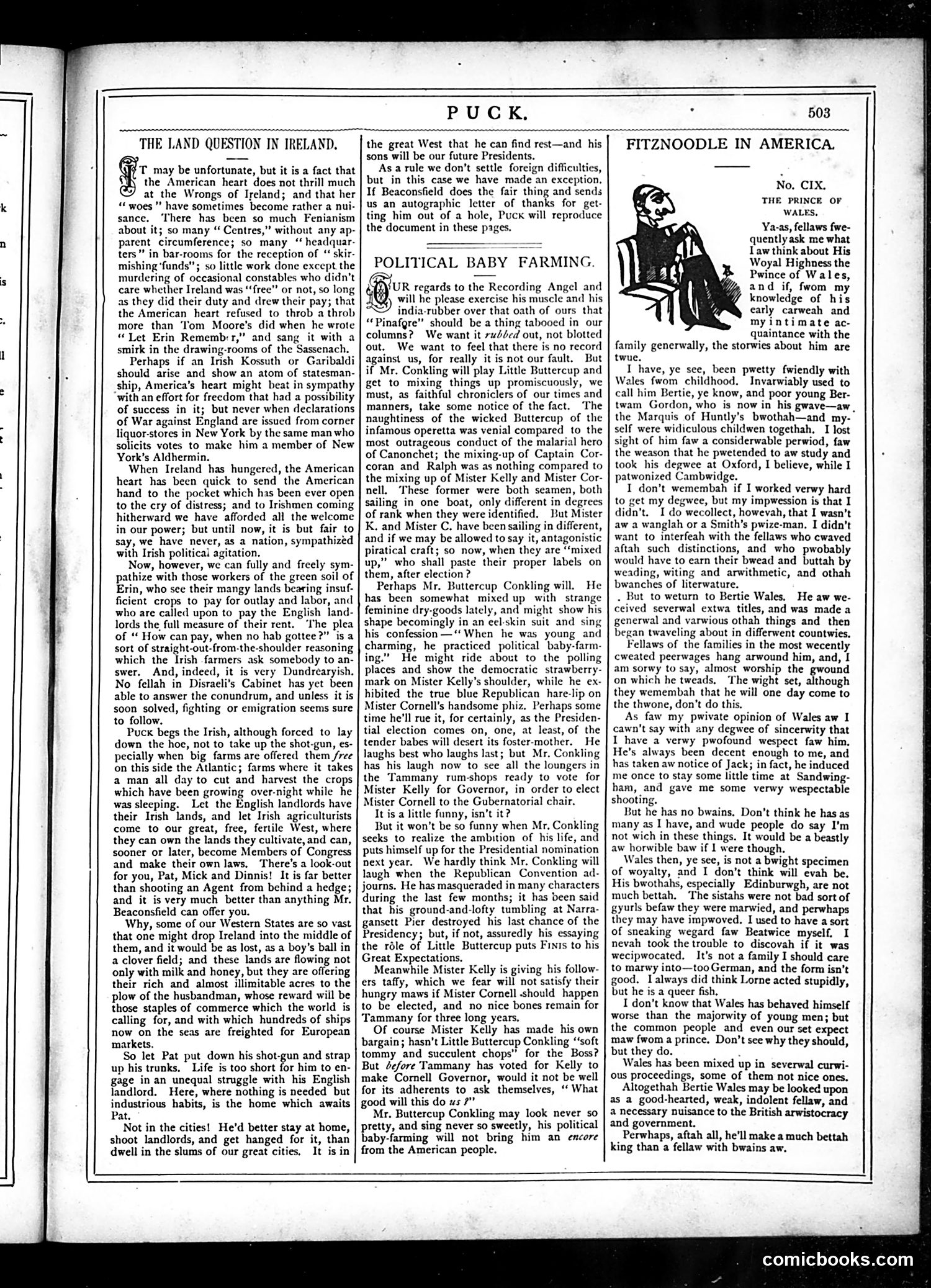
This cartoon appears to be a satirical character sketch titled "The Prince of Wales," depicting an exaggerated Irish or British figure labeled "Fitznoodle." The accompanying text is a lengthy political commentary mocking what appears to be a Irish-American politician or public figure involved in political "baby farming" — a practice of exploiting public offices for patronage and personal gain. The satire criticizes this figure's involvement in American electoral politics, suggesting he manipulates voters and positions for self-interest rather than genuine public service. The text references specific accusations about shirking duties and misusing political influence, particularly regarding Irish immigration and American political conventions. The caricatured facial features and exaggerated style are typical of Puck's approach to political criticism through visual mockery.
📄 Transcribed text from this page (OCR, searchable)
Machine-transcribed from the original scan — historical spelling and the odd misread are preserved.
PUCK, if 503 THE LAND QUESTION IN IRELAND. T may be unfortunate, but it is a fact that the American heart does not thrill much at the Wrongs of Ireland; and that her “woes” have sometimes become rather a nui- sance, ‘There has been so much Fenianism about it; so many “ Centres,” without any ap- parent circumference; so many ‘ headquar- ters” in bar-rooms for the reception of “ skir- mishing ‘funds”; so little work done except the murdering of occasional constables who didn’t care whether Ireland was “free” ot not, so long as they did their duty and drew their pay; that the American heart refused to throb a throb more than ‘Tom Moore's did when he wrote “Let Erin Rememb:r,” and sang it with a smirk in the drawing-rooms of the Sassenach, Perhaps if an Irish Kossuth or Garibaldi should arise and show an atom of statesman- ship, America’s heart might beat in sympathy with an effort for frecdom that had a possibility of success in it; but never when declarations of War against England are issued from corner liquor-stores in New York by the same man who solicits votes to make him a member of New York’s Aldhermin. When Ireland has hungered, the American heart has been quick to send the American hand to the pocket which has been ever open to the cry of distress; and to Irishmen coming hitherward we have afforded all the welcome in our power; but until now, it is but fair to say, we have never, as a nation, sympathized with Irish political agitation. Now, however, we can fully and freely sym- pathize with those workers of the green soil of Erin, who sce their mangy lands bearing insuf- ficient crops to pay for outlay and labor, and who are called upon to pay the English land- lords the full measure of their rent. ‘he plea of “ How can pay, when no hab gottee?” is a sort of straight-out-from-the-shoulder reasoning which the Irish farmers ask somebody to an- swer. And, indeed, it is very Dundrearyish. No fellah in Disraeli’s Cabinet has yet been able to answer the conundrum, and unless it is soon solved, fighting or emigration seems sure to follow. Puck begs the Irish, although forced to lay down the hoe, not to take up the shot-gun, es- pecially when big farms are offered them free on this side the Atlantic; farms where it takes a man all day to cut and harvest the crops which have been growing over-night while he was sleeping. Let the English landlords have their Irish lands, and let Irish agriculturists come to our great, free, fertile West, where they can own the lands they cultivate, and can, sooner or later, become Members of Congress and make their own laws. There's a look-out for you, Pat, Mick and Dinnis! It is far better than shooting an Agent from behind a hedge; and it is very much better than anything Mr. Beaconsfield can offer you. Why, some of our Western States are so vast that one might drop Ireland into the middle of them, and it would be as lost, as a boy’s ball in aclover field; and these lands are flowing not only with milk and honey, but they are offering their rich and almost illimitable acres to the plow of the husbandman, whose reward will be those staples of commerce which the world is calling for, and with which hundreds of ships now on the seas are freighted for European markets. So let Pat put down his shot-gun and strap up his trunks, Life is too short for him to en- gage in an unequal struggle with his English landlord. Here, where nothing is needed but industrious habits, is the home which awaits Pat. Not in the cities! He'd better stay at home, shoot landlords, and get hanged for it, than dwell in the slums of our great cities. It is in the great West that he can find rest—and his sons will be our future Presidents. Asa rule we don’t settle foreign difficulties, but_in this case we have made an exception. If Beaconsfield does the fair thing and sends us an autographic letter of thanks for get- ting him out of a hole, Puck will reproduce the document in these pages. POLITICAL BABY FARMING. NUR regards to the Recording Angel and © will he please exercise his muscle and his india-rubber over that oath of ours that “Pinafgre” should be a thing tabooed in our columns? We want it rud/ed out, not blotted out. We want to feel that there is no record against us, for really it is not our fault. But if Mr. Conkling will play Little Buttercup and get to mixing things up promiscuously, we must, as faithful chroniclers of our times and manners, take some notice of the fact. The naughtiness of the wicked Buttercup of the infamous operetta was venial compared to the most outrageous conduct of the malarial hero of Canonchet; the mixing-up of Captain Cor- coran and Ralph was as nothing compared to the mixing up of Mister Kelly and Mister Cor- nell, ‘These former were both seamen, both sailing in one boat, only different in degrees of rank when they were identified. But Mister K, and Mister C. have been sailing in different, and if we may be allowed to say it, antagonistic piratical craft; so now, when they are “mixed up,” who shall paste their proper labels on them, after election? Perhaps Mr. Buttercup Conkling will. He has been somewhat mixed up with strange feminine dry-goods lately, and might show his shape becomingly in an eel-skin suit and sing his confession —‘ When he young and charming, he practiced political baby-farm ing.” He might ride about to the polling places and show the democratic strawberry- mark on Mister Kelly’s shoulder, while he ex- hibited the true blue Republican hare-lip on Mister Cornell’s handsome phiz. Perhaps some time he'll rue it, for certainly, as the Presiden- tial election comes on, one, at least, of the tender babes will desert its foster-mother. He laughs best who laughs last; but Mr, Conkling has his laugh now to see all the loungers in the Tammany rum-shops ready to vote for Mister Kelly for Governor, in order to elect Mister Cornell to the Gubernatorial chair. It is a little funny, isn’t it? But it won’t be so funny when Mr. Conkling seeks to realize the ambition of his life, and puts himself up for the Presidential nomination next year. We hardly think Mr. Conkling will laugh when the Republican Convention ad- journs. He has masqueraded in many characters during the last few months; it has been said that his ground-and-lofty tumbling at Narra- gansett Pier destroyed his last chance of the Presidency; but, if not, assuredly his essaying the réle of Little Buttercup puts Finis to his Great Expectations, Meanwhile Mister Kelly is giving his follow- ers taffy, which we fear will not satisfy their hungry maws if Mister Cornell should happen to be elected, and no nice bones remain for Tammany for three long years. Of course Mister Kelly has made his own bargain; hasn't Little Buttercup Conkling “‘soft tommy and succulent chops” for the Boss? But Jefore Tammany has voted for Kelly to make Cornell Governor, would it not be well for its adherents to ask themselves, ‘ What good will this do us ?”” Mr. Buttercup Conkling may look never so pretty, and sing never so sweetly, his political baby-farming will not bring him an encore from the American people. FITZNOODLE IN AMERICA. No, CIX. THE PRINCE OF WALES, Ya-as, fellaws fwe- quently ask me what law think about His Woyal Highness the Pwince of Wales, and if, fwom my knowledge of his early carweah and my intimate ac- quaintance with the family generwally, the storwies about him are twue. I have, ye see, been pwetty fwiendly with Wales fwom childhood. Invarwiably used to call him Bertie, ye know, and poor young Ber- twam Gordon, who is now in his gwave—aw the Marquis of Huntly’s bwothah—and my-" self were widiculous childwen togethah, I lost sight of him faw a considerwable perwiod, faw the weason that he pwetended to aw study and took his degwee at Oxford, I believe, while I patwonized Cambwidge. I don’t wemembah if I worked verwy hard to get my degwee, but my impwession is that I didn't. I do wecollect, howevah, that I wasn’t aw a wanglah or a Smith’s pwize-man. I didn’t want to interfeah with the fellaws who cwaved aftah such distinctions, and who pwobably would have to earn their bwead and buttah by weading, witing and arwithmetic, and othah bwanches of literwature. . But to weturn to Bertie Wales. He aw we- ceived severwal extwa titles, and was made a generwal and varwious othah things and then began twaveling about in differwent countwies, Fellaws of the families in the most wecently cweated peerwages hang arwound him, and, I am sorwy to say, almost worship the gwound on which he tweads. The wight set, although they wemembah that he will one day come to the thwone, don't do this. As faw my pwivate opinion of Wales aw I cawn't say with any degwee of sincerwity that I have a verwy pwofound wespect faw him, He's always been decent enough to me, and has taken aw notice of Jack; in fact, he induced me once to stay some little time at Sandwing- ham, and gave me some verwy wespectable shooting. But he has no bwains, Don’t think he has as many as I have, and wude people do say I'm not wich in these things. It would be a beastly aw horwible baw if 1 were though. Wales then, ye see, is not a bwight specimen of woyalty, and I don’t think will evah be. His bwothahs, especially Edinburwgh, are not much bettah, The sistahs were not bad sort of gyurls befaw they were marwied, and perwhaps they may have impwoved. I used to have a sort of sneaking wegard faw Beatwice myself, I nevah took the trouble to discovah if it was wecipwocated, It's not a family I should care to marwy into—too German, and the form isn’t good. Ialways did think Lorne acted stupidly, but he is a queer fish. I don’t know that Wales has behaved himself worse than the majorwity of young men; but the common people and even our set expect maw fwom a prince. Don't sce why they should, but they do. Wales has been mixed up in severwal curwi- ous proceedings, some of them not nice ones. Altogethah Bertie Wales may be looked upon as a good-hearted, weak, indolent fellaw, and @ necessary nuisance to the British arwistocracy and government. Perwhaps, aftah all, he'll make a much bettah king than a fellaw with bwains aw. comicbooks.com