
Puck, 1879-10-15 · page 2 of 18
Puck — October 15, 1879 — page 2: what you’re looking at
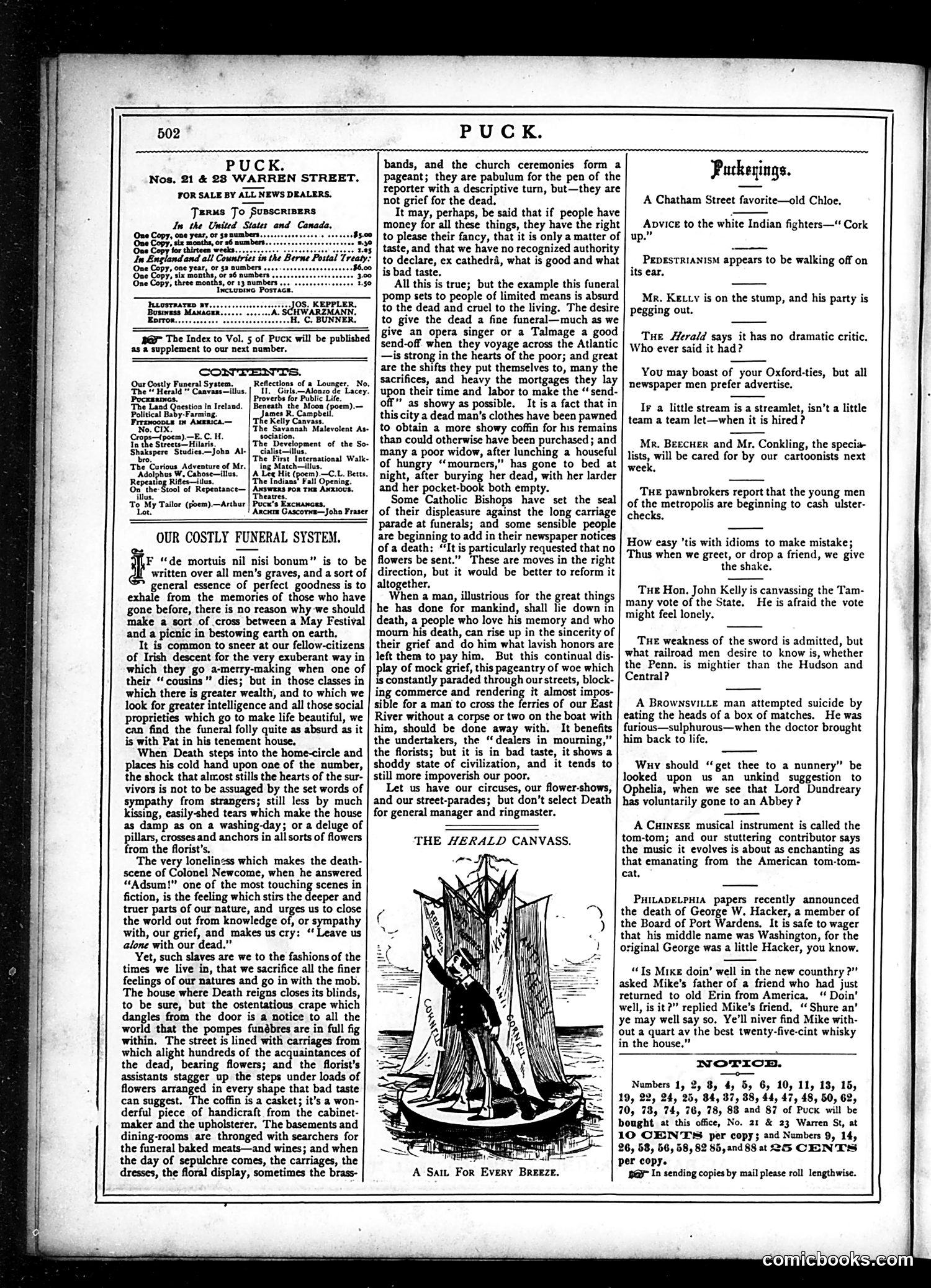
What you’re looking at
This political cartoon depicts a ship in distress, its sails torn and tattered. The illustration appears to comment on instability or turbulent conditions—likely referencing political or economic upheaval of the era when *Puck* was published. The title "A Sail For Every Breeze" suggests adaptability or opportunism, possibly satirizing politicians or leaders who shift positions depending on circumstances. The damaged vessel could represent the nation, government, or a specific institution struggling under changing conditions. Without additional context identifying the specific historical moment, the exact targets remain unclear, but the maritime metaphor was common in 19th-century American political satire to represent the nation's course through troubled waters.
📄 Transcribed text from this page (OCR, searchable)
Machine-transcribed from the original scan — historical spelling and the odd misread are preserved.
502 © PUCK. PUCK. Nos, 21 & 28 WARREN STREET. FOR SALE BY ALL NEWS DEALERS. Jurus To Susscrisers dn the United States and Canada, jOS. KEPPLER. [ARZMANN, . C. BUNNER. ‘GF The Index to Vol. 5 of Puck will be published as a supplement to our next number. bands, and the church ceremonies form a pageant; they are pabulum for the pen of the reporter with a descriptive turn, but—they are not grief for the dead. It may, perhaps, be said that if people have money for all these things, they have the right to please their fancy, that it is only a matter of taste, and that we have no recognized authority to declare, ex cathedrd, what is good and what is bad taste. All this is true; but the example this funeral pomp sets to people of limited means is absurd to the dead and cruel to the living. The desire to give the dead a fine funeral—much as we give an opera singer or a Talmage a good send-off when they voyage across the Atlantic is strong in the hearts of the poor; and great co: Qur Costly Funeral System, ‘The * Herald” Canvass—illus. RIGS. ‘The Land Question in Ireland. Political Baby-Farming. Fregwooous I - Reflections of a Lounger. Né = ames Re Campbell The Kelly Canvass. ion, velopment of the So- — illus, bro. The First International Walk- The Corious Adventure of Mr.| | ing Satch—illus. Adolphus W, Cahose—illus. | A Leg Hit (poem) —C.L. Betts. Repeatiog Rifles—illus. The Indians’ Fall Opening. Ger the Stool of Repentance | Axswens ron THe Auxtous. iiss cares To My Tailor (poem).—Arthur | Pucu’s Excnances. Lot.” ‘ ‘Axcumm Gascoree—Joha Fraser OUR COSTLY FUNERAL SYSTEM. F “de mortuis nil nisi bonum” is to be written over all men’s graves, and a sort of general essence of perfect goodness is to exhale from the memories of those who have gone before, there is no reason why we should make a sort of cross between a May Festival and a picnic in bestowing earth on earth, It is common to sneer at our fellow-citizens of Irish descent for the very exuberant way in which they go a-merry-making when one of their “ " dies; but in those classes in which there is greater wealth, and to which we look for greater intelligence and all those social proprieties which go to make life beautiful, we can find the funeral folly quite as absurd as it is with Pat in his tenement house, When Death steps into the home-circle and places his cold hand upon one of the number, the shock that almost stills the hearts of the sur- vivors is not to be assuaged by the set words of sympathy from strangers; still less by much kissing, easily-shed tears which make the house as damp as on a washing-day; or a deluge of pillars, crosses and anchors in all sorts of flowers from the florist’s. The very loneliness which makes the death- scene of Colonel Newcome, when he answered “Adsum!” one of the most touching scenes in fiction, is the feeling which stirs the deeper and truer parts of our nature, and urges us to close the world out from knowledge of, or sympathy with, our grief, and makes us cry: ‘‘ Leave us alone with our dead.” Yet, such slaves are we to the fashions of the times we live in, that we sacrifice all the finer feelings of our natures and go in with the mob. The house where Death reigns closes its blinds, to be sure, but the ostentatious crape which dangles from the door is a notice to all the world that the pompes funébres are in full fig within. The street is lined with carriages from which alight hundreds of the acquaintances of the dead, bearing flowers; and the florist’s assistants stagger up the steps under loads of flowers arranged in every shape that bad taste can suggest. The coffin is a casket; it's a won- derful piece of handicraft from the cabinet- maker and the upholsterer, The basements and dining-rooms are thronged with searchers for the funeral baked meats—and wines; and when the day of sepulchre comes, the carriages, the dresses, the floral display, sometimes the brass- are the shifts they put themselves to, many the sacrifices, and heavy the mortgages they lay upon their time and labor to make the “‘send- off” as showy as possible. It is a fact that in this city a dead man’s clothes have been pawned to obtain a more showy coffin for his remains than could otherwise have been purchased; and many a poor widow, after lunching a houseful of hungry “mourners,” has gone to bed at night, after burying her dead, with her larder and her pocket-book both empty. Some Catholic Bishops have set the seal of their displeasure against the long carriage parade at funerals; and some sensible people are beginning to add in their newspaper notices ofa death: “It is particularly requested that no flowers be sent.” These are moves in the right direction, but it would be better to reform it altogether. When a maz, illustrious for the great things he has done for mankind, shall lie down in death, a people who love his memory and who mourn his death, can rise up in the sincerity of their grief and do him what lavish honors are left them to pay him, But this continual dis- play of mock grief, this pageantry of woe which is constantly paraded through ourstreets, block- ing commerce and rendering it almost impos- sible for a man to cross the ferries of our East River without a corpse or two on the boat with him, should be done away with. It benefits the undertakers, the “dealers in mourning,” the florists; but it is in bad taste, it shows a shoddy state of civilization, and it tends to still more impoverish our poor. Let us have our circuses, our flower-shows, and our street-parades; but don’t select Death for general manager and ringmaster. THE HERALD CANVASS. Mai A Sait For Every Breeze. Puckeyings. A Chatham Street favorite—old Chloe. Apvice to the white Indian fighters— Cork up.” PEpEsTRIANISM appears to be walking off on its ear. Mr. KeLty is on the stump, and his party is pegging out. Tue Herald says it has no dramatic critic, Who ever said it had? You may boast of your Oxford-ties, but all newspaper men prefer advertise. Ir a little stream is a streamlet, isn’t a little team a team let—when it is hired ? Mr. Beecuer and Mr. Conkling, the specia- lists, will be cared for by our cartoonists next week, Tue pawnbrokers report that the young men of fhe metropolis are beginning to cash ulster- checks. How easy 'tis with idioms to make mistake; Thus when we greet, or drop a friend, we give the shake. Tue Hon. John Kelly is canvassing the Tam- many vote of the State. He is afraid the vote might feel lonely. Tue weakness of the sword is admitted, but what railroad men desire to know is, whether the Penn. is mightier than the Hudson and Central? A BRownsviLLE man attempted suicide by eating the heads of a box of matches. He was furious—sulphurous—when the doctor brought him back to life. Wuy should “get thee to a nunnery” be looked upon us an unkind suggestion to Ophelia, when we see that Lord Dundreary has voluntarily gone to an Abbey ? A Cutnese musical instrument is called the tom-tom; and our stuttering contributor says the music it evolves is about as enchanting as that emanating from the American tom-tom- cat. PHILADELPHIA papers recently announced the death of George W. Hacker, a member of the Board of Port Wardens. It is safe to wager that his middle name was Washington, for the original George was a little Hacker, you know. “Ts Mike doin’ well in the new counthry ?” asked Mike's father of a friend who had just returned to old Erin from America. “ Doin’ well, is it?” replied Mike’s friend. ‘Shure an’ ye may well say so. Ye'll niver find Mike with- out a quart av the best twenty-five-cint whisky in the house.” NOTICE. Numbers 1, 2, 8, 4, 5, 6, 10, 11, 13, 15, 19, 22, 24, 25, 84, 37, 88, 44, 47, 48, 50, 62, 70, 73, 74, 76, 78, 88 and 87 of Puck will be bought at this office, No. 21 & 23 Warren St, at 10 CENTS per copy; and Numbers 9, 14, 26, 58, 56, 58, 82 85,and 88 at 25 CENTS: per copy. sey In sending copies by mail please roll lengthwise.