
Puck, 1879-10-15 · page 11 of 18
Puck — October 15, 1879 — page 11: what you’re looking at
What you’re looking at
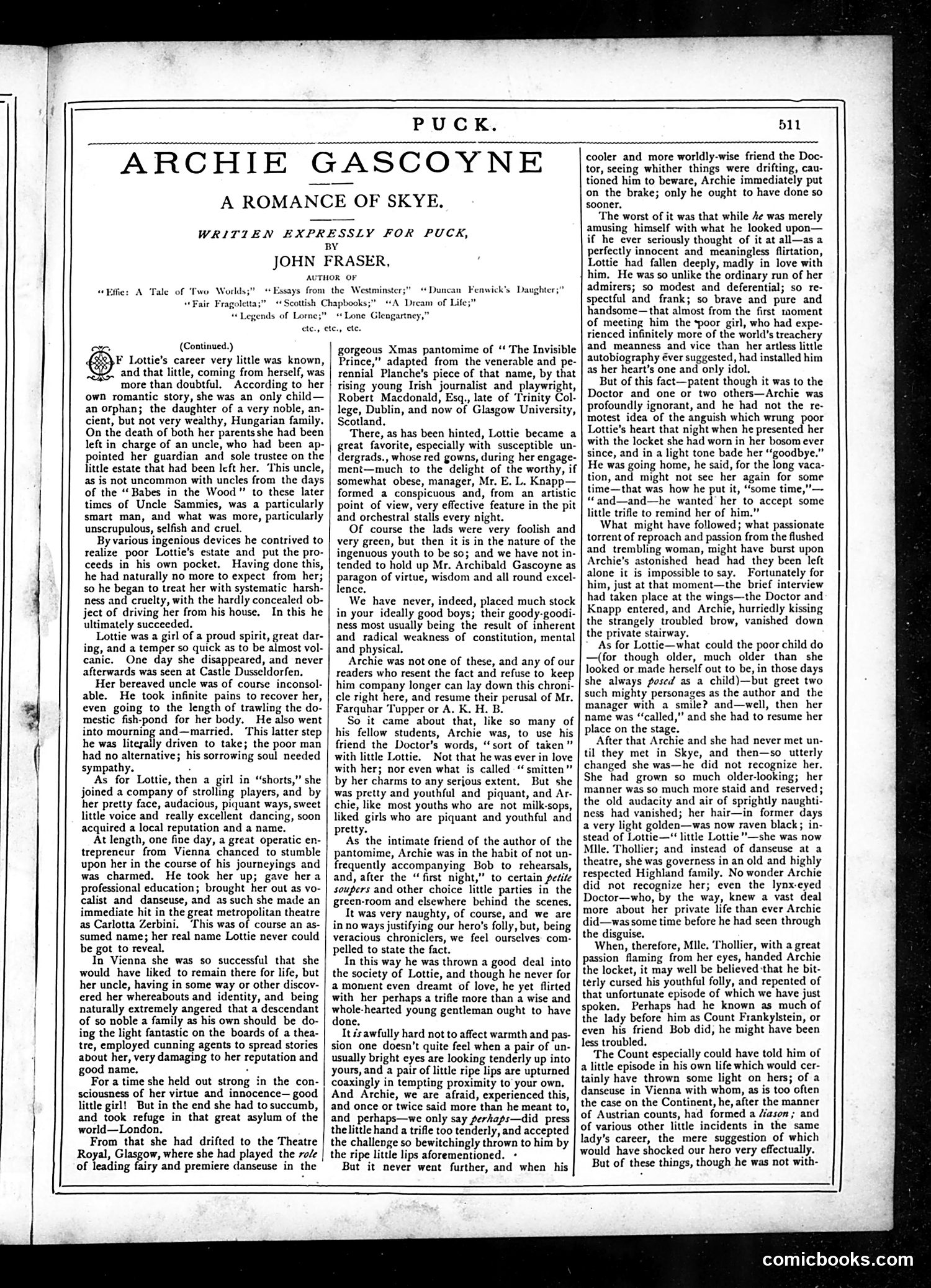
This page is primarily **literary content, not political satire**. It contains "Archie Gascoyne: A Romance of Skye," a serialized story by John Fraser, written expressly for Puck magazine. The text describes a romantic narrative set in Scotland involving characters named Archie, Lottie, and the Doctor. It discusses Archie's relationship with an orphan girl named Lottie and various romantic entanglements—including references to his behavior in Vienna and interactions with theatrical circles. There are **no political cartoons visible** on this page. Instead, this appears to be filler content—serialized fiction that Puck used to supplement its satirical offerings. The page represents the magazine's broader publishing strategy beyond pure political humor.
📄 Transcribed text from this page (OCR, searchable)
Machine-transcribed from the original scan — historical spelling and the odd misread are preserved.
: sat we PUCK. 511 ARCHIE GASCOYNE A ROMANCE OF SKYE, WRITTEN EXPRESSLY FOR PUCK, BY JOHN FRASER, AUTHOR OF “Effie: A Tale of Two Worlds;” “Fair Fragoletta;” 4 “Legends of Lorne;” Essays from the Westminster” Scottish Chapbooks;”” “Duncan Fenwick’s Daughters” “A Dream of Life; “Lone Glengartney,” ete., ete, ete. oo (Continued.) q F Lottie’s career very little was known, and that little, coming from herself, was more than doubtful. According to her own romantic story, she was an only child— an orphan; the daughter of a very noble, an- cient, but not very wealthy, Hungarian family. On the death of both her parents she had been | left in charge of an uncle, who had been ap- pointed her guardian and sole trustee on the little estate that had been left her. ‘This uncle, as is not uncommon with uncles from the days of the “Babes in the Wood” to these later times of Uncle Sammies, was a particularly smart man, and what was more, particularly unscrupulous, selfish and cruel. By various ingenious devices he contrived to realize poor Lottie’s estate and put the pro- ceeds in his own pocket, Having done this, he had naturally no more to expect from her; so he began to treat her with systematic harsh- ness and cruelty, with the hardly concealed ob- ject of driving her from his house, In this he ultimately succeeded. Lottie was a girl of a proud spirit, great dar- ing, and a temper so quick as to be almost vol- canic, One day she disappeared, and never afterwards was seen at Castle Dusseldorfen. Her bereaved uncle was of course inconsol- able. He took infinite pains to recover her, even going to the length of trawling the do- mestic fish-pond for her body. He also went into mourning and—married. This latter step he was liteyally driven to take; the poor man had no alternative; his sorrowing soul needed sympathy, ‘ As for Lottie, then a girl in “shorts,” she joined a company of strolling players, and by her pretty face, audacious, piquant ways, sweet little voice and really excellent dancing, soon acquired a local reputation and a name. At length, one fine day, a great operatic en- trepreneur from Vienna chanced to stumble upon her in the course of his journeyings and was charmed. He took her up; gave her a professional education; brought her out as vo- calist and danseuse, and as such she made an immediate hit in the great metropolitan theatre as Carlotta Zerbini. ‘This was of course an as- sumed name; her real name Lottie never could be got to reveal, In Vienna she was so successful that she would have liked to remain there for life, but her uncle, having in some way or other discov- ered her whereabouts and identity, and being naturally extremely angered that a descendant of so noble a family as his own should be do- ing the light fantastic on the boards of a thea- tre, employed cunning agents to spread stories about her, very damaging to her reputation and For a time she held out strong the con- sciousness of her virtue and innocence— good little girl! But in the end she had to succumb, and took refuge in that great asylum of the world—London. From that she had drifted to the Theatre Royal, Glasgow, where she had played the ro/e | of leading fairy and premiere danseuse in the gorgeous Xmas pantomime of “ ‘The Invisible Prince,” adapted from the venerable and pe- rennial Planche’s piece of that name, by that rising young Irish journalist and playwright, Robert Macdonald, Esq., late of ‘Trinity Col- lege, Dublin, and now of Glasgow University, Scotland. There, as has been hinted, Lottie became a great favorite, especially with susceptible un- dergrads., whose red gowns, during her engage- ment—much to the delight of the worthy, if somewhat obese, manager, Mr. E. L. Knapp— formed a conspicuous and, from an artistic point of view, very effective feature in the pit and orchestral stalls every night. Of course the lads were very foolish and very green, but then it is in the nature of the ingenuous youth to be so; and we have not in- tended to hold up Mr. Archibald Gascoyne as paragon of virtue, wisdom and all round excel- lence, We have never, indeed, placed much stock in your ideally good boys; their goody-goodi- ness most usually being the result of inherent and radical weakness of constitution, mental and physical. Archie was not one of these, and any of our readers who resent the fact and refuse to keep him company longer can lay down this chroni- cle right here, and resume their perusal of Mr. Farquhar Tupper or A. K. H. B. So it came about that, like so many of his fellow students, Archie was, to use his friend the Doctor's words, “sort of taken” with little Lottie. Not that he was ever in love with her; nor even what is called “ smitten” by her charms to any serjous extent. But she was pretty and youthful and piquant, and Ar- chie, like most youths who are not milk-sops, liked girls who are piquant and youthful and pretty. As the intimate friend of the author of the pantomime, Archie was in the habit of not un- frequently accompanying Bob to rehearsals, and, after the “ first night,” to certain petite soupers and other choice little parties in the green-room and elsewhere behind the scenes, It was very naughty, of course, and we are in no ways justifying our hero's folly, but, being veracious chroniclers, we feel ourselves: com- pelled to state the fact. In this way he was thrown a good deal into the society of Lottie, and though he never for a moment even dreamt of love, he yet flirted with her perhaps a trifle more than a wise and whole-hearted young gentleman ought to have done. It #s awfully hard not to affect warmth and pas- sion one doesn’t quite feel when a pair of un- usually bright eyes are looking tenderly up into yours, and a pair of little ripe lips are upturned coaxingly in tempting proximity to your own. And Archie, we are afraid, experienced this, and once or twice said more than he meant to, and_perhaps—we only say perhaps—did press the little hand a trifle too tenderly, and accepted the challenge so bewitchingly thrown to him by the ripe little lips aforementioned. - But it never went further, and when his cooler and more worldly-wise friend the Doc- tor, seeing whither things were drifting, cau- tioned him to beware, Archie immediately put on the brake; only he ought to have done so sooner. The worst of it was that while Ae was merely amusing himself with what he looked upon— if he ever seriously thought of it at all—as a perfectly innocent and meaningless flirtation, Lottie had fallen deeply, madly in love with him. He was so unlike the ordinary run of her admirers; so modest and deferential; so re- spectful and frank; so brave and pure and handsome—that almost from the first moment of meeting him the ‘poor girl, who had expe- rienced infinitely more of the world’s treachery and meanness and vice than her artless little autobiography éver suggested, had installed him as her heart’s one and only idol. But of this fact—patent though it was to the Doctor and one or two others—Archie was profoundly ignorant, and he had not the re- motest idea of the anguish which wrung poor Lottie’s heart that night when he presented her with the locket she had worn in her bosom ever since, and in a light tone bade her “goodbye.” He was going home, he said, for the long vaca- tion, and might not see her again for some time—that was how he put it, “some time,”— “‘and—and—he wanted her to accept some little trifle to remind her of him.” What might have followed; what passionate torrent of reproach and passion from the flushed and trembling woman, might have burst upon Archie's astonished head had they been left alone it is impossible to say. Fortunately for him, just at that moment—the brief interview had taken place at the wings—the Doctor and Knapp entered, and Archie, hurriedly kissing the strangely troubled brow, vanished down the private stairway. As for Lottie—what could the poor child do —(for though older, much older than she looked or made herself out to be, in those days she always posed as a child)—but greet two such mighty personages as the author and the manager with a smile? and—well, then her name was “called,” and she had to resume her place on the stage. After that Archie and she had never met un- til they met in Skye, and then—so utterly changed she was—he did not recognize her. She had grown so much older-looking; her manner was so much more staid and reserved; the old audacity and air of sprightly naughti- ness had vanished; her hair—in former days a very light golden—was now raven black; in- stead of Lottie—‘* little Lottie ’—she was now Mile. Thollier; and instead of danseuse at a theatre, she was governess in an old and highly respected Highland family. No wonder Archie did not recognize her; even the lynx-eyed Doctor—who, by the way, knew a vast deal more about her private life than ever Archie did—was some time before he had seen through the disguise. When, therefore, Mlle. ‘Thollier, with a great passion flaming from her eyes, handed Archie the locket, it may well be believed that he bit- terly cursed his youthful folly, and repented of that unfortunate episode of which we have just spoken, Perhaps had he known as much of the lady before him as Count Frankylstein, or even his friend Bob did, he might have been less troubled. The Count especially could have told him of a little episode in his own life which would cer- tainly have thrown some light on hers; of a danseuse in Vienna with whom, as is too often the case on the Continent, he, after the manner of Austrian counts, had formed a /iason; and of various other little incidents in the same lady’s career, the mere suggestion of which would have shocked our hero very effectually. But of these things, though he was not with- eee one ee comicbooks.com