
Puck, 1879-10-15 · page 10 of 18
Puck — October 15, 1879 — page 10: what you’re looking at
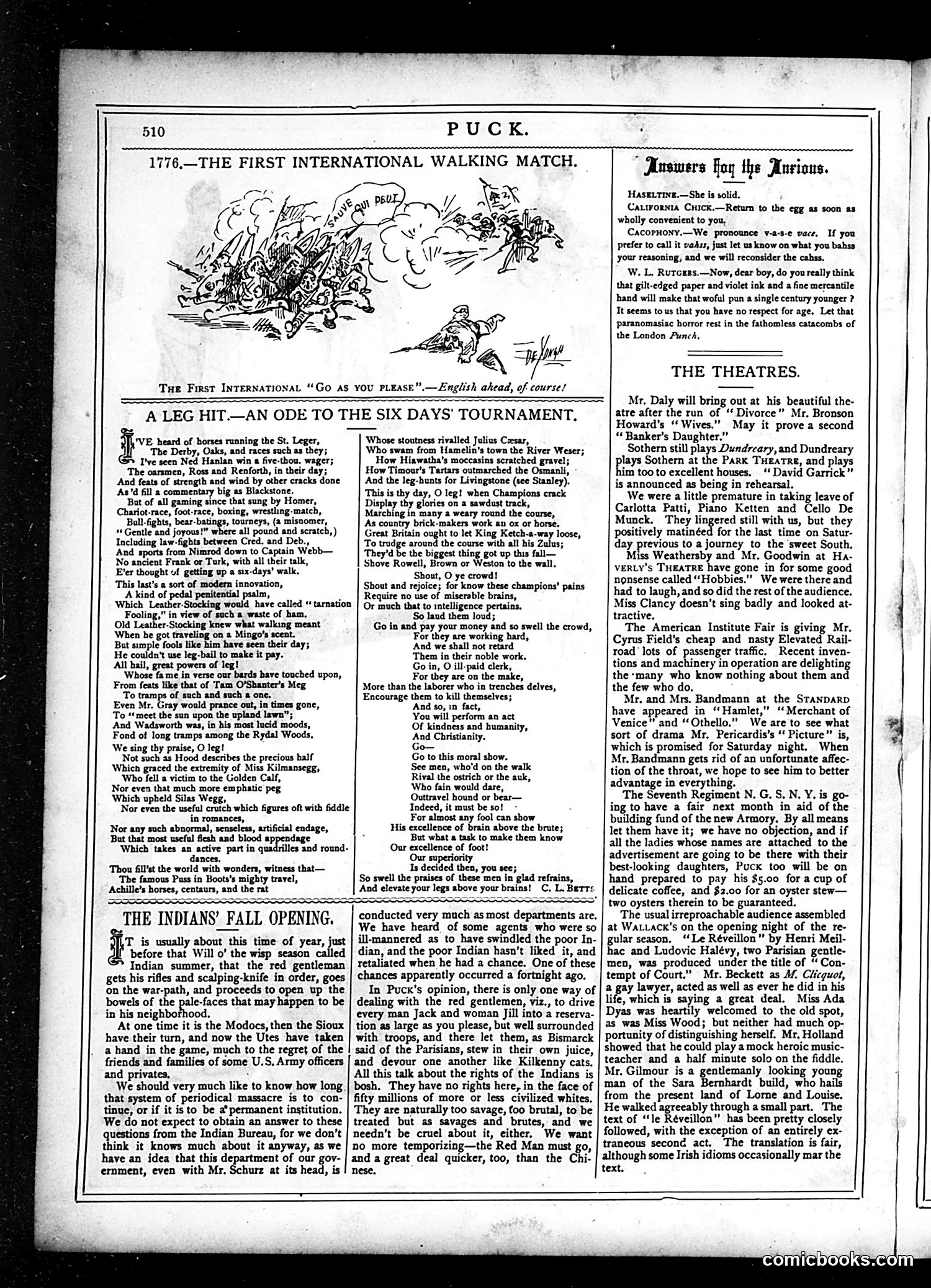
What you’re looking at
The main cartoon, titled "The First International Walking Match, 1776," satirizes the "Go as You Please" walking race—apparently a new sporting spectacle. The chaotic illustration depicts various figures in absurd walking postures, suggesting the event was ridiculous or undignified. The accompanying poem "A Leg Hit" mocks the Six Days Tournament (a walking competition), listing famous historical figures and racehorses alongside contemporary walkers, implying the sport was mockingly elevated to absurd importance. The satire targets the craze for pedestrian racing competitions that were apparently popular entertainment. By invoking 1776 and treating walkers as heroic figures comparable to historical legends, Puck ridicules what it saw as a trivial, undignified sporting fad gaining excessive public attention and enthusiasm.
📄 Transcribed text from this page (OCR, searchable)
Machine-transcribed from the original scan — historical spelling and the odd misread are preserved.
510 PUCK. 1776.—THE FIRST INTERNATIONAL WALKING MATCH. Tue First INTERNATIONAL ‘‘GO AS YOU PLEASE”.—Lnglish ahead, of course! A LEG HIT.—AN ODE TO THE SIX DAYS’ TOURNAMENT, "VE heard of horses running the St. Leger, ‘The Derby, Oaks, and races such as they; T've seen Ned Hanlan win a five-thou, wager ‘The oarsmen, Ross and Renforth, in their day; ‘And feats of strength and wind by other cracks done ‘As’d fill a commentary big as Blackstone. Bat of all gaming since that sung by Homer, Chariot-race, foot-race, boxing, wrestling-match, Ball-fights, bear-batings, tourneys, (a misnomer, «Gentle and joyous!” where all pound and scratch,) Including law-fights between Cred. and Deb., ‘And sports from Nimrod down to Captain Webb— No ancient Frank or Turk, with all their talk, Ever thought of getting up a six-days’ walk. This las’ a sort of Bates: innovation, A kind of pedal itent im, Which Leather Stacking would have called “tarnation Fooling,” in view of such a waste of ham. Old Leather-Stocking knew what walling meant When he got traveling on a Mingo's scent. Bat simple fools like him have seen their day; He couldn't use leg-bail to make it pay. All bail, great powers of leg! ‘Whose fame in verse our bards have touched upon, From feats like that of Tam O'Shanter's Meg To tramps of such and such a one. Even Mr. Gray would prance out, in times gone, To ‘meet the sun upon the upland lawn”; And Wadsworth was, in his most lucid moods, Fond of long tramps among the Rydal Woods. We sing thy praise, O leg! Not such as Hood describes the precious half Which graced the extremity of Miss Kilmansegg, Who fell a victim to the Golden Calf, Nor even that much more emphatic peg ‘Which upheld Silas Wegg, ‘Nor even the usefal crutch which figures oft with fiddle in romances, Nor any such abnormal, senseless, artificial endage, Bat that most sefal flesh and blood sppendage Which takes an active part in quadrilles and round- lances. Thou fill't the world with wonders, witness that— The famous Pass in Boots’s mighty travel, ‘Achille’s horses, centaurs, and the rat ‘Whose stoutness rivalled Julius Czesar, Who swam from Hamelin’s town the River Weser; How Hiawatha’s moccasins scratched gravel; How Timour’s Tartars outmarched the Osmanli, And the leg-bunts for Livingstone (see Stanley). ‘This is thy day, O leg! when Champions crack Display thy glories on a sawdust track, Marching in many a weary round the course, As country brick-makers work an ox or horse. Great Britain ought to let King Ketch-a-way loose, To trudge around the course with all his Zulus; They'd be the biggest thing got up this fall— Shove Rowell, Brown or Weston to the wall. Shout, O ye crowd! Shout and rejoice; for know these champions’ pains Require no use of miserable brains, Or much that to intelligence pertains. laud them loud; Go in and pay your money and so swell the crowd, For they are working hard, And we shall not retard Them in their noble work. Go in, O ill-paid clerk, For they are on the make, More than the laborer who in trenches delves, Encourage them to kill themselves; ‘And so, in fact, You will perform an act Of kindness and humanity, And Christianity. Go— Go to this moral show. See men, who'd on the walk Rival the ostrich or the auk, Who fain would dare, Outtravel hound or bear— Indeed, it must be so! For almost any fool can show His excellence of brain above the brute; But what a task to make them know Or excellence of foot! superior Is decided theo, you ses So swell the praises of these men in glad refrains, above your brains! C, THE INDIANS’ FALL OPENING. T is usually about this time of year, just before that Will 0’ the wisp season led Indian summer, that the red gentleman gets his rifles and scalping-knife in order, goes on the war-path, and proceeds to open up the bowels of the pale-faces that may happen to be in his neighborhood. At one time it is the Modocs, then the Sioux have their turn, and now the Utes have taken a hand in the game, much to the regret of the friends and families of some U.S. Army officers and privates, : We should very much like to know how long that system of periodical massacre is to con- tinue, or if it isto be a’ permanent institution. We do not expect to obtain an answer to these uestions from the Indian Bureau, for we don’t think it knows much about it anyway, as we have an idea that this department of our gov- ernment, even with Mr. Schurz at its head, is conducted very much as most departments are, We have heard of some agents who were so ill-mannered as to have swindled the poor In- dian, and the poor Indian hasn’t liked it, and retaliated when he had a chance. One of these chances apparently occurred a fortnight ago. In Puck's opinion, there is only one way of dealing with the red gentlemen, viz., to drive every man Jack and woman Jill into a reserva- tion as large as you please, but well surrounded with troops, and there let them, as Bismarck said of the Parisians, stew in their own juice, and devour one another like Kilkenny cats. All this talk about the rights of the Indians is bosh. They have no rights here, in the face of fifty millions of more or less civilized whites, ‘They are naturally too savage, foo brutal, to be treated but as savages and brutes, and we needn’t be cruel about it, either. We want no more temporizing—the Red Man must go, and a great deal quicker, too, than the Chi- nese. | Answers Foy the Aneious. HAsELtTiIne.—She is solid. Cattrornta Cxick.—Retum to the egg as soon as wholly convenient to you, CacorHony.—We pronounce v-as-e vace, If you prefer to call it vadss, just let us know on what you bahss your reasoning, and we will reconsider the cahss. W. L. Rutcens.—Now, dear boy, do you really think that gilt-edged paper and violet ink and a fine mercantile hand will make that wofal pun a single century younger ? It seems to us that you have no respect for age. Let that paranomasiac horror rest in the fathomless catacombs of the London Punch, THE THEATRES. Mr. Daly will bring out at his beautiful the- atre after the run of ‘“ Divorce” Mr. Bronson Howard’s ‘ Wives.” May it prove a second “ Banker's Daughter.” Sothern still plays Dundreary, and Dundreary pays Sothern at the Park THEATRE, and plays ‘im too to excellent houses.‘ David Garrick” is announced as being in rehearsal. We were a little premature in taking leave of Carlotta Patti, Piano Ketten and Cello De Munck. They lingered still with us, but they positively matinéed for the last time on Satur- day previous to a journey to the ‘sweet South. Miss Weathersby and Mr. Goodwin at Ha- verLy's THEATRE have gone in for some good nonsense called ‘‘Hobbies.”” We were there and had to laugh, and so did the rest of the audience, Miss Clancy doesn’t sing badly and looked at- tractive. The American Institute Fair is giving Mr. Cyrus Field's cheap and nasty Elevated Rail- road‘ lots of passenger traffic. Recent inven- tions and machinery in operation are delighting the ‘many who know nothing about them and the few who do. Mr. and Mrs. Bandmann at the STANDARD have appeared in “Hamlet,” ‘Merchant of Venice” and “Othello.” We are to see what sort of drama Mr. Pericardis’s “ Picture" is, which is promised for Saturday night. When Mr. Bandmann gets rid of an unfortunate affec- tion of the throat, we hope to see him to better advantage in everything. The Seventh Regiment N. G. S. N. Y. is go- ing to have a fair next month in aid of the building fund of the new Armory. By all means let them have it; we have no objection, and if all the ladies whose names are attached to the advertisement are going to be there with their best-looking daughters, Puck too will be on hand prepared to pay his $5.00 for a cup of delicate coffee, and $2.00 for an oyster stew— two oysters therein to be guaranteed. The usual irreproachable audience assembled at WaLLack's on the opening night of the re- gular season. “Le Réveillon” by Henri Meil- hac and Ludovic Halévy, two Parisian gentle- men, was produced under the title of “Con- tempt of Court.” Mr. Beckett as Af, Clicquot, a gay lawyer, acted as well as ever he did in his life, which is saying a great deal. Miss Ada Dyas was heartily welcomed to the old spot, as was Miss Wood; but neither had much op- portunity of distinguishing herself. Mr, Holland showed that he could play a mock heroic music- teacher and a half minute solo on the fiddle. Mr, Gilmour is a gentlemanly looking young man of the Sara Bernhardt build, who hails from the present land of Lorne and Louise. He walked agreeably through a small part. The text of ‘le Réveillon” has been pretty closely followed, with the exception of an entirely ex- traneous second act. The translation is fair, although some Irish idioms occasionally mar the text,