
A complete issue · 19 pages · 1879
Puck — September 3, 1879
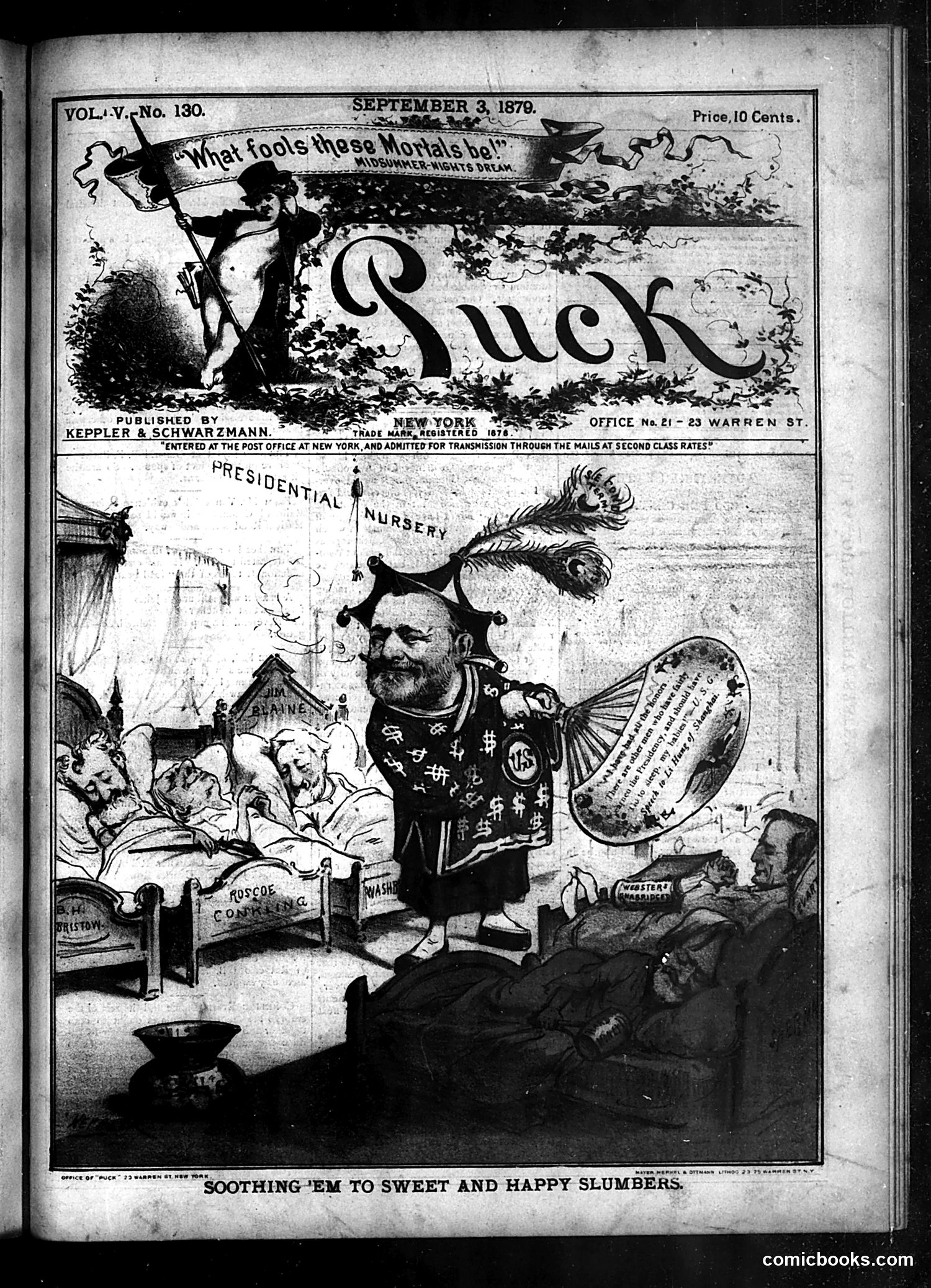
The main cartoon, titled "Soothing 'em to Sweet and Happy Slumbers," depicts a bearded man labeled "Presidential Nursery" holding a fan while attending to sleeping figures in beds. The caption and imagery suggest political satire about a president (identity unclear from the image alone) attempting to manage or pacify various constituencies or political factions represented by the sleeping figures. The figure appears caricatured with exaggerated features typical of 19th-century satirical art. The "nursery" label suggests infantilizing treatment of political groups or rivals—portraying them as children requiring soothing rather than serious engagement. The top masthead features "Suck" branding and decorative artwork typical of Puck's style, with the publication credited to Keppler & Schwarzmann in New York.
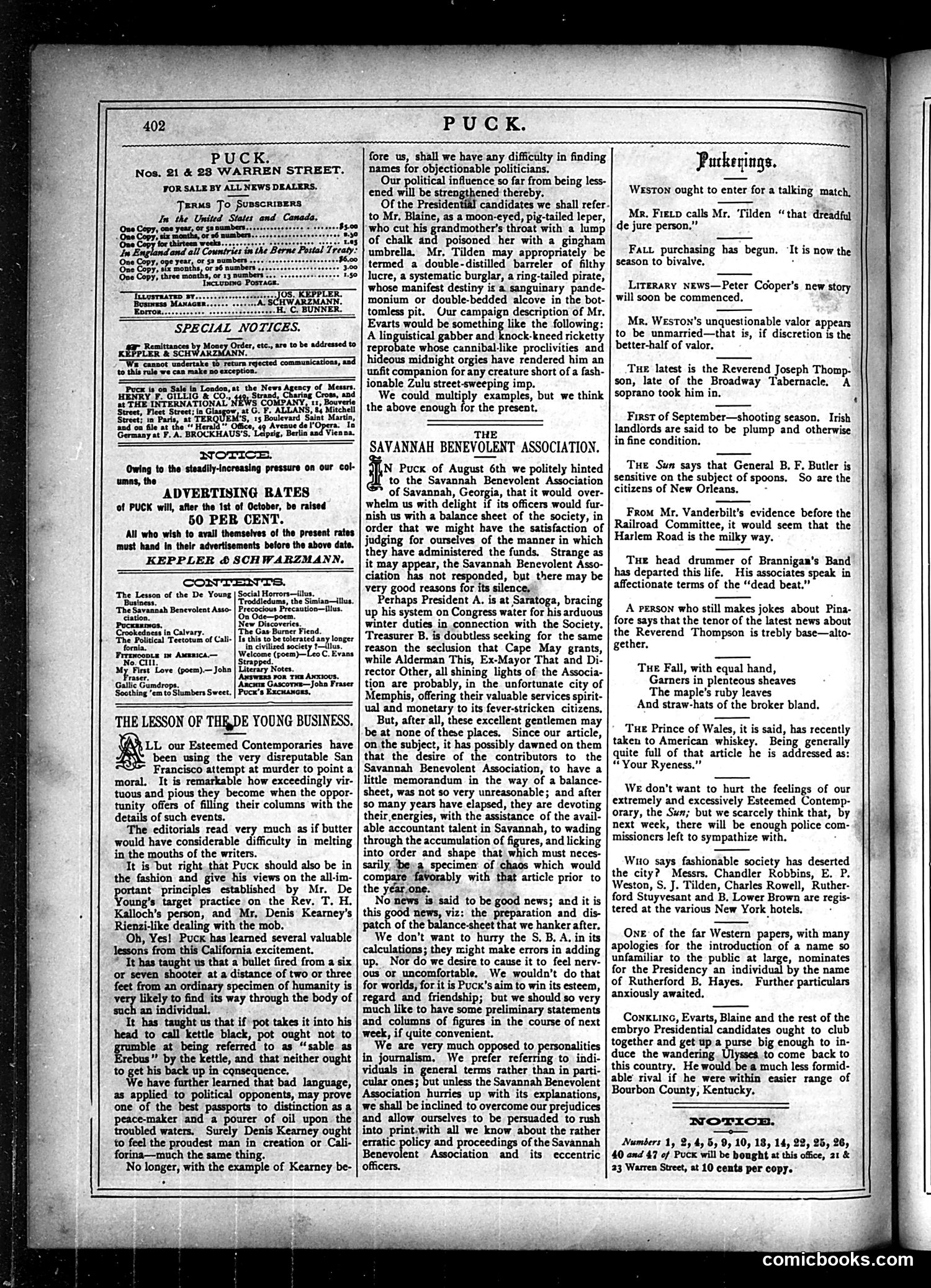
This page is primarily **text-based content** rather than political cartoons. The main articles include: 1. **"The Savannah Benevolent Association"** - A satirical piece criticizing the organization's financial mismanagement and opacity regarding fund administration. 2. **"The Lesson of the De Young Business"** - Commentary on the San Francisco Chronicle's use of disparaging language about a rival newspaper, critiquing journalistic ethics. 3. **"Puckerings"** - Brief social commentary notes, including remarks about General B.F. Butler's sensitivity regarding spoons and references to various public figures. The page contains mostly **advertising notices** and subscription information rather than illustrated political satire. Without visible cartoons on this particular page, the satire operates through written humor and social criticism typical of Puck's editorial voice.
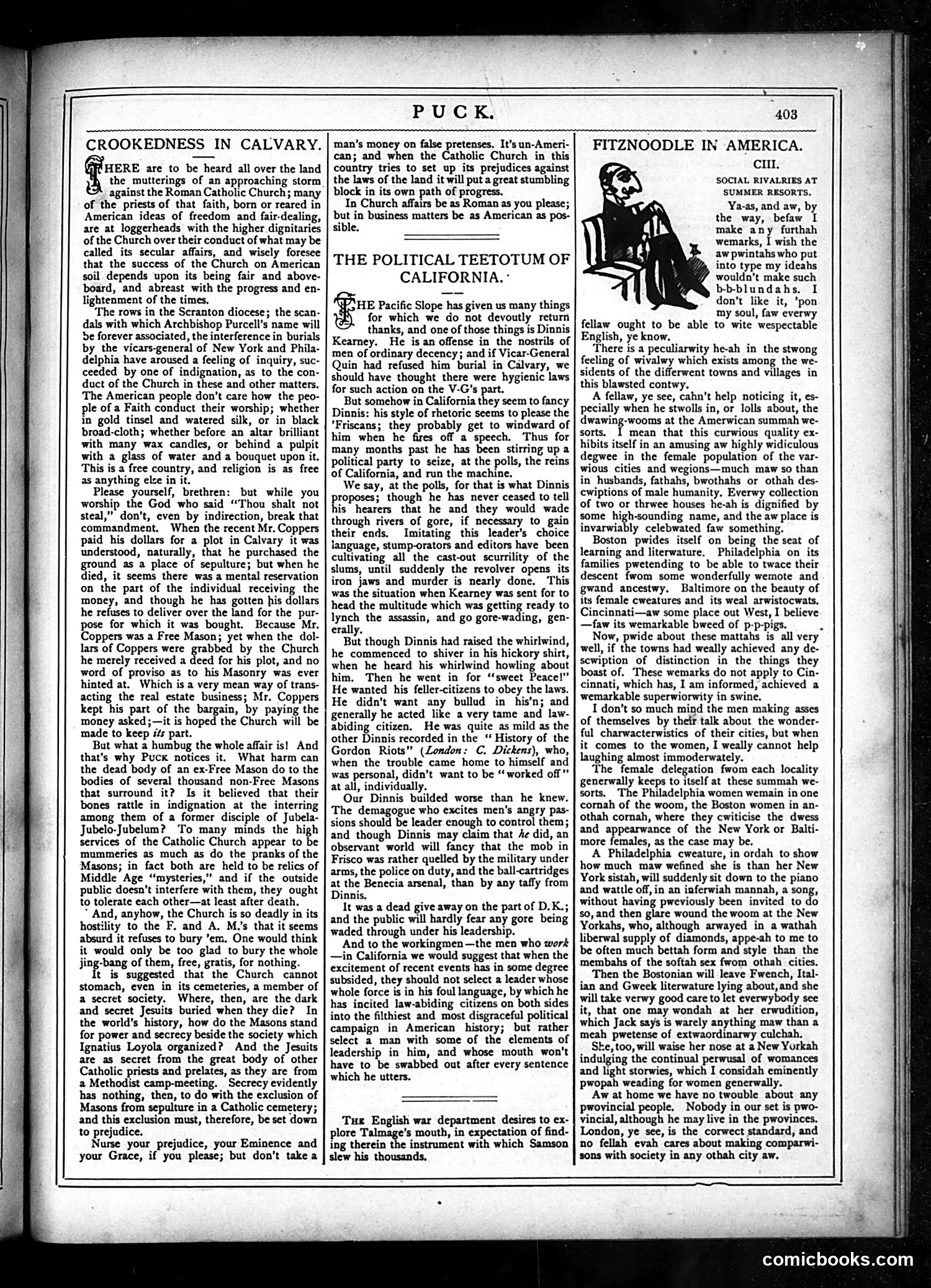
This page contains three distinct articles with satirical commentary: 1. **"Crookedness in Calvary"** attacks Catholic priests for financial malfeasance, accusing them of using religion as cover for embezzlement and fraud. It references a specific scandal involving a priest named Cropley in the Scranton diocese who allegedly misappropriated church funds. 2. **"The Political Teetotum of California"** criticizes Denis Kearney, a California political leader, for inflammatory rhetoric and mob incitement. The "teetotum" metaphor suggests his unpredictable, spinning politics. 3. **"Fitznoodle in America"** features a cartoon character commenting on American social pretensions, particularly mocking the aspirations of newly wealthy Philadelphia and New York families trying to establish themselves among high society through affected cultural pursuits. The satire targets corruption, demagoguery, and social climbing.
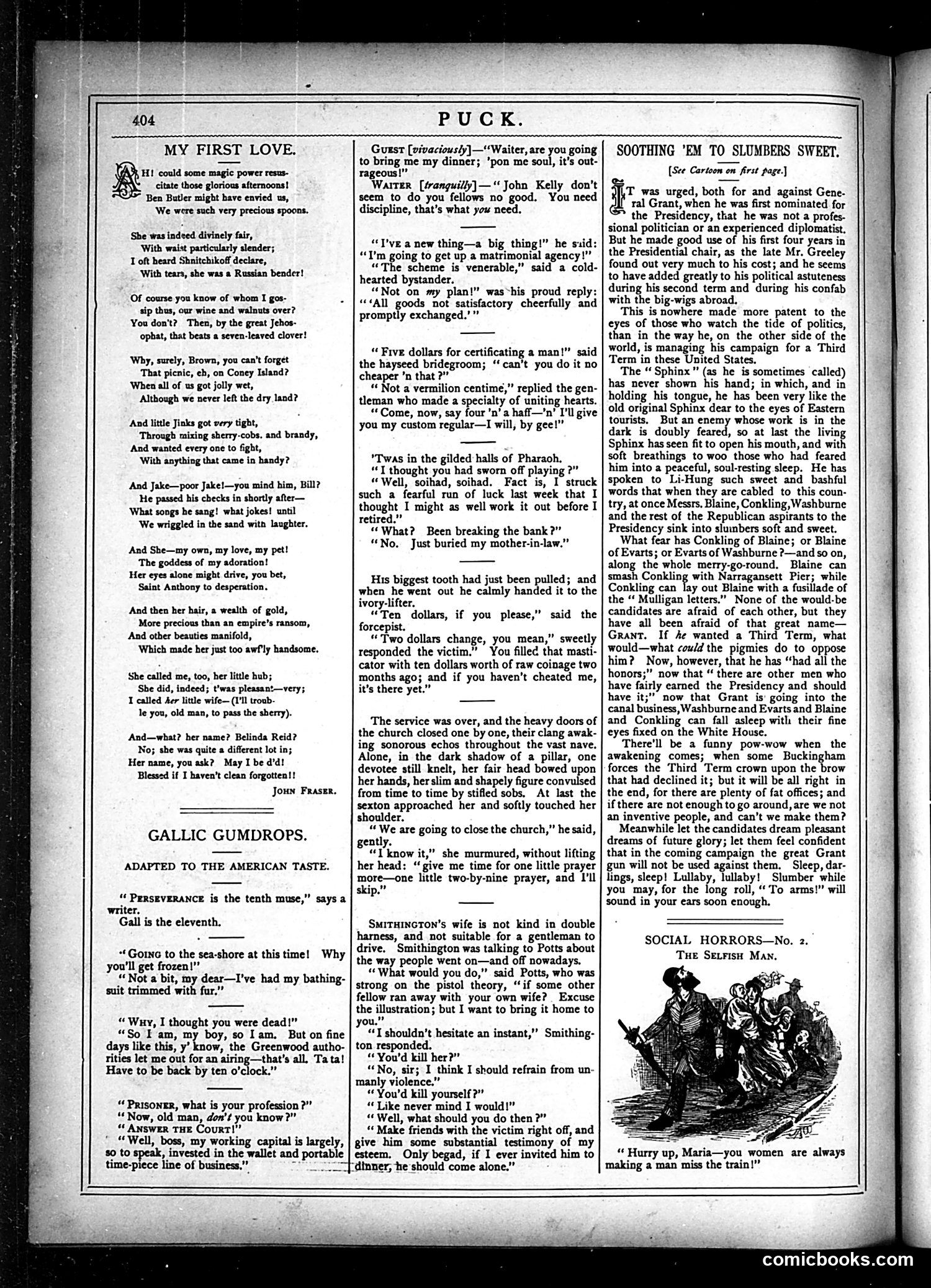
This page contains literary content rather than political cartoons. The main pieces are: 1. **"My First Love"** - A romantic poem by John Fraser, nostalgic in tone, about youthful infatuation. 2. **"Gallic Humdrops"** - Humorous anecdotes adapted for American readers, featuring brief comedic dialogues (appears to be French in origin, given the title). 3. **"Social Horrors—No. 2: The Selfish Man"** - A small illustration with accompanying text satirizing rude social behavior, showing figures in what appears to be a train station scene. The page primarily offers light entertainment—poetry, humor, and social satire—rather than political commentary. The "Social Horrors" series critiques everyday etiquette violations and inconsiderate behavior.
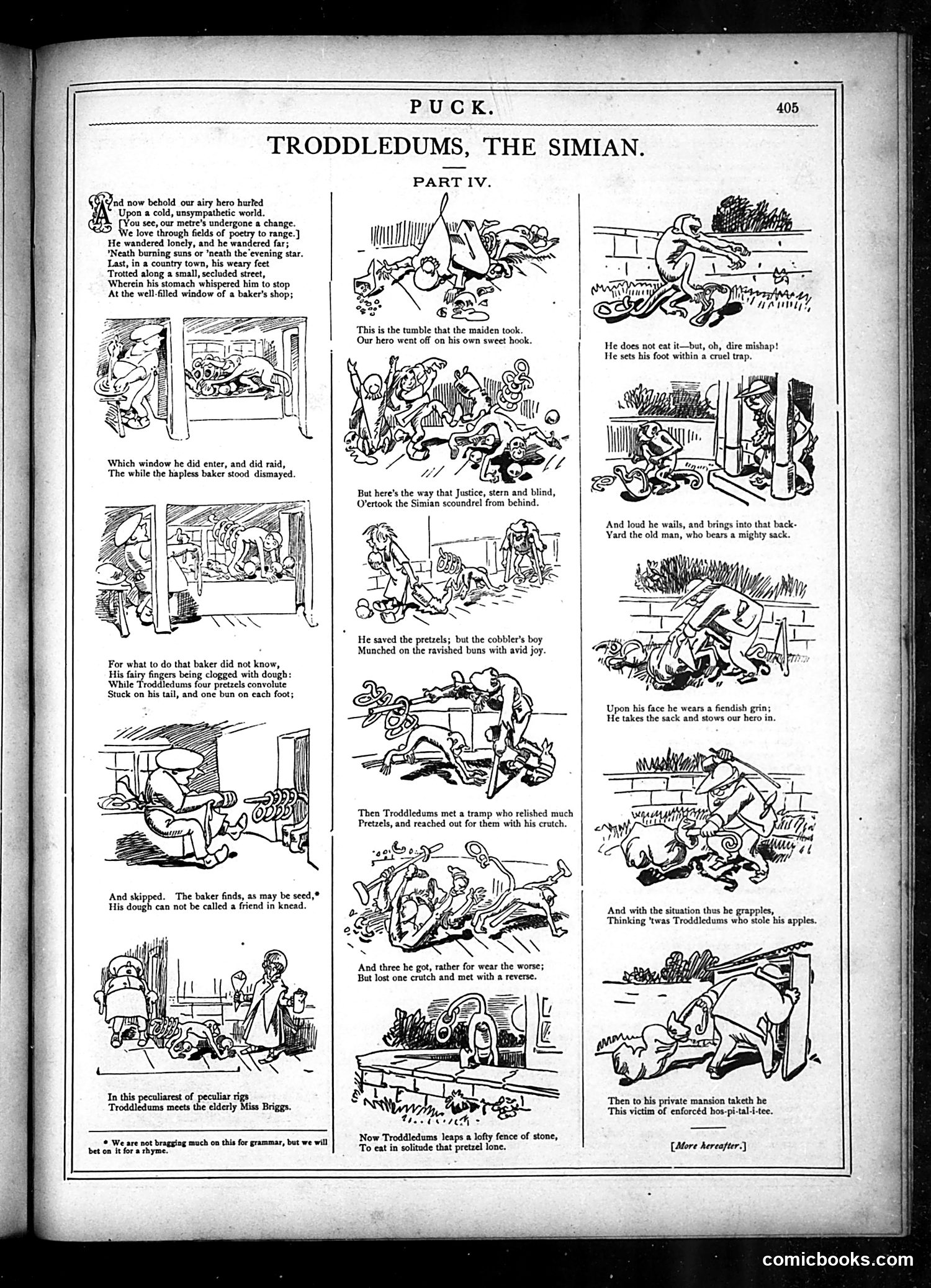
This is a satirical narrative poem illustrated with comic panels. The story follows a character named Troddledums who appears to be portrayed as simian (ape-like), emphasizing the Victorian-era racist caricature trope of comparing certain groups to animals. The narrative follows Troddledums through various misadventures—entering through a baker's window, encountering a trap, being caught by authorities, and ultimately ending up in what appears to be a private asylum or institution. The satire likely mocks social pretensions or a specific public figure of the era, using the "simian" trope common to Puck's sometimes crude satirical approach. Without additional context about which political or social figure "Troddledums" references, the specific target remains unclear, though the overall tone is one of ridicule and social commentary typical of 1880s-90s American satire magazines.
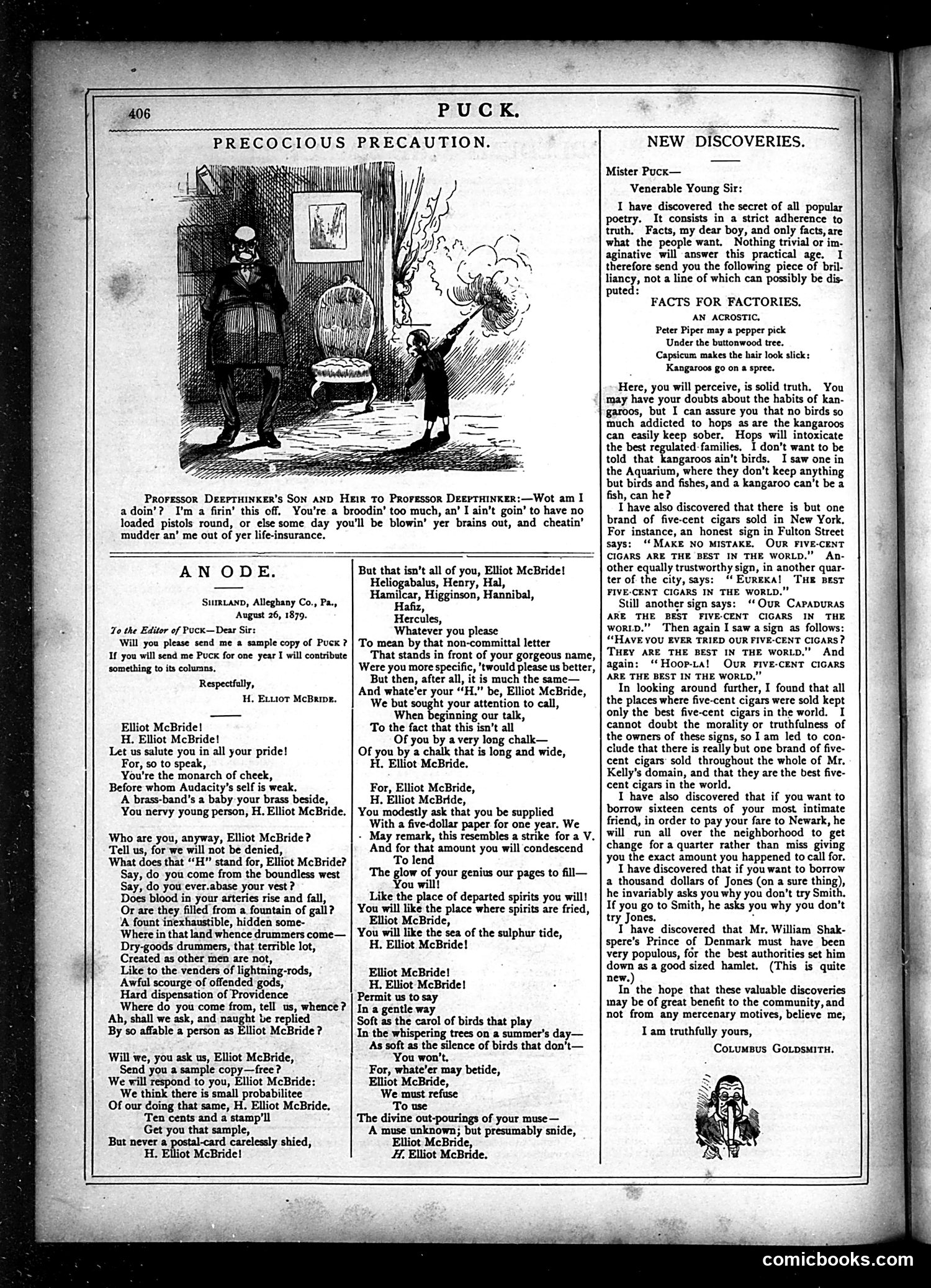
The left-side cartoon depicts a well-dressed gentleman (appearing to be a father figure) forcibly restraining a small child from reaching toward a large cauldron or pot. The title "Precocious Precaution" suggests the satire concerns overly cautious parenting. The accompanying dialogue mocks excessive parental warnings. The adult threatens the child with dire consequences—brains being knocked out, cheating, death—apparently for minor mischief. The satire criticizes Victorian-era parents who employed harsh, exaggerated threats to control children's behavior. This reflects period anxieties about childhood discipline and the emerging debate over appropriate parenting methods. The joke targets adults who invoke disproportionate punishments for trivial infractions, presenting this as absurd overreaction worthy of ridicule.
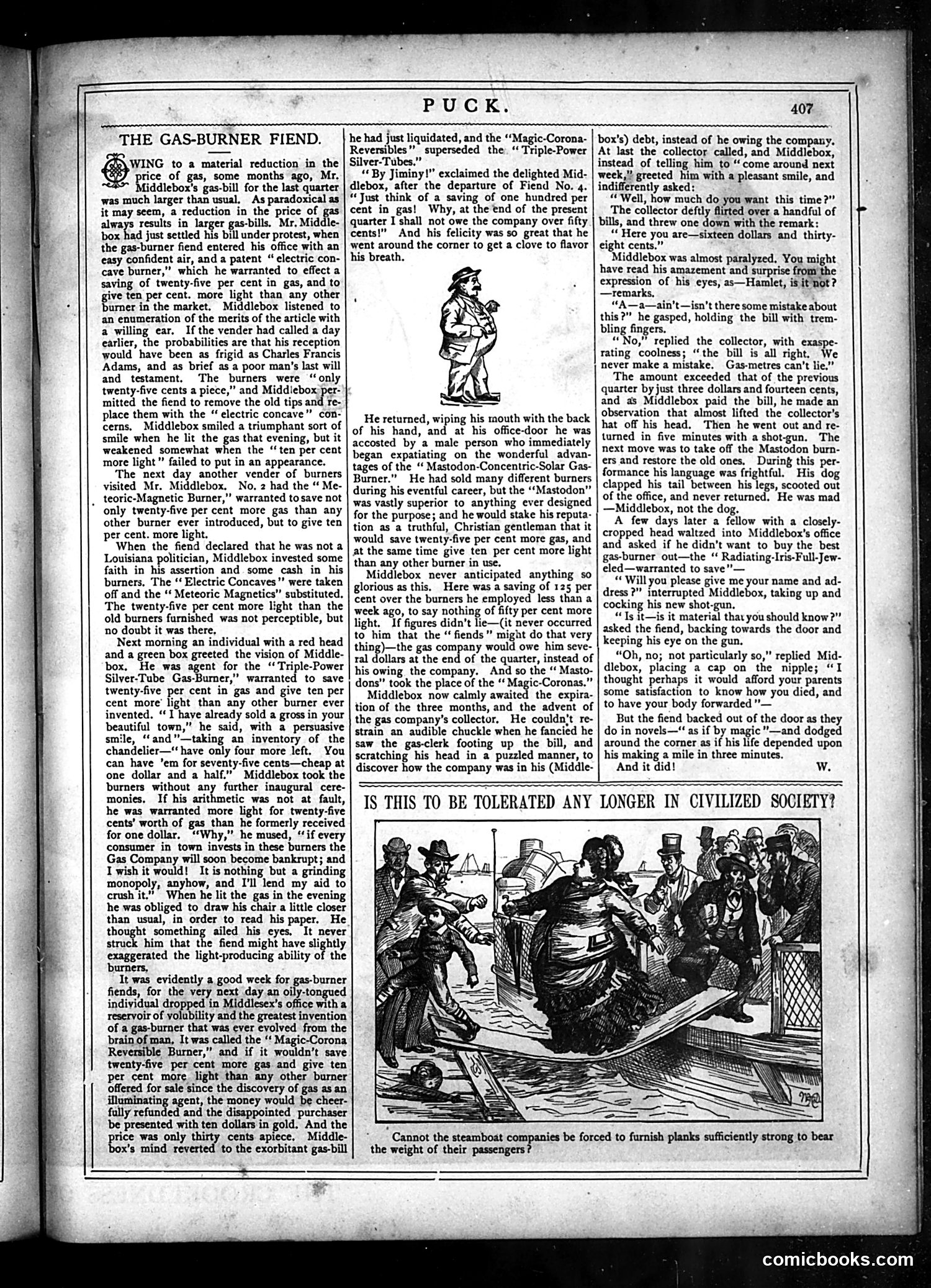
This satirical story mocks **Middlebox**, a gas company representative who promotes an inferior "Magic-Corona Reversible Burner" as superior to competitors' products. The narrative depicts Middlebox as a con artist exploiting consumer trust through exaggerated claims—promising 25% more gas savings and 10% more light than rival burners, which he cannot substantiate. The accompanying cartoon titled **"Is This to Be Tolerated Any Longer in Civilized Society?"** shows what appears to be a con artist or fraudster being confronted or apprehended by citizens or officials, suggesting public outrage against such deceptive commercial practices. The satire targets **corporate dishonesty and monopolistic practices** in the gas industry, criticizing how companies deceive consumers with unverifiable product claims for profit.
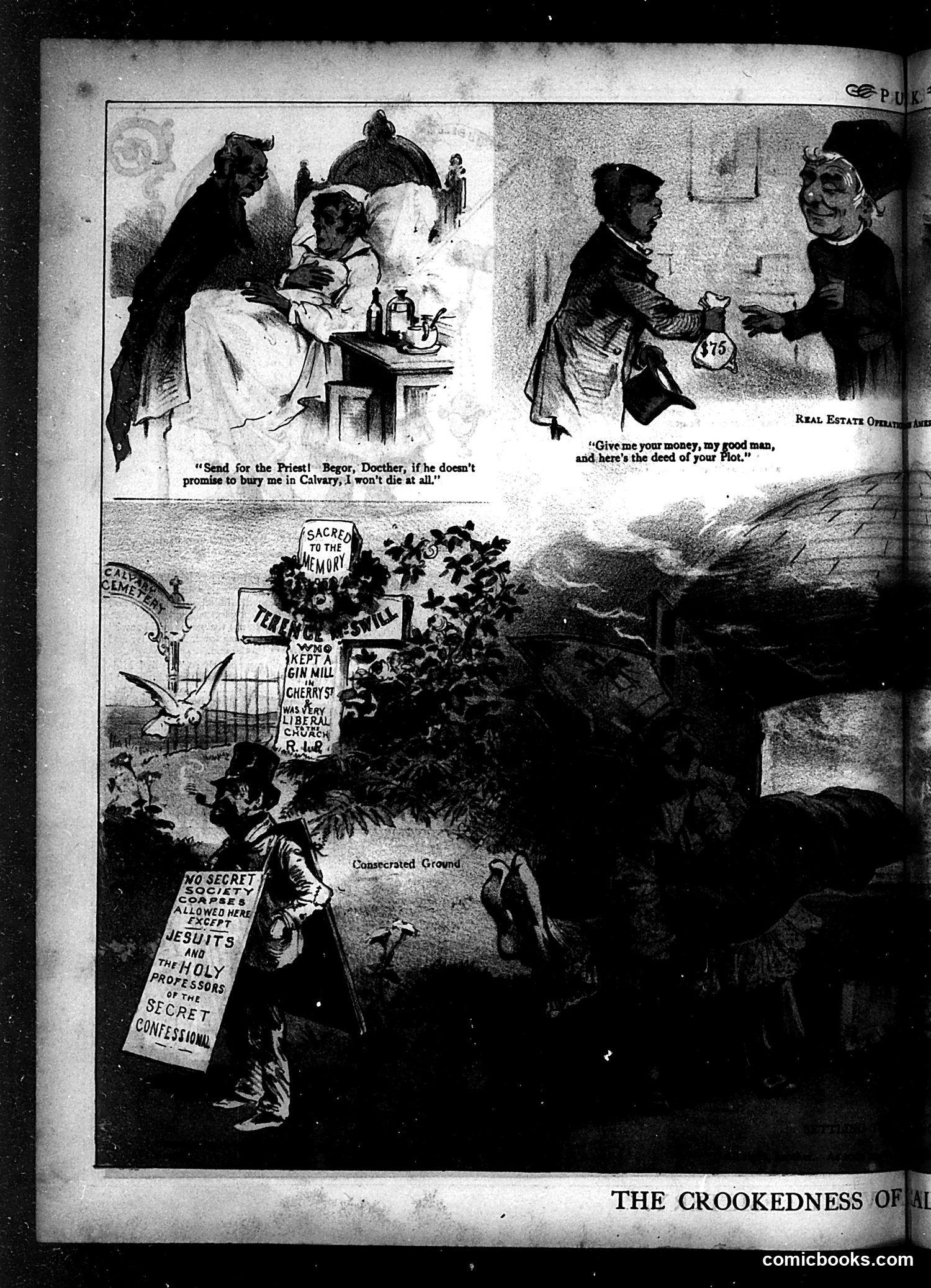
This page contains three distinct satirical scenes: **Top left:** A deathbed scene where someone demands a priest be sent, threatening non-burial in Calvary unless the priest promises proper last rites—satirizing Catholic burial practices and clerical authority. **Top right:** Labeled "Real Estate Operator," a man hands over a deed for $15, suggesting mockery of predatory real estate dealings or fraud. **Bottom:** "Consecrated Ground" shows a cemetery surrounded by signs advertising secular businesses (gin mill, cherry street, etc.) alongside religious institutions (Jesuits, churches). The satire criticizes the commercialization and corruption of supposedly sacred Catholic burial grounds, with secular and profane enterprises encroaching on hallowed space. The overall theme appears to attack Catholic institutional hypocrisy and the commodification of religious practices—common Puck targets during the anti-Catholic sentiment periods of American history.
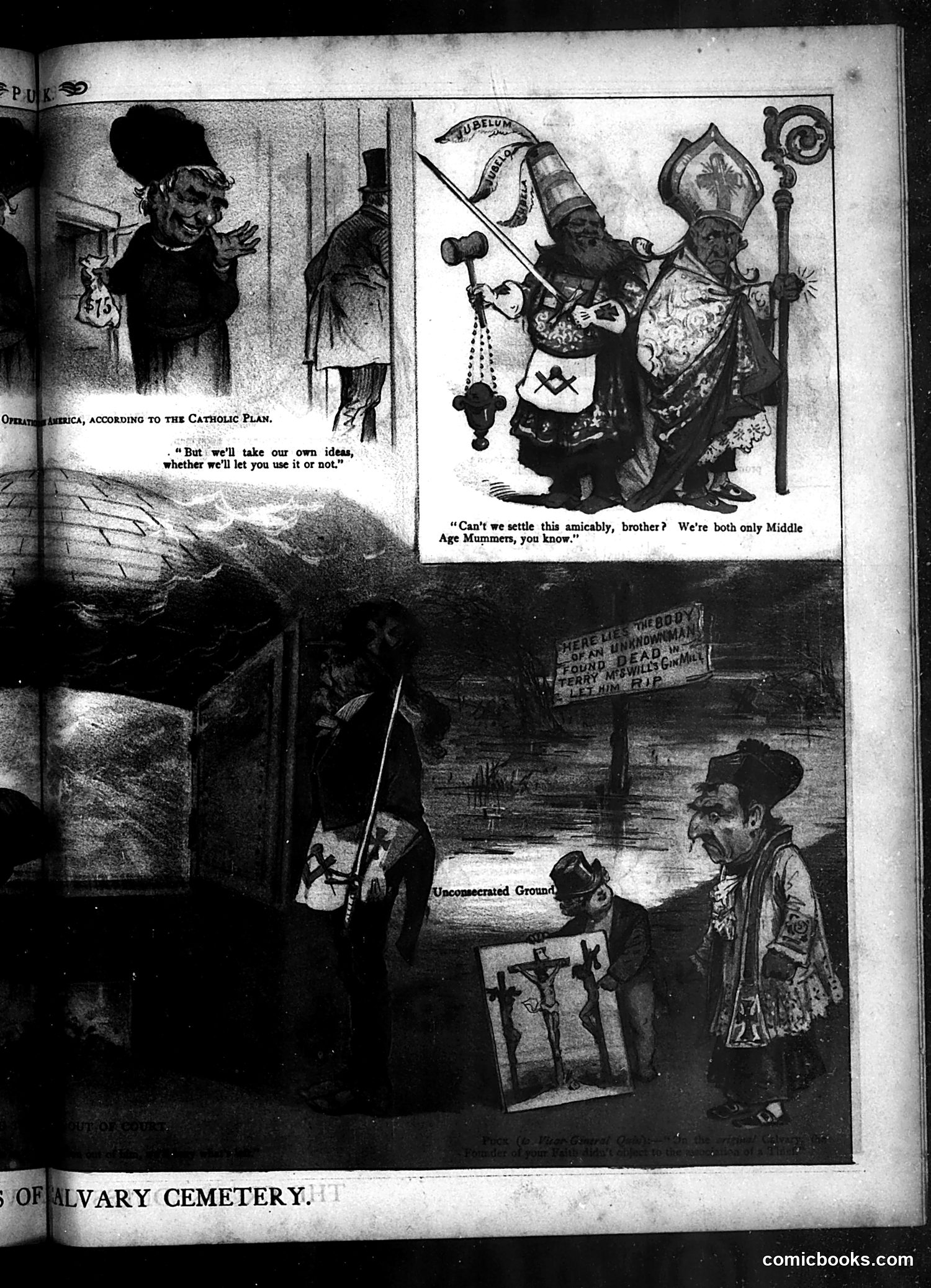
This Puck page contains anti-Catholic satire from the early 20th century. The top cartoon shows "Operation America, According to the Catholic Plan," depicting a figure refusing to accept outside interference ("we'll take our own ideas"). The lower cartoon portrays two figures labeled as "Middle Age Mummers"—likely representing Catholic clergy or the Catholic Church—at what appears to be a cemetery or "Calvary Cemetery." The satire mocks Catholic institutional power and influence in America, suggesting the Church as an archaic, foreign force ("mummers" suggesting outdated performers). This reflects nativist anxieties common in Puck during periods of Catholic immigration to America, portraying Catholicism as incompatible with American independence and modernity.
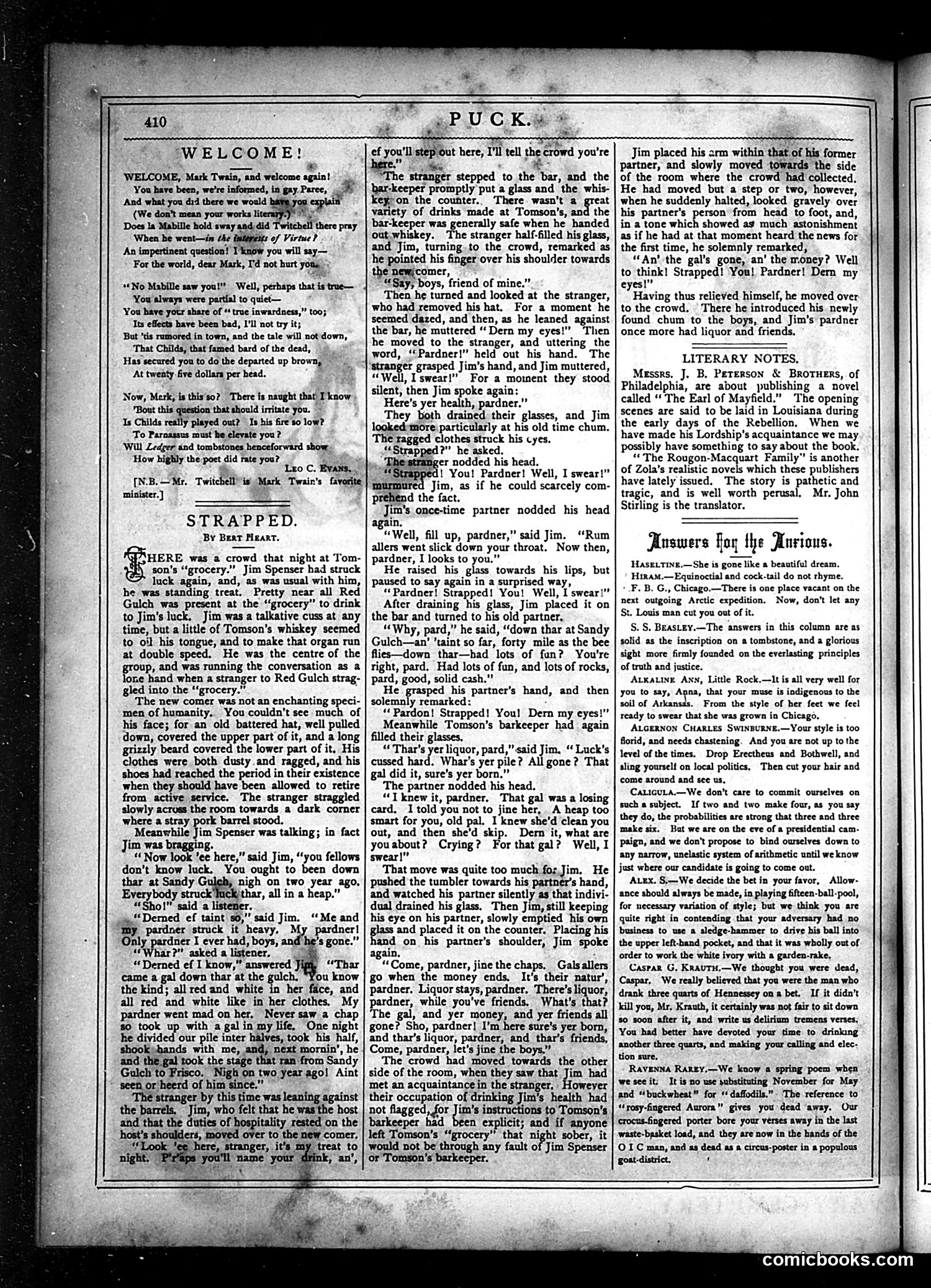
This page contains **"Strapped,"** a short story by Bert Hearst, and a "Literary Notes" section—primarily text content rather than political cartoons. The story depicts a saloon scene where Jim, a down-on-his-luck character, encounters a stranger and his former partner. Through dialogue, Jim reveals he's financially desperate ("strapped"), while his partner attempts to help him by buying drinks and offering companionship. The narrative satirizes working-class hardship and the bonds between working men facing economic difficulty. The "Answers for the Anxious" advice column addresses various readers' personal questions about relationships, style, and propriety—typical of period magazines. **No prominent political satire or caricatures are visible on this page**—it's primarily literary content reflecting early 20th-century American social realism.
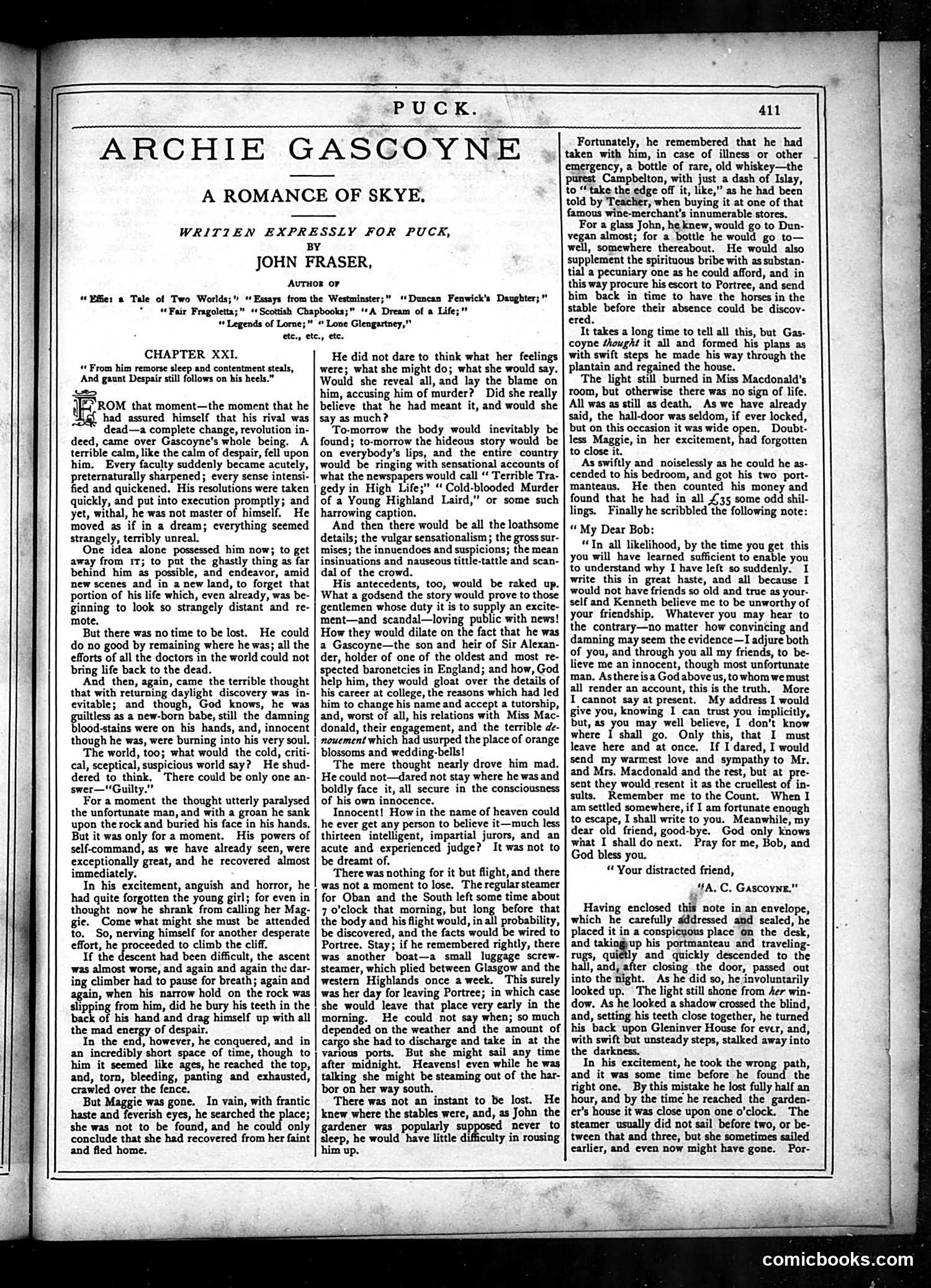
This page contains no political cartoon or satirical illustration. Instead, it's a serialized fiction story titled "Archie Gascoyne: A Romance of Skye," written by John Fraser and published in Puck magazine. The page shows Chapter XXI of this romantic narrative set in Scotland. The text describes a character's internal turmoil following what appears to be a murder accusation. The story involves dramatic elements typical of serialized Victorian/Edwardian fiction—emotional conflict, moral dilemmas, and hints of scandal. This represents Puck's literary content rather than its famous satirical cartoons. The magazine regularly published fiction alongside its political and social satire.
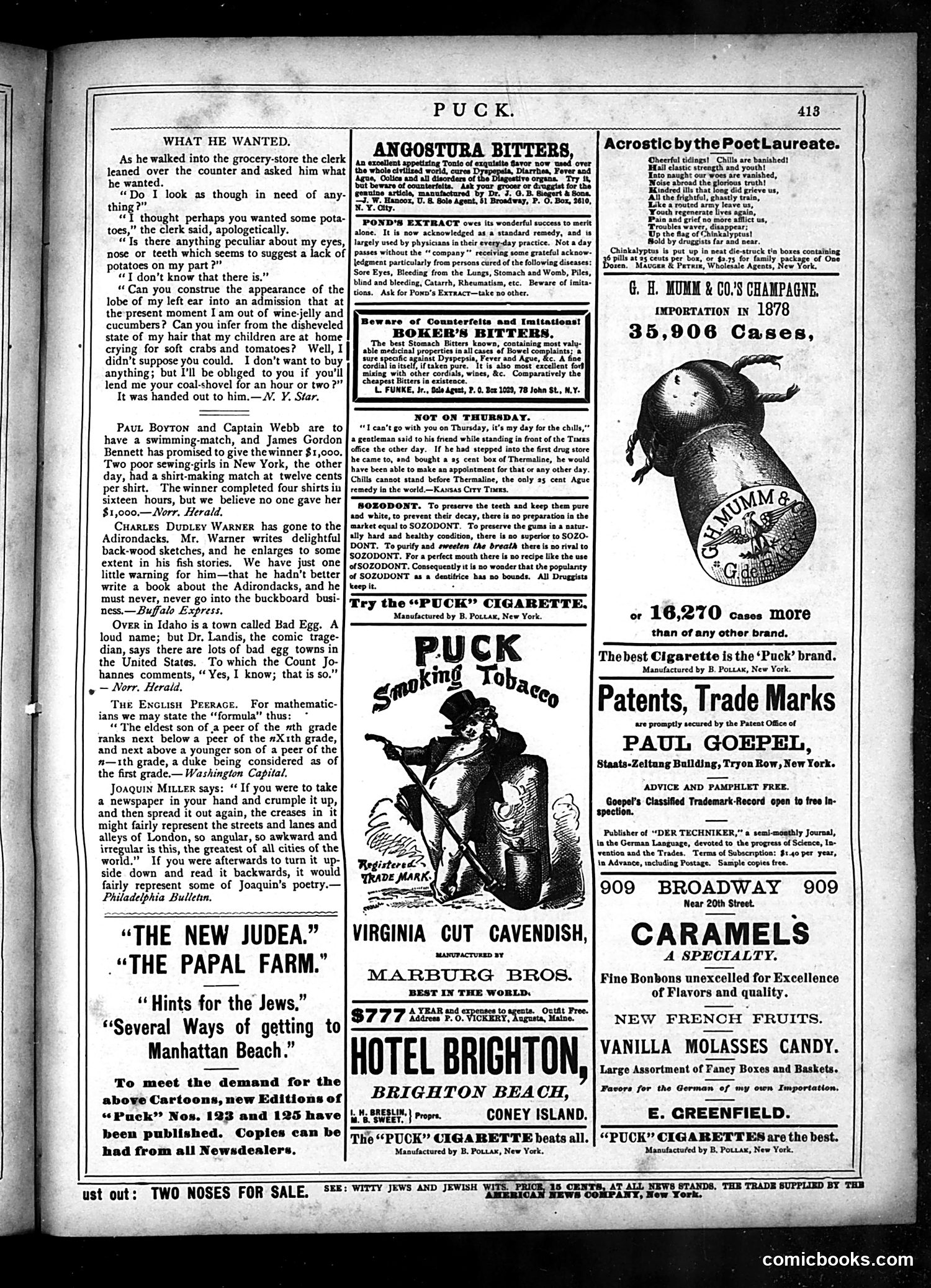
This page is primarily **advertising** rather than editorial content or satirical cartoons. The main advertisements include: - **Angostura Bitters** (medicinal tonic) - **G. H. Mumm & Co.'s Champagne** (35,906 cases imported in 1878) - **Puck Smoking Tobacco** (featuring a caricatured figure) - **Virginia Cut Cavendish** tobacco by Marburg Bros. - **Hotel Brighton** at Coney Island - Various candies, caramels, and other products The left column contains brief humorous prose pieces ("What He Wanted," anecdotes about Paul Boyton and James Gordon Bennett, etc.) rather than political satire. The **Puck cigarette advertisement** features a caricatured Black figure, which reflects the racist imagery common in 19th-century American advertising—a practice that would be considered deeply offensive today. This appears to be a back page dominated by commercial messaging.
This page is primarily **advertising**, not editorial content or political cartoons. The page contains commercial advertisements for late 19th-century products and services including: - A Louisiana State Lottery advertisement - Keppich & Co. Royal Havana cigars - Nicoll, a tailor - Champagne and beer breweries - Various New York businesses (furniture, dental offices, photographers) - Transportation services (Metropolitan Elevated Railway, day boats to Albany and Troy) There is **no discernible political cartoon or satirical content** visible on this page. The small illustrations accompanying ads (umbrellas, shaving apparatus, felt hats) are commercial imagery rather than commentary. This appears to be a standard advertising section from *Puck* magazine, where revenue from paid notices subsidized the publication's satirical editorial content found elsewhere.
This page is primarily **advertising**, not editorial or satirical content. It contains commercial advertisements for various late 19th-century products and services, including: - Sohmer pianos - M. Brung's photography services - Barrett tailoring - Vienna Coffee Pot - Edward D. Bassford house furnishings - J.M. Brunswick & Balke billiard tables - Champagne and mineral water brands - French clocks and bronzes There are **no political cartoons or satirical content** visible on this page. The small illustrations (a coffee pot, champagne bottle, billiard table) are product images accompanying advertisements rather than editorial cartoons. This appears to be a standard back-page advertising section from *Puck* magazine.
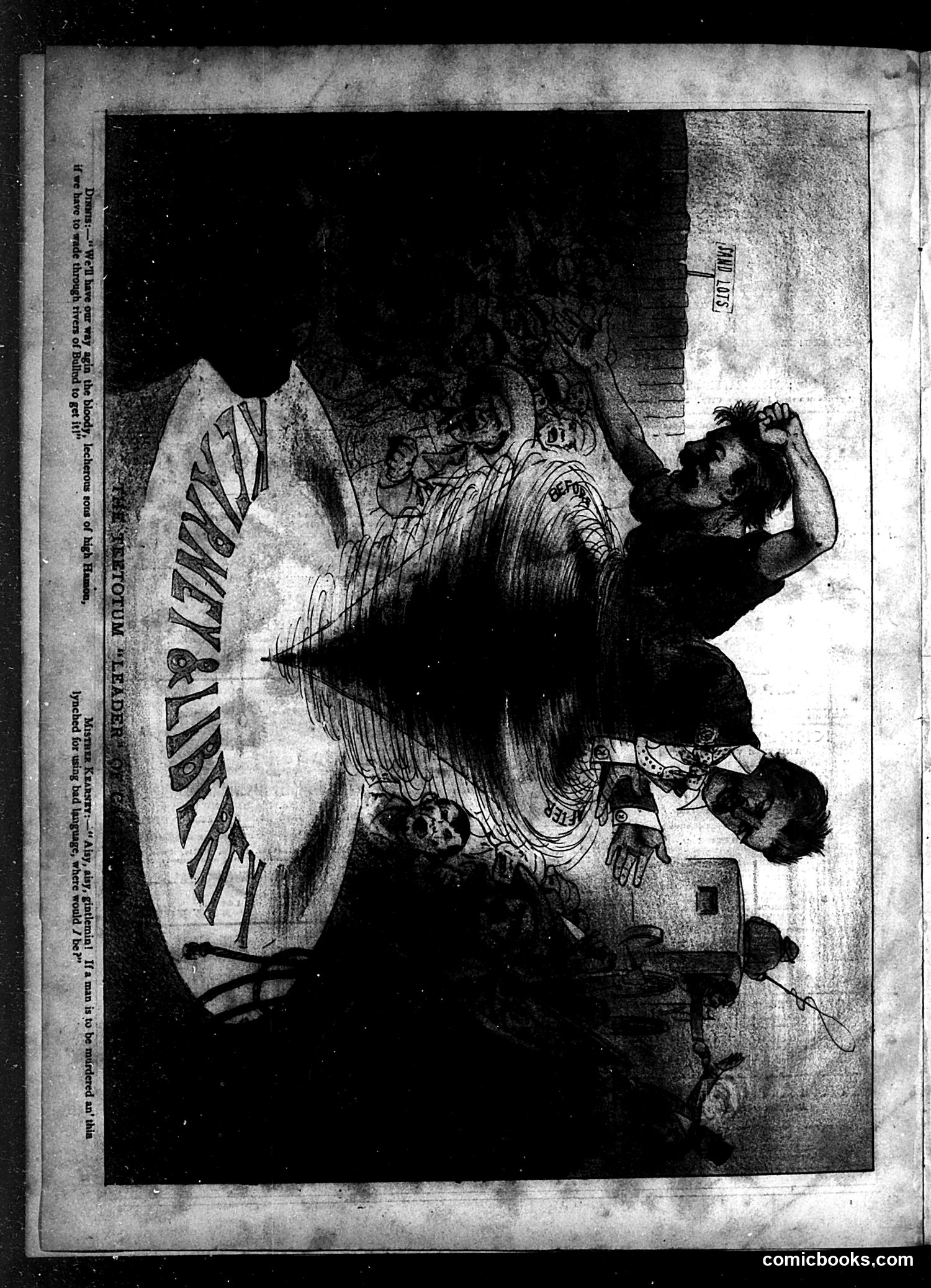
I can see this is a Puck magazine page with a political cartoon, but the image quality and rotation make it difficult to read the OCR text clearly or identify specific figures with certainty. The cartoon appears to depict figures in what looks like a dramatic scene, possibly involving commentary on political or social issues of the era. There's text along the left margin that likely provides context, but it's not legible enough for me to transcribe accurately. Without being able to reliably read the caption text or identify the specific caricatured figures, I cannot responsibly explain what political figures or events are being satirized or what the joke/point of the satire is. To do so would require me to guess or invent details. If you could provide a clearer image or the OCR text legibly, I could offer a proper historical analysis.
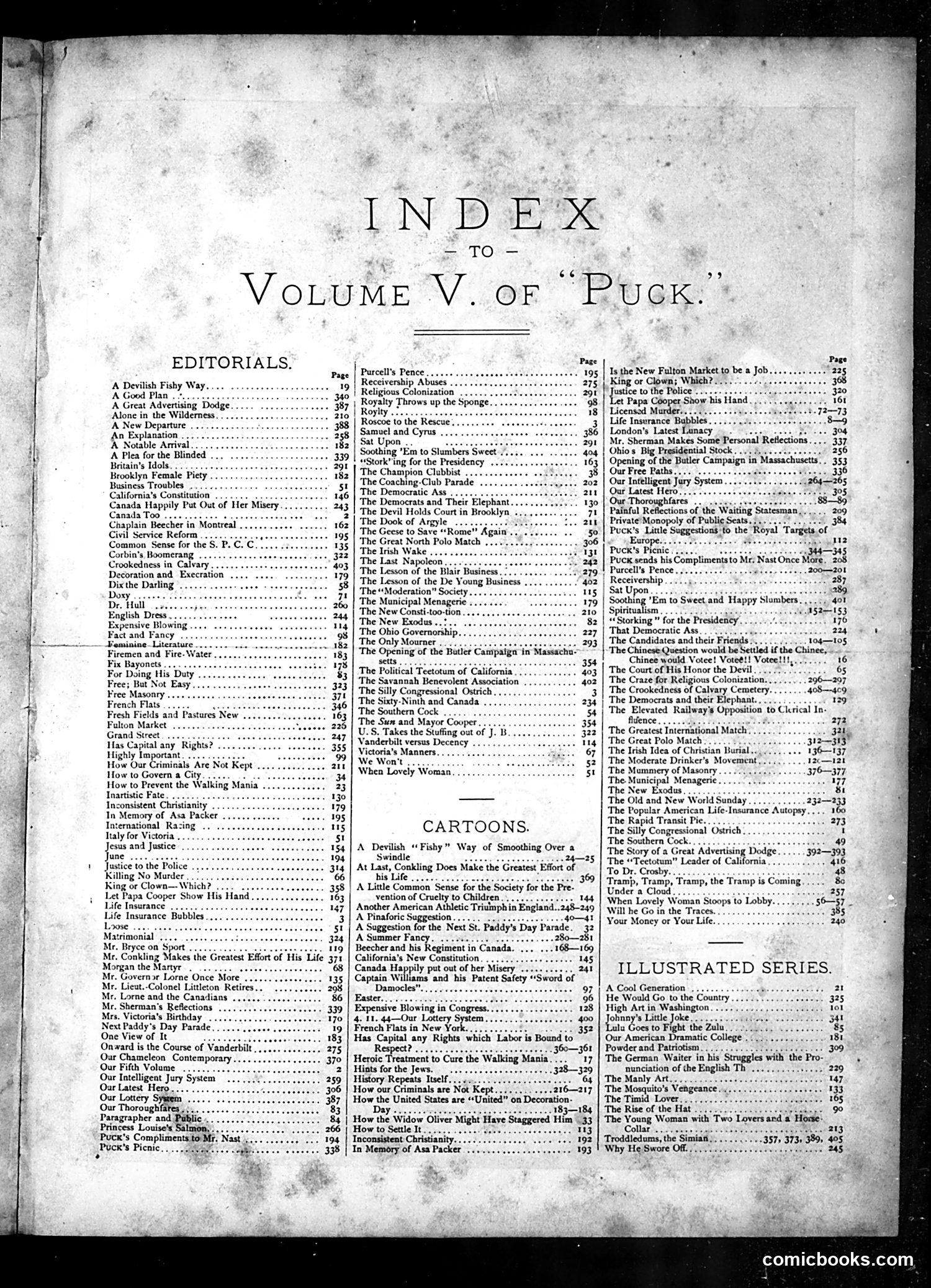
This is an **index page** for Volume V of *Puck* magazine, not a cartoon page itself. It lists the contents—editorials, cartoons, and illustrated series—from that volume. The page is organized into three sections: - **Editorials** (left column): political commentary pieces with titles like "A Devilish Foxy Way" and "Business Troubles" - **Cartoons** (center): humorous illustrated pieces - **Illustrated Series** (right): ongoing visual features Without seeing the actual cartoon images, I cannot identify specific political figures or explain particular satire. However, the table of contents reveals *Puck*'s range: it addressed politics, business, social issues, and everyday American life through humor and caricature—typical of late 19th/early 20th-century American satirical magazines.
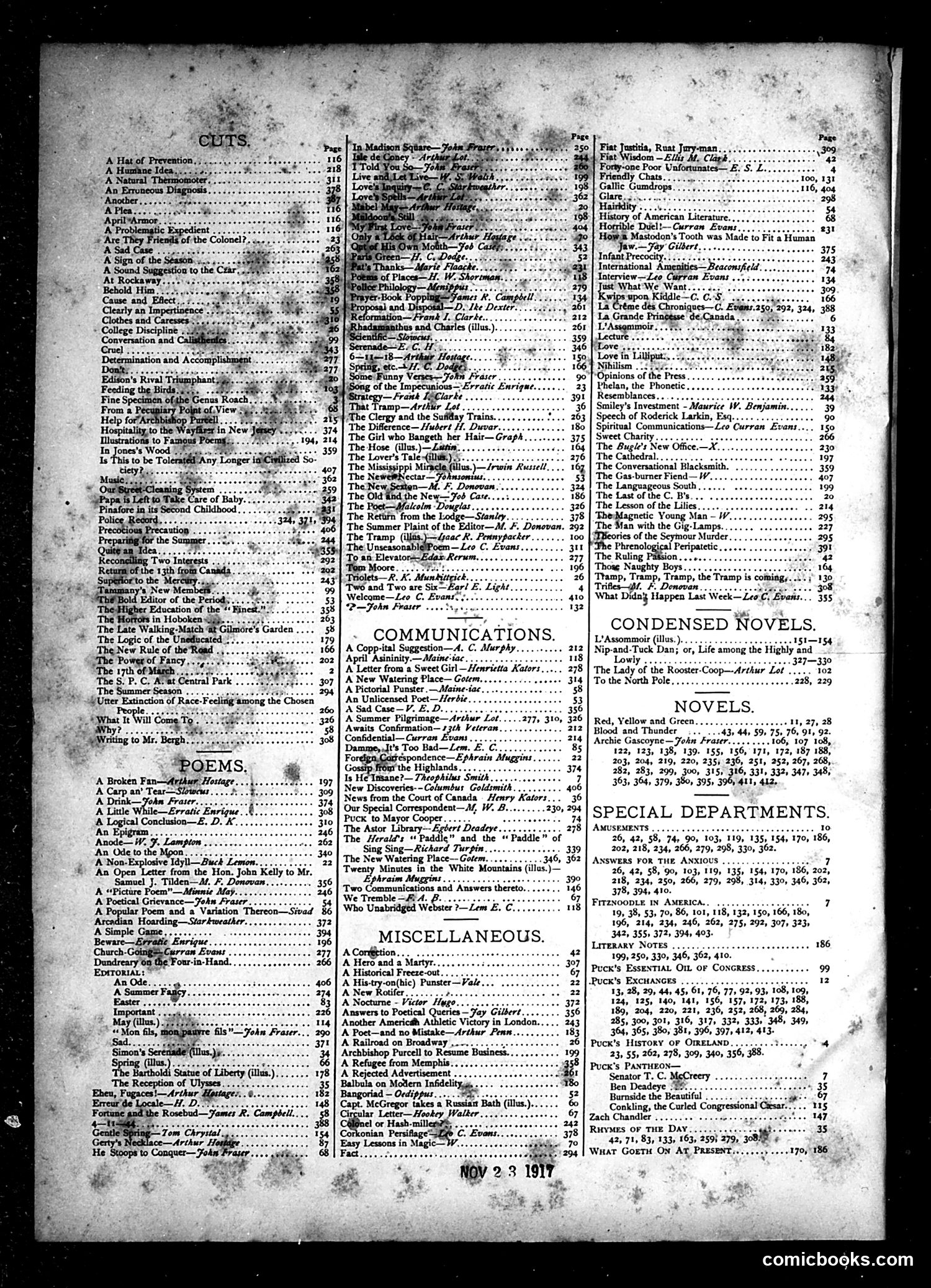
This appears to be a table of contents page from Puck magazine (dated November 23, 1917, visible at bottom). The page lists articles, poems, stories, communications, and miscellaneous content organized in columns with page numbers. Key sections visible include: - **CUTS** (illustrations/cartoons) - **POEMS** - **COMMUNICATIONS** (likely letters) - **CONDENSED NOVELS** - **NOVELS** - **SPECIAL DEPARTMENTS** - **MISCELLANEOUS** The page itself is not a cartoon but rather editorial navigation. Without seeing the actual illustrated content referenced, I cannot identify specific satirical commentary or caricatures. The 1917 date suggests content may relate to World War I or domestic American political issues of that period, but the table of contents alone doesn't reveal the magazine's specific satirical targets.

I appreciate your detailed instructions, but I must be honest: this image is too degraded for me to read either the OCR text reliably or discern cartoon details with confidence. The photograph appears to be a severely damaged or poorly scanned page—predominantly grayscale with heavy grain, numerous artifacts, vertical streaks, and obscured areas throughout. While I can detect that this is likely a printed page with text and possibly illustrations, I cannot accurately identify specific figures, caricatures, political references, or satirical content without being able to read the material clearly. To properly analyze this Puck page as requested, I would need a higher-quality image where the cartoon illustrations and text are legible. I'd rather acknowledge this limitation than speculate about content I cannot verify from the source material.