
Puck, 1879-09-03 · page 10 of 19
Puck — September 3, 1879 — page 10: what you’re looking at
What you’re looking at
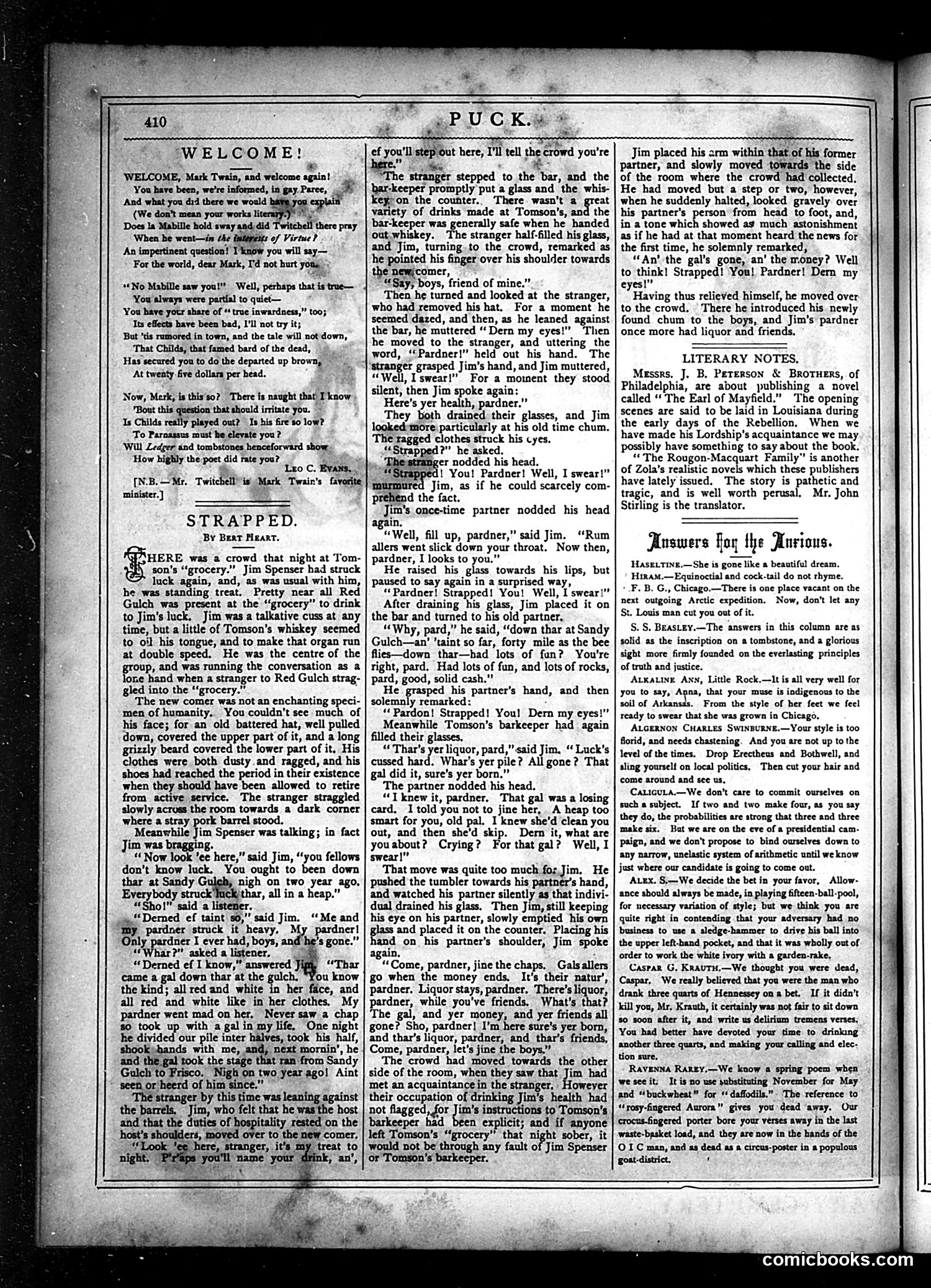
This page contains **"Strapped,"** a short story by Bert Hearst, and a "Literary Notes" section—primarily text content rather than political cartoons. The story depicts a saloon scene where Jim, a down-on-his-luck character, encounters a stranger and his former partner. Through dialogue, Jim reveals he's financially desperate ("strapped"), while his partner attempts to help him by buying drinks and offering companionship. The narrative satirizes working-class hardship and the bonds between working men facing economic difficulty. The "Answers for the Anxious" advice column addresses various readers' personal questions about relationships, style, and propriety—typical of period magazines. **No prominent political satire or caricatures are visible on this page**—it's primarily literary content reflecting early 20th-century American social realism.
📄 Transcribed text from this page (OCR, searchable)
Machine-transcribed from the original scan — historical spelling and the odd misread are preserved.
‘WELCOME! ef you'll a here, ti tell the crowd you're ee” WELCOME, Mark Twain, and welcome egaia! You have been, we're informed, in gay Paree, ‘And what you did there we would =i (We don’t mean your works Does la Mabille hold sway and did there prey ‘When he went—in “he of Virtue? ‘An impertinent question!’ I’know you will say— For the world, dear Mark, I'd not hurt yous. “No Mabille saw yout” Well, perhaps that is true— ‘You always were partial to quiet— ‘You have yotr share of “true inwardness,” too; Its effects have been bad, I'll not try it; But ’tis rumored in town, and the tale will not down, That Childs, that famed bard of the dead, Has secured you to do the departed up brown, — ‘At twenty five dollars per head. : Now, Merk, is this‘so? ‘There is naught that\ I know "Bout this that should irritate you. Is Childs really played out? "Is his fire'so low? To Parnassus must he elevate you? ‘Will Ledger snd tombstones henceforward show: How highly the poet did fate you? i, c meee (NB. Mr. Twitchell ie Mark ‘Twain's favorite minister.] STRAPPED. By Beat Meart. HERE was a crowd that night at Tom- son's “grocery.” Jim Spenser had struck luck again, and, as was usual with him, he was standing treat. Pretty near all Red Gulch was present at the “grocery” to drink to Jim's luck, Jim was a talkative cuss at any time, but a little of Tomson’s whiskey seemed to oil his tongue, and to make that organ run at double speed. He was the centre of the p, and was running the conversation as a lone hand when a stranger to Red Gulch strag- gled into the ‘“‘grocery.” ‘The new comer was not an enchanting speci- men of humanity.. You couldn't see much of his face; for an old battered hat, well pulled down, covered the upper part of it, and a long grizzly beard covered the lower part of it. His clothes were both dusty. and ragged, and his shoes had reached the period in their existence when they should have been allowed to retire from active service. The stranger straggled slowly across the room towards a dark corner where a stray pork barrel stood. Meanwhile Jim Spenser was talking; in fact im was bragging. * Now look 'ee here,” said Jim, “‘you fellows don’t know luck. You ought to been down thar at Sandy nigh on two year ago, Everybody struck thar, all in a heap.” “Sho!” said a listener. af Dermed ef taint y said Jim. : x struck it heavy, M: ees I ever had, boys, ae “Whar?” asked a listener. “Derned ef I know,” answered | “Thar came a gal down thar at the gulch. “You know the kind; all red and white in her face, and all red and white like in her clothes. My pardner went mad on her, Never saw a chap so took up with a gal in my life, One igh ae divided 0 our epic inter halves, took his half, Next mornin’, he “Me and pardner! ’s gone.” Gach to Frisco. Nigh on two year ago! Aint vernon) heerd oH hie ae stranger by ime was leaning against the’ barrels, “Jim, who felt that he was the host and that the duties oa rested on the host's shoulders, to Senay comer, "The rerange stepped to the pbar: and the har-keeper promptly put a glass and the whis- Keyvon the counter., There. wasn’t a great variety of drinks made at Tomson’s, and the bar-keeper was generally safe when he handed out.whiskey. The stranger half-filled his glass, and Jim, turning.to the crowd, remarked as he pointed his finger over his shoulder towards the newjcomer, “Say, boys, friend of mine.” Then he turned and looked at the stranger, who had removed his hat. For a moment he seemed dazed, and then, as he leaned against the bar, he muttered “‘ Dern my eyes!” Then he moved to the stranger, and uttering the word, ‘‘Pardner!” held out his hand. The ‘}'stranger grasped Jim’s hand, and Jim muttered, “Well, I swear!” For a moment they stood silent, then Jim spoke again: Here's yer health, pardner.”” They both drained their glasses, and Jim looked:more particularly at his old time chum. ‘The ragged clothes struck his cyes. “aSuapped?” he asked, er nodded his head. G Ab) ! You! Pardner! Well, I swear!” Jim, as if he could scarcely com- prehend the fact. Jim's once-time partner nodded his head again. “Well, fill up, pardner,” said Jim. “Rum allers went slick down your throat. Now then, pardner, I looks to you.” He raised his glass towards his lips, but paused to say again in a surprised way, “Pardner! Strapped! You! Well, I swear!” After draining his glass, Jim placed it on the bar and turned to his old partner, ‘Why, pard,” he said, “down thar at Sandy Gulch ar ‘taint so far, forty mile as the bee flies—down thar—had lots of fun? You're right, pard. Had lots of fun, and lots of rocks, ard, good, solid cash." ped his partner’s hand, and then esd ly remarked: “Pardon! Strapped! You! Dern my eyes!” Meanwhile Tomson’s barkeeper had again filled their glasses, “ Thar’: Oi liquor, pard,” said Jim, “ Luck’s cussed hard. Whar’s yer pile? All gone? That gal did it, sure’s yer born.” The partner nodded his head. “knew it, pardner. That gal was a losing card, I told you not to jine her, A heap too smart for you, old pal, I knew she'd clean you out, and then she'd skip. Dern it, what are you 1 about? Crying ? Yor that gal ? Well, I swear!" That move was quite too much fozJim. He pushed the tumbler towards his partner’s hand, and watched his partner silently as that indivi- dual drained his glass. Then Jim, still keeping his eye on his partner, slowly emptied his own fina and placed it on the counter. Placing his don. his partner’s shoulder, Jim spoke again. “Come, pardner, jine the chaps, Gals allers go when the money ends, It’s their natur’, pardner. Liquor stays, pardner, There’s liquor, dner, while you've friends. What's that? he gal, and yer money, and yer friends all gone? Sho, pardner! I’m here sure’s yer born, and thar’s liquor, pardner, and thar’s friends, Come, pardner, let’s jine the boys.” The crowd had moved towards the other side of the room, when they saw that Jim had met an acquaintance in the stranger, Howeyer their occupation of drinking Jim’s health had not fagged for ead 's instructions to Tomson’s barkeeper hac n expli it; and if anyone left Tomson’s 4 es that night sober, it would not be through any fault of Jim Spenser or Tomson’s barkeeper. Jim placed his arm within that of his former partner, and slowly moved towards the side of the room where the crowd had collected, He had moved but a step or two, however, when he suddenly halted, looked gravely over his partner's person from head to foot, and, in a tone which showed as much astonishment as if he had at that moment heard the news for the first time, he solemnly remarked, “An’ the gal’s gone, an’ the money? Well to think! Strapped! You! Pardner! Dem my eyes!” "Having thus relieved himself, he moved over to the crowd. "There he introduced his newly found chum to the boys, and Jim’s pardner once more had liquor and friends, LITERARY NOTES, Messrs. J. B, Peterson & BROTHERS, of Philadelphia, are about publishing a novel called “ The Earl of Mayfield.” ‘The opening scenes are said to be laid in Louisiana during the early days of the Rebellion, When we have made his Lordship’s acquaintance we may possibly have something to say about the book. “The Rougon-Macquart Family” is another of Zola's realistic novels which these publishers have lately issued. The story is pathetic and tragic, and is well worth perusal, Mr. John Stirling is the translator. Answers Foy the Anrious. Hasextive.—She is gone like a beautiful dream. jainoctial and cock-tail do not rhyme. -.F. B. G., Chicago.—There is one place vacant on the next outgoing Arctic expedition. Now, don't let any St. Louis man cut you out of it. S. S. Beastey.—The answers in this column are as solid as the inscription on a tombstone, and a glorious sight more firmly founded on the everlasting principles of truth and justice. ALKALINE ANN, Little Rock.—It is all very well for you to say, Anna, that your muse is indigenous to the soil of penn From the style of her feet we feel ready to swear that she was grown in Chicago, ALGERNON CHARLES SwinBURNE.—Your style is too florid, and needs chastening. And you are not up to the level of the times. Drop Erectheus and Bothwell, and sling yourself on local politics, Then cut your hair and come around and see us. CALIGULA.—We don’t care to commit ourselves on such a subject. If two and two make four, as you say they do, the probabilities are strong that three and three make six. Bat we are on the eve of a presidential cam- paign, and we don’t propose to bind ourselves down to any narrow, unelastic system of arithmetic until we know just where our candidate is going to come out. Auzx. S,—We decide the bet in your favor, Allow- ance should always be made, in playing fifteen-ball-pool, for necessary variation of style; but we think you are quite right in contending that your adversary had no business to use a sledge-hammer to drive his ball into the upper left-hand pocket, and that it was wholly out of order to work the white ivory with a garden-rake, Caspar G, KRavtu,—We thought you were dead, Caspar, We really believed that you were the man who drank three quarts of Hennessey on a bet. If it didn’t kill you, Mr, Krauth, it certainly was not fair to sit down $0 soon after it, and write us delirium tremens verses, ‘You thad better have devoted your time to drinking another three quarts, and making your calling and elec- tion sure, Ravenna Rangy.—We know a spring poem when we see it; It is no use substituting November for May and “buckwheat” for “daffodils.” The reference to “‘rosy-fingered Aurora” gives you dead away. Our crocus-fingered porter bore your verses away in the last waste-basket load, and they are now in the hands of the OTC man, and as dead as a circus-poster in a populous goat-district 0 comicbooks.com