
Puck, 1879-09-03 · page 3 of 19
Puck — September 3, 1879 — page 3: what you’re looking at
What you’re looking at
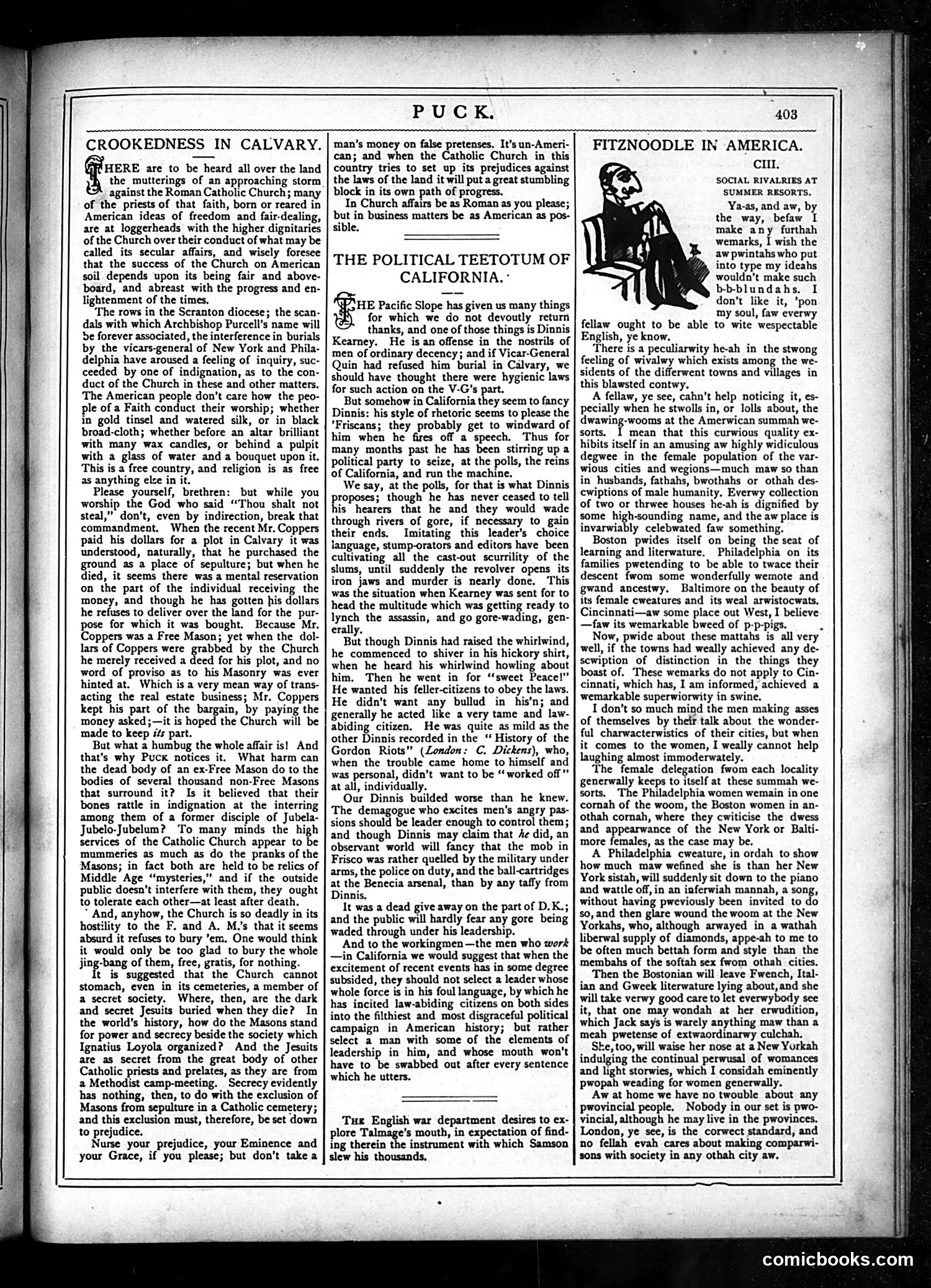
This page contains three distinct articles with satirical commentary: 1. **"Crookedness in Calvary"** attacks Catholic priests for financial malfeasance, accusing them of using religion as cover for embezzlement and fraud. It references a specific scandal involving a priest named Cropley in the Scranton diocese who allegedly misappropriated church funds. 2. **"The Political Teetotum of California"** criticizes Denis Kearney, a California political leader, for inflammatory rhetoric and mob incitement. The "teetotum" metaphor suggests his unpredictable, spinning politics. 3. **"Fitznoodle in America"** features a cartoon character commenting on American social pretensions, particularly mocking the aspirations of newly wealthy Philadelphia and New York families trying to establish themselves among high society through affected cultural pursuits. The satire targets corruption, demagoguery, and social climbing.
📄 Transcribed text from this page (OCR, searchable)
Machine-transcribed from the original scan — historical spelling and the odd misread are preserved.
———— PUCK. 403 CROOKEDNESS IN CALVARY. HERE are to be heard all over the land the mutterings of an approaching storm against the Roman Catholic Church; many of the priests of that faith, born or reared in American ideas of freedom and fair-dealing, are at loggerheads with the higher dignitaries of the Church over their conduct of what may be called its secular affairs, and wisely foresee that the success of the Church on American soil depends upon its being fair and above- board, and abreast with the progress and en- lightenment of the times, ‘The rows in the Scranton diocese; the scan- dals with which Archbishop Purcell’s name will de forever associated, the interference in burials by the vicars-general of New York and Phila- delphia have aroused a feeling of inquiry, suc- ceeded by one of indignation, as to the con- duct of the Church in these and other matters. The American people don’t care how the peo- ple of a Faith conduct their worship; whether in gold tinsel and watered silk, or in black broad-cloth; whether before an altar brilliant with many wax candles, or behind a pulpit with a glass of water and a bouquet upon it. This is a free country, and religion is as free as anything elze in it. Please yourself, brethren: but while you worship the God who said “Thou shalt not steal,” don't, even by indirection, break that commandment. When the recent Mr. Coppers paid his dollars for a plot in Calvary it was understood, naturally, that he purchased the ground as a place of sepulture; but when he died, it seems there was a mental reservation on the part of the individual receiving the money, and though he has gotten his dollars he refuses to deliver over the land for the pur- pose for which it was bought. Because Mr. Coppers was a Free Mason; yet when the dol- lars of Coppers were grabbed by the Church he merely received a deed for his plot, and no word of proviso as to his Masonry was ever hinted at. Which is a very mean way of trans- acting the real estate business; Mr. Coppers kept his part of the bargain, by paying the money asked ;—it is hoped the Church will be made to keep #és part. But what a humbug the whole affair is! And that’s why Puck notices it. What harm can the dead body of an ex-Free Mason do to the bodies of several thousand non-Free Masons that surround it? Is it believed that their bones rattle in indignation at the interring among them of a former disciple of Jubela- Jubelo-Jubelum? To many minds the high services of the Catholic Church appear to be mummeries as much as do the pranks of the Masons; in fact both are held to be relics of Middle Age “mysteries,” and if the outside public doesn’t interfere with them, they ought to tolerate each other—at least after death. * And, anyhow, the Church is so deadly in its hostility to the F. and A. M.’s that it seems absurd it refuses to bury ‘em. One would think it would only be too glad to bury the whole jing bang of them, free, gratis, for nothing. it is suggested that the Church cannot stomach, even in its cemeteries, a member of a secret society. Where, then, are the dark and secret Jesuits buried when they die? In the world’s history, how do the Masons stand for power and secrecy beside the society which Ignatius Loyola organized? And the Jesuits are as secret from the great body of other Catholic priests and prelates, as they are from a Methodist camp-meeting. Secrecy evidently has nothing, then, to do with the exclusion of Masons from sepulture in a Catholic cemetery; and this exclusion must, therefore, be set down to prejudice. Nurse your prejudice, your Eminence and your Grace, if you please; but don’t take a man’s money on false pretenses. It’s un-Ameri- can; and when the Catholic Church in this country tries to set up its prejudices against the laws of the land it will put a great stumbling block in its own path of progress. In Church affairs be as Roman as you please; but in business matters be as American as pos- sible, THE POLITICAL TEETOTUM OF CALIFORNIA. : 'HE Pacific Slope has given us many things for which we do not devoutly return thanks, and one of those things is Dinnis Kearney. He is an offense in the nostrils of men of ordinary decency; and if Vicar-General Quin had refused him burial in Calvary, we should have thought there were hygienic laws for such action on the V-G's part. But somehow in California they seem to fancy Dinnis: his style of rhetoric seems to please the "Friscans; they probably get to windward of him when he fires off a speech. Thus for many months past he has been stirring up a political party to seize, at the polls, the reins of California, and run the machine. We say, at the polls, for that is what Dinnis proposes; though he has never ceased to tell his hearers that he and they would wade through rivers of gore, if necessary to gain their ends. Imitating this leader's choice language, stump-orators and editors have been cultivating all the cast-out scurrility of the slums, until suddenly the revolver opens its iron jaws and murder is nearly done. This was the situation when Kearney was sent for to head the multitude which was getting ready to lynch the assassin, and go gore-wading, gen- erally. But though Dinnis had raised the whirlwind, he commenced to shiver in his hickory shirt, when he heard his whirlwind howling about him. Then he went in for ‘sweet Peace!” He wanted his feller-citizens to obey the laws. He didn’t want any bullud in his’n; and generally he acted like a very tame and law- abiding citizen. He was quite as mild as the other Dinnis recorded in the ‘ History of the Gordon Riots” (London: C, Dickens), who, when the trouble came home to himself and was personal, didn’t want to be “worked off” at all, individually. Our Dinnis builded worse than he knew. The demagogue who excites men's angry pas- sions should be leader. enough to control them; and though Dinnis may claim that Ae did, an observant world will fancy that the mob in Frisco was rather quelled by the military under arms, the police on duty, and the ball-cartridges at the Benecia arsenal, than by any taffy from Dinnis. It was a dead give away on the part of D.K.; and the public will hardly fear any gore being waded through under his leadership. And to the workingmen—the men who work —in California we would suggest that when the excitement of recent events has in some degree subsided, they should not select a leader whose whole force is in his foul language, by which he has incited law-abiding citizens on both sides into the filthiest and most disgraceful political campaign in American history; but rather select a man with some of the elements of leadership in him, and whose mouth won't have to be swabbed out after every sentence which he utters. Tue English war department desires to ex- plore Talmage’s mouth, in expectation of find- ing therein the instrument with which Samson slew his thousands, FITZNOODLE IN AMERICA. Cll. SOCIAL RIVALRIES AT SUMMER RESORTS. Ya-as, and aw, by the way, befaw I make any furthah wemarks, I wish the aw pwintahs who put into type my ideahs wouldn’t make such b-b-blundahs, I don't like it, ‘pon my soul, faw everwy fellaw ought to be able to wite wespectable English, ye know. There is a peculiarwity he-ah in the stwong feeling of wivalwy which exists among the we- sidents of the differwent towns and villages in this blawsted contwy. A fellaw, ye see, cahn’t help noticing it, es- pecially when he stwolls in, or lolls about, the dwawing-wooms at the Amerwican summah we- sorts. I mean that this curwious quality ex- hibits itself in an amusing aw highly widiculous degwee in the female population of the var- wious cities and wegions—much maw so than in husbands, fathahs, bwothahs or othah des- ewiptions of male humanity. Everwy collection of two or thrwee houses he-ah is dignified by some high-sounding name, and the aw place is invarwiably celebwated faw something. Boston pwides itself on being the seat of learning and literwature. Philadelphia on its families pwetending to be able to twace their descent fwom some wonderfully wemote and gwand ancestwy, Baltimore on the beauty of its female cweatures and its weal arwistocwats, Cincinnati—aw some place out West, I believe —faw its wemarkable bweed of p-p-pigs. i Now, pwide about these mattahs is all very well, if the towns had weally achieved any de- scwiption of distinction in the things they boast of. These wemarks do not apply to Cin- cinnati, which has, I am informed, achieved a wemarkable superwiorwity in swine. I don’t so much mind the men making asses of themselves by their talk about the wonder- ful charwacterwistics of their cities, but when it comes to the women, I weally cannot help laughing almost immoderwately. The female delegation fwom each locality generwally keeps to itself at these summah we- sorts. The Philadelphia women wemain in one cornah of the woom, the Boston women in an- othah cornah, where they cwiticise the dwess and appearwance of the New York or Balti- more females, as the case may be. A Philadelphia cweature, in ordah to show how much maw wefined she is than her New York sistah, will suddenly sit down to the piano and wattle off, in an inferwiah mannah, a song, without having pweviously been invited to do so, and then glare wound the woom at the New Yorkahs, who, although arwayed in a wathah liberwal supply of diamonds, appe-ah to me to be often much bettah form and style than the membahs of the softah sex fwom othah cities. Then the Bostonian will leave Fwench, Ital- ian and Gweek literwature lying about, and she will take verwy good care to let everwybody see it, that one may wondah at her erwudition, which Jack says is warely anything maw than a meah pwetense of extwaordinarwy culchah, Ske, too, will waise her nose at a New Yorkah indulging the continual perwusal of womances and light storwies, which I considah eminently pwopah weading for women generwally. Aw at home we have no twouble about any pwovincial people. Nobody in our set is pwo- vincial, although he may live in the pwovinces. London, ye see, is the corwect standard, and no fellah evah cares about making comparwi- sons with society in any othah city aw. comicbooks.com