
Puck, 1879-09-03 · page 11 of 19
Puck — September 3, 1879 — page 11: what you’re looking at
What you’re looking at
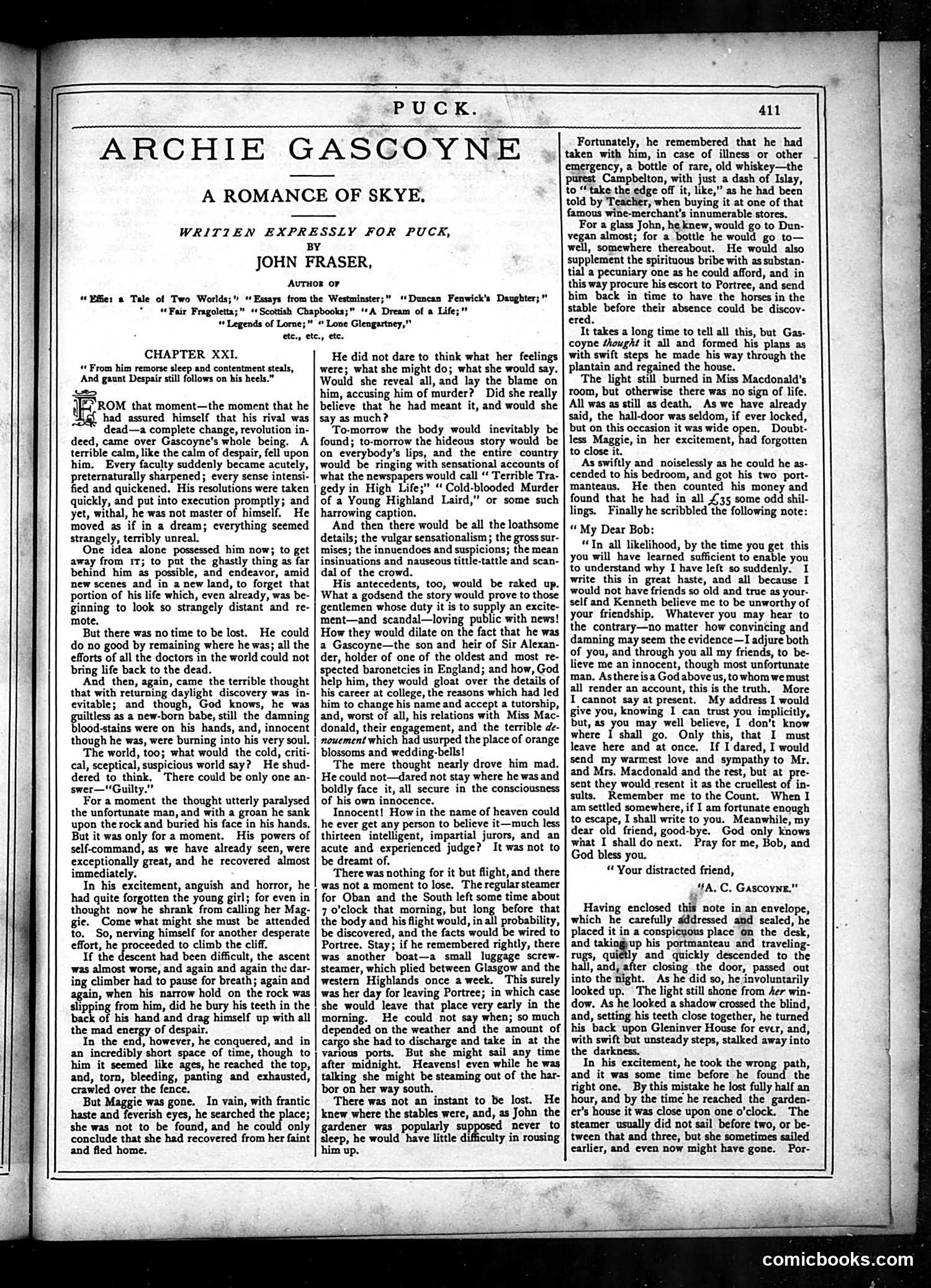
This page contains no political cartoon or satirical illustration. Instead, it's a serialized fiction story titled "Archie Gascoyne: A Romance of Skye," written by John Fraser and published in Puck magazine. The page shows Chapter XXI of this romantic narrative set in Scotland. The text describes a character's internal turmoil following what appears to be a murder accusation. The story involves dramatic elements typical of serialized Victorian/Edwardian fiction—emotional conflict, moral dilemmas, and hints of scandal. This represents Puck's literary content rather than its famous satirical cartoons. The magazine regularly published fiction alongside its political and social satire.
📄 Transcribed text from this page (OCR, searchable)
Machine-transcribed from the original scan — historical spelling and the odd misread are preserved.
PUCK. ARCHIE GASGOYNE A ROMANCE OF SKYE, WRITTEN EXPRESSLY FOR PUCK, BY JOHN FRASER, AuTHOR oF “Effie: a Tale of Two Worlds; «Essays from the Westminster;” ‘‘Duncan Fenwick's Daughter;” “Fair Fragoletta;” ‘Scottish Chapbooks;” ‘A Dream of a Life;" «Legends of Lome; « Lone Glengartney,”” ete., ete., ete. CHAPTER XXI. «From him remorse sleep and contentment steals, And gaunt Despair still follows on his heels.” =) q ROM that moment—the moment that he had assured himself that his rival was dead—a complete change, revolution in- deed, came over Gascoyne’s whole being. A terrible calm, like the calm of despair, fell upon him. Every faculty suddenly became acutely, preternaturally sharpened; every sense intensi- fied and quickened. His resolutions were taken quickly, and put into execution promptly and yet, withal, he was not master of himself. He moved as if in a dream; everything seemed strangely, terribly unreal. One idea alone possessed him now; to get away from IT; to put the ghastly thing as far behind him as possible, and endeavor, amid new scenes and in a new land, to forget that portion of his life which, even already, was be- ginning to look so strangely distant and re- mote. But there was no time to be lost. He could do no good by remaining where he was; all the efforts of all the doctors in the world could not bring life back to the dead. And then, again, came the terrible thought that with returning daylight discovery was in- evitable; and though, God knows, he was guiltless as a new-born babe, still the damning blood-stains were on his hands, and, innocent though he was, were burning into his very soul. The world, too; what would the cold, criti- cal, sceptical, suspicious world say? He shud- dered to think. There could be only one an- swer—“Guilty.” For a moment the thought utterly paralysed the unfortunate man, and with a groan he sank upon the rock and buried his face in his hands. But it was only fora moment. His powers of self-command, as we have already seen, were exceptionally great, and he recovered almost immediately. In his excitement, anguish and horror, he had quite forgotten the young girl; for even in thought now he shrank from calling her Mag- gie. Come what might she must be attended to. So, nerving himself for another desperate effort, he proceeded to climb the cliff. If the descent had been difficult, the ascent was almost worse, and again and again the dar- ing climber had to pause for breath; again and again, when his narrow hold on the rock was slipping from him, did he bury his teeth in the back of his hand and drag himself up with all the mad energy of despair. In the end, however, he conquered, and in an incredibly short space of time, though to him it seemed like ages, he reached the top, and, torn, bleeding, panting and exhausted, crawled over the fence. But Maggie was gone. In vain, with frantic haste and feverish eyes, he searched the paces she was not to be found, and he could only conclude that she had recovered from her faint and fled home. He did not dare to think what her feelings were; what she might do; what she would say. Would she reveal all, and lay the blame on him, accusing him of murder? Did she really believe that he had meant it, and would she say as much? To-morrow the body would inevitably be found; to-morrow the hideous story would be on everybody’s lips, and the entire country would be ringing with sensational accounts of what the newspapers would call “ Terrible Tra- gedy in High Life;” ‘ Cold-blooded Murder of a Young Highland Laird,” or some such harrowing caption. And then there would be all the loathsome details; the vulgar sensationalism ; the gross sur- mises; the innuendoes and suspicions; the mean insinuations and nauseous tittle-tattle and scan- dal of the crowd. His antecedents, too, would be raked up. What a godsend the story would prove to those gentlemen whose duty it is to supply an excite- ment—and scandal—loving public with news! How they would dilate on the fact that he was a Gascoyne—the son and heir of Sir Alexan- der, holder of one of the oldest and most re- spected baronetcies in England; and how, God help him, they would gloat over the details of his career at college, the reasons which had led him to change his name and accept a tutorship, and, worst of all, his relations with Miss Mac- donald, their engagement, and the terrible de- nouement which had usurped the place of orange blossoms and wedding-bells! The mere thought nearly drove him mad. He could not—dared not stay where he was and boldly face it, all secure in the consciousness of his own innocence. Innocent! How in the name of heaven could he ever get any person to believe it—much less thirteen intelligent, impartial jurors, and an acute and experienced judge? It was not to be dreamt of. There was nothing for it but flight, and there was not a moment to lose. The regular steamer for Oban and the South left some time about 7 o'clock that morning, but long before that the body and his flight would, in all probability, be discovered, and the facts would be wired to Portree. Stay; if he remembered rightly, there was another boat—a small luggage screw- steamer, which plied between Glasgow and the western Highlands once aweek. This surely was her day for leaving Portree; in which case she would leave that place very early in the morning. He could not say when; so much depended on the weather and the amount of ‘o she had to discharge and take in at the various ports, But she might sail any time after midnight. Heavens! even while he was talking she might be steaming out of the har- bor on her way south. ‘There was not an instant to be lost. He knew where the stables were, and, as John the gardener was popularly sup) ‘ever to sleep, he would have little difficulty in rousing him up. Fortunately, he remembered that he had taken with him, in case of illness or other emergency, a bottle of rare, old whiskey—the purest Campbelton, with just a dash of Islay, to ‘take the edge off it, like,” as he had been told by Teacher, when buying it at one of that famous wine-merchant’s innumerable stores. For a glass John, he knew, would go to Dun- vegan almost; for a bottle he would go to— well, somewhere thereabout. He would also supplement the spirituous bribe with as substan- tial a pecuniary one as he could afford, and in this way procure his escort to Portree, and send him back in time to have the horses in the stable before their absence could be discov- ered. It takes a long time to tell all this, but Gas- coyne ¢hought it all and formed his plans as with swift steps he made his way through the plantain and regained the house. The light still burned in Miss Macdonald’s room, but otherwise there was no sign of life. All was as still as death, As we have already said, the hall-door was seldom, if ever locked, but on this occasion it was wide open. Doubt- less Maggie, in her excitement, had forgotten to close it, As swiftly and noiselessly as he could he as- cended to his bedroom, and got his two port- manteaus. He then counted his money and found that he had in all £35 some odd shil- lings. Finally he scribbled the following note: “My Dear Bob: “In all likelihood, by the time you get this you will have learned sufficient to enable you to understand why I have left so suddenly. I write this in great haste, and all because I would not have friends so old and true as your- self and Kenneth believe me to be unworthy of your friendship. Whatever you may hear to the contrary—no matter how convincing and damning may seem the evidence—I adjure both of you, and through you all my friends, to be- lieve me an innocent, though most unfortunate man. Asthereisa God above us, to whom we must all render an account, this is the truth. More I cannot say at present. My address I would give you, knowing I can trust you implicitly, but, as you may well believe, I don’t know where I shall go. Only this, that I must leave here and at once. If I dared, I would send my warmest love and sympathy to Mr. and Mrs. Macdonald and the rest, but at pre- sent they would resent it as the cruellest of in- sults, Remember me to the Count. When I am settled somewhere, if I am fortunate enough to escape, I shall write to you. Meanwhile, my dear old friend, good-bye. God only knows what I shall do next. Pray for me, Bob, and God bless you. “ Your distracted friend, _ fA. C. Gascoyne.” Having enclosed this note in an envelope, which he carefully dddressed and sealed, he placed it in a conspicuous place on the desk, and takingup his portmanteau and traveling: rugs, quit and quickly descended to the hall, and, after closing the door, passed out into the night. As he did so, he involuntarily looked up. The light still shone from Aer win- dow. As he looked a shadow crossed the blind, and, setting his teeth close together, he turned his back upon Gleninver House for ever, and, with swift but unsteady steps, stalked away into the darkness. In his excitement, he took the wrong path, and it was some time before he found the right one. By this mistake he lost fully half an hour, and by the time he reached the garden- er’s house it was close upon one o'clock. The steamer usually did not sail before two, or be- tween that and three, but she sometimes sailed earlier, and even now might have gone. Por- comicbooks.com