
A complete issue · 16 pages · 1879
Puck — August 27, 1879
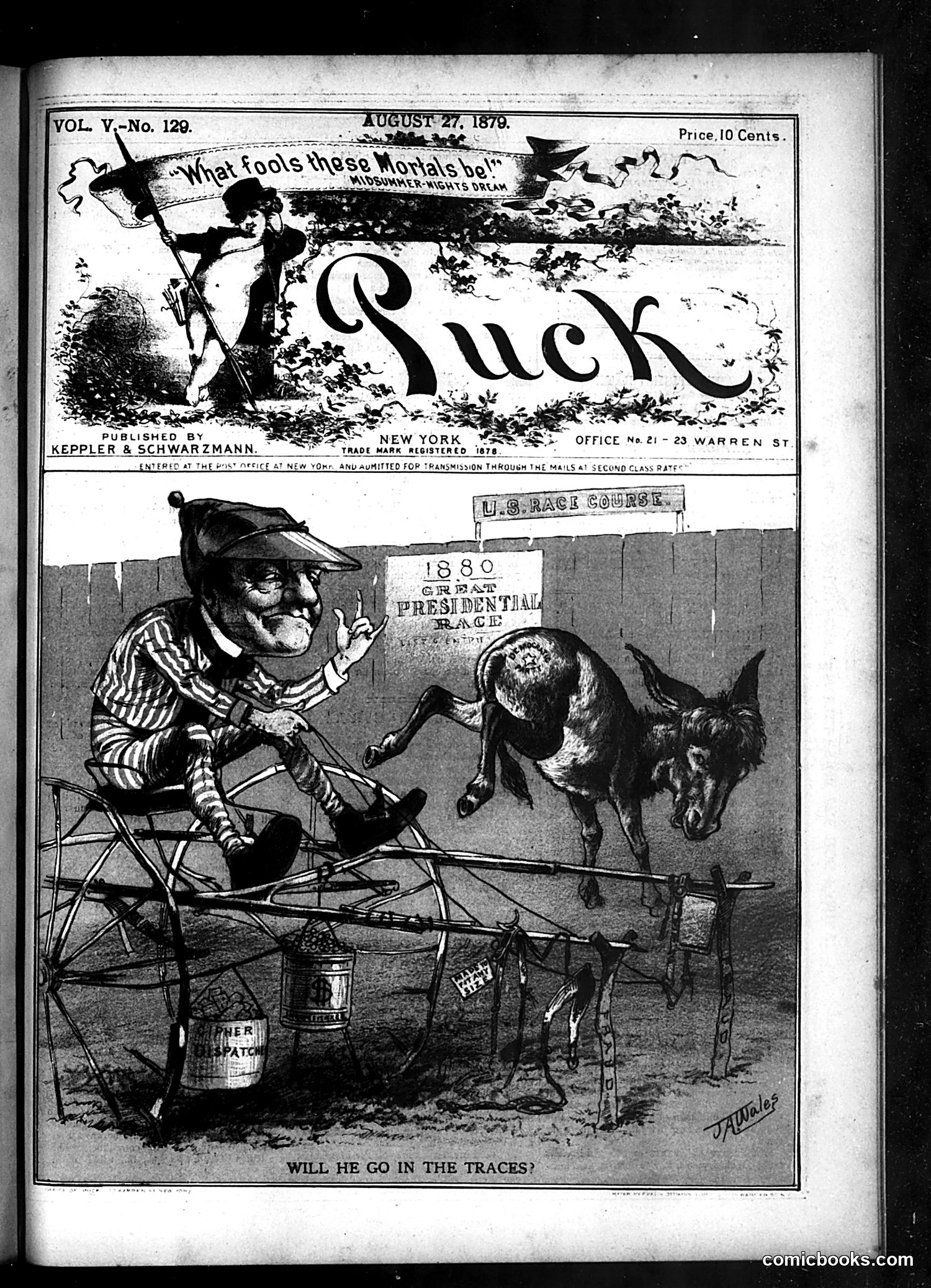
This cartoon satirizes the 1880 U.S. presidential race. A figure in a jester's outfit (representing a political fool or charlatan) sits in a cart being pulled by a reluctant donkey. The cart is labeled "1880 GREAT PRESIDENTIAL RACE," with "U.S. STAGE COACH" marked above. The caption asks: "WILL HE GO IN THE TRACES?"—a pun on horse-racing terminology, questioning whether this candidate will actually participate in the race or prove capable. The jester character appears to represent a weak or unsuitable presidential contender. The donkey's resistance symbolizes public skepticism about this candidate's viability. The satire mocks both the candidate's fitness for office and the broader spectacle of presidential politics.
This page is primarily **text-based editorial content** rather than visual cartoons. The main article discusses **Minister John Welsh's return to Philadelphia**, celebrating his prominence and the public reception. The second major piece, "**Samuel and Cyrus**," appears to satirize a **breach between two prominent men** — likely involving railroad stocks and political ambitions. The satire criticizes their dispute as petty and warns against private quarrels damaging public interests. References to "Presidential election" and "Elevated Road" suggest contemporary political/commercial rivalries. The scattered brief commentary items mock various public figures and situations with typical Puck wit, though without accompanying illustrations, their specific targets remain unclear. The page functions primarily as **opinion journalism** rather than comic satire.
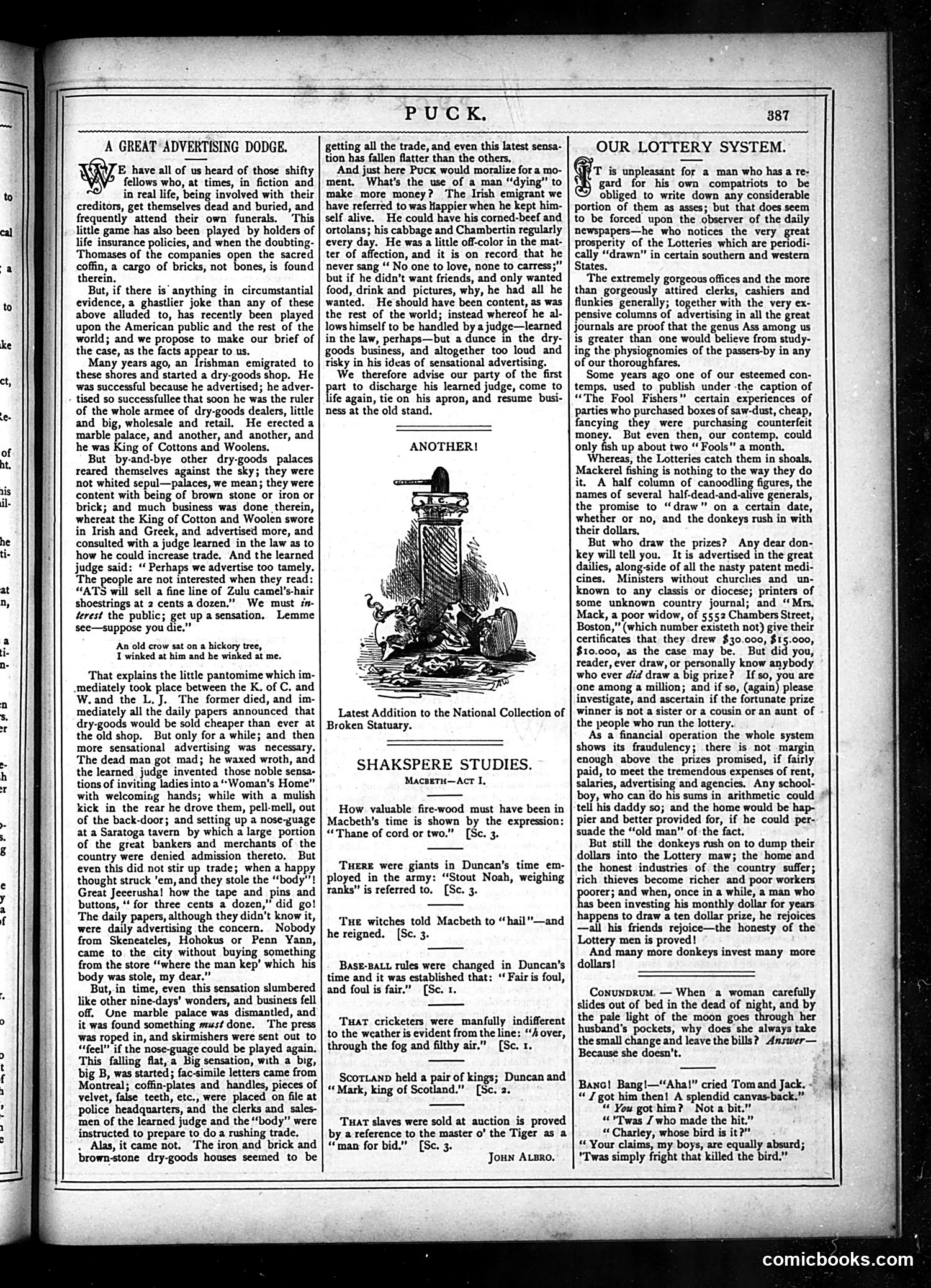
This page contains **three distinct satirical articles** rather than a single cartoon: 1. **"A Great Advertising Dodge"** mocks the dead-man-walking scheme where deceased debtors were publicly advertised as "alive" to collect payments—a scam exploiting creditors' gullibility. 2. **"Our Lottery System"** criticizes newspaper lotteries as fraudulent schemes. The accompanying engraving shows a lottery wheel. The satire exposes how newspapers advertise impossible odds and non-existent prizes while enriching themselves through advertising revenue. 3. **"Shakspere Studies"** provides obscure textual analysis of Macbeth and other Shakespeare plays—likely parodying overly pedantic literary scholarship. The page exemplifies Puck's blend of **social critique and humor**, targeting fraud, gullibility, and pretension in American life.
This page contains several satirical pieces rather than a single cartoon. "A New Departure" mocks proposed reforms to the Police Department, suggesting a "Bureau for the Deaf and Dumb and the Insane to be Cured" as sarcastic commentary on police incompetence. The author argues the police themselves need mental rehabilitation before reforming criminals. "La Creme des Chroniques" presents humorous dialogue snippets mocking various social types—a census-taker, a wife managing household finances, and a nobleman seeking employment. The pieces ridicule pretension and economic anxiety among the middle and upper classes. The right column discusses Irish immigration to America and their political integration, presenting factual commentary rather than satire. The overall page blends social criticism with humor targeting bureaucratic inefficiency and class pretension.
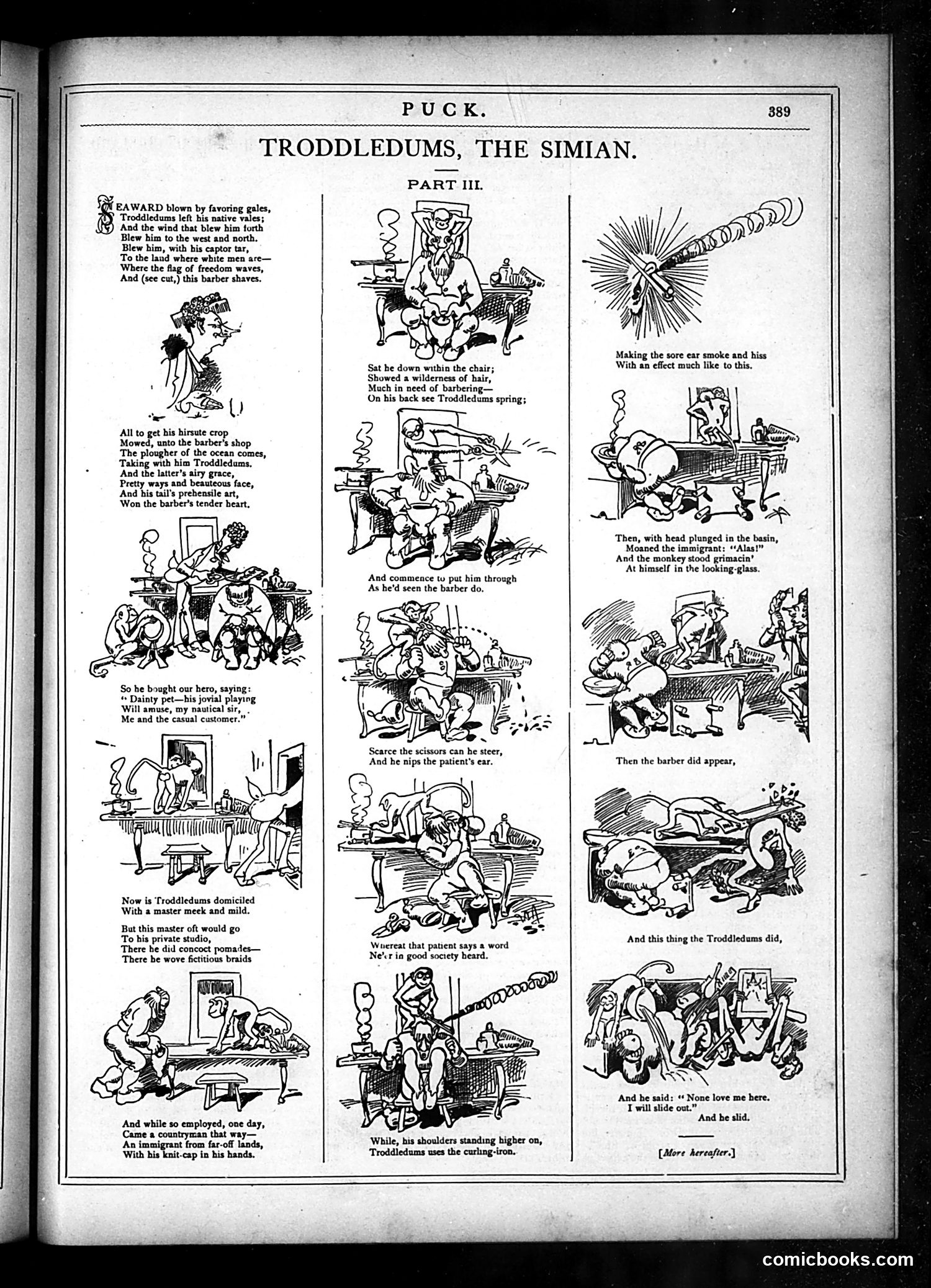
This is a serialized satirical poem with accompanying illustrations mocking a character named Troddledums through animal comparisons and absurd scenarios. The narrative follows Troddledums—depicted as simian (ape-like)—through various humiliating situations: being hired as a barber despite incompetence, botching haircuts, nipping patients' ears with scissors, and generally causing chaos. The satire appears to ridicule someone's incompetence and pretension to respectability. The "Simian" subtitle suggests the target is being portrayed as primitive or brutish despite attempts at civilized employment. Without additional context identifying the specific historical figure, the cartoon likely targets a contemporary public figure whose incompetence or unsuitable behavior made them a mockery—common Puck magazine practice of the era.
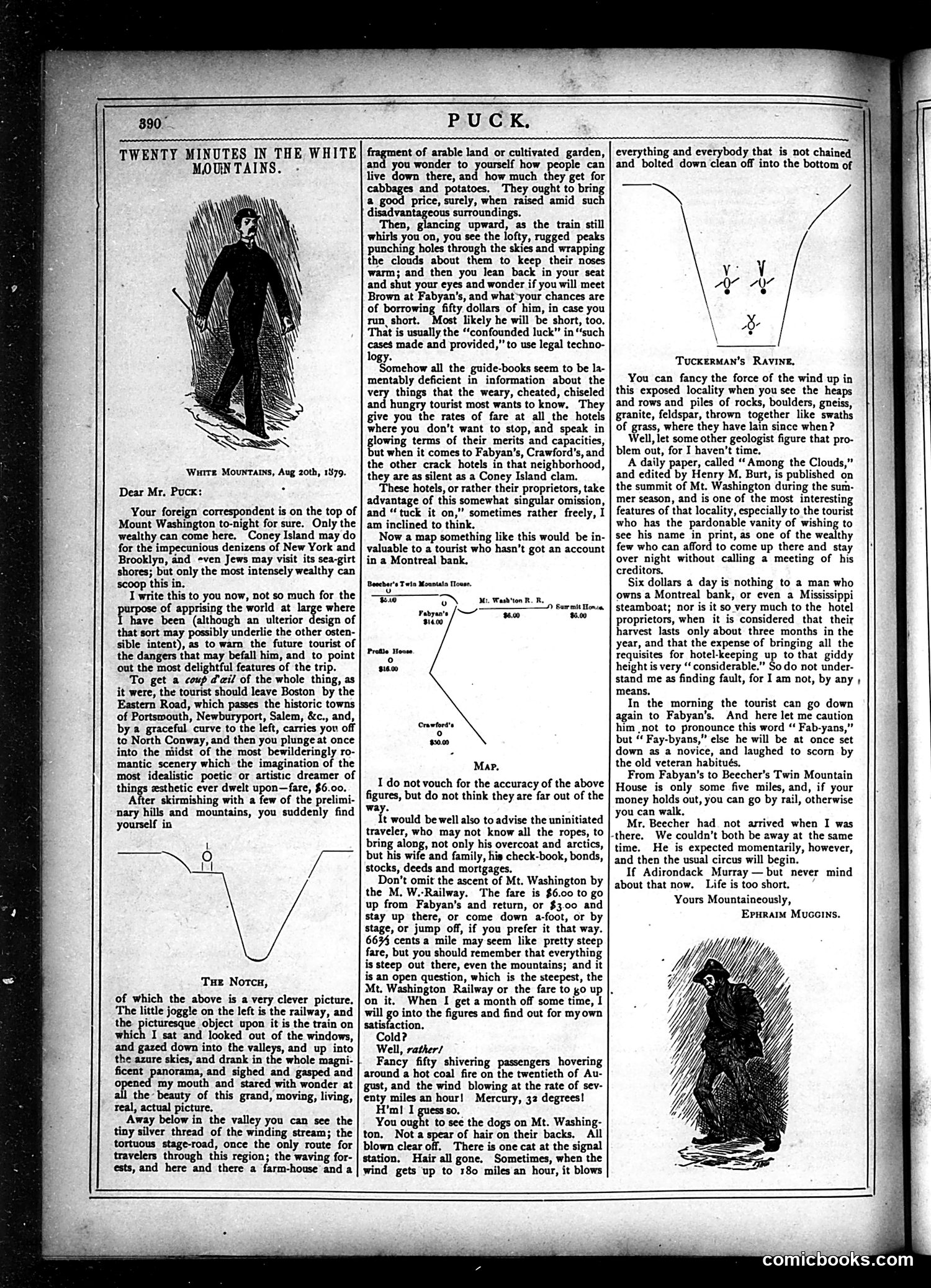
This is a satirical travel piece mocking tourists visiting Mount Washington in New Hampshire. The letter from "Ephraim Muggins" ridicules wealthy Brooklyn visitors who attempt the journey unprepared, claiming they'll meet "Brown at Fabyan's" (a local hotel). The satire targets tourist guidebooks for providing inadequate information about the region's harsh conditions and isolated hotels. Muggins sardonically suggests bringing collateral to hotels, absurdly recommends the "Notch" rail route, and warns about extreme cold and wind (180+ mph gusts mentioned). The humor derives from the contrast between tourists' romantic expectations of "artistic dreamers" and the brutal, uncomfortable reality of Mount Washington's weather and limited accommodations. It's essentially mocking unprepared leisure travelers seeking picturesque mountain scenery.
This page satirizes phrenology—a pseudoscience popular in the 19th century claiming skull bumps revealed character traits. The cartoon shows a "practicing phrenologist" examining a young man's head while lecturing him about his supposed personality defects based on phrenological "science." The satire mocks phrenology's pretensions by having the phrenologist diagnose increasingly absurd character flaws (amativeness, adhesiveness, individuality, etc.) while the young man grows frustrated. The text ridicules how practitioners claimed to scientifically measure human nature through skull analysis. The main joke: phrenology was pseudoscientific nonsense, yet people accepted these charlatans' grandiose claims about reading character from bumps on the head. Puck is lampooning both the false science and gullible believers.
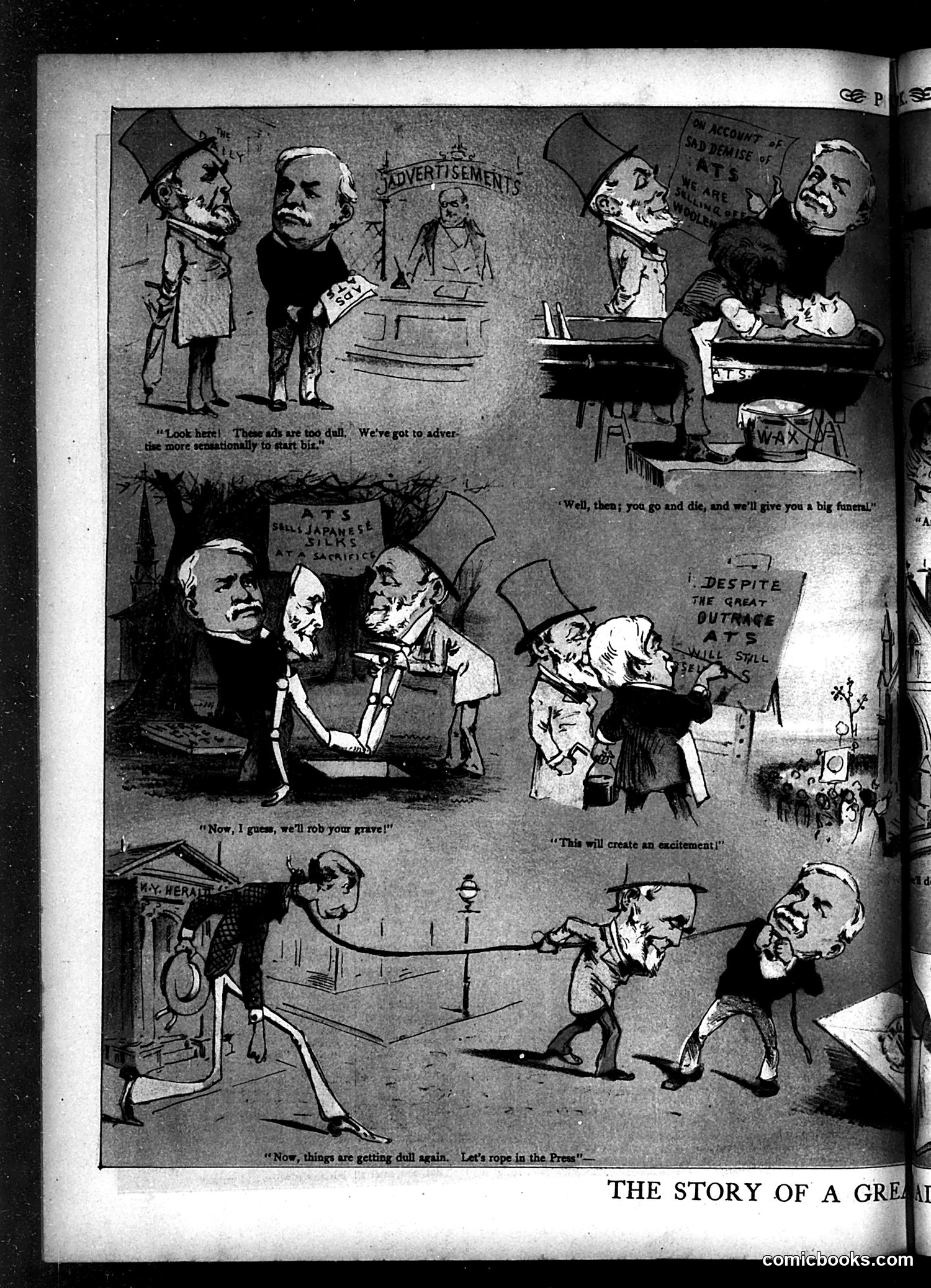
This multi-panel cartoon satirizes newspaper advertising and sensationalism. The top panels show editors discussing how "dull" ads need exaggeration to attract readers. The middle section depicts increasingly dramatic tactics—robbing graves, creating fake "outrages"—to manufacture exciting content. The bottom panels show the consequences: a figure labeled "N.Y. HERALD" (a major newspaper) is literally being hanged by the rope of sensationalism it created. The final caption—"Now, things are getting dull again. Let's rope in the Press"—suggests a vicious cycle where newspapers must continuously escalate fabrications to maintain reader interest. The satire critiques how 19th-century newspapers prioritized sensational, manufactured stories over truthful reporting to drive circulation and advertising revenue.
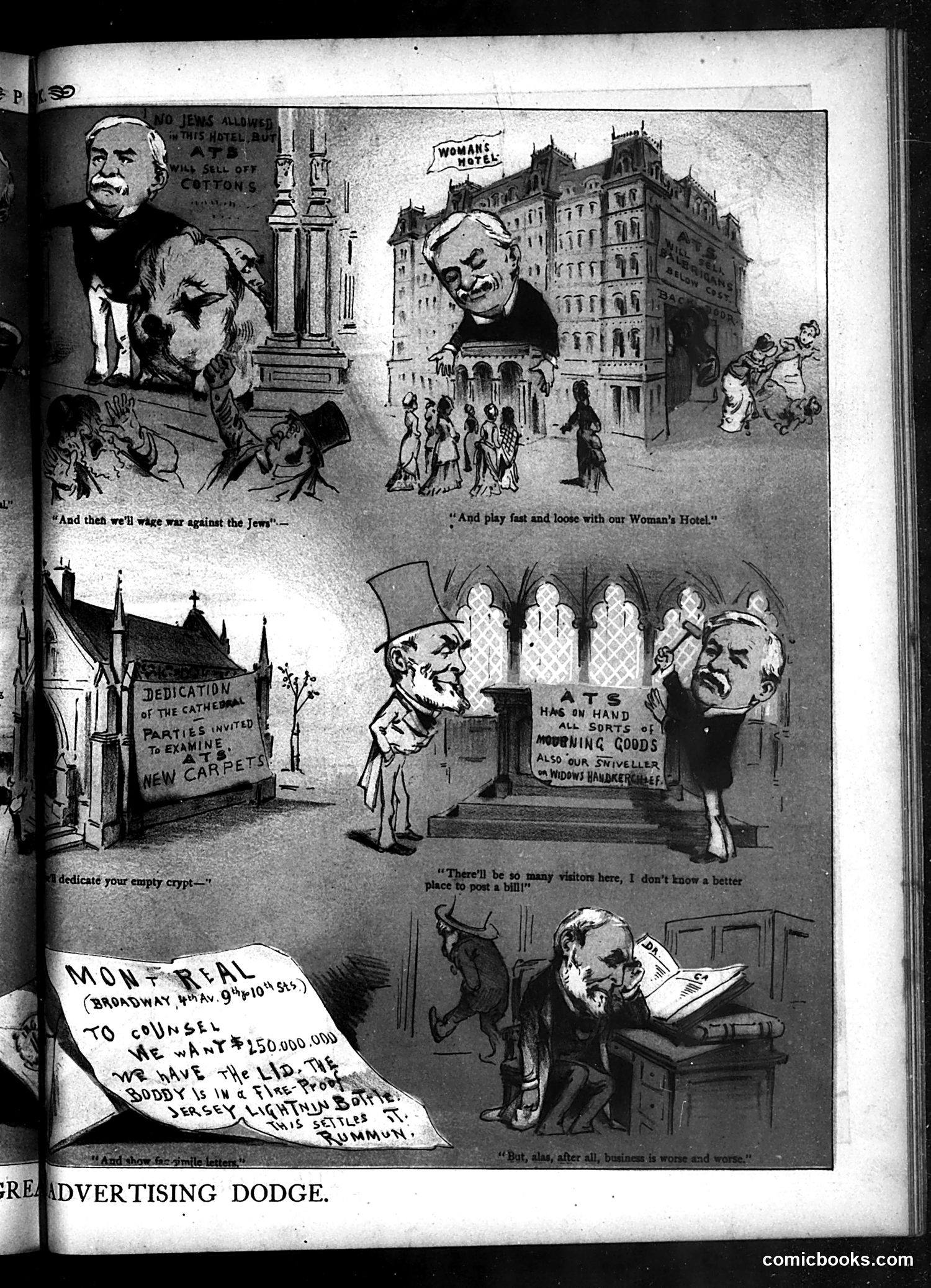
This Puck page satirizes business manipulation through six cartoon vignettes. The top panels mock advertising schemes: one shows figures planning to "wage war against the Jews" while promoting a Women's Hotel, suggesting merchants exploit social prejudice for profit. The cathedral dedication panel depicts clergymen celebrating a new carpet installation while claiming to "dedicate your empty crypt"—mocking religious institutions' focus on material gain. The bottom panels show a con artist with a sign demanding "$150,000" from Montreal, claiming goods are in a "fine pickle," suggesting business scams and settlement schemes. Overall, the cartoons critique how merchants, clergy, and swindlers use social anxieties and false promises to manipulate customers and extract money, with the title "Advertising Dodge" emphasizing deceptive marketing tactics.
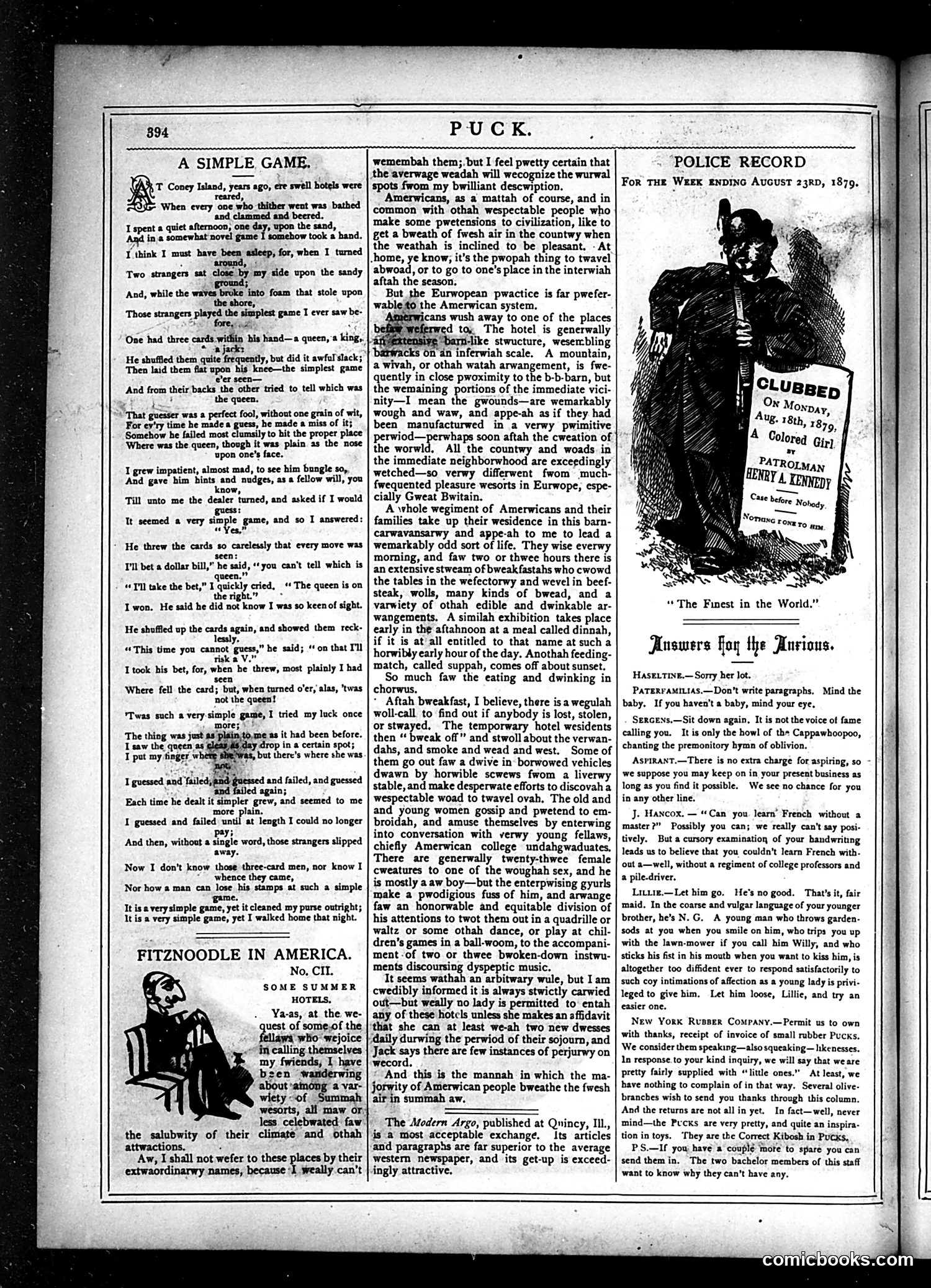
This page contains three distinct sections: **"A Simple Game"** (left): A poem about card-playing on Coney Island, describing a con artist who tricks tourists at cards—a commentary on seaside gambling scams. **"Clubbed" (center/right)**: An illustration showing a figure being beaten, captioned "On Monday, Aug. 18th, 1879, at Oxford City" and credited to artist Henry A. Kennedy. The image likely references a contemporary assault or violence incident, though the specific event is unclear without additional context. **"Answers for the Anxious"** (right): An advice column addressing readers' questions on various topics (lost items, babies, learning French, etc.). **"Fitznoodle in America, No. CII"** (bottom left): A serialized satirical travel narrative mocking American customs and society, typical of Puck's anti-American sentiment for its immigrant readership. The page lacks a major political cartoon but focuses on social satire and humor.
This page contains **no political cartoon or satire**. Rather, it's a serialized romantic fiction story by John Fraser, written expressly for Puck magazine. Chapter XX depicts romantic drama involving characters named Archie, Maggie, the Doctor, and a rival named Macleod. The narrative concerns Archie's conflicted feelings about his relationship with Maggie while another suitor (Macleod) competes for her affection. The text emphasizes emotional turmoil, misunderstandings, and social complications arising from love and class considerations. This represents Puck's **literary content**—serialized entertainment fiction rather than satirical commentary on contemporary politics or social issues.
This page consists primarily of **text content** rather than political cartoons. The main feature is a serialized story titled "Lover's Loan," described as "a narrow walk along the edge of the cliff, which at this point attains its highest height, being over a hundred feet above the shore." Near the bottom appears a small illustration labeled **"Puck's Briefings"** — a section of short satirical news items and social commentary, which was a regular Puck feature. These brief quips targeted contemporary figures and events. The page also contains what appears to be **advertisements or notices** regarding various publications and social items of the era. Without clearer visibility of specific cartoon illustrations or legible captions, precise identification of satirized figures or political references is difficult.
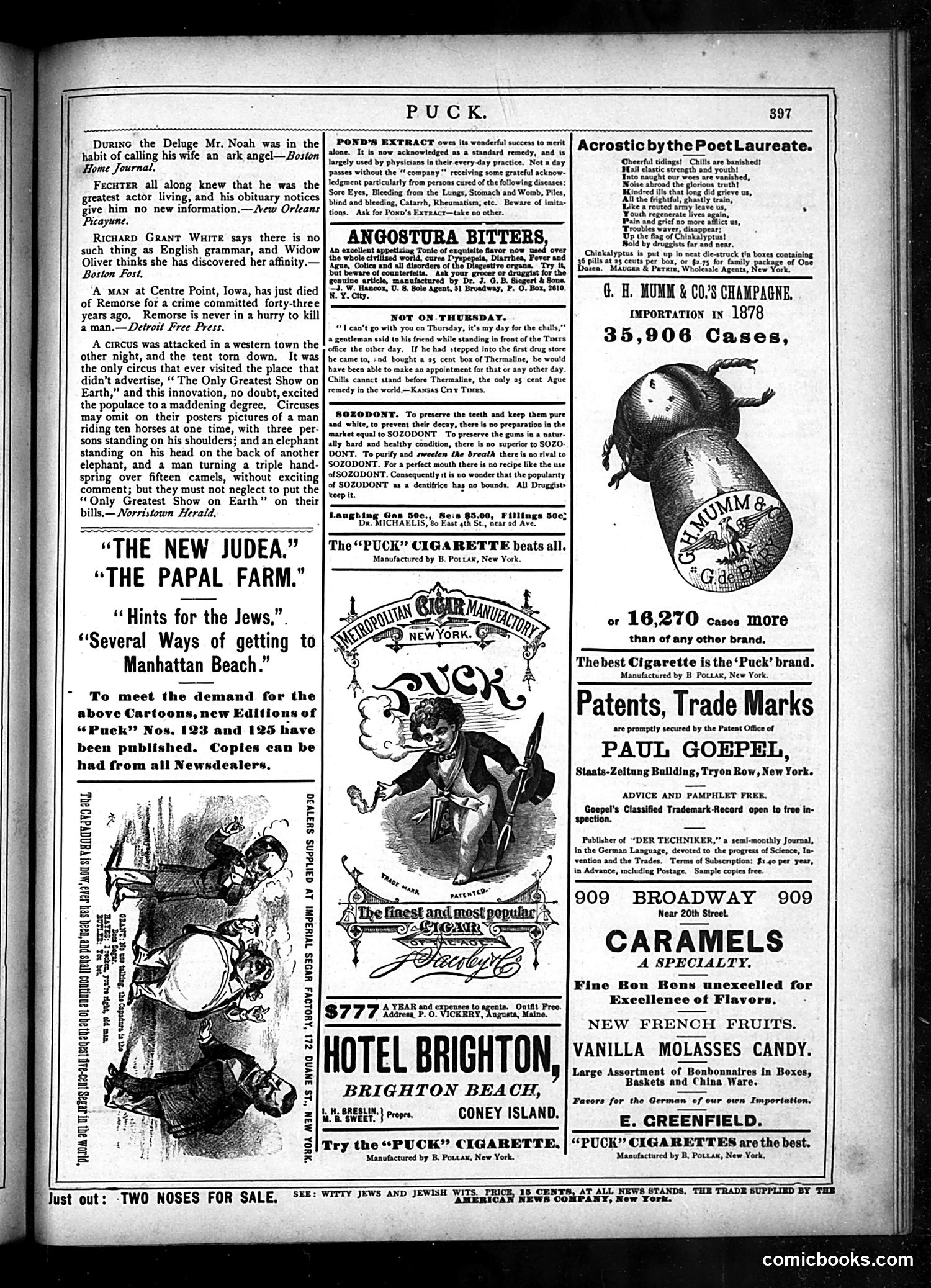
This page is **primarily advertising** for various products (Puck cigarettes, Hotel Brighton, caramels, patent services) with minimal editorial cartoon content. The main illustrated material shows what appears to be a **jester or fool figure** in the central "Puck" cigar advertisement, consistent with the magazine's satirical mascot. The text sections reference contemporary items: Noah's obituary notices, an actor named Richard Grant White, and a circus performance at Centre Point, Iowa. The "Not on Thursday" anecdote appears to be a brief humorous piece about standing before tigers. Several article titles ("The New Judea," "The Papal Farm," "Hints for the Jews") suggest topical satire, though the full context and meaning are unclear from this page alone without access to the complete articles.
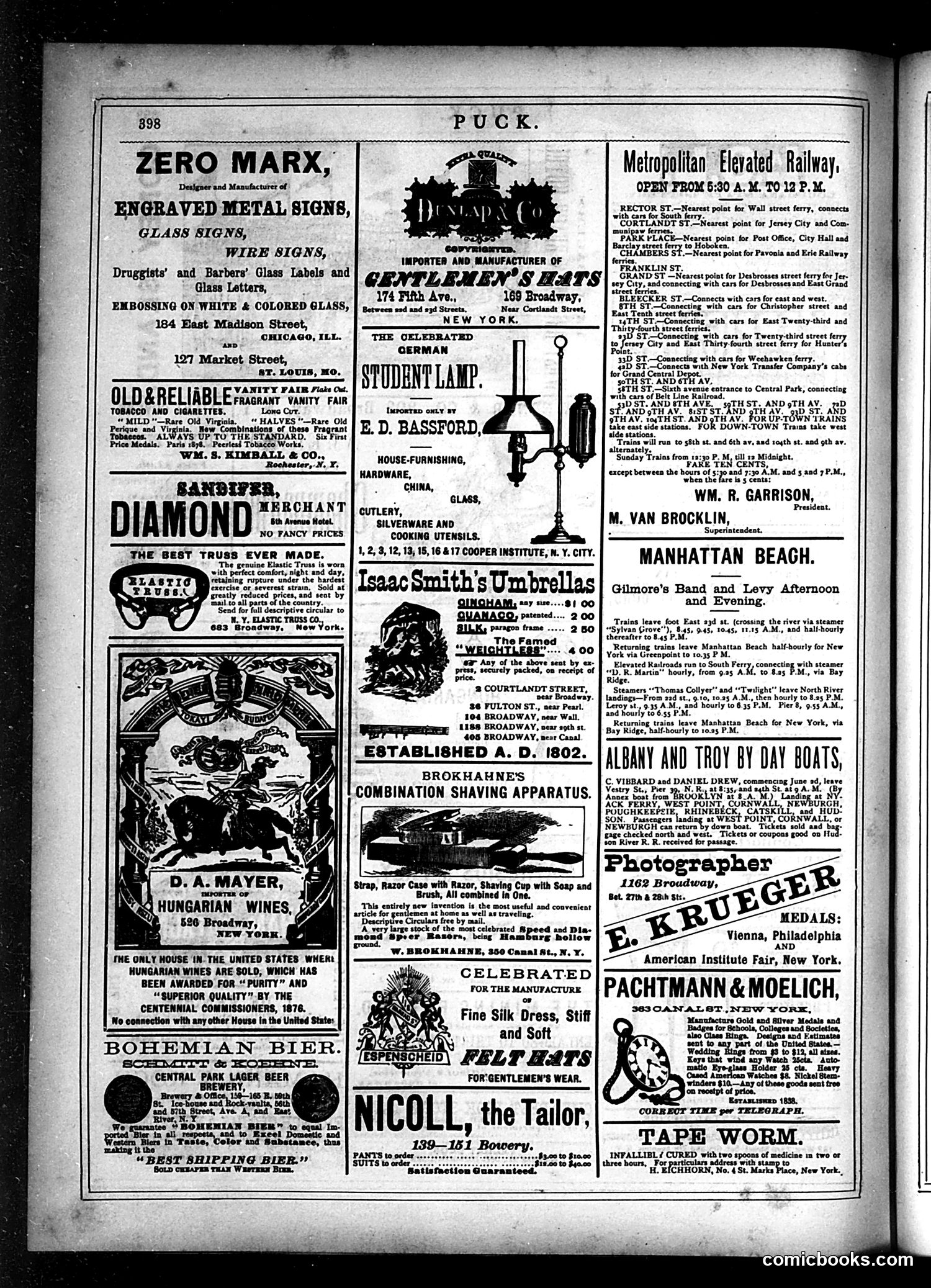
This page is primarily **advertisements**, not satirical content. It displays commercial listings typical of Puck magazine's revenue model, featuring various 1880s-era businesses and products: engraved metal signs, gentlemen's hats, elevated railway information, stomp lamps, umbrellas, wine, elastic trusses, shaving apparatus, photography services, tailoring, and patent medicines. The only illustration with potential satirical intent appears to be **D.A. Mayer's Hungarian Wines advertisement**, which features ornate heraldic imagery with lions—likely mock-heroic branding to suggest Old World legitimacy and superiority, a common advertising trope mocking consumer pretensions. The **"Tape Worm" patent medicine ad** at bottom represents period quackery—dubious medical claims that Puck might have satirized elsewhere, though here it appears as straightforward advertising rather than critique.
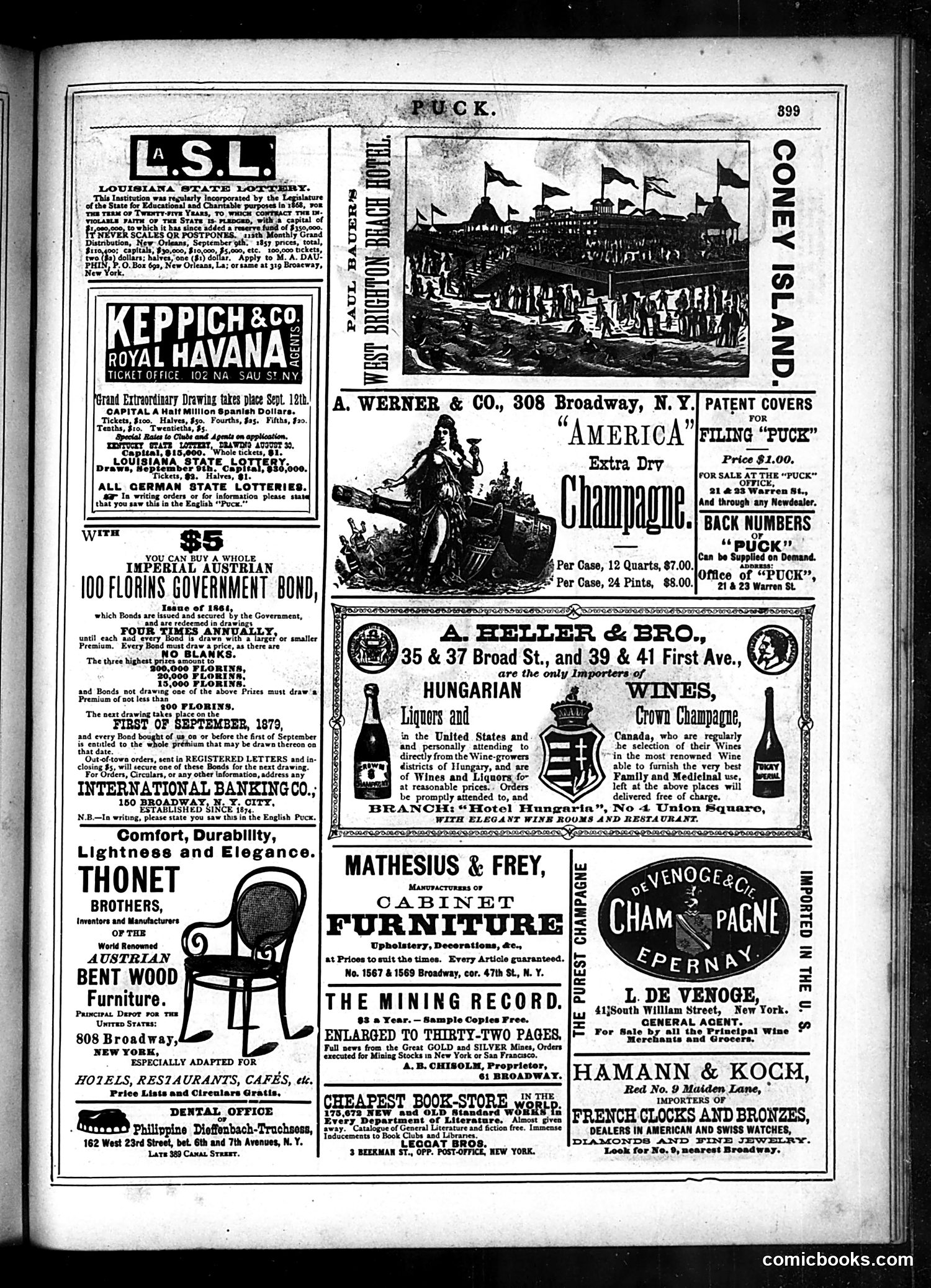
This page is predominantly **advertising**, not satirical content. It showcases late 19th-century commercial advertisements for various products and services, including: - Louisiana State Lottery tickets - Keppich & Co.'s Havana cigars - A. Werner & Co.'s "America" champagne - A. Heller & Bro.'s Hungarian wines and liquors - Mathesius & Frey's cabinet furniture - Pevenoge & Co.'s French champagne - Hamann & Koch's French clocks and bronzes - Various other luxury goods and services The page number (899) and header indicate this is from **Puck magazine**, but this particular page functions as a revenue-generating advertising section rather than containing satirical cartoons. One small engraved illustration shows what appears to be a fair or gathering scene, likely promotional artwork for a lottery or event.
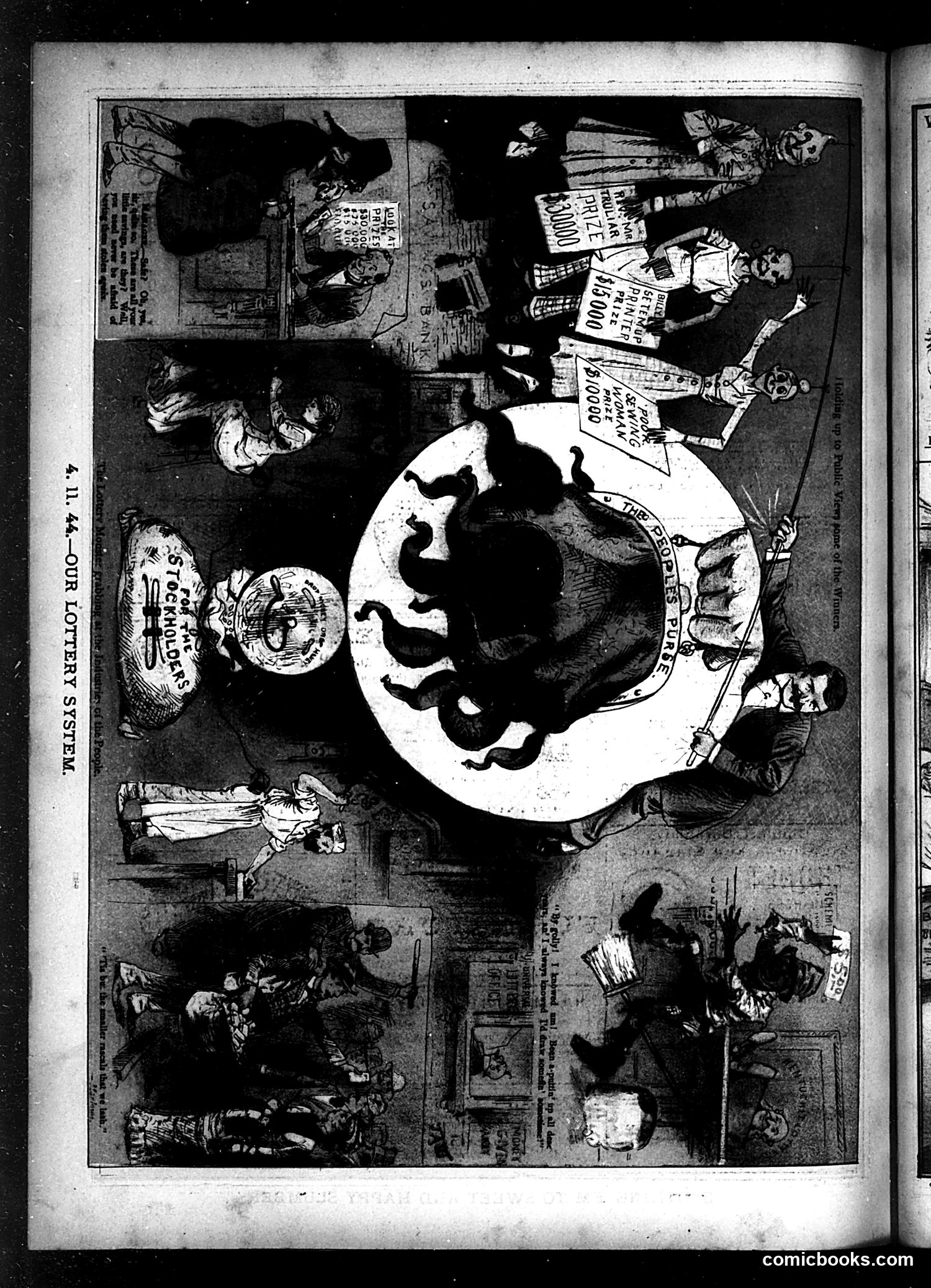
This Puck page satirizes the lottery boom and its social effects. The central circular illustration shows figures participating in lottery activities, with "LOTTERY" text visible on various elements. Multiple smaller panels surround this core image, depicting different lottery-related scenes. The satire appears to critique how lotteries attracted people across social classes—the figures shown include what appear to be wealthy and working-class individuals. The title "All for Lottery Sizzle" suggests the cartoon mocks the flashy promotion and false promises of lottery schemes. The various vignettes likely illustrate different social consequences: gambling addiction, financial ruin, or the contrast between lottery dreams and harsh reality. The composition emphasizes how pervasively lottery fever infected American society.