
Puck, 1879-08-27 · page 6 of 16
Puck — August 27, 1879 — page 6: what you’re looking at
What you’re looking at
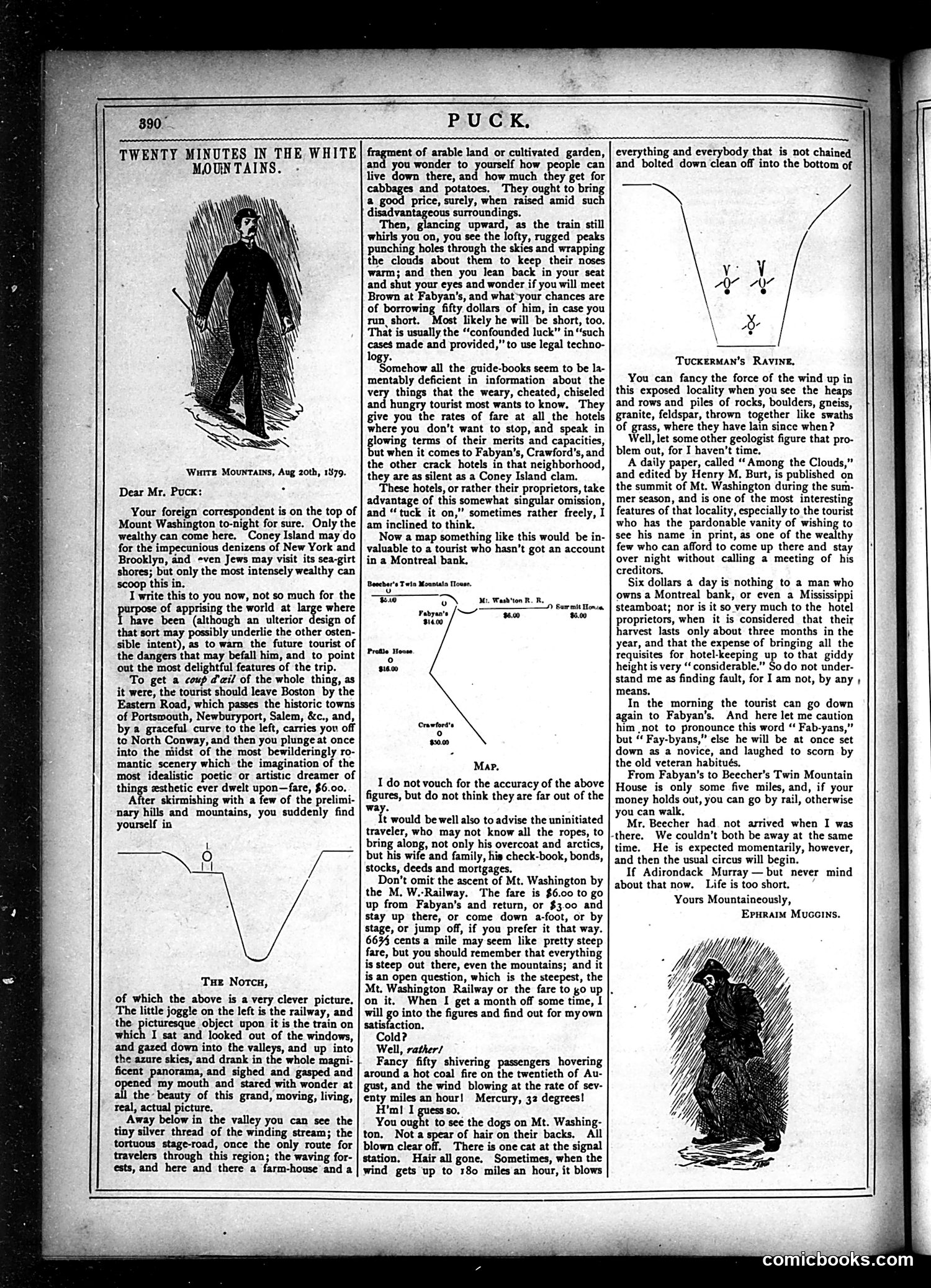
This is a satirical travel piece mocking tourists visiting Mount Washington in New Hampshire. The letter from "Ephraim Muggins" ridicules wealthy Brooklyn visitors who attempt the journey unprepared, claiming they'll meet "Brown at Fabyan's" (a local hotel). The satire targets tourist guidebooks for providing inadequate information about the region's harsh conditions and isolated hotels. Muggins sardonically suggests bringing collateral to hotels, absurdly recommends the "Notch" rail route, and warns about extreme cold and wind (180+ mph gusts mentioned). The humor derives from the contrast between tourists' romantic expectations of "artistic dreamers" and the brutal, uncomfortable reality of Mount Washington's weather and limited accommodations. It's essentially mocking unprepared leisure travelers seeking picturesque mountain scenery.
📄 Transcribed text from this page (OCR, searchable)
Machine-transcribed from the original scan — historical spelling and the odd misread are preserved.
PUCK, TWENTY MINUTES IN THE WHITE MOUNTAINS. ‘Wurre MounTarns, Aug 20th, 1879. Dear Mr. Puck: a Your foreign correspondent is on the top of Mount Washington to-night for sure. Only the wealthy can come here. Coney Island may do for the impecunious denizens of New York and Brooklyn, and ven Jews may visit its sea-girt shores; but only the most intensely wealthy can scoop this in. I write this to you now, not so much for the porpose of apprising the world at e where have been (although an ulterior design of that sort may possibly underlie the other osten- sible intent), as to warn the future tourist of the dangers that may befall him, and to point out the most delightful features of the trip. To get a coup dail of the whole thing, as it were, the tourist should leave Boston by the Eastern Road, which passes the historic towns of Portsmouth, Newburyport, Salem, &c., and, by a graceful curve to the left, carries you off te North Conway, and then you plungeat once into the midst of the most bewilderingly ro- mantic scenery which the imagination of the most idealistic poetic or artistic dreamer of things esthetic ever dwelt upon—fare, $6.00. After skirmishing with a few of the prelimi- nary hills and mountains, you suddenly find yourself in Tue Notcu, of which the above is a very clever picture. The little joggte on the left is the railway, and the Eplctiresane object upon it is the train on which I sat and looked out of the windows, and gazed down into the valleys, the azure skies, and drank in the ficent and up into whole magni- anorama, and sighed and and ay mouth and stared with wonder at the ity of this grand, moving, livin; teal, actual picture. ‘: p Away below in the valley you can see the tiny silver thread of the winding stream; the tortuous stage-road, once the only route for travelers through this region; the waving for- ests, and here and there a farm-house and a Scagrety of arable land or cultivated garden, and you wonder to yourself how ple can live down there, and how much they get for cabbages and potatoes. They ought to bring a good price, surely, when raised amid such disadyantageons surroundings. Then, glancing upward, as the train still whirls you on, you see the lofty, rugged peaks punching holes through the skies and wrapping the clouds about them to keep their noses warm; and then you lean back in your seat and shut your eyes and wonder if you will meet Brown at Fabyan’s, and what-your chances are of borrowing fifty dollars of him, in case you run short. Most likely he will be short, too. That is usually the “confounded luck” in “such cases made and provided,” to use legal techno- logy. Somehow all the guide-books seem to be la- mentably deficient in information about the very things that the weary, cheated, chiseled and hungry tourist most wants to know. They give you the rates of fare at all the hotels where you don’t want to stop, and speak in glowing terms of their merits and capacities, ut when it comes to Fabyan’s, Crawford's, and the other crack hotels in that neighborhood, they are as silent as a Coney Island clam. These hotels, or rather their proprietors, take advantage of this somewhat singular omission, and “tuck it on,” sometimes rather freely, I am inclined to think. Now a map something like this would be in- valuable to a tourist who hasn’t got an account in a Montreal bank. I do not vouch for the accuracy of the above figures, but do not think they are far out of the way. It would be well also to advise the uninitiated traveler, who may not know all the ropes, to bring along, not only his overcoat and arctics, but his wife and family, his check-book, bonds, stocks, deeds and mortgages. Don’t omit the ascent of Mt. Washington by the M. W.-Railway. The fare is $6.00 to go up from Fabyan’s and return, or $3.00 and stay up there, or come down a-foot, or by stage, or jump off, if you prefer it that way. 66% cents a mile may seem like pretty steep fare, but you should remember that everything is steep out there, even the mountains; and it is an open question, which is the steepest, the Mt. Washington Railway or the fare to go up |. on it. When I get a month off some time, 1 will go into the figures and find out for myown satisfaction. Cold? val rehery i 8 ‘anc ity shivering passengers hoverin; around hot coal fire oa the cwentieth of ‘Aue gust, and the wind blowing at the rate of sev- enty miles an hour! Mercury, 32 degrees! H'm! I guess so, You ought to see the dogs on Mt. Washing- ton. Nota spear of hair on their backs. Al blown clear off. There is one cat at the signal station. Hair all gone. Sometimes, when the wind gets up to 180 miles an hour, it blows -there, everything and everybody that is not chained and bolted down clean off into the bottom of ess Tuckerman’s RAvINE, You can fancy the force of the wind up in this exposed locality when you see the heaps and rows and piles of rocks, boulders, gneiss, granite, feldspar, thrown together like swaths of grass, where they have lain since when? Well, let some other geologist figure that pro- blem out, for I haven't time. A daily paper, called “Among the Clouds,” and edited by Henry M., Burt, is published on the summit of Mt. Washington during the sum- mer season, and is one of the most interesting features of that locality, especially to the tourist who has the pardonable vanity of wishing to see his name in print, as one of the wealthy few who can afford to come up there and stay over night without calling a meeting of his creditors, Six dollars 4 day is nothing to a man who owns a Montreal bank, or even a Mississippi steamboat; nor is it so very much to the hotel proprietors, when it is considered that their harvest lasts only about three months in the year, and that the expense of bringing all the requisites for hotel-keeping up to that giddy height is very “‘ considerable.” So do not under- stand me as finding fault, for I am not, by any means. In the morning the tourist can go down again to Fabyan’s. And here let me caution him ,not to pronounce this word “ Fab-yans,”” but “ Fay-byans,” else he will be at once set down as a novice, and laughed to scorn by the old veteran habitués. From Fabyan’s to Beecher’s Twin Mountain House is only some five miles, and, if your money holds out, you can go by rail, otherwise you can walk. Mr. Beecher had not arrived when I was We couldn’t both be away at the same time. He is expected momentarily, however, and then the usual circus will begin. If Adirondack Murray — but never mind about that now. Life is too short. Yours Mountaineously, Epuramm Mucoins. ~ COMICDOOKS.com