
Puck, 1879-08-27 · page 3 of 16
Puck — August 27, 1879 — page 3: what you’re looking at
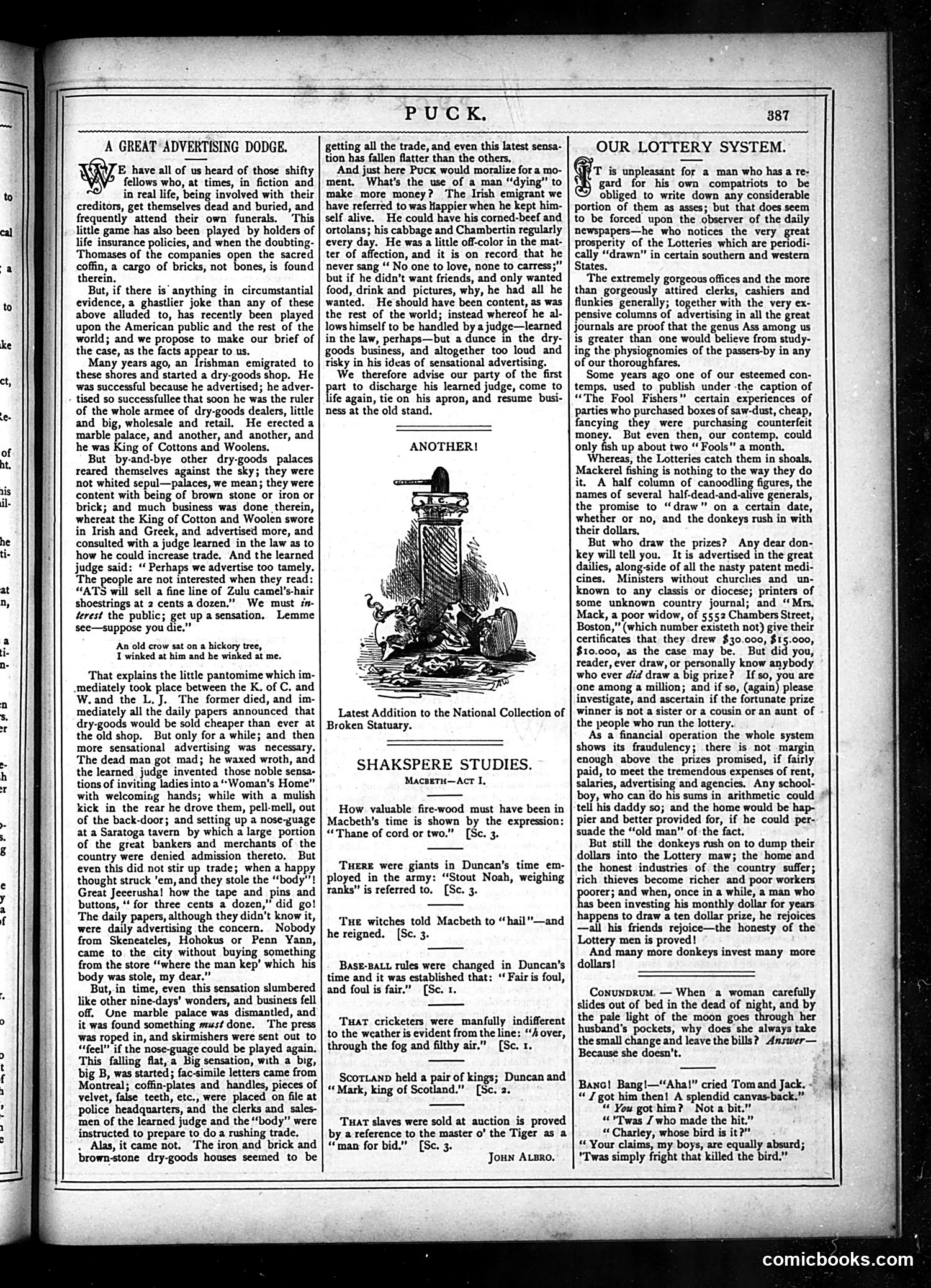
What you’re looking at
This page contains **three distinct satirical articles** rather than a single cartoon: 1. **"A Great Advertising Dodge"** mocks the dead-man-walking scheme where deceased debtors were publicly advertised as "alive" to collect payments—a scam exploiting creditors' gullibility. 2. **"Our Lottery System"** criticizes newspaper lotteries as fraudulent schemes. The accompanying engraving shows a lottery wheel. The satire exposes how newspapers advertise impossible odds and non-existent prizes while enriching themselves through advertising revenue. 3. **"Shakspere Studies"** provides obscure textual analysis of Macbeth and other Shakespeare plays—likely parodying overly pedantic literary scholarship. The page exemplifies Puck's blend of **social critique and humor**, targeting fraud, gullibility, and pretension in American life.
📄 Transcribed text from this page (OCR, searchable)
Machine-transcribed from the original scan — historical spelling and the odd misread are preserved.
PUCK, 387 A GREAT ADVERTISING DODGE. E have all of us heard of those shifty fellows who, at times, in fiction and in real life, being involved with their creditors, get themselves dead and buried, and frequently attend their own funerals. This little game has also been played by holders of life insurance policies, and when the doubting- Thomases of the companies open the sacred coffin, a cargo of bricks, not bones, is found therein, But, if there is’ anything in circumstantial evidence, a ghastlier joke than any of these above alluded to, has recently been played upon the American public and the rest of the world; and we propose to make our brief of the case, as the facts appear to us, Many years ago, an Irishman emigrated to these shores and started a dry-goods shop. He was successful because he advertised; he adver- + tised so successfullee that soon he was the ruler of the whole armee of dry-goods dealers, little and big, wholesale and retail. He erected a marble palace, and another, and another, and he was King of Cottons and Woolens. But by-and-bye other dry-goods ces reared themselves against the sky; they were not whited sepul—palaces, we mean; they were content with being of brown stone or iron or brick; and much business was done therein, whereat the King of Cotton and Woolen swore in Irish and Greek, and advertised more, and consulted with a judge learned in the law as to how he could increase trade, And the learned judge said: ‘‘ Perhaps we advertise too tamely. The people are not interested when they read: “ATS will sell a fine line of Zulu camel’s-hair shoestrings at 2 cents a dozen.” We must in- terest the public; get up a sensation, Lemme see—suppose you die,” ‘An old crow sat on a hickory tree, I winked at him and he winked at me. That explains the little pantomime which im- -mediately took place between the K. of C, and W.and the L. J. The former died, and im- mediately all the daily papers announced that dry-goods would be sold cheaper than ever at the old shop. But only for a while; and then more sensational advertising was necessary. ‘The dead man got mad; he waxed wroth, and the learned judge invented those noble sensa- tions of inviting ladies into a‘*Woman’s Home” with welcoming hands; while with a mulish kick in the rear he drove them, pell-mell, out of the back-door; and setting up a nose-guage at a Saratoga tavern by which a large portion of the great bankers and merchants of the country were denied admission thereto. But even this did not stir up trade; when a happy thought struck ‘em, and they stole the “body”! Great Jecerusha! how the tape and pins and buttons, ‘‘ for three cents a dozen,” did go! The daily papers, although they didn’t know it, were daily advertising the concern. Nobody from Skeneateles, Hohokus or Penn Yann, came to the city without buying something from the store ‘where the man kep’ which his body was stole, my dear.” But, in time, even this sensation slumbered like other nine-days’ wonders, and business fell off. Une marble palace was dismantled, and it was found something mus¢ done. ‘The press was roped in, and skirmishers were sent out to “feel” if the nose-guage could be played again. This falling flat, a Big sensation, with a big, big B, was started; fac-simile letters came from Montreal; coffin-plates and handles, pieces of velvet, false teeth, etc., were placed on file at police headquarters, and the clerks and sales- men of the learned judge and the “‘body”’ were instructed to prepare to do a rushing trade, . Alas, it came not. ‘The iron and brick and brown-stone dry-goods houses seemed to be getting all the trade, and even this latest sensa- tion has fallen flatter than the others, And just here Puck would moralize for a mo- ment. What's the use of a man “dying” to make more money? The Irish emigrant we have referred to was Happier when he kept him- self alive. He could have his corned-beef and ortolans; his cabbage and Chambertin regularly every day. He was a little off-color in the mat- ter of affection, and it is on record that he never sang ‘‘ No one to love, none to carress;” but if he didn’t want friends, and only wanted food, drink and pictures, why, he had all he wanted. He should have been content, as was the rest of the world; instead whereof he al- lows himself to be handled by a judge—learned in the law, perhaps—but a dunce in the dry- goods business, and altogether too loud and risky in his ideas of sensational advertising. We therefore advise our party of the first art to discharge his learned judge, come to ife again, tie on his apron, and resume busi- ness at the old stand, ANOTHER! Latest Addition to the National Collection of Broken Statuary. SHAKSPERE STUDIES. MacsetH—Act I, How valuable fire-wood must have been in Macbeth’s time is shown by the expression: “Thane of cord or two.” [Sc. 3. ‘Tere were giants in Duncan's time em- ployed in the army: “Stout Noah, weighing ranks” is referred to. [Sc. 3. ‘Tue witches told Macbeth to “‘hail”—and he reigned. [Sc. 3. BasE-BALL rules were changed in Duncan's time and it was established that: ‘Fair is foul, and foul is fair.” (Sc. 1. Tuat cricketers were manfully indifferent to the weather is evident from the line: “A over, through the fog and filthy air.” (Sc. 1. ScotLanp held a pair of kings; Duncan and “Mark, king of Scotland.” [Sc. 2. Tuat slaves were sold at auction is proved by a reference to the master o’ the Tiger as a ‘man for bid.” [Sc. 3. Joun ALsRo. OUR LOTTERY SYSTEM. T is unpleasant for a man who has a re- gard for his own compatriots to be obliged to write down any considerable portion of them as asses; but that does seem to be forced upon the observer of the daily newspapers—he who notices the very at prosperity of the Lotteries which are periodi- cally ‘‘drawn” in certain southern and western States. The extremely gorgeous offices and the more than gorgeously attired clerks, cashiers and flunkies generally; together with the very ex- pensive columns of advertising in all the great journals are proof that the genus Ass among us is greater than one would believe from study- ing the physiognomies of the passers-by in any of our thoroughfares, Some years ago one of our esteemed con- temps, used to publish under -the caption of “The Fool Fishers” certain experiences of parties who purchased boxes of saw-dust, cheap, fancying they were purchasing counterfeit money. But even then, our contemp, could only fish up about two “ Fools” a month, Whereas, the Lotteries catch them in shoals, Mackerel fishing is nothing to the way they do it. A half column of canoodling figures, the names of several half-dead-and-alive generals, the promise to “draw” on a certain date, whether or no, and the donkeys rush in with their dollars. But who draw the prizes? Any dear don- key will tell you. It is advertised in the great dailies, along-side of all the nasty patent medi- cines. Ministers without churches and un- known to any classis or diocese; printers of some unknown country journal; and ‘Mrs. Mack, a poor widow, of 5552 Chambers Street, Boston,” (which number existeth not) give their certificates that they drew $30.000, $15.000, $10,000, as the case may be. But did you, reader, ever draw, or personally know anybody who ever did draw a big prize? Ifso, you are one among a million; and if se, (again) please investigate, and ascertain if the fortunate prize winner is not a sister or a cousin or an aunt of the people who run the lottery. As a financial operation the whole system shows its fraudulency; there is not margin enough above the prizes promised, if fairly paid, to meet the tremendous expenses of rent, salaries, advertising and agencies. Any school- boy, who can do his sums in arithmetic could * tell his daddy so; and the home would be hap- pier and better provided for, if he could per- suade the ‘old man” of the fact. But still the donkeys rush on to dump their dollars into the Lottery maw; the home and the honest industries of the country suffer; rich thieves become richer and poor workers poorer and when, once in a while, a man who been investing his monthly dollar for years happens to draw a ten dollar prize, he rejoices —all his friends rejoice—the honesty of the Lottery men is proved! And many more donkeys invest many more dollars! Conunprum.— When a woman carefully slides out of bed in the dead of night, and by the pale light of the moon goes through her husband's pockets, why does she always take the small change and leave the bills? Answer— Because she doesn’t. M Banc! Bang!—‘‘Aha!” cried Tom and Jack. - “ J got him then! A splendid canvas-back.” “ You got him? Not a bit.” “Twas J who made the hit.” “Charley, whose bird is it?” ‘Your claims, my boys, are Srey abe 'Twas simply fright that killed the bird.” comicbooks.com