
Puck, 1879-08-27 · page 11 of 16
Puck — August 27, 1879 — page 11: what you’re looking at
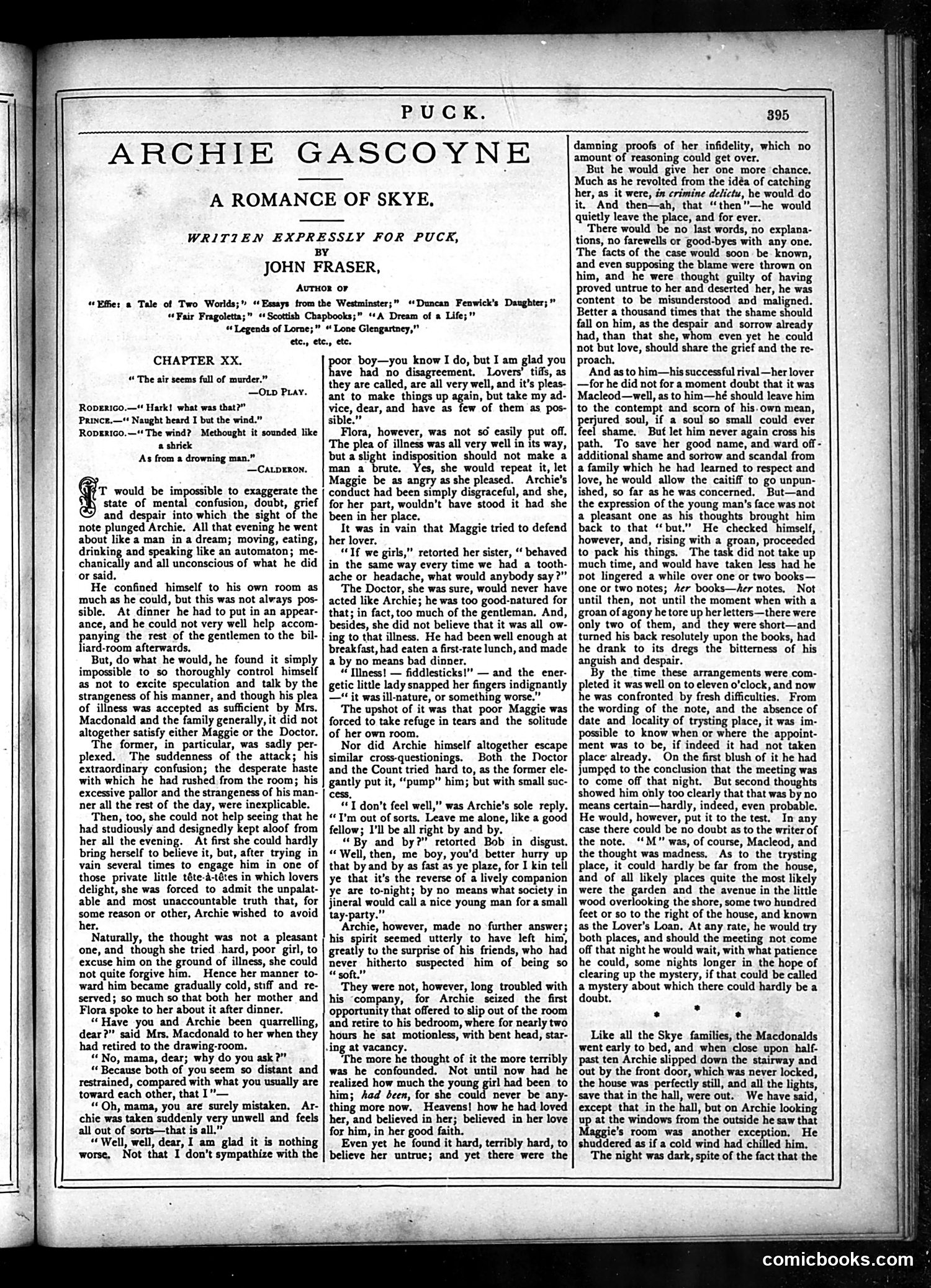
What you’re looking at
This page contains **no political cartoon or satire**. Rather, it's a serialized romantic fiction story by John Fraser, written expressly for Puck magazine. Chapter XX depicts romantic drama involving characters named Archie, Maggie, the Doctor, and a rival named Macleod. The narrative concerns Archie's conflicted feelings about his relationship with Maggie while another suitor (Macleod) competes for her affection. The text emphasizes emotional turmoil, misunderstandings, and social complications arising from love and class considerations. This represents Puck's **literary content**—serialized entertainment fiction rather than satirical commentary on contemporary politics or social issues.
📄 Transcribed text from this page (OCR, searchable)
Machine-transcribed from the original scan — historical spelling and the odd misread are preserved.
PUCK. ARCHIE GASCOYNE - A ROMANCE OF SKYE, WRITTEN EXPRESSLY FOR PUCK, BY JOHN FRASER, AvTHOR oF “Effie: a Tale of Two Worlds;” ‘Essays from the Westminster;” “Duncan Fenwick's Daughter;” «Fair Fragoletta;” ‘Scottish Chapbooks;” “A Dream of a Life;”” “Legends of Lorne;” « Lone Glengartney,” etc., etc, etc, CHAPTER XX. “ The air seems full of murder.” Prince.—‘ Naught heard I but the wind.” Ropsrico.—' The wind? Methought it sounded like a shriek As from a drowning man.” —CALDERON. T would be impossible to exaggerate the state of mental confusion, doubt, grief and despair into which the sight of the note plunged Archie. All that evening he went about like a man in a dream; moving, eating, drinking and speaking like an automaton; me- chanically and all unconscious of what he did or said. He confined himself to his own room as much as he could, but this was not always pos- sible. At dinner he had to put in an appear- ance, and he could not very well help accom- panying the rest of the gentlemen to the bil- liard-room afterwards, But, do what he would, he found it simply impossible to so thoroughly control himself as not to excite speculation and talk by the strangeness of his manner, and though his plea of illness was accepted as sufficient by Mrs. Macdonald and the family generally, it did not altogether satisfy either Maggie or the Doctor. The former, in particular, was sadly per- plexed. The suddenness of the attack; his extraordinary confusion; the desperate haste with which he had rushed from the room; his excessive pallor and the strangeness of his man- ner all the rest of the day, were inexplicable. Then, too, she could not help seeing that he had studiously and designedly kept aloof from her all the evening. At first she could hardly bring herself to believe it, but, after trying in vain several times to engage him in one of those private little téte-a-tétes in which lovers delight, she was forced to admit the unpalat- able and most unaccountable truth that, for some reason or other, Archie wished to avoid her. Naturally, the thought was not a pleasant one, and though she tried hard, poor girl, to excuse him on the ground of illness, she could not quite forgive him. Hence her manner to- ward him became gradually cold, stiff and re- served; so much so that both her mother and Flora spoke to her about it after dinner. “Have you and Archie been quarrelling, dear?” said Mrs. Macdonald to her when they had retired to the drawing-room. “No, mama, dear; why do you ask ?” “ Because both of you seem so distant and restrained, compared with what you usually are toward each other, that 1"— ‘Qh, mama, you are surely mistaken. Ar- chie was taken suddenly very unwell and feels all out of sorts—that is all.” “Well, well, dear, I am glad it is nothing worse, Not that I don’t sympathize with the pecs boy—you know I do, but I am glad you ave had no disagreement. Lovers’ tiffs, as they are called, are all very well, and it’s pleas- ant to make things up agai, Dut take my ad- vice, dear, and have as few of them as pos- sible.” Flora, however, was not so easily put off. The plea of illness was all very well in its way, but a slight indisposition should not make a man a brute. Yes, she would repeat it, let Maggie be as angry as she pleased. Archie's conduct had been simply disgraceful, and she, for her part, wouldn’t have stood it had she been in her place. It was in vain that Maggie tried to defend her lover. “If we girls,” retorted her sister, “ behaved in the same way every time we had a tooth- ache or headache, what would anybody say?” The Doctor, she was sure, would never have acted like Archie; he was too good-natured for that; in fact, too much of the gentleman. And, besides, she did not believe that it was all ow- ing to that illness. He had been well enough at breakfast, had eaten a first-rate lunch, and made a by no means bad dinner. “ Tllness! — fiddlesticks!" — and the ener- getic little lady snapped her fingers indignantly — it was ill-nature, or something worse.” ‘The upshot of it was that poor Maggie was forced to take refuge in tears and the solitude of her own room. Nor did Archie himself altogether escape similar cross-questionings. Both the Doctor and the Count tried hard to, as the former ele- gantly put it, “pump” him; but with small suc- cess, “T don’t feel well,” was Archie's sole reply. “I'm out of sorts. Leave me alone, like a good fellow; I'll be all right by and by. “By and by?” retorted Bob in disgust. “Well, then, me boy, you'd better hurry op that by and by as fast as ye plaze, for I kin tel ye that it’s the reverse of a lively companion ye are to-night; by no means what society in jineral would call a nice young man for a small tay-party.” ‘Archie, however, made no further answer; his spirit seemed utterly to have left him, greatly to the surprise of his friends, who had never hitherto suspected him of being so « soft.” They were not, however, long troubled with his ‘company, for Archie seized the first opportunity that offered to slip out of the room and retire to his bedroom, where for nearly two hours he sat motionless, with bent head, star- .ing at vacancy. ‘The more he thought of it the more terribly was he confounded. Not until now had he realized how much the young girl had been to him; Aad deen, for she could never be any- thing more now. Heavens! how he had loved her, and believed in her; believed in her love for him, in her good faith. Even yet he found it hard, terribly hard, to believe her untrue; and yet there were the damning proofs of her infidelity, which no amount of reasoning could get over. But he would give her one more chance, Much as he revolted from the idéa of catching her, as it were, in crimine delictu, he would do it. And then—ah, that “then”—he would quietly leave the place, and for ever. There would be no last words, no explana- tions, no farewells or good-byes with any one. The facts of the case would soon be known, and even supposing the blame were thrown on. him, and he were thought guilty of having proved untrue to her and deserted her, he was content to be misunderstood and maligned. Better a thousand times that the shame should fall on him, as the despair and sorrow already had, than that she, whom even yet he could not but love, should share the grief and the re- proach, And as to him—his successful rival—her lover —for he did not for a moment doubt that it was Macleod—well, as to him—hé should leave him to the contempt and scorn of his.own mean, Pe jured soul, if a soul so small could ever feel shame. But let him never again cross his path. To save her good name, and ward off- additional shame and sortow and scandal from a family which he had learned to respect and love, he would allow the caitiff to go unpun- ished, so far as he was concerned. But—and the expression of the young man’s face was not a pleasant one as his thoughts brought him back to that “but.” He checked himself, however, and, rising with a groan, proceeded to pack his things. The task did not take up much time, and would have taken less had he pot lingered a while over one or two books— one or two notes; Aer books—Aer notes. Not until then, not until the moment when with a groan of agony he tore up herletters—there were only two of them, and they were short—and turned his back resolutely upon the books, had he drank to its dregs the bitterness of his anguish and despair. By the time these arrangements were com- pleted it was well on to eleven o'clock, and now he was confronted by fresh difficulties. From the wording of the note, and the absence of date and locality of trysting place, it was im- possible to know when or where the appoint- ment was to be, if indeed it had not taken place already. On the first blush of it he had jumped to the conclusion that the meeting was to come off that night. But second thoughts showed him only too clearly that that was by no means certain—hardly, indeed, even probable. He would, however, put it to the test. In any case there could be no doubt as to the writer of the note. ‘*M” was, of course, Macleod, and the thought was madness, As to the trysting place, it could hardly be far from the house, and of all likely places quite the most likely were the garden and the avenue in the little wood overlooking the shore, some two hundred feet or so to the right of the house, and known as the Lover’s Loan, At any rate, he would try both places, and should the meeting not come off that night he would wait, with what patience he could, some nights longer in the hope of clearing up the mystery, if that could be called a mystery about which there could hardly be a doubt. * . * Like all the Skye families, the Macdonalds went early to bed, and when close upon half- past ten Archie slipped down the stairway and out by the front door, which was never locked, the house was perfectly still, and all the lights, save that in the hall, were out. We have said, except that in the hall, but on Archie looking up at the windows from the outside he saw that ie’s room was another exception, He shuddered as if a cold wind had chilled him. The night was dark, spite of the fact that the comicbooks.com