
A complete issue · 16 pages · 1879
Puck — August 13, 1879
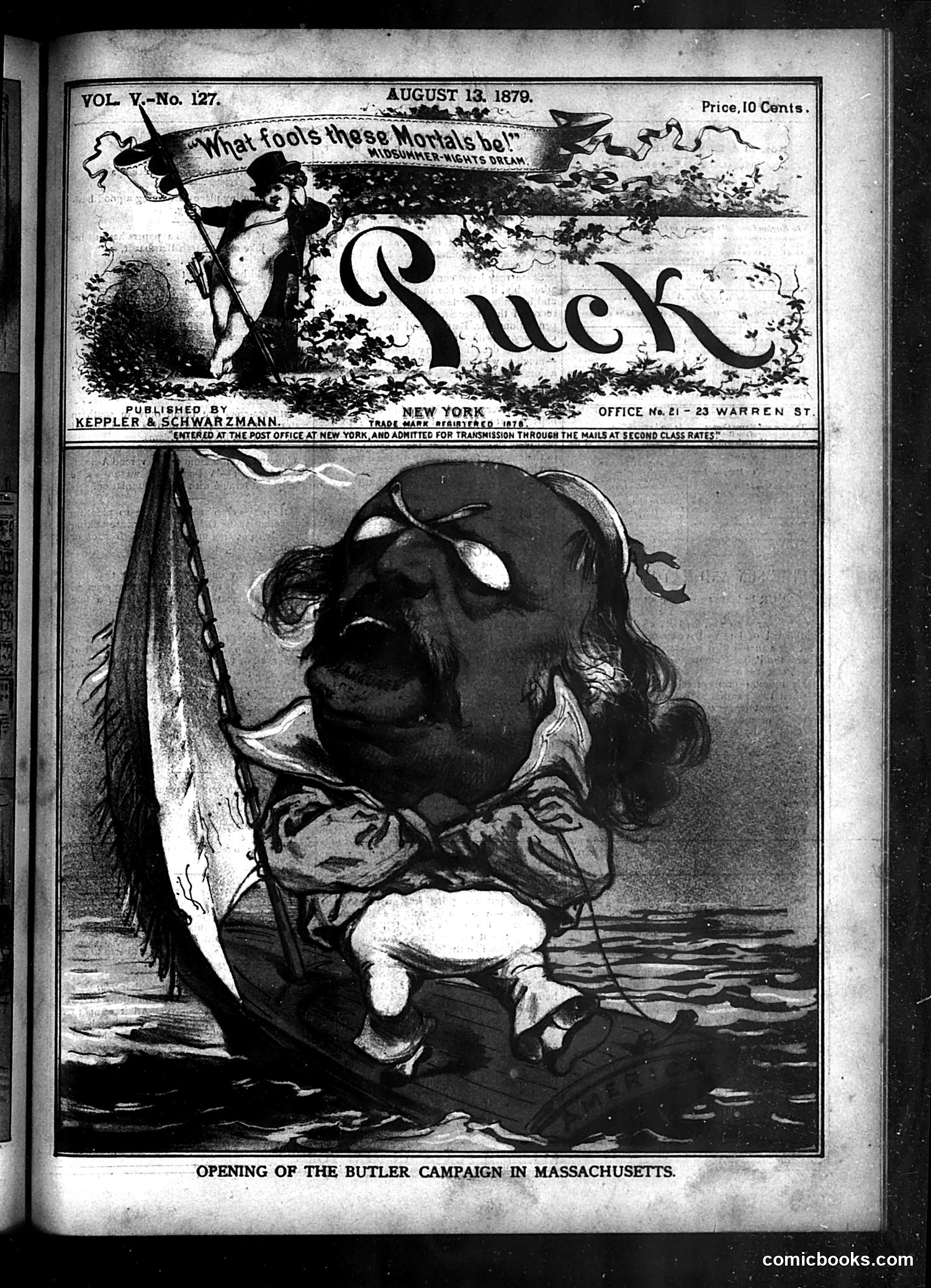
This issue's main cartoon satirizes the "Opening of the Butler Campaign in Massachusetts." The image depicts a grotesque, demonic figure emerging from water, holding a tattered flag—appearing to represent Butler's political campaign as something monstrous or destructive. The header quote "What fools these Mortals be!" (from *A Midsummer Night's Dream*) signals mockery of those supporting Butler's political efforts. General Benjamin Butler was a controversial Union general and Radical Republican politician; this cartoon likely criticizes his Massachusetts campaign as dangerous or ridiculous. The demonic imagery suggests Puck's editors viewed Butler negatively and his campaign as something to be feared or ridiculed rather than taken seriously.
This page contains several short editorial commentaries rather than a single cartoon. The main piece, "The Sun and Mayor Cooper," critiques Mayor Cooper and the Police Commissioner, praising their efficiency but ironically noting they've dismissed Commissioner Smith without proper justification. The editors argue this undermines law and due process—even efficient government must follow legal procedures. A secondary section discusses the Butler Campaign in Massachusetts, suggesting Dennis Kearney (likely the "Workingmen's Party" candidate) is making inflammatory speeches to gain attention before the formal campaign launch. Brief notes satirize various local issues: watering-places, Philadelphia papers, Delaware farmers, and a Presbyterian clergyman's sermon. The page is primarily text-based commentary rather than illustrated political satire.
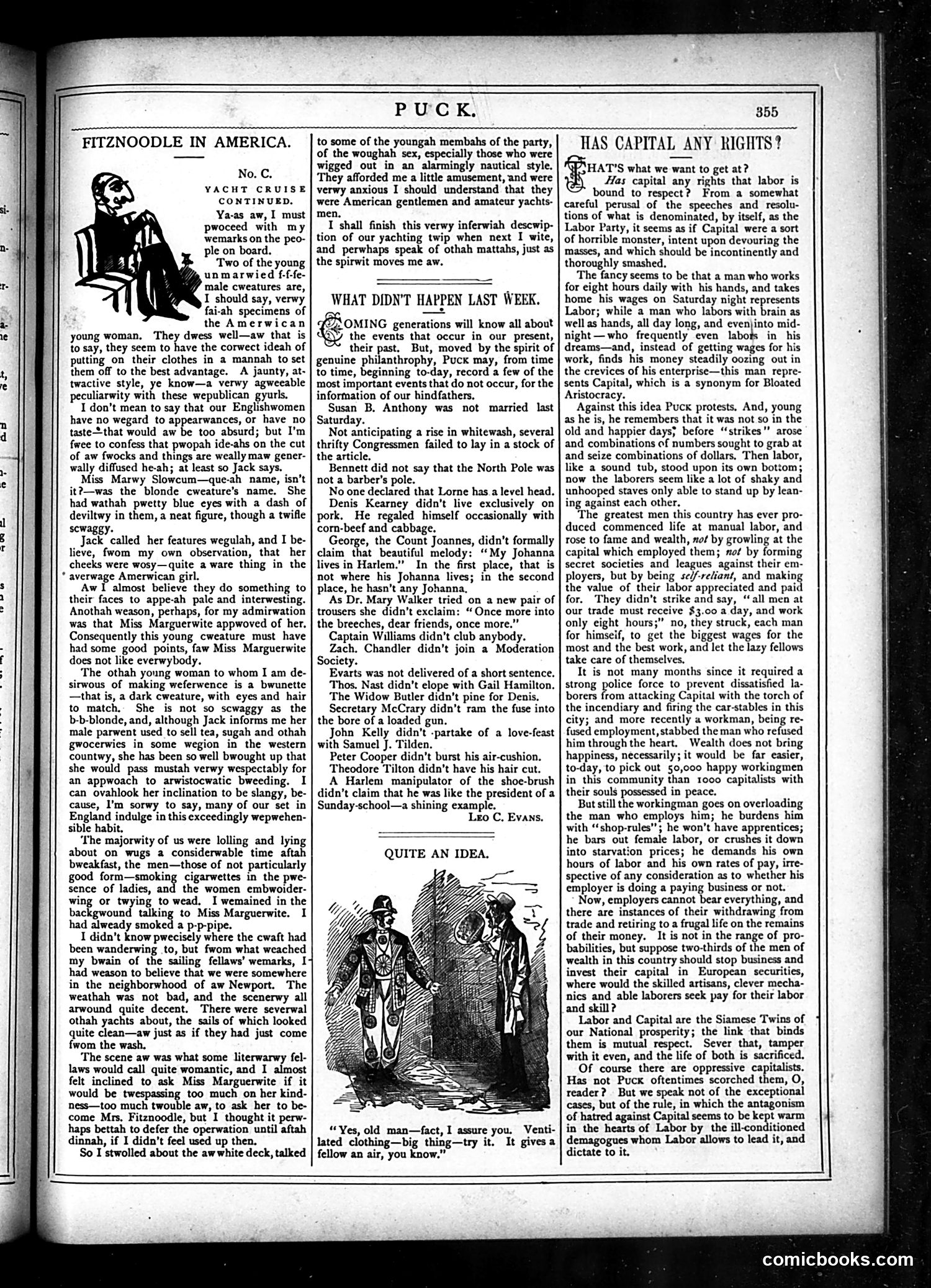
This page contains three distinct sections: 1. **"Fitznoodle in America" (top left)**: A serialized story about a snobbish English yacht-club visitor observing American social customs and romance. 2. **"What Didn't Happen Last Week" (center)**: A satirical column listing fictional events that *didn't* occur—a comedic format mocking contemporary scandals, labor disputes, and political figures. It references various failed "strikes" and scandals involving named individuals, suggesting actual controversies readers would recognize. 3. **"Quite an Idea" (bottom right)**: A cartoon with two figures in period dress, accompanying text about ventilated clothing as a humorous concept. 4. **"Has Capital Any Rights?" (right column)**: A serious political essay debating labor and capital relations, arguing both deserve respect but criticizing exploitative capitalist practices. The page blends humor with earnest social commentary typical of Puck's satirical approach.
This page contains primarily **text content** rather than political cartoons. The main sections include: 1. **"An Open Letter from Hon. John Kelly to Mr. Samuel J. Tilden"** — a satirical poem addressing two Democratic political figures, likely from the 1870s-80s era. 2. **"Puck's History of Ireland"** — a historical essay about Irish saints and their veneration, particularly St. Owney and other figures. 3. **"Answers to Poetical Queries"** — a humor column addressing reader submissions about relationships and social situations. 4. **"A Sad Case"** — a mathematical puzzle presented as comic correspondence. The page demonstrates Puck's characteristic mix of political satire, historical commentary, and reader-response humor, though without visible illustrations on this particular page.
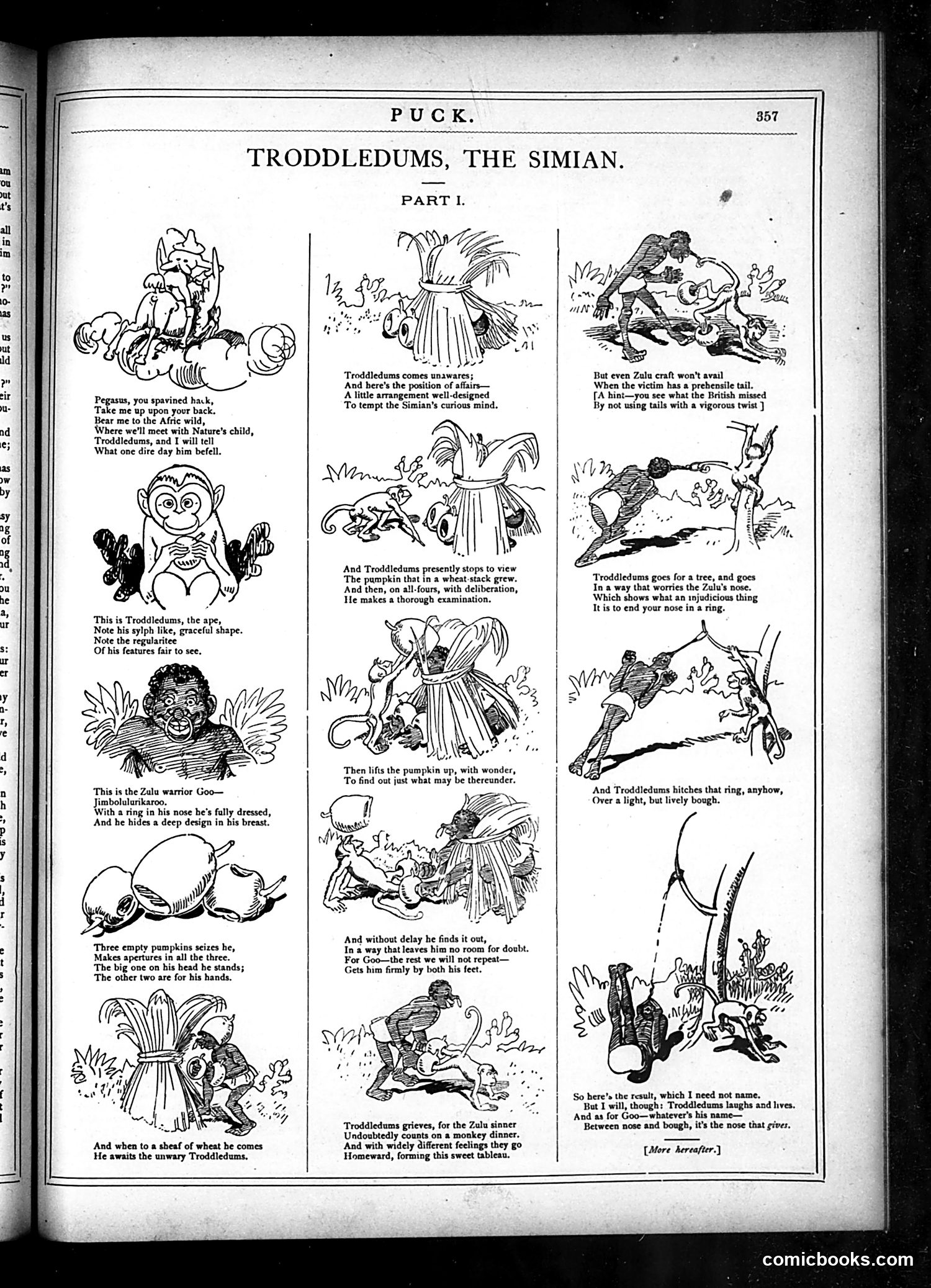
This is a serialized satirical narrative (Part I) mocking a figure called "Troddledums," depicted as an ape-like creature. The story follows Troddledums through various misadventures involving a Zulu warrior and pumpkins, presented in verse with accompanying illustrations. The satire appears to target political or public figures through animal caricature—a common Puck strategy. The "Simian" designation emphasizes mockery through animalistic comparison. While the specific political reference remains unclear without additional context, the elaborate narrative structure and consistent character focus suggest Troddledums represents a notable contemporary figure worthy of extended ridicule. The pumpkin imagery may carry symbolic meaning related to foolishness or abundance, though its specific significance is uncertain.
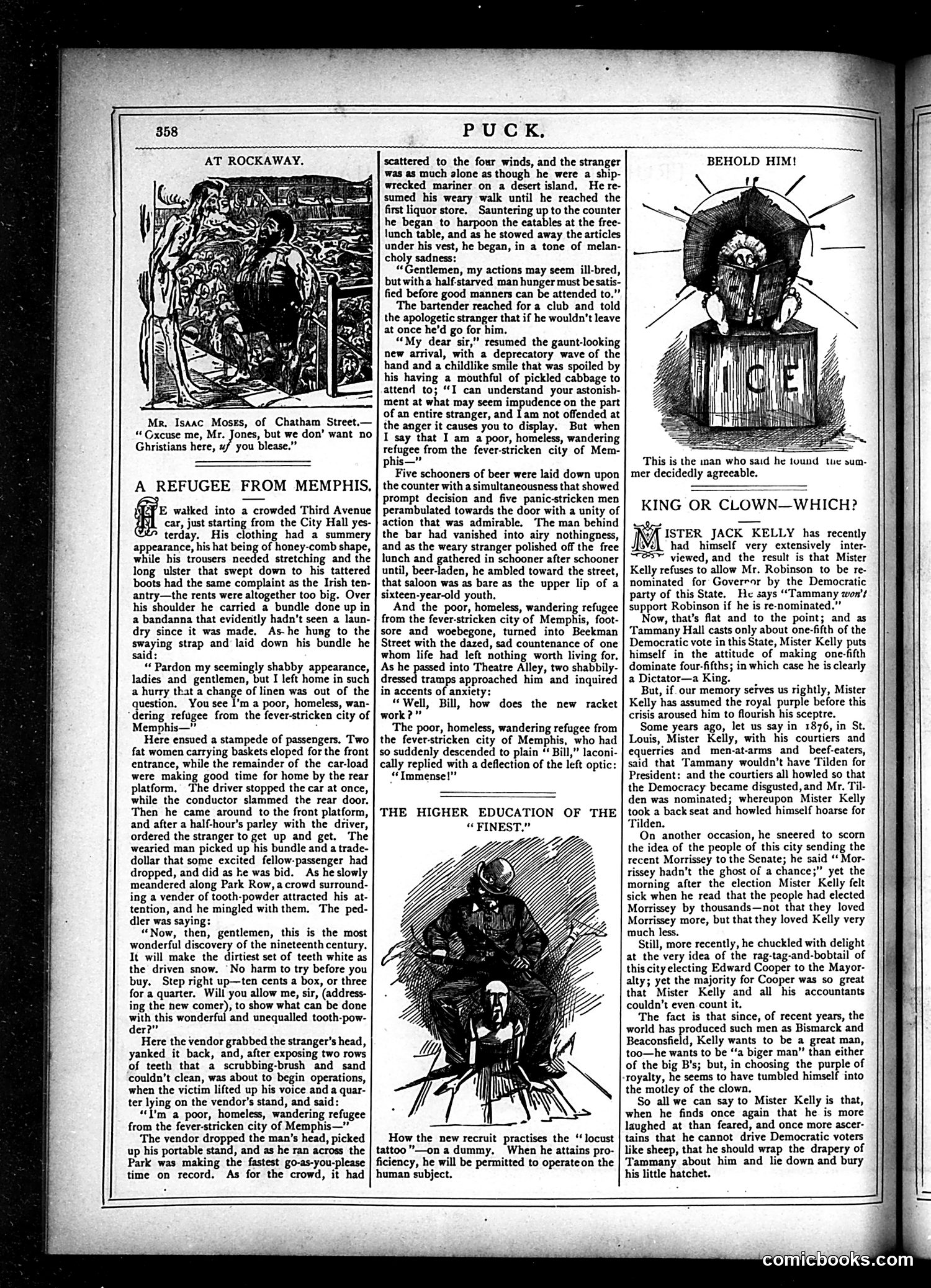
This page contains three distinct political satires targeting Democratic politics in what appears to be the Gilded Age. **"A Refugee from Memphis"** mocks a poor, ragged man arriving in a crowded city—likely satirizing Southern Democratic voters fleeing their regions. **"King or Clown—Which?"** attacks Mister Jack Kelly, a Democratic figure who apparently wants to be nominated as a "great man" but is dismissed as a would-be dictator. The cartoon ridicules his pretensions and vanity, suggesting he's unfit for leadership and should be laughed out of politics. **"The Higher Education of the 'Finest'"** depicts police recruits practicing the "locust tattoo" (beating) on a dummy—dark satire about police brutality and inadequate training in Democratic-controlled cities. The overall theme critiques Democratic urban political machines, corruption, and their effects on city governance and citizens.
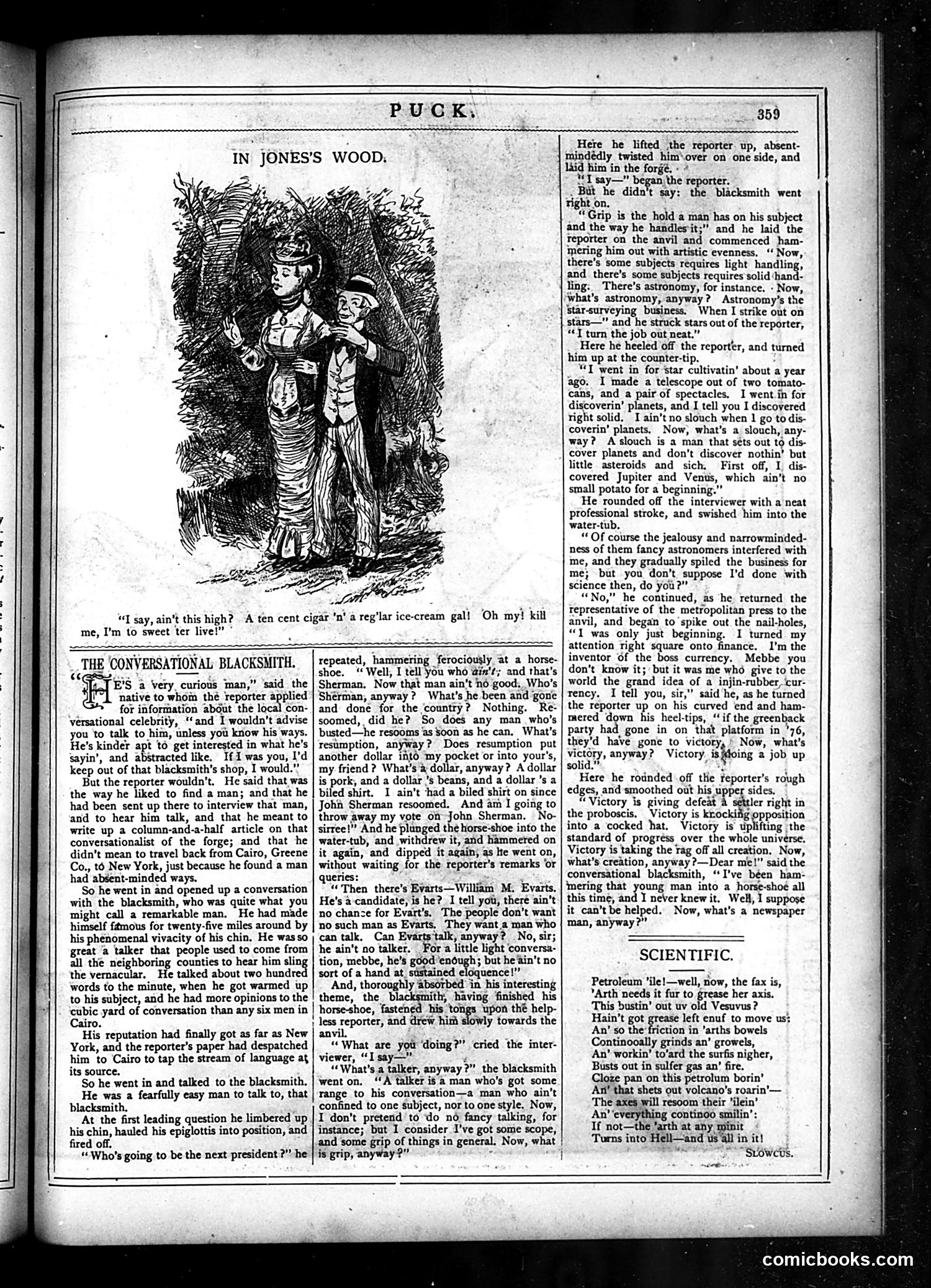
This Puck page contains two separate pieces: **"In Jones's Wood"** (top): An illustrated story featuring two figures in a wooded setting. The accompanying text discusses a reporter interviewing a blacksmith, with dialogue about various topics including astronomy, planets, and Jupiter. The conversation becomes increasingly absurd—the blacksmith disparages fancy astronomers while boasting of his own astronomical observations made through improvised equipment (tobacco cans and spectacles). **"The Conversational Blacksmith"** (bottom): Continues the blacksmith character, satirizing his tendency to have strong opinions on every subject while lacking actual expertise. The text mocks his verbose, rambling conversation style and his dismissive attitude toward educated people, particularly regarding a political candidate named Evarts. The satire targets working-class pretension and the figure of the opinionated ignoramus who speaks confidently beyond his knowledge.
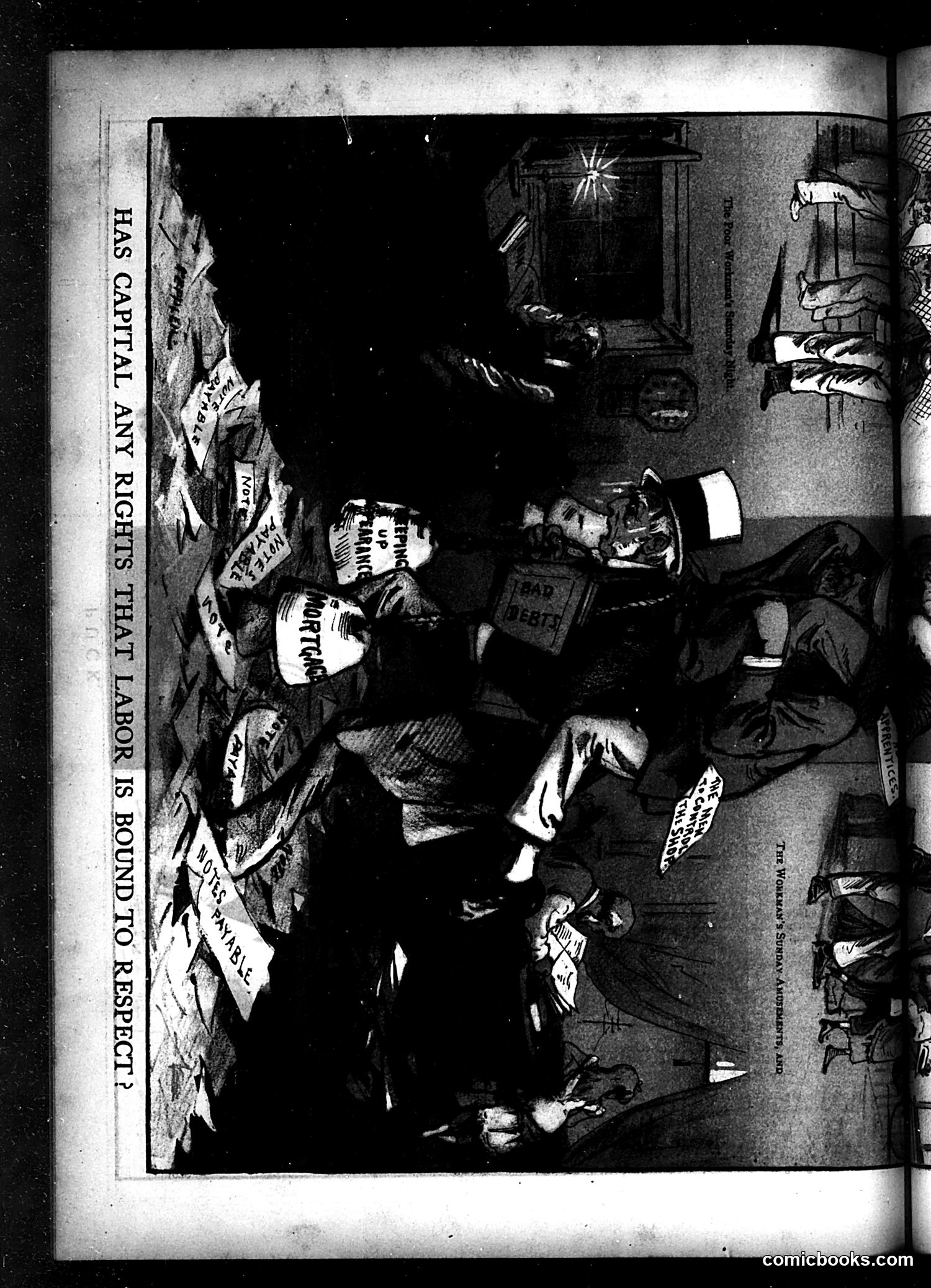
This page is titled "HAS CAPITAL ANY RIGHTS THAT LABOR IS BOUND TO RESPECT?" — a pointed question about labor-capital relations. The cartoon appears to depict a confrontation scene, likely from a labor dispute or strike. Multiple figures are shown in what appears to be an interior space, with various signs visible (though text is difficult to read clearly due to image quality). The scene suggests conflict or tension between groups. Given Puck's satirical stance and the era this represents, this likely comments on contentious labor disputes of the period — possibly addressing whether capitalists/business owners have legitimate rights when facing worker demands. The composition and grouping suggest competing interests in violent opposition rather than respectful negotiation, ironically reinforcing the headline's question through visual conflict.
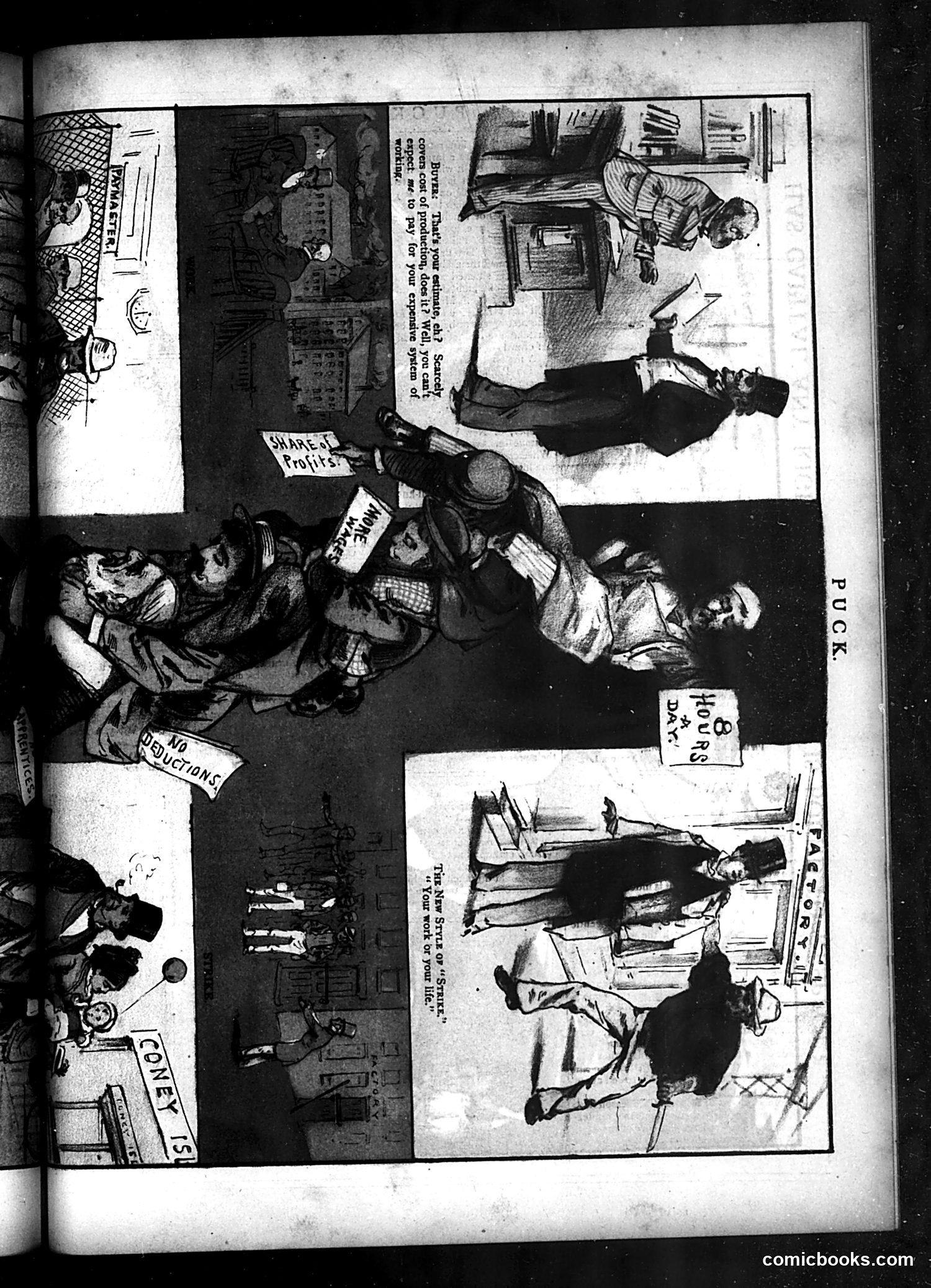
This page appears to contain multiple comic strips or satirical panels arranged vertically. While the OCR text is largely illegible, the image shows what appears to be political or social satire typical of Puck magazine's style. The visible panels depict figures in various domestic and social situations. Labels visible include references to "Politics," "No Reductions," and what appears to be commentary on everyday life or current events of the publication's era. Without clearer text or more legible captions, I cannot definitively identify the specific political figures, events, or satirical targets being referenced. The artwork style and layout suggest early-to-mid 20th century American satire, but determining the precise jokes, references, or social commentary would require either clearer source material or additional historical context about Puck's publication date.
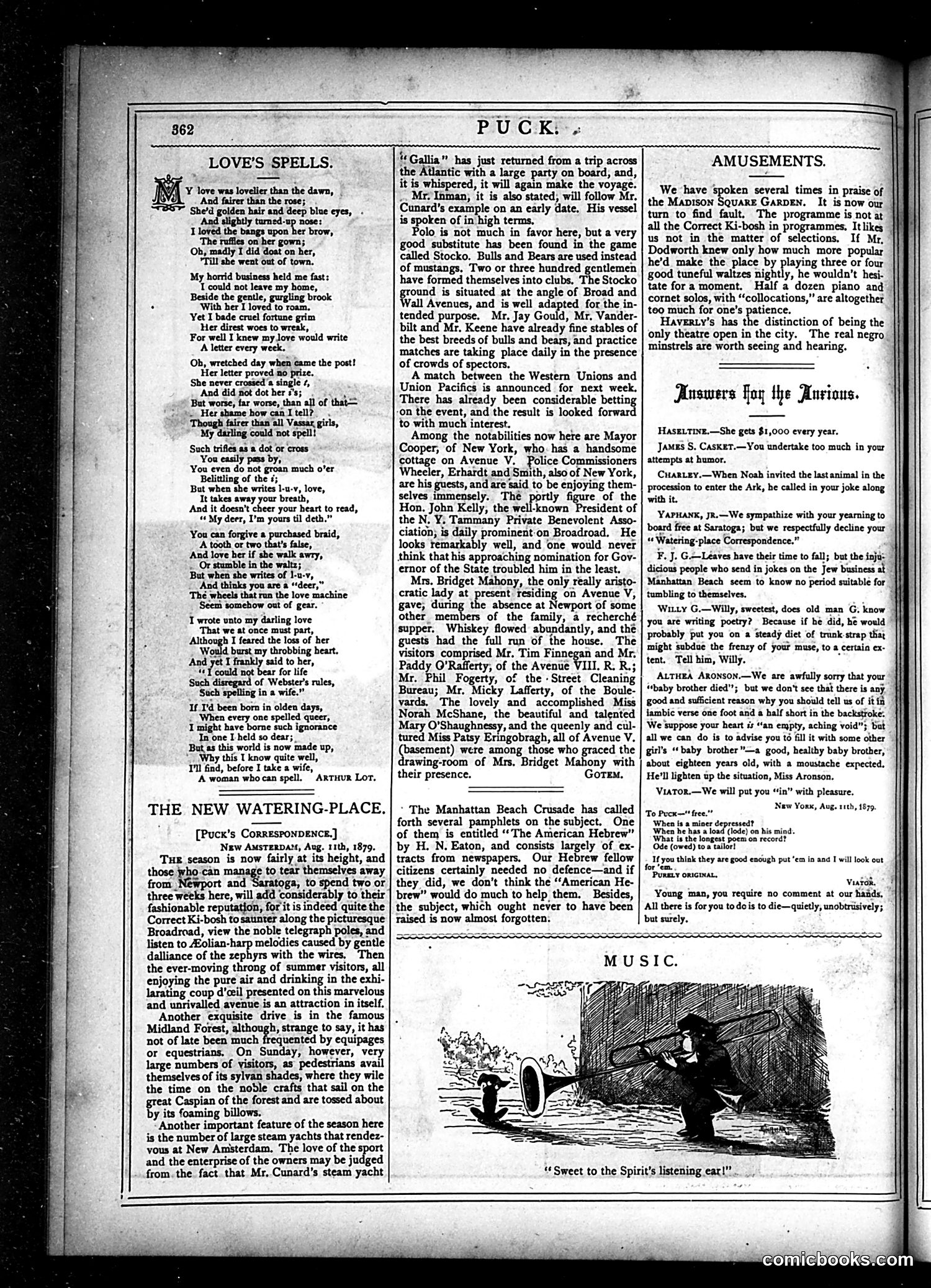
This page contains several distinct sections: "Love's Spells" (a romantic poem), "Answers for the Anxious" (advice column), and "The New Watering-Place" (travel piece about New Amsterdam/the Netherlands). The primary visual content is a small illustration labeled "MUSIC" showing what appears to be a classical or romantic scene with musical instruments and figures by water, captioned "Sweet to the Spirit's listening ear!" The page lacks prominent political cartoons or caricatures. Instead, it focuses on literary content—poetry, advice, and travel writing—typical of Puck's mixed entertainment format. Without clearer identifying details in the images or text, I cannot specify particular political figures or contemporary references being satirized on this specific page.
This page is primarily **literary content, not political satire**. It presents "Archie Gascoyne: A Romance of Skye," a serialized story by John Fraser, written expressly for Puck magazine. The text is Chapter XVIII of a romantic narrative set in Scotland. It contains no political cartoons or satirical commentary on contemporary events or figures. Instead, it consists of prose fiction involving characters like the Count, the Doctor, Bob, and Flora—with plot elements concerning a mountain spring, social comedy, and romantic entanglements. While Puck was known for satire, this particular page serves as **serialized entertainment rather than political commentary**. The humor derives from the narrative itself rather than topical satire.
This page features a poem titled "Puck's Archipelago" with accompanying illustration of what appears to be cherubs or putti in water. The poem uses maritime metaphors to describe romantic and social scenes—"lovers stroll in the glinting gloam," references to boats and water gates. The right column contains miscellaneous satirical notes and observations typical of Puck's format, including jibes at various social figures and institutions. Without clearer identification of specific contemporary references in these brief items, I cannot definitively explain particular political targets, though the tone suggests criticism of diplomatic corps, old-age questions, and gender-related social customs of the period. The page appears primarily literary/poetic rather than cartoon-focused.
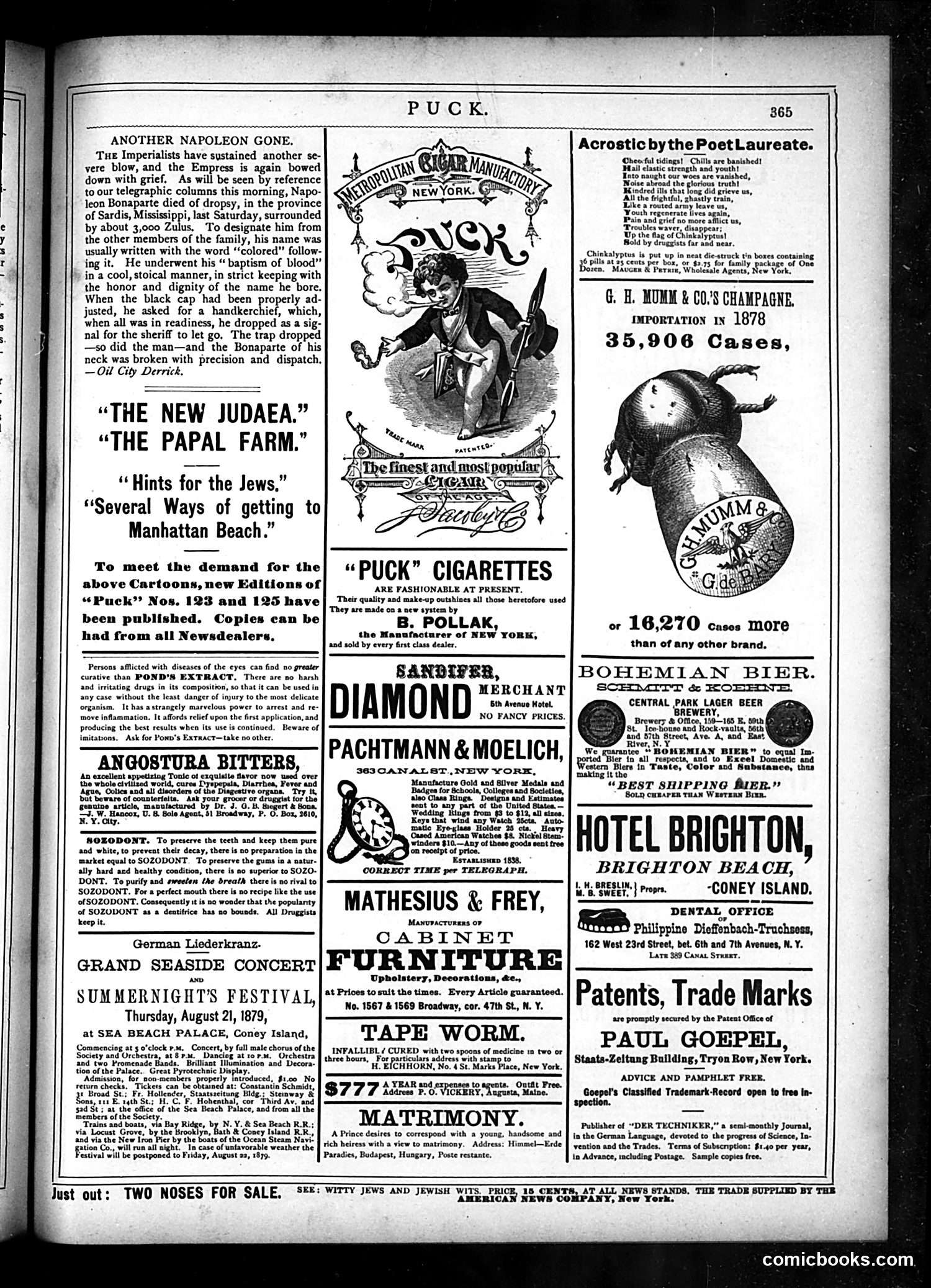
This page is primarily **advertisements and notices** rather than political satire. The main cartoon depicts a jester or fool-like figure labeled "PUCK" - the magazine's mascot - advertising cigarettes manufactured by B. Pollak of New York. The left column contains editorial notices about Puck's publications and a "Grand Seaside Concert/Summernight's Festival" event scheduled for August 21, 1879. The rest of the page features commercial advertisements for champagne, beer, furniture, dental services, and other goods typical of late-19th-century New York. The content reflects Puck's dual role as both satirical publication and advertising vehicle for urban merchants and manufacturers of the era.
This is primarily an **advertising page** from Puck magazine (page 366), not a political cartoon. It contains numerous commercial advertisements typical of the era, including: - Louisiana State Lottery - Keppich & Co. cigars - Metropolitan Elevated Railway schedules - Isaac Smith's Umbrellas - Thonet Brothers furniture - Brokhahnes' shaving apparatus - E. Krueger (photographer) - Nicoll the Tailor - Various other period businesses The page includes a notable **student lamp advertisement** by E.D. Bassford, featuring an illustration of an adjustable oil lamp—a common household item of the era. There are no political cartoons or satirical content visible; this is a straightforward commercial directory page reflecting late 19th or early 20th-century New York City businesses.
This is primarily an **advertising page** from Puck magazine (page 367), not a political cartoon. The page features multiple advertisements for: - **Peter Doelger's Lager Beer** (brewery at 405-433 East 55th St., NY) — prominently displayed with their award medals and an illustration of what appears to be a fair or public gathering - **A. Werner & Co.'s "America" Champagne** (Extra Dry) - **Heller & Bro.'s Hungarian wines and liquors** at multiple locations - Various other services (book binding, financial bonds, banking) The advertisements showcase late 19th-century commercial products and services available to New York readers, reflecting the beverage and business culture of the era. There is **no political satire or cartoon content visible** on this particular page.
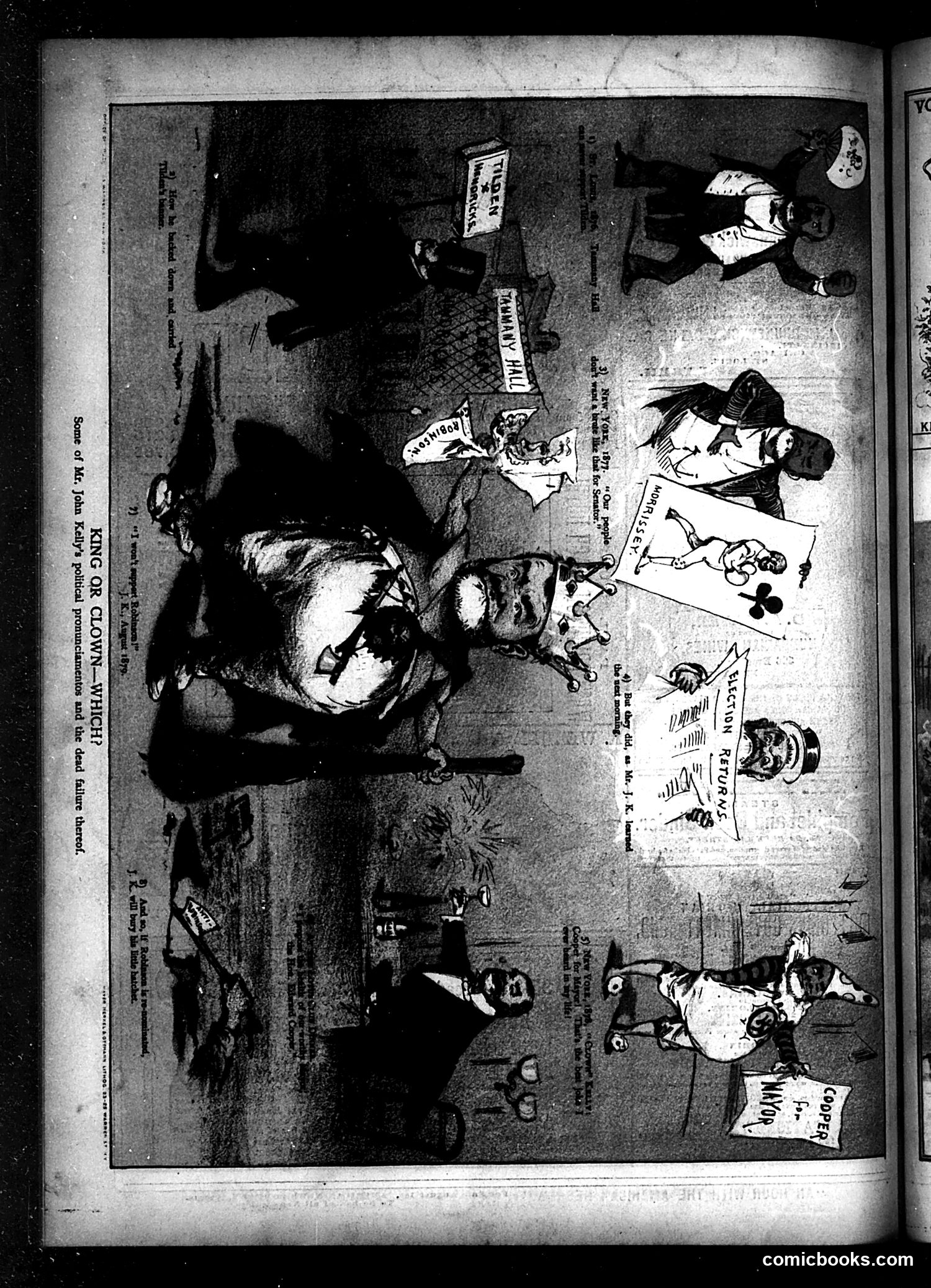
This page from *Puck* magazine contains satirical cartoons, though the image quality makes complete details difficult to discern. The main large illustration on the left appears to show a rotund figure in period dress, likely representing a political or social figure of the era. The smaller panels on the right contain character studies or sequential narrative moments with dialogue balloons. The text reference to "KING OR COLONIST-WHICH?" suggests the cartoons address American colonial or post-colonial political debates—possibly about authority, representation, or governance structures. Without clearer image resolution, I cannot confidently identify specific individuals or pinpoint the exact historical event or controversy being satirized, though the overall thrust appears critical of political power or social hierarchy.