
Puck, 1879-08-13 · page 6 of 16
Puck — August 13, 1879 — page 6: what you’re looking at
What you’re looking at
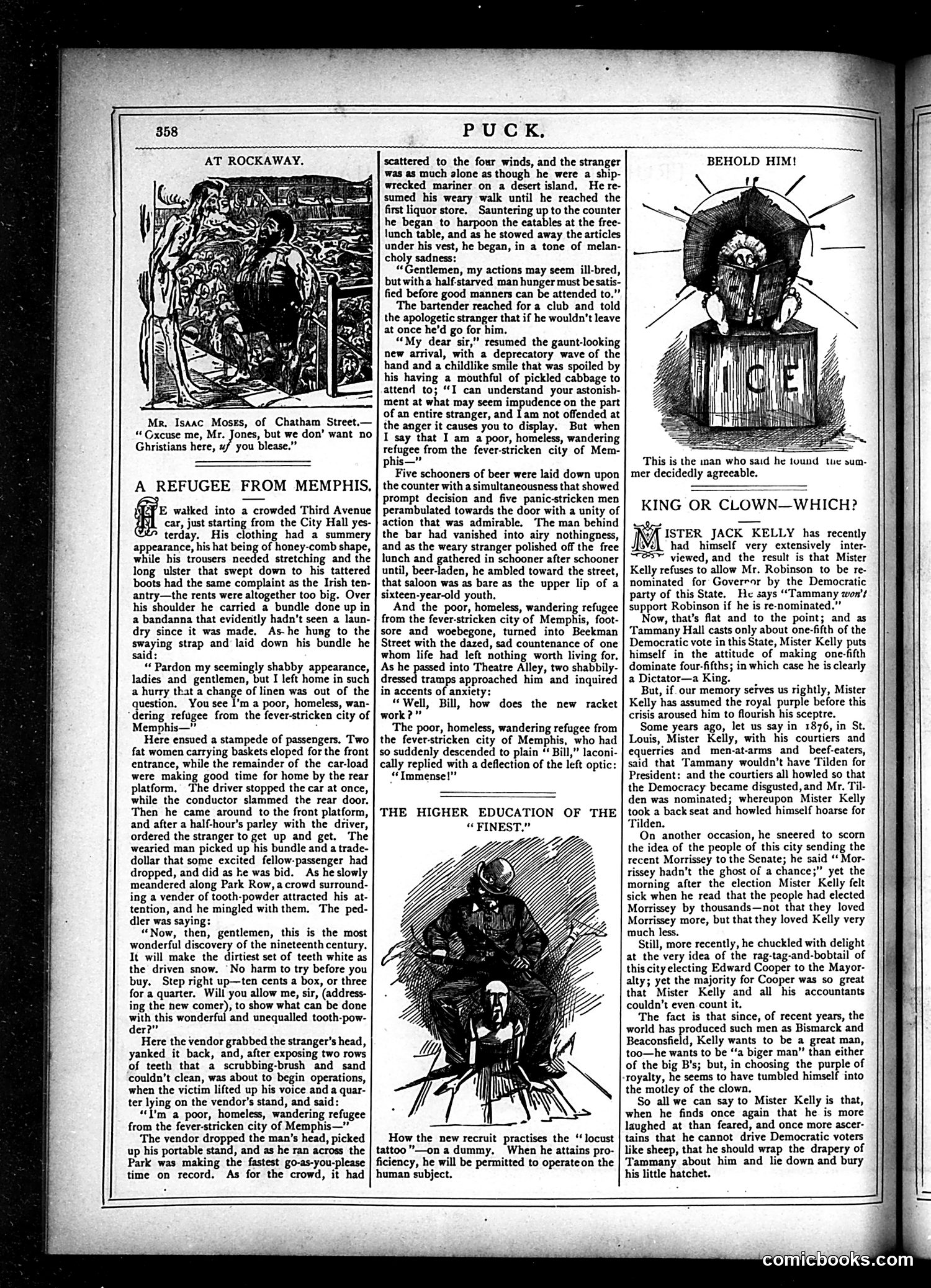
This page contains three distinct political satires targeting Democratic politics in what appears to be the Gilded Age. **"A Refugee from Memphis"** mocks a poor, ragged man arriving in a crowded city—likely satirizing Southern Democratic voters fleeing their regions. **"King or Clown—Which?"** attacks Mister Jack Kelly, a Democratic figure who apparently wants to be nominated as a "great man" but is dismissed as a would-be dictator. The cartoon ridicules his pretensions and vanity, suggesting he's unfit for leadership and should be laughed out of politics. **"The Higher Education of the 'Finest'"** depicts police recruits practicing the "locust tattoo" (beating) on a dummy—dark satire about police brutality and inadequate training in Democratic-controlled cities. The overall theme critiques Democratic urban political machines, corruption, and their effects on city governance and citizens.
📄 Transcribed text from this page (OCR, searchable)
Machine-transcribed from the original scan — historical spelling and the odd misread are preserved.
PUCK. AT ROCKAWAY. Mr. Isaac Moses, of Chatham Street.— “ Oxcuse me, Mr. Jones, but we don’ want no Ghristians here, uf you blease.” A REFUGEE FROM MEMPHIS. E walked into a crowded Third Avenue car, just starting from the City Hall yes- terday. His clothing had a summery appearance, his hat being of honey-comb shape, while his trousers needed stretching and the long ulster that swept down to his tattered boots had the same complaint as the Irish ten- antry—the rents were altogether too big. Over his shoulder he carried a bundle done up in a bandanna that evidently hadn't seen a laun- dry since it was made. As-he hung to the swaying strap and laid down his bundle he said: “ Pardon my seemingly shabby appearance, ladies and gentlemen, but I left home in such a hurry that a change of linen was out of the question. You see I'm a poor, homeless, wan- “dering refugee from the fever-stricken city of Memphis—” Here ensued a stampede of passengers. Two fat women carrying baskets eloped for the front entrance, while the remainder of the car-load were making good time for home by the rear platform. ‘The driver stopped the car at once, while the conductor slammed the rear door. Then he came around to the front platform, and after a half-hour’s parley with the driver, ordered the stranger to get up and get. The wearied man picked up his bundle and a trade- dollar that some excited fellow-passenger had dropped, and did as ke was bid. As he slowly meandered along Park Row, a crowd surround- ing a vender of tooth-powder attracted his at- tention, and he mingled with them, The ped- dler was saying: “Now, then, gentlemen, this is the most wonderful discovery of the nineteenth century, It will make the dirtiest set of teeth white as the driven snow. ‘No harm to try before you buy. Step right up—ten cents a box, or three for a quarter. Will you allow me, sir, (address- ing the new comer), to show what can be done with this wonderful and unequalled tooth-pow- der?” Here the vendor grabbed the stranger’s head, yanked it back, and, after exposing two rows of teeth that a scrubbing-brush and sand couldn’t clean, was about to begin operations, when the victim lifted up his voice and a quar- ter lying on the vendor's stand, and said: “l'm a poor, homeless, wandering refugee from the fever-stricken city of Memphis—” The vendor dropped the man’s head, picked up his portable stand, and as he ran across the Park was making the fastest go-as-you-please time on record. As for the crowd, it had scattered to the four winds, and the stranger was as much alone as though he were a ship- wrecked mariner on a desert island. He re- sumed his weary walk until he reached the first liquor store. Sauntering up to the counter he began to harpoon the eatables at the free- lunch table, and as he stowed away the articles under his vest, he began, in a tone of melan- choly sadness: “Gentlemen, my actions may seem ill-bred, but witha half-starved man hunger must besatis- fied before good manners can be attended to.” The bartender reached for a club and told the apologetic stranger that if he wouldn't leave at once he'd go for him. “My dear sir,” resumed the gaunt-looking new arrival, with a deprecatory wave of the hand and a childlike smile that was spoiled by his having a mouthful of pickled cabbage to attend to; “I can understand your astonish- ment at what may seem impudence on the part of an entire stranger, and 1am not offended at the anger it causes you to display. But when I say that I am a poor, homeless, wandering religee: from the fever-stricken city of Mem- is—" Five schooners of beer were laid down upon the counter with a simultaneousness that showed Prompt decision and five panic-stricken men perambulated towards the door with a unity of action that was admirable. The man behind the bar had vanished into airy nothingness, and as the weary stranger polished off the free lunch and gathered in schooner after schooner until, beer-laden, he ambled toward the street, that saloon was as bare as the upper lip of a sixteen-year-old youth, And the poor, homeless, wandering refugee from the fever-stricken city of Memphis, foot- sore and woebegone, turned into Beekman Street with the dazed, sad countenance of one whom life had left nothing worth living for. As he passed into Theatre Alley, two shabbily- dressed tramps approached him’ and inquired in accents of anxiety: “Well, Bill, how does the new racket work ?”” ‘The poor, homeless, wandering refugee from the fever-stricken city of Memphis, who had so suddenly descended to plain “ Bill,” laconi- cally replied with a deflection of the left optic: “Immense!” THE HIGHER EDUCATION OF THE “ FINEST.” How the new recruit practises the ‘locust tattoo”—on a dummy. When he attains pro- ficiency, he will be permitted to operateon the human subject. BEHOLD HIM! This is the man who said he tound tue sum- mer decidedly agreeable. KING OR CLOWN—WHICH? (WoL had himself very extensively inter- Mi ISTER JACK KELLY has recently viewed, and the result is that Mister Kelly refuses to allow Mr. Robinson to be re- nominated for Goverror by the Democratic party of this State. He says “Tammany won't support Robinson if he is re-nominated.” Now, that’s flat and to the point; and as Tammany Hall casts only about one-fifth of the Democratic vote in this State, Mister Kelly puts himself in the attitude of making one-fifth dominate four-fifths; in which case he is clearly a Dictator—a King. But, if our memory seives us rightly, Mister Kelly has assumed the royal purple before this crisis aroused him to flourish his sceptre. Some years ago, let us say in 1876, in St. Louis, Mister Kelly, with his courtiers and equerries and men-at-arms and beef-eaters, said that Tammany wouldn’t have Tilden for President: and the courtiers all howled so that the Democracy became disgusted, and Mr. Til- den was nominated; whereupon Mister Kelly took a back seat and howled himself hoarse for Tilden. On another occasion, he sneered to scorn the idea of the people of this city sending the recent Morrissey to the Senate; he said ‘ Mor- rissey hadn’t the ghost of a chance;" yet the morning after the election Mister Kelly felt sick when he read that the people had elected Morrissey by thousands—not that they loved Morrissey more, but that they loved Kelly very much less, Still, more recently, he chuckled with delight at the very idea of the rag-tag-and-bobtail of this city electing Edward Cooper to the Mayor- alty; yet the majority for Cooper was so great that Mister Kelly and all his accountants couldn’t even count it. The fact is that since, of recent years, the world has produced such men as Bismarck and Beaconsfield, Kelly wants to be a great man, too—he wants to be ‘“‘a biger man” than either of the big B's; but, in choosing the purple of royalty, he seems to have tumbled himself into the motley of the clown, So all we can say to Mister Kelly is that, when he finds once again that he is more laughed at than feared, and once more ascer- tains that he cannot drive Democratic voters like sheep, that he should wrap the drapery of ‘Tammany about him and lie down and bury his little hatchet. Comicbooks.com ~