
Puck, 1879-08-13 · page 4 of 16
Puck — August 13, 1879 — page 4: what you’re looking at
What you’re looking at
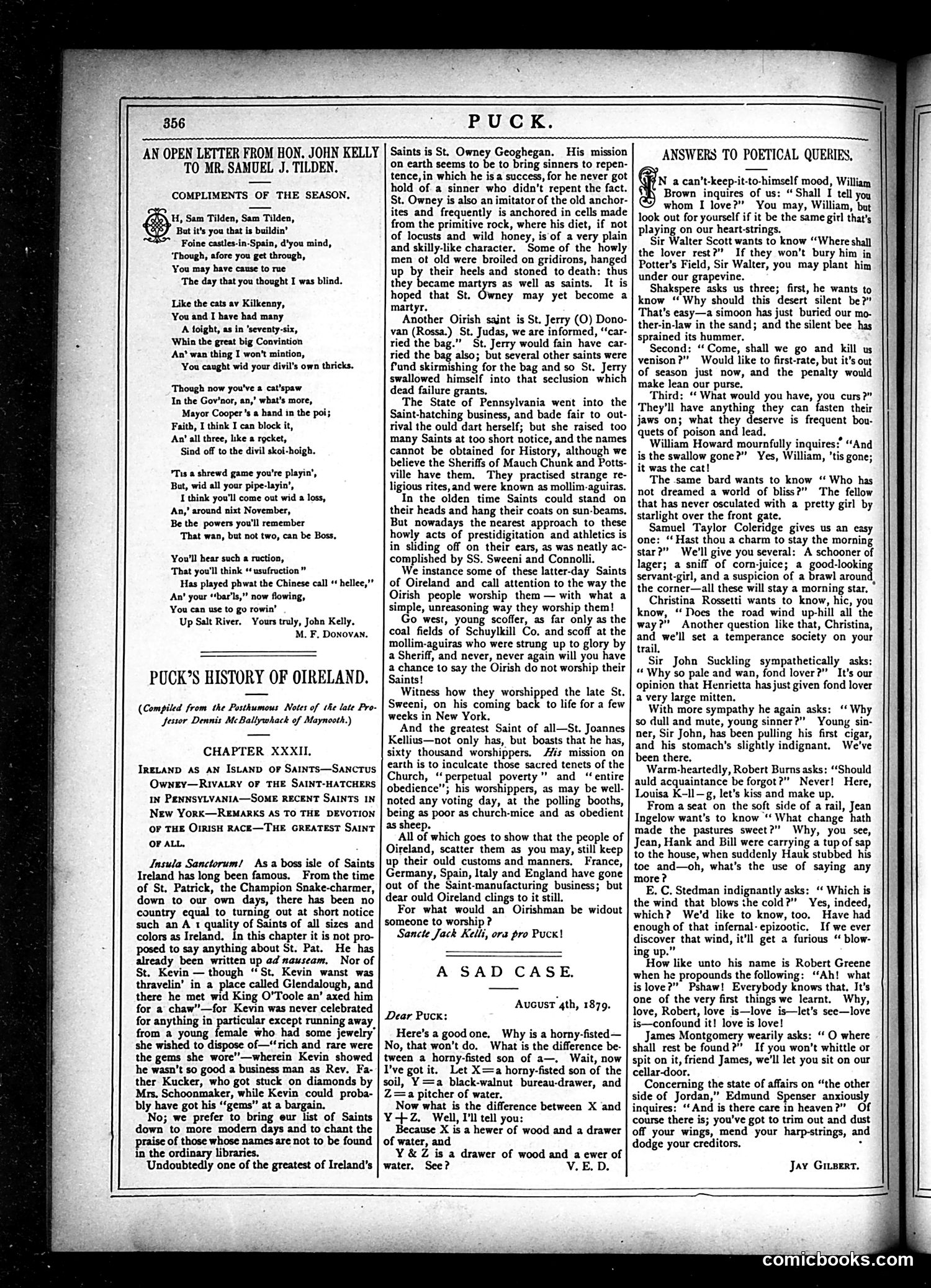
This page contains primarily **text content** rather than political cartoons. The main sections include: 1. **"An Open Letter from Hon. John Kelly to Mr. Samuel J. Tilden"** — a satirical poem addressing two Democratic political figures, likely from the 1870s-80s era. 2. **"Puck's History of Ireland"** — a historical essay about Irish saints and their veneration, particularly St. Owney and other figures. 3. **"Answers to Poetical Queries"** — a humor column addressing reader submissions about relationships and social situations. 4. **"A Sad Case"** — a mathematical puzzle presented as comic correspondence. The page demonstrates Puck's characteristic mix of political satire, historical commentary, and reader-response humor, though without visible illustrations on this particular page.
📄 Transcribed text from this page (OCR, searchable)
Machine-transcribed from the original scan — historical spelling and the odd misread are preserved.
PUCK. AN OPEN LETTER FROM HON. JOHN KELLY TO MR. SAMUEL J. TILDEN. COMPLIMENTS OF THE SEASON, H, Sam Tilden, Sam Tilden, But it's you that is buildin’ Foine castles-in-Spain, d’you mind, ‘Though, afore you get through, ‘You may have cause to rue ‘The day that you thought I was blind. Like the cats av Kilkenny, You and I have had many A toight, as in ‘seventy-six, Whin the great big Convintion An’ wan thing I won't mintion, ‘You caught wid your divil’s own thricks. Though now you've a cat'spaw In the Gov'nor, an,’ what's more, Mayor Cooper’s a hand in the pois Faith, I think I can block it, An’ all three, like a rocket, Sind off to the divil skoi-hoigh. ‘Tus a shrewd game you're playin’, But, wid all your pipe-layin’, I think you'll come out wid a loss, An,’ around nist November, Be the powers you'll remember That wan, but not two, can be Boss, You'll hear such a ruction, ‘That you'll think “usufruction” Has played phwat the Chinese call + hellee,"* ‘An' your “bar'ls,”” now flowing, You can use to go rowin’ Up Salt River. Yours truly, John Kelly. M. F, Donovan. POCK’S HISTORY OF OIRELAND. (Compiled from the Posthumous Notes of the late Pro- fessor Dennis McBallywhack of Maynooth.) CHAPTER XXXII. IRELAND AS AN IsLAND oF SaInTS—SANCTUS Owngy—RIVALRY OF THE SAINT-HATCHERS IN PENNSYLVANIA—SOME RECENT SAINTS IN New YorK—REMARKS AS TO THE DEVOTION OF THE O1RISH RACE—THE GREATEST SAINT OF ALL, Insula Sanctorum! Asa boss isle of Saints Ireland has long been famous. From the time of St. Patrick, the Champion Snake-charmer, down to our own days, there has been no country equal to turning out at short notice such an A 1 quality of Saints of all sizes and colors as Ireland. In this chapter it is not pro- posed to say anything about St. Pat. He has already been written up ad nauseam. Nor of St. Kevin — though “St. Kevin wanst was thravelin’ in a place called Glendalough, and there he met wid King O'Toole an’ axed him for a chaw”—for Kevin was never celebrated for anything in particular except running away from apoag female who had some ‘ewelty" she wished to dispose of—‘“rich and rare were the gems she wore’—wherein Kevin showed he wasn’t so good a business man as Rev. Fa- ther Kucker, who got stuck on diamonds by Mrs. Schoonmaker, while Kevin could proba- bly have got his “gems” at a bargain. ‘No; we prefer to bring eur list of Saints down to more modern days and to chant the praise of those whose names are not to be found in the ordi libraries. Saints is St. Owney Geoghegan. His mission on earth seems to be to bring sinners to repen- tence, in which he isa success, for he never got hold of a sinner who didn't repent the fact. St. Owney is also an imitator of the old anchor- ites and frequently is anchored in cells made from the primitive rock, where his diet, if not of locusts and wild honey, is‘of a very plain and skilly-like character. Some of the howly men ot old were broiled on gridirons, hanged up by their heels and stoned to death: thus they became martyrs as well as saints. It is hoped that St. Owney may yet become a martyr. Another Oirish sajnt is St. Jerry (O) Dono- van (Rossa.) St. Judas, we are informed, “car- ried the bag.” St. Jerry would fain have car- ried the bag also; but several other saints were fund skirmishing for the bag and so St. Jerry swallowed himself into that seclusion which dead failure grants. The State of Pennsylvania went into the Saint-hatching business, and bade fair to out- rival the ould dart herself; but she raised too many Saints at too short notice, and the names cannot be obtained for History, although we believe the Sheriffs of Mauch Chunk and Potts- ville have them. They practised strange re- ligious rites, and were known as mollim-aguiras. In the olden time Saints could stand on their heads and hang their coats on sun-beams, But nowadays the nearest approach to these howly acts of prestidigitation and athletics is in sliding off on their ears, as was neatly ac- complished by SS. Sweeni and Connolli. We instance some of these latter-day Saints of Oireland and call attention to the way the Oirish people worship them — with what a simple, unreasoning way they worship them! Go west, young scoffer, as far only as the coal fields of Schuylkill Co, and scoff at the mollim-aguiras who were strung up to glory by a Sheriff, and never, never again will you have a chance to say the Oirish do not worship their Saints! Witness how they worshipped the late St. Sweeni, on his coming back to life for a few weeks in New York. And the greatest Saint of all—St. Joannes Kellius—not only has, but boasts that he has, sixty thousand worshippers, Ais mission on earth is to inculcate those sacred tenets of the Church, “ perpetual poverty” and “entire obedience”; his worshippers, as may be well- noted any voting day, at the polling booths, being as poor as church-mice and as obedient as sheep, All of which goes to show that the people of Oireland, scatter them as you may, still keep up their ould customs and manners. France, Germany, Spain, Italy and England have gone out of the Saint-manufacturing business; but dear ould Oireland clings to it still. For what would an Oirishman be widout someone to worship ? Sancte Jack Kelli, ora pro Puck! A SAD CASE, Avcusr 4th, 1879. Dear Puck: Here's a goodone, Why is a horny-fisted— No, that won’t do. What is the difference be- tween a horny-fisted son of a—. Wait, now I've got it. Let X=a horny-fisted son of the soil, Y =a black-walnut bureau-drawer, and Z=a pitcher of water. Now what is the difference between X and Y+Z. Well, I'll tell you: Because X is a hewer of wood and a drawer of water, an Y & Z is a drawer of wood and a ewer of Undoubtedly one of the greatest of Ireland’s water, See? V. E. D. ANSWERS TO POETICAL QUERIES. N acan’t-keep-it-to-himself mood, William Brown inquires of us: “Shall I tell whom I love?” You may, William, but look out for yourself if it be the same girl that’s playing on our heart-strings. Sir Walter Scott wants to know ‘Where shall the lover rest?” If they won't bury him in Potter’s Field, Sir Walter, you may plant him under our grapevine. Shakspere asks us three; first, he wants to know “Why should this desert silent be?” That's easy—a simoon has just buried our mo- ther-in-law in the sand; and the silent bee has sprained its hummer. Second: “Come, shall we go and kill us venison?” Would like to first-rate, but it's out of season just now, and the penalty would make lean our purse. Third: ‘‘ What would you have, you curs?” They'll have anything they can fasten their jaws on; what they deserve is frequent bou- quets of poison and lead. William Howard mournfully inquires: “And is the swallow gone?” Yes, William, ’tis gone; it was the cat! The .same bard wants to know ‘ Who has not dreamed a world of bliss?” ‘The fellow that has never osculated with a pretty girl by starlight over the front gate. Samuel Taylor Coleridge gives us an easy one: ‘“ Hast thou a charm to stay the morning star?” We'll give you several: A schooner of lager; a sniff of corn-juice; a good-lookin; servant-girl, and a suspicion of a brawl around, the corner—all these will stay a morning star, Christina Rossetti wants to know, hic, you know, “Does the road wind up-hill all the way?” Another question like that, Christina, and we'll set a temperance society on your trail. Sir John Suckling sympathetically asks: “Why 30 pale and wan, fond lover?” It’s our opinion that Henrietta has just given fond lover a very large mitten, With more sympathy he again asks: ‘Why so dull and mute, young sinner?” Young sin- ner, Sir John, has been pulling his first cigar, and his stomach's slightly indignant. We've been there, Warm-heartedly, Robert Burns asks: “Should auld acquaintance be forgot?” Never! Here, Louisa K-ll—g, let’s kiss and make up. From a seat on the soft side of a rail, Jean Ingelow want's to know ‘‘ What change hath made the pastures sweet?” Why, you see, Jean, Hank and Bill were carrying a tup of sap to the house, when suddenly Hauk stubbed his toe and—oh, what’s the use of saying any more? E. C. Stedman indignantly asks: ‘ Which is the wind that blows the cold?” Yes, indeed, which? We'd like to know, too, Have had enough of that infernal- epizootic. If we ever discover that wind, it'll get a furious “ blow- ing up.” How like unto his name is Robert Greene when he propounds the following: “Ah! what is love?” Pshaw! Everybody knows that. It’s one of the very first things we learnt. Why, love, Robert, love is—love is—let's see—love is—confound it! love is love! James Montgomery wearily asks: ‘‘O where shall rest be found?” If you won't whittle or spit on it, friend James, we'll let you sit on our cellar-door, Concerning the state of affairs on “‘the other side of Jordan,” Edmund Spenser anxiously inquires: ‘And is there care in heaven?” Of course there is; you've got to trim out and dust off your wings, mend your harp-strings, and dodge your creditors. . Jay Grert.