
Puck, 1879-08-13 · page 11 of 16
Puck — August 13, 1879 — page 11: what you’re looking at
What you’re looking at
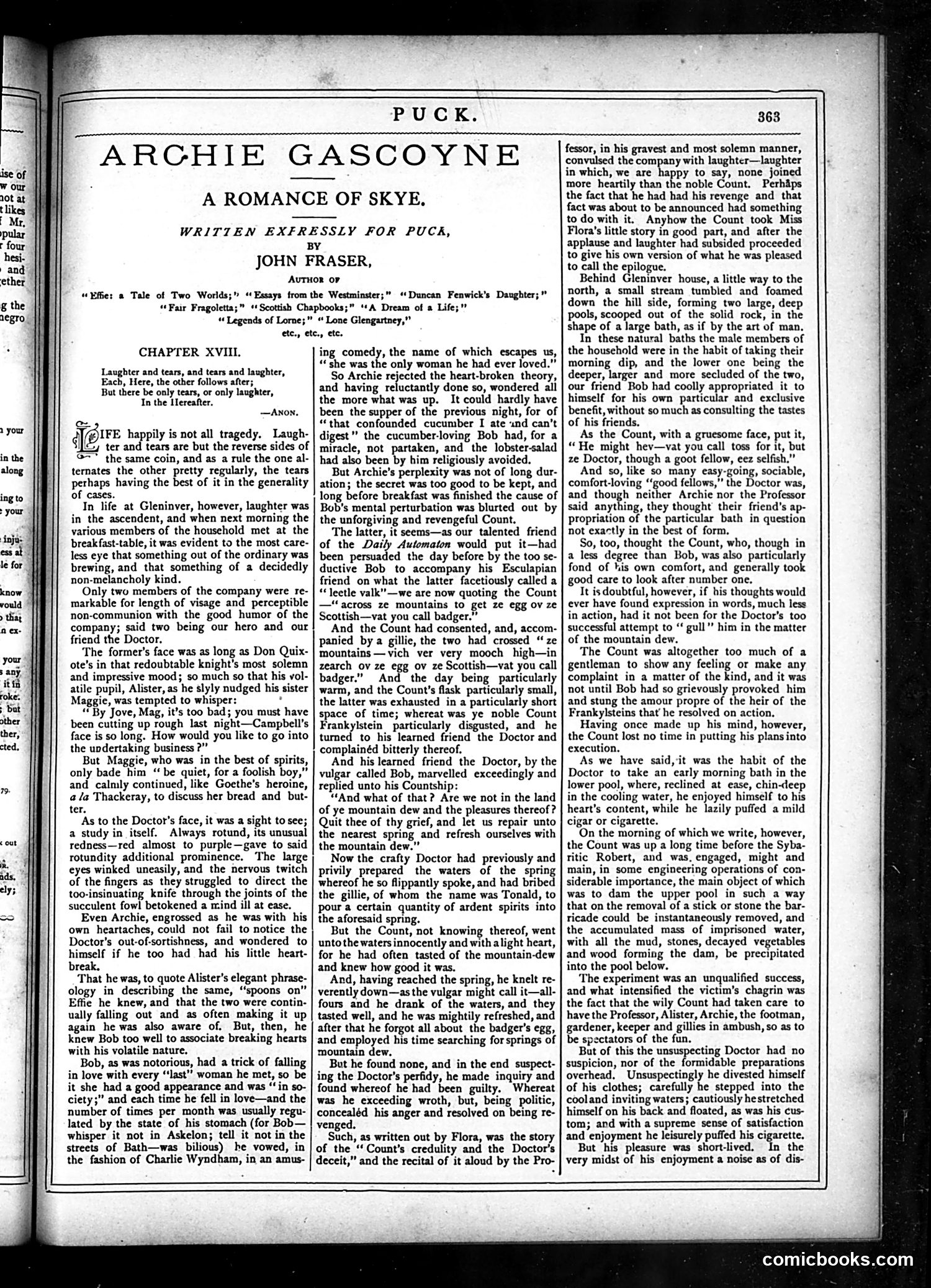
This page is primarily **literary content, not political satire**. It presents "Archie Gascoyne: A Romance of Skye," a serialized story by John Fraser, written expressly for Puck magazine. The text is Chapter XVIII of a romantic narrative set in Scotland. It contains no political cartoons or satirical commentary on contemporary events or figures. Instead, it consists of prose fiction involving characters like the Count, the Doctor, Bob, and Flora—with plot elements concerning a mountain spring, social comedy, and romantic entanglements. While Puck was known for satire, this particular page serves as **serialized entertainment rather than political commentary**. The humor derives from the narrative itself rather than topical satire.
📄 Transcribed text from this page (OCR, searchable)
Machine-transcribed from the original scan — historical spelling and the odd misread are preserved.
PUCK. 363 ARGHIE GASCOYNE A ROMANCE OF SKYE. WRITTEN EXFRESSLY FOR PUCK, BY JOHN FRASER, AvuTHOR oF “fier a Tale of Two Worlds;” «Essays from the Westminster;" Duncan Fenwick's Daughter; ” «Fair Fragoletta;” “Scottish Chapbooks;" “A Dream of a Life;” «Legends of Lorne; “ Lone Glengartney,” ete, eta, etc. CHAPTER XVIII. Laughter and tears, and tears and laughter, Each, Here, the other follows after; But there be only tears, or only laughter, In the Hereafter. —ANon. om ene happily is not all tragedy. Laugh- W) ter and tears are but the reverse sides of @" the same coin, and as a rule the one al- ternates the other pretty regularly, the tears perhaps having the best of it in the generality of cases. In life at Gleninver, however, laughter was in the ascendent, and when next morning the various members of the household met at the breakfast-table, it was evident to the most care- less eye that something out of the ordinary was brewing, and that something of a decidedly non-melancholy kind. Only two members of the company were re- markable for length of visage and perceptible non-communion with the good humor of the company; said two being our hero and our friend the Doctor. The former's face was as long as Don Quix- ote’s in that redoubtable knight's most solemn and impressive mood; so much so that his vol- atile pupil, Alister, as he slyly nudged his sister Maggie, was tempted to whisper: . «By Jove, Mag, it’s too bad; you must have been cutting up rough last night—Campbell’s face is so long. How would you like to go into the undertaking business ?” But Maggie, who was in the best of spirits, only bade him ‘be quiet, for a foolish boy,” and calmly continued, like Goethe's heroine, ala Thackeray, to discuss her bread and but- ter. As to the Doctor's face, it was a sight to see; a study in itself. Always rotund, its unusual redness—red almost to purple—gave to said rotundity additional prominence. ‘The large eyes winked uneasily, and the nervous twitch of the fingers as they struggled to direct the too-insinuating knife through the joints of the succulent fowl betokened a mind ill at ease. Even Archie, engrossed as he was with his own heartaches, could not fail to notice the Doctor’s out-of-sortishness, and wondered to himself if he too had had his little heart- break. That he was, to quote Alister’s elegant phrase- ology in describing the same, “spoons on” Effie he knew, and that the two were contin- ually falling out and as often making it up again he was also aware of. But, then, he knew Bob too well to associate breaking hearts with his volatile nature, Bob, as was notorious, had a trick of falling in love with every “last” woman he met, so be it she had a good ap, ce and was “‘in so- ciety;” and each time he fell in love—and the number of times per month was usually regu- lated by the state of his stomach (for Bob— whisper it not in Askelon; tell it not in the streets of Bath—was bilious) he vowed, in the fashion of Charlie Wyndham, in an amus- ing comedy, the name of which escapes us, “she was the only woman he had ever loved.” So Archie rejected the heart-broken theory, and having reluctantly done so, wondered all the more what was up. It could hardly have been the supper of the previous night, for of “that confounded cucumber I ate und can’t digest” the cucumber-loving Bob had, for a miracle, not partaken, and the lobster-salad had also been by him religiously avoided. But Archie's perplexity was not of long dur- ation; the secret was too good to be kept, and long before breakfast was finished the cause of Bob's mental perturbation was blurted out by the unforgiving and revengeful Count. The latter, it seems—as our talented friend of the Daily Automaton would put it—had been persuaded the day before by the too se- ductive Bob to accompany his Esculapian friend on what the latter facetiously called a “leetle valk" —we are now quoting the Count —‘‘across ze mountains to get ze egg ov ze Scottish—vat you call badger.” And the Count had consented, and, accom- panied by a gillie, the two had crossed “ ze mountains —vich ver very mooch high—in zearch ov ze egg ov ze Scottish—vat you call badger.” And the day being particularly warm, and the Count’s flask particularly small, the latter was exhausted in a particularly short space of time; whereat was ye noble Count Frankylstein particularly disgusted, and he turned to his learned friend the Doctor and complainéd bitterly thereof. And his learned friend the Doctor, by the vulgar called Bob, marvelled exceedingly and replied unto his Countship: “And what of that? Are we not in the land of ye mountain dew and the pleasures thereof? Quit thee of thy grief, and let us repair unto the nearest spring and refresh ourselves with the mountain dew.” Now the crafty Doctor had previously and privily prepared the waters of the spring whereof he so flippantly spoke, and had bribed the gillie, of whom the name was Tonald, to pour a certain quantity of ardent spirits into the aforesaid spring. But the Count, not knowing thereof, went unto the waters innocently and with alight heart, for he had often tasted of the mountain-dew and knew how good it was. And, having reached the spring, he knelt re- verently down—as the vulgar might call it—all- fours and he drank of the waters, and they tasted well, and he was mightily refreshed, and after that he forgot all about the badger’s egg, and employed his time searching for springs of mountain dew. But he found none, and in the end suspect- ing the Doctor's perfidy, he made inquiry and found whereof he had been guilty. Whereat was he exceeding wroth, but, being politic, concealéd his anger and resolved on being re- venged. Such, as written out by Flora, was the story of the ‘‘Count’s credulity and the Doctor's deceit,” and the recital of it aloud by the Pro- fessor, in his gravest and most solemn manner, convulsed the company with laughter—laughter in-whichiwe?areihs py to say, none joined more heartily than the noble Count. Perhaps the fact that he had had his revenge and that fact was about to be announced had something to do with it. Anyhow the Count took Miss Flora’s little story in good part, and after the applause and laughter had subsided proceeded to give his own version of what he was pleased to call the epilogue. Behind Gleninver house, a little way to the north, a small stream tumbled and foamed down the hill side, forming two large, deep pools, scooped out of the solid rock, in the shape of a large bath, as if by the art of man, In these natural baths the male members of the household were in the habit of taking their morning dip, and the lower one being the deeper, larger and more secluded of the two, our friend Bob had coolly appropriated it to himself for his own particular and exclusive benefit, without so much as consulting the tastes of his friends. As the Count, with a gruesome face, put it, “He might hev—vat you call toss for it, but ze Doctor, though a goot fellow, eez selfish.” And so, like so many easy-going, sociable, comfort-loving “(good fellows,” the Doctor was, and though neither Archie nor the Professor said anything, they thought their friend's ap- propriation of the particular bath in question not exactly in the best of form. So, too, thought the Count, who, though in a less degree than Bob, was also particularly fond of his own comfort, and generally took good care to look after number one. It is doubtful, however, if his thoughts would ever have found expression in words, much less in action, had it not been for the Doctor’s too successful attempt to “‘ gull”? him in the matter of the mountain dew. The Count was altogether too much of a gentleman to show any feeling or make any complaint in a matter of the kind, and it was not until Bob had so grievously provoked him and stung the amour propre of the heir of the Frankylsteins that’ he resolved on action, Having once made up his mind, however, the Count lost no time in putting his plans into execution. As we have said, it was the habit of the Doctor to take an early morning bath in the lower pool, where, reclined at ease, chin-leep in the cooling water, he enjoyed himself to his heart’s content, while he lazily puffed a mild cigar or cigarette. On the morning of which we write, however, the Count was up a long time before the Syba- ritic Robert, and was, engaged, might and main, in some engineering operations of con- siderable importance, the main object of which was to dam the upper pool in such a way that on the removal of a stick or stone the bar- ricade could be instantaneously removed, and the accumulated mass of imprisoned water, with all the mud, stones, decayed vegetables and wood forming the dam, be precipitated into the pool below. ‘The experiment was an unqualified success, and what intensified the victim’s chagrin was the fact that the wily Count had taken care to have the Professor, Alister, Archie, the footman, gardener, keeper and gillies in ambush, so as to be spectators of the fun. But of this the unsuspecting Doctor had no suspicion, nor of the formidable preparations overhead. Unsuspectingly he divested himself of his clothes; carefully he stepped into the cooland inviting waters; cautiously hestretched himself on his back and floated, as was his cus- tom; and with a supreme sense of satisfaction and enjoyment he leisurely puffed his cigarette, But his pleasure was short-lived. In the very midst of his enjoyment a noise as of dis- comicbooks.com