
Puck, 1879-08-13 · page 3 of 16
Puck — August 13, 1879 — page 3: what you’re looking at
What you’re looking at
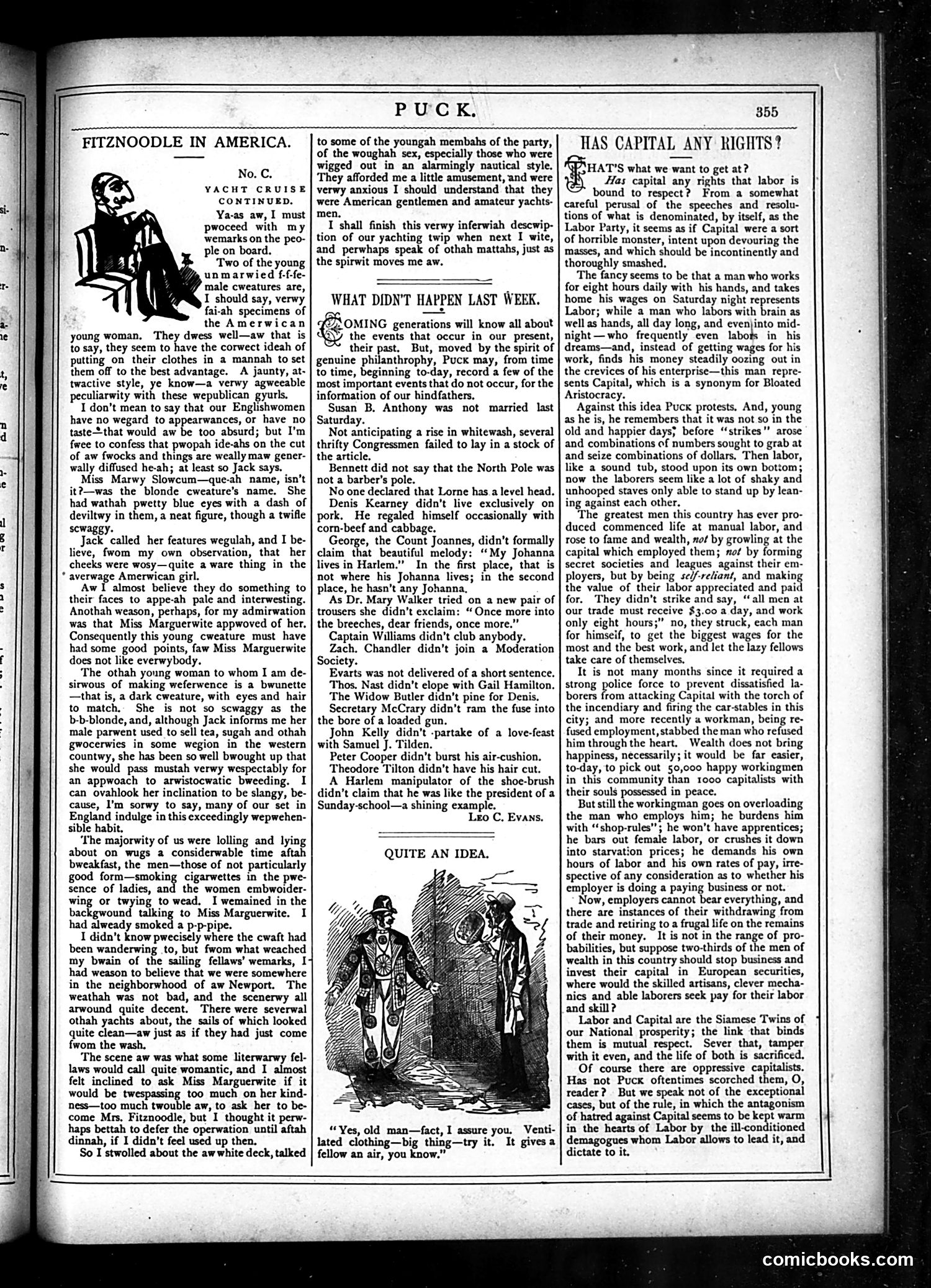
This page contains three distinct sections: 1. **"Fitznoodle in America" (top left)**: A serialized story about a snobbish English yacht-club visitor observing American social customs and romance. 2. **"What Didn't Happen Last Week" (center)**: A satirical column listing fictional events that *didn't* occur—a comedic format mocking contemporary scandals, labor disputes, and political figures. It references various failed "strikes" and scandals involving named individuals, suggesting actual controversies readers would recognize. 3. **"Quite an Idea" (bottom right)**: A cartoon with two figures in period dress, accompanying text about ventilated clothing as a humorous concept. 4. **"Has Capital Any Rights?" (right column)**: A serious political essay debating labor and capital relations, arguing both deserve respect but criticizing exploitative capitalist practices. The page blends humor with earnest social commentary typical of Puck's satirical approach.
📄 Transcribed text from this page (OCR, searchable)
Machine-transcribed from the original scan — historical spelling and the odd misread are preserved.
PUCK. 355 FITZNOODLE IN AMERICA. No. C. YACHT CRUISE CONTINUED. Ya-as aw, I must pwoceed with my wemarks on the peo- ple on board, Two of the young unmarwied f-f-fe- male cweatures are, I should say, verwy fai-ah specimens of the Amerwican young woman, They dwess well—aw that is to say, they seem to have the corwect ideah of putting on their clothes in a mannah to set them off to the best advantage. A jaunty, at- twactive style, ye know—a verwy agweeable peculiarwity with these wepublican gyurls. I don’t mean to say that our Englishwomen have no wegard to appearwances, or have no tastethat would aw be too absurd; but I'm fwee to confess that pwopah ide-ahs on the cut of aw fwocks and things are weally maw gener- wally diffused he-ah; at least so Jack says. Miss Marwy Slowcum—que-ah name, isn’t it?—was the blonde cweature’s name. She had wathah pwetty blue eyes with a dash of deviltwy in them, a neat figure, though a twifle wagey. Jack called her features wegulah, and I be- lieve, fwom my own observation, that her cheeks were wosy—quite a ware thing in the . averwage Amerwican girl. Aw TI almost believe they do something to their faces to appe-ah pale and interwesting. Anothah weason, perhaps, for my admirwation was that Miss Marguerwite appwoved of her, Consequently this young cweature must have had some good points, faw Miss Marguerwite does not like everwybody. ‘The othah young woman to whom I am de- sirwous of making weferwence is a bwunette —that is, a dark cweature, with eyes and hair to match, She is not so scwaggy as the b-b-blonde, and, although Jack informs me her male parwent used to sell tea, sugah and othah gwocerwies in some wegion in the western countwy, she has been so well bwought up that she would pass mustah verwy wespectably for an appwoach to arwistocwatic bweeding. I can ovahlook her inclination to be slangy, be- cause, I'm sorwy to say, many of our set in England indulge in this exceedingly wepwehen- sible habit, ‘The majorwity of us were lolling and lying about on wugs a considerwable time aftah bweakfast, the men—those of not particularly good form—smoking cigarwettes in the pwe- sence of ladies, and the women embwoider- wing or twying to wead. I wemained in the backgwound talking to Miss Marguerwite. I had alweady smoked a P-P-pipe. I didn’t know pwecisely where the cwaft had been wanderwing to, but fwom what weached my bwain of the sailing fellaws’ wemarks, I had weason to believe that we were somewhere in the neighborwhood of aw Newport. The weathah was not bad, and the scenerwy all arwound quite decent. There were severwal othah yachts about, the sails of which looked quite clean—aw just as if they had just come fwom the wash, The scene aw was what some literwarwy fel- laws would call quite womantic, and I almost felt inclined to ask Miss Marguerwite if it would be twespassing too much on her kind- ness—too much twouble aw, to ask her to be- come Mrs, Fitznoodle, but I thought it perw- haps bettah to defer the operwation until aftah dinnah, if I didn’t feel used up then. So I stwolled about the aw white deck, talked to some of the youngah membahs of the party, of the woughah sex, especially those who were wigged out in an alarmingly nautical style. They afforded me a little amusement, and were verwy anxious I should understand that they were American gentlemen and amateur yachts- men. I shall finish this verwy inferwiah descwip- tion of our yachting twip when next I wite, and perwhaps speak of othah mattahs, just as the spirwit moves me aw. WHAT DIDN'T HAPPEN LAST WEEK. 2 OMING generations will know all about y the events that occur in our present, their past. But, moved by the spirit of genuine philanthrophy, Puck may, from time to time, beginning to-day, record a few of the most important events that do not occur, for the information of our hindfathers. Susan B. Anthony was not married last Saturday. Not anticipating a rise in whitewash, several thrifty Congressmen failed to lay in a stock of the article, Bennett did not say that the North Pole was not a barber's pole. No one declared that Lorne has.a level head. Denis Kearney didn't live exclusively on pork. He regaled himself occasionally with corn-beef and cabbage. George, the Count Joannes, didn’t formally claim that beautiful melody: “My Johanna lives in Harlem.” In the first place, that is not where his Johanna lives; in the second place, he hasn’t any Johanna, As Dr. Mary Walker tried on a new pair of trousers she didn’t exclaim: “ Once more into the breeches, dear friends, once more.” Captain Williams didn’t club anybody. Zach, Chandler didn’t join a Moderation Society. Evarts was not delivered of a short sentence. Thos. Nast didn’t elope with Gail Hamilton. The Widow Butler didn’t pine for Denis. Secretary McCrary didn’t ram the fuse into the bore of a loaded gun. John Kelly didn’t -partake of a love-feast with Samuel J. Tilden. Peter Cooper didn’t burst his air-cushion. Theodore Tilton didn’t have his hair cut. A Harlem manipulator of the shoe-brush didn’t claim that he was like the president of a Sunday-school—a shining example. Leo C, Evans. QUITE AN IDEA. “Yes, old man—fact, I assure you. Venti- lated clothing—big thing—try it. It gives a fellow an air, you know.” HAS CAPITAL ANY RIGHTS? HAT’S what we want to get at? #as capital any rights that labor is bound to respect? From a somewhat careful perusal of the speeches and resolu- tions of what is denominated, by itself, as the Labor Party, it seems as if Capital were a sort of horrible monster, intent upon devouring the masses, and which should be incontinently and thoroughly smashed. The fancy seems to be that a man who works for eight hours daily with his hands, and takes home his wages on Saturday night represents Labor; while a man who labors with brain as well as hands, all day long, and evenjinto mid- night—who frequently even labots in his dreams—and, instead of getting wages for his work, finds his money steadily oozing out in the crevices of his enterprise—this man repre- sents Capital, which is a synonym for Bloated Aristocracy. Against this idea Puck protests. And, young as he is, he remembers that it was not so in the old and happier days; before “strikes” arose and combinations of numbers sought to grab at and seize combinations of dollars, Then labor, like a sound tub, stood upon its own bottom; now the laborers seem like a lot of shaky and unhooped staves only able to stand up by lean- ing against each other. The greatest men this country has ever pro- duced commenced life at manual labor, and rose to fame and wealth, nof by growling at the capital which employed them; not by forming secret societies and leagues against their em- ployers, but by being se//-reliant, and makin; the value of their labor appreciated and paid for. They didn't strike and say, “all men at our trade must receive $3.00 a day, and work only eight hours;” no, they struck, each man for himseif, to get the biggest wages for the most and the best work, and let the lazy fellows take care of themselves. It is not many months since it required a strong police force to prevent dissatisfied la- borers from attacking Capital with the torch of the incendiary and firing the car-stables in this city; and more recently a workman, being re- fused employment, stabbed the man who refused him through the heart, Wealth does not bring happiness, necessarily; it would be far easier, to-day, to pick out 50,000 happy workingmen in this community than 1000 capitalists with their souls possessed in peace. But still the workingman goes on overloading the man who employs him; he burdens him with “shop-rules”; he won't have apprentices; he bars out female labor, or crushes it down into starvation prices; he demands his own hours of labor and his own rates of pay, irre- spective of any consideration as to whether his employer is doing a paying business or not. Now, employers cannot bear everything, and there are instances of their withdrawing from trade and retiring to a frugal life on the remains of their money. It is not in the range of pro- babilities, but suppose two-thirds of the men of wealth in this country should stop business and invest their capital in European securities, where would the skilled artisans, clever mecha- nics and able laborers seek pay for their labor and skill? Labor and Capital are the Siamese Twins of our National prosperity; the link that binds them is mutual respect. Sever that, tamper with it even, and the life of both is sacrificed. Of course there are oppressive capitalists. Has not Puck oftentimes scorched them, O, reader? But we speak not of the exceptional cases, but of the rule, in which the antagonism of hatred against Capital seems to be kept warm in the hearts of Labor by the ill-conditioned demagogues whom Labor allows to lead it, and dictate to it. comicbooks.com