
A complete issue · 16 pages · 1879
Puck — July 16, 1879
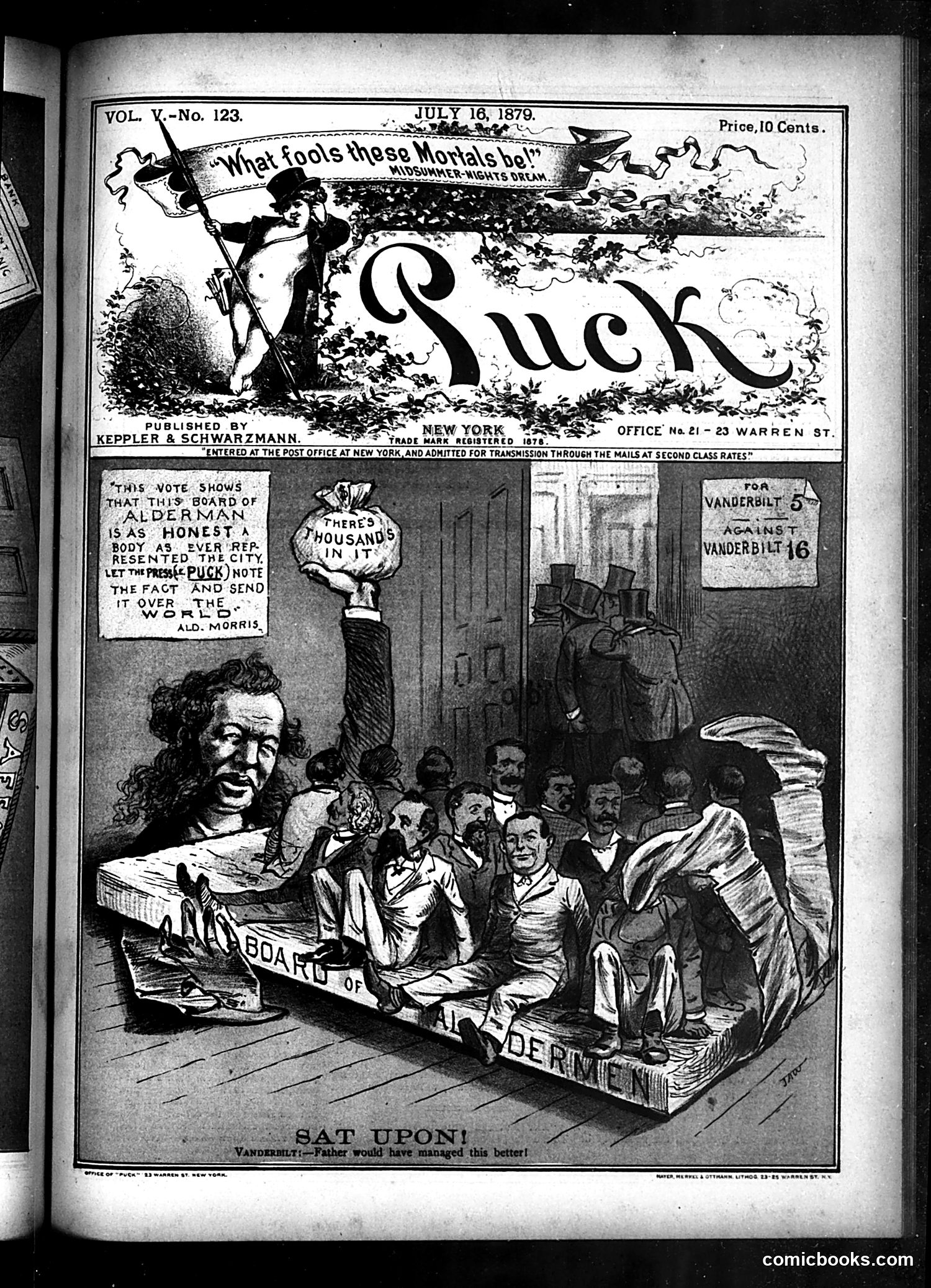
**Main Cartoon: "Sat Upon!"** This satirizes the Vanderbilt family's conduct during a public scandal. The illustration depicts well-dressed figures riding in a boat labeled "Board of Derelicts," being crushed beneath a giant foot. The caption suggests a Vanderbilt family member ("Father") should have managed the situation better. **Upper Cartoon: "What Fools These Mortals Be"** References a Board of Aldermen's alleged honesty, with accompanying text by Ald. Morris claiming the board is trustworthy. The sardonic headline suggests skepticism about municipal government integrity. Both cartoons mock wealthy elites and corrupt civic institutions—typical Puck targets. The magazine presents itself as exposing hypocrisy among the powerful through satirical visual commentary.
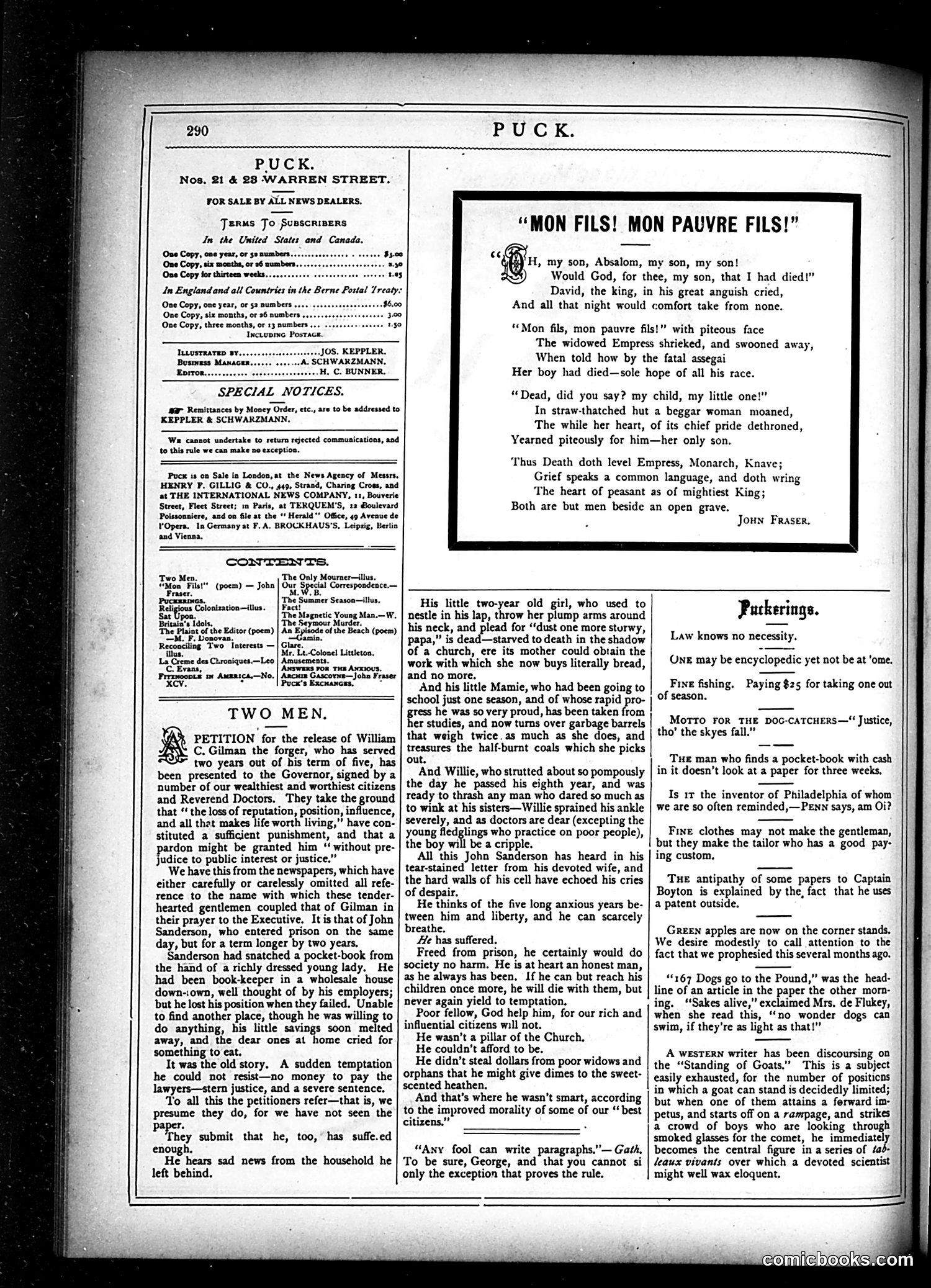
The main content is a poem titled **"Mon Fils! Mon Pauvre Fils!"** (My Son! My Poor Son!) attributed to John Fraser. It depicts a grieving father (labeled "David, the King") and mother (an "Empress") mourning their dead son, with the poem's theme being that death equalizes all ranks—both monarch and peasant face the same fate beside "an open grave." The remainder of the page consists of miscellaneous short satirical pieces and social commentary typical of Puck's format, including sections on "Puckerings" (brief witticisms) and articles on various social topics. **No clear political cartoon** is visible on this page. The content appears primarily literary and editorial rather than visual satire.
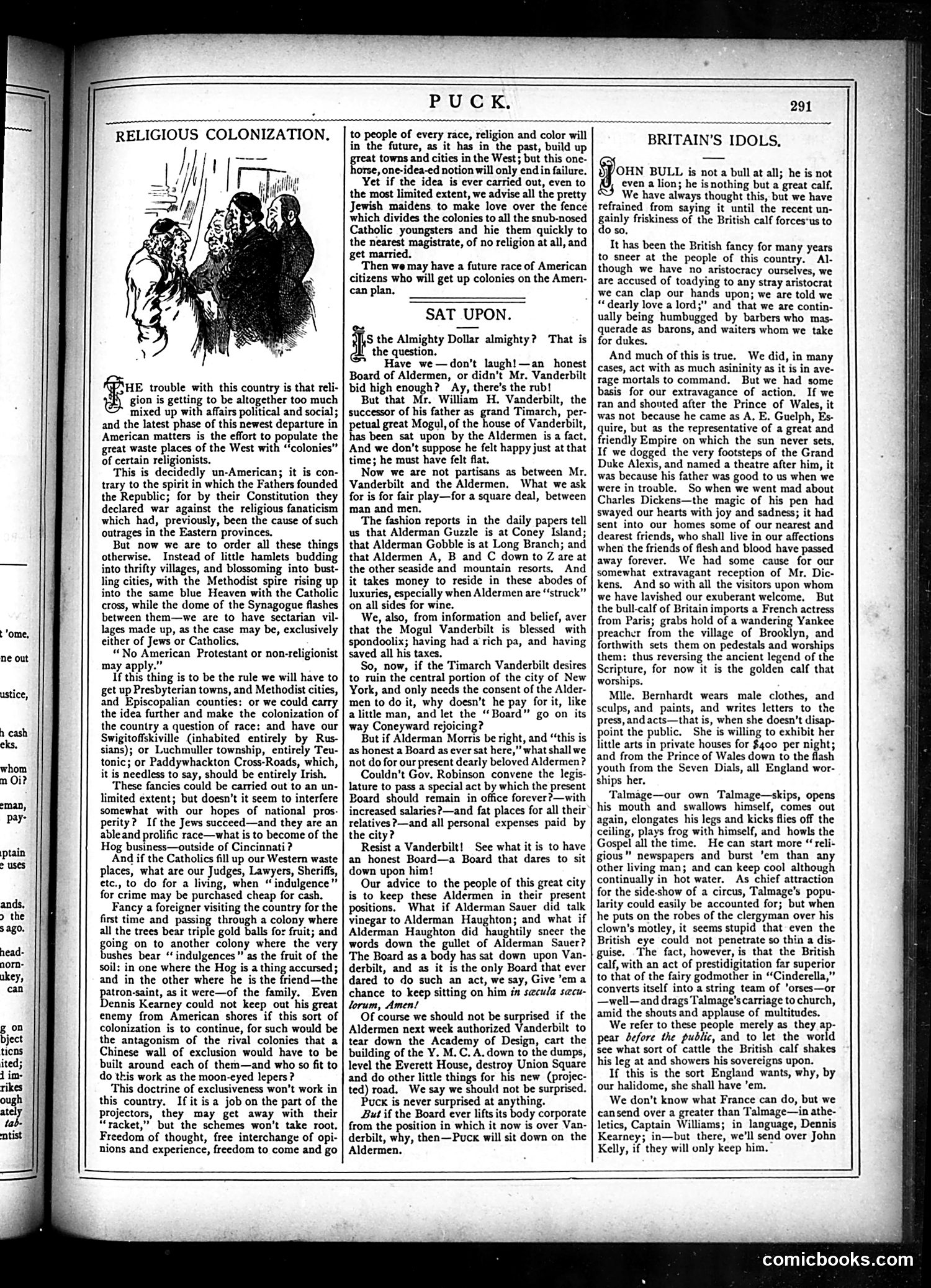
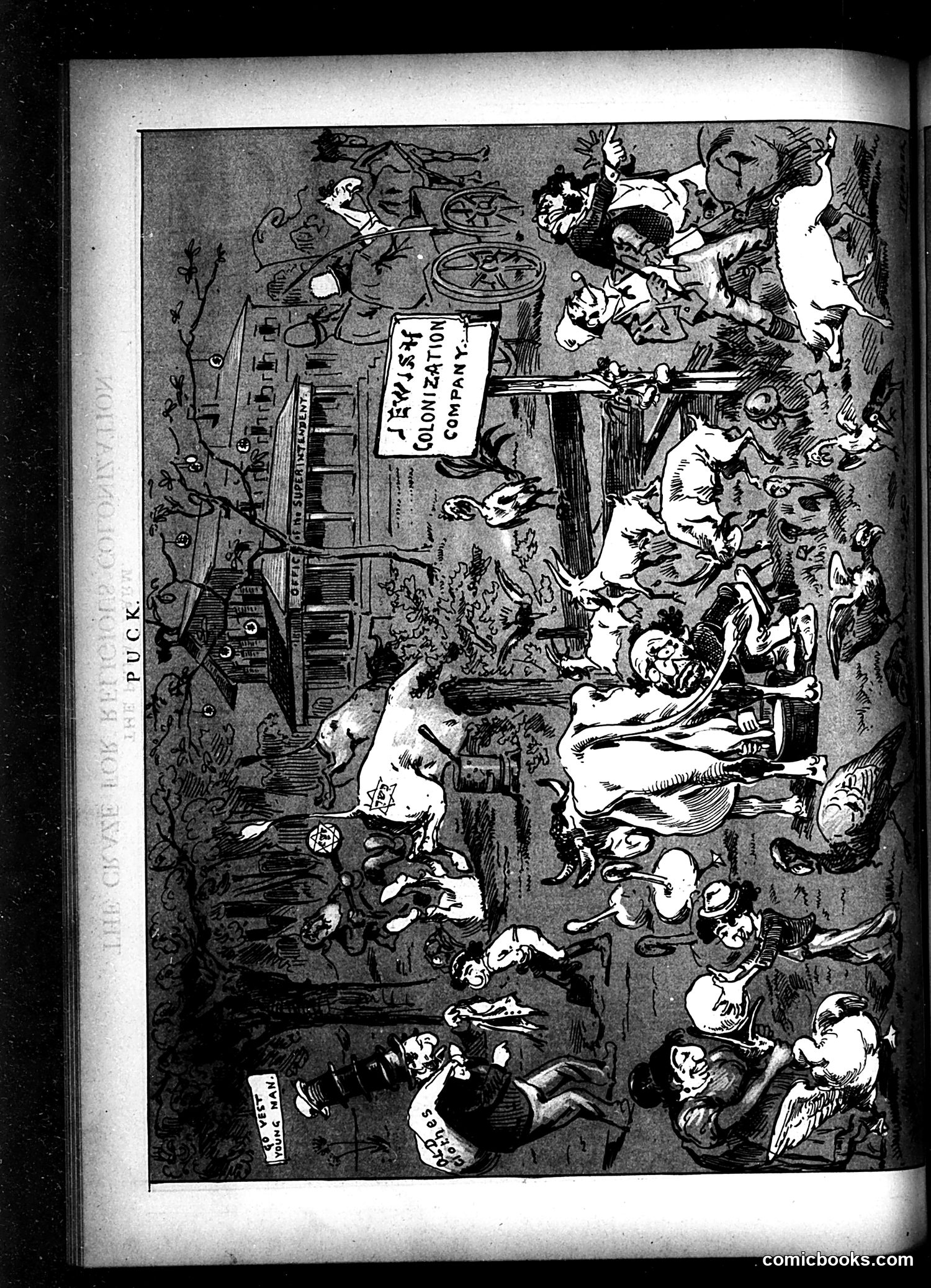
The page contains three distinct sections: "Religious Colonization" (left cartoon), "Sat Upon" (center), and "Britain's Idols" (right). The **left cartoon** satirizes American religious groups establishing colonies, depicting what appears to be clergy and lay people promoting sectarian settlements—likely critiquing the era's utopian religious communities. The **center section** mocks wealthy industrialists like Vanderbilt and Aldermen, questioning their philanthropic motives and suggesting they exploit charitable boards for personal gain. The **right section** attacks British reverence for wealthy figures like John Bull (symbol of Britain itself), suggesting the nation ridicules its own aristocrats while fawning over American billionaires. The satire targets British hypocrisy regarding class deference and American wealth worship. Overall, the page critiques religious tribalism, corrupt philanthropy, and transatlantic class pretension.
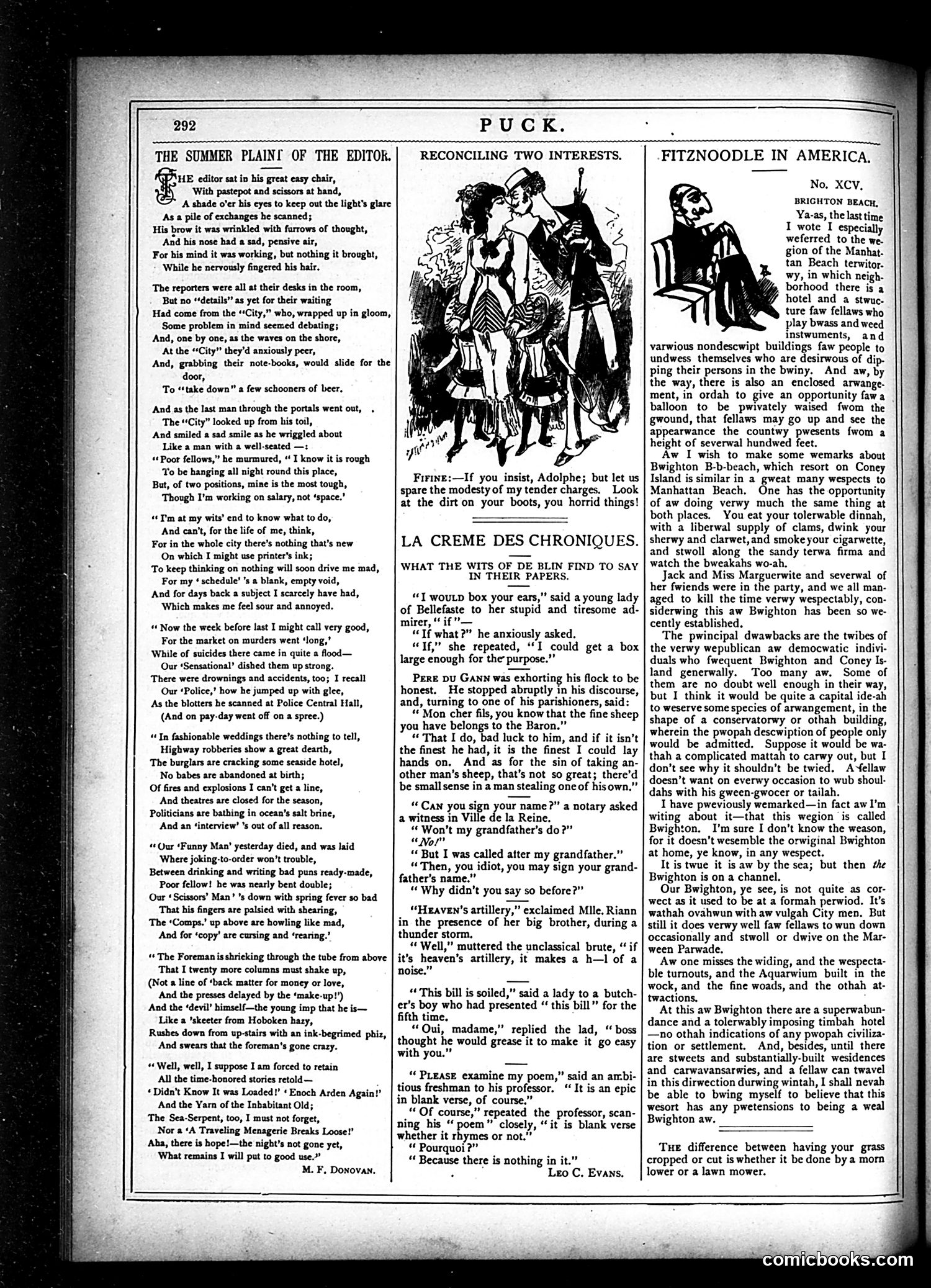
This cartoon depicts a social/romantic scenario rather than political satire. It shows a well-dressed man (likely representing a gentleman or suitor) positioned between two women, appearing to negotiate or mediate between them—hence "reconciling two interests." The women seem to represent competing romantic or social claims on the man's attention. The cartoon satirizes the social dynamics of courtship in the Gilded Age, mocking either the man's attempt to maintain multiple romantic entanglements simultaneously or the absurdity of the situation itself. The title suggests the humor lies in the impossibility of genuinely satisfying conflicting romantic interests—a commentary on period gender relations and courtship conventions rather than specific political events.
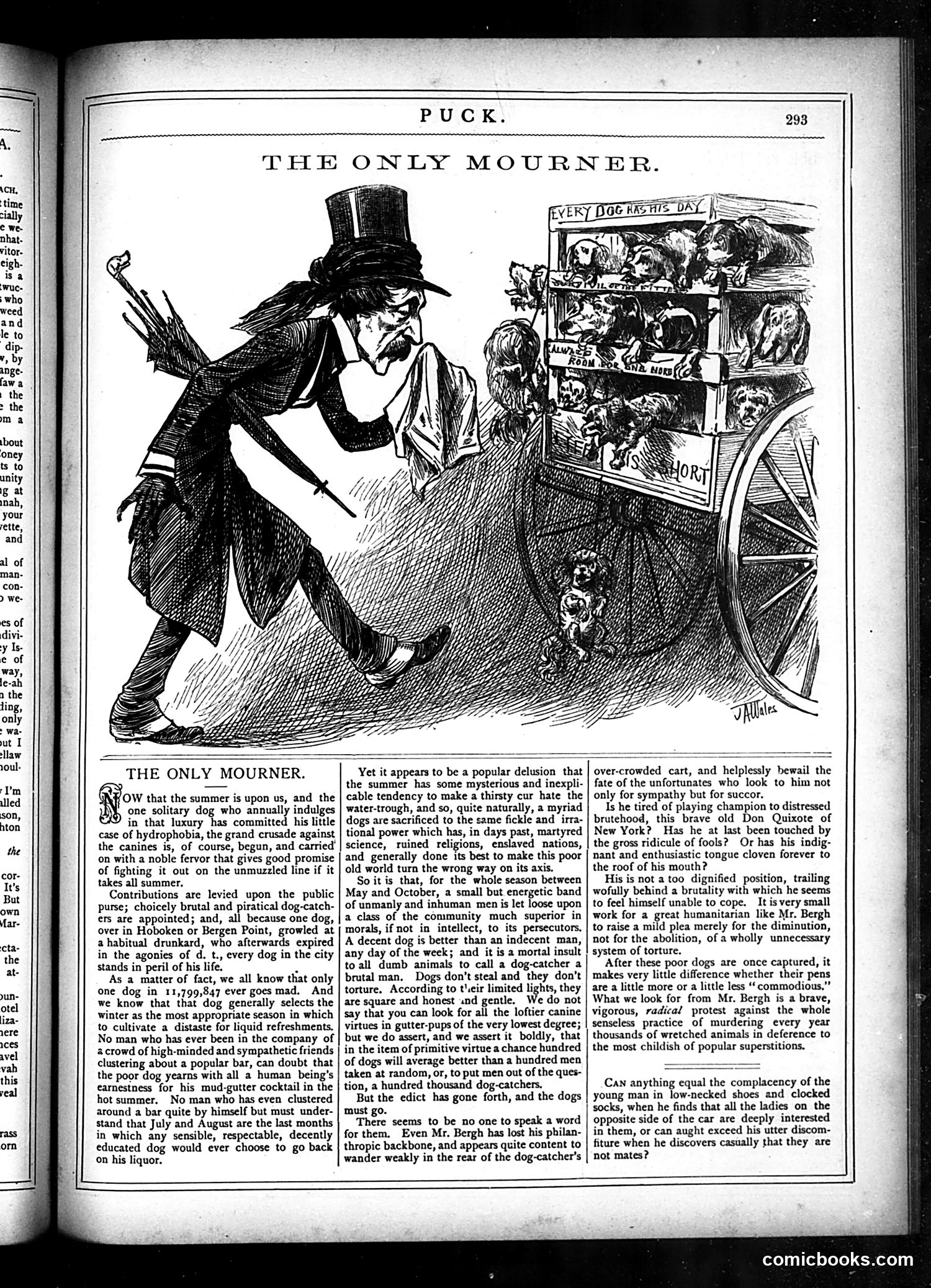
This cartoon satirizes summer's cruel treatment of urban dogs. The figure in the top hat (appearing to represent a wealthy dog owner or society gentleman) mourns beside a cart labeled "Every Dog Has His Day" filled with captured dogs—likely strays destined for death. The satire critiques the hypocrisy of summer society: while the wealthy pursue leisure and "thirst-quenching" pleasures, poor dogs are indiscriminately rounded up and killed. The accompanying text sarcastically notes that even a disgraced dog-catcher receives sympathy, yet hundreds of dogs are sacrificed without moral outcry. The cartoon mocks callous indifference to animal suffering and society's selective compassion—mourning one man while slaughtering thousands of animals.
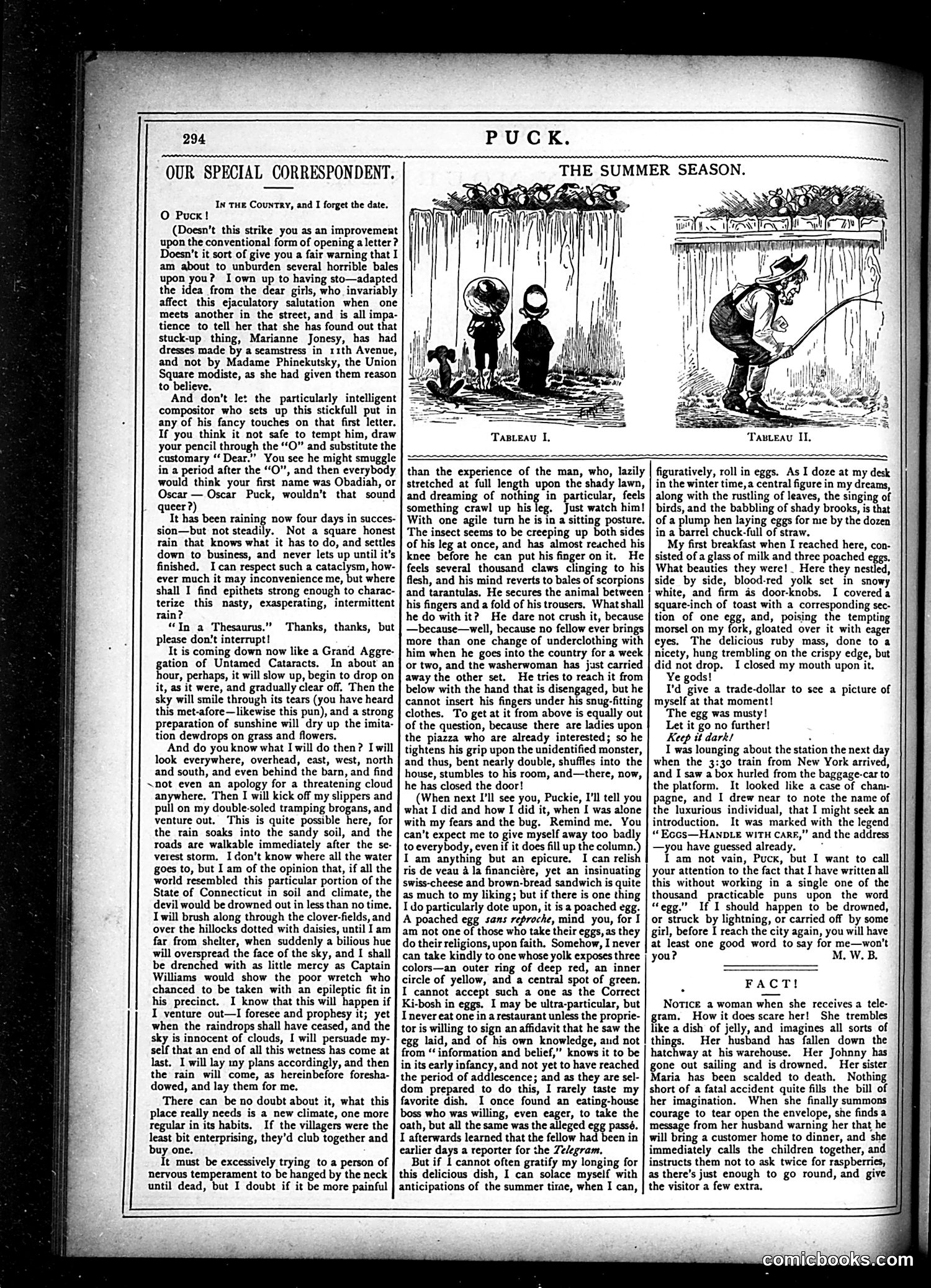
This page contains two sections: "Our Special Correspondent" (satirical commentary) and "The Summer Season" (two illustrated tableaux). The left column is a letter to Puck magazine complaining about artistic and literary quality, mentioning specific New York addresses and artists like Madame Phinekusky. The correspondent criticizes the "Unidentified Character" column and discusses social pretensions. The two right-side illustrations show summer leisure scenes: one depicts a man lying on a shady lawn observing insects, while the other shows what appears to be well-dressed people at a social gathering or resort. These appear to satirize upper-class summer behavior and rural recreation. The final section "Fact!" humorously describes a woman receiving a telegram about a drowned husband, presenting the absurdity of unexpected domestic crisis interrupting leisurely activities. The satire targets urban society's affectations and leisured classes.
This page contains three distinct satirical articles rather than illustrated cartoons: 1. **"The Magnetic Young Man"** – A humorous story about a young man from Rodney, Ontario, who possesses unusual magnetic powers that attract metal objects and create electrical phenomena. The satire mocks both pseudoscientific claims of the era and gullible public fascination with such "powers." 2. **"Theories of the Seymour Murder"** – Commentary on the mysterious death of Mr. John F. Seymour, shot in unclear circumstances. This section satirizes public speculation and competing theories about the crime's cause. 3. Multiple brief items including **"Inspector Mulrohead's Inside Theory,"** **"Captain Smashey's Astronomical Theories,"** and **"Coroner Croaker's Toxicological Theory"** – These mock amateur detectives and officials offering competing, often absurd explanations for the Seymour case. The overall satire targets Victorian-era credulity and sensationalism.
This appears to be a satirical illustration titled "The Cyanide Plot" (visible on a sign in the image). The cartoon depicts a chaotic factory or industrial setting with numerous figures engaged in what appears to be dangerous or criminal activity involving cyanide. The scene shows workers or conspirators around large containers and industrial equipment, suggesting commentary on either workplace safety violations, industrial poisoning scandals, or potentially a criminal conspiracy involving toxic substances. The crowded composition with multiple figures in various states of activity is typical of Puck's detailed satirical style. Without clearer identification of specific individuals or dates visible in the image, the exact historical event being referenced remains unclear, though it appears to critique industrial malpractice or a notable poisoning-related scandal of the era.
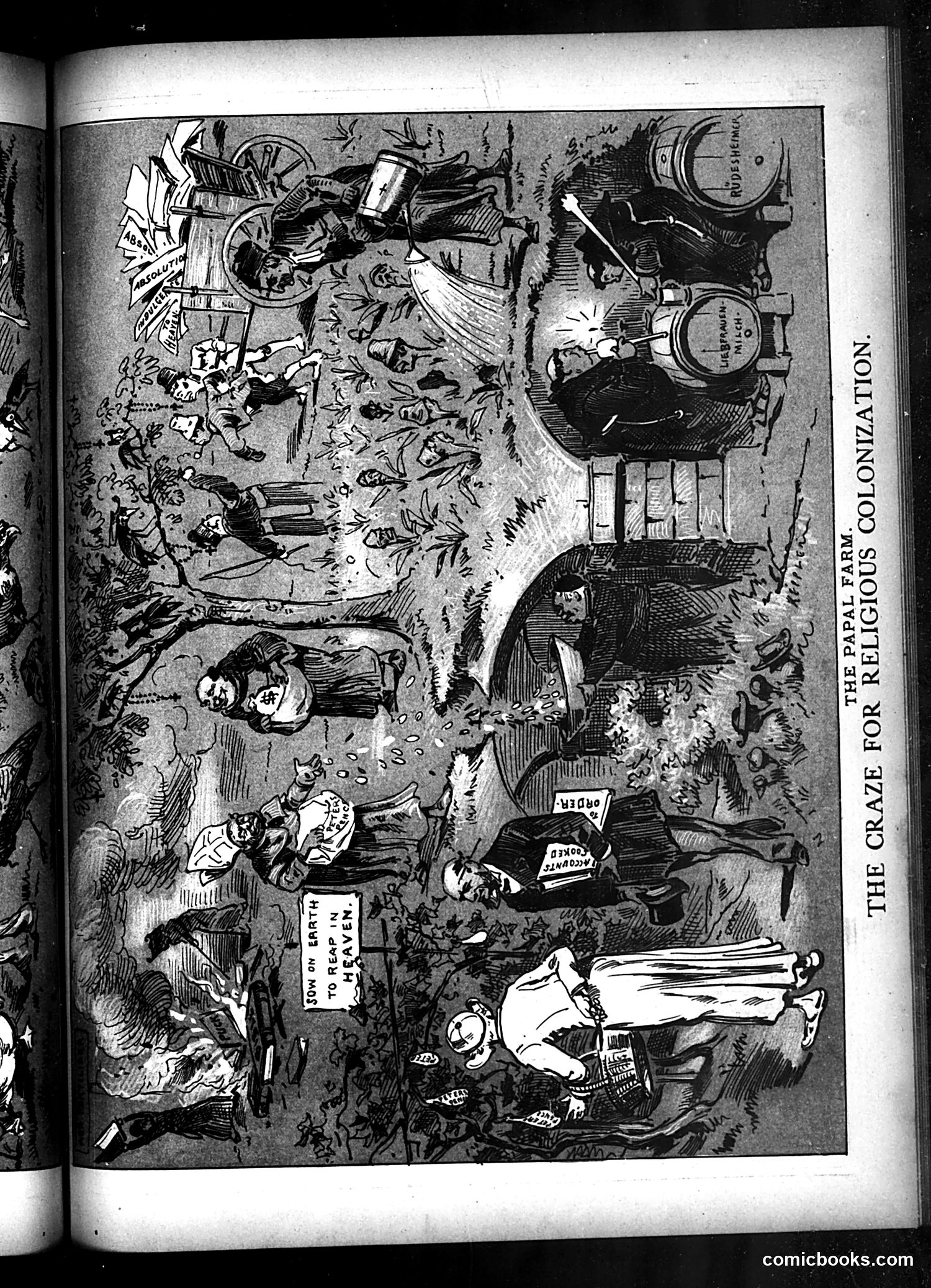
This Puck cartoon satirizes the late 19th-century rush by European powers to establish colonies under the guise of religious missions. The chaotic scene depicts competing Christian missionaries and colonial administrators scrambling over a map of Africa, fighting over territory while claiming to bring civilization and Christianity. The title's irony is key: the cartoon mocks how colonizers used "religious colonization" as moral justification for territorial conquest and exploitation. Various European figures appear engaged in violent competition, suggesting that beneath pious missionary rhetoric lay naked imperial ambition and greed. The scene emphasizes the hypocrisy—these supposedly devout Christians are shown brawling and scheming rather than practicing their professed faith, revealing the cartoon's central critique: colonial expansion was fundamentally about power and profit, not genuine religious conviction.
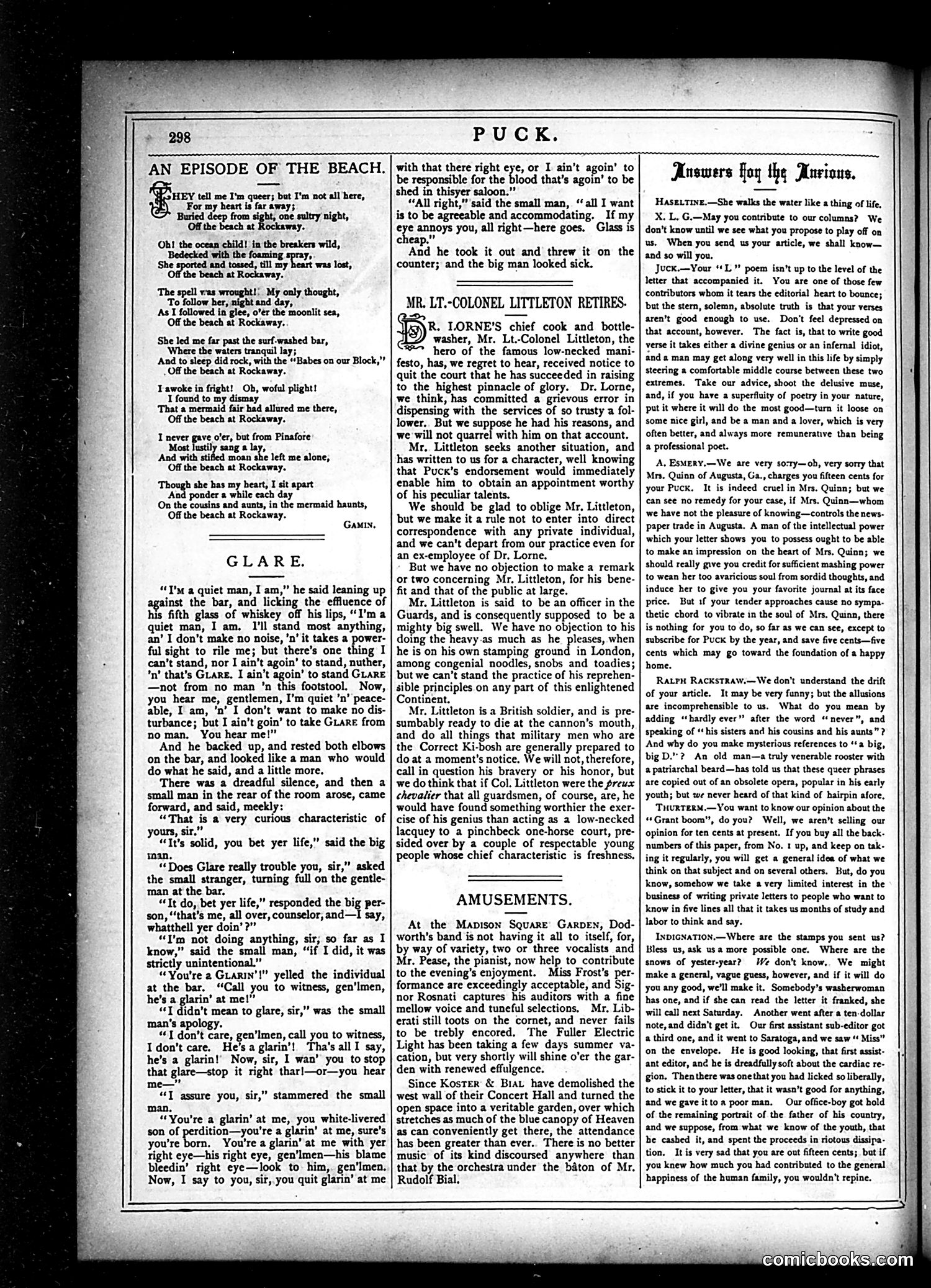
This page contains three sections: a poem titled "An Episode of the Beach" (romantic verse about lost love), a humorous dialogue called "Glare" (about a quiet man in a bar confronting someone who stares at him), and "Answers for the Anxious" (an advice column). The "Glare" piece appears to be the main satirical content. It depicts a social confrontation between two men—one accusing another of staring aggressively. The small man defends himself meekly while the larger aggressor demands respect. The satire mocks masculine posturing and bar-room bravado, suggesting how trivial slights escalate into performative displays of toughness among working-class men. The advice column addresses reader questions about domestic matters and writing, presenting common social anxieties of the era.
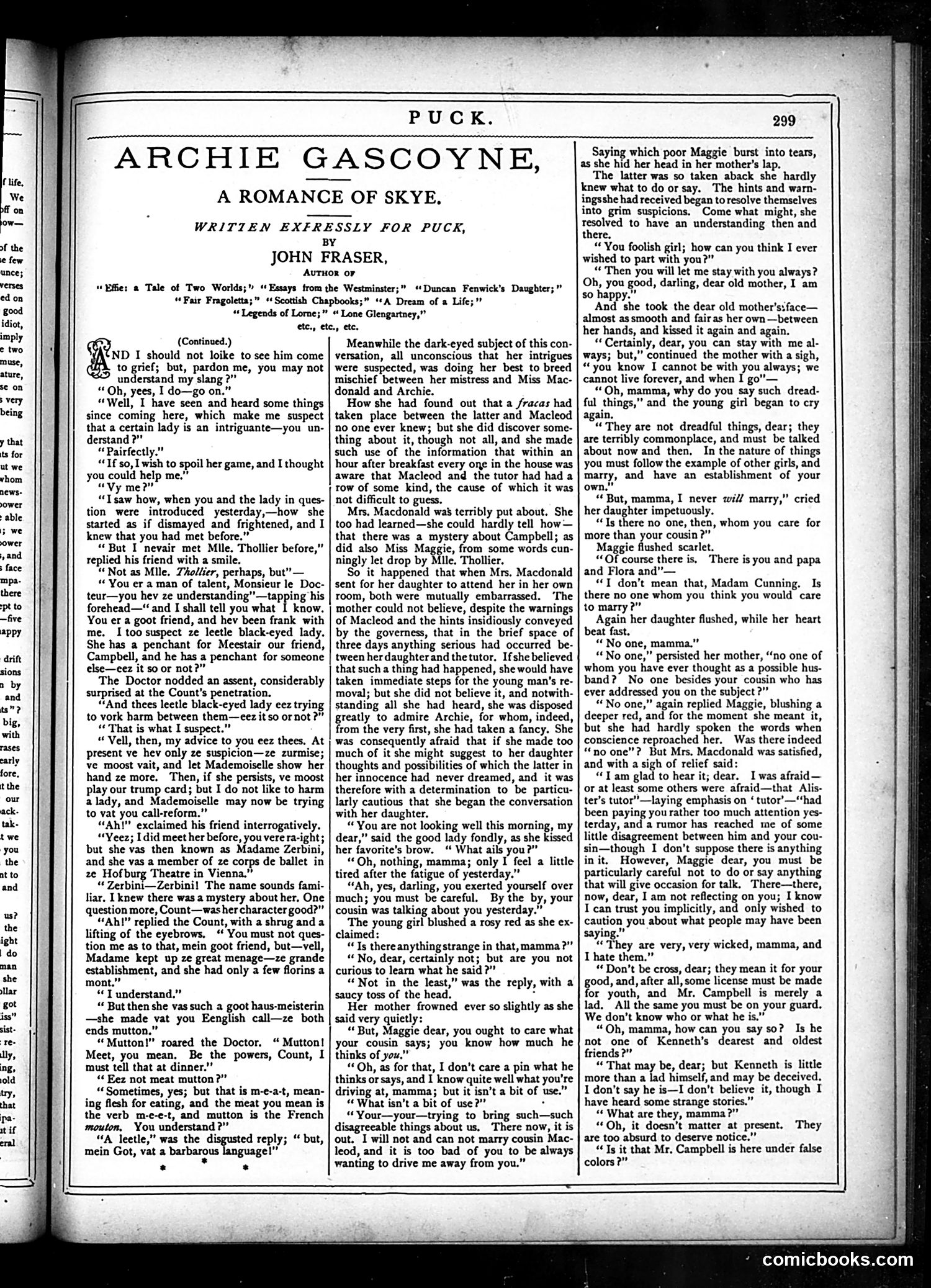
This page is primarily **text fiction, not a political cartoon**. It's the continuation of "Archie Gascoyne, A Romance of Skye," a serialized story by John Fraser written expressly for Puck magazine. The narrative follows a romantic plot involving characters named Maggie, Archie, and others in what appears to be a Scottish setting. The dialogue concerns personal relationships, family concerns, and romantic entanglements—particularly around whether Maggie should marry or leave with Archie. **No political or social satire is evident** on this page. This represents Puck's literary fiction content rather than its signature satirical cartooning. The page number (299) suggests this is deep within a longer issue featuring mixed content types.
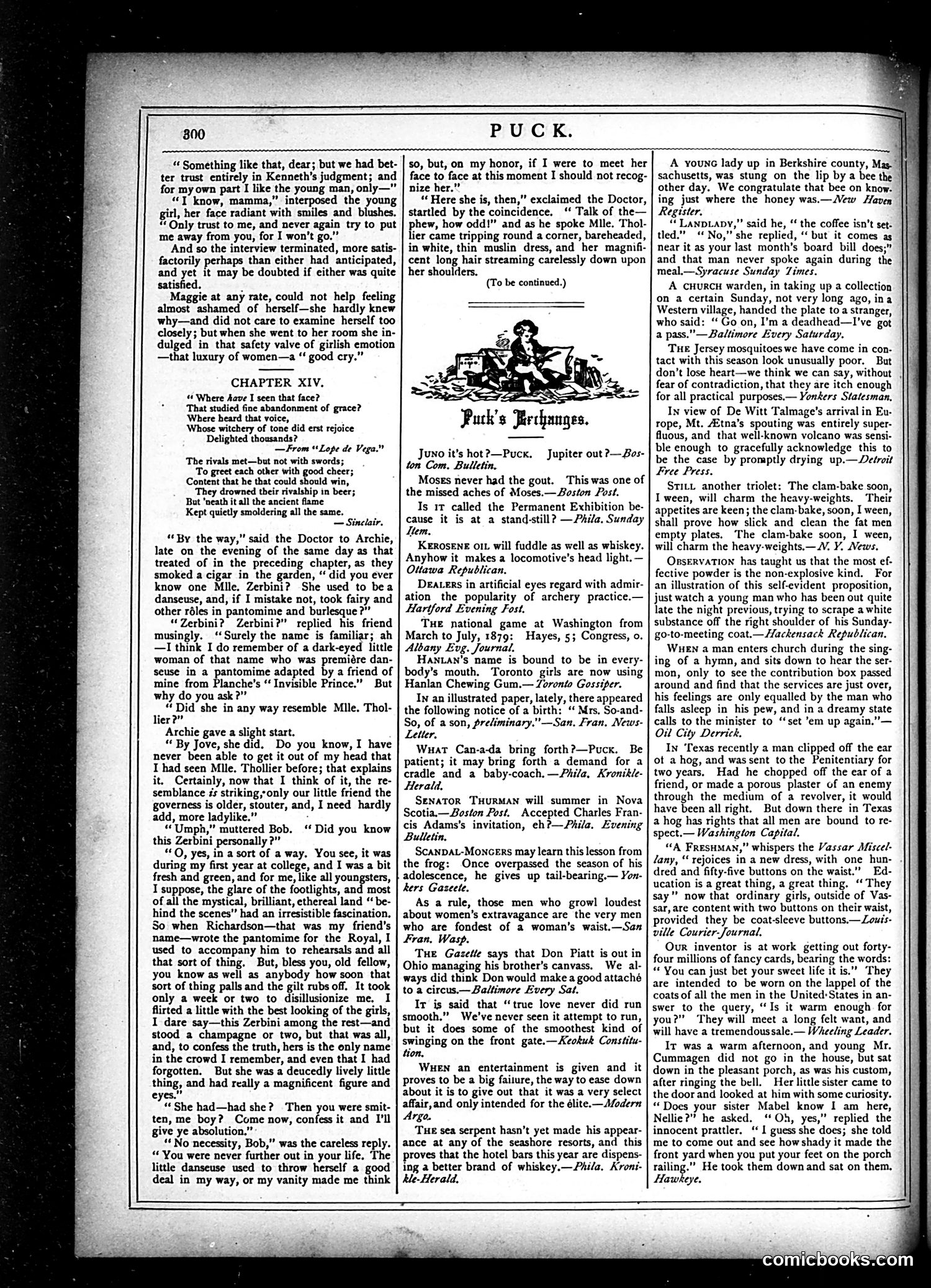
This page presents "Puck's Briefings," a section of short satirical items and jokes rather than a single political cartoon. The content includes brief, witty observations on contemporary social topics: a young woman stung by a bee, church collection practices, the clam-bake food trend, archery's popularity, a birth announcement, and various humorous anecdotes about men's behavior in church and social settings. The items mock middle and upper-class American social conventions—pretension, hypocrisy, and absurdity in everyday life. References to specific newspapers (Baltimore, Toronto, San Francisco papers) suggest these are gathered from contemporary sources. Rather than targeting specific politicians, these briefings offer general social satire typical of Puck's humor: poking fun at human nature and contemporary manners.
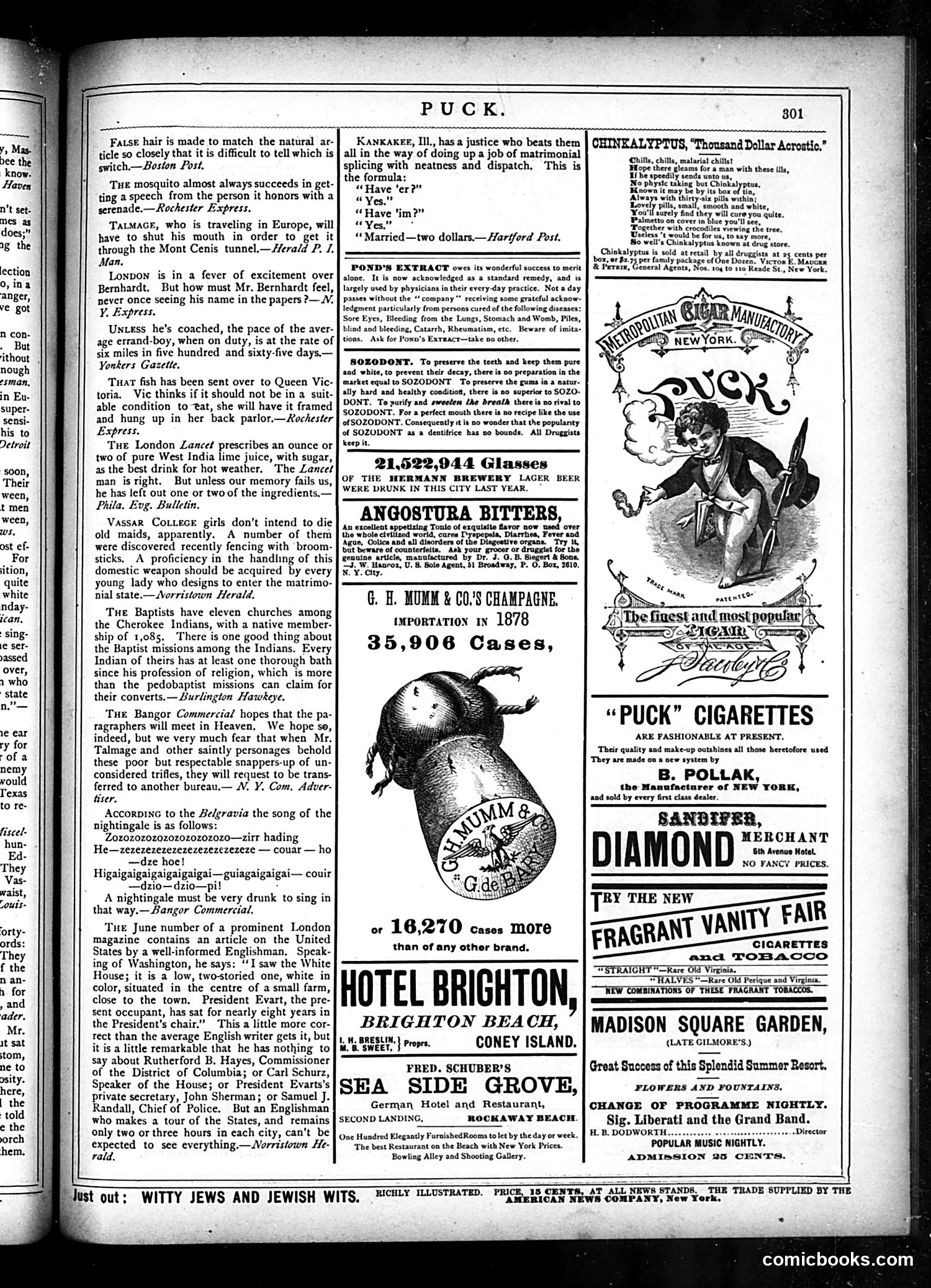
This page is primarily **advertising and commercial content** rather than political satire. The dominant image shows a large pear with a face and wings—the mascot for **G. Humm & Co.'s Champagne**, advertising their 1878 importation of 35,906 cases and additional stock. Below are advertisements for: - **Puck Cigarettes** by B. Pollak - **Hotel Brighton** (Brighton Beach, Coney Island) - **Fred. Schuber's Sea Side Grove** (Rockaway Beach) - **Madison Square Garden** (Gilmore's venue) - Various other commercial establishments The small text snippets at page top contain brief humorous anecdotes typical of *Puck's* satirical style, but the page itself functions primarily as a revenue-generating advertising vehicle rather than presenting coherent political or social commentary.
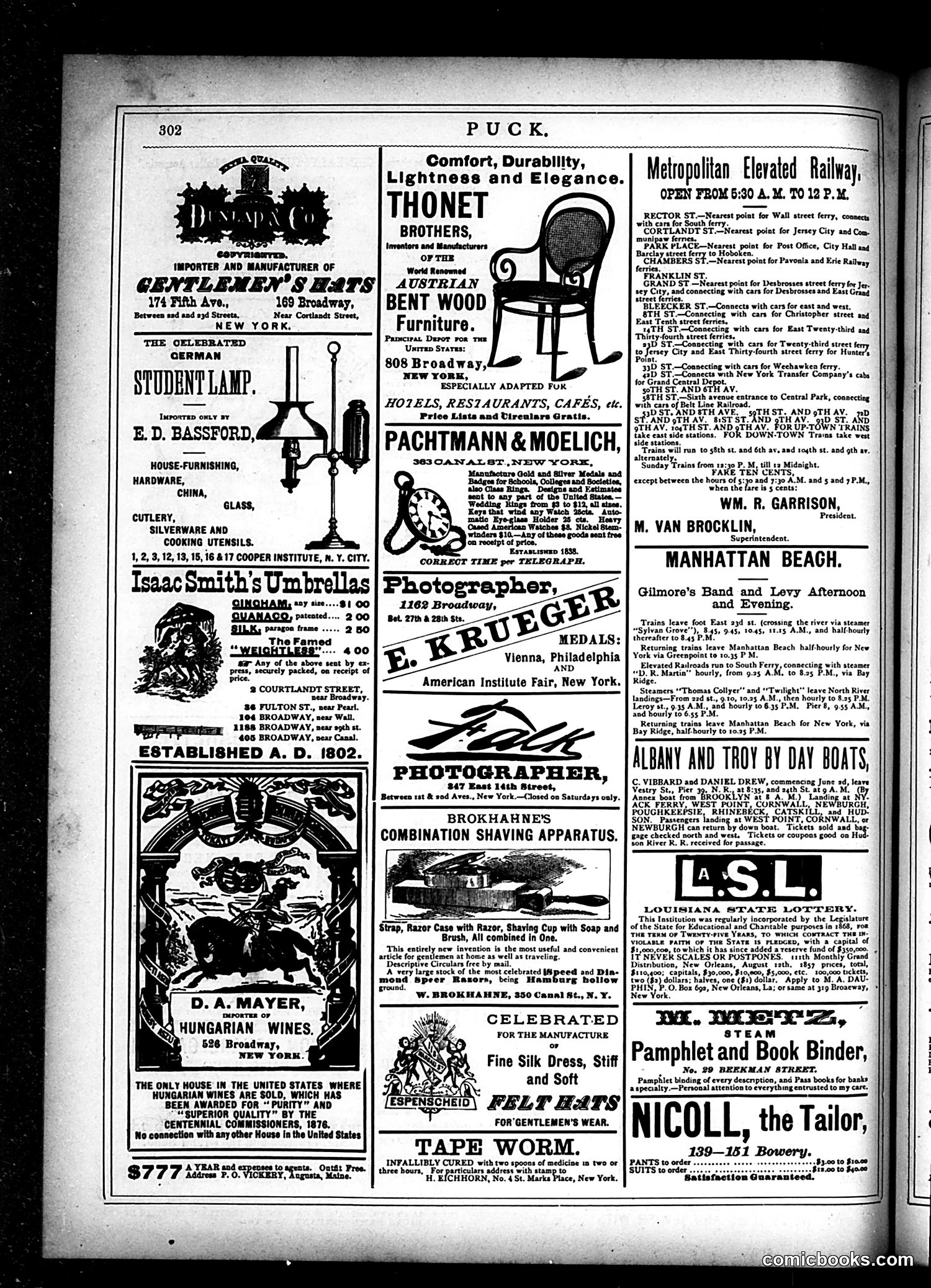
This page is primarily **advertising**, not editorial content or political cartoons. It contains commercial advertisements for various 19th-century products and services including: - Gentlemen's hats (Dunlap & Co.) - A student lamp (E.D. Bassford) - Umbrellas (Isaac Smith's) - A photographer (E. Krueger) - Transportation services (Metropolitan Elevated Railway, Manhattan Beach boats, Albany and Troy day boats) - A lottery (Louisiana State Lottery) - Clothing and tailoring services - Shaving apparatus and felt hats While Puck was a satirical magazine, **this particular page contains no visible political cartoons or social satire**—it's a straightforward advertisements page typical of late 19th-century publications, which relied heavily on paid advertising for revenue.
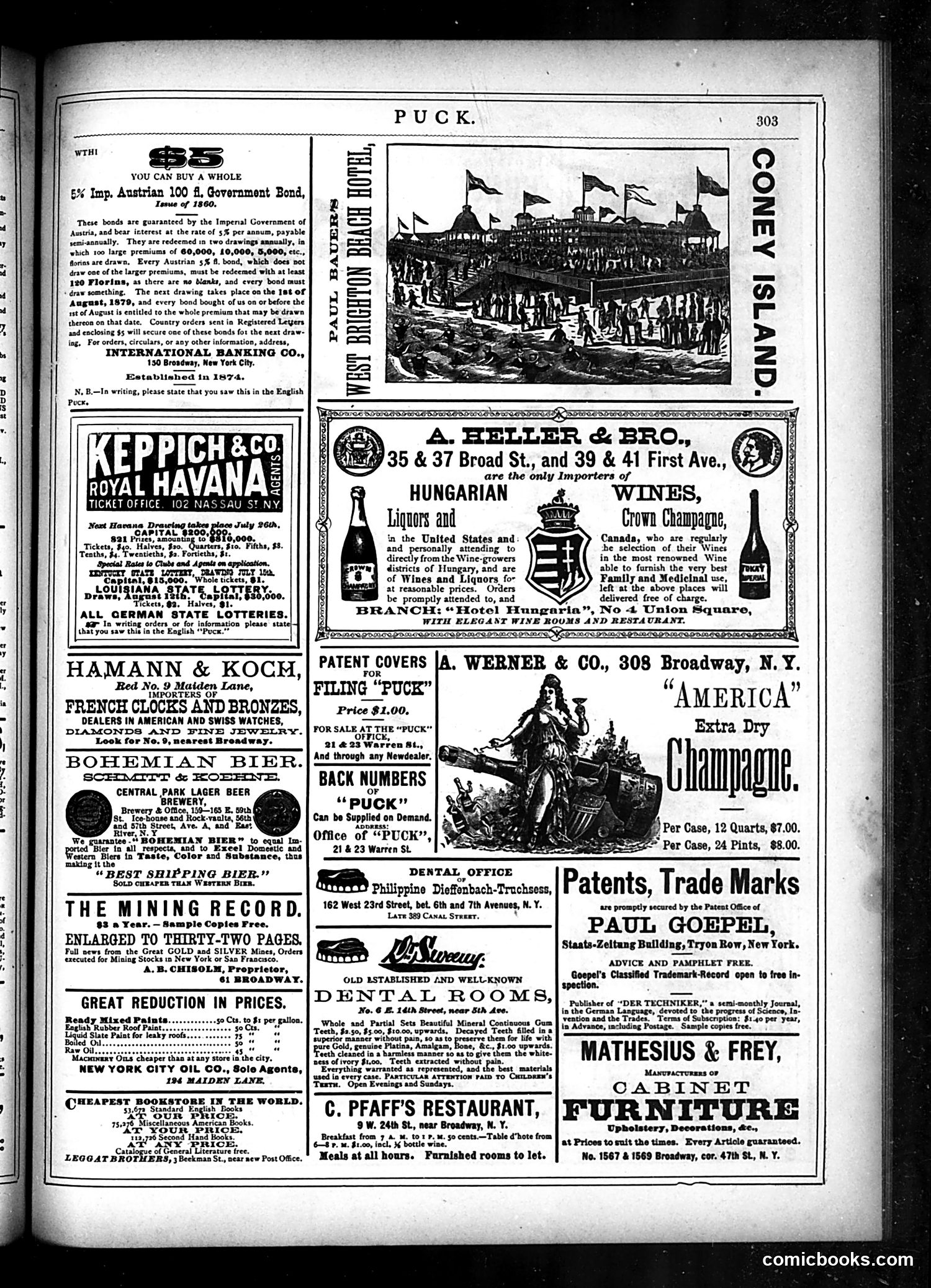
This page is primarily **advertising**, not political satire. The top features "Coney Island" as a heading with an engraved illustration showing a crowded beach scene with flags and pavilions—likely promoting the popular New York resort destination. Below are various commercial advertisements for: Austrian bonds, Keppich & Co. theater tickets, Hamann & Koch (clocks/jewelry), Bohemian beer, dental services, wines and champagne, furniture, and restaurants. The page number (303) and "PUCK" masthead indicate this is from the satirical magazine, but this particular page serves primarily as a revenue-generating advertising section rather than containing political cartoons or social commentary.
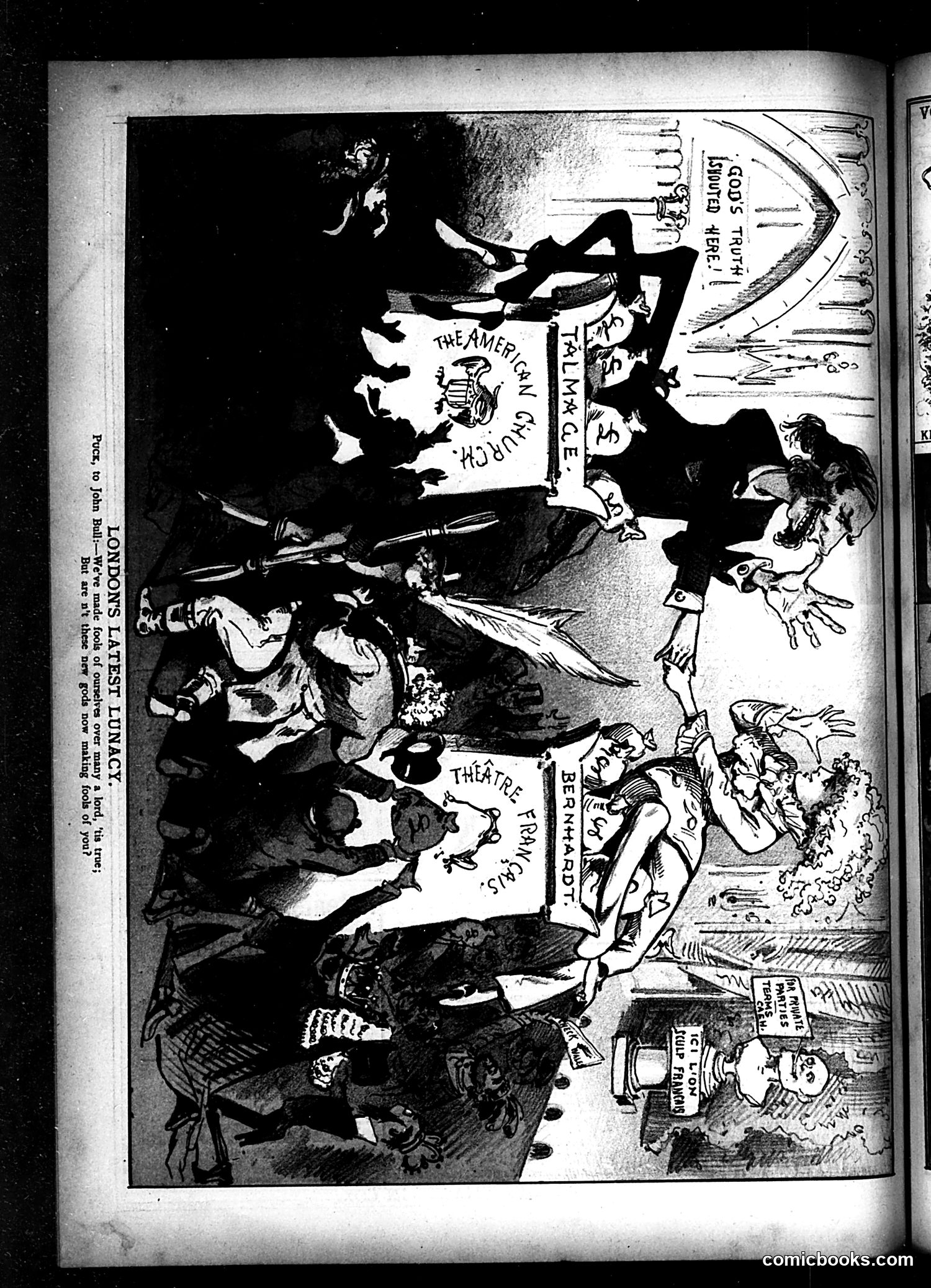
This Puck page contains satirical illustrations about American theatrical and cultural life. The visible text references "The American Girl," "Theatre," and "Bernard Shaw" — suggesting commentary on contemporary theater and perhaps debates about American versus European (particularly Irish playwright Shaw's) cultural influences. The cartoon style uses exaggerated caricatures typical of Puck's approach. While the image quality makes precise identification difficult, the compositions appear to depict theatrical scenes or performers in satirical situations, likely mocking either specific productions, acting styles, or cultural pretensions of the era. The page seems to address early 20th-century American anxieties about theater's role in society and potentially the influence of foreign literary figures on American cultural tastes — common Puck themes of this period.