
Puck, 1879-07-16 · page 10 of 16
Puck — July 16, 1879 — page 10: what you’re looking at
What you’re looking at
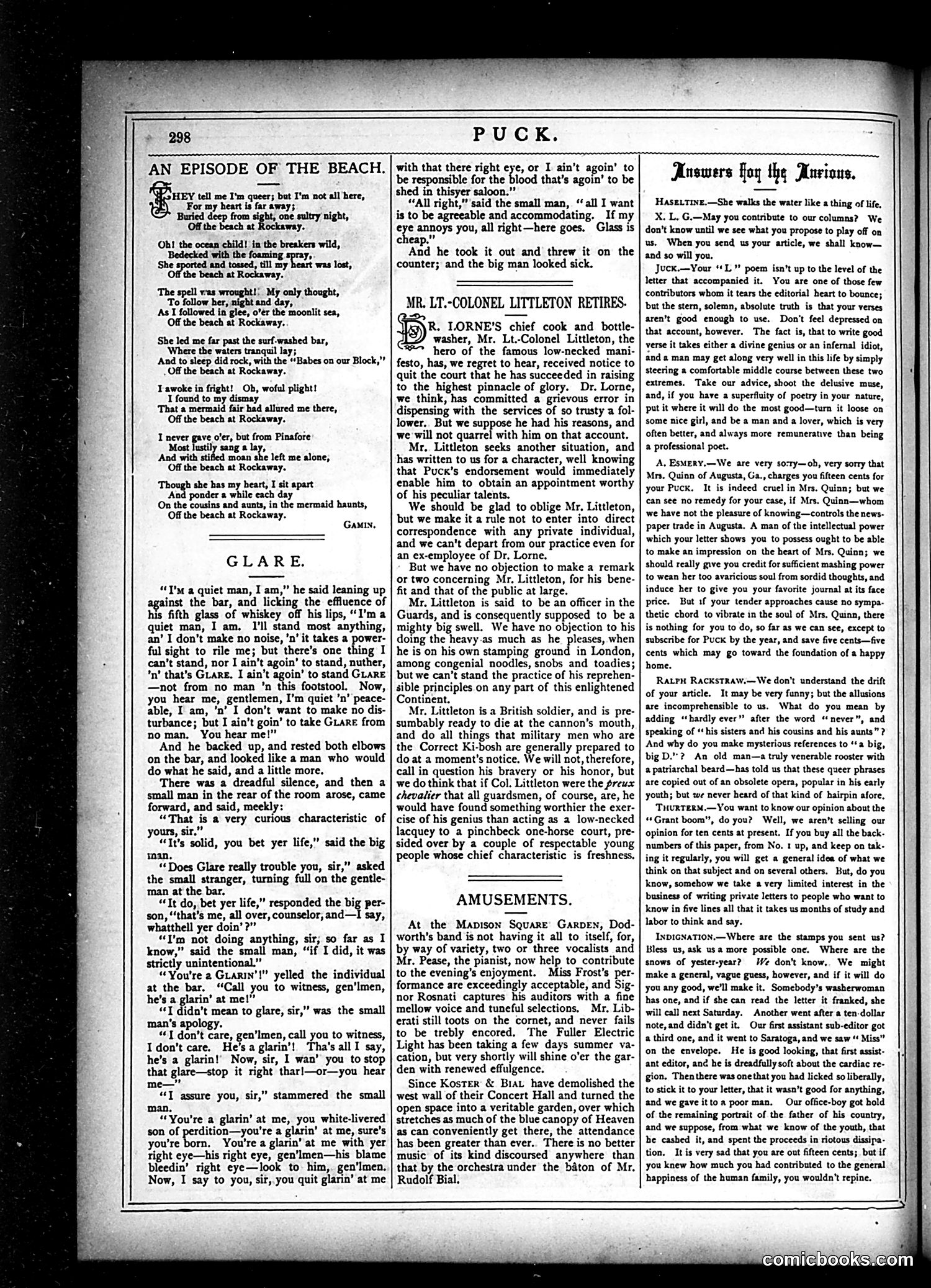
This page contains three sections: a poem titled "An Episode of the Beach" (romantic verse about lost love), a humorous dialogue called "Glare" (about a quiet man in a bar confronting someone who stares at him), and "Answers for the Anxious" (an advice column). The "Glare" piece appears to be the main satirical content. It depicts a social confrontation between two men—one accusing another of staring aggressively. The small man defends himself meekly while the larger aggressor demands respect. The satire mocks masculine posturing and bar-room bravado, suggesting how trivial slights escalate into performative displays of toughness among working-class men. The advice column addresses reader questions about domestic matters and writing, presenting common social anxieties of the era.
📄 Transcribed text from this page (OCR, searchable)
Machine-transcribed from the original scan — historical spelling and the odd misread are preserved.
PUCK. AN EPISODE OF THE BEACH. HEY tell me I'm queer; but I'm not all here, For my heart is far away; Buried deep from sight, one sultry night, (Offthe Leach at Rockaway. i Ob! the ocean child! in the breakers wild, Bedecked ‘with the foamin, She sported and tossed, tll my heart was lost, the beach at Rockaway. The spell vas 1; My only thought, Tolnilow Beker roger eno As I followed in glee, o'er the moonlit sea, Off the beach at Rockaway. She led me far past the surf.washed bar, ‘Where the waters tranquil lay; And to sleep did rock, with the “Babes on our Block,"* Off the beach at Rockaway. Tawoke in fright! Ob, woful plight! T found to my dismay ‘That a mermaid fair had allared me there, Off the beach at Rockaway. never gave oer, but from Pinafore Most lustily sang » lay, ‘And with stifed moan the left me alone, Off the beach at Rockaway. Though she has my heart, I sit a; ‘Ad ponder a while each day ra On the cousins and aunts, in the mermaid haunts, Off the beach at Rockaway. Gain, GLARE. “Y'-a quiet man, I am,” he said leaning up against the bar, and licking the effluence of his fifth glass of whiskey off his lips, “I'ma quiet man, I am. I'll stand most anything, an’ I don’t make no noise, 'n’ it takes a power- ful sight to rile me; but there’s one thing 1 can't stand, nor I ain’t agoin’ to stand, nuther, " that’s Gare. I ain’t agoin’ to stand GLARE —not from no man 'n this footstool. Now, you hear me, gentlemen, I’m quiet 'n’ peace- able, I am, ‘n’ I don’t want to make no dis- turbance; but I ain't goin’ to take GLare from no man, You hear me!” And he backed up, and rested both elbows on the bar, and looked like a man who would do what he said, and a little more. There was a dreadful silence, and then a small man in the rear of the room arose, came forward, and said, meekly: “That is a very curious characteristic of yours, sir.” “It's solid, you bet yer life,” said the big man. «Does Glare really trouble you, sir,” asked the small stranger, turning full on the gentle- man at the bar. “Tt do, bet yer life,” responded the big per- son, “that’s me, all over, counselor, and—I say, whatthell yer doin’ ?” “I'm not doing anything, sir, so far as I know,” said the small man, “if I did, it was strictly unintentional.” “You're a GLarin’!" yelled the individual at the bar. ‘Call you to witness, gen’lmen, he’s a glarin’ at me!” “T didn’t mean to glare, sir,” was the small man's apology. “1 don't care, gen'lmen, call you to witness, I don’t care. He's a glarin’! Tha's all 1 say, he’s a glarin!’ Now, sir, I wan’ you to stop that glare—stop it right thar!—or—you hear met “I assure you, sir,” stammered the small “You're a glarin’ at me, you whitelivered son of perdition—you're a glarin’ at me, sure’s you're born. You're a glarin’ at me with yer right eye—his right eye, gen'lmen—his blame bleedin’ right eye—look to him,. gen’lmen. Now, I say to you, sir, you quit glarin’ at me with that there right eye, or I ain’t agoin’ to be responsible for the blood that’s agoin’ to be shed in thisyer saloon.” “All right,” said the small man, “all I want is to be agreeable and accommodating. If my eye annoys you, all right—here goes, Glass is cheap.” And he took it out and threw it on the counter; and the big man looked sick. MR. LT.-COLONEL LITTLETON RETIRES. R. LORNE'S chief cook and bottle- washer, Mr. Lt.-Colonel Littleton, the "~~ hero of the famous low-necked mani- festo, has, we regret to hear, received notice to quit the court that he has succeeded in raising to the highest pinnacle of glory. Dr. Lorne, we think, has committed a grievous error in dispensing with the services of so trusty a fol- lower. But we Suppose he had his reasons, and we will not quarrel with him on that account. Mr. Littleton seeks another situation, and has written to us for a character, well knowing that Puck’s endorsement would immediately enable him to obtain an appointment worthy of his peculiar talents, We should be glad to oblige Mr. Littleton, but we make it a rule not to enter into direct correspondence with any private individual, and we can't depart from our practice even for an ex-employee of Dr, Lorne. But we have no objection to make a remark or two concerning Mr, Littleton, for his bene- fit and that of the public at large. Mr. Littleton is said to be an officer in the Guards, and is consequently supposed to be a mighty big swell. We have no objection to his doing the heavy.as much as he pleases, when he is on his own stamping ground in London, among congenial noodles, snobs and toadies; but we can’t stand the practice of his reprehen- sible principles on any part of this enlightened Continent. Mr. Littleton is a British soldier, and is pre- sumbably ready to die at the cannon’s mouth, and do all things that military men who are the Correct Ki-bosh are generally prepared to do at a moment's notice. We will not, therefore, call in question his bravery or his honor, but we do think that if Col. Littleton were the preux chevatier that all guardsmen, of course, are, he would have found something worthier the exer- cise of his genius than acting as a low-necked lacquey to a pinchbeck one-horse court, pre- sided over by a couple of respectable young people whose chief characteristic is freshness, AMUSEMENTS. At the Mapison Square Garpen, Dod- worth's band is not having it all to itself, for, by way of variety, two or three vocalists and Mr. Pease, the pianist, now help to contribute to the evening's enjoyment. Miss Frost’s per- formance are exceedingly acceptable, and Sig- nor Rosnati captures his auditors with a fine mellow voice and tuneful selections. Mr. Lib- erati still toots on the cornet, and never fails to be trebly encored, The Fuller Electric Light has been taking a few days summer va- cation, but very shortly will shine o'er the gar- den with renewed effulgence. Since Koster & Bat have demolished the west wall of their Concert Hall and turned the open space into a veritable garden, over which stretches as much of the blue canopy of Heaven as can conveniently get there, the attendance has been greater than ever.. There is no better music of its kind discoursed anywhere than that by the orchestra under the baton of Mr. Rudolf Bial. Answers foy the Aurious. Haszitive.—She walks the water like a thing of life. X. L. G.—May you contribute to our columns? We don't know until we see what you propose to play off on us. When you send us your article, we shall know— and so will you. Juck.—Your “L ” poem isn't up to the level of the letter that accompanied it. You are one of those few contributors whom it tears the editorial heart to bounce; but the stern, solemn, absolute truth is that your verses aren't good enough to use. Don't feel depressed on that account, however. The fact is, that to write good verse it takes either a divine genius or an infernal idiot, anda man may get along very well in this life by simply steering a comfortable middle course between these two extremes. Take our advice, shoot the delusive muse, and, if you have a superfluity of poetry in your nature, put it where it will do the most good—tum it loose on some nice girl, and be a man and a lover, which is very often better, and always more remunerative than being a professional poet. A, Esmery.—We are very so:ty—ob, very sorry that Mrs. Quinn of Augusta, Ga., charges you fifteen cents for your Puck. It is indeed cruel in Mrs. Quinn; but we can see no remedy for your case, if Mrs. Quinn—whom we have not the pleasure of knowing—controls the news- paper trade in Augusta, A man of the intellectual power which your letter shows you to possess ought to be able to make an impression on the heart of Mrs. Quinn; we should really give you credit for sufficient mashing power to wean her too avaricious soul from sordid thoughts, and induce her to give you your favorite journal at its face price. But if your tender approaches cause no sympa- thetic chord to vibrate in the soul of Mrs. Quinn, there is nothing for you to do, so far as we can see, except to subscribe for Puck by the year, and save five cents—five cents which may go toward the foundation of a happy home. Ratrn RackstRaw.—We don't understand the drift of your article. It may be very funny; but the allusions are incomprehensible to us. What do you mean by adding ‘hardly ever” after the word “never”, and speaking of “his sisters and his cousins and his aunts”? ‘And why do you make mysterious references to “a big, big D."? An old man—a truly venerable rooster with a patriarchal beard—has told us that these queer phrases are copied out of an obsolete opera, popular in his early youth; but we never heard of that kind of hairpin afore, ‘THURTERM.—You want to know our opinion about the “Grant boom", do you? Well, we aren’t selling our opinion for ten cents at present. If you buy all the back- numbers of this paper, from No. 1 up, and keep on tak- ing it regularly, you will get a general idea of what we think on that subject and on several others. But, do you know, somehow we take a very limited interest in the business of writing private letters to people who want to know in five lines all that it takes us months of study and labor to think and say. INDIGNATION.—Where are the stamps you sent us? Bless us, ask usa more possible one. Where are the snows of yester-year? We don't know. We might make a general, vague guess, however, and if it will do you any good, we'll make it. Somebody’s washerwoman has one, and if she can read the letter it franked, she will call next Saturday. Another went after a ten-dollar note, and didn't get it. Our first assistant sub-editor got a third one, and it went to Saratoga, and we saw “¢ Miss” on the envelope. He is good looking, that first assist- ant editor, anc he is dreadfully soft about the cardiac re- gion, Then there was onethat you had licked so liberally, to stick it to your letter, that it wasn’t good for anything, and we gave itto. poor man. Our office-boy got hold of the remaining portrait of the father of his country, and we suppose, from what we know of the youth, that he cashed it, and spent the proceeds in riotous dissipa- tion. It is very sad that you are ont fifteen cents; but if you knew how much you had contributed to the general happiness of the human family, you wouldn't repine. comicbooks:eom