
Puck, 1879-07-16 · page 2 of 16
Puck — July 16, 1879 — page 2: what you’re looking at
What you’re looking at
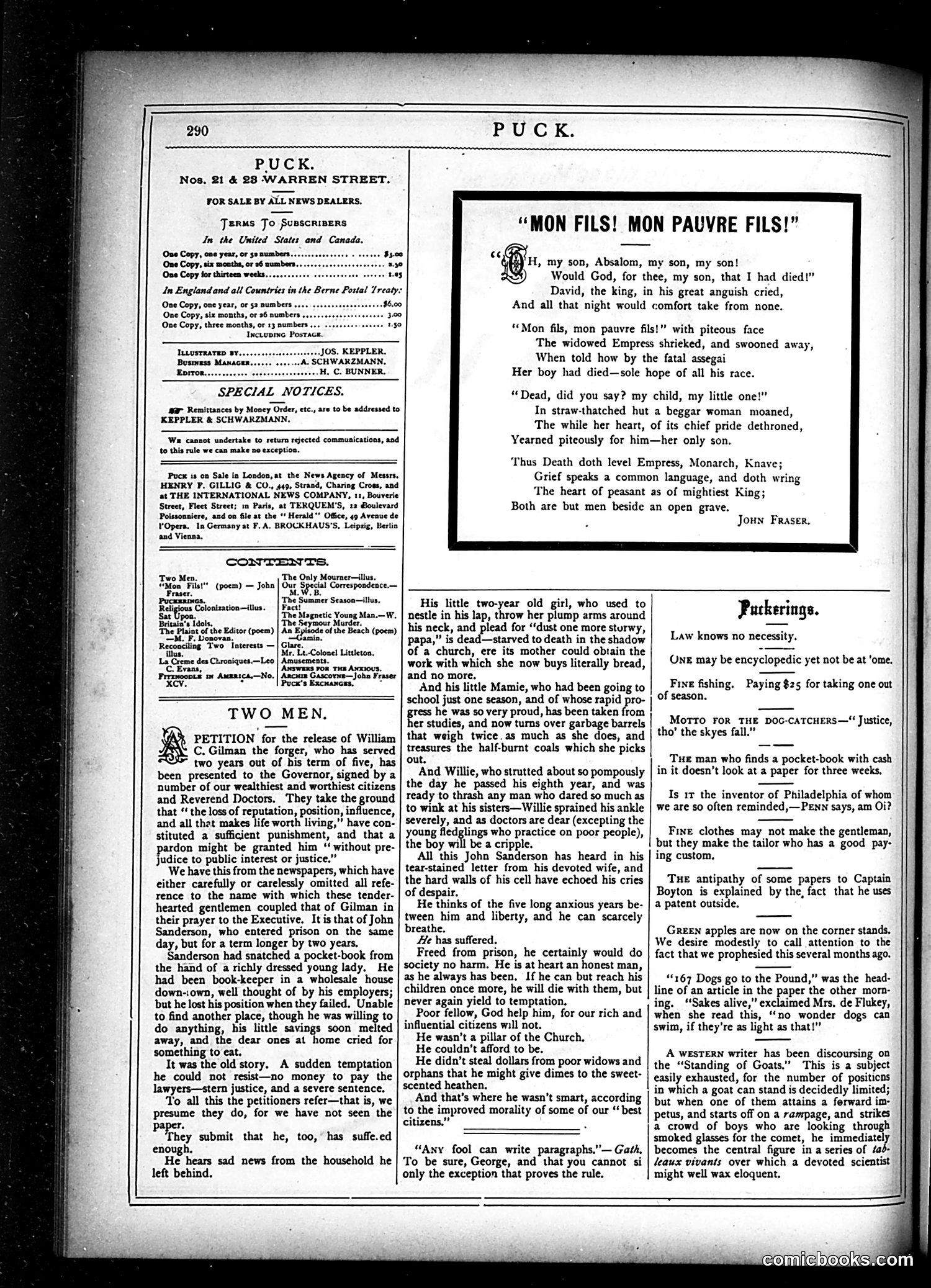
The main content is a poem titled **"Mon Fils! Mon Pauvre Fils!"** (My Son! My Poor Son!) attributed to John Fraser. It depicts a grieving father (labeled "David, the King") and mother (an "Empress") mourning their dead son, with the poem's theme being that death equalizes all ranks—both monarch and peasant face the same fate beside "an open grave." The remainder of the page consists of miscellaneous short satirical pieces and social commentary typical of Puck's format, including sections on "Puckerings" (brief witticisms) and articles on various social topics. **No clear political cartoon** is visible on this page. The content appears primarily literary and editorial rather than visual satire.
📄 Transcribed text from this page (OCR, searchable)
Machine-transcribed from the original scan — historical spelling and the odd misread are preserved.
PUCK. Nos, 21 & 28 WARREN STREET. FOR SALE BY ALL NEWS DEALERS. “MON FILS! MON PAUVRE FILS!” oF GQ. my son, Absalom, my son, my son! Would God, for thee, my son, that I had died!” David, the king, in his great anguish cried, And all that night would comfort take from none. Terms To Susscrisers In the United States and Canada. ‘One Copy, one year, or 32 numbers... . One Copy, six months, or 26 numbers. ‘One Copy for thirteen weeks. 4n England and all Countries in the Berne Postal Treaty: ‘One Copy, one year, or 52 numbers 86.00 One Copy, six months, or 26 number + 300 One Copy, three months, or 13 numbers .. + bo Inctupme Postace. .JOS. KEPPLER. SCHWARZMANN. -H, C. BUNNER. SPECIAL NOTICES. “Mon fils, mon pauvre fils!” with piteous face ‘The widowed Empress shrieked, and swooned away, When told how by the fatal assegai Her boy had died—sole hope of all his race. Intusrrarep sy... “Dead, did you say? my child, my little one!” In straw-thatched hut a beggar woman moaned, mar Remittances by Money Order, etc., are to be addressed to KEPPLER & SCHWARZMANN. ‘We cannot undertake to return rejected communications, and to this rule we can make no exception. Pucx is on Sale in London, at the News Agency of Messrs, HENRY P. GILLIG & CO., 449, Strand, Charing Cross, and at THE INTERNATIONAL NEWS COMPANY, i Street, Fleet Street; in Paris, at TERQUEM'S, Poissonniere, and on file at Herald" Office, 49 Avenue de Opera. In Germany at F.A. BROCKHAUS'S, Leipzig, Berlin and Vienna, CONTENTS. ‘The Only Mourner—illus, Our Special Correspondence.— The Summer Season—illus, Fact ‘The Magnetic Young Man.—W. define Réitor (poem) | An Eyliode ofthe Besch( at of the Editor (poem: Sr bewraen On |S ao Reconciling ‘Two interests —| Glare. illus. Mr. Le. La Creme des Chroniques.—Leo | Amusement C, Evans, ‘Two Men. “Mon Fils!" (poem) — John ‘Fraser. lonization—illus. el Littheton, ts. TWO MEN. ee eas Ante: sm Aumnica,—No, | Ancurm Gascorne—John Fraser xcv. * Pucx’s Exchances, x PETITION for the release of William C. Gilman the forger, who has served IN two years out of his term of five, has been presented to the Governor, signed by a number of our wealthiest and worthiest citizens and Reverend Doctors, They take the ground that “‘ the loss of reputation, position, influence, and all thet makes life worth living,” have con- stituted a sufficient punishment, and that a rdon might be granted him “ without pre- judice to public interest or justice.” We have this from the newspapers, which have either carefully or carelessly omitted all refe- rence to the name with which these tender- hearted gentlemen coupled that of Gilman in their prayer to the Executive. It is that of John Sanderson, who entered prison on the same day, but for a term longer by two years, Sanderson had snatched a pocket-book from the hand of a richly dressed young lady. He had been book-keeper in a wholesale house down-:own, well thought of by his employers; but he lost his position when they failed. Unable to find another place, though he was willing to do anything, his little savings soon melted away, and the dear ones at home cried for something to eat. It was the old story, A sudden temptation he could not resist—no money to pay the lawyers—stern justice, and a severe sentence, To all this the petitioners refer—that is, we presume they do, for we have not seen the Paper. They submit that he, too, has suffe.ed enough, He hears sad news from the household he left behind. The while her heart, of its chief pride dethroned, Yearned piteously for him—her only son. Thus Death doth level Empress, Monarch, Knave; Grief speaks a common language, and doth wring The heart of peasant as of mightiest King; Both are but men beside an open grave. Joun Fraser, His little two-year old nestle in his lap, throw her plump arms around his neck, and plead for ‘‘dust one more sturwy, papa,” is dead—starved to death in the shadow of a church, ere its mother could obtain the work with which she now buys literally bread, and no more. And his little Mamie, who had been going to school just one season, and of whose rapid pro- ress he was so very proud, has been taken from er studies, and now turns over garbage barrels that weigh twice.as much as she does, and treasures the half-burnt coals which she picks out. And Willie, who strutted about so pompously the day he passed his eighth year, and was ready to thrash any man who dared so much as to wink at his sisters—Willie sprained his ankle severely, and as doctors are dear (excepting the young fledglings who practice on poor people), the boy will be a cripple. All this John Sanderson has heard in his tear-stained letter from his devoted wife, and the hard walls of his cell have echoed his cries of despair. He thinks of the five long anxious years be- tween him and liberty, and he can scarcely breathe. He has suffered. Freed from prison, he certainly would do society no harm. He is at heart an honest man, as he always has been, If he can but reach his children once more, he will die with them, but never again yield to temptation, Poor fellow, God help him, for our rich and influential citizens will not. He wasn't a pillar of the Church, He couldn’t afford to be. He didn’t steal dollars from poor widows and orphans that he might give dimes to the sweet- scented heathen, And that's where he wasn’t smart, according to the improved morality of some of our “‘ best citizens.” A “Any fool_can write paragraphs.”— Gath. To be sure, George, and that you cannot si only the exception that proves the rule. girl, who used to | Pl Puckerings. Law knows no necessity. One may be encyclopedic yet not be at ‘ome, Fine fishing. Paying $25 for taking one out of season. MotTo FOR THE DOG-CATCHERS—“ Justice, tho’ the skyes fall.” Tue man who finds a pocket-book with cash in it doesn’t look at a paper for three weeks. Is 17 the inventor of Philadelphia of whom we are so often reminded,— Penn says, am Oi? Fine clothes may not make the gentleman, but they make the tailor who has a good pay- ing custom, Tue antipathy of some papers to Captain Boyton is explained by the, fact that he uses a patent outside. Green apples are now on the corner stands, We desire modestly to call attention to the fact that we prophesied this several months ago. “167 Dogs go to the Pound,” was the head- line of an article in the paper the other morn- ing. ‘‘Sakes alive,” exclaimed Mrs. de Flukey, when she read this, ‘no wonder dogs can swim, if they're as light as that!” A WESTERN writer has been discoursing on the “Standing of Goats.” This is a subject easily exhausted, for the number of positicns in which a goat can stand is decidedly limited; but when one of them attains a ferward im- petus, and starts off on a rampage, and strikes a crowd of boys who are looking through smoked glasses for the comet, he immediat v4 becomes the central figure in a series of fab- deaux vivants over which a devoted scientist might well wax eloquent,