
Puck, 1879-07-16 · page 3 of 16
Puck — July 16, 1879 — page 3: what you’re looking at
What you’re looking at
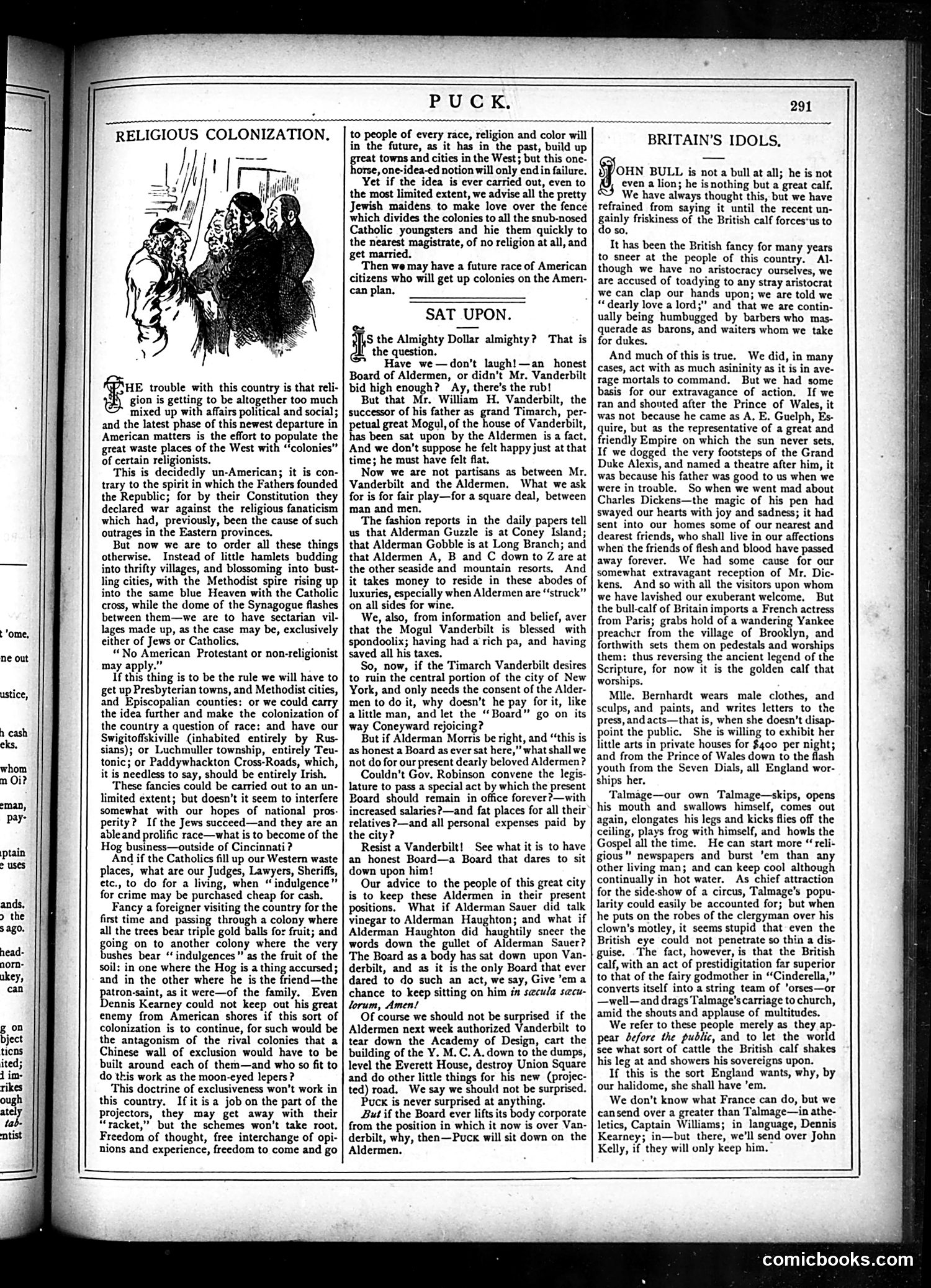
The page contains three distinct sections: "Religious Colonization" (left cartoon), "Sat Upon" (center), and "Britain's Idols" (right). The **left cartoon** satirizes American religious groups establishing colonies, depicting what appears to be clergy and lay people promoting sectarian settlements—likely critiquing the era's utopian religious communities. The **center section** mocks wealthy industrialists like Vanderbilt and Aldermen, questioning their philanthropic motives and suggesting they exploit charitable boards for personal gain. The **right section** attacks British reverence for wealthy figures like John Bull (symbol of Britain itself), suggesting the nation ridicules its own aristocrats while fawning over American billionaires. The satire targets British hypocrisy regarding class deference and American wealth worship. Overall, the page critiques religious tribalism, corrupt philanthropy, and transatlantic class pretension.
📄 Transcribed text from this page (OCR, searchable)
Machine-transcribed from the original scan — historical spelling and the odd misread are preserved.
PUCK. gion is getting to be altogether too much mixed up with affairs political and social; and the latest phase of this newest departure in American matters is the effort to populate the great waste places of the West with “colonies” of certain religionists. This is decidedly un-American; it is con- trary to the spirit in which the Fathers founded the Republic; for by their Constitution they declared war against the religious fanaticism which had, previously, been the cause of such outrages in the Eastern provinces. But now we are to order all these things otherwise. Instead of little hamlets budding into thrifty villages, and blossoming into bust- ling cities, with the Methodist spire rising up into the same blue Heaven with the Catholic cross, while the dome of the Synagogue flashes between them—we are to have sectarian vil- lages made up, as the case may be, exclusively either of Jews or Catholics, “No American Protestant or non-religionist may apply.” If this thing is to be the rule we will have to get up Presbyterian towns, and Methodist cities, and Episcopalian counties: or we could the idea further and make the colonization of the country a question of race: and have our Swigitoffskiville (inhabited entirely by Rus- sians); or Luchmuller township, entirely Teu- tonic; or Paddywhackton Cross-Roads, which, it is needless to say, should be entirely Irish, These fancies could be carried out to an un- limited extent; but doesn’t it seem to interfere somewhat with our hopes of national pros- perity? If the Jews succeed—and they are an ableand prolific race—what is to become of the Hog business—outside of Cincinnati? And if the Catholics fill up our Western waste places, what are our Judges, Lawyers, Sheriffs, etc. to do for a living, when “indulgence” for crime may be purchased cheap for cash. Fancy a foreigner visiting the country for the first time and passing through a colony where all the trees bear triple gold balls for fruit; and going on to another colony where the very ushes bear ‘‘ indulgences” as the fruit of the soil: in one where the Hog is a thing accursed; and in the other where he is the friend—the tron-saint, as it were—of the family. Even ennis Kearney could not keep out his great enemy from American shores if this sort of colonization is to continue, for such would be the antagonism of the rival colonies that a Chinese wall of exclusion would have to be built around each of them—and who so fit to do this work as the moon-eyed lepers? This doctrine of exclusiveness won't work in this country. If it isa job on the part of the Projectors, they may get away with their “racket,” but the schemes won't take root. Freedom of thought, free interchange of opi- nions and experience, freedom to come and go ee trouble with this country is that reli- to people of every race, religion and color will in the future, as it has in the past, build up eat towns and cities in the West; but this one- jorse, one-idea-ed notion will only endin failure. Yet if the idea is ever carried out, even to the most limited extent, we advise all the pretty Jewish maidens to make love over the fence which divides the colonies to all the snub-nosed Catholic youngsters and hie them quickly to the nearest magistrate, of no religion at all, and get married. ‘Then we may have a future race of American citizens who will get up colonies on the Ameri- can plan, SAT UPON. S the Almighty Dollar almighty? That is the question. Have we—don’t laugh!—an honest Board of Aldermen, or didn’t Mr. Vanderbilt bid high enough? Ay, there’s the rub! But that Mr. William H. Vanderbilt, the successor of his father as grand Timarch, per- petual great Mogul, of the house of Vanderbilt, has been sat upon by the Aldermen isa fact. And we don’t suppose he felt happy just at that time; he must have felt flat. Now we are not partisans as between Mr. Vanderbilt and the Aldermen. What we ask for is for fair play—for a square deal, between man and men, The fashion reports in the daily papers tell us that Alderman Guzzle is at Coney Island; that Alderman Gobble is at Long Branch; and that Aldermen A, B and C down to Z are at the other seaside and mountain resorts, And it takes money to reside in these abodes of luxuries, especially when Aldermen are “struck” on all sides for wine. We, also, from information and belief, aver that the Mogul Vanderbilt is blessed with spondoolix; having had a rich pa, and having saved all his taxes. So, now, if the Timarch Vanderbilt desires to ruin the central portion of the city of New York, and only needs the consent of the Alder- men to do it, why doesn’t he pay for it, like a little man, and let the “Board” go on its way Coneyward rejoicing? But if Alderman Morris be right, and “this is as honest a Board as ever sat here,” what shall we not do for our present dearly beloved Aldermen? Couldn't Gov. Robinson convene the legis- lature to pass a special act by which the present Board should remain in office forever?—with increased salaries?—and fat places for all their relatives ?—and all personal expenses paid by the city? Resist a Vanderbilt! See what it is to have an honest Board—a Board that dares to sit down upon him! . Our advice to the people of this great city is to keep these Aldermen in their present positions. What if Alderman Sauer did talk vinegar to Alderman Haughton; and what if Alderman Haughton did haughtily snecr the words down the gullet of Alderman Sauer? The Board as a body has sat down upon Van- derbilt, and as it is the only Board that ever dared to do such an act, we say, Give ’em a chance to keep sitting on him in secula secu- lorum, Ament Of course we should not be surprised if the Aldermen next week authorized Vanderbilt to tear down the Academy of Design, cart the building of the Y. M. C. A. down to the dumps, level the Everett House, destroy Union Square and do other little things for his new (projec- ted) road. We say we should not be surprised. Pucx is never surprised at anything. But if the Board ever lifts its body corporate from the position in which it now is over Van- derbilt, why, then—Puckx will sit down on the Aldermen. BRITAIN’S IDOLS, OHN BULL is not a bull at all; he is not even a lion; he isnothing but a great calf. We have always thought this, but we have refrained from saying it until the recent un- gainly friskiness of the British calf forces‘us to do so, It has been the British fancy for many years to sneer at the people of this country. Al- though we have no aristocracy ourselves, we are accused of toadying to any stray aristocrat we can clap our hands upon; we are told we “dearly love a lord;” and that we are contin- ually being humbugged by barbers who mas- querade as barons, and waiters whom we take for dukes. And much of this is true. We did, in many cases, act with as much asininity as it is in ave- rage mortals to command. But we had some basis for our extravagance of action. If we ran and shovted after the Prince of Wales, it was not because he came as A. E. Guelph, Es- quire, but as the representative of a great and friendly Empire on which the sun never sets. If we dogged the very footsteps of the Grand Duke Alexis, and named a theatre after him, it was because his father was good to us when we were in trouble. So when we went mad about Charles Dickens—the magic of his pen had swayed our hearts with joy and sadness; it had sent into our homes some of our nearest and dearest friends, who shall live in our affections when the friends of flesh and blood have passed away forever. We had some cause for our somewhat extravagant reception of Mr. Dic- kens, And so with all the visitors upon whom we have lavished our exuberant welcome. But the bull-calf of Britain imports a French actress from Paris; grabs hold of a wandering Yankee preacher from the village of Brooklyn, and forthwith sets them on pedestals and worships them: thus reversing the ancient legend of the Scripture, for now it is the golden calf that worships. Mile. Bernhardt wears male clothes, and sculps, and paints, and writes letters to the press, and acts—that is, when she doesn't disap- point the public, She is willing to exhibit her little arts in private houses for $400 per night; and from the Prince of Wales down to the flash youth from the Seven Dials, all England wor- ships her. Talmage—our own Talmage—skips, opens his mouth and swallows himself, comes out again, clongates his legs and kicks flies off the ceiling, plays frog with himself, and howls the Gospel all the time. He can start more reli- gious” newspapers and burst ‘em than any other living man; and can keep cool although continually in hot water. As chief attraction for the side-show of a circus, Talmage’s popu- larity could easily be accounted for; but when he puts on the robes of the clergyman over his clown’s motley, it seems stupid that even the British eye could not penetrate so thin a dis- guise. The fact, however, is that the British calf, with an act of prestidigitation far superior to that of the fairy godmother in “Cinderella,” converts itself into a string team of 'orses—or —well—and drags Talmage's carriage to church, amid the shouts and applause of multitudes. We refer to these people merely as they a pear before the public, and to let the world see what sort of cattle the British calf shakes his leg at and showers his sovereigns upon. If this is the sort England wants, why, by our halidome, she shall have 'em. We don’t know what France can do, but we cansend over a greater than Talmage—in athe- letics, Captain Williams; in language, Dennis Kearney; in—but there, we'll send over John Kelly, if they will only keep him, comicbooks.com