
Puck, 1879-07-16 · page 5 of 16
Puck — July 16, 1879 — page 5: what you’re looking at
What you’re looking at
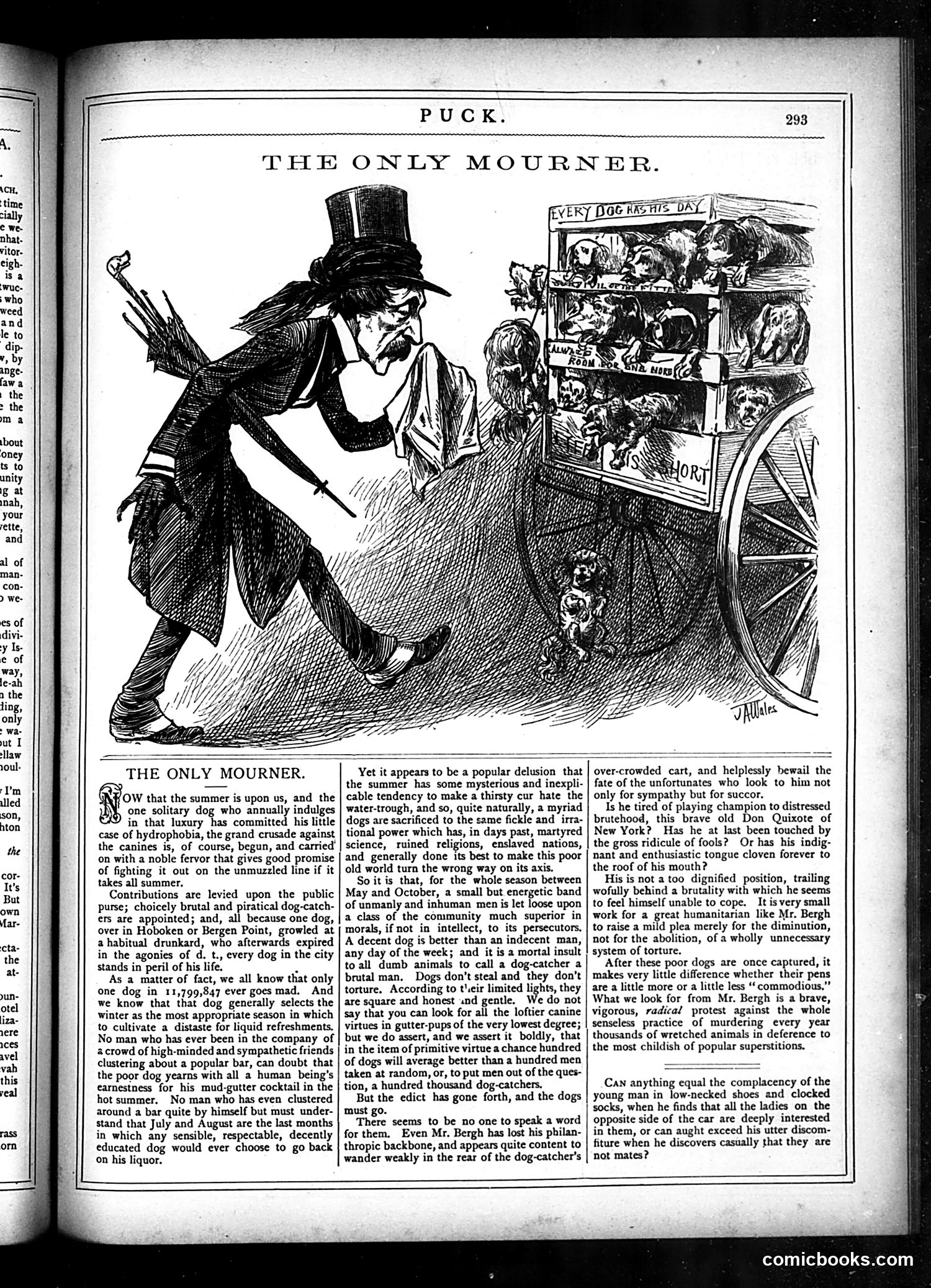
This cartoon satirizes summer's cruel treatment of urban dogs. The figure in the top hat (appearing to represent a wealthy dog owner or society gentleman) mourns beside a cart labeled "Every Dog Has His Day" filled with captured dogs—likely strays destined for death. The satire critiques the hypocrisy of summer society: while the wealthy pursue leisure and "thirst-quenching" pleasures, poor dogs are indiscriminately rounded up and killed. The accompanying text sarcastically notes that even a disgraced dog-catcher receives sympathy, yet hundreds of dogs are sacrificed without moral outcry. The cartoon mocks callous indifference to animal suffering and society's selective compassion—mourning one man while slaughtering thousands of animals.
📄 Transcribed text from this page (OCR, searchable)
Machine-transcribed from the original scan — historical spelling and the odd misread are preserved.
PUCK. THE ONLY MOURNER. 3 Wy HN Why. MYT y Yi yy, \ Yop Di os YY YY yy Wy, YY LLY) iy Uiftg Lp ji) Vp, ty Yj YY THE ONLY MOURNER. OW that the summer is upon us, and the one solitary dog who annually indulges in that luxury has committed his little case of hydrophobia, the grand crusade against the canines is, of course, begun, and carried’ on with a noble fervor that gives good promise of fighting it out on the unmuzzled line if it takes all summer. Contributions are levied upon the public purse; choicely brutal and piratical dog-catch- ers are appointed; and, all because one dog, over in Hoboken or Bergen Point, growled at a habitual drunkard, who afterwards expired in the agonies of d. t., every dog in the city stands in peril of his life. . As a matter of fact, we all know that only one dog in 11,799,847 ever gocs mad. And we know that that dog generally selects the winter as the most appropriate season in which to cultivate a distaste for liquid refreshments. No man who has ever been in the company of acrowd of high-minded and sympathetic friends clustering about a popular bar, can doubt that the poor dog yearns with all a human being’s earnestness for his mud-gutter cocktail in the hot summer. No man who has even clustered around a bar quite by himself but must under- stand that July and August are the last months in which any sensible, respectable, decently educated dog would ever choose to go back on his liquor. Yet it appears to be a popular delusion that the summer has some mysterious and inexpli- cable tendency to make a thirsty cur hate the water-trough, and so, quite naturally, a myriad dogs are sacrificed to the same fickle and irra- tional power which has, in days past, martyred science, ruined religions, enslaved nations, and generally done its best to make this poor old world turn the wrong way on its axis. So it is that, for the whole season between May and October, a small but energetic band of unmanly and inhuman men is let loose upon a class of the community much superior in morals, if not in intellect, to its persecutors. A decent dog is better than an indecent man, any day of the week; and it is a mortal insult to all dumb animals to call a dog-catcher a brutal man. Dogs don’t steal and they don’t torture, According to t/eir limited lights, they are square and honest und gentle. We do not say that you can look for all the loftier canine virtues in gutter-pups of the very lowest degree; but we do assert, and we assert it boldly, that in the item of primitive virtue a chance hundred of dogs will average better than a hundred men taken at random, or, to put men out of the ques- tion, a hundred thousand dog-catchers. But the edict has gone forth, and the dogs must go. There seems to be no one to speak a word for them. Even Mr. Bergh has lost his philan- thropic backbone, and appears quite content to wander weakly in the rear of the dog-catcher’s over-crowded cart, and helplessly bewail the fate of the unfortunates who look to him not only for sympathy but for succor. Is he tired of playing champion to distressed brutehood, this brave old Don Quixote of New York? Has he at last been touched by the gross ridicule of fools? Or has his indig- nant and enthusiastic tongue cloven forever to the roof of his mouth? His is not a too dignified position, trailing wofully behind a brutality with which he seems to feel himself unable to cope. It is very small work for a great humanitarian like Mr. Bergh to raise a mild plea merely for the diminution, not for the abolition, of a wholly unnecessary system of torture. After these poor dogs are once captured, it makes very little difference whether their pens are a little more or a little less ‘ commodious,”” What we look for from Mr. Bergh is a brave, vigorous, radica/ protest against the whole senseless practice of murdering every year thousands of wretched animals in deference to the most childish of popular superstitions. Can anything equal the complacency of the young man in low-necked shoes and clocked socks, when he finds that all the ladies on the opposite side of the car are deeply interested in them, or can aught exceed his utter discom- fiture when he discovers casually that they are not mates? comicbooks.com