
Puck, 1879-07-16 · page 11 of 16
Puck — July 16, 1879 — page 11: what you’re looking at
What you’re looking at
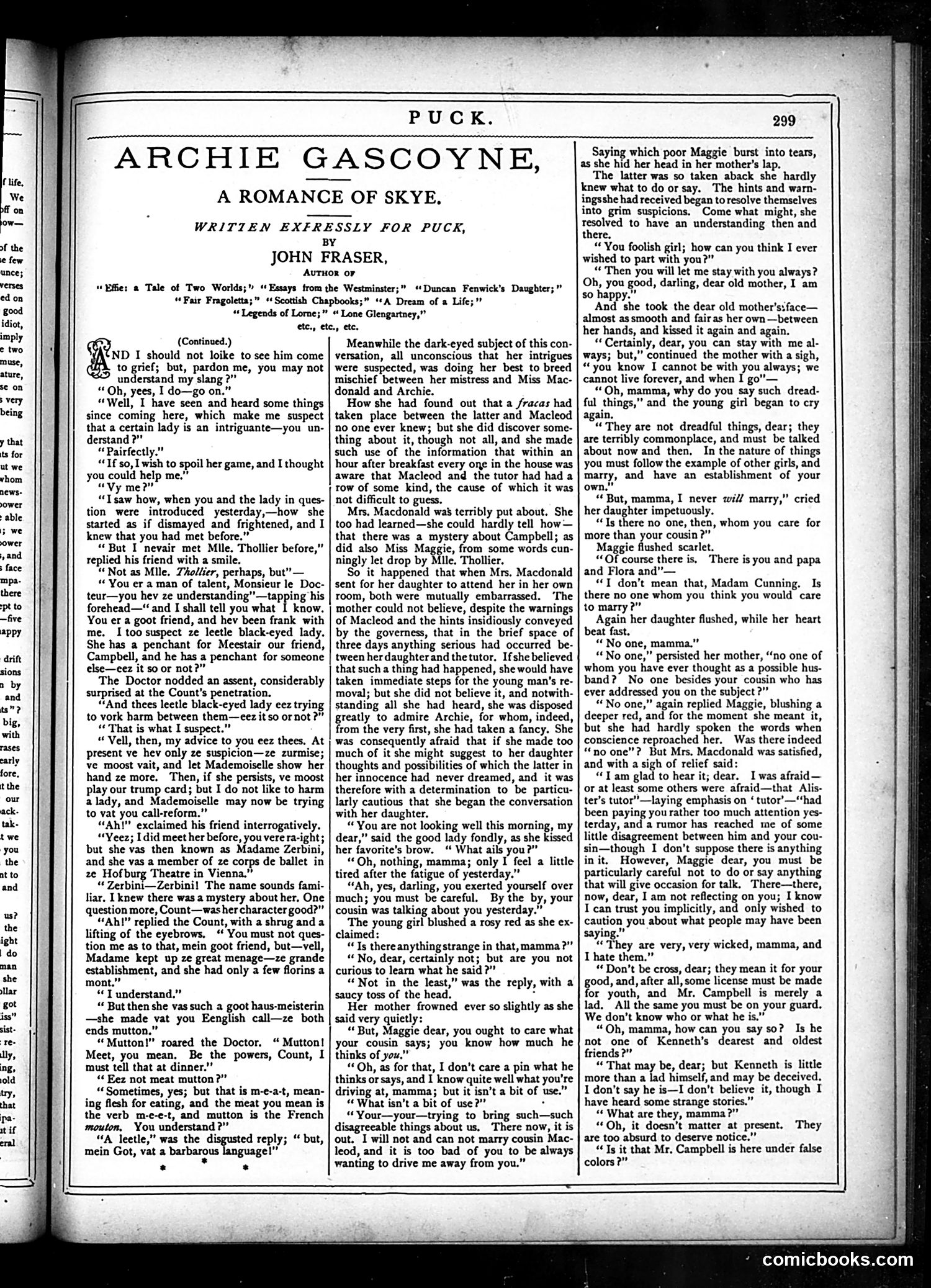
This page is primarily **text fiction, not a political cartoon**. It's the continuation of "Archie Gascoyne, A Romance of Skye," a serialized story by John Fraser written expressly for Puck magazine. The narrative follows a romantic plot involving characters named Maggie, Archie, and others in what appears to be a Scottish setting. The dialogue concerns personal relationships, family concerns, and romantic entanglements—particularly around whether Maggie should marry or leave with Archie. **No political or social satire is evident** on this page. This represents Puck's literary fiction content rather than its signature satirical cartooning. The page number (299) suggests this is deep within a longer issue featuring mixed content types.
📄 Transcribed text from this page (OCR, searchable)
Machine-transcribed from the original scan — historical spelling and the odd misread are preserved.
PUCK. ARCHIE GASCOYNE, A ROMANCE OF SKYE, WRITIEN EXFRESSLY FOR PUCK, BY JOHN FRASER, Auruor oF “Effie: a Tale of Two Worlds;” «Essays from the Westminster;” “Duncan Fenwick’s Daughter; ” “Fair Fragoletta;” «Scottish Chapbooks;” ‘A Dream of a Life;’? “Legends of Lorne;” « Lone Glengartney,” etc., etc, etc, (Continued.) ND I should not loike to see him come to grief; but, pardon me, you may not understand my slang ?” “Oh, yees, I do—go on.” “Well, I have seen and heard some things since coming here, which make me suspect that a certain lady is an intriguante—you un- derstand ?” “Pairfectly.” “If so, I wish to spoil her game, and I thought you could help me,” “Vy me?” “Tsaw how, when you and the lady in ques- tion were introduced yesterday,—how she started as if dismayed and frightened, and I knew that you had met before.” “But I nevair met Mile. Thollier before,” replied his friend with a smile. “Not as Mlle. Zhollier, perhaps, but” — “You er a man of talent, Monsieur le Doc- teur—you hev ze understanding"—tapping his forehead—“ and I shall tell you what I know. You er a goot friend, and hev been frank with me. I too suspect ze leetle black-eyed lady. She has a penchant for Meestair our friend, Campbell, and he has a penchant for someone else—cez it so or not?” The Doctor nodded an assent, considerably surprised at the Count’s penetration. “And thees leetle black-eyed lady eez trying to vork harm between them—eez it so or not ?” “That is what I suspect.” “Vell, then, my advice to you eez thees. At present ve hev only ze suspicion—ze zurmise; ve moost vait, and let Mademoiselle show her hand ze more. Then, if she persists, ve moost play our trump card; but I do not like to harm a lady, and Mademoiselle may now be trying to vat you call-reform.” “Ah!” exclaimed his friend interrogatively. “Yeez; [did meet her before, you vere ra-ight; but she vas then known as Madame Zerbini, and she vas a member of ze corps de ballet in ze Hofburg Theatre in Vienna.” “ Zerbini—Zerbini! The name sounds fami- liar. [knew there was a mystery about her. One question more, Count—washer character good?” “Ah!” replied the Count, with a shrug anda lifting of the eyebrows. ‘‘ You must not ques- tion me as to that, mein goot friend, but—vell, Madame kept up ze great menage—ze grande establishment, and she had only a few florins a mont,” “T understand.” “ But then she vas such a goot haus-meisterin —she made vat you Eenglish call—ze both ends mutton.” “Mutton!” roared the Doctor. “ Mutton! Meet, you mean. Be the powers, Count, I must tell that at dinner.” “ Eez not meat mutton?” “Sometimes, yes; but that is m-e-a-t, mean- ing flesh for eating, and the meat you mean is the verb m-e-e-t, and mutton is the French mouton, You understand?” “A leetle,” was the di mein Got, vat a barbarous * ed reply; “ but, guage!’ * Meanwhile the dark-eyed subject of this con- versation, all unconscious that her intrigues were suspected, was doing her best to breed mischief between her mistress and Miss Mac- donald and Archie. How she had found out that a fracas had taken place between the latter and Macleod no one ever knew; but she did discover some- thing about it, though not all, and she made such use of the information that within an hour after breakfast every one in the house was aware that Macleod and the tutor had had a row of some kind, the cause of which it was not difficult to guess. Mrs, Macdonald was terribly put about. She too had learned—she could hardly tell how— that there was a mystery about Campbell; as did also Miss Maggie, from some words cun- ningly let drop by Mile. Thollier. So it happened that when Mrs. Macdonald sent for her daughter to attend her in her own room, both were mutually embarrassed. ‘The mother could not believe, despite the warnings of Macleod and the hints insidiously conveyed by the governess, that in the brief space of three days anything serious had occurred be- tween herdaughterand thetutor. Ifshe believed that such a thing had happened, she would have taken immediate steps for the young man's re- moval; but she did not believe it, and notwith- standing all she had heard, she was disposed greatly to admire Archie, for whom, indeed, from the very first, she had taken a fancy. She was consequently afraid that if she made too much of it she might suggest to her daughter thoughts and possibilities of which the latter in her innocence had never dreamed, and it was therefore with a determination to be particu- larly cautious that she began the conversation with her daughter. “You are not looking well this morning, my dear,” said the good lady fondly, as she kissed her favorite's brow. ‘“ What ails you?” ‘Oh, nothing, mamma; only I feel a little tired after the fatigue of yesterday.” “Ah, yes, darling, you exerted yourself over much; you must be careful. By the by, your cousin was talkiag about you yesterday.” ‘The young girl blushed a rosy red as she ex- claimed: “Ts there anything strange in that, mamma?” “No, dear, certainly not; but are you not curious to learn what he said?” “Not in the least,” was the reply, with a saucy toss of the head. . Her mother frowned ever so slightly as she said very quietly: “But, Maggie dear, you ought to care what your cousin says; you know how much he thinks of you.” ‘Oh, as for that, I don’t care a pin what he thinks or says, and I know quite well what you're driving at, mamma; but it isn’t a bit of use.” “ What isn’t a bit of use?” $ “Your—your—trying to bring such—such disagreeable things about us. There now, it is out. I will not and can not cousin Mac- leod, and it is too bad of you to be always wanting to drive me away from you.” Saying which poor Maggie burst into tears, as she hid her head in her mother’s lap. The latter was so taken aback she hardly knew what to do or say. The hints and warn- ingsshe had received began to resolve themselves into grim suspicions, Come what might, she resolved to have an understanding then and there, “You foolish girl; how can you think I ever wished to part with you?” “ Then you will let me stay with you always? Oh, you good, darling, dear old mother, I am so happy.” And she took the dear old mother’s:face— almost as smooth and fairas her own—between her hands, and kissed it again and again. “Certainly, dear, you can stay with me al- ways; but,” continued the mother with a sigh, “you know I cannot be with you always; we cannot live forever, and when I go"— “Oh, mamma, why do you say such dread- ful things,” and’ the young girl began to cry again. “They are not dreadful things, dear; they are terribly commonplace, and must be talked about now and then, In the nature of things you must follow the example of other girls, and marry, and have an establishment of your own.” “But, mamma, I never wid marry,” cried her daughter impetuously. Sh there no one, then, whom you care for more than your cousin?” Maggie flushed scarlet. “Of course there is. There is you and papa and Flora and”— “T don’t mean that, Madam Cunning. Is there no one whom you think you would care to marry?” Again her daughter flushed, while her heart beat fast. “No one, mamma.” “No one,” persisted her mother, “no one of whom you have ever thought as a possible hus- band? No one besides your cousin who has ever addressed you on the subject?” “No one,” again replied Maggie, blushing a deeper red, and for the moment she meant it, but she had hardly spoken the words when conscience reproached her. Was there indeed “no one”? But Mrs, Macdonald was satisfied, and with a sigh of relief said: “Tam glad to hear it; dear, I was afraid— or at least some others were afraid—that Alis- ter’s tutor—laying emphasis on ‘ tutor’—“had been paying you rather too much attention yes- terday, and a rumor has reached me of some litle disagreement between him and your cou- sin—though I don’t suppose there is anything in it, However, Maggie dear, you must be particularly careful not to do or say anything that will give occasion for talk. There—there, now, dear, I am not reflecting on you; I know I can trust you implicitly, and only wished to caution you about what people may have been saying.” “They are very, very wicked, mamma, and T hate them.” “Don't be cross, dear; they mean it for your good, and, after all, some license must be made for youth, and Mr. Campbell is merely a lad." All the same you must be on your guard. We don’t know who or what he is.” “Oh, mamma, how can you say so? Is he not one of Kenneth’s dearest and oldest friends?” ““ That may be, dear; but Kenneth is little more than a lad himself, and may be deceived, I don't say he is—I don't believe it, though I have heard some strange stories.” “What are they, mamma?” “Oh, it doesn’t matter at present, are too absurd to deserve notice.” “Ts it that Mr. Campbell is here under false colors ?”” They * comicbooks.com