
A complete issue · 16 pages · 1879
Puck — July 9, 1879
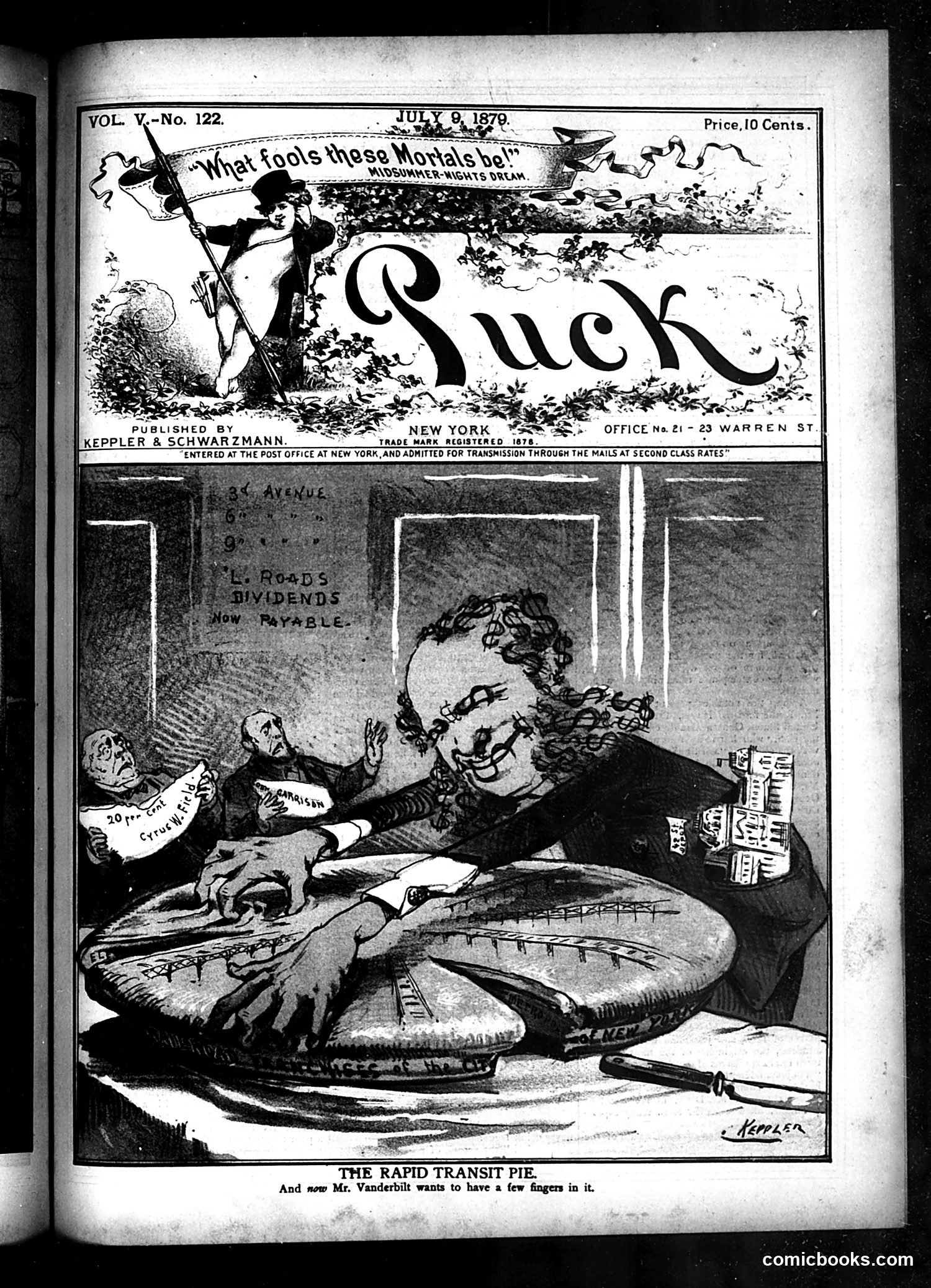
This cartoon satirizes the **rapid transit debate** in 1870s New York, likely referencing the **elevated railway** ("el") construction projects that were transforming the city. The caricatured figure appears to be a wealthy businessman or politician—possibly a Vanderbilt (the caption mentions "Mr. Vanderbilt")—attempting to monopolize a large pie labeled with financial terms: "dividends," "roads," and "10% payable." Smaller figures compete for pieces, suggesting wealthy elites fighting over profits from rapid transit infrastructure contracts. The satire criticizes how powerful industrialists exploited public transportation projects for personal gain, treating essential city infrastructure as a financial opportunity to be carved up among the wealthy rather than developed for public benefit. The "pie" metaphor emphasizes the private enrichment disguised as progress.
This page contains **no visible political cartoons**—it's primarily text content including: - **"A Summer Fancy"**: A poem about observing summer leisure activities (wealthy people at the shore, servants, romance) - **"Parkerings"**: A column of brief satirical observations on various topics including historical ruins, oil speculation, medical quackery, and social pretension - **A major article**: "Department of Mr. Charles A. Dana for Europe," reporting on a farewell dinner for the *Sun* editor's European voyage, attended by prominent figures including President Rutherford B. Hayes, Justice Bradley, and George Washington Childs The content satirizes Gilded Age society—wealth disparities, medical frauds, social climbing—typical of Puck's satirical mission. The Dana piece documents actual 1870s journalism politics and social networking among elites.
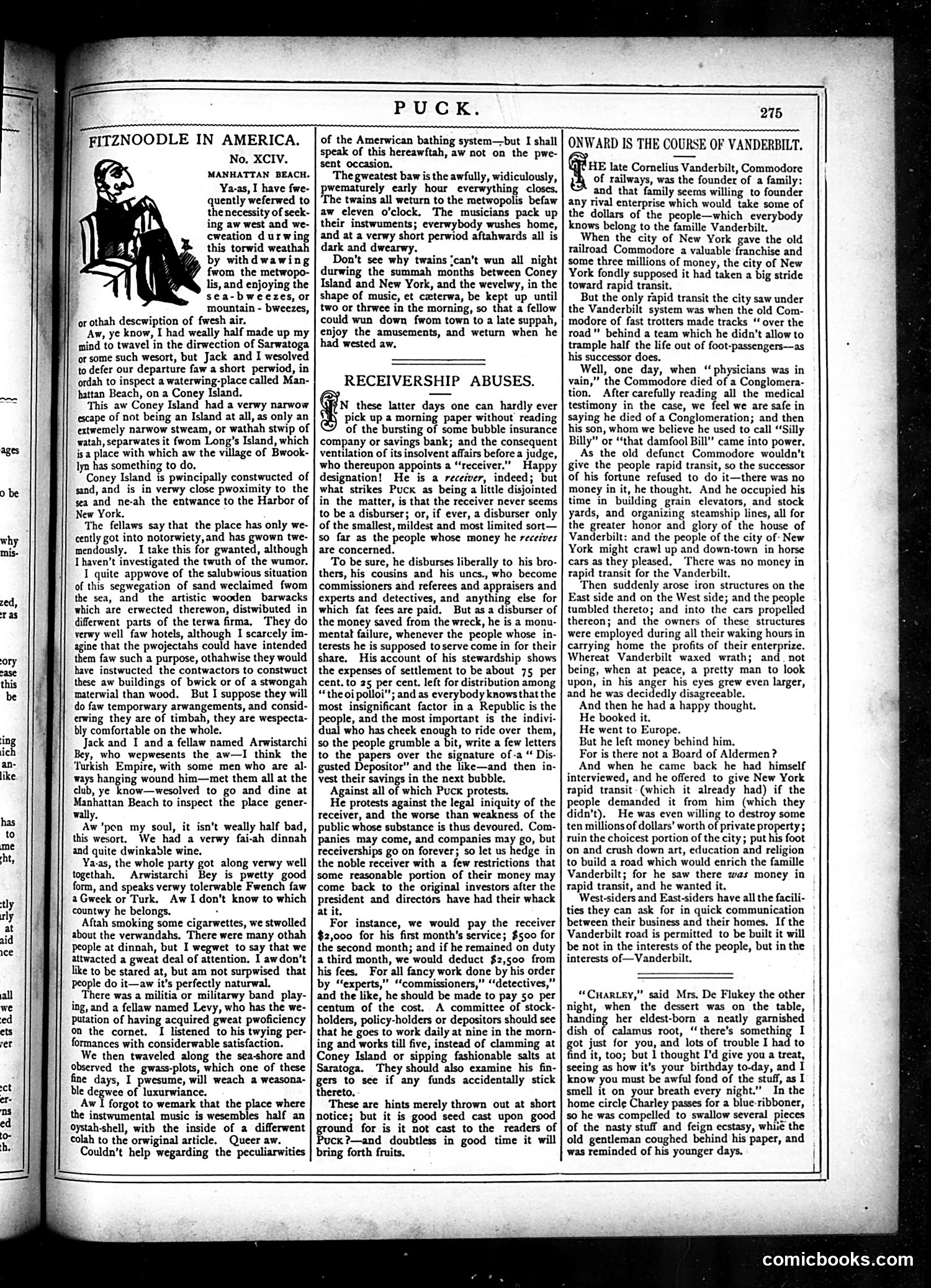
This page contains two separate satirical pieces: **"Fitznoodle in America"** (left) appears to be a humorous travelogue mocking a naive European visitor's exaggerated impressions of American life, particularly New York and Coney Island. The caricatured figure observes local customs with comedic bewilderment. **"Onward is the Course of Vanderbilt"** (right) satirizes Commodore Vanderbilt's railroad empire and the family's wealth accumulation. It critiques how the Vanderbilts controlled New York's transportation infrastructure and used their fortune to expand influence, while questioning the ethics of their business practices and suggesting they exploited public resources for private gain. The piece challenges whether such concentrated wealth and power serves the public interest. Both pieces reflect Puck's satirical agenda of critiquing American excess and elite privilege.
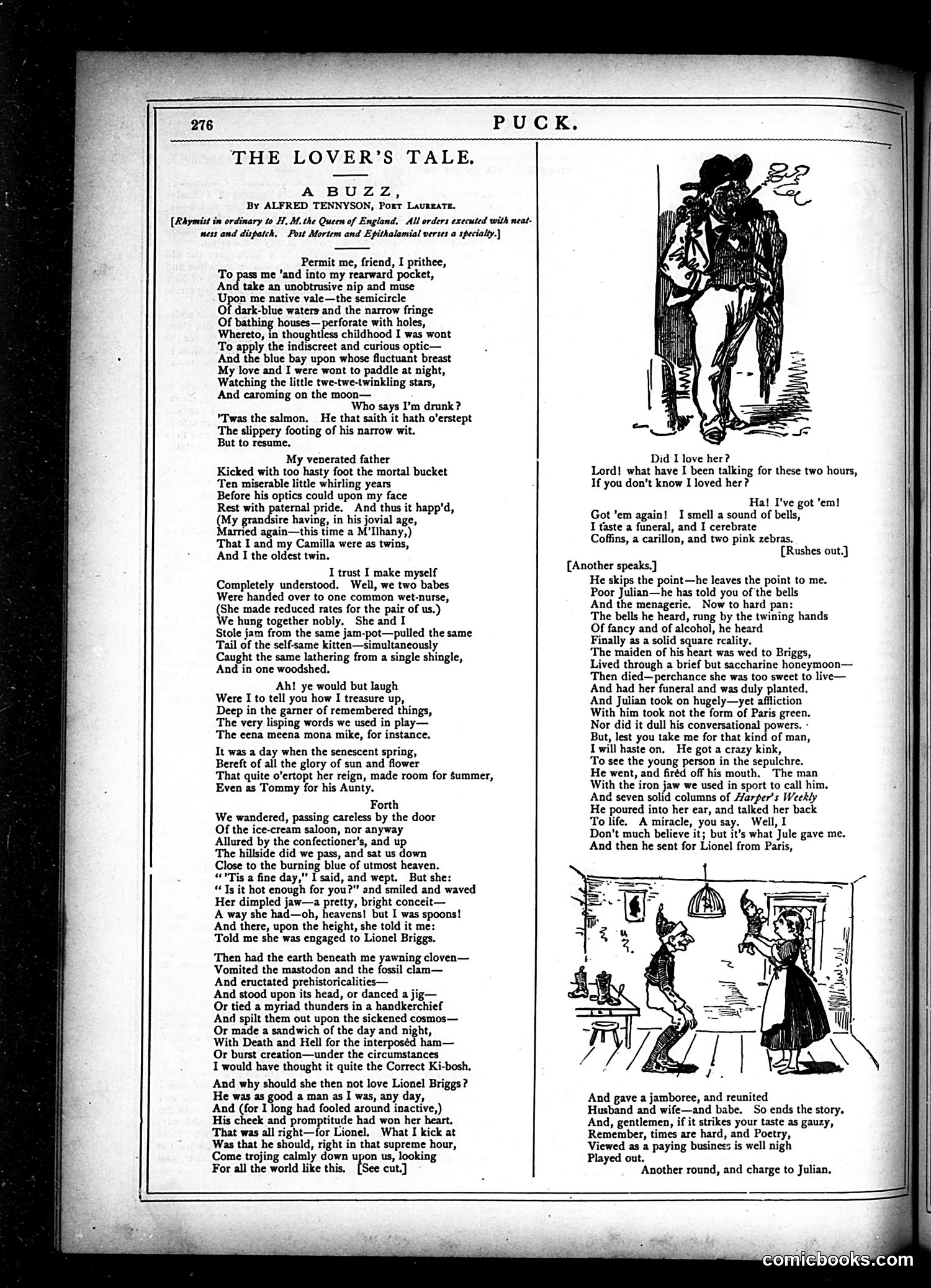
This page reproduces Tennyson's poem with satirical illustrations. The top cartoon shows a disheveled man and woman in an intimate moment, mocking romantic poetry's pretensions. The bottom illustration depicts a domestic scene where a man appears to be telling an exaggerated story to his wife and another couple, suggesting the "lover's tale" is really just drunken boasting. The caption notes the story ends with "Another round, and charge to Julian"—implying the narrator is using sentimental romance as an excuse for drinking. Puck's satire targets Victorian sentimentality and male posturing: the "lover's tale" is exposed as cheap theatricality and alcohol-fueled storytelling rather than genuine passion. The cartoons undercut Tennyson's elevated romantic verse through crude visual humor.
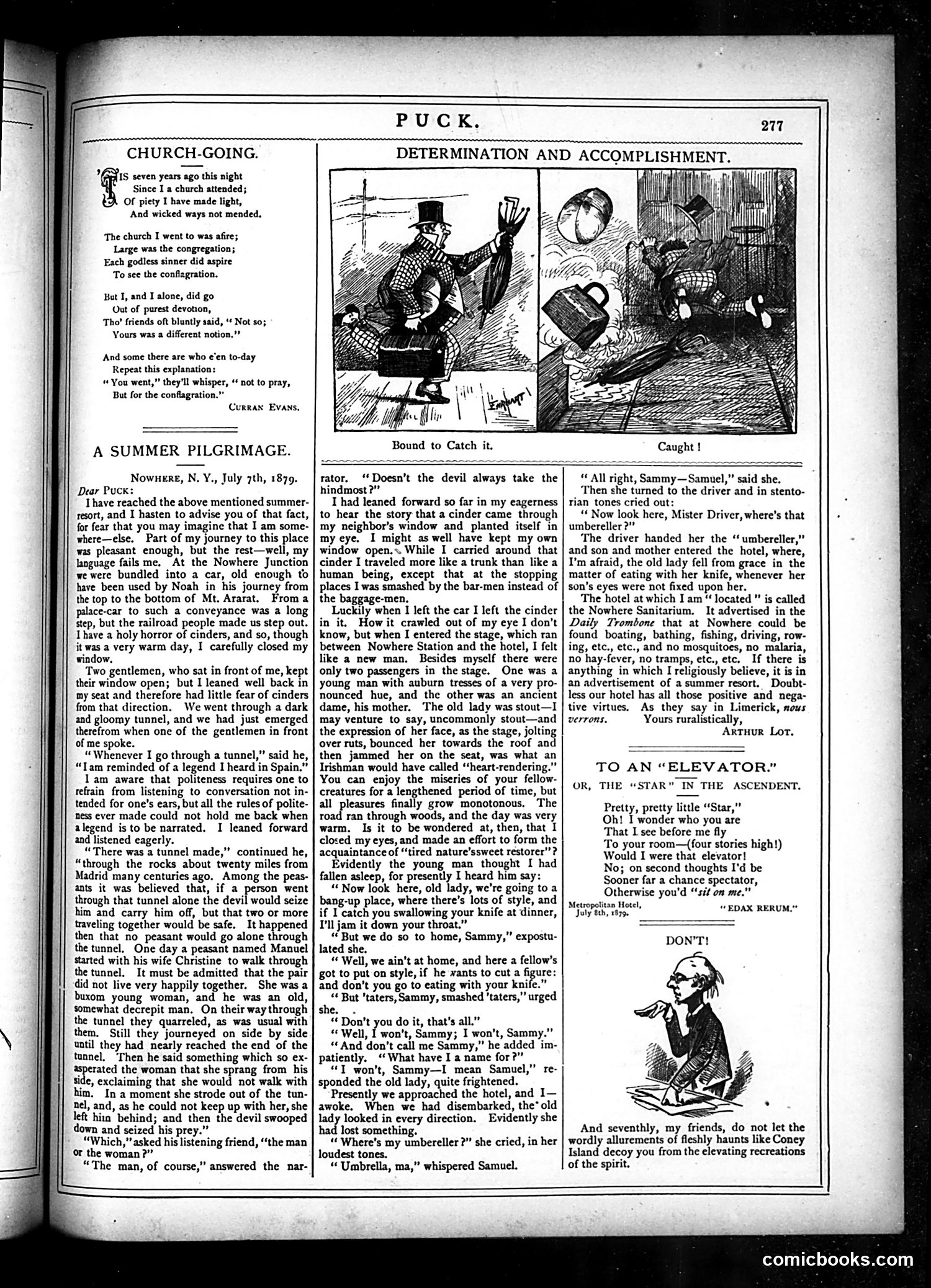
This page contains three separate pieces rather than unified political cartoons: 1. **"Church-Going"** (left): A poem by Curran Evans about attending church seven years after losing faith, satirizing religious hypocrisy. 2. **"A Summer Pilgrimage"** (center/left): A travel narrative letter from Nowhere, N.Y. (July 7th, 1879) describing humorous misadventures on a railroad journey, including encounters with eccentric passengers and a woman traveling with a cinder in a window box. 3. **"Determination and Accomplishment"** (right): A two-panel cartoon showing someone attempting to catch a ball, failing initially, then succeeding. Includes dialogue between a driver and passenger about managing an umbrella. 4. **"To An Elevator"** (bottom right): A brief humorous poem mocking elevator technology as a novelty. The page is primarily satirical social commentary on contemporary American life rather than political commentary.
This page consists primarily of **letters to the editor** rather than cartoons or satirical illustrations. The visible content includes: 1. **"The Astor Library"** - A letter discussing the building's architectural features, botanical specimens, and lighting experiments. It appears to be commentary on the institution's design and educational merit. 2. **"A Letter from a Sweet Girl"** - Correspondence from Toronto criticizing Canadian soldiers' conduct, specifically objecting to their interaction with local women and their appearance (uniforms, maroon color). The letter expresses concern about social propriety and military discipline. 3. **"Puck's History of Ireland"** - Beginning of a serialized historical commentary on Irish-British relations, mentioning various historical figures and events. The page lacks prominent political cartoons but instead features satirical written commentary typical of Puck's editorial content from 1879.
This page contains three distinct articles rather than political cartoons: 1. **"Police Philology"** — A humorous piece about wordplay involving police jargon, particularly discussing terms like "Lister" and "Cop." 2. **"The Lesson of the Blair Business"** — A satirical commentary on a case involving someone named Blair (likely a real incident from the magazine's era). It critiques a wealthy man's treatment of servants and challenges about domestic authority, suggesting Blair represents a class of Americans "wholly unfit to have servants." 3. **"Amusements"** and **"Music in the Air"** — Brief entertainment notices and a poem about a senator. The Blair article appears to be the primary satirical content, attacking wealthy employers' pretensions and poor treatment of domestic workers—a social critique typical of Puck's reform-minded humor targeting class attitudes.
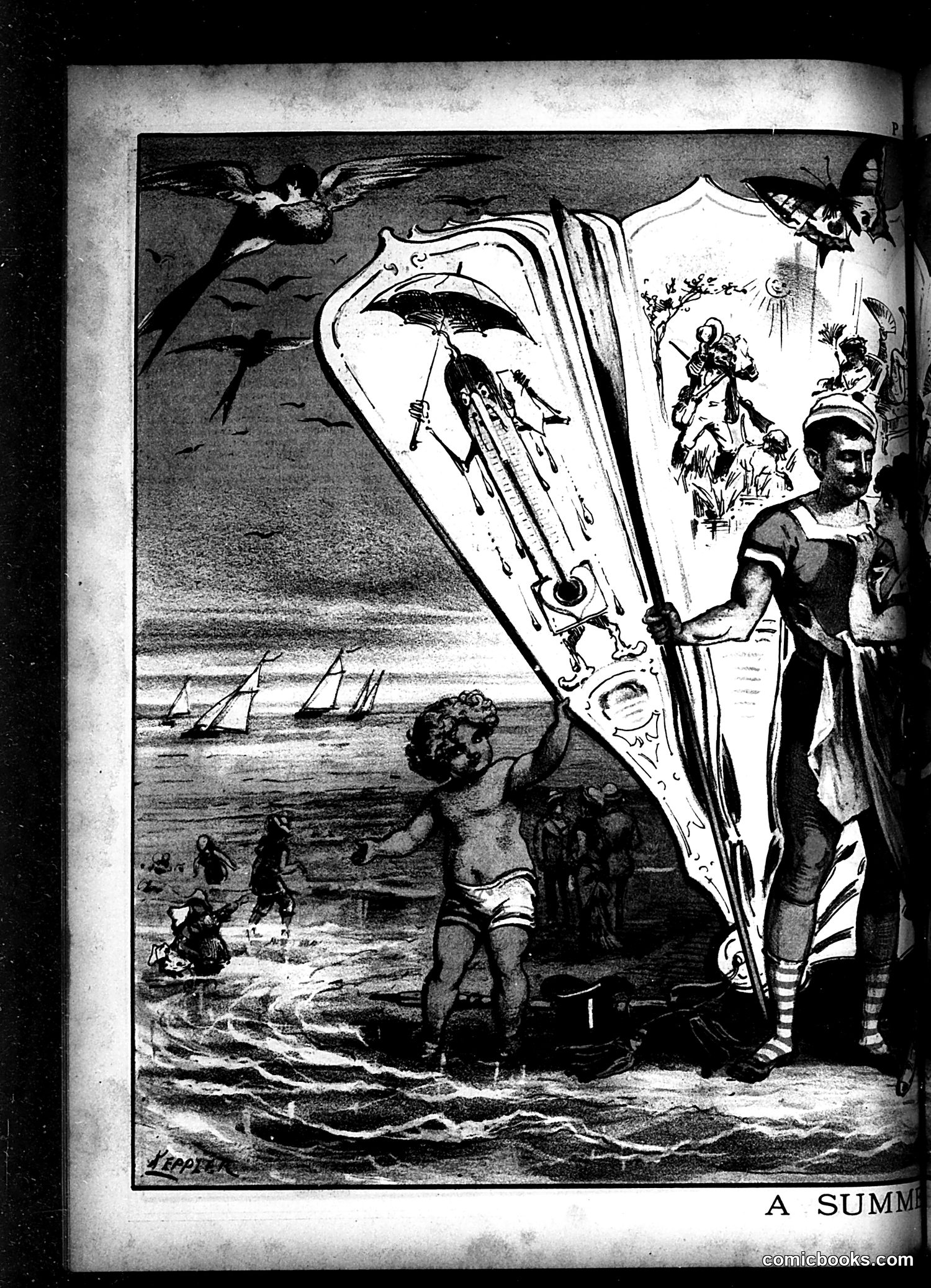
This appears to be a satirical beach scene from Puck magazine, though the caption is cut off ("A SUMM[ER]..."). The cartoon depicts a large decorative parasol or beach umbrella as the central focus, with figures in period bathing attire below it. The illustration seems to satirize summer leisure culture or beach fashion of the era. The elaborate, ornate umbrella dominates the composition, suggesting commentary on ostentatious display or impractical fashion accessories. Cherubs or putti appear in the upper portion, which was common decorative motif in satirical art. Without the complete caption, the specific political or social target remains unclear, though the exaggerated scale of the umbrella relative to the beachgoers suggests mockery of vanity or excessive consumerism in leisure activities.
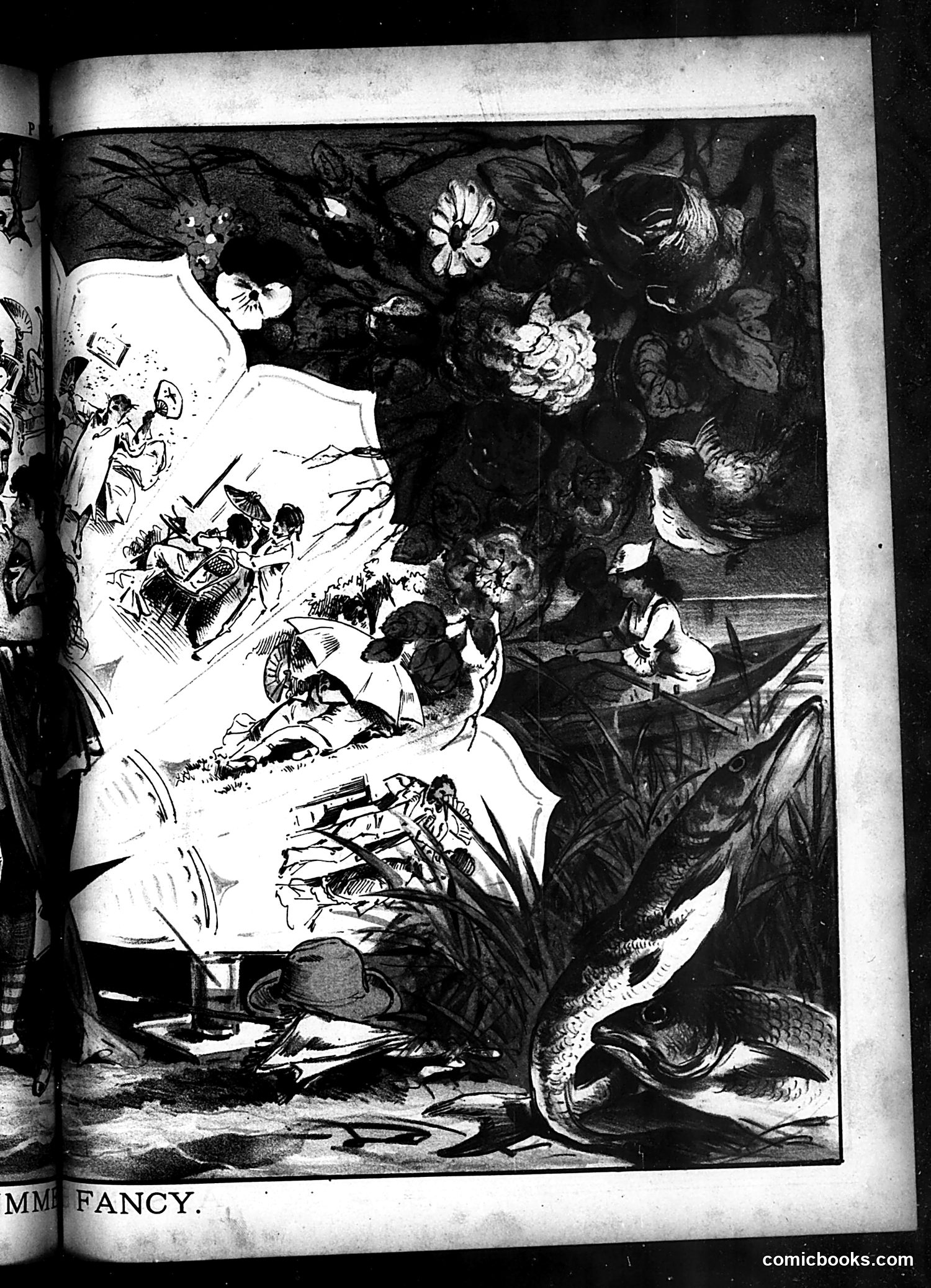
This page from *Puck* magazine shows a satirical illustration labeled "FANCY" depicting a chaotic dream or fantasy scene. The composition contrasts white-draped figures (appearing to be sleeping or dreaming) on the left with dark, surreal imagery on the right—including flowers, skulls, and possibly demonic or grotesque faces hovering above. The satire likely explores the disconnect between people's comfortable, innocent daytime reality (the white-draped sleepers) and their darker unconscious thoughts or societal anxieties manifesting as nightmares. The juxtaposition of "fancy" (imagination/dreams) with grotesque imagery suggests commentary on hidden fears or repressed aspects of society that emerge when people aren't conscious of them. Without additional context about the publication date, the specific political targets remain unclear.
This page is primarily **serialized fiction rather than political satire**. It presents "Archie Gascoyne, A Romance of Skye," a romantic serial story by John Fraser written expressly for Puck magazine. The visible portion shows Chapter XII ("Sea-Lore"), continuing a narrative about Captain Macleod and various characters including Maggie, Archie, and others in what appears to be a Scottish island setting. The text focuses on romantic entanglements, social class tensions, and dramatic dialogue rather than political commentary. **There are no political cartoons or caricatures visible on this page.** It's a straightforward example of how Puck, despite its reputation for satire, also published fiction and serialized stories to fill its pages and entertain readers.
This page contains dialogue from what appears to be a comedic story or play, likely titled around "Colin" and "Archie" based on character names. The text depicts a confrontation where characters discuss insults, apologies, and honor—suggesting a satirical treatment of aristocratic or upper-class social codes. References to "Captain," "Professor," and "Doctor" indicate class-conscious humor mocking formal titles and social pretension. The repeated emphasis on apologies, cigars, and gentlemanly conduct parodies Victorian-era codes of honor and masculine etiquette. Without visible illustrations on this particular page, I cannot identify specific caricatures or political figures. The satire appears directed at social conventions and class posturing rather than specific contemporary political events or individuals.
This page contains **Chapter XIII of a serialized story** ("A jealous man's egg stolen twice") alongside **Puck's Britnages** — a section of satirical short items and jokes. The main narrative discusses household discord and failed attempts to resolve tensions, culminating in a planned shooting and fishing expedition. The **Britnages section** consists of brief satirical commentary on contemporary topics: Egyptian politics (Ismail I's retirement), subscriber complaints about hats and comet predictions, commentary on various American cities and events, and social observations about customs like purchasing gloves for children and monument construction. These items mock bureaucratic inefficiency, regional peculiarities, and everyday absurdities rather than targeting specific individuals. The humor relies on wordplay and deadpan observation typical of 1880s satirical magazines.
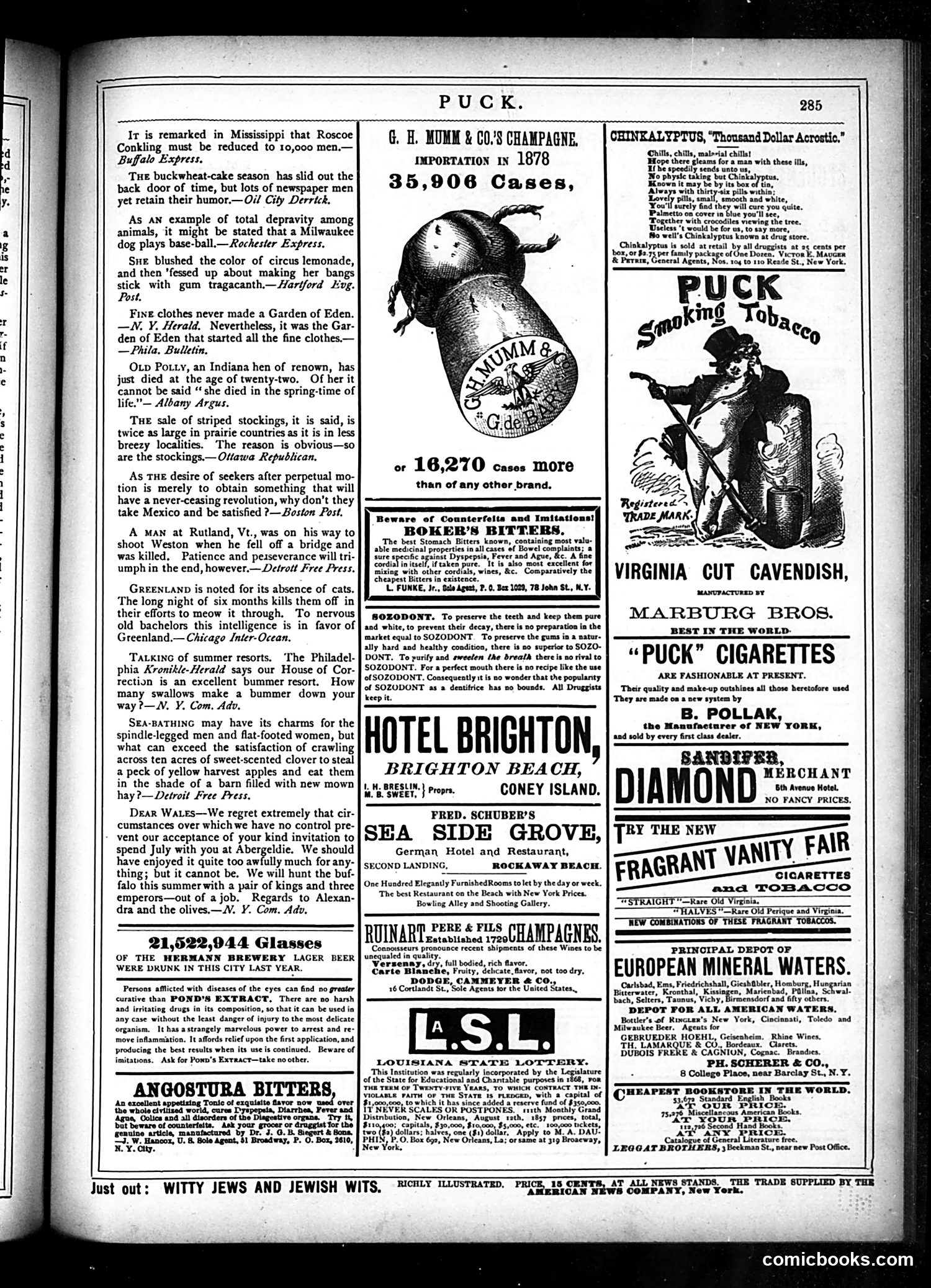
This page is primarily **advertising content** rather than satirical cartoon material. The dominant features include: - Multiple product advertisements (Puck Smoking Tobacco, champagne, beer, hotel services, cigarettes) - Small text items with humorous anecdotes in the left column—typical Puck filler content making light observations about animals, fashion, and social customs The page contains **no identifiable political cartoon or caricature**. The only illustration is the Puck Smoking Tobacco advertisement showing a cherub-like figure, which is the magazine's mascot/brand imagery rather than satire. The scattered witticisms (about Milwaukee dogs, fine clothes, Indian hens, etc.) reflect period humor but lack coherent satirical commentary on specific political events or figures. This appears to be a typical revenue-generating page from Puck's later editorial formula.
This appears to be primarily an **advertising page** from Puck magazine, not a political cartoon. The page is densely packed with commercial advertisements for various late 19th-century products and services, including: - Student lamps and household hardware - Dental services and rooms - Fine silk dress materials - Photographers' studios - Billiard tables - Gentlemen's hats and clothing - Tailoring services - Patent medicines (notably "Tape Worm" treatment) - Mineral water and beer The only illustration that might be considered satirical is a small image for **Brohahne's Combination Shaving Apparatus**, but it appears to be straightforward product advertising rather than social or political commentary. The page is numbered 286 and labeled "PUCK" at the top, confirming its origin.
This page is primarily **advertising content** rather than editorial cartoons. The dominant features are commercial advertisements from the 1890s era, including: - **Cowperthwait & Co.** furniture store offering parlor and chamber suits on credit - **Mathesius & Frey** cabinet furniture manufacturers - **Hamann & Koch** watch and jewelry dealers - **Keppich & Co.** Royal Havana cigars - **Piper-Heidsieck** champagne (with decorative bottle imagery) - Various transportation services (railroads, steamboats) - **Madison Square Garden** advertising summer programming The page includes some small transit/railway notices at top left, but contains **no visible political cartoons or satirical illustrations**. This appears to be a back or filler page of Puck magazine dedicated entirely to period advertisements targeting middle and upper-class consumers.
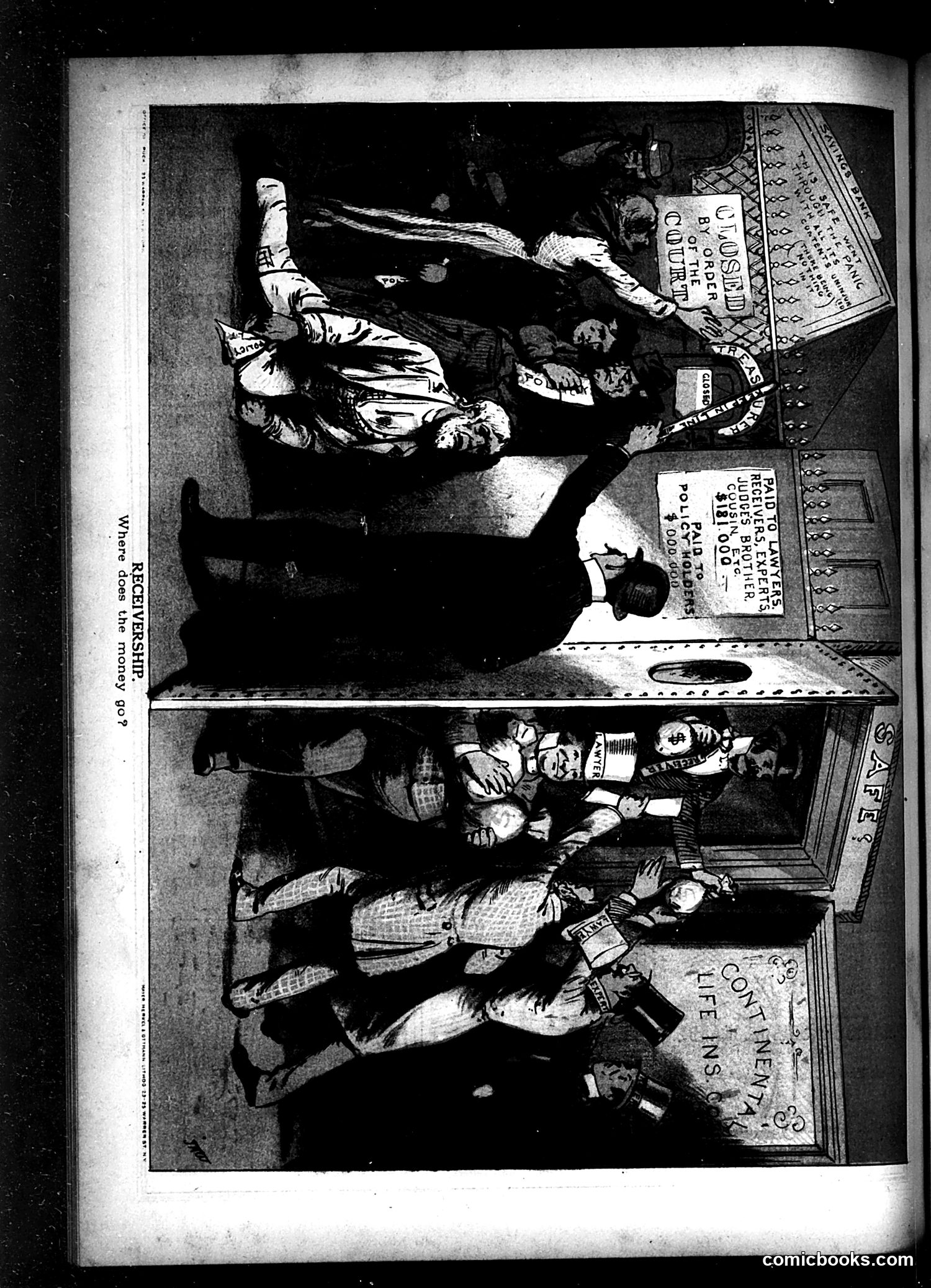
This page appears to contain two separate cartoon panels, though the image quality and rotation make precise interpretation challenging. The OCR text is largely illegible in the provided excerpt. From what's visible, the upper panel shows figures in period dress (appears to be late 19th century based on clothing styles). The lower panel depicts multiple figures in what appears to be an interior domestic or social setting, with various characters interacting. Without clearer text or legible captions, I cannot reliably identify the specific political figures, events, or satirical points being made. The magazine's masthead confirms this is from *Puck*, the well-known American humor publication, but determining the exact subject matter and satirical targets would require more legible source material.