
Puck, 1879-07-09 · page 5 of 16
Puck — July 9, 1879 — page 5: what you’re looking at
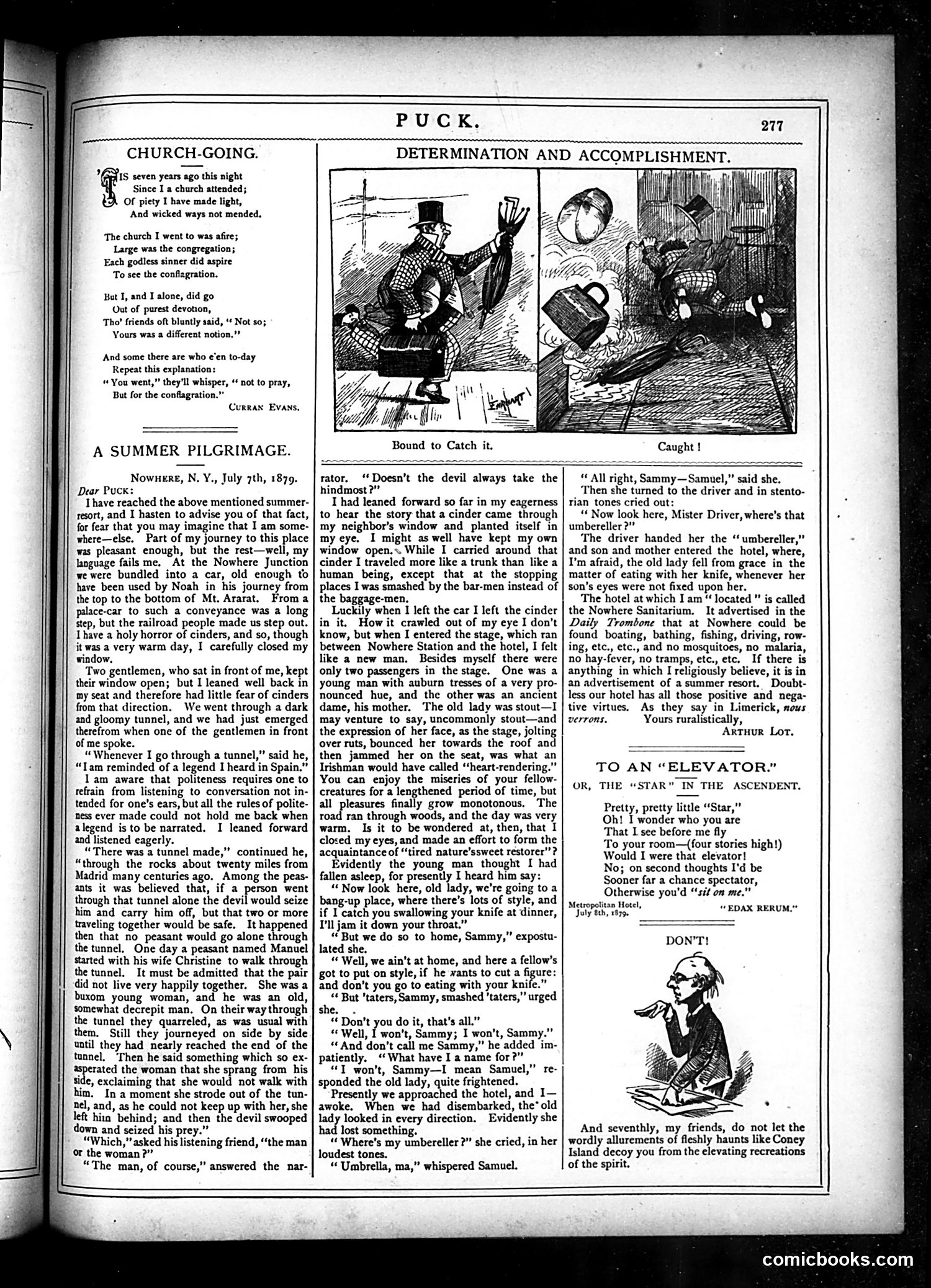
What you’re looking at
This page contains three separate pieces rather than unified political cartoons: 1. **"Church-Going"** (left): A poem by Curran Evans about attending church seven years after losing faith, satirizing religious hypocrisy. 2. **"A Summer Pilgrimage"** (center/left): A travel narrative letter from Nowhere, N.Y. (July 7th, 1879) describing humorous misadventures on a railroad journey, including encounters with eccentric passengers and a woman traveling with a cinder in a window box. 3. **"Determination and Accomplishment"** (right): A two-panel cartoon showing someone attempting to catch a ball, failing initially, then succeeding. Includes dialogue between a driver and passenger about managing an umbrella. 4. **"To An Elevator"** (bottom right): A brief humorous poem mocking elevator technology as a novelty. The page is primarily satirical social commentary on contemporary American life rather than political commentary.
📄 Transcribed text from this page (OCR, searchable)
Machine-transcribed from the original scan — historical spelling and the odd misread are preserved.
PUCK. CHURCH-GOING. 11s seven years ago this night Since I a church attended; Of piety I have made light, And wicked ways not mended. ‘The church I went to was afire; Large was the congregation; Each godless sinner did aspire To see the conflagration. Bat I, and I alone, did go Out of purest devotion, Tho! friends oft bluntly said, “* Not so; Yours was a different notion.” And some there are who e’en to-day Repeat this explanation: “You went,” they'll whisper, “ not to pray, But for the conflagration.” Curran Evans. A SUMMER PILGRIMAGE. Nownere, N, Y., July 7th, 1879. Dear Puck: Ihave reached the above mentioned summer- resort, and I hasten to advise you of that fact, for fear that you may imagine that I am some- where—else. Part of my journey to this place was pleasant enough, but the rest—well, my language fails me. At the Nowhere Junction we were bundled into a car, old enough to have been used by Noah in his journey from the top to the bottom of Mt. Ararat. Froma ce-car to such a conveyance was a long step, but the railroad people made us step out. Ihave a holy horror of cinders, and so, though it was a very warm day, I carefully closed my window, Two gentlemen, who sat in front of me, kept their window open; but I leaned well back in my seat and therefore had little fear of cinders from that direction, We went through a dark and gloomy tunnel, and we had just emerged therefrom when one of the gentlemen in front of me spoke. “Whenever I go through a tunnel,” said he, “Tam reminded of a legend I heard in Spain.” lam aware that politeness requires one to refrain from listening to conversation not in- tended for one’s ears, but all the rules of polite- ness ever made could not hold me back when alegend is to be narrated. I leaned forward and listened eagerly. “There was a tunnel made,” continued he, “through the rocks about twenty miles from Madrid many centuries ago. Among the peas- ants it was believed that, if a person went through that tunnel alone the devil would seize him and carry him off, but that two or more traveling together would be safe. It happened then that no peasant would go alone through the tunnel, One day a peasant named Manuel started with his wife Christine to walk through the tunnel. It must be admitted that the pair did not live very happily together. She was a buxom young woman, and he was an old, somewhat decrepit man. On their way through the tunnel they quarreled, as was usual with them, Still they journeyed on side by side until they had nearly reached the end of the tunnel, ‘Then he said something which so ex- asperated the woman that she sprang from his side, exclaiming that she would not walk with him. In a moment she strode out of the tun- nel, and, as he could not keep up with her, she left hin behind; and then the devil swooped lown and seized his prey.” “Which,” asked his listening friend, “the man or the woman ?” “The man, of course,” answered the nar- DETERMINATION AND ACCOMPLISHMENT. Bound to Catch it, Caught ! rator. ‘Doesn't the devil always take the hindmost ?” Thad leaned forward so far in my eagerness to hear the story that a cinder came through my neighbor’s window and planted itself in my eye. I might aswell have kept my own window open.« While I carried around that cinder I traveled more like a trunk than like a human being, except that at the stopping places I was smashed by the bar-men instead of the baggage-men, Luckily when I left the car I left the cinder in it. How it crawled out of my eye I don’t know, but when I entered the stage, which ran between Nowhere Station and the hotel, I felt like a new man. Besides myself there were only two passengers in the stage. One was a young man with auburn tresses of a very pro- nounced hue, and the other was an ancient dame, his mother. The old lady was stout—I may venture to say, uncommonly stout—and the expression of her face, as the stage, joltin; over ruts, bounced her towards the roof and then jammed her on the seat, was what an Irishman would have called “‘heart-rendering.” You can enjoy the miseries of your fellow- creatures for a lengthened period of time, but all pleasures finally grow monotonous. The road ran through woods, and the day was very warm. Is it to be wondered at, then, that I closed my eyes, and made an effort to form the acquaintance of “tired nature’ssweet restorer”? Evidently the young man thought I had fallen asleep, for presently I heard him say: “ Now look here, old lady, we're going to a bang-up place, where there’s lots of style, and if I catch you swallowing your knife at dinner, I'll jam it down your throat.” “But we do so to home, Sammy,” expostu- lated she, “ Well, we ain't at home, and here a fellow’s got to put on style, if he wants to cut a figure: and don’t you go to eating with your knife.” “ But 'taters, Sammy, smashed 'taters,” urged she. . “ Don't you do it, that’s all.” “Well, I won’t, Sammy; I won't, Sammy.” “And don’t call me Sammy,” he added im- patiently. ‘What have I a name for?” “1 won’t, Sammy—I mean Samuel,” re- sponded the old lady, quite frightened. Presently we approached the hotel, and I— awoke. When we had disembarked, the* old lady looked in every direction. Evidently she had lost something. “Where's my umbereller ?” she cried, in her loudest tones. “ Umbrella, ma,” whispered Samuel. “ All right, Sammy—Samuel,” said she. ‘Then she turned to the driver and in stento- rian tones cried out: “ Now look here, Mister Driver, where's that umbereller ?” The driver handed her the ‘ umbereller,” and son and mother entered the hotel, where, I'm afraid, the old lady fell from grace in the matter of eating with her knife, whenever her son's eyes were not fixed upon her. The hotel at which I am “ located " is called the Nowhere Sanitarium. It advertised in the Daily Trombone that at Nowhere could be found boating, bathing, fishing, driving, row- ing, etc., etc., and no mosquitoes, no malaria, no hay-fever, no tramps, etc., ete. If there is anything in which I religiously believe, it is in an advertisement of a summer resort. Doubt- less our hotel has all those positive and nega- tive virtues, As they say in Limerick, nous verrons. Yours ruralistically, ARTHUR Lor. TO AN “ELEVATOR.” OR, THE “STAR” IN THE ASCENDENT. Pretty, pretty little “Star,” Oh! I'wonder who you are That L see before me fly To your room—{four stories high!) Would I were that elevator! No; on second thoughts I'd be Sooner far a chance spectator, Otherwise you'd “sit on me." Metropolitan Hotel, iw eRUM.” perieony EDAX RERUM.’ DON’T! And seventhly, my friends, do not let the wordly allurements of fleshly haunts like Coney Island decoy you from the elevating recreations of the spirit. comicbooks.com