
Puck, 1879-07-09 · page 3 of 16
Puck — July 9, 1879 — page 3: what you’re looking at
What you’re looking at
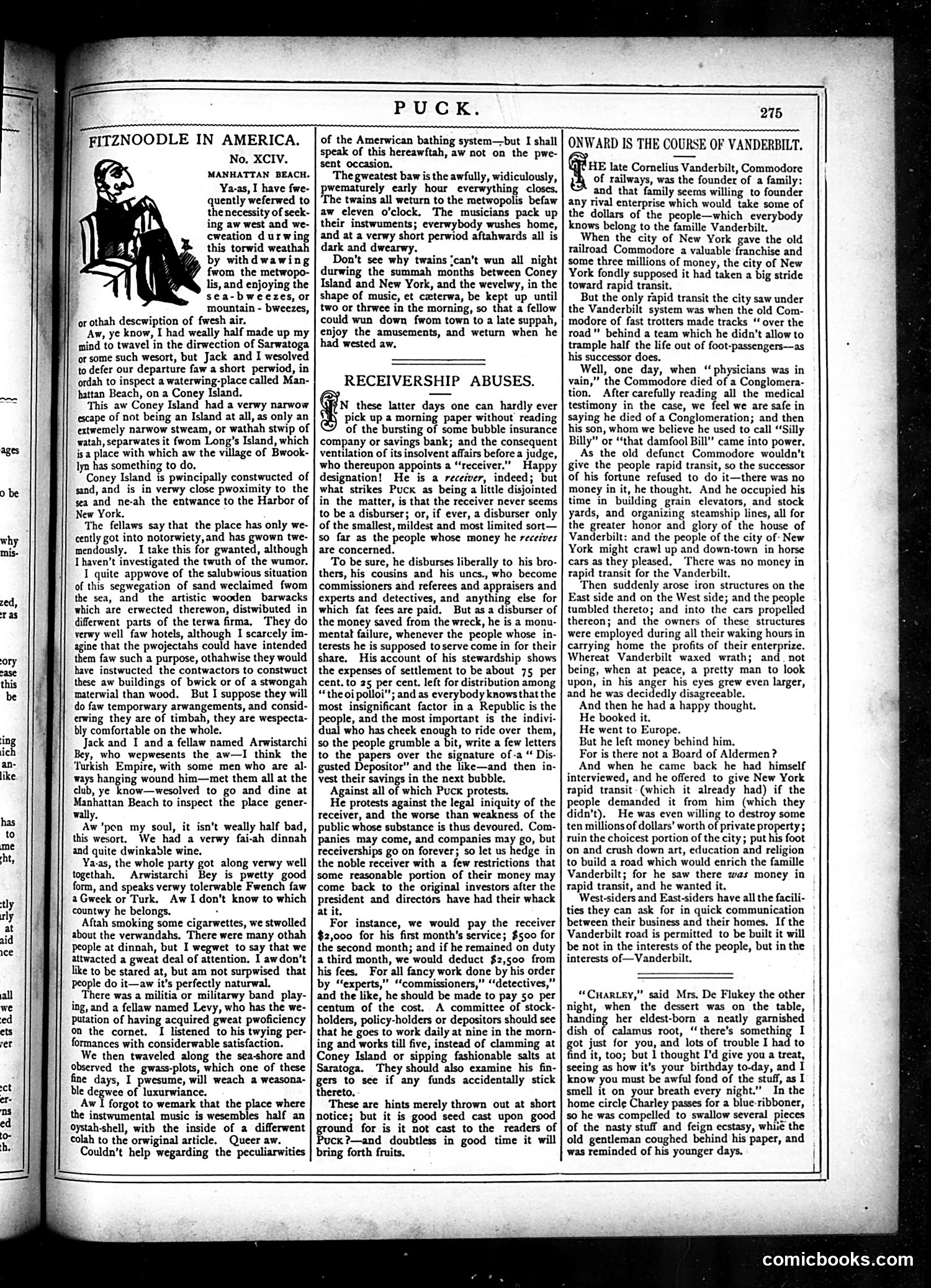
This page contains two separate satirical pieces: **"Fitznoodle in America"** (left) appears to be a humorous travelogue mocking a naive European visitor's exaggerated impressions of American life, particularly New York and Coney Island. The caricatured figure observes local customs with comedic bewilderment. **"Onward is the Course of Vanderbilt"** (right) satirizes Commodore Vanderbilt's railroad empire and the family's wealth accumulation. It critiques how the Vanderbilts controlled New York's transportation infrastructure and used their fortune to expand influence, while questioning the ethics of their business practices and suggesting they exploited public resources for private gain. The piece challenges whether such concentrated wealth and power serves the public interest. Both pieces reflect Puck's satirical agenda of critiquing American excess and elite privilege.
📄 Transcribed text from this page (OCR, searchable)
Machine-transcribed from the original scan — historical spelling and the odd misread are preserved.
PUCK. 275 | FITZNOODLE IN AMERICA. No. XCIV. MANHATTAN BEACH. Ya-as, I have fwe- quently weferwed to thenecessity of seek- ing aw west and we- cweation d urwing this torwid weathah by withdwawing fwom the metwopo- lis, and enjoying the sea-bweezes, or mountain - bweezes, or othah descwiption of fwesh air. ‘Aw, ye know, I had weally half made up my mind to twavel in the dirwection of Sarwatoga or some such wesort, but Jack and I wesolved to defer our departure faw a short perwiod, in ordah to inspect a waterwing-place called Man- hattan Beach, on a Coney Island. This aw Coney Island had a verwy narwow escape of not being an Island at all, as only an extwemely narwow stweam, or wathah stwip of watah, separwates it fwom Long’s Island, which isa place with which aw the village of Bwook- lyn has something to do. Coney Island is pwincipally constwucted of sand, and is in verwy close pwoximity to the sea and ne-ah the entwance to the Harbor of New York. The fellaws say that the place has only we- cently got into notorwiety,and has gwown twe- mendously. I take this for gwanted, although Thaven’t investigated the twuth of the wumor. I quite appwove of the salubwious situation of this segwegation of sand weclaimed fwom the sea, and the artistic wooden barwacks which are erwected therewon, distwibuted in diflerwent parts of the terwa firma. They do verwy well faw hotels, although I scarcely im- agine that the pwojectahs could have intended them faw such a purpose, othahwise they would have instwucted the contwactors to constwuct these aw buildings of bwick or of a stwongah materwial than wood. But I suppose they will do faw temporwary arwangements, and consid- erwing they are of timbah, they are wespecta- bly comfortable on the whole. Jack and I and a fellaw named Arwistarchi Bey, who wepwesents the aw—I think the Turkish Empire, with some men who are al- ways hanging wound him—met them all at the club, ye know—wesolved to go and dine at Manhattan Beach to inspect the place gener- wally. Aw 'pon my soul, it isn’t weally half bad, this wesort. We had a verwy fai-ah dinnah and quite dwinkadle wine. Ya-as, the whole party got along verwy well togethah. Arwistarchi Bey is pwetty good form, and speaks verwy tolerwable Fwench faw aGweek or Turk. Aw I don't know to which countwy he belongs. i. Aftah smoking some cigarwettes, we stwolled about the verwandahs. There were many othah People at dinnah, but I wegwet to say that we attwacted a gweat deal of attention. I awdon’t like to be stared at, but am not surpwised that People do it—aw it’s perfectly naturwal, _ There was a militia or militarwy band play- ing, and a fellaw named Levy, who has the we- putation of having acquired gweat pwoficiency on the cornet. I listened to his twying per- formances with considerwable satisfaction. We then twaveled along the sea-shore and observed the gwass-plots, which one of these fine days, I pwesume, will weach a weasona- ble degwee of luxurwiance. Aw I forgot to wemark that the place where the instwumental music is wesembles half an oystah-shell, with the inside of a differwent colah to the orwiginal article. Queer aw. Couldn’t help wegarding the peculiarwities of the Amerwican bathing system—but I shall speak of this hereawftah, aw not on the pwe- sent occasion, ‘The gweatest baw is the awfully, widiculously, Freeney early hour everwything closes. ¢ twains all weturn to the metwopolis befaw aw eleven o'clock. The musicians pack up their instwuments; everwybody wushes home, and at a verwy short perwiod aftahwards all is dark and dwearwy. Don’t see why twains ‘can't wun all night durwing the summah months between Coney Island and New York, and the wevelwy, in the shape of music, et caterwa, be kept up until two or thrwee in the morning, so that a fellow could wun down fwom town to a late suppah, enjoy the amusements, and weturn when he had wested aw. RECEIVERSHIP ABUSES. N these latter days one can hardly ever pick up a morning paper without’ reading of the bursting of some bubble insurance company or savings bank; and the consequent ventilation of its insolvent affairs before a judge, who thereupon appoints a “receiver.” Happy designation! He is a receiver, indeed; but what strikes Puck as being a little disjointed in the matter, is that the receiver never seems to be a disburser; or, if ever, a disburser only of the smallest, mildest and most limited sort— so far as the people whose money he receives are concerned. To be sure, he disburses liberally to his bro- thers, his cousins and his uncs., who become commissioners and referees and appraisers and experts and detectives, and anything else for which fat fees are paid. But as a disburser of the money saved from the wreck, he is a monu- mentat failure, whenever the people whose in- terests he is supposed to serve come in for their share. His account of his stewardship shows the expenses of settlement to be about 75 per cent. to 25 per cent. left for distribution among “the oi polloi”; and as everybody knowsthat the most insignificant factor in a Republic is the people, and the most important is the indivi- dual who has cheek enough to ride over them, so the people grumble a bit, write a few letters to the papers over the signature of-a “ Dis- gusted Depositor” and the like—and then in- vest their savings in the next bubble. Against all of which Puck protests. He protests against the legal iniquity of the receiver, and the worse than weakness of the public whose substance is thus devoured. Com- panies may come, and companies may go, but receiverships go on forever; so let us hedge in the noble receiver with a few restrictions that some reasonable portion of their money may come back to the original investors after the president and directors have had their whack at it, For instance, we would pay the receiver $2,000 for his first month’s service; $500 for the second month; and if he remained on duty a third month, we would deduct $2,500 from his fees. For all fancy work done by his order by “experts,” ‘commissioners,” “detectives,” and the like, he should be made to pay 50 per centum of the cost. A committee of stock- holders, policy-holders or depositors should see that he goes to work daily at nine in the morn- ing and works till five, instead of clamming at Coney Island or sipping fashionable salts at Saratoga. They should also examine his fin- gers to see if any funds accidentally stick thereto, These are hints merely thrown out at short notice; but it is good seed cast upon good ground for is it not cast to the readers of Puck?—and doubtless in good time it will bring forth fruits. ONWARD IS THE COURSE OF VANDERBILT. HE late Cornelius Vanderbilt, Commodore of railways, was the founder of a family: and that family seems willing to founder any rival enterprise which would take some of the dollars of the people—which everybody knows belong to the famille Vanderbilt. When the city of New York gave the old railroad Commodore a valuable franchise and some three millions of money, the city of New York fondly supposed it had taken a big stride toward rapid transit. But the only rapid transit the city saw under the Vanderbilt system was when the old Com- modore of fast trotters made tracks “ over the road” behind a team which he didn’t allow to trample half the life out of foot-passengers—as his successor does. Well, one day, when “ physicians was in vain,” the Commodore died of a Conglomera- tion. After carefully reading all the medical testimony in the case, we feel we are safe in saying he died of a Conglomeration; and then his son, whom we believe he used to call ‘Silly Billy” or ‘that damfool Bill” came into power, As the old defunct Commodore wouldn't give the people rapid transit, so the successor of his fortune refused to do it—there was no money in it, he thought. And he occupied his time in building grain elevators, and stock yards, and organizing steamship lines, all for the greater honor and glory of the house of Vanderbilt: and the people of the city of: New York might crawl up and down-town in horse cars as they pleased, There was no money in rapid transit for the Vanderbilt. Then suddenly arose iron structures on the East side and on the West side; and the people tumbled thereto; and into the cars propelled thereon; and the owners of these structures were employed during all their waking hours in carrying home the profits of their enterprize. Whereat Vanderbilt waxed wrath; and. not being, when at peace, a pretty man to look upon, in his anger his eyes grew even larger, and he was decidedly disagreeable. And then he had a happy thought. He booked it. He went to Europe. But he left money behind him. For is there not a Board of Aldermen? And when he came back he had himself interviewed, and he offered to give New York rapid transit (which it already had) if the people demanded it from him (which they didn’t). He was even willing to destroy some ten millions of dollars’ worth of private property; ruin the choicest portion of the city; put his foot on and crush down art, education and religion to build a road which would enrich the famille Vanderbilt; for he saw there was money in rapid transit, and he wanted it. West-siders and East-siders have all the facili- ties they can ask for in quick communication between their business and their homes. If the Vanderbilt road is permitted to be built it will be not in the interests of the people, but in the interests of—Vanderbilt. “Cnartey,” said Mrs. De Flukey the other night, when the dessert was on the table, handing her eldest-born a neatly garnished dish of calamus root, ‘there’s something I ‘ot just for you, and lots of trouble I had to find it, too; but 1 thought I'd give you a treat, seeing as how it’s your birthday to-day, and I know you must be awful fond of the stuff, as I smell it on your breath every night.” home circle Charley passes for a blue-ribboner, ‘so he was compelled to swallow several pieces of the nasty stuff and feign ecstasy, whiie the old gentleman coughed behind his paper, and was reminded of his younger days. comicbooks.com Inthe |