
Puck, 1879-07-09 · page 6 of 16
Puck — July 9, 1879 — page 6: what you’re looking at
What you’re looking at
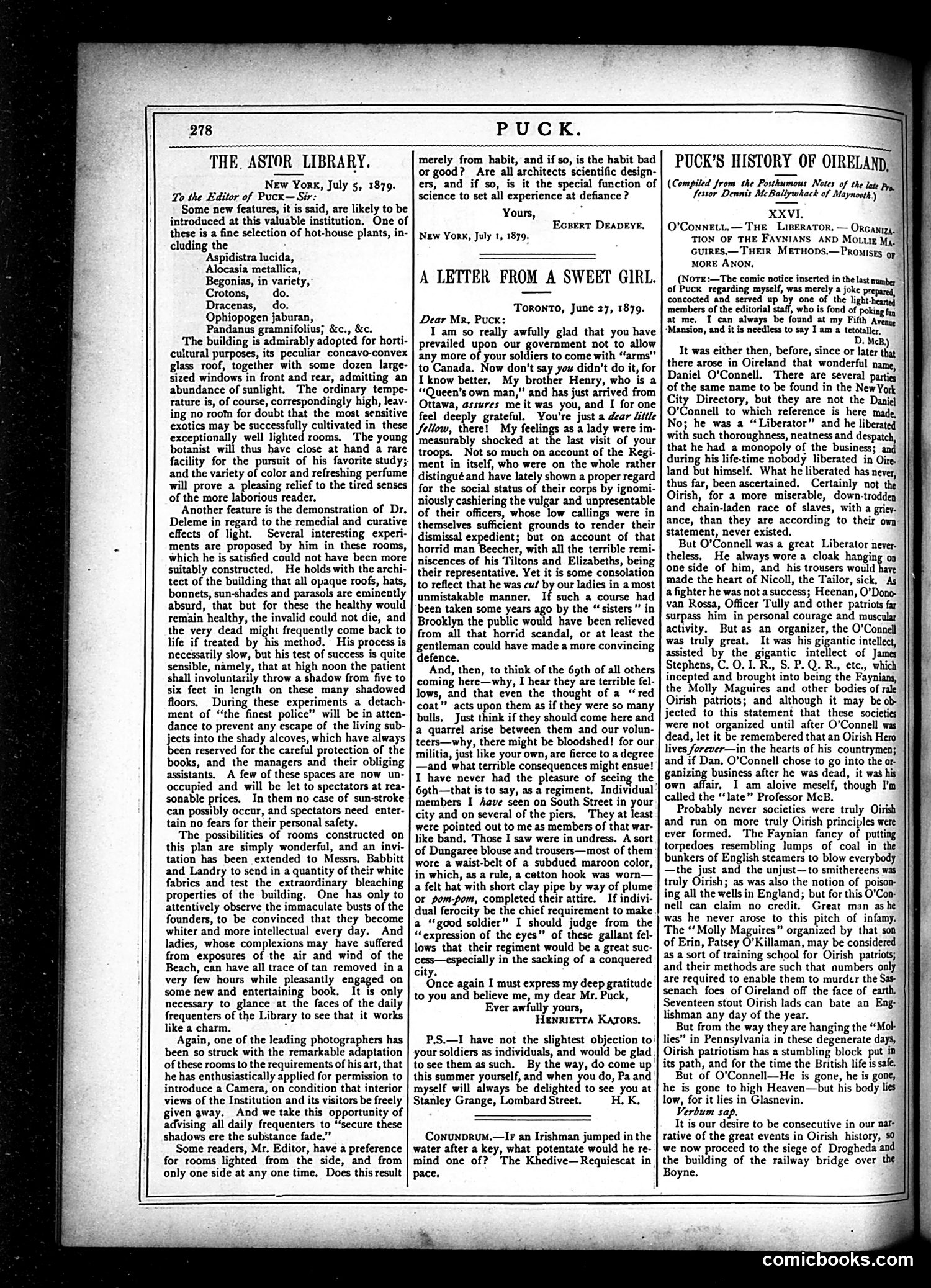
This page consists primarily of **letters to the editor** rather than cartoons or satirical illustrations. The visible content includes: 1. **"The Astor Library"** - A letter discussing the building's architectural features, botanical specimens, and lighting experiments. It appears to be commentary on the institution's design and educational merit. 2. **"A Letter from a Sweet Girl"** - Correspondence from Toronto criticizing Canadian soldiers' conduct, specifically objecting to their interaction with local women and their appearance (uniforms, maroon color). The letter expresses concern about social propriety and military discipline. 3. **"Puck's History of Ireland"** - Beginning of a serialized historical commentary on Irish-British relations, mentioning various historical figures and events. The page lacks prominent political cartoons but instead features satirical written commentary typical of Puck's editorial content from 1879.
📄 Transcribed text from this page (OCR, searchable)
Machine-transcribed from the original scan — historical spelling and the odd misread are preserved.
PUCK. THE. ASTOR LIBRARY. New York, July 5, 1879. To the Editor of Puck— Sir: Some new features, it is said, are likely to be introduced at this valuable institution. One of these is a fine selection of hot-house plants, in- cluding the : Aspidistra lucida, Alocasia metallica, Begonias, in variety, Crotons, do. Dracenas, do. Ophiopogen jaburan, Pandanus gramnifolius; &c., &c. ‘The building is admirably adopted for horti- cultural purposes, its uliar concavo-convex glass roof, together with some dozen large- sized windows in front and rear, admitting an abundance of sunlight. The ordinary tempe- rature is, of course, correspondingly high, leav- ing no room for doubt that the most sensitive exotics may be successfully cultivated in these exceptionally well lighted rooms, The young botanist will thus have close at hand a rare facility for the pursuit of his favorite study; and the variety of color and refreshing perfume will prove a pleasing relief to the tired senses of the more laborious reader. Another feature is the demonstration of Dr. Deleme in regard to the remedial and curative effects of light. Several interesting experi- ments are proposed by him in these rooms, which he is satisfied could not have been more suitably constructed. He holds with the archi- tect of the building that all opaque roofs, hats, bonnets, sun-shades and parasols are eminently absurd, that but for these the healthy would remain healthy, the invalid could not die, and the very dead might frequently come back to life if treated by his method, His process is necessarily slow, but his test of success is quite sensible, namely, that at high noon the patient shall involuntarily throw a shadow from five to six feet in length on these many shadowed floors, During these experiments a detach- ment of “the finest police” will be in atten- dance to prevent any escape of the living sub- jects into the shady alcoves, which have always been reserved for the careful protection of the books, and the managers and their obliging assistants. A few of these spaces are now un- occupied and will be let to spectators at rea- sonable prices, In them no case of sun-stroke can possibly occur, and spectators need enter- tain no fears for their personal safety. The possibilities of rooms constructed on this plan are simply wonderful, and an invi- tation has been extended to Messrs, Babbitt and Landry to send in a quantity of their white fabrics and test the extraordinary bleaching properties of the building. One has only to attentively observe the immaculate busts of the founders, to be convinced that they become whiter and more intellectual every day. And ladies, whose complexions may have suffered from exposures of the air and wind of the Beach, can have all trace of tan removed ina very few hours while pleasantly engaged on some new and entertaining book. It is only necessary to glance at the faces of the daily frequenters of the Library to see that it works like a charm. 5 ‘Again, one of the leading photographers has been so struck with the remarkable adaptation of these rooms to the requirements of his art, that he has enthusiastically applied for permission to introduce a Camera, on condition that interior views of the Institution and its visitors be freely given gway. And we take this opportunity of advising all daily frequenters to “secure these shadows ere the substance fade.” Some readers, Mr. Editor, have a preference for rooms lighted from the side, and from only one side at any one time. Does this result merely from habit, and if so, is the habit bad or good? Are all architects scientific design- ers, and if so, is it the special function of science to set all experience at defiance ? Yours, Ecpert DEADEYE. New York, July 1, 1879. A LETTER FROM A SWEET GIRL. Toronto, June 27, 1879. Dear Mr, Puck: I am so really awfully glad that you have prevailed upon our government not to allow any more of your soldiers to come with “arms” to Canada. Now don't say you didn’t do it, for I know better. My brother Henry, who is a “Queen’s own man,” and has just arrived from Ottawa, assures me it was you, and I for one feel deeply grateful. You're just a dear /ittle fellow, there! My feelings as a lady were im- measurably shocked at the last visit of your troops, Not so much on account of the Regi- ment in itself, who were on the whole rather distingué and have lately shown a proper regard for the social status of their corps by ignomi- niously cashiering the vulgar and unpresentable of their officers, whose low callings were in themselves sufficient grounds to render their dismissal expedient; but on account of that horrid man Beecher, with all the terrible remi- niscences of his Tiltons and Elizabeths, being their representative. Yet it is some consolation to reflect that he was cué by our ladies in a most unmistakable manner. If such a course had been taken some years ago by the “sisters” in Brooklyn the public would have been relieved from all that horrid scandal, or at least the gentleman could have made a more convincing defence. And, then, to think of the 69th of all others coming here—why, I hear they are terrible fel- lows, and that even the thought of a “red coat” acts upon them as if they were so many bulls. Just think if they should come here and a quarrel arise between them and our volun- teers—why, there might be bloodshed! for our militia, just like your own, are fierce to a degree —and what terrible consequences might ensue! I have never had the pleasure of seeing the 6gth—that is to say, as a regiment. Individual members I Aave seen on South Street in your city and on several of the piers, They at least were pointed out to me as members of that war- like band. Those I saw were in undress. A sort of Dungaree blouse and trousers—most of them wore a waist-belt of a subdued maroon color, in which, as a rule, a cetton hook was worn— a felt hat with short clay pipe by way of plume or pom-pom, completed their attire. If indivi- dual ferocity be the chief requirement to make a “good soldier” I should judge from the “expression of the eyes” of these gallant fel- lows that their regiment would be a great suc- cess—especially in the sacking of a conquered city. Once again I must express my deep gratitude to you and believe me, my dear Mr. Puck, Ever awfully yours, Henrietta Kazors, P.S.—I have not the slightest objection to your soldiers as individuals, and would be glad to see them as such. By the way, do come up this summer yourself, and when the do, Paand myself will always be delighted to see you at Stanley Grange, Lombard Street. H.K. ConunpruM.—IF an Irishman jumped in the water after a key, what potentate would he re- mind one of? The Khedive—Requiescat in pace. | own affair, PUCK’S HISTORY OF OIRELAND, | (Compiled from the Posthumous Notes of the late fessor Dennis McBallywhack of Maynooth XXVI. O'Connett.— THE Liperator. — Orcaniy. TION OF THE FAYNIANS AND MOLUE My. GuIRES.— THEIR METHODS.— Promises or. MORE ANON, (Nore:—The comic notice inserted in the last number of Puck regarding myself, was merely a concocted and served up by one of the members of the editorial stafl, who is fond of at me. I can always be found at my Fifth Avense ‘Mansion, and it is needless to say I am a tetotaller, D. McB It was either then, before, since or later that there arose in Oireland that wonderful Daniel O'Connell. There are several parties of the same name to be found in the New York City Directory, but they are not the Daniel O'Connell to which reference is here made, No; he was a “Liberator” and he liberated with such thoroughness, neatness and despatch, that he had a monopoly of the business; and during his life-time nobody liberated in Oire. land but himself. What he liberated has never, thus far, been ascertained. Certainly not the Oirish, for a more miserable, down-trodden and chain-laden race of slaves, with a griev- ance, than they are according to their ow statement, never existed. But O'Connell was a great Liberator never. theless, He always wore a cloak hanging oo one side of him, and his trousers would ts made the heart of Nicoll, the Tailor, sick. As a fighter he was not a success; Heenan, O'Dono- van Rossa, Officer Tully and other patriots far surpass him in personal courage and muscular activity. But as an organizer, the O'Connell was truly great. It was his gigantic intellect, assisted by the gigantic intellect of James Stephens, C.O. 1. R., S. P.Q.R., ete., which incepted and brought into being the Faynians, the Molly Maguires and other bodies of rale Oirish patriots; and although it may be ob- jected to this statement that these societies were not organized until after O’Connell was dead, let it be remembered that an Oirish Hero lives forever—in the hearts of his countrymen; and if Dan, O'Connell chose to go into the or- ganizing business after he was dead, it was his I am aloive meself, though I'm called the “late” Professor McB. Probably never societies were truly Oirish and run on more truly Oirish principles were ever formed. ‘The Faynian fancy of putting torpedoes resembling lumps of coal in the bunkers of English steamers to blow everybody —the just and the unjust—to smithereens was truly Oirish; as was also the notion of poison ing all the wells in England; but for this O'Con- nell can claim no credit. Great man ashe was he never arose to this pitch of infamy. The “Molly Maguires” organized by that son of Erin, Patsey O’Killaman, may be considered as a sort of training school for Oirish patriots; and their methods are such that numbers only are required to enable them to murder the Sas senach foes of Oireland off the face of earth. Seventeen stout Oirish lads can bate an Eng- lishman any day of the year. jut from the way they are hanging the “Mol- in Pennsylvania in these degenerate days, Oirish patriotism has a stumbling block put ia its path, and for the time the British life is safe, But of O’Connell—He is gone, he is gone, he is gone to high Heaven—but his body lies low, for it lies in Glasnevin, Verbum sap. It is our desire to be consecutive in our nat: rative of the great events in Oirish history, $0 we now proceed to the siege of Drogheda and the building of the railway bridge over the Boyne, comicbooks.com