
Puck, 1879-07-09 · page 4 of 16
Puck — July 9, 1879 — page 4: what you’re looking at
What you’re looking at
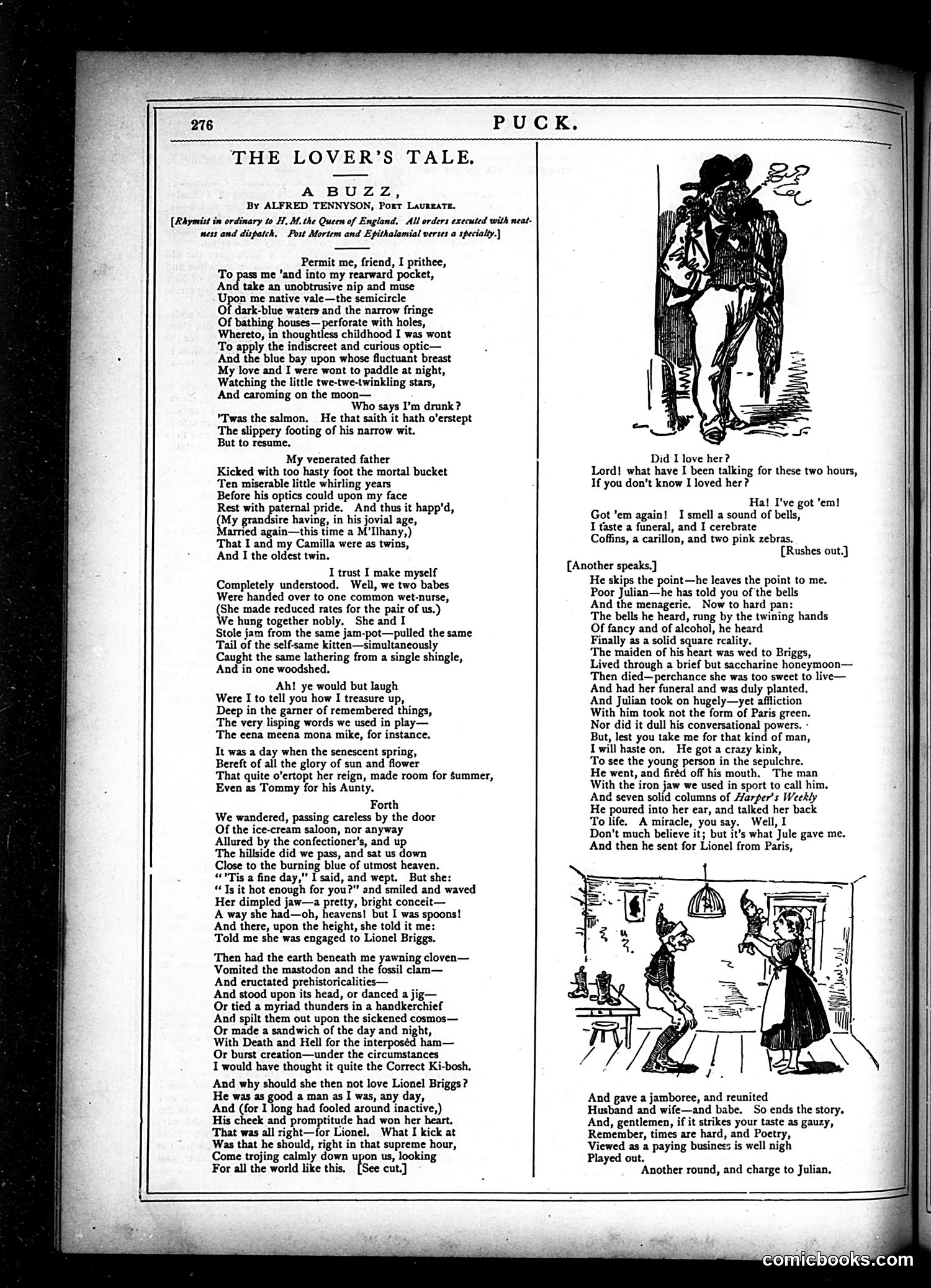
This page reproduces Tennyson's poem with satirical illustrations. The top cartoon shows a disheveled man and woman in an intimate moment, mocking romantic poetry's pretensions. The bottom illustration depicts a domestic scene where a man appears to be telling an exaggerated story to his wife and another couple, suggesting the "lover's tale" is really just drunken boasting. The caption notes the story ends with "Another round, and charge to Julian"—implying the narrator is using sentimental romance as an excuse for drinking. Puck's satire targets Victorian sentimentality and male posturing: the "lover's tale" is exposed as cheap theatricality and alcohol-fueled storytelling rather than genuine passion. The cartoons undercut Tennyson's elevated romantic verse through crude visual humor.
📄 Transcribed text from this page (OCR, searchable)
Machine-transcribed from the original scan — historical spelling and the odd misread are preserved.
THE LOVER’S TALE, A BUZZ, By ALFRED TENNYSON, Port Laureate. [Rhymist in ordinary to H,M.the Queen of England. All orders executed with neat- ness and dispatch. Post Mortem and Epithalamial verses a specialty.) Permit me, friend, I prithee, To pass me ’and into my rearward pocket, And take an unobtrusive nip and muse Upon me native vale—the semicircle Of dark-blue waters and the narrow fringe Of bathing houses— perforate with holes, Whereto, in thoughtless childhood I was wont To apply the indiscreet and curious optic— And the blue bay upon whose fluctuant breast My love and I were wont to paddle at night, Watching the little twe-twe-twinkling stars, And caroming on the moon— Who says I’m drunk? 'Twas the salmon. He that saith it hath o’erstept The slippery footing of his narrow wit. But to resume. My venerated father Kicked with too hasty foot the mortal bucket Ten miserable little whirling years Before his optics could upon my face Rest with paternal pride. And thus it happ’d, My grandsire having, in his jovial age, arried again—this time a M’llhany,) That I and my Camilla were as twins, And I the oldest twin. I trust I make myself Completely understood. Well, we two babes Were handed over to one common wet-nurse, She made reduced rates for the pair of us.) ‘e hung together nobly. She and I Stole jam from the same jam-pot—pulled the same Tail of the self-same kitten—simultaneously Caught the same lathering from a single shingle, And in one woodshed, Ah! ye would but laugh Were I to tell you how I treasure up, Deep in the garner of remembered things, ‘The very lisping words we used in play— The eena meena mona mike, for instance, It was a day when the senescent spring, Bereft of all the glory of sun and flower That quite o’ertopt her reign, made room for Summer, Even as Tommy for his Aunty. Forth We wandered, passing careless by the door Of the ice-cream saloon, nor anyway Allured by the confectioner’s, and up The hillside did we pass, and sat us down Close to the burning blue of utmost heaven. “’Tis a fine day,” I said, and wept. But she: “Ts it hot enough for you?” and smiled and waved Her dimpled jaw—a pretty, bright conceit— A way she had—oh, heavens! but I was spoons! And there, upon the height, she told it me: Told me she was engaged to Lionel Briggs. Then had the earth beneath me yawning cloven— Vomited the mastodon and the fossil clam— And eructated prehistoricalities— And stood upon its head, or danced a jig— Or tied a myriad thunders in a handkerchief And spilt them out upon the sickened cosmos— Or made a sandwich of the day and night, With Death and Hell for the interpos¢td ham— Or burst creation—under the circumstances I would have thought it quite the Correct Ki-bosh, And why should she then not love Lionel Briggs? He was as good a man as I was, any day, And (for I long had fooled around inactive,) His cheek and promptitude had won her heart, That was all right—for Lionel. What I kick at Was that he should, right in that supreme hour, Come trojing calmly down upon us, looking For all the world like this, [See cut.] Did 1 love her? Lord! what have I been talking for these two hours, If you don't know I loved her? Ha! I've got ’em! Got ’em again! I smell a sound of bells, I taste a funeral, and I cerebrate Coffins, a carillon, and two pink zebras. [Rushes out.] [Another speaks.] He skips the point—he leaves the point to me. Poor Julian—he has told you of the bells And the menagerie. Now to hard pan: The bells he heard, rung by the twining hands Of fancy and of alcohol, he heard Finally as a solid square reality. ‘The maiden of his heart was wed to Briggs, Lived through a brief but saccharine honeymoon— Then died—perchance she was too sweet to live— And had her funeral and was duly planted. And Julian took on hugely—yet affliction With him took not the form of Paris green. Nor did it dull his conversational powers. - But, lest you take me for that kind of man, I will haste on, He got a crazy kink, To see the young person in the sepulchre. He went, and firéd off his mouth. The man With the iron jaw we used in sport to call him. And seven solid columns of Harper's Weekly He poured into her ear, and talked her back To life. A miracle, you say. Well, I Don't much believe it; but it’s what Jule gave me. And then he sent for Lionel from Paris, And gave a jamboree, and reunited Husband and wife—and babe. So ends the story. And, gentlemen, if it strikes your taste as gauzy, Remember, times are hard, and Poetry, Viewed as a paying business is well nigh Played out. Another round, and charge to Julian. “comicboo