
Puck, 1879-07-09 · page 7 of 16
Puck — July 9, 1879 — page 7: what you’re looking at
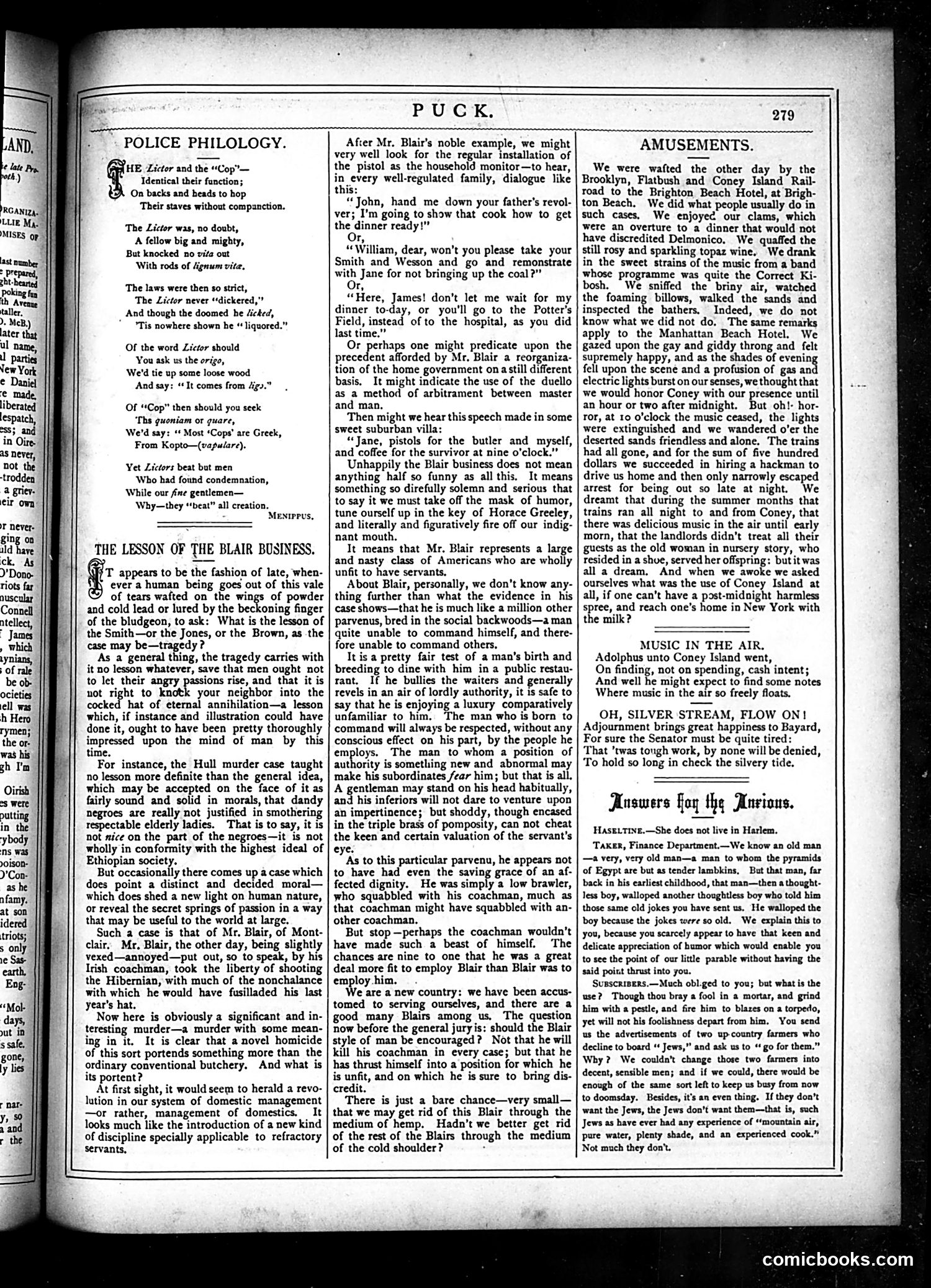
What you’re looking at
This page contains three distinct articles rather than political cartoons: 1. **"Police Philology"** — A humorous piece about wordplay involving police jargon, particularly discussing terms like "Lister" and "Cop." 2. **"The Lesson of the Blair Business"** — A satirical commentary on a case involving someone named Blair (likely a real incident from the magazine's era). It critiques a wealthy man's treatment of servants and challenges about domestic authority, suggesting Blair represents a class of Americans "wholly unfit to have servants." 3. **"Amusements"** and **"Music in the Air"** — Brief entertainment notices and a poem about a senator. The Blair article appears to be the primary satirical content, attacking wealthy employers' pretensions and poor treatment of domestic workers—a social critique typical of Puck's reform-minded humor targeting class attitudes.
📄 Transcribed text from this page (OCR, searchable)
Machine-transcribed from the original scan — historical spelling and the odd misread are preserved.
ocieties ell was, h Hero rymen; the or- was his gh I'm Oirish os were putting in the ybody PUCK. 279 POLICE PHILOLOGY. HE Lictor and the “Cop”— Identical their function; On backs and heads to hop Their staves without companction. The Lictor was, no doubt, A fellow big and mighty, But knocked no vita out With rods of fignum vite, The laws were then so strict, The Lictor never ‘dickered,” And though the doomed he /icked, " ‘Tis nowhere shown he “liquored.” Of the word Lictor should You ask us the origo, We'd tie up some loose wood And say: “It comes from digs.” Of “Cop” then should you seek ‘Ths guoniam or quare, We'd say: ‘* Most ‘Cops’ are Greek, From Kopto—(vapulare), Yet Lictors beat but men ‘Who had found condemnation, While our fine gentlemen— Why—they “beat” all creation Mestrrus, THE LESSON OF THE BLAIR BUSINESS. T appears to be the fashion of late, when- ever a human being goes out of this vale of tears wafted on the wings of powder and cold lead or lured by the beckoning finger of the bludgeon, to ask: What is the lesson of the Smith—or the Jones, or the Brown, as the case may be—tragedy ? As a general thing, the tragedy carries with it no lesson whatever, save that men ought not to let their angry ions rise, and that it is not right to knotk your neighbor into the cocked hat of eternal annihilation—a lesson which, if instance and illustration could have done it, ought to have been pretty thoroughly impressed upon the mind of man by this time. For instance, the Hull murder case taught no lesson more definite than the general idea, which may be accepted on the face of it as fairly sound and solid in morals, that dandy negroes are really not justified in smothering respectable elderly ladies. That is to say, it is not nice on the part of the negroes—it is not wholly in conformity with the highest ideal of Ethiopian society. But occasionaily there comes up a case which does point a distinct and decided moral— which does shed a new light on human nature, or reveal the secret springs of passion in a way that may be useful to the world at large. Such a case is that of Mr. Blair, of Mont- clair. Mr, Blair, the other day, being slightly vexed—annoyed—put out, so to s] » by his Irish coachman, took the liberty of shooting the Hibernian, with much of the nonchalance with which he would have fusilladed his last year's hat. Now here is obviously a significant and in- teresting murder—a murder with some mean- ing in it. It is clear that a novel homicide of this sort portends something more than the ordinary conventional butchery. And what is its portent? At first sight, it would seem to herald a revo- lution in our system of domestic management —or rather, management of domestics. It looks much like the introduction of a new kind of discipline specially applicable to refractory servants, After Mr. Blair's noble example, we might very well look for the regular installation of the pistol as the household monitor—to hear, is every well-regulated family, dialogue like this: “John, hand me down your father's revol- ver; I'm going to show that cook how to get the dinner ready!” Or, “William, dear, won't you please take your Smith and Wesson and go and remonstrate with Jane for not bringing up the coal?” Or, “Here, James! don’t let me wait for my dinner to-day, or you'll go to the Potter's Field, instead of to the hospital, as you did last time.” Or perhaps one might predicate upon the precedent afforded by Mr. Blair a reorganiza- tion of the home government on astill different basis. It might indicate the use of the duello as a method of arbitrament between master and man, Then might we hear this speech made in some sweet suburban villa: “Jane, pistols for the butler and myself, and coffee for the survivor at nine o'clock.” Unhappily the Blair business does not mean anything half so funny as all this, It means something so direfully solemn and serious that to say it we must take off the mask of humor, tune ourself up in the key of Horace Greeley, and literally and figuratively fire off our indig- nant mouth. It means that Mr. Blair represents a large and nasty class of Americans who are wholly unfit to have servants. About Blair, personally, we don’t know any- thing further than what the evidence in his case shows—that he is much like a million other parvenus, bred in the social backwoods—a man quite unable to command himself, and there- fore unable to command others, It isa pretty fair test of a man’s birth and breeding to dine with him in a public restau- rant. If he bullies the waiters and generally revels in an air of lordly authority, it is safe to say that he is enjoying a luxury comparatively unfamiliar to him, The man who is born to command will always be respected, without any conscious effect on his part, by the people he employs. The man to whom a position of authority is something new and abnormal may make his subordinates fear him; but that is all, A gentleman may stand on his head habitually, and his inferiors will not dare to venture upon an impertinence; but shoddy, though encased in the triple brass of pomposity, can not cheat the keen and certain valuation of the servant's eye. As to this particular parvenu, he appears not to have had even the saving grace of an af- fected dignity. He was simply a low brawler, who squabbled with his coachman, much as that coachman might have squabbled with an- other coachman, But stop—perhaps the coachman wouldn't have made such a beast of himself. The chances are nine to one that he was a great deal more fit to employ Blair than Blair was to employ him. fe are a new country: we have been accus- tomed to serving ourselves, and there are a good many Blairs among us, The question now before the general jury is: should the Blair style of man be encouraged? Not that he will kill his coachman in every case; but that he has thrust himself into a position for which he is unfit, and on which he is sure to bring dis- credit. There is just a bare chance—very small— that we may get rid of this Blair through the medium of hemp. Hadn't we better get rid of the rest of the Blairs through the medium of the cold shoulder? = AMUSEMENTS. We were wafted the other day by the Brooklyn, Flatbush and Coney Island Rail- road to the Brighton Beach Hotel, at Brigh- ton Beach. We did what people usually do in such cases, We enjoyeé our clams, which were an overture to a dinner that would not have discredited Delmonico. We quaffed the still rosy and sparkling topaz wine. We drank in the sweet strains of the music from a band whose programme was quite the Correct Ki- bosh. We sniffed the briny air, watched the foaming billows, walked the sands and inspected the bathers. Indeed, we do not know what we did not do. The same remarks apply to the Manhattan Beach Hotel. We gazed upon the gay and giddy throng and felt supremely happy, and as the shades of evenin; fell upon the scene and a profusion of gas and electric lights burst on our senses, we thought that we would honor Coney with our presence until an hour or two after midnight. But oh!- hor- ror, at to o'clock the music ceased, the lights were extinguished and we wandered o'er the deserted sands friendless and alone. The trains had all gone, and for the sum of five hundred dollars we succeeded in hiring a hackman to drive us home and then only narrowly escaped arrest for being out so late at night. We dreamt that during the summer months that trains ran all night to and from Coney, that there was delicious music in the air until early morn, that the landlords didn’t treat all their guests as the old woman in nursery story, who resided in a shve, served her offspring: but it was all a dream. And when we awoke we asked ourselves what was the use of Coney Island at all, if one can't have a post-midnight harmless spree, and reach one’s home in New York with the milk? MUSIC IN THE AIR, Adolphus unto Coney Island went, On finding, not on spending, cash intent; And well he might expect to find some notes Where music in the air so freely floats. OH, SILVER STREAM, FLOW ON! Adjournment brings great happiness to Bayard, For sure the Senator must be quite tired: That 'twas tough work, by none will be denied, To hold so long in check the silvery tide. Answers foq the Anrious. Hasg.tive.—She does not live in Harlem. ‘Taxer, Finance Department.—We know an old man —a very, very old man—a man to whom the pyramids of Egypt are but as tender lambkins, But that man, far back in his earliest childhood, that man—then a thought- less boy, walloped another thoughtless boy who told him those same old jokes you have sent us, He walloped the boy because the jokes were so old. We explain this to you, because you scarcely appear to have that keen and delicate appreciation of humor which would enable you to see the point of our little parable without having the said point thrust into you, SUBSCRIBERS.—Much obl.ged to you; but what is the use? Though thou bray a fool in a mortar, and grind him with a pestle, and fire him to blazes on a torpedo, yet will not his foolishness depart from him, You send us the advertisements of two up-country farmers who decline to board “ Jews,” and ask us to “go for them.” Why? We couldn’t change those two farmers into decent, sensible men; and if we could, there would be enough of the same sort left to keep us busy from now to doomsday. Besides, it's an even thing. If they don’t want the Jews, the Jews don’t want them—that is, such Jews as have ever had any experience of “mountain air, pure water, plenty shade, and an experienced cook.” ‘Not much they don't. comicbooks.com